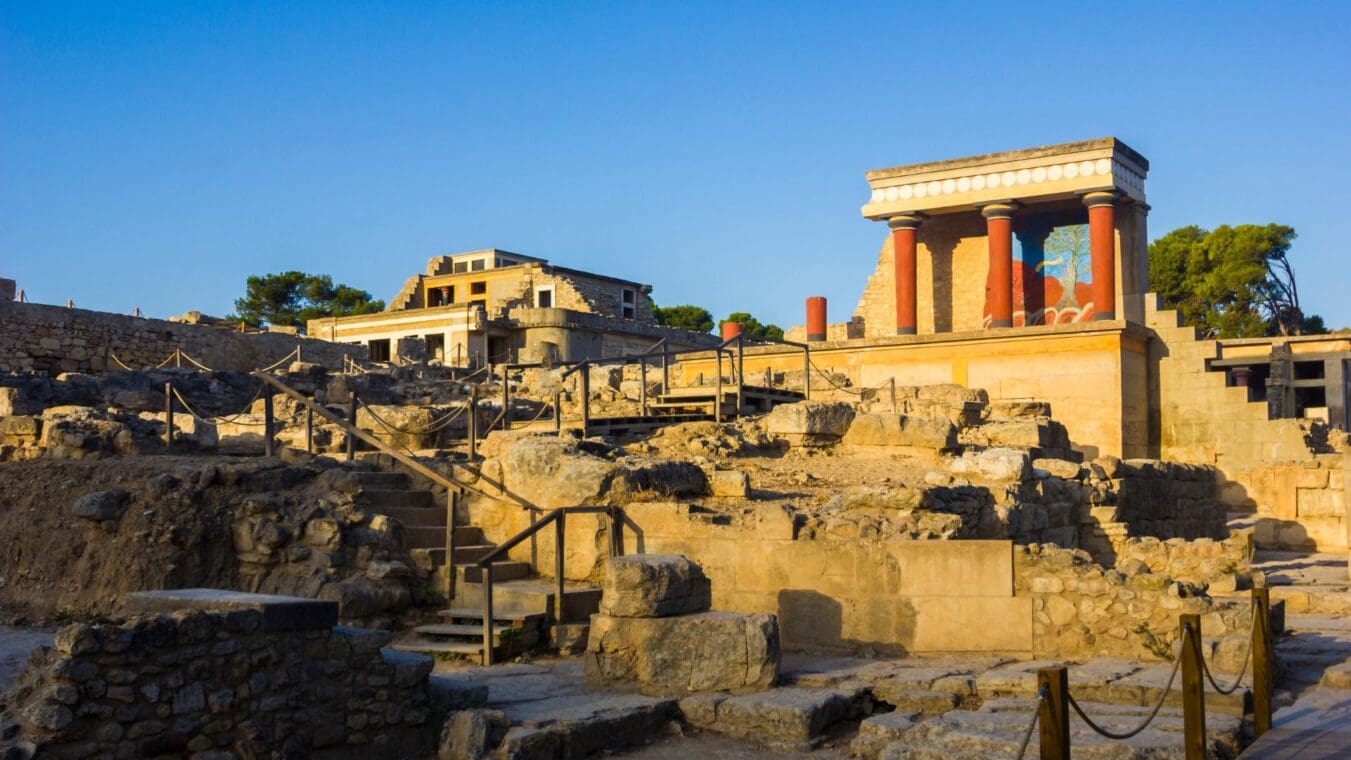
The Archaeological site of Knossos in Crete is the most important bronze age settlement in the Aegean.
Once home to a seafaring and trading people, it was the hub of the first maritime empire. Known as the Minoans today, they controlled the island of Crete, the nearby Cycladic islands and had settlements around the east coast of the Mediterranean for over a thousand years.
Often called the oldest city in Europe, the site of Knossos is the stuff of legends. Greek myths tell of the King Minos who trapped his half beast son the minotaur in a labyrinth, the architect of the labyrinth Daedalus escaped the island with his son Icarus using wings made of feathers and wax. Finally, Plato’s description of the lost city of Atlantis bears close resemblance to the palace of Knossos on Crete. The best way to visit the archaeological site of Knossos is with a guide. Information panels are lacking and the site is huge. With a guided tour you can see the very best of the archaeological site and your guide will explain the development and long history of the Minoans.
Greece Tours
Explore the Magic of Greece!
When English archaeologist Arthur Evans visited the island of Crete in 1896, he was struck by amulets worn by the locals that looked similar to ancient seals. Evans was looking for traces of the Mycenaean civilisation of mainland Greece, but instead he discovered an entirely new, earlier seafaring civilisation that he would call the Minoans after the ancient legends. He bought a section of land and began excavations. What he discovered was a huge complex of many buildings like the labyrinth of myth. These buildings were related to production and storage and would come to be known as palaces. Evans also discovered a written script that he would differentiate and call Linear A and Linear B.
The early Minoans were blessed as Crete was self-sufficient with food, water and wood to build boats. After making advances in agriculture the Minoans turned to the sea to reach the other side of the island to sell their goods. They soon emerged as a seafaring nation and began trading with Cyprus, the Levante and Egypt.
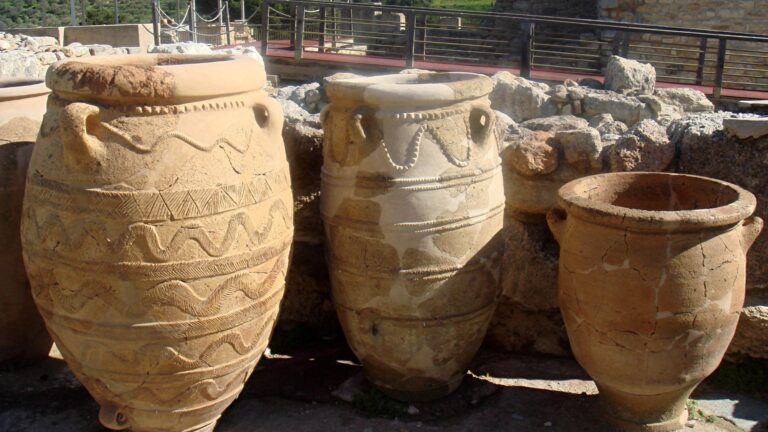
Cretan exports consisted of timber, foodstuffs, cloth, and, most likely, olive oil. Numerous pithoi – large storage jars up to five feet tall were found. They were mainly used for storage of oil, wool, wine, and grain. The Minoans also traded finely crafted luxury goods. They acquired gold and other metals and became skilled metal workers, producing intricate gold and bronze jewellery and other items. It was their success in trading that led the Minoans to invent a written script, probably to keep track of the movement of goods, although it has yet to be deciphered.
Knossos is not the only Minoan site on Crete, there are remains of other complexes in Malia in the eastern part of the island and Zakros and Phaistos to the south.
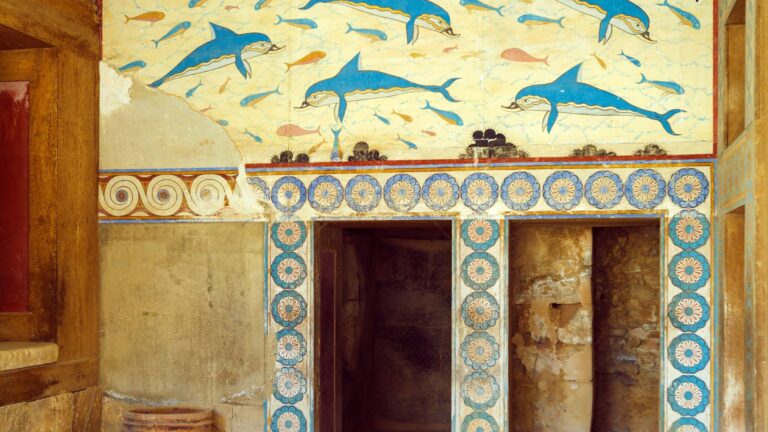
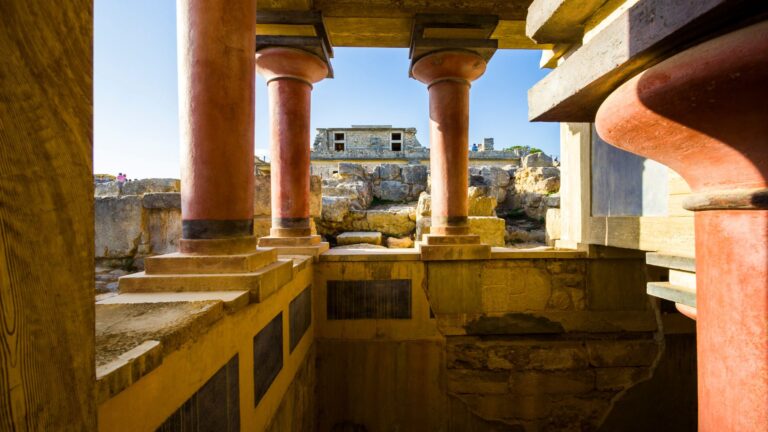
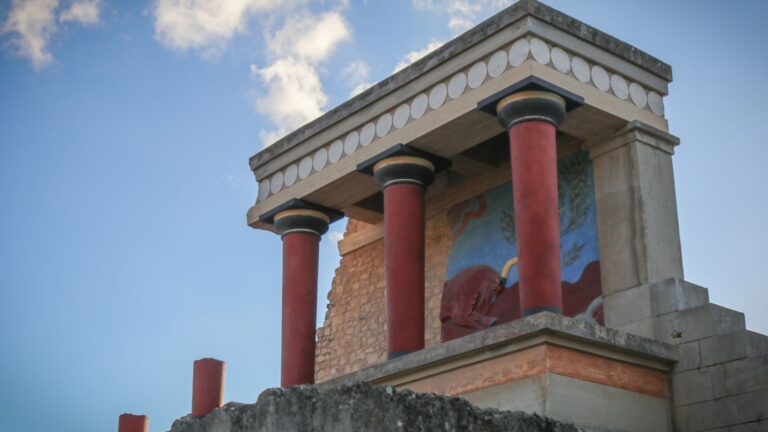
We know little about Minoan government or how the different palaces worked together. Knossos however, appears to have been the most important centre on Crete, perhaps the capital. The largest palace stretches over 6 acres and boasts 1,300 rooms. Although these complexes are called palaces, they were large centres of production, administration and storage for trade. There are remains of a theatre, workshops and several large warehouses. Some of the buildings reached as high as five storeys, were beautifully decorated in colourful marine frescoes and had complex facilities including indoor plumbing – bathrooms, toilets, and a drainage system.
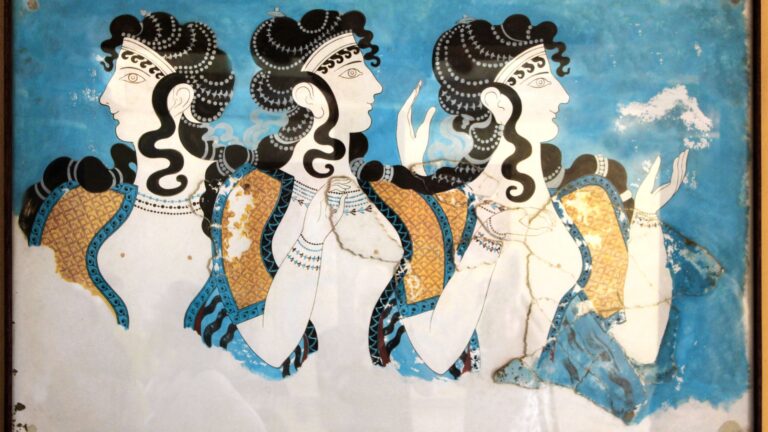
Little is known about the Minoan form of government and politics. The lack of fortification walls or discovery of weapons implies that the Minoans were not concerned with warfare. Visitors will see the so-called Throne Room with a stone throne and beautiful colourful decorations, although there is no evidence of a king in the frescoes only in the Greek legends. Women seem to have played a dominant part in political and religious life of the Minoans as they appear more often in frescoes.
Many statuettes of what may be a snake goddess have been found as well as figurines of women holding what appear to be ceremonial axes. The men that are depicted are doing manual jobs whereas the women are dressed in colourful exotic clothes. Perhaps their husbands are out on a sea voyage.
The bull was certainly important to the Minoans, bulls feature in the frescoes and a number of bull’s head drinking cups have been found. As well as well as the famous bull-jumping fresco which implies it was a popular sport or form of entertainment.
The height of Minoan culture was 1750 to 1500 BC, although it declined starting with the eruption of the volcano island of Thera, today known as Santorini. Although it recovered, the rise in power of the Mycenaeans, a warlike people on the mainland and more natural disasters brought an end to the Minoan civilisation.
Combining a visit to the archaeological site of Knossos with the Heraklion Archaeological Museum offers a complete view of this fascinating ancient civilisation of Crete. If you are planning a visit to the island of Crete, Through Eternity can help to customise your trip and ensure you see the very best the Island has to offer.
Plan Your Athens Visit Today!