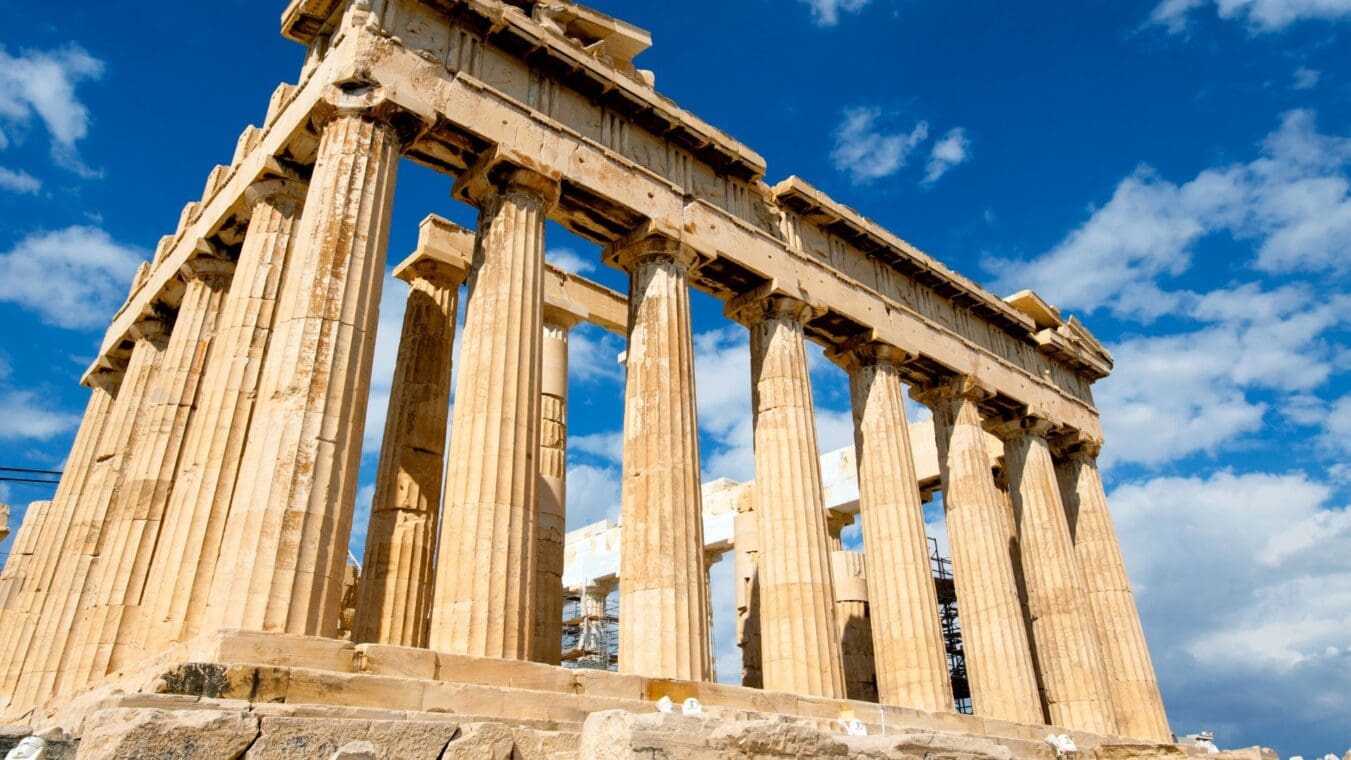
Much like the Colosseum in Rome or the Pyramids of Giza, the Acropolis has become a symbol synonymous with an ancient civilization.
In many ways, these monuments represent the pinnacle of certain elements of those civilizations– the Colosseum is a testament to the excesses, decadence, and violent inhumanity of Rome; the Pyramids represent the power and godlike stature of the pharaohs; and the Acropolis symbolizes the refined elegance and nascent democratic spirit of the Athenians– but at the same time, these symbols obscure that which they represent.
What each of these archaeological sites fail to capture is the day to day life of the people who made up these complex worlds. Their grandiosity was to the ancient world what a Buckingham Palace is to Trafalgar Square– an obfuscation of the lived reality of the citizens. For those examples of the ancient world, we must visit the Forum in Rome, or a site like the Siwa Oasis in Egypt. For Athens, the best archaeological ruin is the Ancient Agora of Athens.
Unlike the Acropolis, weighed down by religious buildings and stuffy religious ceremonies, the Agora was an area for the commoners and nobles alike to congregate, shop, and conduct business. As the political, commercial, and social center of Athenian culture, it witnessed the great political debates, the philosophical discussions, and the gossip and rivalries that made the city. Pericles, Themistokles, and Demosthenes– some of history’s greatest politicians– defined the earliest versions of democracy in the Agora, while poets and playwrights like Euripides, Aeschylus, Sophocles, and Aristophanes, and historians like Thucydides and Herodotus, composed their greatest works here. Crucially, this would be where the fathers of Western philosophy– Socrotes, Plato, and Aristotle– would find their first audiences.
The Ancient Agora truly is where the drama of Athens truly unfolded.
Visiting it today can be bewildering. Crumbled marble litters the ground and weeds have overtaken the greatest of buildings. But a careful examination can bring it to life.
Athens Tours
Explore the Greek Capital
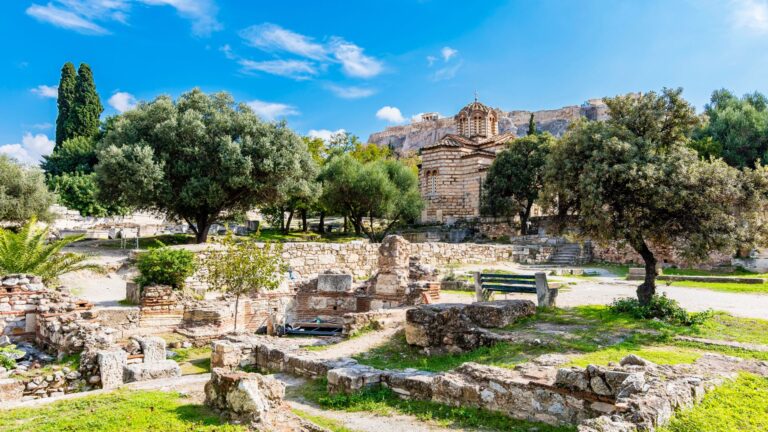
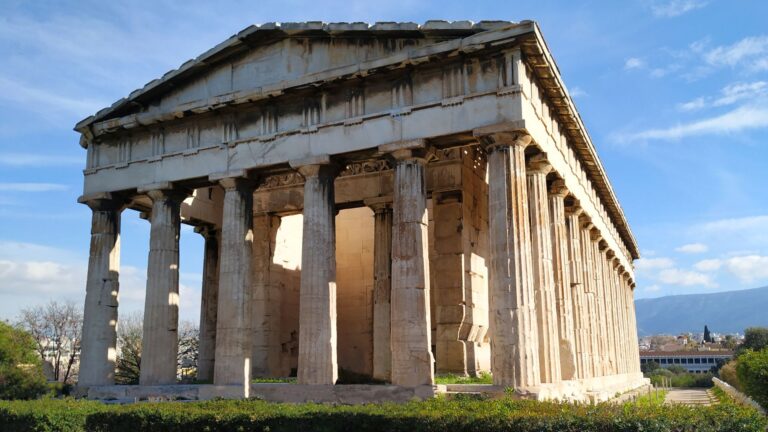
For starters, the most intact building from Ancient Athens remaining is the Temple of Hephaestus. Not only is this the most well preserved ruin in the Agora, it is the best preserved Doric temple in all of mainland Greece. Though for many centuries it was falsely attributed to the mythical founder of Athens, Theseus, it is recognized today as a temple to the god of blacksmiths (and, as many temples in Athens, Athena as well).
Though not as recognizable or important as the Parthenon, it was built with the same Pentilic marble, and featured beautiful friezes of the 12 labors of Hercules on one side, and the labors of Theseus on the other. It would later be converted to a church, which perhaps is why it is so well preserved. This temple being in the heart of the Agora attests to the omnipresent importance of religion in the state.
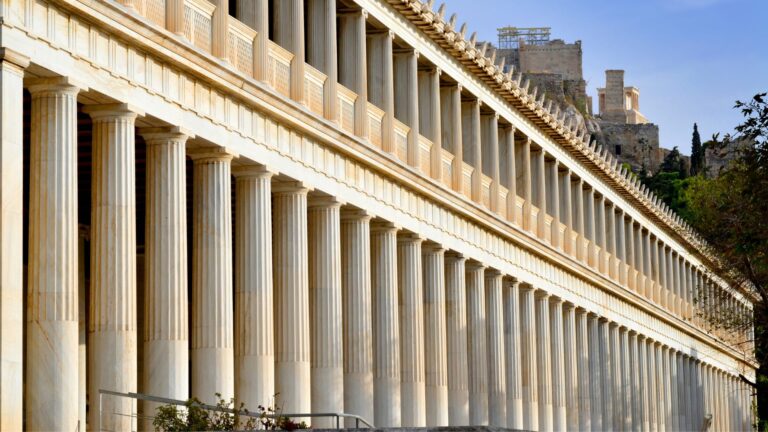
The other building which draws in visitors is the Stoa of Attalos. This 1950’s-era reconstruction of a 2nd century BCE building is the site of the Museum of the Ancient Agora, which houses many of the excavated sculptural decorations from the area. The Stoa itself, however, is an excellent representation of the many stoae which lined the sides of the Agora. Typically a colonnaded walkway or portico, the stoae served as the primary meeting grounds for many Athenians.
The Stoa Poikile, whose ruins lie northwest of the Stoa of Attalos, is where the philosopher Zeno of Citium preached a view of the world that would come to be so associated with its location it would adopt the name Stoicism.
In many other ways, these stoae became the first art museums, as the halls would come to be decorated with the many artistic works being produced in the city at the time. Many of those artworks today live in the Stoa of Attalos, making it an essential stop on any tour of the Agora.

Throughout the Agora in ancient times, many of Greece’s finest sculptors worked tirelessly to create the legacy that is Greek art. Myron, whose “Discus Thrower” has become iconic, likely worked in this square, as did Praxitiles, Bryaxis, and Euphranor. Their sculptures survive today as some of the best examples of Greek art, and many of their works– if not all– were carved here amongst the ruckus and hulabaloo of Athenian life.
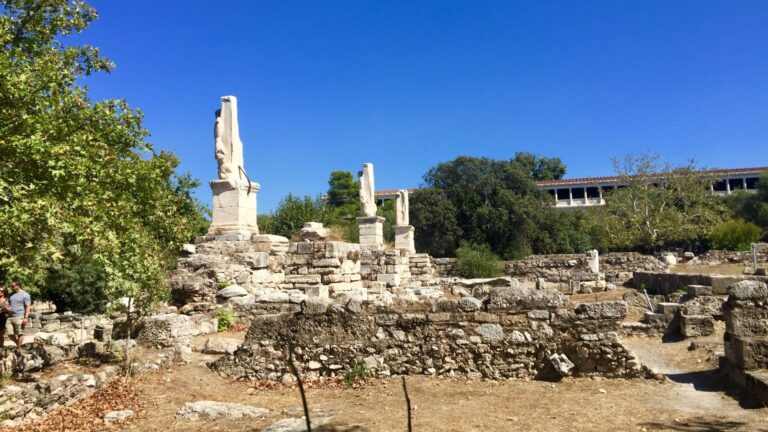
As a result of its centrality to the artistic life of Athens, nearly 400 years after the completion of many of the buildings, the Roman consul Agrippa– son-in-law to the first emperor, Augustus– would build the Odeon of Agrippa. This performance venue was the equivalent of an Opera house, and could seat over 1,000 people. During its height, it featured some of the greatest art and architecture in the Agora, and became one of the most popular venues for poetry and musical performances, political speeches, and plays.
A stone’s throw away lie the remains of a small building known as the Tholos. Despite its conservative footprint, the Tholos was the epicenter of Athenian democracy. Fifty “senators” were selected from each of Athens’ ten tribes to serve for just 35 days. These tribes were supposedly derived from the original inhabitants of the city, and the accumulated wealth and influence by the more prosperous tribes was meant to be curbed and inhibited by the structure proposed. Though this would lay the foundations for democracies to come in very direct ways– the idea of equal representation and a politically active citizen body– it would also prove to be an unwieldy form of government, likely showing the foundations of modern democracy in other ways.
Though the Acropolis will always serve as a testament to the highest and noblest ambitions of Greek civilization, it is in the Agora that the culture would truly define itself. For this reason alone, the Ancient Agora of Athens is one of the most unmissable sites in all of Greece.
Plan Your Athens Visit Today!