Get the most out of your visit to the Eiffel Tower. There’s plenty to do and see close by on the Right Bank!
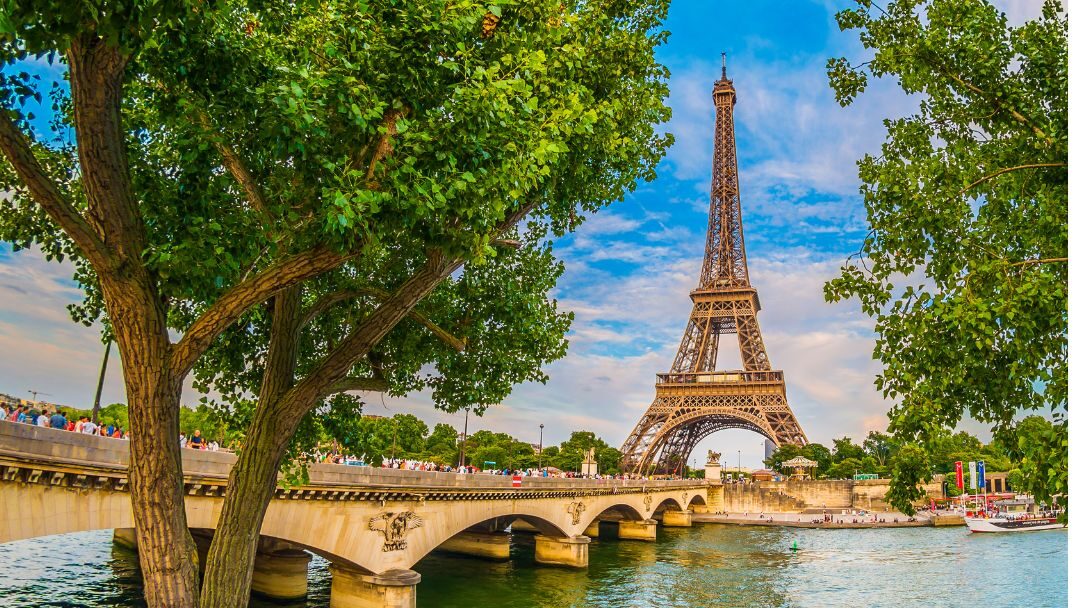
In our last Paris dispatch, we spent the day ambling around the Left Bank, exploring (and eating) within a 15-minute radius of the Eiffel Tower. Today we’re doing the same thing, but this time on the Right Bank. It’s just a matter of crossing the Pont d’Iena, the bridge that connects the Eiffel Tower to Place du Trocadéro on the other side of the River Seine.
Tagging along is our old friend Terry: well-seasoned world traveler, Germanophile and longtime critic of all things French, over the years even his heart of ice has been melted by the delights of the City of Lights.
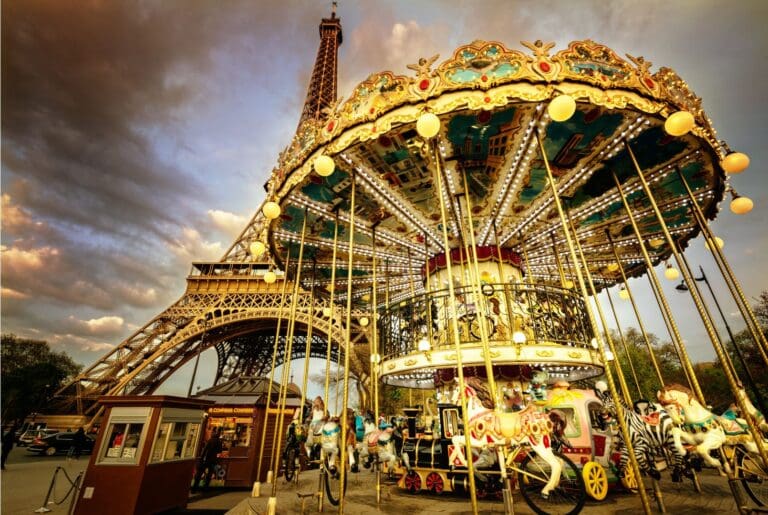
Having all been up the Tower several times – and more than once together – we simply meet in the Champ de Mars, walk beneath Monsieur Eiffel’s pride and joy, and strike off across the Iéna Bridge. The first things we encounter once on the Right Bank are the small playground and the gilded glory of its Carrousel, among the last of the Belle Epoque merry-go-rounds, with its exquisitely carved horses, sleighs and hot-air balloons.
Best Paris Tours
Explore the City of Lights!
Since we’ve got no kids in tow today, we just breeze on by and continue up the steps through the steeply-sloped garden, around the outside bend of the Museum of Man, and up to the expansive esplanade above Place du Trocadéro. This massive half-moon is essentially a raised platform sitting at the center of the twin arms of the Palais de Chaillot. These structures house the Museum of Man, the National Museum of the Navy, the Museum of Architecture and Heritage, and the National Museum of French Monuments (there’s a lot of space).
They are all worth a stop, but we shan’t be visiting them today. The weather is glorious and it will take more than anthropological analysis to drag us indoors. We do, however, linger amongst the groups of global gawkers, pickpockets, buskers, hawkers, and students recently arrived for their semester abroad, our arms outstretched in defense against the slew of selfie sticks and their blissfully oblivious wielders, and focus on the spectacle before us.
And what a spectacle it is.

Reluctantly turning our backs on the slender silver lady, we gaze out over the busy traffic hub of Place du Trocadéro. Our plan is to avoid the chaos of the cars for as long a we can, so we decide to meander through the memorials in the subdued atmosphere of the Passy Cemetery. Established in 1802, it wraps around the west bend of Place du Trocadéro in what was at the time a separate suburban community. Since 1874 it has been a kind of aristocratic necropolis, the preferred resting place of the well-heeled residents of the chic quarters this side of the nearby Champs-Elysées.
In the shade of nearly 300 trees lie the mortal remains of some 2500 people, some of whose names are unfamiliar to us but leave us impressed nonetheless. For example, Bảo Đại (1913-1997), the last emperor of Vietnam; James Gordon Bennett, Jr. (1841-1918), owner of the New York Herald and founder of the International Herald Tribune; Julie Bienvenüe (1860-1950), cousin of Fulgence Bienvenüe, the inventor of Paris’ metro, and wife of the legendary First World War hero, Marshall Foch. Among the names we immediately recognize are the composers Claude Debussy (1862-1918), and Gabriel Fauré (1845-1924); Pierre-François Pascal Guerlain (1798-1864), the creator of the fabulous perfume; Impressionist painter Édouard Manet (1832-1883); and in a soberingly recent arrival, the great designer – Audrey Hepburn’s favorite – Hubert de Givenchy (1927-2018).

Properly caffeinated – both relaxed and energized – we cross Avenue Kléber and begin our stroll up Avenue du Président Wilson, named in honor of US President Woodrow Wilson. Lined with great shade trees – especially plane and chestnut – and stately townhouses, the grand avenue was home to a number of remarkable residents. Number 10 was the Paris abode of Albert I, Prince of Monaco, in the early 20th century. Since 1923 it has been the residence of the papal nuncio, or Vatican ambassador. Number 18 is abuilding built in 1913. Designed by the architect Henri Tauzin, its clean lines and simple slopes announce the arrival of Art Deco. Johnny Hallyday, the iconic French rocker, also lived in the street during the 1970s.

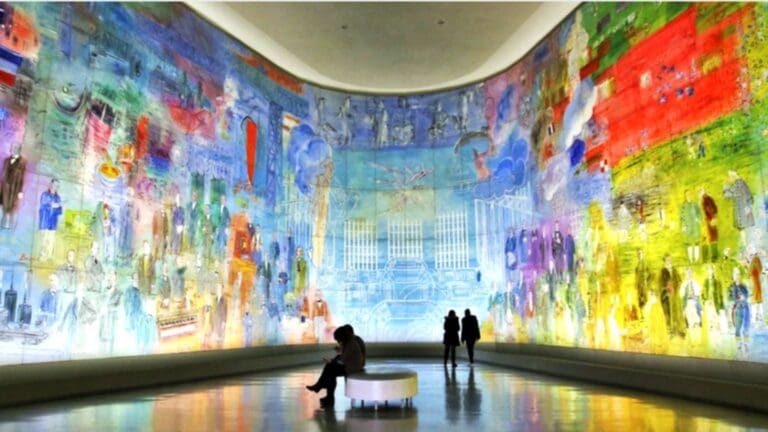
We negotiate our way around Place d’Iéna, and before long we arrive at number 13, the eye-catching Palais de Tokyo, so named because of the old Quai de Tokio (now Avenue New York) that runs along the River Seine. In full-blown monumental 1930s Art Deco style, the structure is impossible to ignore. Terry is drawn like a moth to flame, and when he realizes that the east wing is home to the Paris Museum of Modern Art, we have no choice but to follow him in. We argue that the weather is much too nice to spend time in a museum, but Terry, true to form, brooks no dissent.
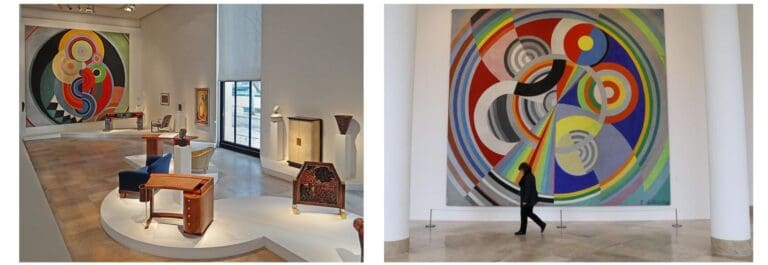
While temporary exhibits carry a cost of 7 to 15€, entrance to the permanent collections is free of charge. With nearly 15,000 works of art in various media on display, the collections represent the riche texture of artistic creation in the 20th and 21st centuries and reflect the dynamism of the contemporary art scene. We breeze through, taking in the stark contrasts of luminescent white walls and explosions of color and form. This is first exposure to this less frequented and under-appreciated museum, and as we leave we vow to come back one rainy day and take the time to experience it properly.
Practical information: The Musée d’Art Moderne de Paris is open Tuesday to Sunday from 10:00 a.m. to 6:00 p.m. Ticket counter closes at 5:15 p.m.
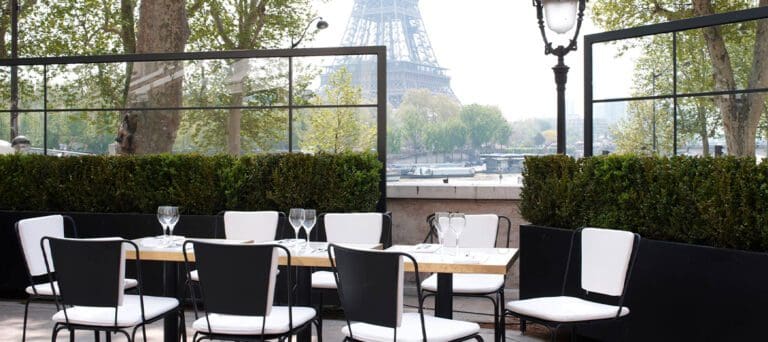
Sated, our eyes filled with beauty and our minds opened and inspired, in one accord and in a single breath, we all say, “Lunch!”. There’s no doubt that this lunch will be long and lingering. Our initial intention was to grab something quick and light. But our spirits have been uplifted and we all agree that this calls for something out of the ordinary: Monsieur Bleu. We are familiar with the name and the excellent reputation, but none of us has ever been. As the restaurant is strategically located in the west wing of the Palais de Tokyo, out of the east wing of which we have just emerged – and as it features a riverfront terrace with a spectacular view of Our Lady of Eiffel, we seize the day and take the plunge.
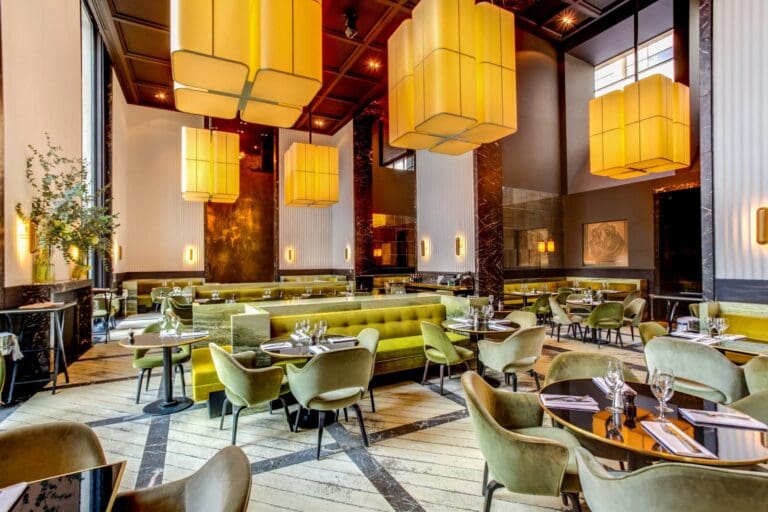
Sophisticated yet welcoming, urbane but comfortable, Monsieur Bleu features new takes on established traditions – at times selecting dishes from elsewhere and adding a distinctive French touch – with a particular eye to the produce and products of the changing of the seasons. Among the various delights that grace our table are langoustine and duck foie gras ravioli served in a sour broth; an egg parfait with mushrooms and spinach; fresh green beans with Sicilian pistachios and delicately smoked ricotta cheese; sea scallops presented in their shells with spinach, capers, lemon, and a curry sauce; and a saddle of lamb with hummus, carrots and a North African harissa sauce. Adjectives are both inadequate and unnecessary. Frankly, the menu speaks for itself.
We spend over two hours lingering luxuriously over our lunch. Although we contemplate calling it a day and going for a nap, we decide that we just need a good post-meal digestive stroll to get the blood flowing again. We haven’t gone more than 100 meters from the door of the Palais de Tokyo when we see signs for the Yves Saint Laurent Museum. Terry (predictably) rolls his eyes, but the skies have clouded over a bit, leaving him with little cause to protest. Besides, he led us into the Museum of Modern Art and later thanked him for it. We will now lead him to admire the daring designs of one of France’s – and thereby the world’s – most respected couturiers, for which we are certain he will later thank us.
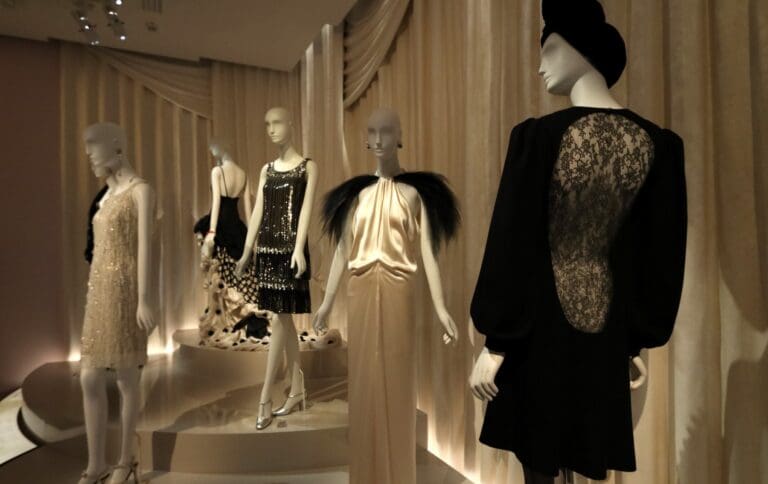
Opened in 2017, this rather particular museum occupies the building where, from 1974 to 2002, Yves Saint Laurent exercised his talents – and exorcised his demons – to produce some of the most startling and influential haute-couture creations of the 20th century. Room after room, we are confronted by the evidence of his creative genius, as both permanent collections and temporary exhibits display the products and recount the process of high-fashion design. The experience, though, is far more than a stroll down memory lane. What we see is a poignant picture of life and culture in the second half of the last century, as the fashions themselves reflect haute couture traditions that accompanied a certain art de vivre, one that no longer exists.
Practical Information: The Musée Yves Saint Laurent is located at 5, Avenue Marceau and is open from Tuesday to Sunday from 11:00 a.m. to 6:00 p.m. Last entrance is at 5:15 p.m. Open on Thursdays until 9:00 p.m.

It is now just after 5:00 p.m. – we have spent far longer here than any of use expected to, simply basking in the sheer glamor and utter elegance of the place. But, of course, there is always room for glamor and elegance, so we decide to build on the afternoon trend by having cocktails in the bar of the legendary George V. Little more than a 5-minute walk away, the hotel has been gracing the avenue of the same name at number 31 since 1928.
Sleek and somber, the very picture of understated opulence, the George V has hosted princes and presidents, socialite, celebrities and sultans, for nigh on a century. We saunter in with cool confidence and make our way to the bar. Decked in wood panel walls and parquet floors, this is aristocratic version of Art Deco design. The mood is muted and the tone is hushed, and we sip on our signature spritzes. They are 34€ each, but made with champagne, Lillet Blanc, St. Germain liqueur, ginger-infused Suze bitter, and soda, and imbibed in an ambiance of languorous leisure, they are absolutely worth it. Even Teutonic Terry is impressed. None of us can imagine a better way to end our day on the Right Bank, and no more than a 15-minute walk from the Eiffel Tower.
Book Your Paris Experience