There are some 12,000 paintings at the Louvre.
You can’t see all of them. You’d only have barely begun by the time your eyes blistered. Even if you limited yourself to readily recognizable names, you’d still be working through wagons’ worth of works by da Vinci (6), Botticelli (6), Raphael (10), Titian (14), Bosch, Caravaggio (3), Velazquez (2), Goya (8), El Greco (3), David (15), Poussin (40!), Rubens (a whopping 51!!)… the list goes on. Here we’re going to narrow it down to the five most famous paintings in the collections – other than the Mona Lisa – and talk about why they are so well known.
DISCLAIMER: This is not an attempt to identify the five most important paintings, nor is it a shot at pointing out the five most influential paintings. Just the five most famous ones. And by famous, we mean the works that would prompt the greatest number of average Joes and Joannes to say, “Haven’t I seen this before?” or, “Ah, that’s here?!” We will list them in reverse order of fame/familiarity, according to our (completely unscientific and totally subjective personal) opinion.
But we think rather highly of our (completely unscientific and totally subjective personal) opinion, and we do have some base for evaluation. We recently saw a similar list with a similar title, one that was clearly presenting works that the writer thought should be the most famous, not the ones that actually are the most famous, without stating that this is what they were doing. We were shocked and dismayed! Well, not really. But we have decided to take a different path by identifying the five tableaux that we truly do believe are the most readily recognizable of those gracing the halls of the Louvre.
Best Paris Tours
Explore the City of Light!

The Raft of the Medusa
Théodore Géricault, 1819
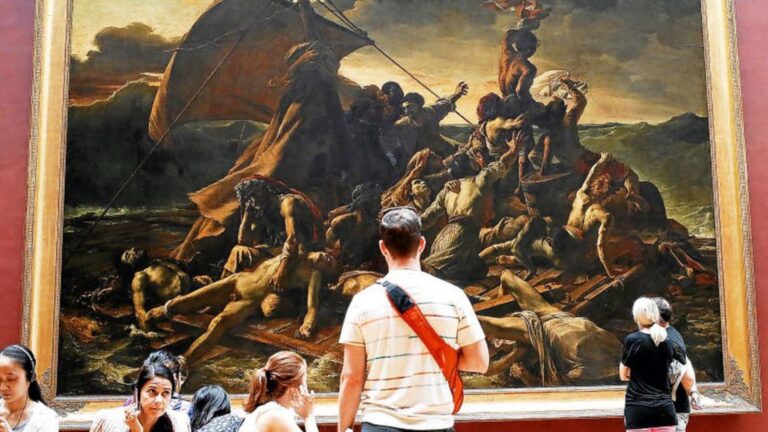
Measuring 4.91 meters by 7.16 meters (about 16’1” × 23’5”!), this massive canvas is practically a portable mural. The subject is the 1816 shipwreck of a French frigate 100 km (62 miles) off the coast of Mauritania, a tragedy widely attributed to the utter incompetence of the ship’s captain. There were more than 400 people on board but room in the lifeboats for not quite 250. Most of the rest built a makeshift raft, clambered aboard, and drifted for 13 days before being rescued by a passing ship. By that time, all but 15 had died: of dehydration or despair, with the weakest being killed and the dead being eaten by the others. Occurring barely a year following the restoration of the Bourbon kings to the throne in the wake of Napoleon’s defeat at Waterloo, the whole debacle became a metaphor for the shipwreck of state and the bungling royal government.
Géricault began in 1818 and worked into the next year, finishing just in time to have it entered into competition at the Louvre’s Salon of 1819. It was a calculated move: this was his first shot at the big time, and he had chosen a hot topic that was still on everyone’s mind. Its gruesome depiction of horror and hopelessness – including realistic images of rigor mortis and decaying flesh – may have been controversial at the time, but the piece certainly packs an emotional punch. It’s terrifying to regard, but we can’t take our eyes off it. This is probably the key to its perennial appeal and its permanent place in the collective awareness of Western civilization.
The Oath of the Horatii
Jacques-Louis David, 1784
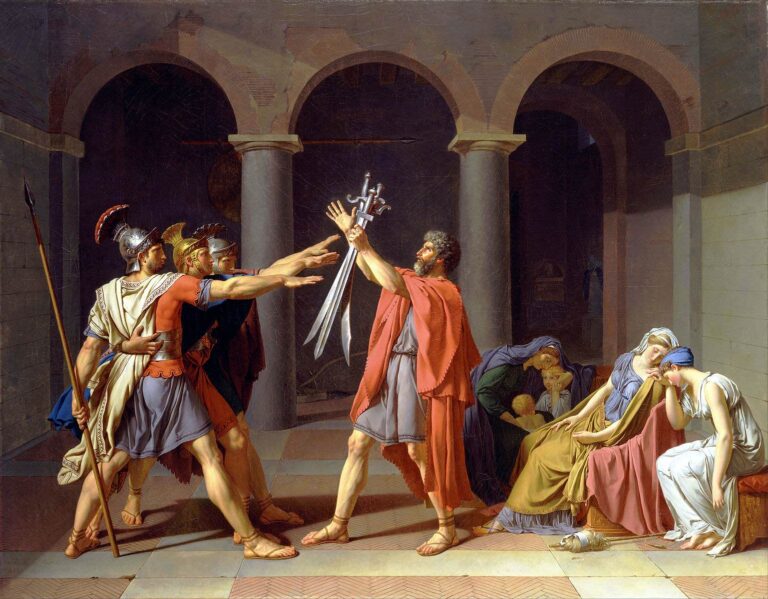
In the great vein of Neoclassical painting, this work reflects the taste for high historical drama then in vogue, in this case an ancient legend of Early Rome. It is also evidence of the 5 years the artist had spent in the Eternal City as the winner of the Rome prize, awarded by the French government. The oeuvre was in fact painted in Rome during another extended sojourn there between 1784 and 1785, just a few years before the storming of the Bastille. It had been commissioned by an assistant to King Louis XVI, intended as an allegory of loyalty and service to the state, and by extension to the king. As the flames of revolution licked higher, David’s massive masterpiece – it measures about 3.30 meters by 4.25 meters (nearly 11 feet by 14 feet) – practically became a recruiting poster for the anti-monarchy militias.
This is one of the paintings found in nearly every Introduction to Art text book in the Western world, as well as an ever-present illustration in histories of the past 300 years. The evident martial spirit that pervades the scene, with the attendant implications of honor, service and sacrifice, of patriotism and love of liberty, along with its sheer ubiquitousness, are what have guaranteed its long-lasting recognizability.
Portrait of King Louis XIV
Hyacinthe Rigaud, 1701
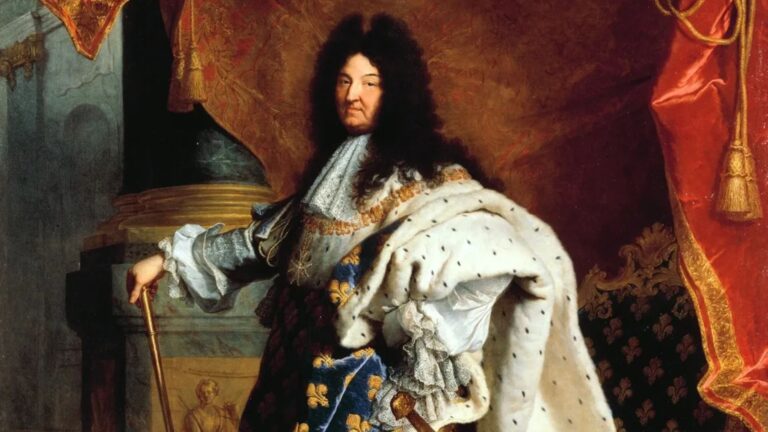
The Sun King… Versailles… “I am the state”… “After me, the Flood”… King Louis XIV brought France to the very apogee of power on the Continent. King at the age of 5 and on the throne for 72 years and 110 days, he still holds the record as the world’s longest reigning monarch. Countless portraits, and copies of those portraits, from over seven decades as king of France, pepper public museums and private collections around the globe. But one stands head and shoulders above the rest: Hyacinthe Rigaud’s Portrait of Louis XIV in Coronation Robes from 1701, when the king was 63 years old. Absent are both arrogance and ambition. Here the king stands, at the request of his adoring grandson, King Philip V of Spain, and despite his painful gout, with nothing to accomplish, nothing to prove. This is majesty revealed, in its purest form, with both magnificence and munificence to spare.
Rigaud is considered as one of the greatest portraitists of the period, alongside Rubens, Rembrandt and Van Dyck. This work remains the quintessential portrait not only of old Louis but of grand baroque portraits tout court.
The Coronation of Napoleon
Jacques-Louis David, 1807
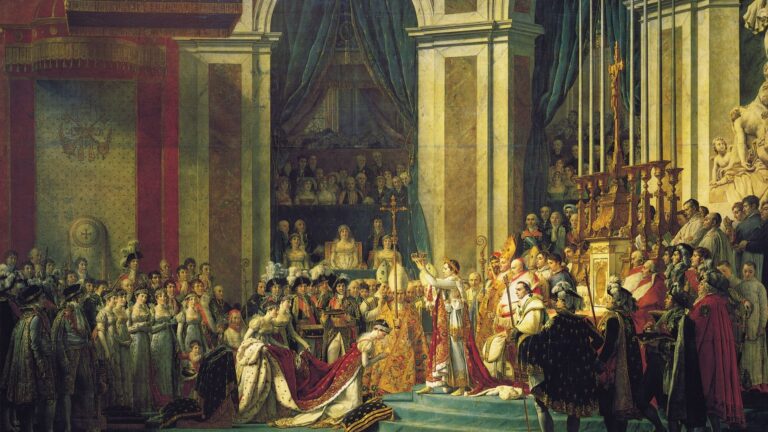
Here we see David, the great Revolutionary painter, appearing once again, this time for the grand and glorious scene set in Notre-Dame de Paris on 2 December 1804. Interestingly, it is not the grand homme himself being crowned, but rather his consort, Joséphine de Beauharnais. We see Napoleon already wearing the ancient crown of laurels, extending a more traditional piece out before him, preparing to place it lovingly on his wife’s head, as the emperor’s mother looks on pacifically from the box seat and the pope extends his hand in blessing. These last details were the result of some creative photoshopping, avant le mot, for the purposes of propaganda.
There is some dispute about the actual impetus for these modifications, but here are the versions that we like best. Napoleon would actually have been sporting the crown traditionally identified as that of Charlemagne. Here, though, his Caesar-like crown of laurels reflects His Imperial Highness’ predilection for all things Ancient Roman.
Madame Mère, as Napoleon’s mother was called, boycotted the event altogether, either because she was displeased by the direction her son’s regime was taking, because she was annoyed by Napoleon’s squabbles with his brothers, or because she had no liking for Joséphine (or likely some mélange of all of the above). But it was imperative to present the image of a united imperial family, so David popped her up in the box, looking on lovingly.
As for the pope, David had originally painted Pius VII gazing on beneficently, with his hands lying loosely on his robes. When the painter was nearing completion, Napoleon visited him in the studio he had set up in the chapel of Cluny College near the Sorbonne. The emperor somewhat caustically remarked that he had not brought the pope all the way from Rome just to sit there with his hands in his lap. So splish splash, a little deft brushwork, and history was rewritten in a manner more pleasing to the imperial patron. Then, as now, it was all about the optics.
The absolutely immense tableau measures 6.2 meters by 7.3 meters (about 20 feet by 24 feet). Its ready familiarity reflects the unending fascination that the Napoleonic saga still inspires in throngs of visitors from every corner of the Earth.
Liberty Leading the People
Eugène Delacroix, 1830
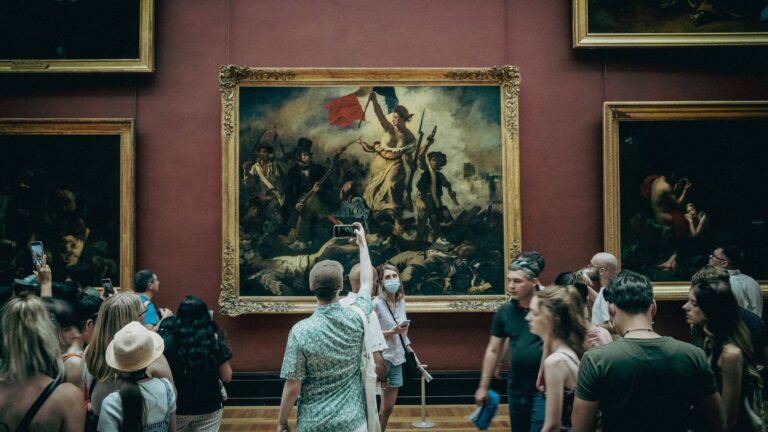
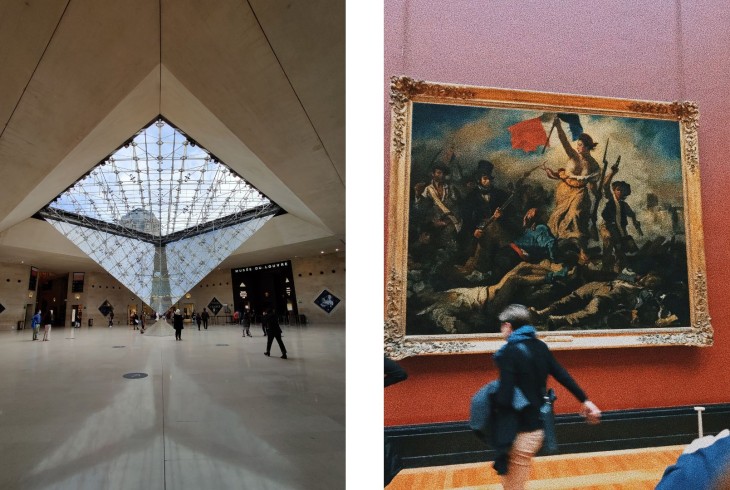
Often mistaken for representing events of the French Revolution that began in 1789, this unflinchingly Romantic-era oeuvre actually celebrates the toppling of the regime of King Charles X in the so-called July Revolution of 1830. The scene features a robust woman of the people, bearing the Tricolor flag and wearing the Phrygian cap that had symbolized freedom for the Revolutionaries since the storming of the Bastille. She is flanked by members of various social classes – from bourgeois boys to university students, and even a pistol-packing working-class kid – and is born forward, almost aloft, by the bodies of the fallen heroes whose sacrifice ensured the relentless march of liberty. The brushwork is bold, the colors are brilliant, with an emphasis on energy, emotion and expressiveness that are the hallmarks of the new Romantic movement, a reaction against the academic precision of the previous Neoclassical period.
Its themes of liberty for the people, the right response of the governed to tyrannical government, and the inclusion of broad swaths of society united by common cause have earned this work the place it holds in our minds. The masterpiece’s unvarnished drama of the narration and the impassioned expressiveness have earned it the place it holds in our hearts, making it – aside from the Mona Lisa – the most familiar and recognizable painting in the vast collections of the Louvre.
Book Your Paris Experience