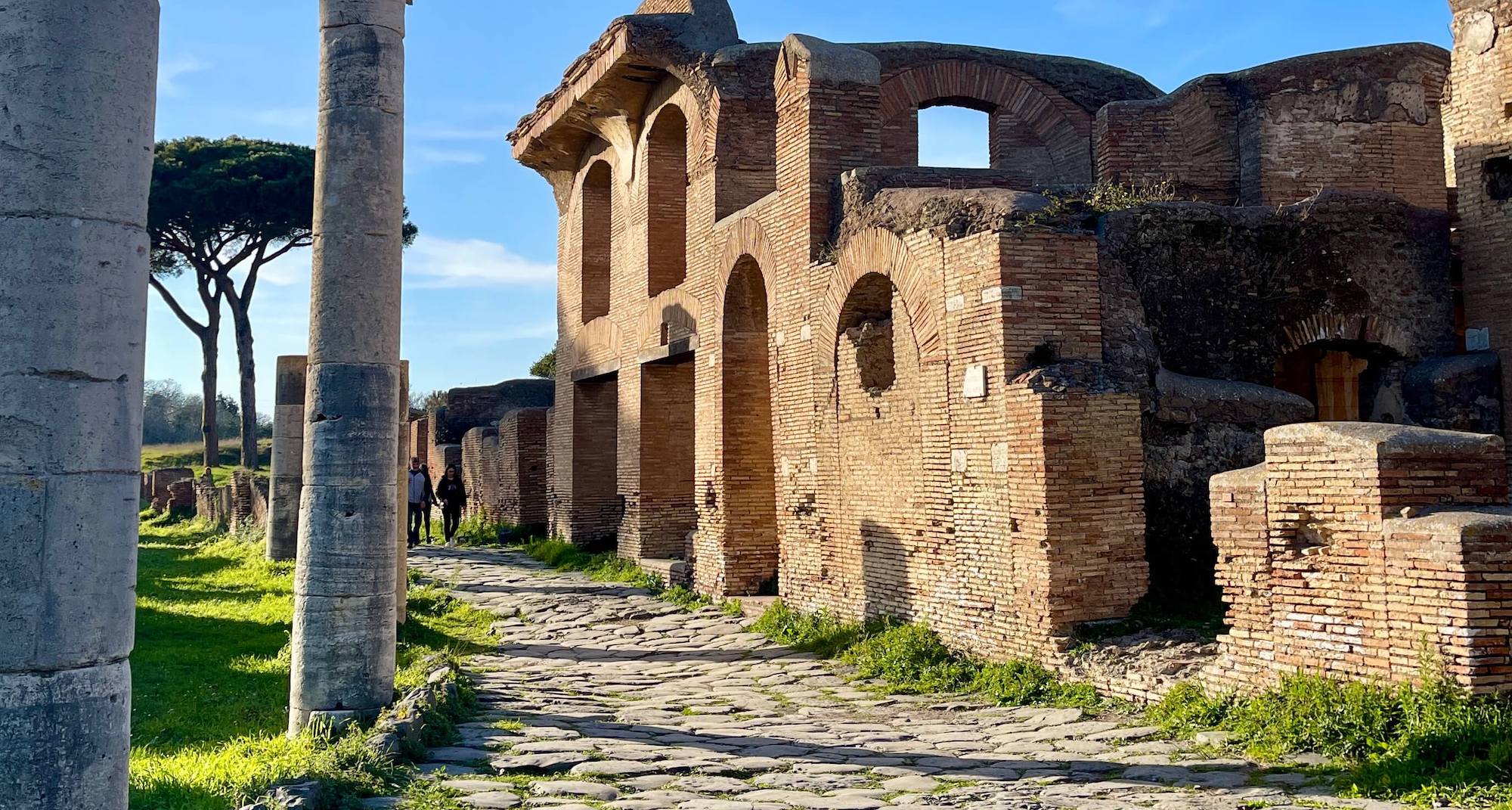
If you want to get up close and personal with the majestic remains of antiquity but don’t have time to head to Pompeii, then a visit to Ostia Antica – just half an hour by train from central Rome – is a must.
Surrounded by umbrella pines and swaying cypress trees in the beautiful Roman countryside, Ostia Antica was the Roman Empire’s most important port. The harbor city was a vital cog in the massive machinery of the empire, and today its wonderfully preserved mix of cobbled streets, atmospheric temples, ruined theaters, villas, shops, apartment blocks and warehouses offers a unique insight into what it was like to live in an ancient Roman town over two millennia ago. Exploring the ruins is the very best of the many things to do in Ostia, Italy. In this guide we’re taking a closer look at ten things you need to look out for in the complex jigsaw of ruins on your tour of Ostia Antica.
 Prefer to explore Ostia with a guide?

Ostia Antica is one of Rome’s most rewarding archaeological sites, but its streets, temples, shops, baths, and apartment blocks make far more sense with someone to bring the ancient city back to life. Our private tour explores the ruins with an expert guide, revealing how ordinary Romans lived, worked, worshipped, and entertained themselves here.
Ancient Rome Tours
Visit Ostia Antica
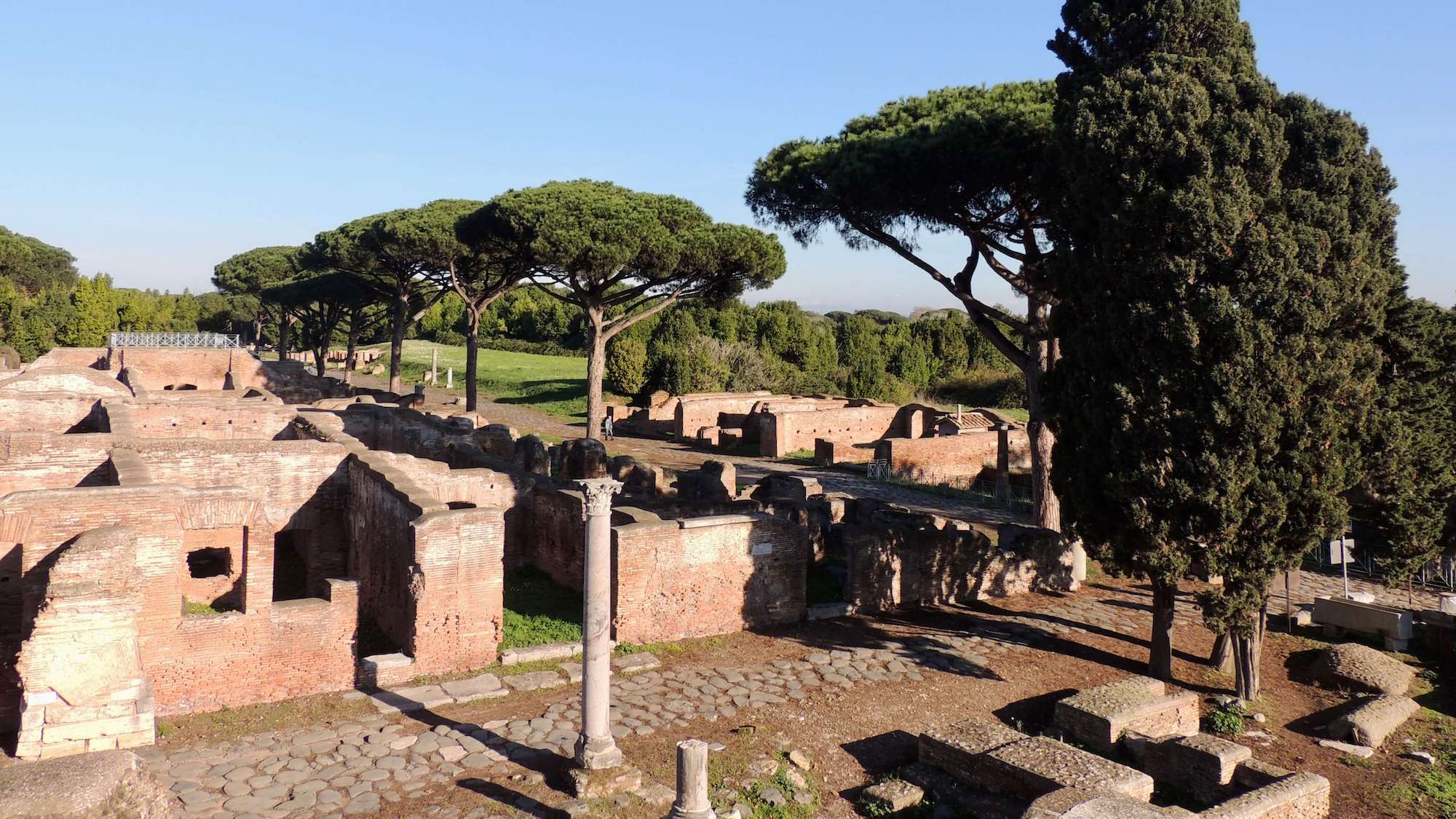
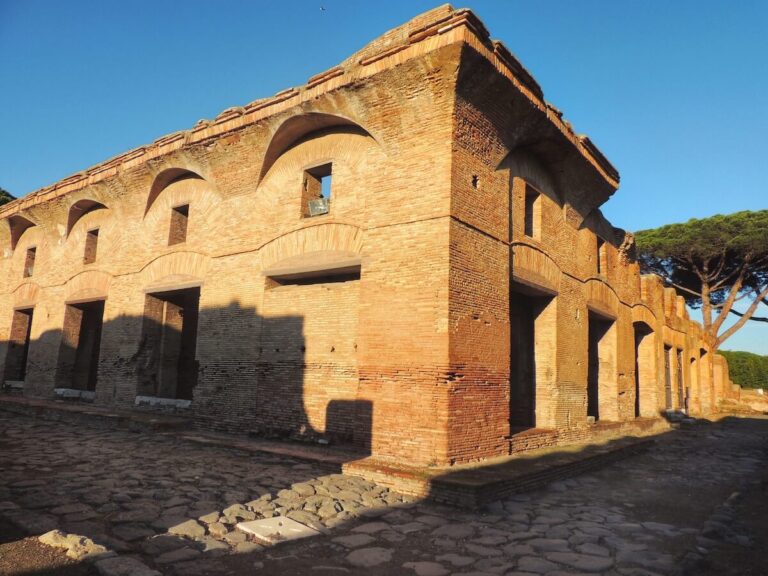
The sprawling so-called House of Diana is a fascinating example of a large, multi-storied apartment building (known as an insula ) for the middle classes that was common in the densely populated urban centers of antiquity. The House of Diana owes its name to a painting depicting the hunter goddess Diana found at the building’s entrance, and dates from around 150 AD.
The ground floor was given over to shops, whose wide entrances you can still see clearly today, whilst multiple staircases lead to the floors above. The first floor was reserved for the shopkeepers, who lived directly above their premises; spacious, well-heeled apartments on the next floor gave way to more modest lodgings as the building ascended.
The House of Diana is beautifully decorated with mosaic floors and frescoed walls, with depictions of complex geometries, foliage, Medusa heads, fish and birds recurring motifs. It’s a fascinating example of a complex, multi-functional residential building from antiquity that is centuries ahead of its time in its approach to urban design.

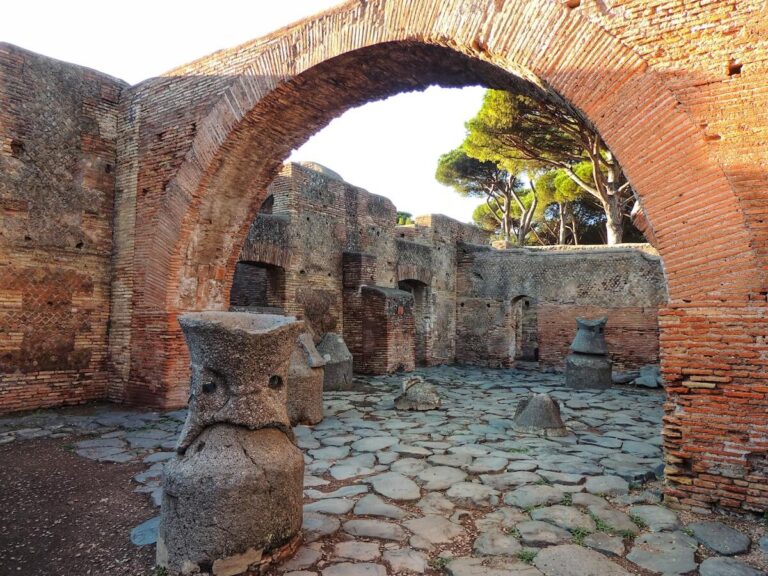
Bread was a staple of the Roman diet, and mills and bakeries were regular features in every city in the ancient world. In Ostia Antica, the bakery surviving on the Via dei Mulini offers a fascinating insight into the art of baking in antiquity. Built in around 120 AD, bread made here would have supplied not only the local populace but also have been imported into Rome to feed the ever-hungry metropolis.
Originally a funnel-shaped element hanging from the roof would have scattered a steady supply of grain onto the imposing lava-stone millstones that still dot the ruined building. The millstones have a large cone-shaped base known as a meta surmounted by a moveable element known as a catullus that could be rotated via a lever turned by slaves or mules, the latter of whom had to be blindfolded to stop them from becoming dizzy. Grain trapped between the two elements would be ground into flour. In a separate room the flour was kneaded into dough, which was finally baked into loaves ready for sale.
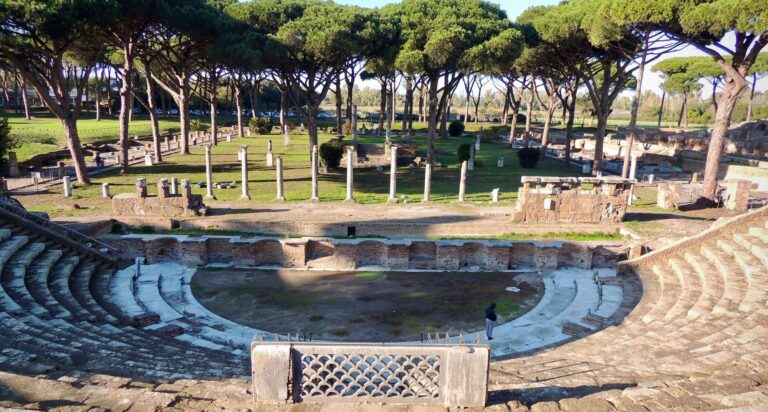
Perhaps the most impressive building in Ostia, the city’s theater is one of the most important examples of its kind in the world. Built during the reign of Augustus at the end of the first century BC and expanded two centuries later, Ostia’s theater is one of the oldest masonry theaters in the world. At its peak the structure could accommodate 4,000 spectators, and survives in excellent condition.
Four stairways provide access to the rows of seats in the cavea, while the main barrel-vaulted entrance provided direct access to the orchestra level. The lowest marble rows of seats were reserved for high-status patrons. Behind the stage three marble theatrical masks constitute the remains of the scaenae frons or the lavishly decorated architectural background that was a characteristic of ancient Roman theaters.
When in Ostia take a seat on the steps with a spectacular view of the Roman countryside stretching out before you, and let yourself be transported back in time to the dramatic world of the ancient stage.
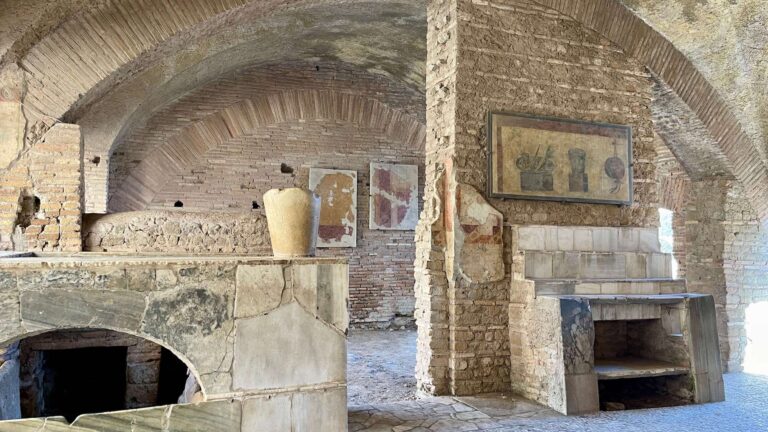
Did you know that ancient Romans enjoyed a meal out as much as we do today? As you tour Pompeii or Ostia, you will likely stumble upon the remains of a thermopolium, one of the most characteristic eating establishments of the ancient world.
A thermopolium was a kind of ancient fast food joint, with a large window open onto the street allowing access to a long take away counter within. The counter would be lined with deep recesses called dolia for storing food, as well as amphorae brimful with cheap wine. Many thermopolia in fact doubled as notorious boozers. Behind, a little shrine dedicated to Bacchus, god of wine, and Mercury, god of commerce, ensured the good fortune of the establishment.
In the more well-heeled thermopolia, like this 3rd-century example on the Via di Diana in Ostia Antica, a beautifully painted menu on the wall behind the counter was on hand to help you choose your meal. You might find yourself tucking into eggs and olives, spicy turnips, lentils, meat or fish, all accompanied with the infamous garum – a rotten fish sauce that might be thought of as the ketchup of antiquity.
Some of the other options on offer would be likely to turn many modern stomachs: according to the famous Roman cookbook “De re coquinaria” (On the subject of cooking) written by a certain Apicius in the 1st century AD, among the dishes most appreciated by ancient palates were flamingo’s tongue, grilled dormouse, and even boar stuffed with living mockingbirds, which were supposed to surprise the guests by flying out when the boar was cut open.
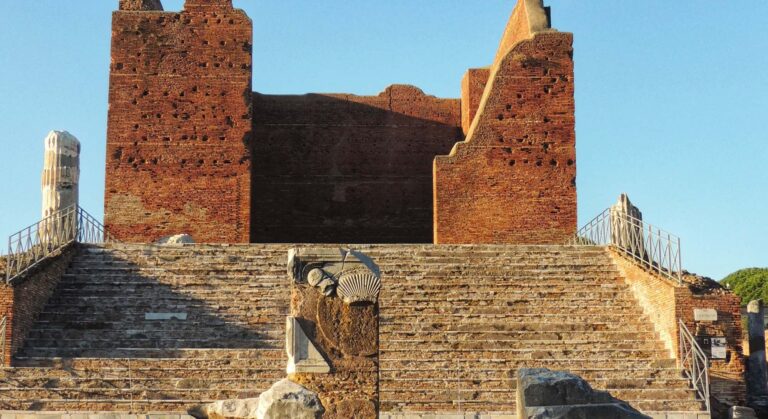
If you have visited Rome then it’s likely you’ll be familiar with the Roman Forum , the civic and religious center of life in the ancient city. The Forum was the centerpiece of all Roman cities, and Ostia was no exception. The main surviving building of ancient Ostia’s Forum is the imposing Capitolium, a large temple dedicated to the gods Jupiter, Juno and Minerva – otherwise known as the Capitoline triad thanks to the temple dedicated to them on the Capitoline hill. Every Roman colony featured a Capitolium, symbolic of the transposition of the official cult of Rome to the new settlement.
Ostia’s impressive brick Capitolium was constructed in 120 AD. Stairs lead up to a high podium that originally featured 6 columns. The stark brick skeleton that we can see today would have been completely covered in priceless marbles, prized off in the Middle Ages. Cult statues of the divinities, also long ago plundered, once graced the interior. The temple’s altar stands at the base of the steps.
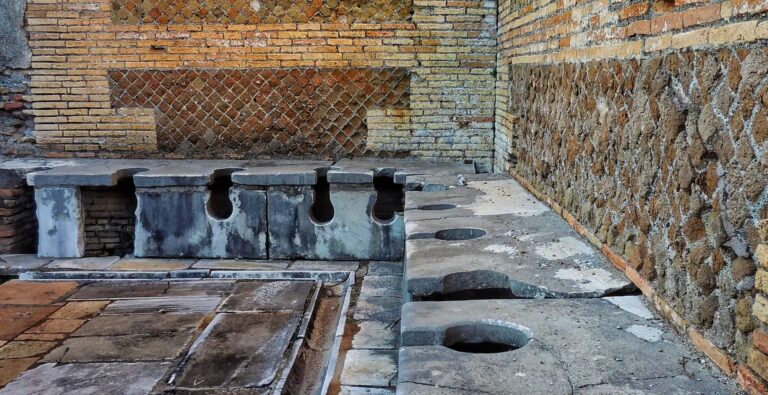
Life was unimaginably different in antiquity than it is today in so many ways; but whilst morals, customs and technology change at often bewildering speed, humans are still humans. And they have certain unavoidable biological needs – like going to the bathroom. As a highly sophisticated and complex civilization, ancient Romans were just as concerned as we are about devising ablution solutions. Public toilets were common in antiquity, and this incredibly well-preserved example in Ostia Antica showcases Roman plumbing at its finest.
The latrines were originally accessed via a revolving door, and consisted of a communal marble bench running along 3 walls with 20 seats spaced at a wince-inducing proximity for those of us used to modern conceptions of privacy. Each seat has its own hole leading downwards to a single drainage channel beneath that would have been fed with running water to flush away waste and fluids. The world would have to wait until the 15th century before toilet paper was invented, so patrons of the latrine made do with a sponge attached to a stick to wipe themselves.
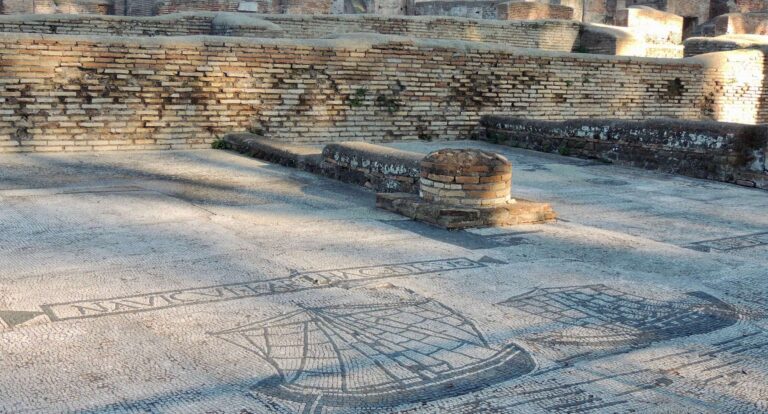
Ostia owed its ancient prosperity to one thing and one thing alone: its status as a trade hub and port to the biggest city in antiquity. A bewildering variety of goods arrived here every day from the furthest-flung corners of the known world: grain from Sardinia and olive oil from Tunisia; wine from Greece and marble from Egypt. More sinisterly, slaves and exotic animals regularly passed through Ostia on their way to certain death in the Roman arena.
In the city’s so-called Piazza of the Corporations, located behind the Theatre, we can get a vivid insight into this trade. The offices of the city’s most important guilds and merchant bodies surrounded the vast open square, and each was decorated with a beautiful mosaic depicting their various vocations – from importers of grain to elephants, rope-makers and leather tanners, shipbuilders and shipping companies based all over the Mediterranean.
Statues of various illustrious citizens and corporation leaders adorned the square, whilst at the center a 1st-century AD temple rises on a high podium. Although the exact identity of the deity to whom the temple was dedicated hasn’t been determined, one theory identifies it as Ceres, goddess of agriculture and grain, harvests and abundance. The dedication of a temple to her at the heart of the trading district would have underlined the importance of the food staple to the city’s economy, and by extension the prosperity that commerce brought to Ostia.
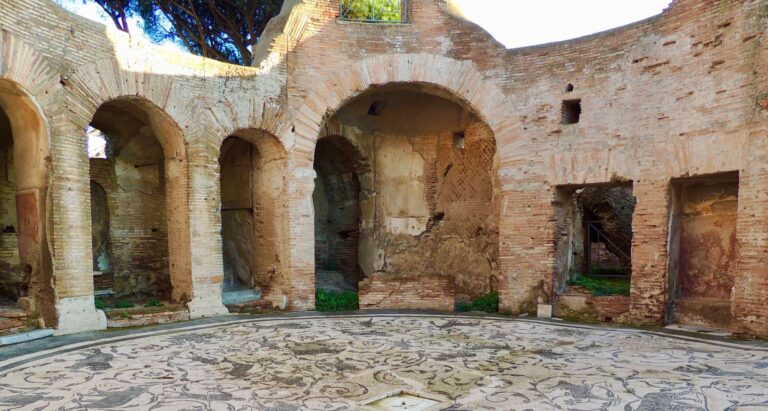
While Ostia Antica is home to a number of thermal bath complexes (as you’ll know if you have visited Pompeii with us , ancient Romans were extremely keen on bathing), our favorite is the Baths of Porta Marina.
Built in around 110 AD, the complex is also known as the Baths of Marciana on account of a portrait bust of the emperor Trajan’s sister Marciana discovered in the ruins. The remains of cold and warm baths are still visible, where mosaics portray maritime motifs appropriate to the space.
The real highlight though is the fascinating monochrome mosaics in what may have been the changing room to the attached gymnasium depicting athletes working out in scenes of remarkable contemporaneity: a boxer is declared winner by a referee; a pair of wrestlers are locked in combat; a discus thrower prepares to launch; victors receive cups and wreaths, while what appears to be a precursor to the modern football lies on the ground. Look out too for one particularly buff specimen pumping iron.
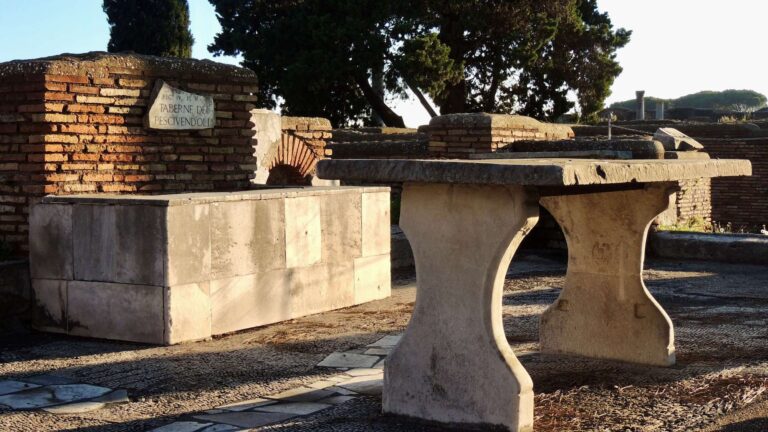
One of the most fascinating aspects of wandering through the ruins of Ostia Antica is that the ancient city is divided so neatly into distinctive quarters revolving around common functions. The area surrounding Ostia’s liveliest and most important crossroads at the junction of the Decumanus Maximus and Via della Foce was devoted to markets and food shops.
Largest amongst them was the Macellum, or meat market. In a buzzing city like Ostia, the slaughterhouse would have been a hive of near constant activity. The meat market is entered via a colonnaded entrance porch, while a fountain stands at the center of the marble floor within. Counters running along the sides were provided for the display of the merchandise.
If meat wasn’t your thing you could pop next door to the Fishmongers’ Tabernae, or fishmongers’ shops, added to the complex in the 3rd century AD. Look out for a floor mosaic depicting a dolphin chowing down on an octopus, accompanied by an inscription intended to ward off the evil eye: ‘inbide, te calco’ (‘oh jealous one, I trample over you’). At the center of the shop is a fine marble table, whilst set against the back wall is a fish-basin lined with marble.
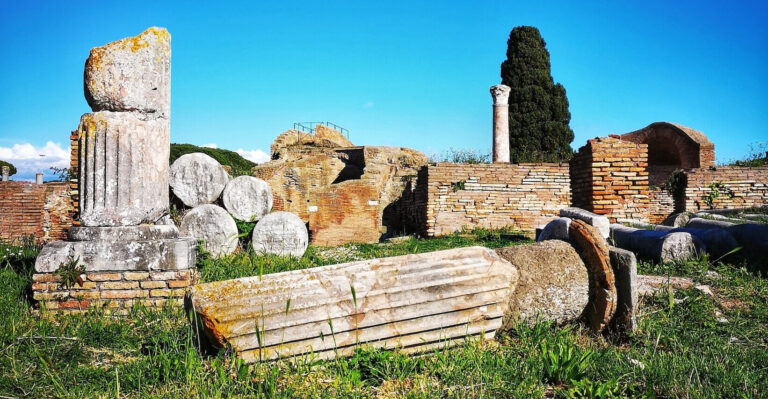
One of the most under-appreciated sites in Ostia Antica is the fascinating temple of Fabri Navales, or the city’s ship carpenters guild. Unsurprisingly, in the main port of ancient Rome this guild was one of the most powerful groups in the city, and their spacious temple reflected their powerful status. Mysteriously, it seems that sometime in the 4th century AD the temple was repurposed as a storehouse for marble to be used in new building projects.
Today 46 magnificent unused Greek marble columns lie abandoned amongst the ruins, inscribed with the name ‘Volusianus’ – probably a reference to the powerful urban prefect Volusianus Lampadius who was a big player in the building trade. What grand building were these beautiful columns destined for, and why were they never used? Nobody knows – it remains an evocative ancient mystery.
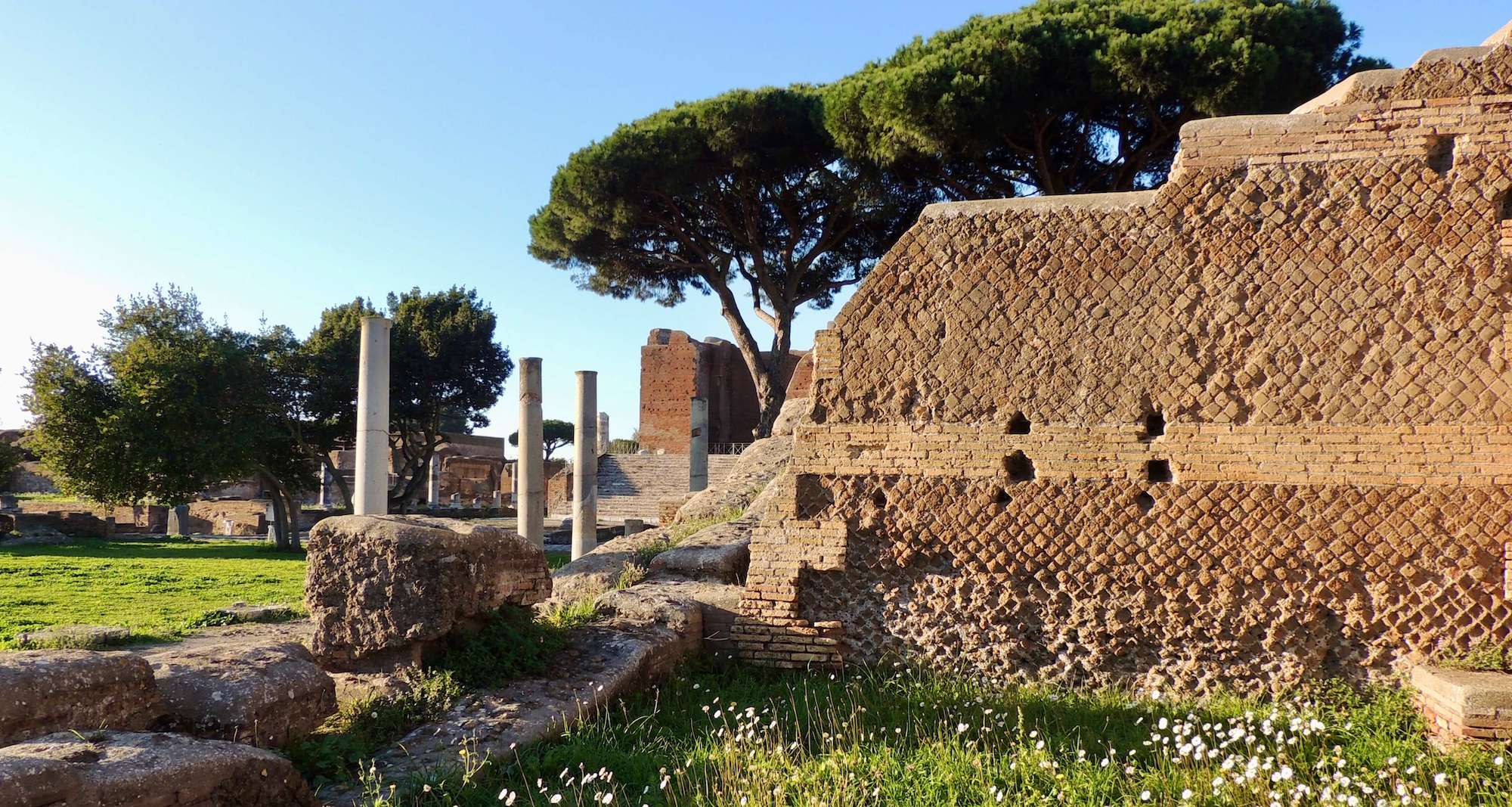
These are just some of the many highlights that await visitors to Ostia Antica. The vast extent of the ancient ruins means that it can be difficult to see all the highlights of this extraordinary ancient site in a single visit. Through Eternity Tours offers private tours of Ostia Antica led by our team of expert archaeologists and historians to help you find your way around. In our opinion it’s the best way to get to grips with this unmissable ancient treasure.
The Medieval Borgo and the Castle of Julius II
Just outside the excavation entrance sits a tiny fortified hamlet that most day-trippers walk straight past. ts centerpiece is the Castle of Julius II, commissioned from 1483 by Cardinal Giuliano della Rovere—the future Pope Julius II—who transformed an earlier medieval fortress into the imposing Renaissance stronghold seen today. Beside it stands the church of Sant’Aurea, built over the burial site of an early Christian martyr. Opening days and access arrangements vary, so check locally before visiting. Among the things to do in Ostia town, this pocket-sized borgo is the easiest to miss and the most rewarding to linger in — a Renaissance village only a short walk from the ancient city.
Ostia Lido: Rome’s Seaside Escape
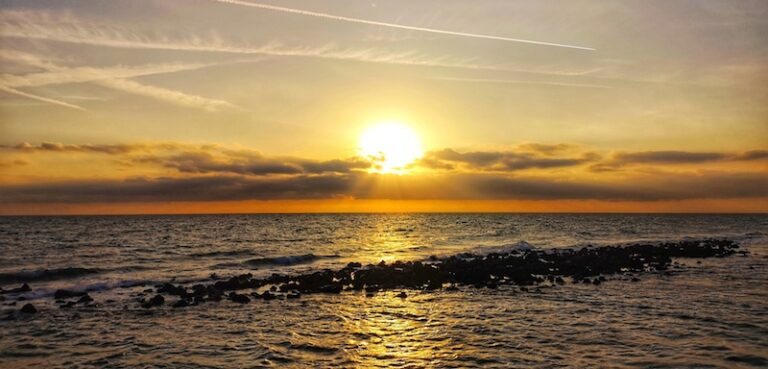
A few stops further along the same railway line, the ruins give way to sand. Ostia Lido is Rome’s seaside escape, with a long sandy beach and seafront promenade. This is Rome’s own beach, where locals escape the city heat throughout the summer. The classic pairing is ruins in the morning, beach in the afternoon. Along the waterfront you’ll find a mix of paid beach clubs (stabilimenti) with sunbeds and facilities, and free public stretches of sand for anyone happy to bring their own towel.
Where to Eat Near Ostia Antica
For lunch, the trattorias scattered through the medieval borgo beside the ruins are the natural choice, serving straightforward Roman and coastal dishes in a setting far quieter than central Rome. If you’re continuing on to the coast, the seafood restaurants along the Ostia Lido waterfront are the better option, with the day’s catch and a sea view thrown in. Food inside the archaeological park itself is limited to a small cafeteria, so it’s smarter to plan lunch around either the borgo or the beach rather than the excavations.

Getting to Ostia Antica is straightforward: take the train from Porta San Paolo station — right beside Piramide on Metro Line B — to the Ostia Antica stop, a ride of about 30 minutes on a standard public transport ticket, no separate fare required. The site is closed most Mondays, so check current hours and ticket prices on the official Parco Archeologico di Ostia Antica website before you travel, since opening times shift seasonally and the site closes earlier in winter. The park is entirely outdoors with long stretches of uneven ancient paving and limited shade, so comfortable shoes, water, and sun protection are essential, especially in summer.
For full details on tickets, hours and the best routes through the ruins, read our complete guide on how to visit Ostia Antica.

Is Ostia Antica Worth Visiting?
Yes — for many visitors it’s one of the best-value day trips from Rome, combining genuinely world-class ruins with a fraction of the crowds you’ll find at the Colosseum or Pompeii. Its multi-story apartment blocks (insulae), intact mosaic floors, and well-preserved theater give a more complete picture of ordinary Roman city life than almost any other site accessible from Rome in half a day.
How Much Time Do You Need at Ostia Antica?
Plan on 3 to 4 hours to cover the main sights comfortably — the theater, the Forum, the Baths of Neptune, and a handful of the best-preserved insulae — though the site sprawls across roughly 150 hectares, and dedicated ruin enthusiasts could easily spend a full day exploring its quieter corners.
Is Ostia Antica Better Than Pompeii?
It depends what you’re after, not which site is objectively superior. Pompeii is larger, more famous, and has the haunting plaster casts of victims that Ostia doesn’t; Ostia Antica is closer to Rome, far less crowded, and better for seeing multi-story Roman housing intact. Many visitors who’ve done both actually prefer Ostia for a relaxed half-day trip, while Pompeii remains the more monumental and comprehensive archaeological experience.
Do You Need a Guide to Visit Ostia Antica?
Not necessarily — the site is well signposted and easy to explore independently with a map or guidebook in hand. That said, a guide adds real value here: many of Ostia’s most fascinating stories — its commercial life, apartment buildings, guilds and warehouses — aren’t immediately obvious from the ruins alone. isn’t always obvious from the ruins alone, and a good guide can bring the everyday texture of the ancient port city to life in a way self-guided visitors often miss.
Book Your Ancient Rome Experience