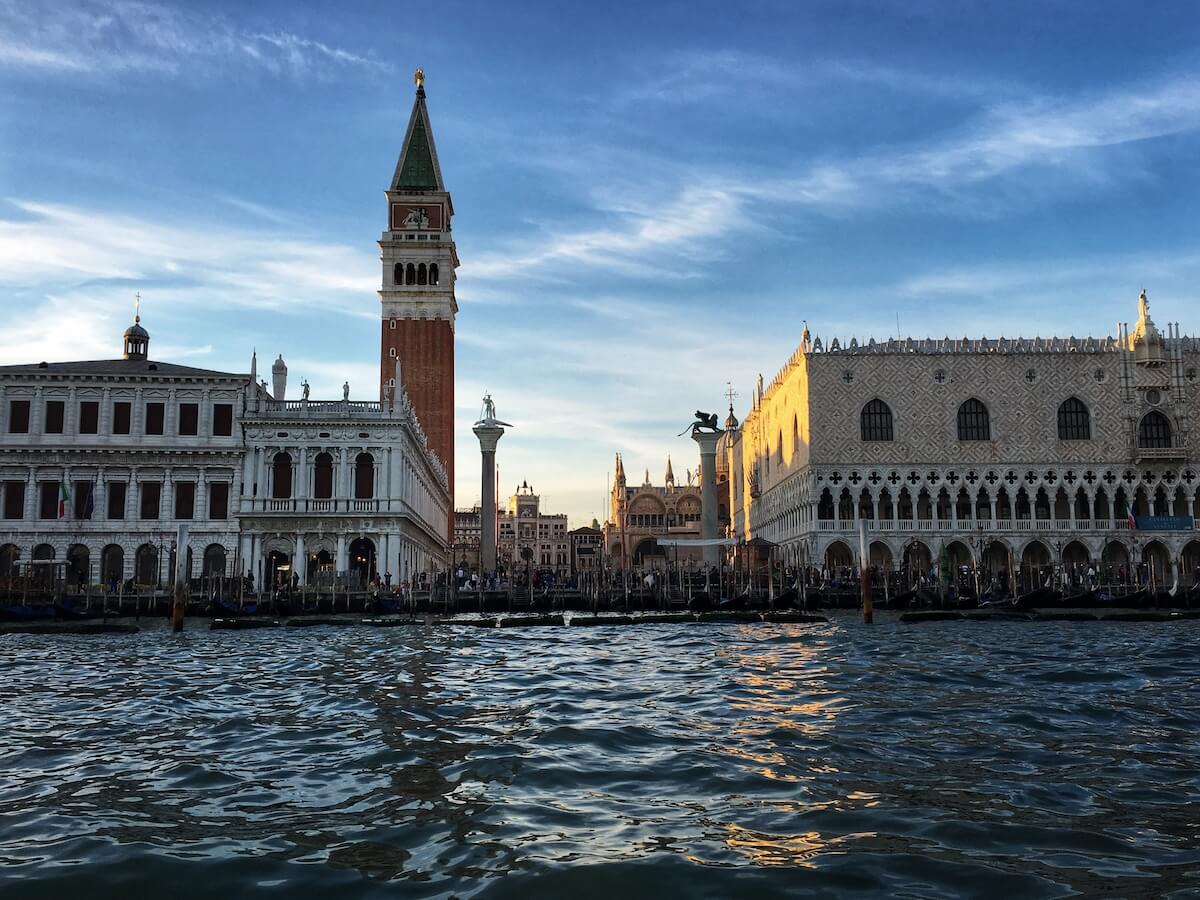
The seven main attractions in St. Mark’s Square, Venice, are St. Mark’s Basilica and its mosaics, Doge’s Palace, the Campanile, Caffè Florian and Quadri, Correr Museum, the bronze horses, and the winged lion of Torre dell’Orologio, the iconic clocktower in St Marks Square and Piazza San Marco. For more ideas beyond the square, see our guide to the best museums in Venice.
In Venice, all roads (or should that be canals?) lead to Piazza San Marco.
This sweeping square has stood at the heart of Venetian life for centuries. It is every visitor’s principal point of reference in the labyrinthine Serenissima.
The architecture alone justifies the visit. Elegant arcades line both sides, the Procuratie Vecchie to the north and the Procuratie Nuove to the south. At the far end, the almost other-worldly form of St. Mark’s Basilica gleams above the crowds. It is the image of Venice that stays with you longest.
But Venice’s premier public space holds far more than first meets the eye. Read on for the seven things worth your time in Piazza San Marco, and how to see each one well.
Venice Tours
Visit St. Mark's Basilica!
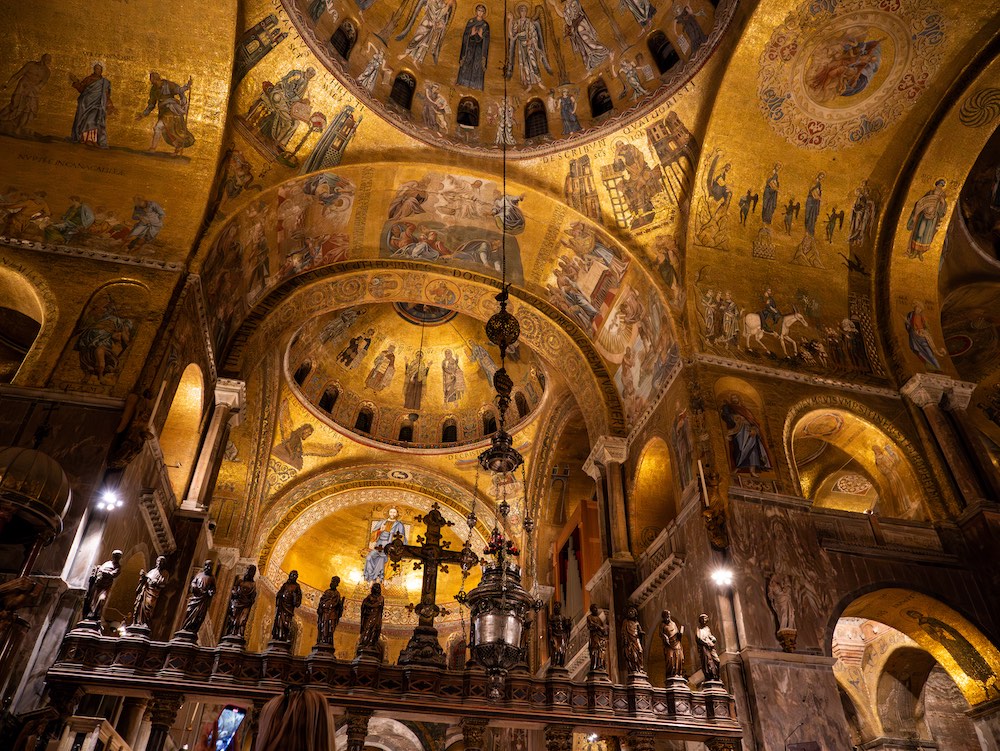


Dominating the piazza to which it gives its name, Saint Mark’s basilica is one of the world’s greatest churches. With a history stretching back over 1,000 years, the sprawling cathedral encapsulates the mysterious charm and eccentric beauty of Venice in microcosm.
After Venetian sailors stole the body of the apostle Saint Mark from Egypt in an audacious 9th-century heist, the city determined to construct a site of worship befitting the elevated status of their adopted patron saint. The resulting church is so beautiful that no photos can do it justice, and its glittering array of domes, turrets, arches and gables is a fusion of eastern and western architecture that reflects the Serenissima’s cosmopolitan heritage.
The Golden Mosaics and the Pala d’Oro
Step inside for a genuine visual shock. More than 4,000 square metres of mosaic shimmer from every surface, turning the church into a vision of heaven. Not for nothing is San Marco known as the Chiesa d’Oro, the Church of Gold.
The mosaics took centuries to complete. Work began in the early Middle Ages and continued through the Renaissance and beyond, which is why Byzantine rigidity in the older domes gives way to softer, more naturalistic figures elsewhere. Look up at the Ascension Dome for the most spectacular of them all.
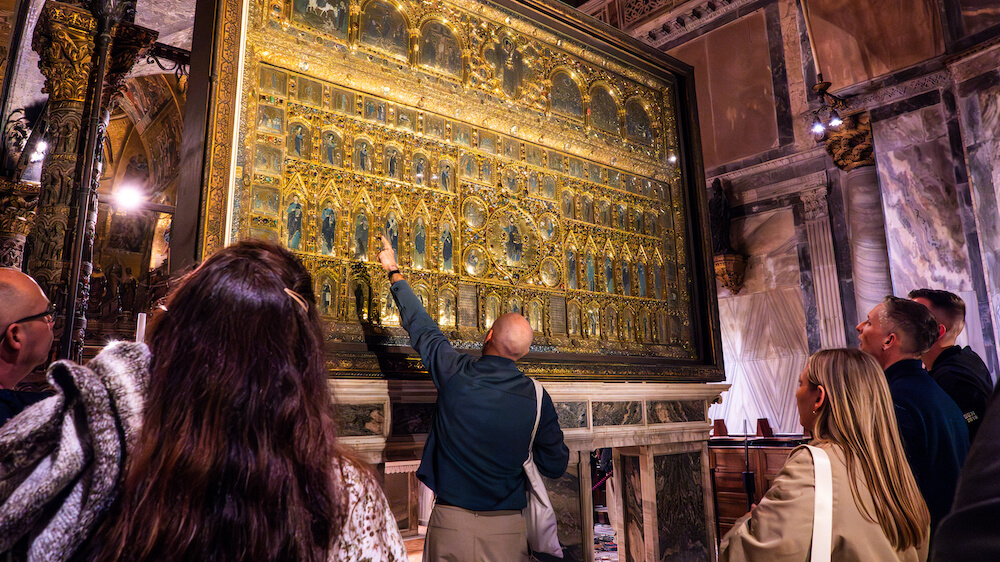
Behind the high altar stands the Pala d’Oro, a Byzantine altarpiece of gold, enamel and precious stones assembled over four centuries. It holds roughly 1,900 gems. Few visitors give it the time it deserves.
St. Mark’s Basilica Tickets, Hours and Queues
Entry to the basilica is no longer free. A basic admission ticket is required, with separate tickets for the Pala d’Oro, the Museum and the loggia terrace. Book online in advance and you will skip the longest queues.
Queues build fast from mid-morning through the afternoon, particularly between June and September. Arrive for opening, or come late in the day. Bare shoulders and knees are refused entry, and large bags must be left at the nearby deposit.
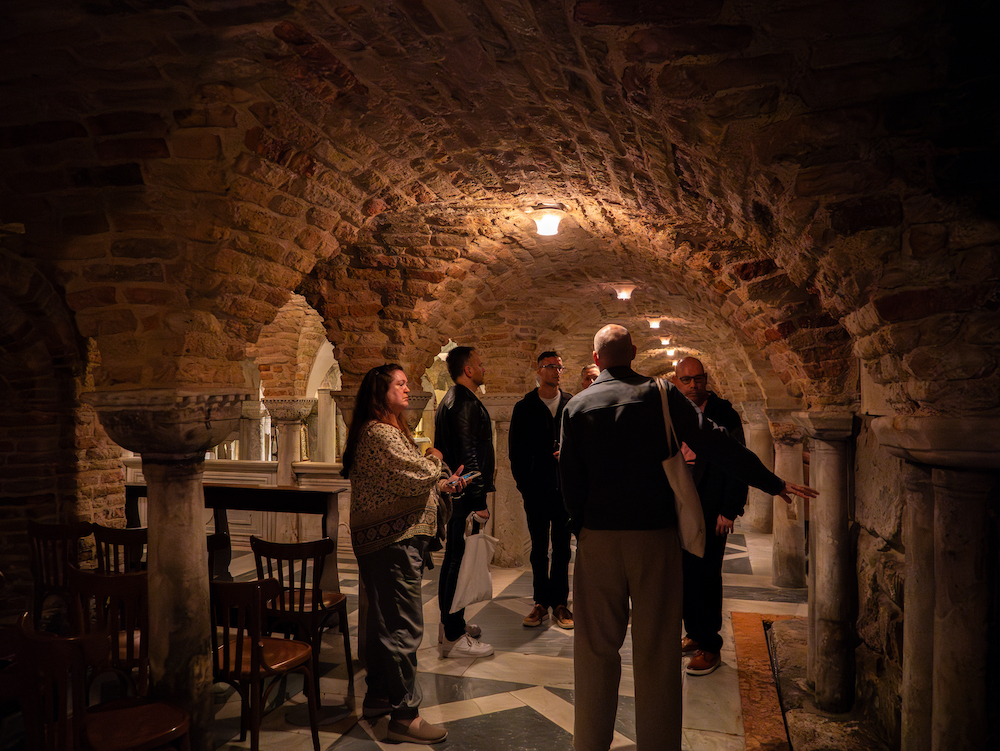
Discover how to visit St Mark’s Basilica at night and avoid the crowds with us. Through Eternity offer an exclusive after-hours visit of Saint Mark’s basilica that will enable you to avoid the queues and the crowds as well as visiting areas of the cathedral that are usually closed to the general public.


At the far end of Saint Mark’s Square heading towards the waters of the Venetian Lagoon is the Piazzetta San Marco, home to one of the city’s most important buildings. Enviably sited along the waterfront, this masterpiece of Gothic architecture constituted the political epicentre of the Venetian Republic.
As its name implies, the Doge’s Palace was the official residence of the ruling Doge of Venice. The hypnotic rows of pink-tinged arches date from the 1300s, and are a truly spectacular sight as the sun begins to set over the water.
Inside, the scale is startling. Vast state rooms, lavish private apartments, courtrooms, assembly halls and prisons all sit under one roof. Together they show the machinery that kept one of the world’s great maritime powers running like clockwork for five centuries.
What to See Inside the Doge’s Palace
A visit to the Doge’s Palace is essential. Jacopo Sansovino’s Scala d’Oro, the golden staircase that led to the Doge’s living quarters, sets the tone on arrival.
Then comes the Chamber of the Great Council, one of the largest rooms in Europe. The assemblies of the Venetian Republic met here beneath paintings glorifying the city’s power, including Tintoretto’s Paradise, among the largest canvases ever painted.
Other rooms hold more glorious examples of Venetian art. Veronese’s Juno Bestowing Her Gifts on Venice looked down on the scheming of the Council of Ten in the Sala Consiglio dei Dieci. Works by Titian, Tintoretto and Tiepolo light up further chambers. The 15th-century Scala dei Giganti, meanwhile, is one of Italy’s most beautiful staircases.
The Doge’s Palace is one of the highlights of our Essential Venice tour. Find out more here!
Doge’s Palace tickets
Doge’s Palace tickets cost €35 for a standard adult ticket, or €30 when bought online more than 30 days before the visit. The standard St. Mark’s Square Museums Ticket costs €35 and covers Doge’s Palace, the Correr Museum, Museo Archeologico and the monumental rooms of the Biblioteca Marciana. The Secret Itineraries are a separate guided route into the palace’s hidden administrative rooms and prison spaces, while the regular visitor route crosses the Bridge of Sighs into the prison. The Secret Itineraries Tour costs €40 full price (€20 reduced). Advance booking is sensible in busy periods, and online timed tickets can help you skip the line at the ticket office.

At 98.6 metres high, the brick Campanile di San Marco is Venice’s tallest building. This is the bell tower of Saint Mark’s Basilica, which once doubled as a lighthouse to guide ships to the mouth of the Grand Canal, and the current design dates from 1515.
The actual tower that we see today is in fact an exact replica of the original, built in 1912 after the tower collapsed in 1902. At the top of the tower a golden statue of the archangel Gabriel stands silent watch over the sprawling Floating City below, whilst five bells are located in the belfry.
The Five Bells of the Campanile di San Marco
The chiming of each bell historically signified something different to Venetians: the largest of the bells, known as the Marangona, rang twice a day to signal the beginning and end of the working day. The Nona peeled each midday; The Trottiera called members of the Maggior Consiglio to council sessions, whilst the Mezza Terza chimed when the Senate was sitting.
The smallest of the bells is also the most foreboding: the peeling of the Malefico meant that a public execution was imminent.
When in Venice make sure to climb up the campanile (tickets €8) for spectacular views across the city and its endless canals from the observation deck above. If you’re not feeling energetic, then fear not, a lift will whisk you easily to the top.

Napoleon famously dubbed Piazza San Marco as the ‘drawing room of Europe,’ and today the sweeping square remains one of the best places for people watching anywhere on earth.
There is no better way to drink in the atmosphere of Venice than from a table on the square. Two historic cafés, Caffè Florian and Caffè Quadri, have been in business here since the 18th century. Both offer old-world charm in quantity.
Caffè Florian and Caffè Quadri
Caffè Florian opened in 1720, founded to feed Venice’s growing appetite for coffee imported from the Ottoman Empire. Its interior of mirrors, stuccoes, marble and crisp white tablecloths has changed remarkably little since.
The guest list runs from Byron and Shelley to Casanova, who reportedly favoured it as hunting ground. A live orchestra still serenades the terrace on most evenings.
Opulent Cafe Quadri meanwhile is the epitome of Belle Epoque good taste, and its interior stuffed with antique furniture as well as paintings by Pietro Longhi and Giuseppe Put will transport you back in time to Venice’s Golden Age.
Caffè Florian prices are firmly at the luxury end, particularly if you take a table on the terrace. When the orchestra is playing, a €7-per-person music supplement is added to the bill, so check the current menu before sitting down. Coffee at the bar inside costs a fraction of the terrace price and is the sensible choice if you mainly want to see the rooms. Terrace seating is a once-in-a-visit indulgence rather than especially good value, but for the setting, service and music in Piazza San Marco, it can be worth doing once.

When the crowds thronging Piazza San Marco get too much, then head to this fascinating museum located at the west end of the square.
The building began life when Venice was under Napoleonic rule in the first decade of the 19th century, and was initially intended as a palatial new residence for the French sovereign. The opulent palace served as the official residence of the Hapsburg Court when the city subsequently became part of the Austrian empire, and today offers visitors a splendid window into the refined and elegant world of 19th-century Venetian high society.
A series of grand reception rooms, staircases and ballrooms are all beautifully decorated in neoclassical style, whilst artefacts, artworks and displays offer a crash course in Venetian history. A fine permanent collection of paintings as well as regular exhibitions makes the museum well worth a visit when in Venice.
Correr Museum tickets are included in the combined museum ticket, alongside the Doge’s Palace, Museo Archeologico and Biblioteca Marciana. The Museo Correr entrance also leads into the Museo Archeologico and the monumental rooms of the library, while the building itself occupies the Napoleonic Wing and part of the Procuratie Nuove, on a site associated with the 16th-century church rebuilt by Sansovino. Look for the first-floor windows for one of the best free views back down the length of Piazza San Marco, then take time for the Canova rooms and the architectural sequence of buildings around the square.

Amongst the many beautiful features of the facade of Saint Mark’s basilica, visitors are sure to notice the four magnificent bronze horses that seem poised at any moment to gallop off the church’s loggia and into the square below.
Known as the Cavalli di San Marco in Italian, these horses originally formed part of an ensemble depicting a quadriga (an ancient racing chariot). Their provenance is uncertain, but given their size and quality it’s likely that the horses originally graced an imperial monument in Rome before being transported to Constantinople during its rise to prominence in late antiquity.
They stood at the Hippodrome of Constantinople for centuries. Then, in 1204, Venetian soldiers looted them during the sack of the city in the Fourth Crusade.
Doge Enrico Dandolo installed them on the basilica’s loggia in 1254, and there they stayed for more than five centuries. Napoleon took them next, carting them off to Paris in 1797 to adorn the Arc de Triomphe du Carrousel.
They came home to the Serenissima in 1815 after the emperor’s defeat. In the 1980s conservators moved them inside the basilica and replaced them with exact replicas. The horses on the facade today are copies; the originals are upstairs in the Museo di San Marco, a few metres away and far less visited.

Horses aren’t the only form of animal life you should be on the lookout for in Piazza San Marco. Saint Mark himself is traditionally most associated with the lion, his apostolic emblem, and if you know where to look you’ll see depictions of nature’s most formidable feline all across the Floating City.
Direct your gaze upwards to the top of one of the two granite columns that soar skywards from the square and you’ll spy a magnificent winged lion in bronze.
The bronze beast is far older than Venice itself. It was probably cast as early as 300 BC, possibly for a monument to the Hittite god Sandas or another pre-Christian deity of the Near East. Venetian craftsmen modified it in the Middle Ages, and it took on its present identity as the lion of St. Mark.
Where to Find the Other Lions in Piazza San Marco
Another winged lion stands atop the piazza’s clocktower. On the north side of the square, meanwhile, in the so-called Piazzetta dei Leoncini, two beautiful red marble lions greet visitors as they arrive in Saint Mark’s Square, their backs worn smooth from generations of children sitting on them.
When to Visit St. Mark's Square
Early morning: St. Mark’s Square early morning is the closest you will get to having this vast piazza to yourself. At Piazza San Marco at sunrise, the basilica catches the first light while delivery boats, cleaners, workers and a few photographers replace the daytime crowds. Arrive before 8am for the quietest atmosphere; by 9am, organized groups and day-trippers begin to arrive.
Evening: St. Mark’s Square in the evening is Through Eternity’s preferred hour. The basilica is floodlit, the crowds thin after many day-trippers leave, and the café orchestras play around the square as the light fades. It is atmospheric, but not empty: summer evenings and weekends can remain busy well after dinner. If you want the best time to visit Piazza San Marco for atmosphere rather than solitude, this is our choice.
Acqua alta season: Acqua alta, or high water, is most likely to affect Venice from autumn into winter, with October through January the period to watch. When the tide rises high enough, the lowest parts of St. Mark’s Square can flood, and raised walkways, or passerelle, are installed so visitors can cross the piazza. Check the tide forecast before setting out, especially in November and December; the Comune’s Centro Maree provides forecasts and alerts. Flooding does not mean the square is closed, but it can change your route.
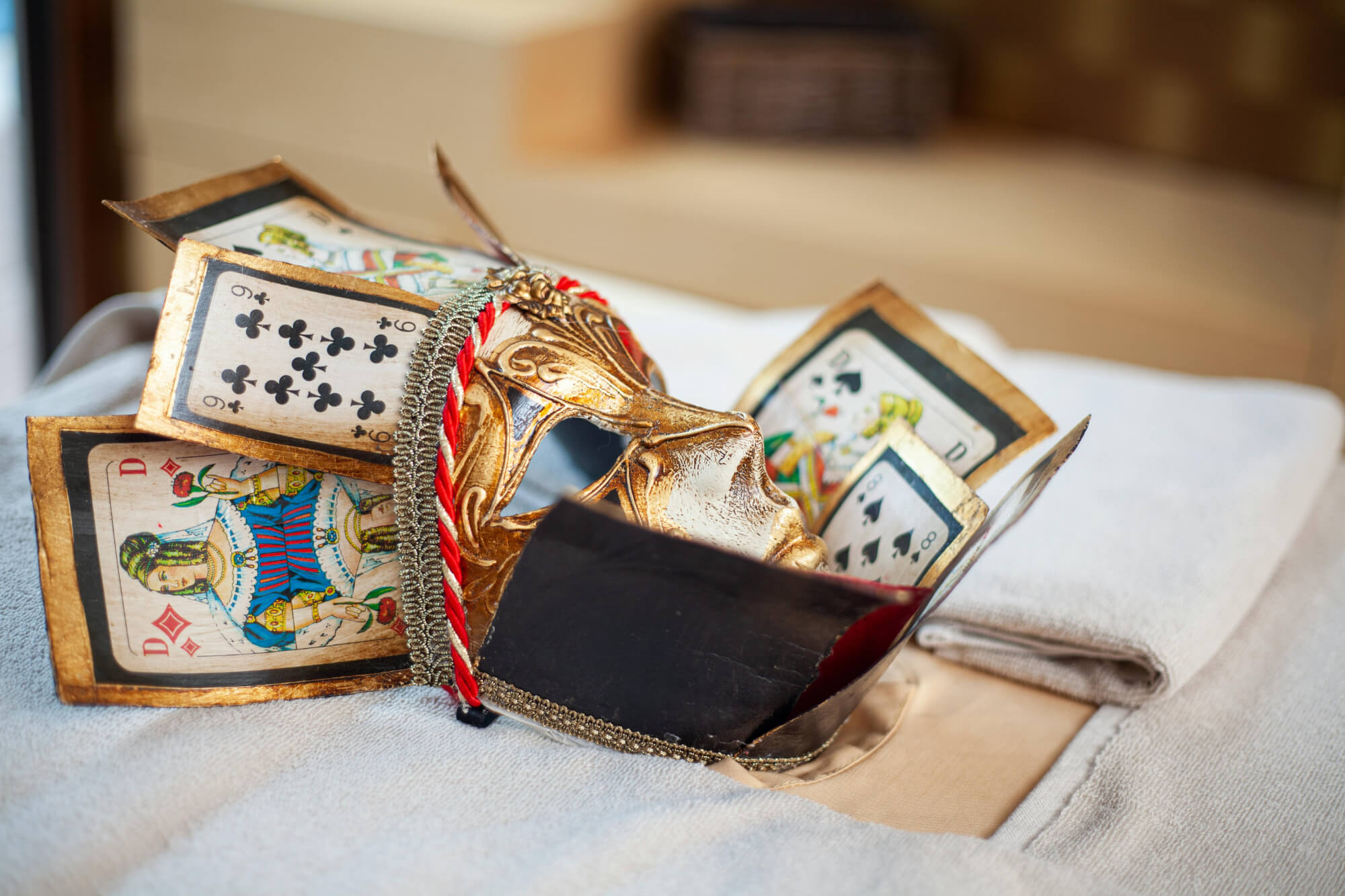
Peak season is busiest, particularly in spring, April, June and September, and crowds can remain high on fall days. For a seasonal celebration, see our guide to Carnival in Venice. For broader planning, consult our Venice travel guide for 2026.
And yes, the pigeons are still here. St. Mark’s Square pigeons are part of the scenery, but feeding them has been banned since 2008 and remains prohibited; the city can fine people who feed pigeons or seagulls.
Planning Your Visit to Piazza San Marco
Getting there
To plan how to get to St. Mark’s Square, use a map and aim for one of the nearby vaporetto stops. Line 1 stops at San Marco Vallaresso and San Marco–San Zaccaria; Line 2 serves San Marco Giardinetti and San Marco–San Zaccaria, while lines 4.1, 5.1 and 5.2 also serve San Zaccaria. From the stops, it is a few minutes’ walk. Rialto Bridge is about 10–15 minutes away on foot. From Santa Lucia railway station, allow roughly 30–35 minutes walking, or take Line 1 or 2.
See our guide to where to stay in Venice here.
The Venice access fee
The Venice access fee, officially the contributo di accesso, applies to day visitors on designated dates and hours when the scheme is in operation. In 2026, the fee was €5 for visitors who paid by the fourth day before arrival and €10 for those paying during the final three days, with exemptions for groups including overnight guests, residents and children under 14.
The 2026 trial ended on July 26, but the city is expected to continue the scheme in 2027, with the dates, rates and registration process still subject to approval; reports have suggested a substantially higher maximum fee. Check the official Venice access-fee website before travelling, as the rules can change from year to year. When the fee applies, eligible day visitors must register and either pay or obtain proof of exemption before entering the historic center during the designated hours.
And finally, how long to spend in Piazza San Marco? The square itself is compact enough to see on foot, but the major attractions require substantially more time. Allow around 30 to 45 minutes to walk around St. Mark’s Square and take in its principal buildings and monuments without going inside. Allow at least half a day if you want to visit St. Mark’s Basilica, Doge’s Palace and the Correr Museum.
For a complete guide to how to see the best of Venice in a single day, including the major sights of Saint Mark’s Square, see our one day in Venice itinerary
Frequently Asked Questions About St. Mark's Square
How much time do you need in St. Mark’s Square?
Allow around 30 to 45 minutes to walk around St. Mark’s Square and take in its principal buildings and monuments from outside. If you want to visit St. Mark’s Basilica, Doge’s Palace and the Correr Museum, allow several hours for the area rather than trying to squeeze everything into a quick stop. The square itself is compact, but the Basilica, Doge’s Palace and Correr are substantial attractions with separate admission and opening hours.
Is St. Mark’s Basilica free to enter?
No, St. Mark’s Basilica is not free for most visitors in 2026. Standard admission is €10, while combined tickets for the Basilica and other areas cost more; children under 11 and several other categories are admitted free. The Campanile has a separate ticket. The Basilica’s opening hours vary with religious services, and visitors must follow a dress code covering shoulders and knees.
What is the best time of day to visit St. Mark’s Square?
Early morning is the best time to visit St. Mark’s Square if you want to see it with fewer people around. Arrive before the main tour groups and day visitors gather, when you can walk around the piazza more easily and appreciate the full sweep of the Basilica, Campanile, Doge’s Palace and Procuratie. Evening is the better choice for atmosphere, when the Basilica is illuminated and the cafés’ orchestras are playing. The square can still be busy at this time, particularly in peak season.
Do you need to book tickets for the Doge’s Palace in advance?
Advance booking is not obligatory for the standard visit to Doge’s Palace, but it is advisable during busy periods if you want to secure your preferred entry time. The standard St. Mark’s Square Museums Ticket can also be bought without a specified entry time, subject to the current admission conditions. The current standard ticket is €35, or €30 when purchased online more than 30 days before the visit. Special routes such as the Secret Itineraries require advance reservation.
Why is St. Mark’s Square flooded?
St. Mark’s Square floods during acqua alta when exceptionally high tides push water into Venice’s lowest-lying areas. The flooding is caused by a combination of astronomical tides, weather and lagoon conditions, and the city installs raised walkways, or passerelle, when necessary. Check the tide forecast before visiting during the wetter months, particularly in fall and winter. The Comune’s Centro Maree publishes forecasts, real-time measurements and alerts.
Can you visit St. Mark’s Square at night?
Yes, St. Mark’s Square is open at night, and the illuminated Basilica and surrounding buildings make the piazza particularly atmospheric after dark. The Basilica’s normal tourist admission ends at 4:45pm, but separate evening visits to the illuminated Basilica and Crypt are offered, with one-hour slots beginning at 7:30pm or 8pm. These slots tend to book out quickly, so consider booking a night tour of Saint Mark’s to take advantage of these special openings. The Campanile also stays open into the evening during the summer season. Doge’s Palace and the Correr Museum have occasional extended Friday and Saturday openings in summer, but these are seasonal rather than standard nightly hours.
For more essentials on a first trip to Venice, see our guide to the city’s key sights.
We hope you enjoyed our guide to what to see in St. Mark’s Square! Through Eternity Tours offer a range of expert led Venice small group tours and private itineraries, from tours of Saint Mark’s basilica and the Doge’s Palace to off-the-beaten track sites and visits to the islands of the Venetian lagoon. Check out our Venice tours page for more, and get planning your perfect trip to the Floating City!
Venice Tours
Discover the Magic of St. Mark's!