What have the Romans ever done for us?
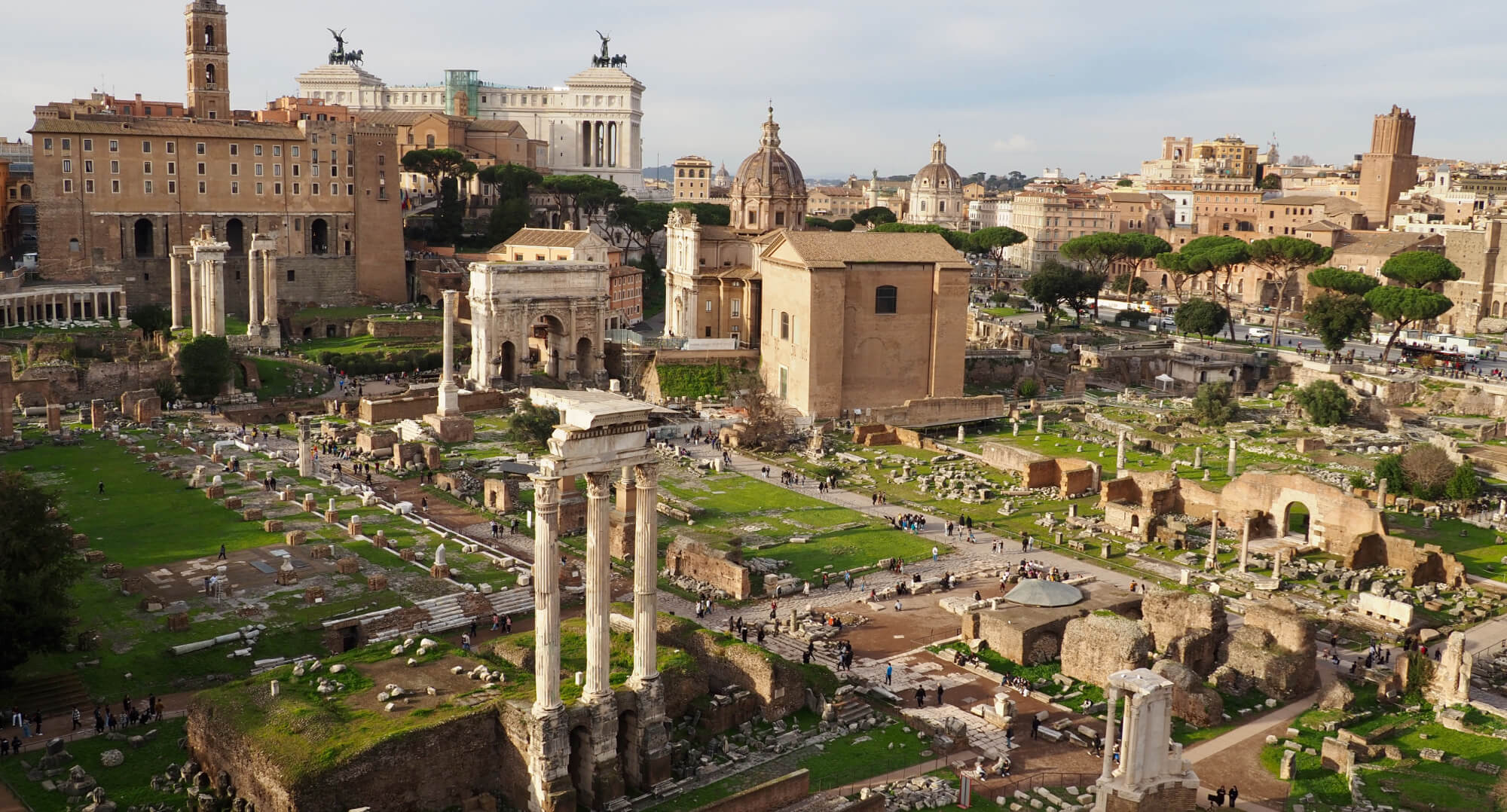
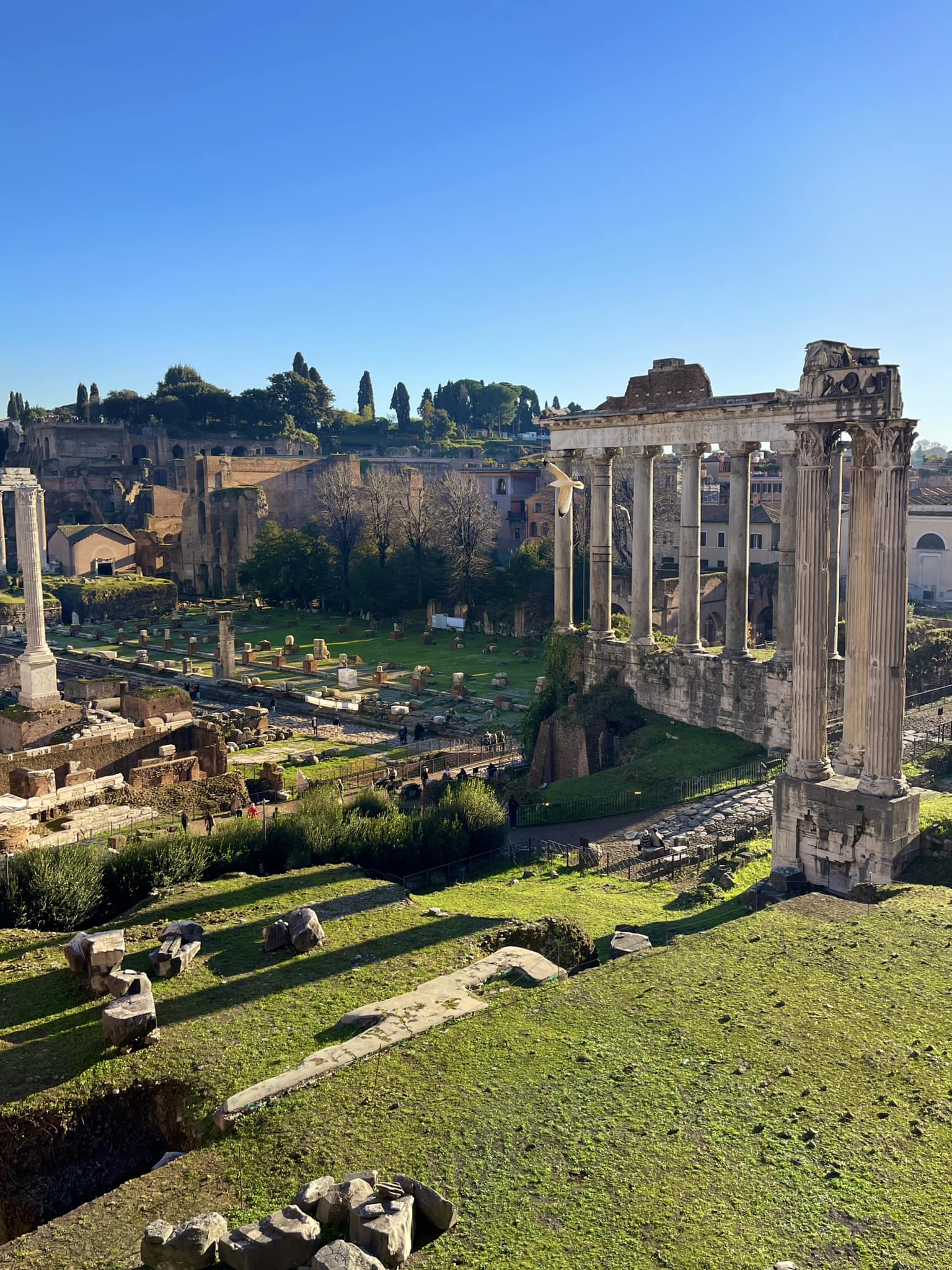
Well, if you’ve ever had the chance to explore the Roman Forum and Palatine Hill, you’ll know that the answer is: quite a lot. From the Latin alphabet to advances in sanitation, architecture, legal codes, engineering and much more, many of the fundamentals of our modern world can be traced back to the great ancient empire.
But the Romans left us something else too: some truly extraordinary stories about the people who ruled them.
The emperors who commissioned Rome’s grandest monuments were not always the noble marble-faced figures of history books. Ancient writers were fascinated by their personalities, habits and scandals, recording stories about poisoned figs, outsize artistic ambitions, extravagant appetites and even an emperor who eventually decided that growing cabbages was preferable to ruling the Roman world.
This week on our blog we’ve gathered ten of the strangest, most human stories about the emperors to have come down to us from ancient sources. Some of these stories are probably true; others are impossible to verify, and all are tinged by the grudges, prejudices and taste for gossip that animated Roman society as much as they do our own.
From cheese overdoses to toilet taxes and a horse nearly made consul, the following tales might not tell us everything about the men who ruled Rome – but they certainly make the history more interesting.
 Want to meet the emperors in person?

Explore the Forum and Palatine with an expert guide who can bring the personalities, rivalries and outrageous stories of ancient Rome to life.
Our Ancient City Tours
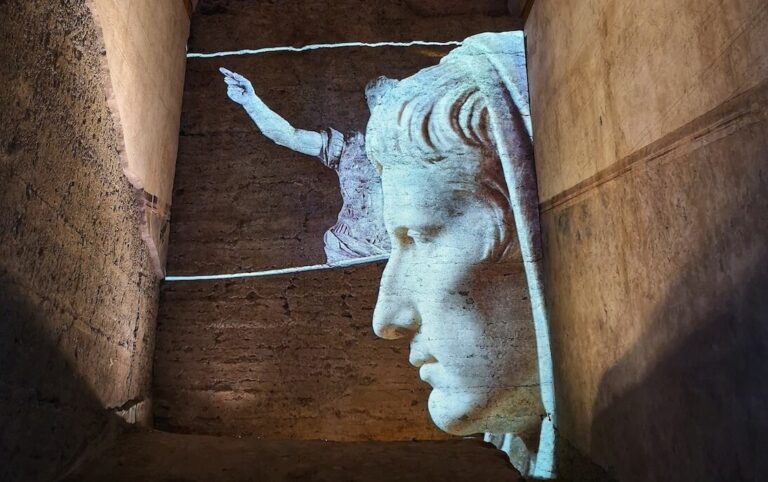
The man who became Rome’s first emperor — and, remarkably, wasn’t murdered for it.
After decades of civil war following Julius Caesar’s assassination, Augustus did something rather clever: he took total power while insisting he’d merely restored the Republic. He never called himself king or dictator, just princeps, or “first citizen” – but very much a first among equals. It was political theatre of the highest order, and it worked. Augustus went on to rule for 41 years, longer than any Roman emperor who followed him, and when he finally died in 14 AD he was 75 years old, having survived the knives, coups and civil wars that had claimed so many of his contemporaries.
Or did he?
As Augustus lay dying, the ancient historian Cassius Dio tells us, rumours began to circulate that his death was not quite as natural as it appeared. Some suspected his wife Livia of poisoning him in order to clear the way for her son Tiberius, supposedly smearing poison on figs still hanging on trees that Augustus liked to pick from himself.
Dio is careful to present this as a rumour rather than established fact, and there is no good evidence that Livia actually murdered her husband. But it makes a deliciously ironic ending to the life of the man who had survived decades of civil war: after all that, Rome wondered whether Augustus had finally been done in by his own wife.


The emperor who retired to Capri and a life of sexual deviance.
Augustus’s heir Tiberius was, by most accounts, a competent enough administrator for years – dour, private, hard to warm to. Then in 27 AD he decamped to the island of Capri and essentially governed the empire by letter for the rest of his life, leaving the provinces to be administered by the officials already in place. He never returned to Rome. But what he did on that island became one of ancient history’s most enduring scandals.
The historian Suetonius, writing decades later, describes an old man who’d built himself a private pleasure compound and populated it with performers “selected as experts” and trained children he nicknamed his “minnows.” Galleries of erotic art meanwhile advised guests on what was expected of them. The ancient scholar’s account goes further still, making sexual allegations involving children and other lurid behaviour against the emperor.
Whether Suetonius was reporting fact or repeating the worst gossip Rome could invent about an unpopular emperor is impossible to establish. But the stories were certainly memorable. He describes the caves and groves of Capri being turned into what amounted to outdoor sex theaters, with young men and women dressed as little Pans and nymphs. Pan and his goat-legged companions were familiar figures in Greco-Roman art and literature, associated with lust, drunkenness and the wilder side of sexual appetite.
Against that backdrop, it was little wonder that wagging tongues soon conferred on the emperor’s enclave the nickname Caprineum – a play on Capri’s Latin name, Capreae, and capra, “goat.” Tiberius, derided for his sordid lechery and feared for his cruelty in equal measure, spent the final decade of his life on the island and never set foot in Rome again.

The emperor who reportedly wanted to make his horse a consul.
Caligula, or “Little Boots,” became one of the most notorious Roman emperors of all. Famed in ancient literature for his cruelty and extravagance, the young emperor left behind a laundry list of excess when he was eventually assassinated at the still tender age of 28. Putting enemies to death on the merest whim, humiliating senators and indulging in spectacular displays of imperial power were among the more infamous accusations levelled against him.
His favourite horse, Incitatus, meanwhile, was treated rather better than most Romans. According to Suetonius, the pampered animal had a marble stable, an ivory manger, purple blankets, jewellery, slaves and even a house of its own, where guests were supposedly entertained in its name. Cassius Dio adds that its oats were mixed with gold and that Caligula made the horse a priest.
Then there is the famous consul story. Suetonius says it was reported that Caligula intended to make Incitatus consul, a position that would have placed a horse at the summit of Roman political life. Scholars doubt that the appointment actually happened, and modern historians have suggested that the emperor’s rhetorical proposal may have been an elaborate insult to the Senate: if Caligula could make a horse a consul, what did that say about the people currently occupying the office?
Whether it was a serious plan, a joke, or a piece of hostile gossip, the story has been enthusiastically repeated down the centuries as evidence of Caligula’s precarious mental state, and Incitatus has taken his place as one of the most famous horses in history.

The megalomaniac emperor who had aspirations to be a musician.
It is a measure of the megalomaniacal Nero’s own excesses that he more than matched Caligula in notoriety, known to history as the murderer of his own mother, a persecutor of Christians, a violent bully and much more besides. But the bad-to-the-bone emperor’s final words revealed a very different side to his character. As he prepared to take his own life, with his enemies closing in, ancient sources recount that the emperor uttered the immortal line “Qualis artifex pereo” – “What an artist dies in me.”
Nero, you see, was a serious amateur musician and actor, and loved nothing more than performing on the cithara, a sophisticated type of lyre. He did not merely dabble. He trained his voice, performed in public and became increasingly determined to win prizes at the Greek games. Suetonius says that he even recruited thousands of people to practise the correct applause for his performances.
The audiences, however, were not always there entirely of their own free will. Suetonius describes theatres being kept under guard and doors being watched so that nobody could simply walk out during one of the emperor’s performances. Ancient writers were united in their dislike of Nero, so we should probably treat some of the theatrical horror stories with caution; but there is no doubt that the narcissistic Nero took his artistic ambitions very seriously.
And what about the famous story that he fiddled while Rome burned? Well, for one thing the fiddle is a later invention, and Nero’s instrument was the cithara. More importantly, the surviving ancient accounts do not give us the neat modern image of an emperor casually watching his city burn while playing a violin. The story grew considerably in the telling.

The emperor who gave his name to public urinals.
If you had the good fortune to become the emperor of the world’s largest ancient empire, what would you like to have been remembered for? Ushering in the long period of peace known as the Pax Romana, like Augustus? Commissioning fabulous buildings like the Pantheon, one of the many fruits of the architecture-obsessed Hadrian’s reign? Or even just being an unhinged despot like Caligula or Nero? All might be preferable to the most enduring legacy of the emperor Vespasian.
Despite being responsible for a series of military successes and beginning work on the Colosseum, Vespasian’s name became associated with something considerably less glamorous. During his reign, a tax was imposed on the collection and sale of urine, which was valuable for industrial purposes including tanning and cleaning textiles due to its high ammonia content. Concerned for the family reputation, the emperor’s son Titus apparently objected to the unsavoury source of the revenue.
According to Suetonius, the unabashed Vespasian responded by holding some of the money under Titus’s nose and asking whether the smell offended him. When Titus replied that it did not, Vespasian delivered the punchline: “Pecunia non olet” – “money doesn’t stink.”
Perhaps not, but the link between the emperor and urine stuck, to the degree that when public urinals arrived on the scene centuries later they soon became known as vespasiani in Italian and vespasienne in French. It may not have been the legacy he had in mind, but at least nobody can accuse him of being forgettable.
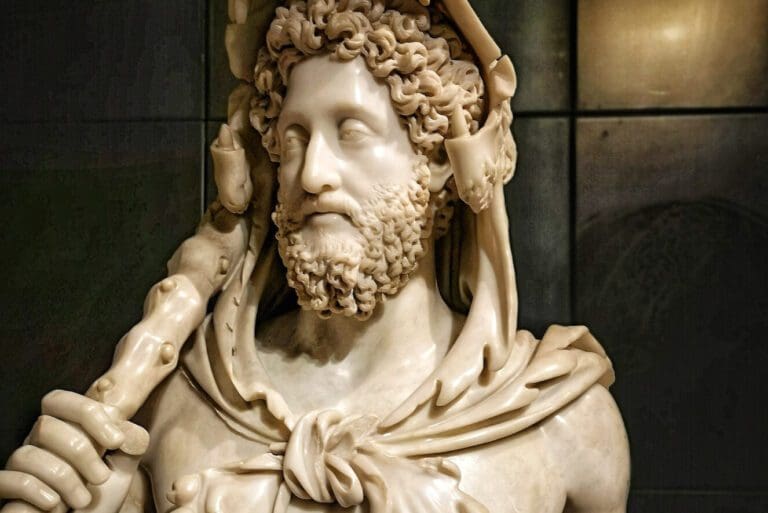
The Emperor Who Wanted to Be a Gladiator.
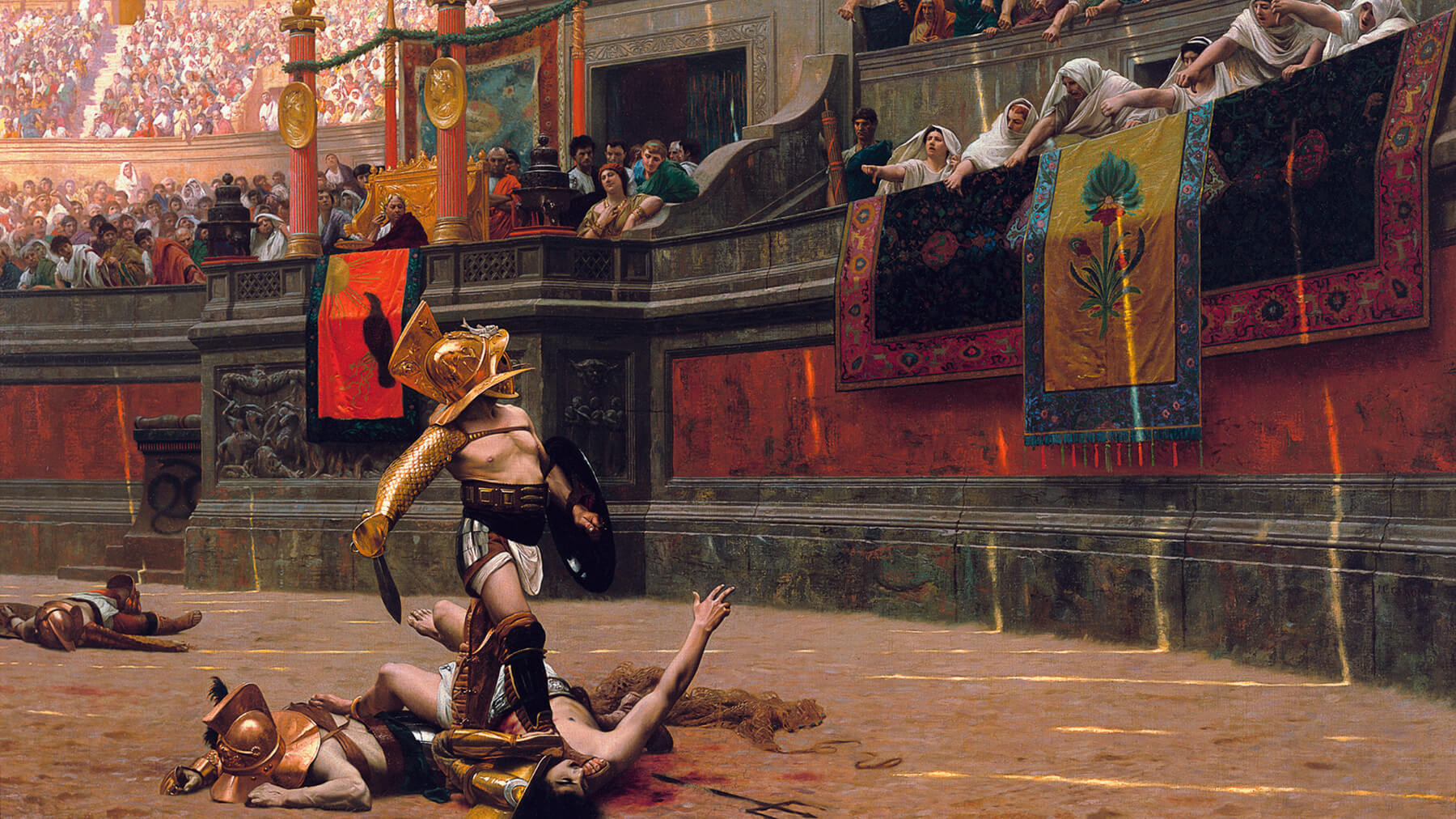
Commodus had no need to prove himself in the arena. He was emperor of Rome, son of Marcus Aurelius and ruler of an empire stretching across three continents. Yet toward the end of his reign, he became determined to do something no Roman emperor should really have been doing: fight as a gladiator.
Commodus had a particular fascination with Hercules, the mythical strongman who battled monsters and brought order to a dangerous world. He increasingly presented himself as a new Hercules, appearing with the hero’s lion skin and club and adopting Herculean titles. The arena offered him a perfect stage. Here he could display his supposedly superhuman strength and skill before enormous crowds.
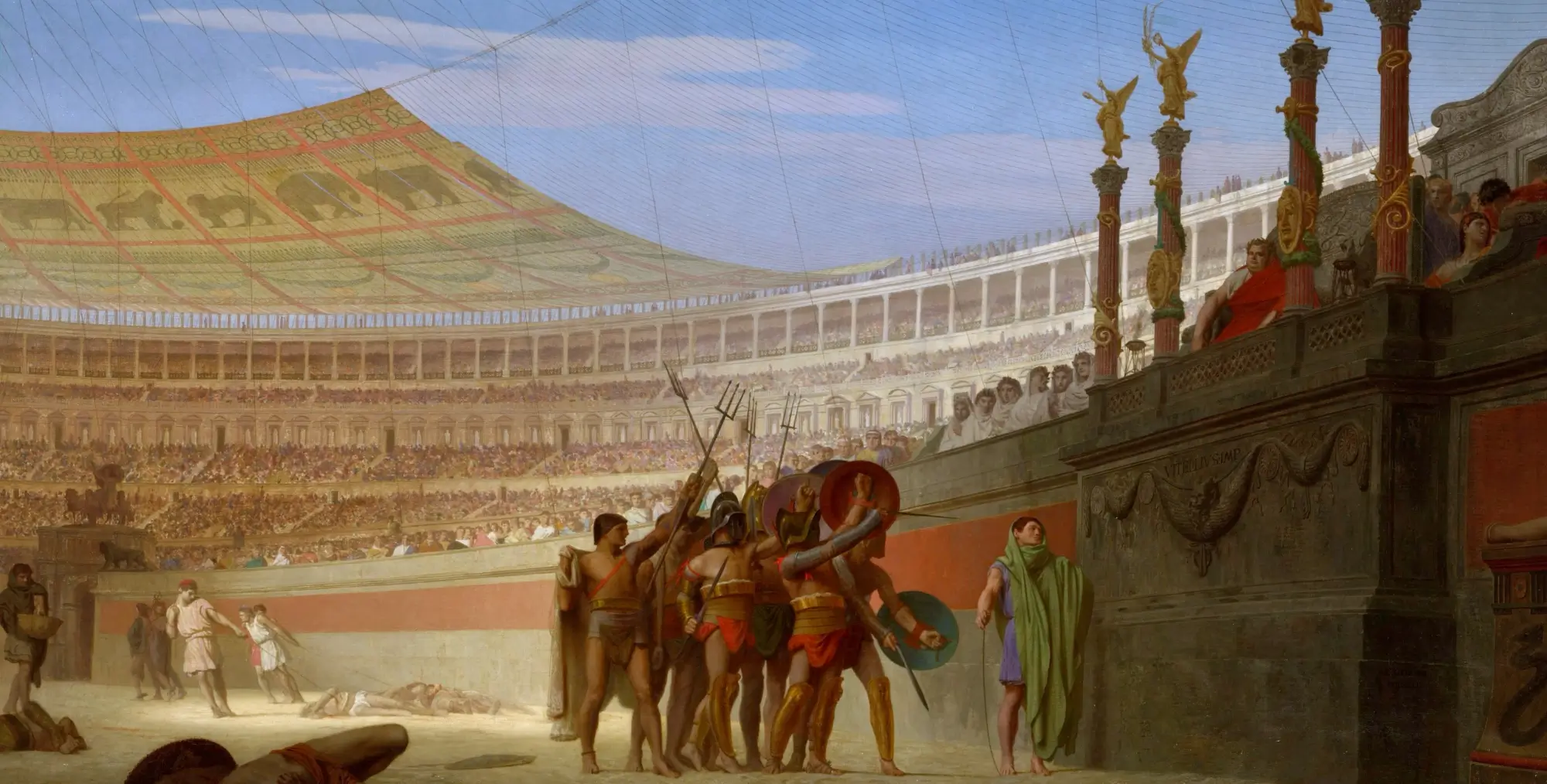
According to Cassius Dio, Commodus killed a remarkable assortment of animals in the Colosseum, including a tiger, a hippopotamus and an elephant. He was particularly fond of ostriches. Herodian claims that he could shoot off their heads with arrows, leaving the headless birds running around the arena. On another occasion, Commodus killed an ostrich, cut off its head and then marched over to the senators waving the bloody trophy in one hand and his sword in the other. He said nothing, but the message seemed clear: he could do the same to them. The senators understood the threat perfectly well, but the spectacle was so absurd that they struggled to keep straight faces. Dio says some even stuffed laurel leaves into their mouths to conceal their laughter.
Commodus also fought as a gladiator, though the contests were carefully arranged to preserve the emperor’s safety. His opponents knew better than to kill him, and he generally fought with a wooden sword. Commodus wanted his performances recorded officially, and ancient sources attribute an extraordinary – and frankly risible – 12,000 victories to the vainglorious ruler.
It is tempting to write all this off as the behaviour of a deranged emperor, but modern historians have taken a more nuanced view. Commodus was certainly behaving in ways that shocked the Roman elite, but his obsession with the arena and Hercules also had a political purpose: he was presenting himself as a heroic figure who demonstrated courage, strength and victory over death before the Roman people.

Hadrian may have had his own architect executed for criticizing his designs.
No emperor left a bigger physical mark on the empire than Hadrian: the Pantheon as we know it, Hadrian’s Wall in Britain, the sprawling villa at Tivoli, temples and cities rebuilt across three continents. He also, by ancient accounts, fancied himself a genuine architectural talent rather than merely a patron, and one famous story claims that his vanity cost a man his life.
Early in his career, Hadrian supposedly sat in on a design discussion between the emperor Trajan and Trajan’s court architect, Apollodorus of Damascus, the brilliant architect behind Trajan’s Forum and Column. Hadrian offered up an opinion. Apollodorus, unimpressed, allegedly snapped: “Be off, and draw your gourds – you don’t understand any of these matters.”
Hadrian, it seems, did not forget the insult. After himself becoming emperor, the historian Cassius Dio recounts that Hadrian sent Apollodorus his own design for the Temple of Venus and Roma at the edge of the Roman Forum, apparently expecting praise. Instead, the cranky architect pointed out that the statues inside were too tall for the room: if the goddesses ever decided to stand up, they would be unable to do so without banging their heads on the ceiling.
Hadrian was furious with the architect’s contempt. According to Dio, he first banished Apollodorus and later had him executed. It’s a magnificent story, but whether it actually happened is another matter. Cassius Dio was writing more than a century after the events, and modern historians have questioned the plausibility of the anecdote. The story may tell us as much about later perceptions of Hadrian’s vanity and his rivalry with Apollodorus as it does about the fate of the architect himself.
What we can say with certainty is that Apollodorus disappeared from the imperial scene, while the Temple of Venus and Roma went ahead under Hadrian’s patronage.
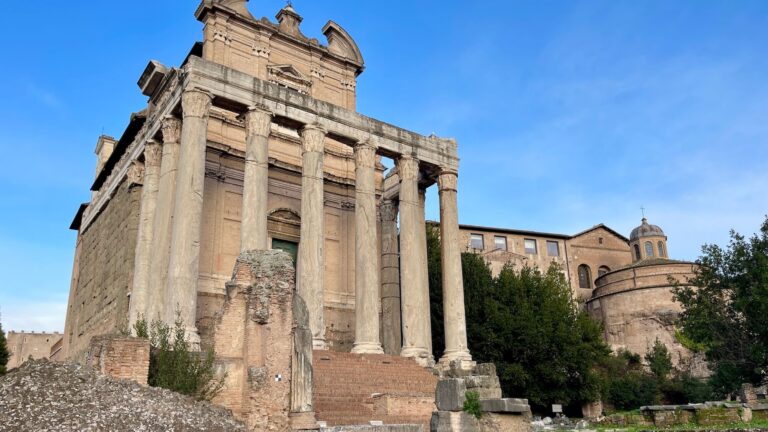
The emperor who died of a cheese overdose.
What is it that we find so fascinating about ignoble celebrity deaths? It might not quite be up there with the final moments of Elvis or Marilyn Monroe, but the untimely demise of the emperor Antoninus Pius in 161 AD is pretty embarrassing.
Antinous was that rare thing – a Roman emperor who was popular with his subjects, well-regarded for his moderation and wise council, and who wasn’t bumped off by jealous rivals or disgruntled relatives. Indeed, Antinous lived to the ripe old age of 75, and would probably have chalked up a few more years had he not fallen victim to his too-healthy appetite.
The much-loved emperor, who was by all accounts something of a gourmet, spent the final years of his reign at his villa in the town of Lorium outside Rome, where he overdosed on cheese. According to ancient sources, Antinous ‘rather greedily’ overindulged one night at dinner on some particularly delicious Alpine fromage. He vomited during the night, developed a raging fever the following day, and died three days later.

Rome’s first African-born emperor had a fractious family life.
By the time Septimius Severus seized power in 193 AD, Rome had already been ruled by several emperors born outside Italy. But Severus broke new ground: he was the first emperor born in North Africa. He came from Leptis Magna, on the Libyan coast, into a wealthy provincial family of Roman and Punic background.
Ancient writers noted his African origins, and later sources remark on his accent. He remained closely connected to his native city throughout his career, eventually lavishing Leptis Magna with grand public buildings whose ruins still stand today. He proved one of Rome’s more effective and ruthless rulers, expanding the empire and reforming the army after the chaos of the civil wars that brought him to power. He was still campaigning in Britain when he died at York in 211 AD.
According to Cassius Dio, his final advice to his two feuding sons, Caracalla and Geta, was concise and pragmatic: “Be harmonious, enrich the soldiers, and scorn all other men.” They ignored the first instruction almost immediately. Within a year, Caracalla had Geta murdered and ordered his memory erased from public life.
We can still see that family falling apart in a remarkable little painting in Berlin. The Severan Tondo, made around AD 200, shows Septimius Severus with his wife Julia Domna and their two sons. It is the only surviving painted portrait of a Roman imperial family – and Geta’s face has been deliberately scraped away. After his murder, his brother’s image was erased from monuments across the empire as part of his damnatio memoriae. Someone did the same thing to the little family portrait, leaving an eerie blank where Geta’s face once was.
It is a remarkably intimate reminder of just how quickly imperial family politics could turn vicious: a portrait commissioned to celebrate the dynasty became, within a few years, a record of one brother’s attempt to erase the other from history.

Cross-Dressing Elagabalus prostituted himself in brothels – according to his enemies.
Although he is far from the most famous emperor in the annals of Roman history, Elagabalus deserves to be much better known for the extraordinary stories told about his short reign.
Elagabalus came from a family of Syrian high priests devoted to the god Elagabal, hence the name by which the emperor is usually known. Unexpectedly elevated to power at the age of 14 through a complicated web of family and political manoeuvring, the young emperor apparently cared little for the customs or culture of the empire he would come to rule.
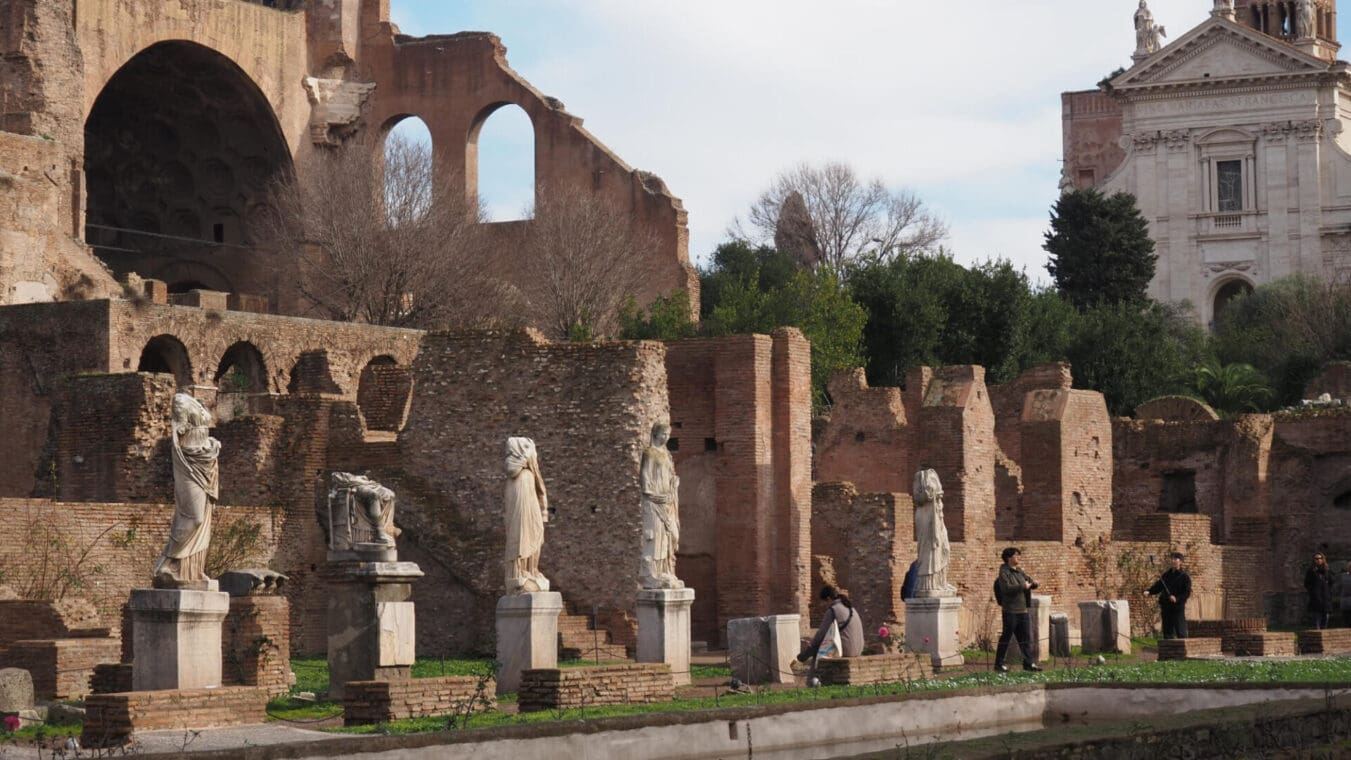
Elagabalus soon brought the worship of his Syrian god to the centre of imperial life. One of his first acts as emperor was to demote Jupiter from his perch as Rome’s most important god and replace him with his beloved Baal instead, to whom he dedicated a magnificent temple on the Palatine Hill. As if that wasn’t bad enough, after dabbling with the idea of marrying a charioteer by the name of Hierocles and making him joint-caesar, Elagabalus instead wedded the high priestess of Vesta (having a relationship with a Vestal Virgin was an outrageous provocation of Rome’s sacred norms).
The most extraordinary stories about Elagabalus come, once again, from Cassius Dio, whose hatred of the emperor is impossible to miss. Dio claims that Elagabalus would dress as a woman, frequent the city’s seediest taverns and brothels disguised as a prostitute, and there ‘imitate the most lewd women.’ More scandalously still, Dio reports that the young emperor desperately sought a physician capable of giving him female genitalia.
These stories have made Elagabalus a modern symbol of sexual and gender nonconformity, but the ancient evidence needs to be handled carefully. Dio was a Roman senator writing after Elagabalus’s death, and his account is steeped in hostility toward an emperor he regarded as an affront to Roman customs. The stories may preserve real behaviour, hostile exaggerations, or some mixture of the two.
What is certain is that Elagabalus’s reign ended violently. In 222 AD, at just 18, he was murdered by members of the Praetorian Guard and his body was thrown into the Tiber along with that of his lusty charioteer lover Hierocles. The leader of the assassination plot? Elagabulus’ own grandmother Julia Maesa, whose schemings were responsible for putting him on the throne in the first place.

The emperor who gave up the throne to grow cabbages.
Every other emperor on this list either clung to power until someone pried it from them or was carried out feet first. Diocletian is the one glorious exception. After about 21 exhausting years steering Rome through some of its worst crises – reorganizing the imperial administration and establishing the Tetrarchy, with two senior emperors and two junior Caesars in the process – he did something almost no Roman ruler had done in four centuries.
In 305 AD, he simply retired, voluntarily handing over the purple cloak in a formal ceremony and withdrawing to the vast palace he’d built for himself at Split, on the Dalmatian coast.
There had been a dark side to the emperor’s reign, too. Diocletian was responsible for the most extensive official persecution of Christians in the Roman Empire. Beginning in 303 AD, a series of edicts ordered churches to be destroyed, Christian scriptures burned, clergy imprisoned, and Christians pressured to sacrifice to the traditional Roman gods. Those who refused could face torture, imprisonment, or execution. The persecution was not equally severe everywhere, and it continued under some of his colleagues even after Diocletian’s abdication, but it remains one of the defining stains of his reign.
And yet, after stepping down, Diocletian seems to have been perfectly content to leave imperial politics behind. He spent his retirement at his palace, where he took an interest in his gardens. When his former colleague Maximian later wrote asking him to return and help sort out the political chaos his successors were creating, Diocletian reportedly replied that if Maximian could see the cabbages he had grown with his own hands, he would never ask him to return to imperial life.
After decades spent trying to keep the Roman world under control, the emperor who had reorganized the empire simply decided he had had enough.
The ruins of the Forum and Palatine tell the story of imperial power, but they also preserve something rather more entertaining: the personalities of the people who wielded it. Augustus could be calculating, Caligula bizarre, Nero theatrical, Hadrian obsessive, and Diocletian surprisingly fond of cabbages. Their monuments may have been designed to make emperors look larger than life. The stories behind them often do the opposite, reminding us just how human — and how eccentric — these powerful men could be. Want to meet them on their own turf? Explore the Forum and Palatine with one of our expert guides.
How to Visit the Roman Forum and Palatine Hill
The Roman Forum and Palatine Hill form part of the Archaeological Park of the Colosseum (PArCo), and you can visit them with a combined Colosseum, Roman Forum and Palatine ticket, or with a Forum Pass SUPER that covers the Forum, Palatine and Imperial Fora without the Colosseum.
The Forum-Palatine area currently opens at 9am, with closing times varying according to the season. Tickets can be booked through the official PArCo website, and the standard Colosseum ticket is valid for 24 hours, allowing one visit to the Colosseum and one to the Forum-Palatine archaeological area.
Allow at least two hours to see the main sights, and considerably longer if you want to explore the Palatine’s museums, imperial residences and other archaeological sites. Wear comfortable shoes and bring water: the site is extensive, uneven underfoot and has relatively little shade.
Tip: The Forum and Palatine make much more sense with some context. The ruins can otherwise be difficult to read, particularly if you don’t know what you’re looking at or how the buildings fitted into the ancient city. A guided visit can turn the scattered columns and foundations into a coherent picture of Rome’s political and religious centre.
Roman Forum and Palatine Hill FAQ
Can I visit the Roman Forum and Palatine Hill without visiting the Colosseum?
Yes. The Forum Pass SUPER provides access to the Roman Forum, Palatine Hill, Imperial Fora and a number of additional archaeological sites without including the Colosseum.
How long do I need for the Roman Forum and Palatine Hill?
Allow at least two hours for the main sights. If you want to explore the wider archaeological area and additional sites, plan on three hours or more.
What is the best time to visit the Roman Forum?
Earlier in the day is generally more comfortable, particularly during Rome’s hotter months. Check the current opening hours when booking, as they change seasonally.
Is the Roman Forum wheelchair accessible?
Parts of the archaeological area are accessible, but the terrain is uneven and some routes are challenging. Check the PArCo’s current accessibility information before visiting.
Do I need a guide for the Roman Forum?
You don’t need one, but the Forum is much easier to understand with a guide. Many of the buildings survive only as foundations or fragments, so knowing what stood there, what happened there and how the different parts of the city connected can transform the experience.
Plan Your Ancient City Visit Today!