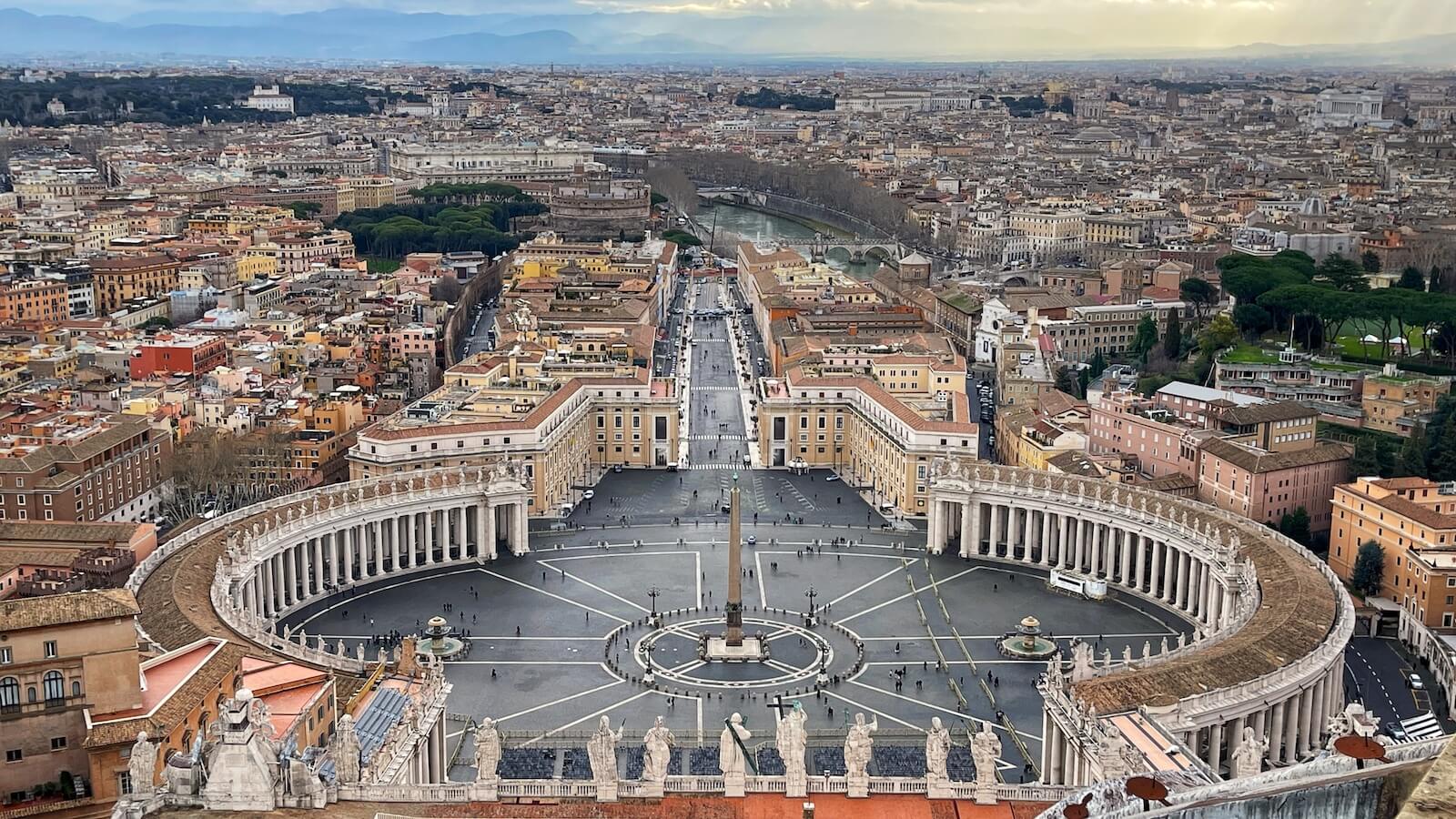
Offering unrivalled views across Rome and spectacular up-close vistas on the incredible decorations that adorn the world’s largest church, we think that climbing the dome of St. Peter’s Basilica is a must-do when visiting the Vatican city in Rome. In an earlier article, we used our insider knowledge and experience to show you how to climb the dome of St. Peter’s. But what do you need to see when you’re up there? Read on to discover five things you need to look out for when making the climb!
 Want to explore St. Peter's Basilica with an expert?

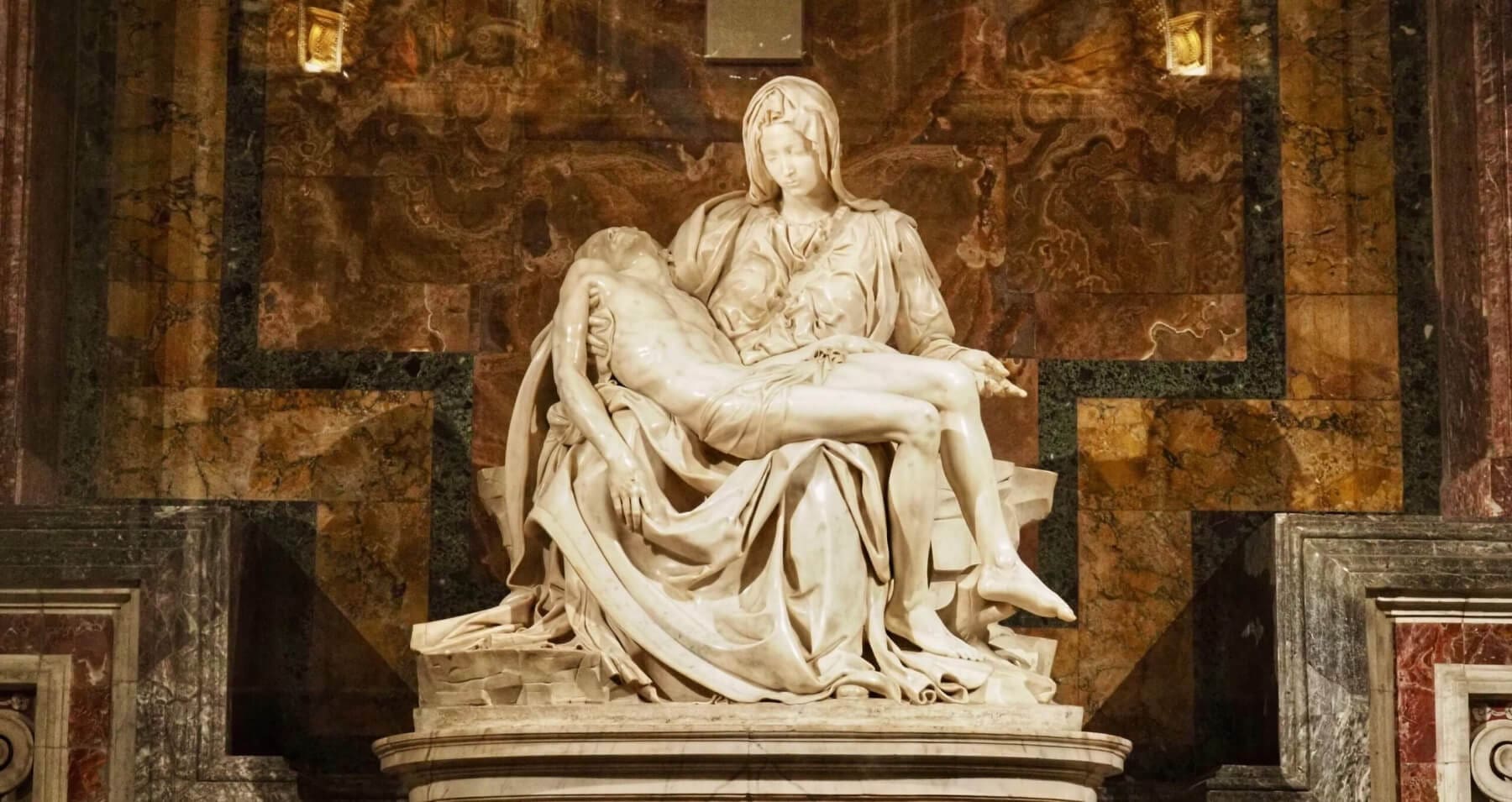
From Michelangelo’s Pietà to Bernini’s baldachin, St. Peter’s is filled with masterpieces that reveal centuries of papal history and ambition. Our expert-led tours bring the basilica’s art and architecture to life.
Climb St. Peter's Dome
Vatican Tours
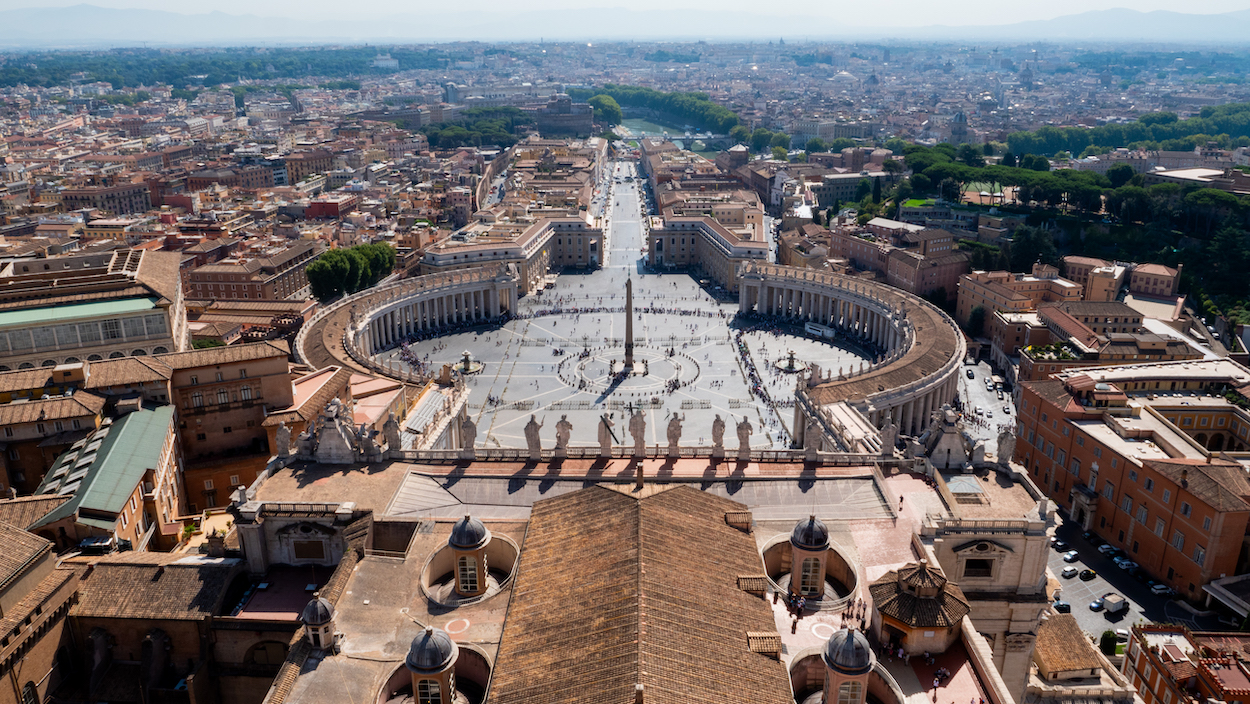
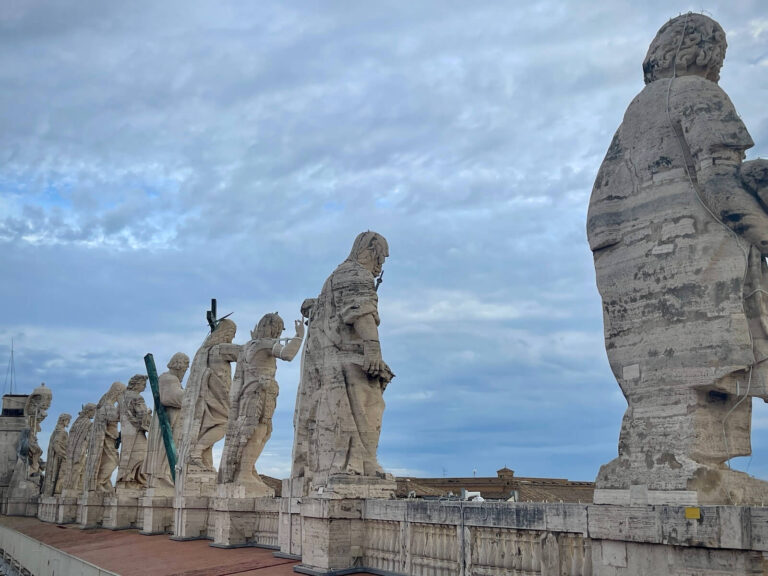
Back down in St. Peter’s Square, you’ll probably have noticed that a series of sculptures of saints line up in rows all along the bulging colonnades that surround the piazza. The statues culminate on the roof line of the basilica itself, where 13 monumental figures stand silent guard.
At the centre is the figure of Christ himself in the guise of the Redeemer, grasping his cross. He is flanked by 11 of his twelve apostles. St. Peter, to whom the church is dedicated, has his own massive statue down in the piazza itself, and is replaced here with John the Baptist.
The sculptures were made by a motley crew of artists between 1612 and 1614, to coincide with the completion of the church facade by architect Carlo Maderno.
On your climb to the top of St. Peter’s dome, you’ll be making a stop at the basilica’s roofline, where you will be able to get within touching distance of these monumental sculptures. Prepare for a shock though: as the works were only intended to be seen from front on way down in the square below, the sculptors didn’t bother to complete the backs of the statues in anything more than the most cursory way!

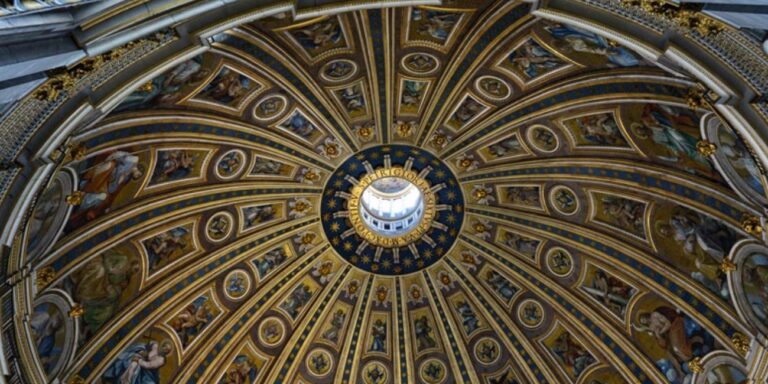
Whether you decide to take the elevator up the first portion of the dome climb or you are one of those hardy souls that chooses to tackle all 551 steps on foot, you’ll eventually find your way onto the walkway that runs all around the interior of St. Peter’s Dome.
From here you’ll gain a spectacular, unrivalled perspective of the stunning dome mosaic decorations that look so small from ground level way down in the church; only from up here can you truly get a sense of the monumentality of the decorations.
The interior of the dome is divided into sections, and feature mosaics picturing six levels of angels and saints ascending towards the divine realm of heaven – symbolised by the golden stars surrounding the cupola, where God the Father reigns in glory. The Four Evangelists meanwhile appear in the four spandrels of the dome in medallions that measure no less than 8.5 metres in diameter.
Whilst you are on the walkway, make sure to take a close look at the mosaics that are within touching distance of where you are standing – you can see that the artworks are composed of thousands and thousands of small tiles, known as tesserae, in a bewildering variety of colours. Many are covered in gold leaf, and the shimmering effect they produce is spell-binding.
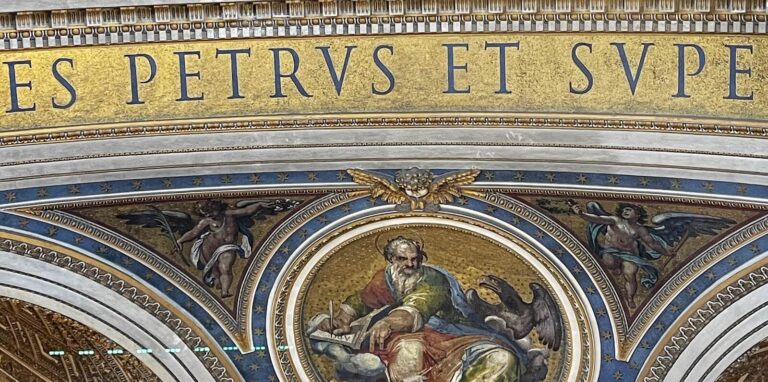
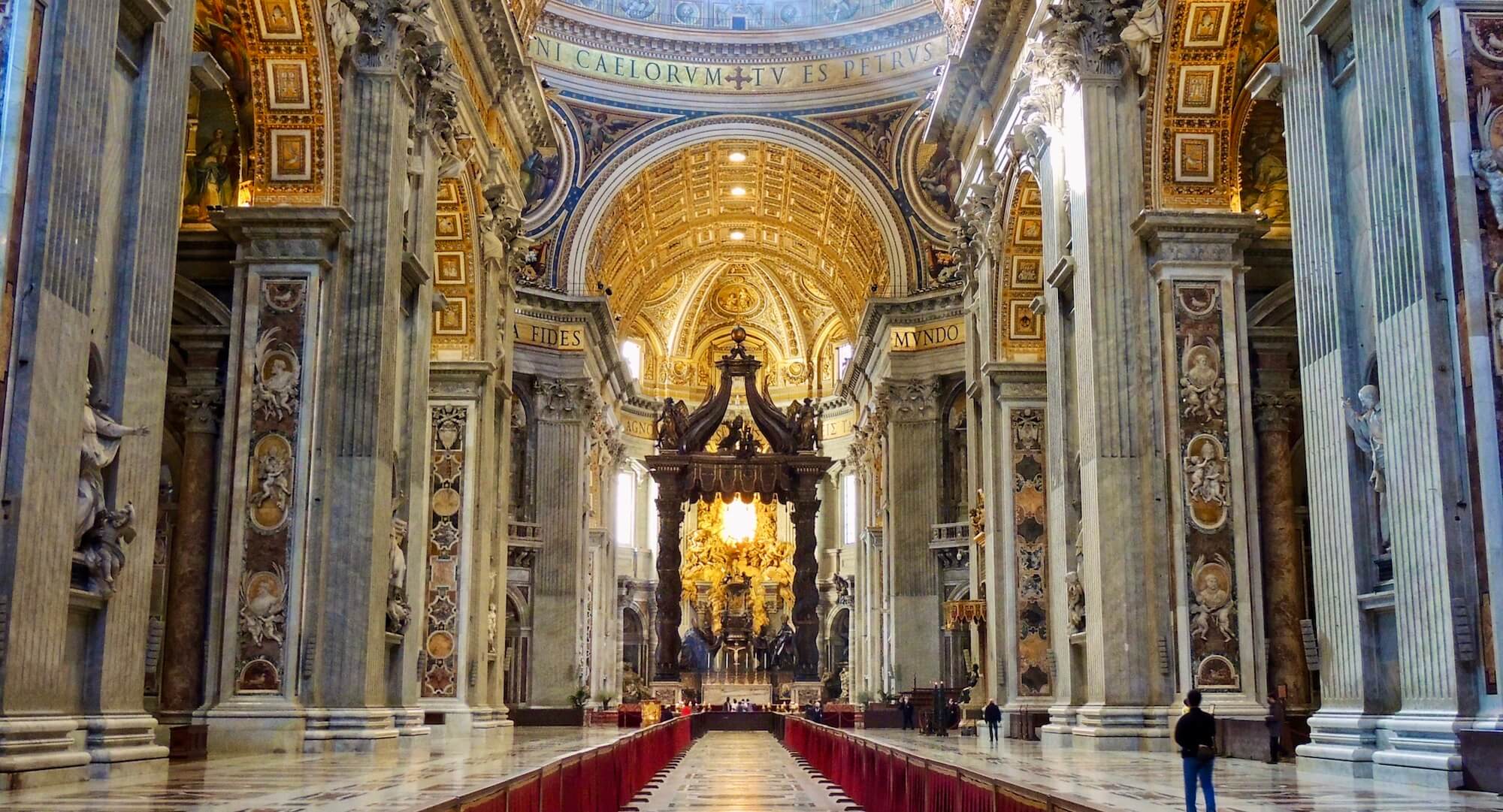
Look out for the inscription that runs around the base of the drum below the 16 large windows that flood the basilica with light: TU ES PETRUS ET SUPER HANC PETRAM AEDIFICABO ECCLESIAM MEAM, ET TIBI DABO CLAVES REGNI CAELORUM. That is, “You are Peter, and on this rock [“petram”] I will build my church, and to you, I will give the keys of the kingdom of god.”
The text comes from the Gospel of Matthew, and reads as the Catholic justification of the role of the Popes as leaders of the Christian world. The text is fully legible to worshippers down on the floor of the basilica, and from up here it’s easy to see why: each letter is fully 9 feet tall!
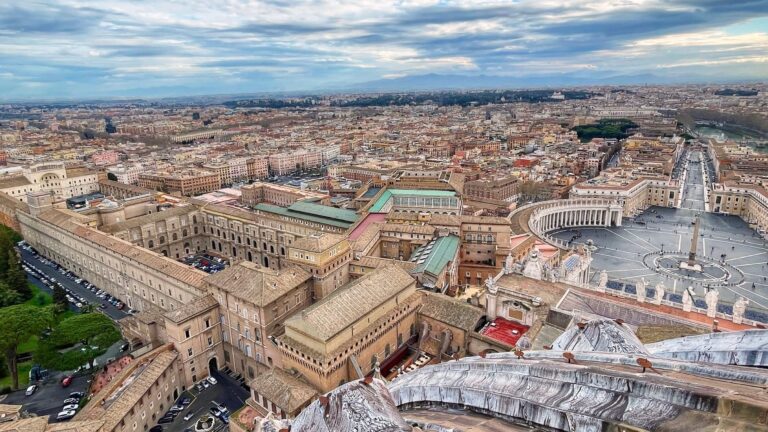
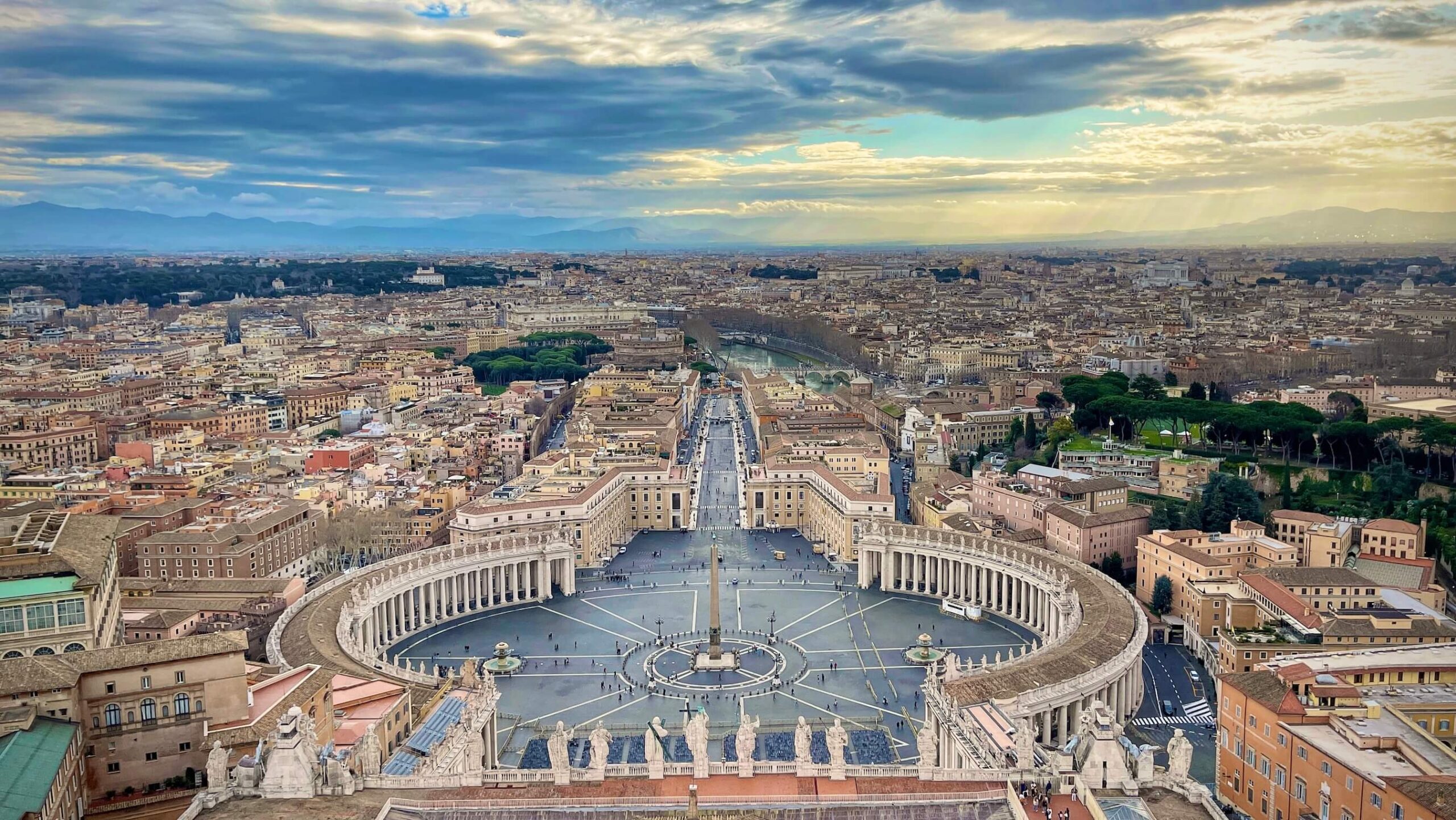
You’ll be puffing by the time you finally emerge blinking into the sunlight at the top of St. Peter’s dome after ascending the final spiral staircase, but what a visual treat lies in store as your reward! The view from the external walkway around the top of the basilica’s cupola is quite simply breathtaking. From here you’ll get a clear sense of the magnificent design of St. Peter’s Square far below, where Baroque master Gianlorenzo Bernini designed a massive, spreading arcade of columns to simulate a metaphorical embrace welcoming pilgrims into the church.
You’ll also be able to look down on the remainder of the Vatican City, which is normally invisible to visitors – the green, rolling grounds of the Vatican Gardens are immediately recognisable, as are the series of palaces and courtyards that make up the Vatican Museums. Look carefully and you’ll be able to make out the Pinecone Courtyard, and even the Sistine Chapel itself. Visible too is the Domus Sanctae Marthae, a relatively humble guest house where Pope Francis lives away from the luxury of the Papal palace.
Beyond the Vatican city, the entire city of Rome spreads out before you in every direction – you’ll spy the river Tiber meandering its way lazily through the metropolis far below, and the distant hills that circle the city to the north and south on the horizon.
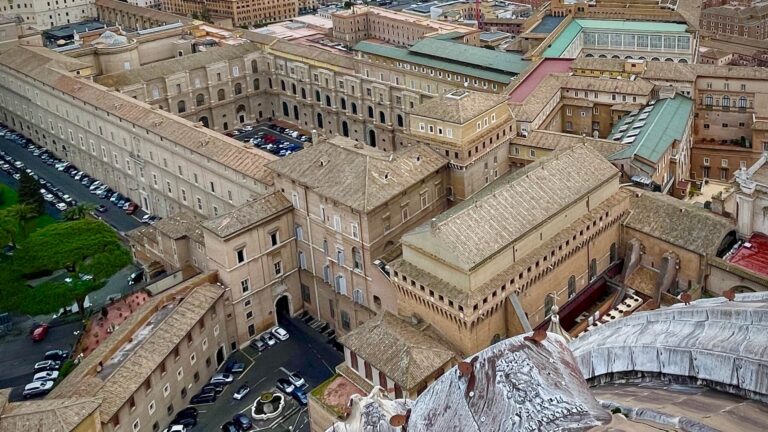
If you take a tour of the Vatican Museums when in Rome, you’ll be spending some time in the Sistine Chapel admiring the era-defining frescoes painted there by Michelangelo in the 16th century. But very few visitors to the Vatican actually have any idea what the Sistine Chapel looks like from the outside!
That’s because there are very few vantage points from which you can see the exterior of the Sistine Chapel in the dense urban fabric around the Vatican. The viewing platforms you’ll encounter on the Dome climb are a welcome exception.
As you will see both from the top of the cupola and from the large landing before taking the elevator back to the floor of the basilica, contrary to what you might have thought when in the Vatican Museums, the Chapel is actually a large, separate building that is only linked to the remainder of the Vatican Palaces via a single wall. Its architecture might surprise you too – with its crenellations and high, forbidding brick walls, it looks more like a fortified defensive structure than a house of worship. And for good reason.
When Pope Sixtus IV commissioned the Sistine Chapel in the 1470s, he wasn’t just looking for a nice new place where he could say mass. In the war-torn climate of the 15th century Italy, he also had his own wellbeing firmly in mind. And so the Sistine Chapel was built to double as an impregnable inner fortress within the Vatican complex that would form the last port of refuge in case of attack.

Opening Hours
- Summer Hours (April 1 – September 30): Every day from 7.30am and to 6pm
- Winter Hours (October 1 – March 31) : Every day from 7.30am and to 5pm
Please note that in busy periods the queue to climb the dome may be closed half an hour before the stated time.
On some Wednesday mornings the Basilica and the Dome Climb will be closed due to Papal Audiences. On these occasions the Basilica, as well as the Dome, will open at 12.30pm. The schedule of Papal audiences varies through the year, but as it can be tricky to work out exactly when they take place in advance we recommend avoiding this time when planning your visit.
Ready to visit St. Peter's?
Book Your Tour Here!