Gaze up at the imposing facade of the Gesù, the mother church of the Jesuits and Rome’s great showpiece of Baroque artistry, and look for a little door just to the right hand side. Thousands of visitors pass this spot every day, but few notice this modest doorway. Behind it lies one of the most unexpected sights in Rome.
Climb the stairs inside and you’ll find yourself stepping into the Rooms of St Ignatius (Camere di Sant’Ignazio), the remarkably preserved domestic quarters where Ignatius of Loyola, founder of the Society of Jesus, spent the final twelve years of his life. Here, in a handful of modest rooms, one of the most influential religious figures of the sixteenth century lived, prayed and directed the extraordinary expansion of the Jesuit order.
Reaching them is an experience in itself: pass through an astonishingly elaborate corridor decorated by Andrea Pozzo, where painted architecture, illusionistic perspective and scenes from the saint’s life transform an ordinary passageway into a theatrical Baroque spectacle. At the end of this remarkable approach lie the rooms themselves, a world away from the grandeur of the church next door.
For anyone interested in Rome’s art and history, the combination is irresistible: an intimate glimpse of a fascinating historical figure, an extraordinary work of Baroque art, and a little piece of the city that most people walk straight past.
 Visit the Rooms of St Ignatius

Step inside the rooms where the founder of the Jesuits spent his final years, and admire Andrea Pozzo’s extraordinary illusionistic corridor on a custom tour of Baroque Rome.
Rome Tours
Explore Baroque Rome

Who Was St Ignatius of Loyola?

To understand the importance of these rooms, we need to know a little about the extraordinary man who once called them home. Ignatius of Loyola was born Íñigo López de Loyola in the Basque Country in 1491. His early life wasn’t the pious, contemplative one we might expect of a future saint. Ignatius was a soldier and courtier, an ambitious young man who enjoyed the high life and had a taste for the thrill of adventure.
All that changed in an instant in the year 1521, when he was gravely injured during the French siege of Pamplona. A cannonball shattered his leg, and a long and painful period of convalescence followed. With precious little to occupy him, Ignatius began reading accounts of the lives of Christ and the saints to pass the time, paving the way for his religious conversion.
After recovering, Ignatius embarked on a lengthy spiritual journey and series of pilgrimages. In Paris he gathered a small circle of like-minded companions, with whom he eventually travelled to Rome. In 1540 their nascent religious order received official papal approval by Pope Paul III, and the Society of Jesus was born. Ignatius was elected as its first Superior General.
The new order, widely known as the Jesuits, quickly developed into one of the most dynamic forces of the Catholic Church. As a key driver of the Counter-Reformation, the order became highly influential in matters of religious education, establishing a series of colleges and undertaking missionary work to the furthest-flung corners of the world. Ignatius proved to be a remarkably energetic organiser, overseeing this rapidly expanding network from the Jesuit base in Rome.
It was in the rooms beside the Gesù that he spent the final twelve years of his life, from 1544 until his death in 1556. They would become the nerve centre of an organisation whose influence extended across the entire globe.

The Jesuit Founder at Home: Life in the Casa Professa

The residence where Ignatius lived was known as the Casa Professa, the principal Jesuit house in Rome. Constructed between 1543 and 1544, it stood beside Santa Maria della Strada, a small church that eventually made way for the monumental Church of the Gesù on the same site.
In keeping with Ignatius’ lifestyle, the rooms themselves were modest. Ignatius lived and worked in three small chambers that had little in common with the grandeur that would later become associated with the order’s Roman headquarters. Ignatius had little time for fripperies, and his attention was firmly fixed on the business of establishing and directing his new religious order.
And there was plenty of business to attend to. Ignatius dedicated the Constitutions of the Society of Jesus here, the foundational document that laid down the organisation’s structure, principles and modus procedendi, as well as maintaining a wide-ranging correspondence with Jesuits scattered across Europe and beyond. Thousands of letters passed through his hands, transforming this small Roman residence into the nerve-centre of an increasingly far-flung religious network.
Andrea Pozzo's Extraordinary Illusionistic Corridor

Before reaching Ignatius’s rooms, you pass through one of the most delightful artistic surprises in all of Rome. The corridor leading to the saint’s quarters was transformed in the 1680s by the virtuoso Jesuit artist Andrea Pozzo, who transfigured this otherwise ordinary passageway into an elaborate painted gallery celebrating the life, miracles and heavenly glory of the Jesuit founder.
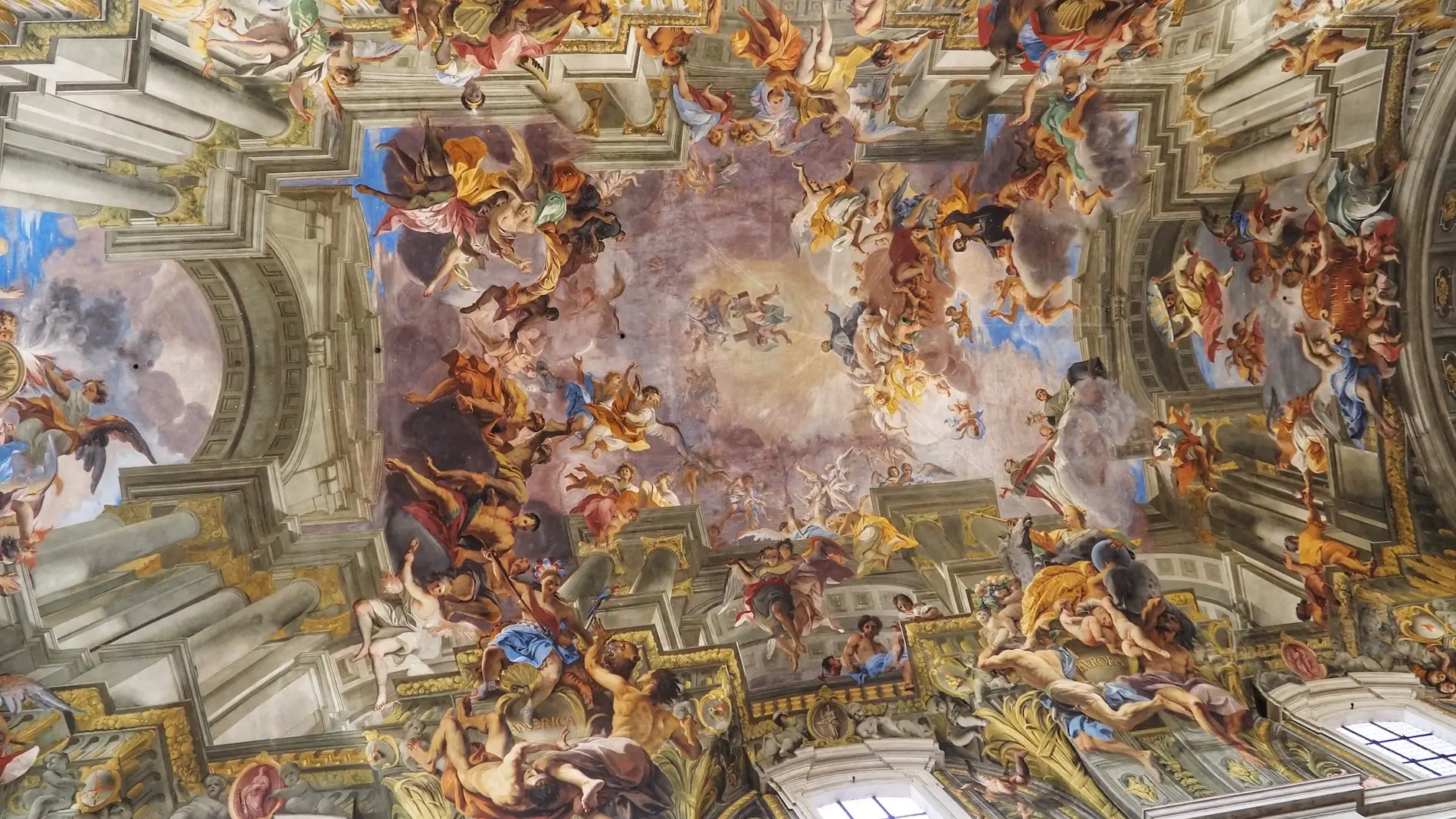
Pozzo was one of the great masters of Baroque illusionism. His extraordinary ceiling fresco in the nearby Church of Sant’Ignazio, where a painted architectural framework opens onto a swirling vision of heaven, is among the most spectacular examples of the genre, known as quadratura, in the world. Here, working on a far smaller scale, Pozzo succeeded in conjuring up just as much magic in the unpromising surrounds of the narrow corridor.
As you enter, take a moment to look back at the painted entrance itself. An elaborate architectural frame surrounds an inscription inviting visitors to enter the sacred rooms of St Ignatius, their former inhabitant and now heavenly patron (Ignatius had been canonised in 1622), while angels carry portraits of the Jesuit saints Francis Xavier and Francis Borgia.
The walls meanwhile are filled with painted architectural details and framed scenes illustrating episodes from Ignatius’s life and miraculous interventions. In one, an angel disguised as a pilgrim completes a portrait of the saint; elsewhere, Ignatius intervenes to cure a sick nun, comforts prisoners and miraculously extinguishes a raging fire.
In effect you are looking at some very refined early-modern propaganda. Many of these miracles were attributed to Ignatius after his death, helping gather momentum for his canonisation campaign. Pozzo presents Ignatius here as a powerful heavenly intercessor, continuing to protect and assist the faithful long after his earthly life had ended.
The ceiling carries the story further. Among the painted medallions and elaborate architectural ornamentation, Pozzo evokes the saint’s passage from death to heavenly glory. Look finally towards the far end of the passage, where a group of daringly foreshortened angel musicians sit beneath a painted arch serenading us as we approach Ignatius’s rooms. It’s almost as if the saint’s heavenly court has assembled to welcome those coming to pay their respects.
A Master Manipulator of Perspective

Underpinning the uncanny effect of the space is Pozzo’s extraordinary manipulation of perspective. The corridor is only around thirteen and a half metres long, with an awkwardly angled wall at the far end and a relatively shallow vaulted ceiling. Yet the painted architecture seems to extend the space into a much grander gallery, complete with columns, arches and elaborate architectural mouldings.
The secret is a carefully calculated perspective trick that comes together from one particular position. Look for the marble rose set into the floor, which marks the ideal viewing point. Stand here and the fictive architecture suddenly falls into place, making the painted space appear remarkably convincing. Start walking towards the end of the corridor, however, and the illusion quickly starts to break down: columns lean, cornices bend and the apparently solid architecture loses its shape.
Inside the Rooms of St Ignatius

Just beyond this elaborate Baroque spectacle lie the small, unpretentious chambers where the man himself spent his final years. After the splendour of Pozzo’s corridor, the humble nature of the rooms themselves come as something of a surprise, like stepping out of an opera house and into a monk’s bare cell.
The rooms retain the no-frills character of a sixteenth-century domestic residence. This was where Ignatius slept, prayed, read and worked, surrounded by the documents and correspondence that occupied so much of his time. The display cases hold the small, human leftovers of a life: a fragment of his cassock (the long robe worn by clergy), his shoes, and his cloak.
There is also a copy of the first Italian edition of his life story, written by Pedro de Ribadeneira, who was his own secretary. In a small anteroom, he once received missionaries before they set off for distant lands, and welcomed them back again. Look out, too, for the painting of Ignatius writing the Constitutions, the rulebook of the Society of Jesus. It is a fitting subject for a place where the order’s foundations were laid.
The largest room is now a chapel. Tradition holds that this is where Ignatius spent his final hours and died on 31 July 1556, aged 64. Outside, a small terrace recalls his habit of gazing up at the heavens to pray. Beneath it, the city he was working to transform spread out from his windows, a Rome of cardinals and beggars alike that he had made it his mission to unite. Taken together, the rooms offer a fascinating personal encounter with one of the great figures of the sixteenth century. Small they may be, but their historical associations are immense.
How the Rooms Survived: The Great Flood of 1598

There is another remarkable story behind the survival of Ignatius’s rooms. By the end of the sixteenth century, the original Casa Professa had fallen into a dangerous state of disrepair. Matters came to a head on Christmas Eve 1598, when the Tiber burst its banks in one of the most devastating floods in Rome’s history.
The flood badly damaged the foundations of the residence, leaving the Jesuits with a difficult decision. They needed to rebuild their headquarters, but the rooms in which their founder had lived and died had already become an important place of pilgrimage. The thought of simply demolishing them was out of the question.
The solution was an ingenious feat of engineering. When construction of a new Casa Professa began in 1599, the Jesuits arranged for a system of supporting vaults to be built beneath the original chambers. This allowed the rooms to be preserved while the surrounding building was reconstructed and expanded.
The work was carried out under the direction of Superior General Claudio Acquaviva, one of the most important figures in the early history of the Society of Jesus. The preserved rooms were ceremonially reopened in 1605, on the anniversary of Ignatius’s death.
Visiting the Rooms of St Ignatius

The Rooms of St Ignatius are located at Piazza del Gesù 45, immediately beside the Church of the Gesù, in the heart of Rome’s historic centre.
Admission is free, and you’ll want to plan to spend around 30 minutes inside. Current opening hours are Monday to Saturday, 4–6 pm, and Sunday, 10 am–12 pm, although arrangements can change, so it’s sensible to check before setting out.
I’d strongly recommend combining the visit with the Church of the Gesù itself. The magnificent church, with its spectacular ceiling frescoes and extraordinary chapels, provides a fitting counterpart to the modest rooms where the Jesuit founder spent his final years. The contrast between the two is fascinating: one celebrates the immense religious and artistic legacy of the Society of Jesus, while the other brings us close to the man whose vision helped create it.
Rooms of St Ignatius FAQ

Where are the Rooms of St Ignatius in Rome?
The Rooms of St Ignatius (Camere di Sant’Ignazio) are inside the Casa Professa, beside the Church of the Gesù in central Rome. The entrance is at Piazza del Gesù 45.
Can you visit the Rooms of St Ignatius?
Yes. The rooms are open to visitors, who can see the modest chambers where Ignatius lived and worked, along with Andrea Pozzo’s remarkable painted corridor. Entrance is free but opening hours can vary, so check ahead before visiting.
Who was St Ignatius of Loyola?
Ignatius of Loyola (1491–1556) was a Basque priest and former soldier who founded the Society of Jesus, better known as the Jesuits. He was the order’s first Superior General and was canonised in 1622.
What did Ignatius of Loyola do in the Rooms of St Ignatius?
Ignatius lived in the Casa Professa from 1544 until his death in 1556. Here he worked on the Constitutions of the Society of Jesus, directed the growing order and maintained an extensive correspondence with Jesuits around the world.
What is the Society of Jesus?
The Society of Jesus is a Catholic religious order founded by Ignatius of Loyola and his companions in 1540. Its members are known as Jesuits. The order became renowned for its schools and universities, missionary activity, scholarship and influence within the Catholic Church.
Who painted the corridor in the Rooms of St Ignatius?
The corridor was transformed in the 1680s by the Jesuit artist and architect Andrea Pozzo. Its painted architecture, scenes of miracles attributed to Ignatius and angel musicians create an extraordinary illusionistic passage leading to the saint’s rooms.
Book Your Rome Experience