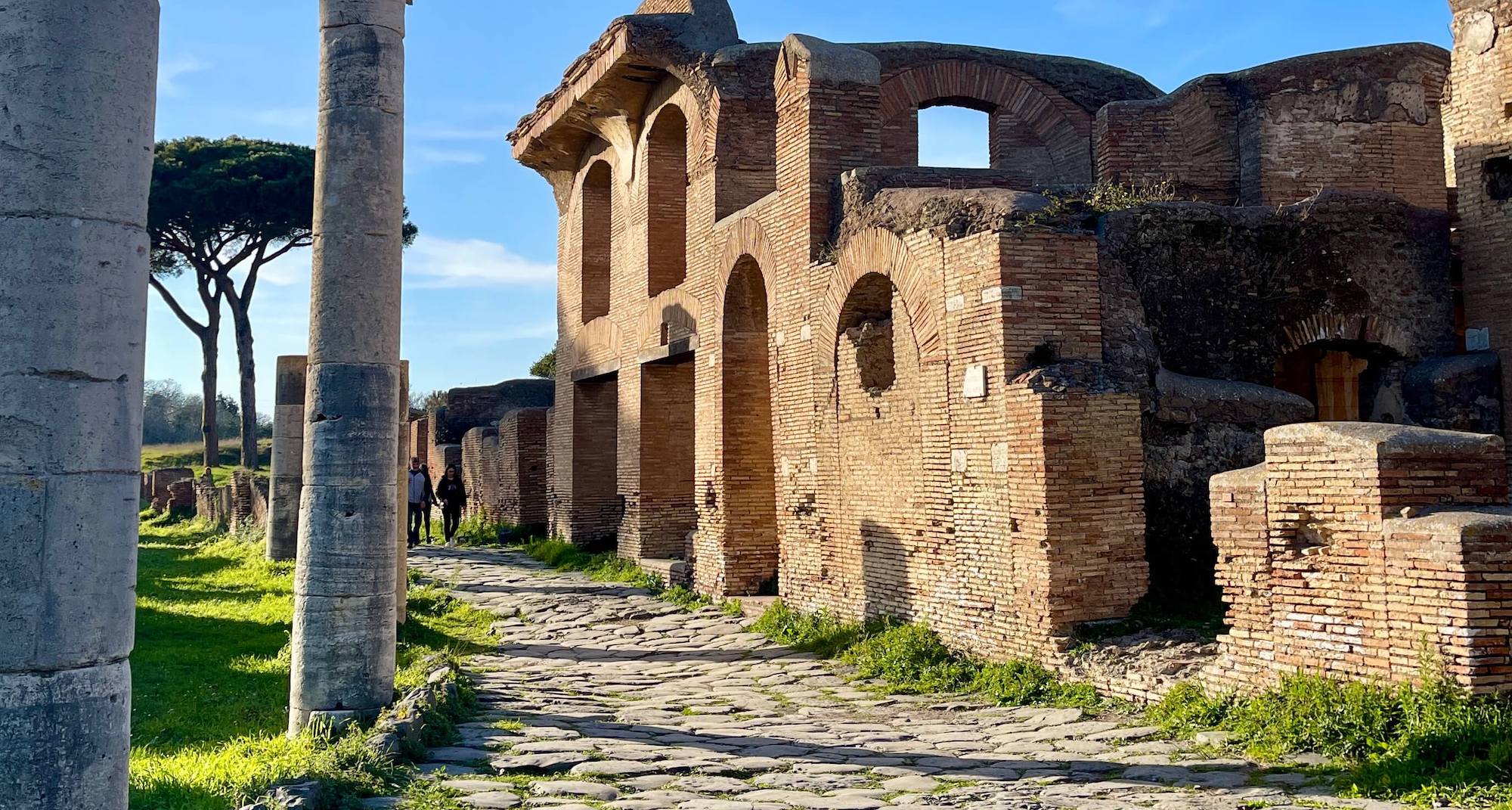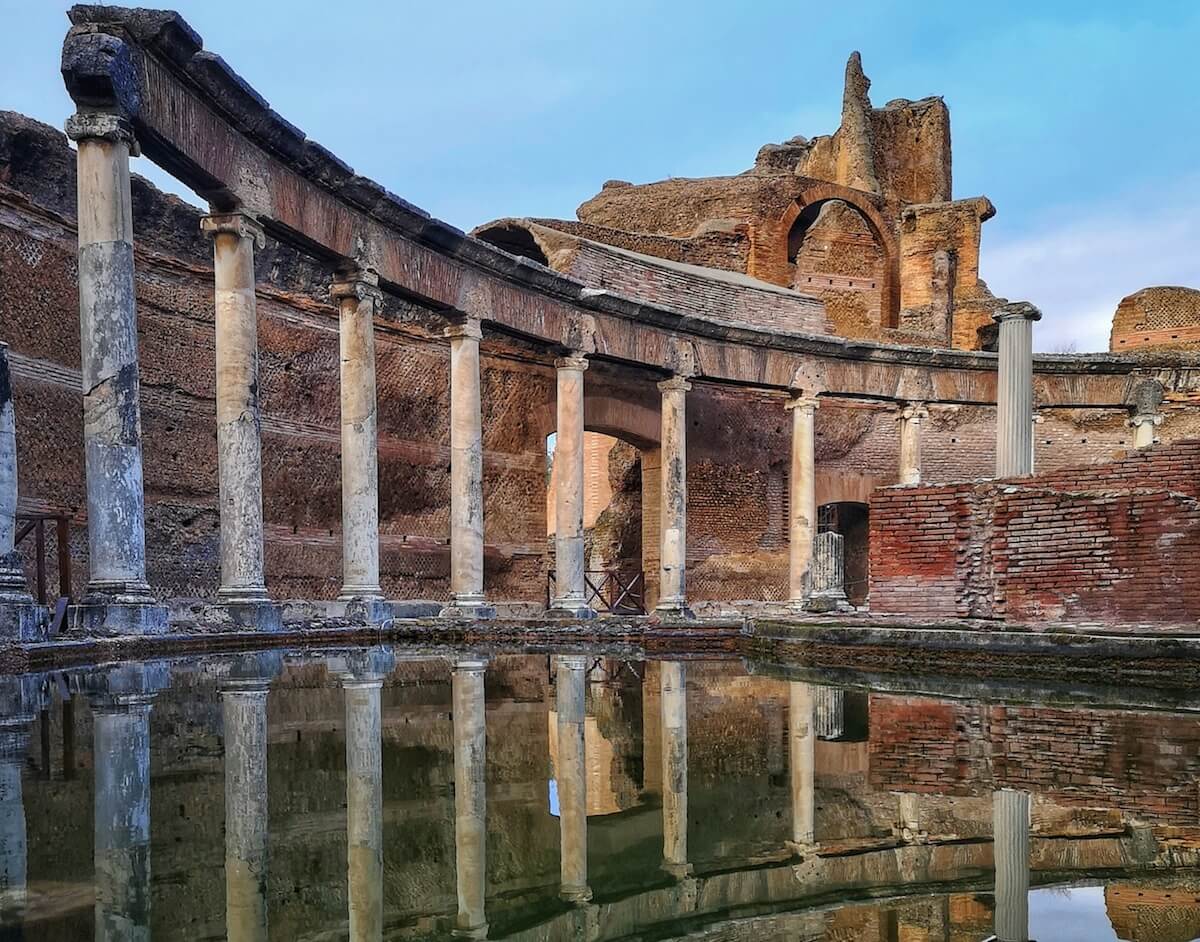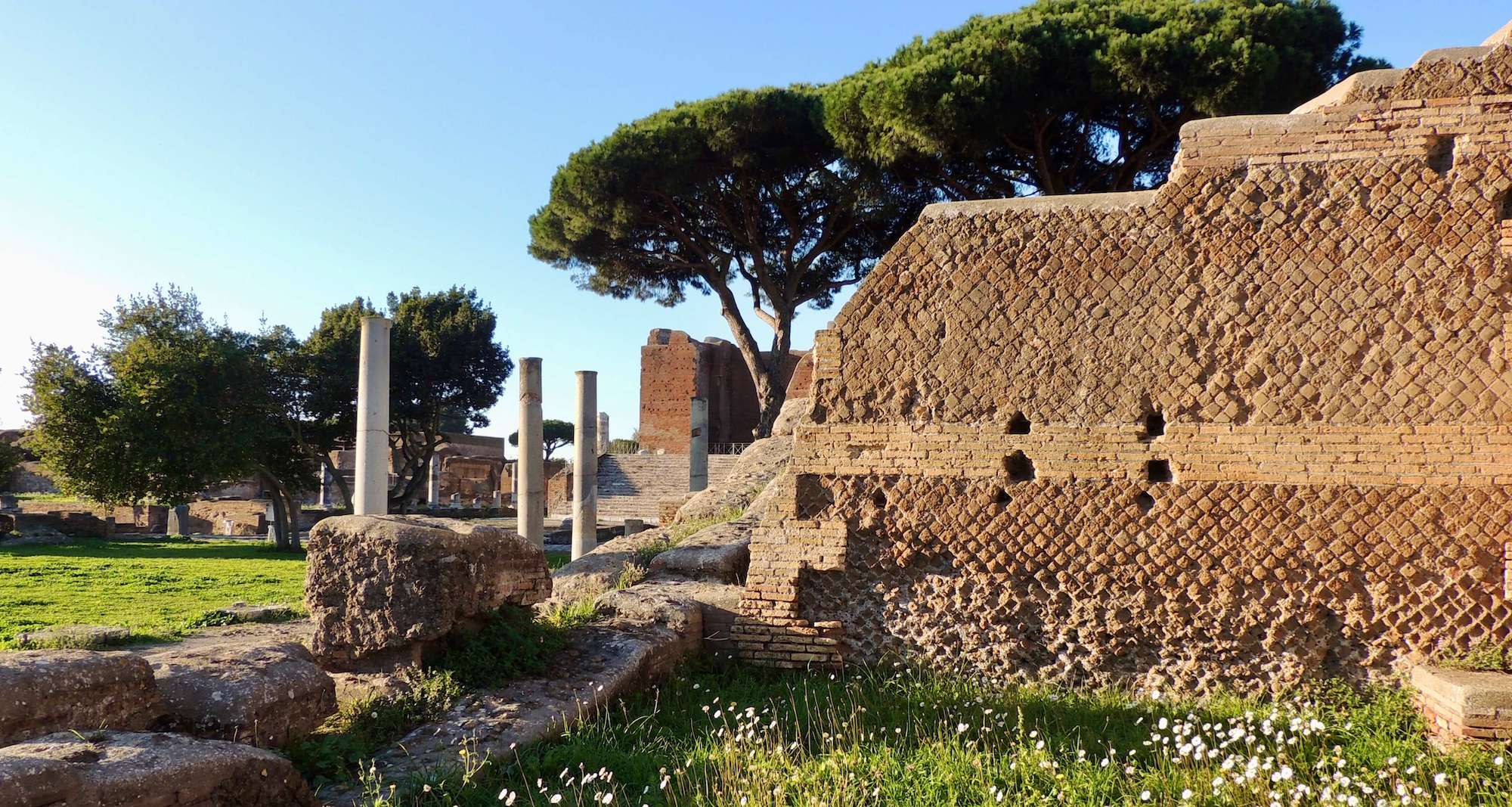
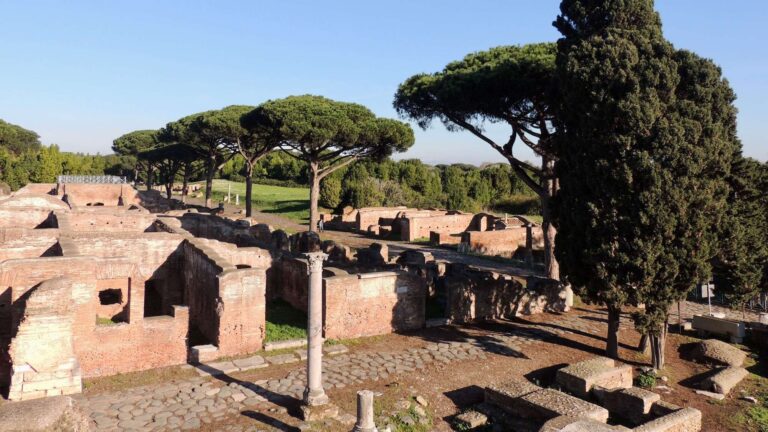
Gazing across the magnificent ancient ruins of Ostia Antica, It's easy to conclude that this might just be Italy's best kept ancient secret.
Just a half hour’s train ride from Rome, the ruins of this abandoned port city are just as impressive as Pompeii, and without the crowds – a visit here offers a thrillingly immersive window into every aspect of life in ancient Rome.
Beautifully sited amongst the pine trees of the Roman countryside, I never tire of wandering its remarkably preserved streets and exploring its temples and shops, theaters and bathhouses – for me, it’s an absolute must-visit when in Rome.
But how to visit Ostia Antica? From tickets to tours, what to see and how to get there, find out everything you need to know about visiting Ostia Antica with our comprehensive guide!
Ancient Rome Tours
Visit Ostia Antica
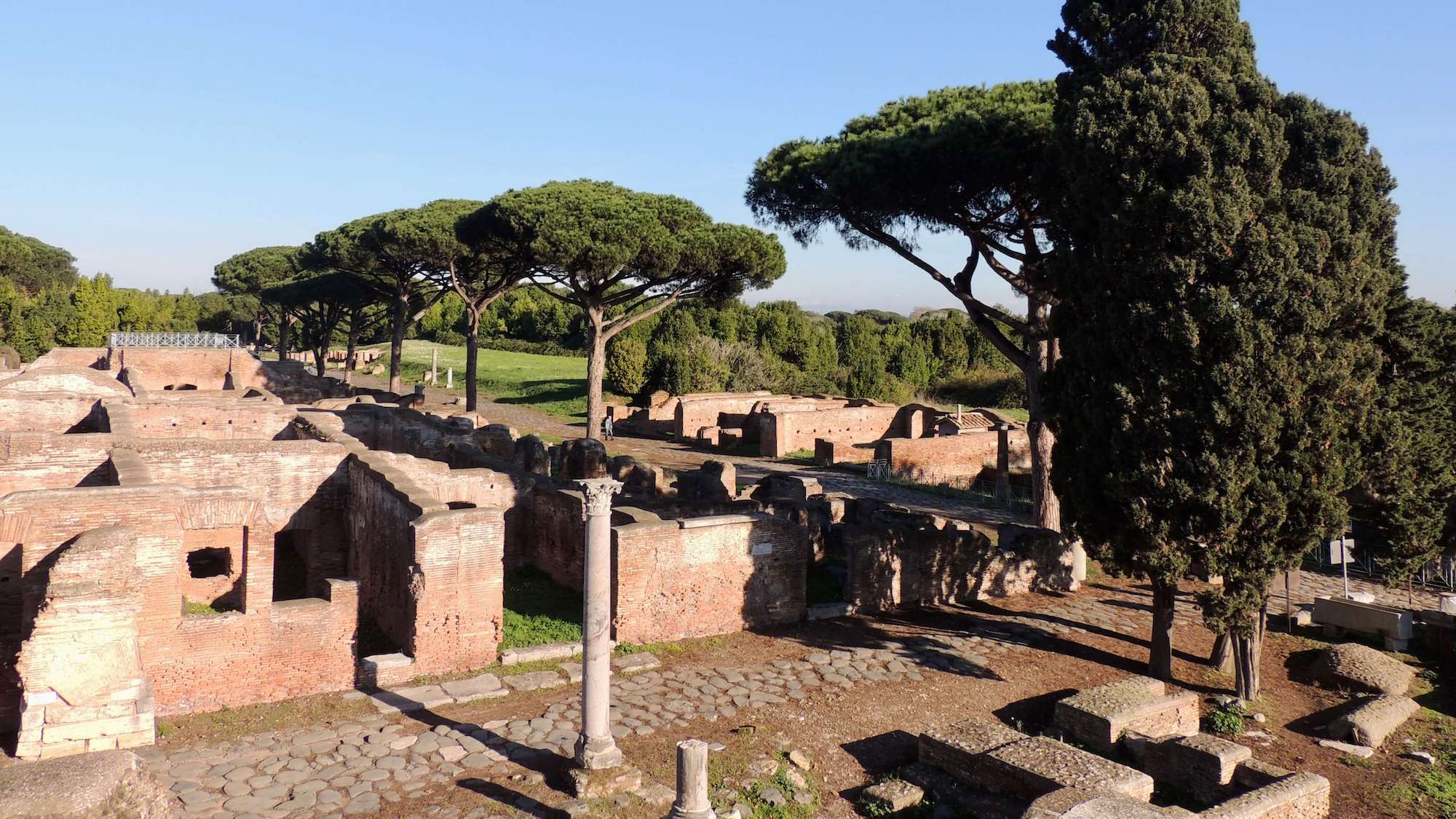
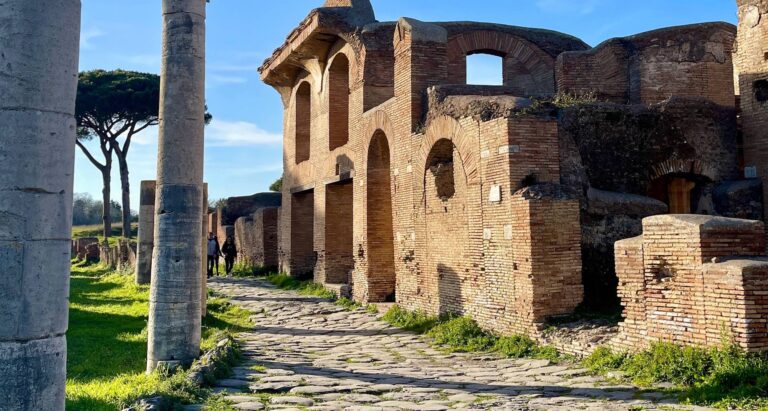
Let’s start with the basics. Ostia Antica is the remarkably well-preserved ancient port city of Rome, located about 30 minutes by train from the Eternal City. In antiquity, Ostia was strategically sited at the mouth of the river Tiber where it flowed into the Tyrrenian sea (today it is 4km inland), allowing it to function as a vital commercial hub for the Roman empire.
Its status as the center of Rome’s vast import and export network at the heart of the Mediterranean meant Ostia soon became an extremely important city, and its extensive well-preserved ruins offer a fascinating look into what life was like in the ancient world.

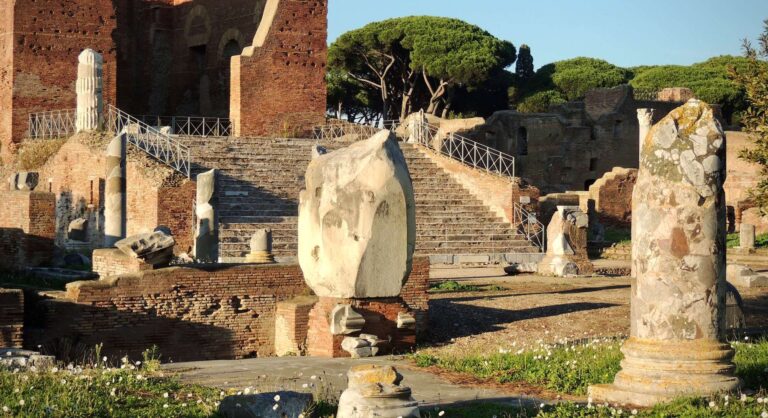
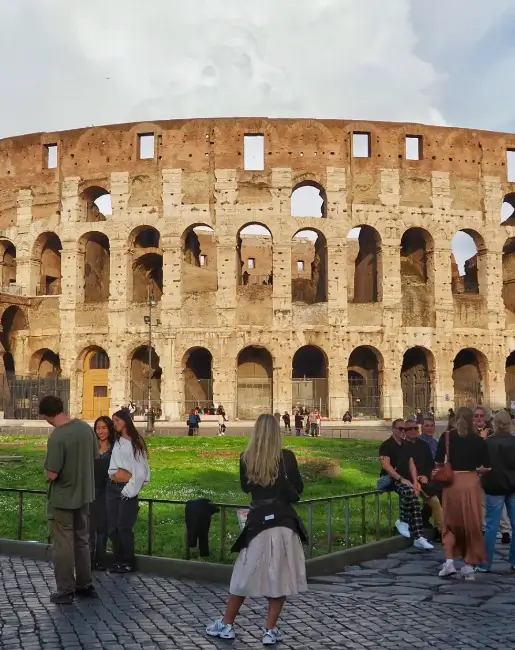
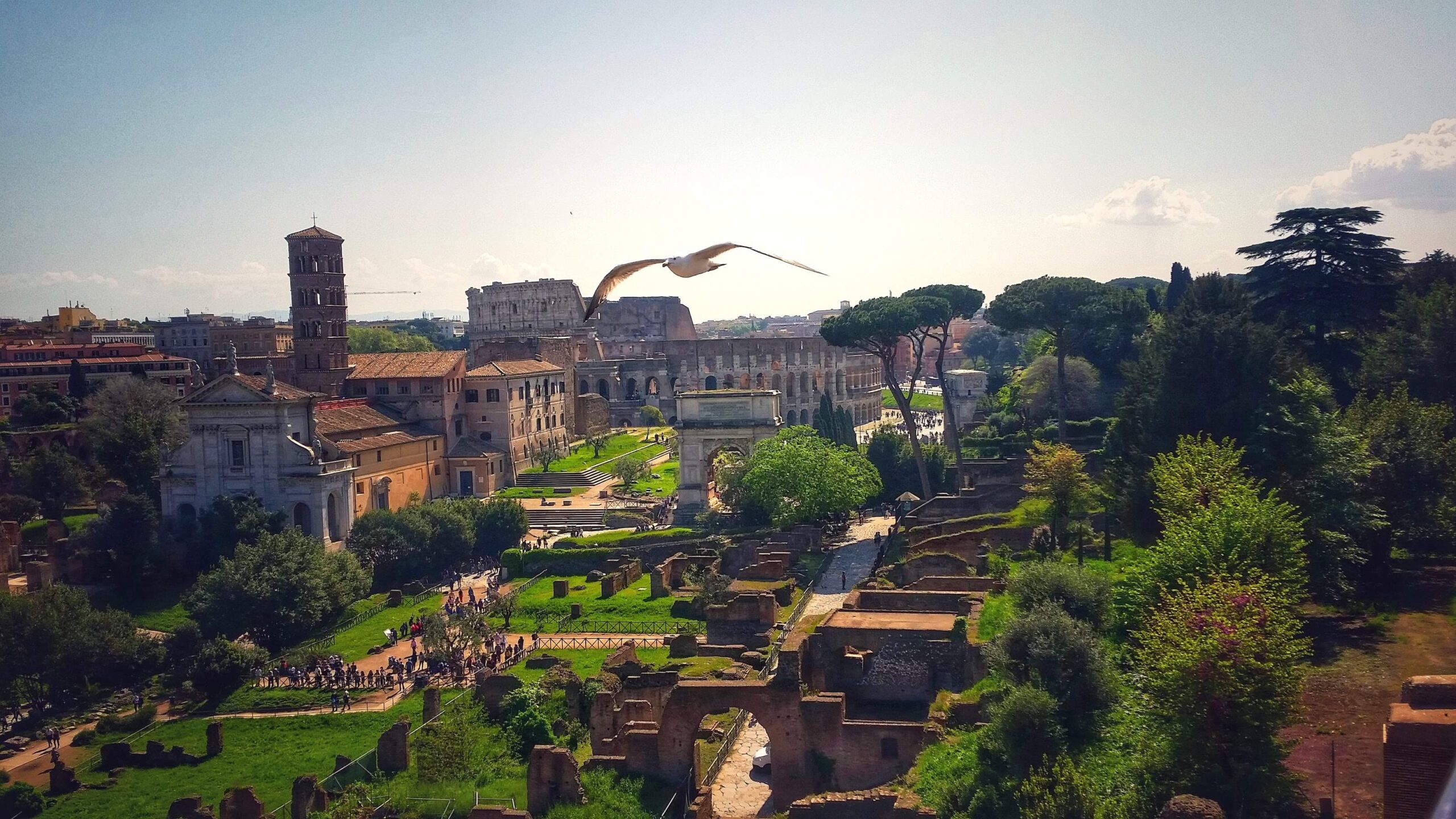
You’ll no doubt have already spent quite a bit of time exploring ancient ruins in Rome – after the Colosseum, the Roman Forum, the Palatine Hill and all the rest, it might be tempting to skip another ancient archaeological park. Not so fast! There are some crucial differences that make Ostia unmissable in our book.
- Firstly, the main ancient sites in Rome itself are all monumental in nature. They speak to the grandeur of empire, to the great deeds of famous men and the limitless scope of ultimate power. But they tell us relatively little about how ordinary people lived in antiquity. Visiting Ostia, by contrast, feels like immersing yourself in the fascinating yet ordinary daily lives of ordinary people, separated from us by a vast stretch of time but little else. The experience of wandering through a largely intact Roman town, through baths and warehouses, shops, apartments, public toilets, theaters and much more immersed in the trees and rolling hills of the lovely Lazio countryside is truly unforgettable.
- Secondly, and just as importantly, are the crowds. Or rather, the lack of them! Despite its superb state of preservation, Ostia Antica never seems to get too busy. After battling the endless flow of people in the Colosseum, this will definitely feel like a most welcome respite. It’s perfectly possible to have large swathes of the city virtually all to yourself, which makes the experience of exploring so much more enjoyable.
- Finally, the fact that Ostia is such an easy and cheap day trip from Rome only adds to its must-visit status. Keep reading to find out how to get to Ostia from central Rome.
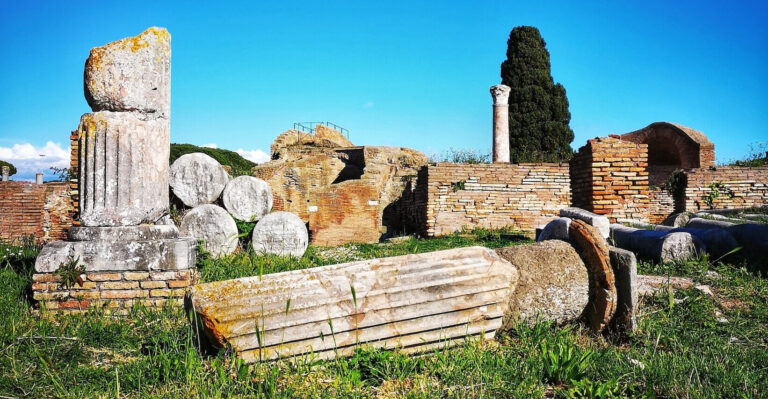
Founded as far back as 620 BC as a military outpost, Ostia Antica was initially established to exert Roman control over the Lazio coast. Ostium means “mouth” in Latin, and refers to the settlement’s strategic location at the mouth of the Tiber River. What began as a minor fortification soon evolved into a bustling commercial hub as Rome expanded, with the city proper springing into being sometime in the 4th century BC.
The first important industry here was salt, which was extracted from nearby marshes. As the Roman Republic grew into an empire, Ostia Antica became the primary gateway for goods entering the capital from across the Mediterranean. This trade was crucial for sustaining Rome’s rapidly expanding population.
The city’s proximity to both the Tiber River and Rome’s main roads, Via Ostiense and Via Portuensis, allowed for the swift movement of goods into the capital, solidifying Ostia’s role as Rome’s most vital commercial port. By the middle of the second century AD, Ostia had transformed into a thriving city of around 50,000 inhabitants, with impressive infrastructure including warehouses (known as horrea), markets, and port facilities.
Ostia also housed offices for merchants from across the empire, as seen in the mosaics of the Square of the Corporations, which detail the various trades conducted there, including grain shipping, transportation of luxury goods, and even elephant handling.
During its peak, Ostia not only served as a critical trade center but also mirrored the urban life of Rome. The city had its own theater, public baths, temples, and residential districts. However, by the 5th century AD, with the decline of the Roman Empire and shifting trade routes, Ostia’s importance began to wane. Eventually, the silting of the Tiber and coastal erosion pushed the city further inland, leading to its abandonment.

Tickets
- Full-priced tickets for adults cost €18.
- EU citizens between 18 and 25 years old are entitled to a reduced-price ticket that costs €2.
- EU citizens younger than 18 years old and children younger than 12 from outside the EU enter Ostia Antica for free.
- Audioguides cost €5 or €7, depending on the option you choose.
- The archaeological site of Ostia Antica is free to visit on the first Sunday of each month. You don’t need to reserve your entrance in advance to take advantage of the first entry, and can get your free ticket from the ticket office on site. Queues will be longer than usual on these days, but tend to move quickly.
- You can buy your tickets to Ostia Antica online via the official Coopculture website here: Ostia Antica Tickets. Unlike other sites in Rome and surrounding areas, it isn’t essential to book your tickets in advance to Ostia – the site is so large that overcrowding is rarely an issue here, so you can also simply buy your tickets at the ticket office on site.

Opening Hours
The Ostia Antica archaeological park opens from Tuesday to Sunday, and opening times depend on the time of year:
- 25th October – 28th February: 8.30AM – 4.30 PM
- 1st March – 31st March: 8.30AM – 5.15PM
- 1st April – 30th September: 8.30AM – 7.00PM
- 1st October – 24th October: 8.30AM – 6.30PM
The ticket office closes one hour before the stated closing times.

How to Get to Ostia
Ostia Antica is easy to reach via public transport from Rome. To do so, you’ll first need to take the blue metro line B to Piramide station (if you are coming from central Rome, the Colosseum or Termini station then look for southbound trains towards Laurentina). Once at Piramide station, climb up from the platform to the concourse level and look for signs to the Roma Lido line.
This train is also part of Rome’s metro network, so you won’t need a new ticket. Take this train to Ostia Antica station – the ride takes about 35 minutes, and the archaeological park is a short, well-signposted walk from here.

Ok we might be biased, but we’d definitely recommend taking a guided tour of Ostia Antica primarily due to the sheer size and complexity of the site. Covering over 100 acres, the wonderfully preserved ruins are extremely varied and conceal many fascinating corners that you’d be liable to miss exploring on your own – especially given many of the park’s most interesting sites lack accompanying information panels. Taking advantage of a guide’s expertise, you’ll gain a better understanding of how ancient Romans lived, worked, and socialized here.
Further complicating the picture for the unprepared visitor is the long history of the city: Ostia offers up a layered archaeology of ancient Rome, featuring structures from different periods, all jumbled together. Part of a knowledgeable guide’s job is explaining how these disparate elements fit together, helping you to understand the evolution of Rome’s ancient port over the centuries. They can also highlight smaller, easily missed details like mosaics, frescoes, and the fascinating evidence of Roman engineering and technological prowess.
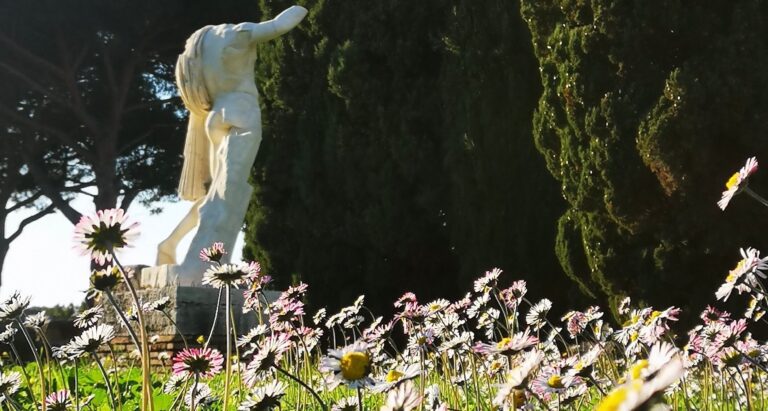
Ostia Antica is a very large archaeological site spread out over a wide area. To see the highlights and get a good sense of the ancient city you’ll need to allocate at least 2 hours to visit the park. If you’d like to explore Ostia in its entirety, allow up to 4 hours.
Ostia Antica is laid out like a typical Roman city, with a central main street called the Decumanus Maximus running east to west all through the site. It’s this main thoroughfare that will help you navigate Ostia Antica, as it begins right at the entrance to the archaeological park. Many of the most important sites at Ostia are located either on or near the Decumanus Maximus, or on the roads that lead off it, including the Cardo Maximus and Via della Foce.
Take notice of the signs dotted around the site and make use of the map you’ll be provided with at the entrance to find your way to the highlights described below.
If you have a full day to spare, after visiting the ruins it’s worthwhile to continue your journey onwards to the modern coastal town of Ostia just a couple of stops further along the train line – it’s a great place for a drink along the seafront or some good value seafood.
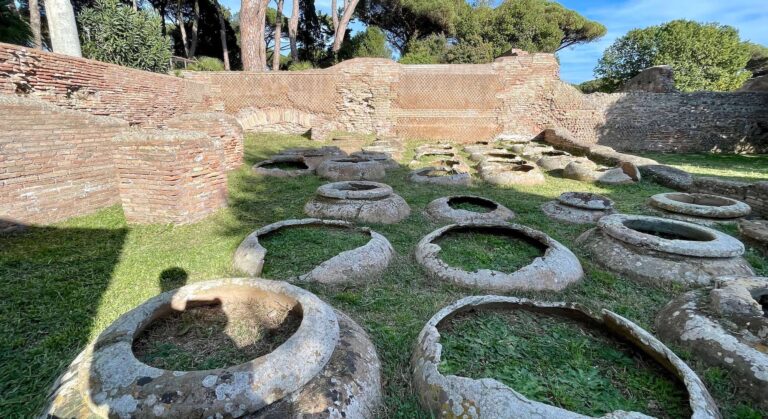
A bewildering variety of goods arrived in Ostia every day from the most distant corners of the known world. The following are just a few of the most important: grain from Sicily, Sardinia and Egypt; olive oil from Puglia, Spain and Tunisia; wine from Gaul (France); marble and precious stones from Turkey, Greece and the Near East; spices, perfumes and luxury fabrics from across Asia.
This merchandise was stored in the highly organized horrea, which featured specialized areas for different products, elevated floors to keep goods dry and stringent fire safety measures – Ostia’s imports were of immense value to the Roman state, and their appropriate preservation was a top priority for the city’s administration.
More sinisterly, Ostia was also a major center for the Roman slave trade. Slaves were brought here from conquered territories across the empire, from as far away as Northern Europe, North Africa, and the Near East. They were auctioned in Ostia before being transported to various parts of the Roman Empire, including Rome itself, where they served in households, farms, factories and workshops.
Ostia was also where many of the wild animals destined for the games at the Colosseum arrived from far-flung shores. Exotic animals such as lions from Africa, tigers from Asia, bears from Scotland and even African elephants were shipped through Ostia. The traffic in wild animals was a lucrative business, as can be seen from mosaics in the Square of the Corporations.
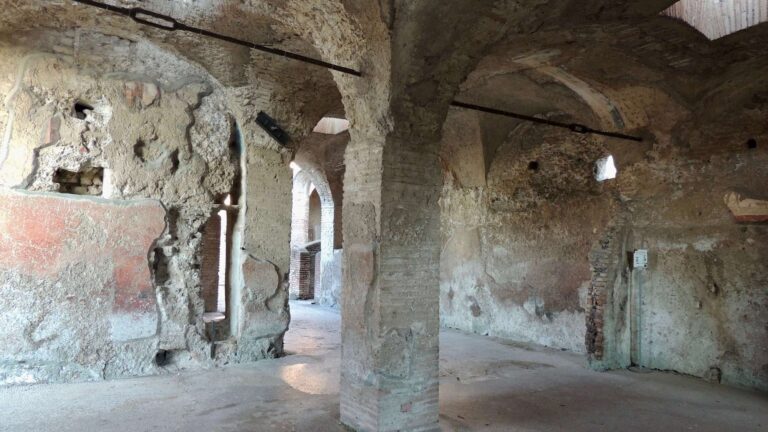
For our complete guide to what you need to see at Ostia Antica, see our dedicated article here: 10 Things You Need to See at Ostia Antica.
What follows is a brief summary of some of the highlights you should look out for when visiting the ancient port city.
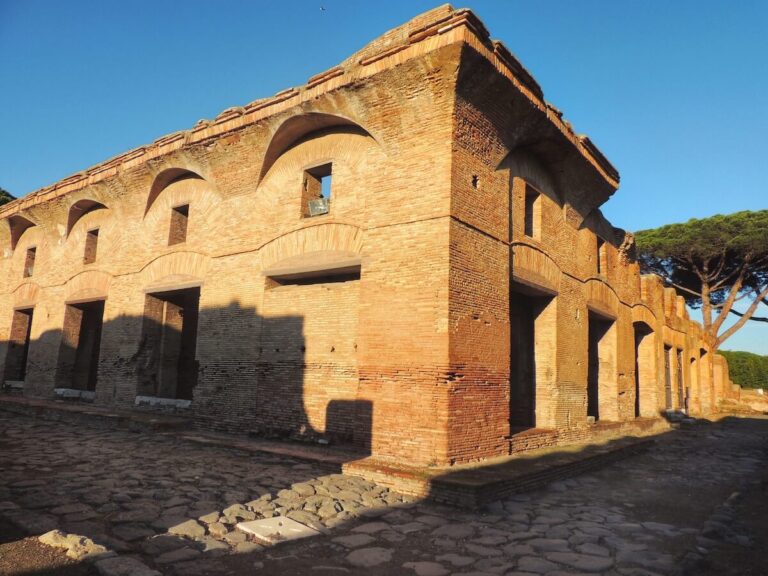
This multi-story apartment building from around 150 AD housed shops on the ground floor and residences above. Named after a painting of the goddess Diana, it’s decorated with beautiful mosaics and frescoes, and is a great example of Roman urban design.
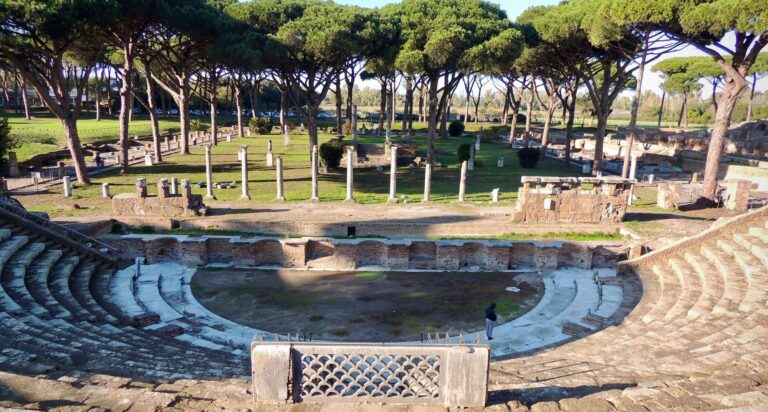
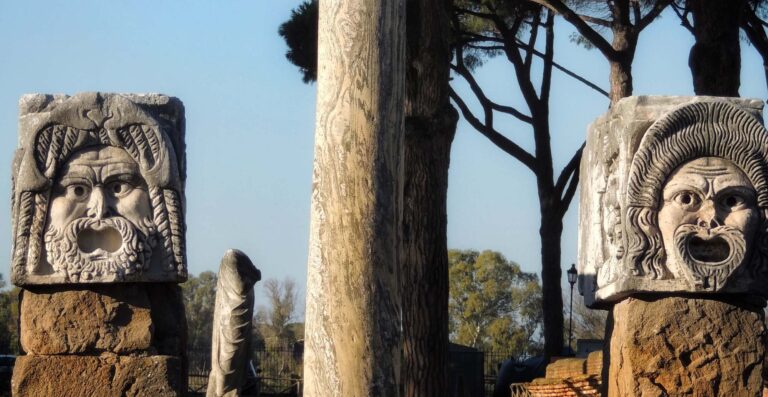
Ostia’s ancient theater, built in the 1st century BC, could seat up to 4,000 people. With its impressive cavea and decorated stage backdrop featuring glaring theatrical masks, it’s one of the best-preserved examples of Roman theaters anywhere – and is still used today for concerts and theatrical events!
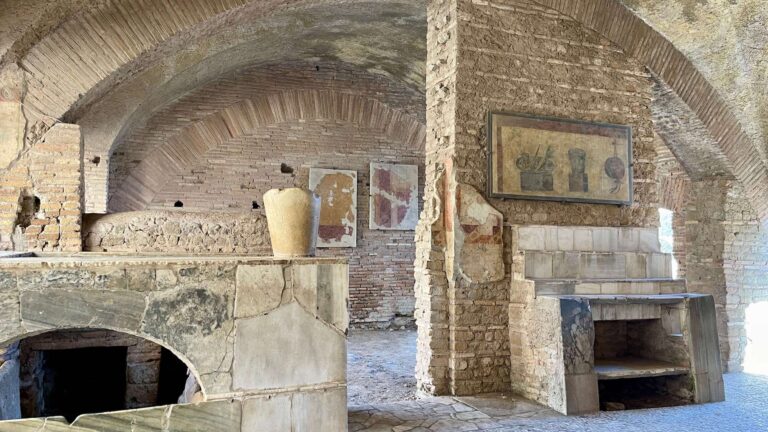
This ancient Roman “fast food” spot served quick meals spiked with the ubiquitous garum (a pungent fish sauce) and brimming goblets of wine to busy punters. You can still see the take-away counter where thermopolium staff dished out the daily goods, as well as a shrine to Bacchus and Mercury on the wall that ensured the shop’s continuing good fortune.
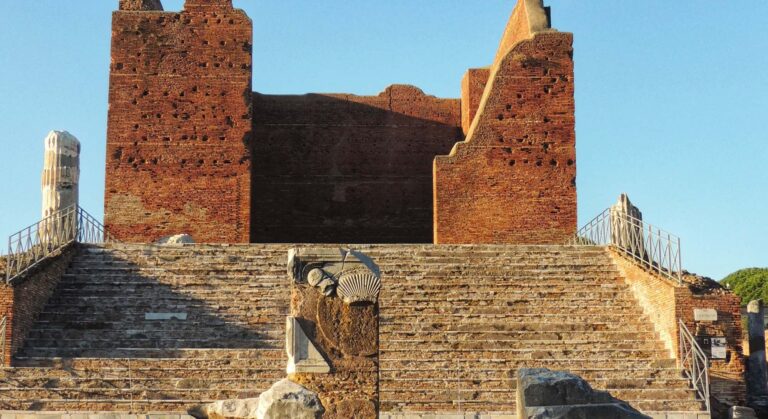
Built in 120 AD, Ostia’s Capitolium was a temple dedicated to Jupiter, Juno, and Minerva. Wherever the Romans went, they imposed a similar city plan centered around a religious and civic center known as the Forum. Based on the capitol in Rome itself, Ostia’s grand Capitolium has long lost its precious marble veneer and today presents an imposing appearance in exposed brick.
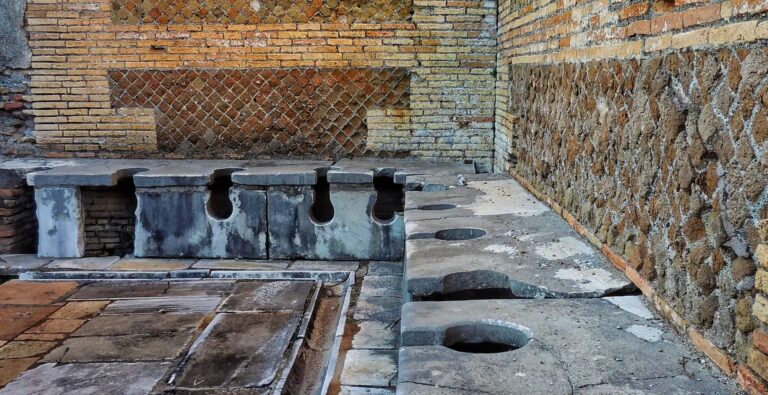
Ostia’s communal public latrines reflect advanced Roman plumbing. A marble bench with 20 seats led to a drainage system flushed by water. Patrons used sponges on sticks for hygiene, showcasing the Roman solution to bathroom needs in antiquity.
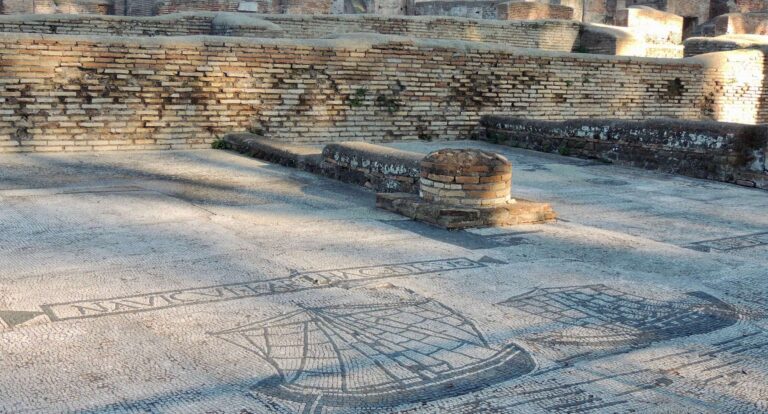
In this grand square, we get a vivid glimpse into the various kinds of commerce that sustained Ostia’s economy. This was where the offices of important guilds and merchants were located, adorned with mosaics depicting various vocations from grain importers to shipbuilders, fish merchants and slavers. At its center, a temple dedicated to Ceres, goddess of agriculture, symbolized the city’s dependence on grain.
We think Ostia is just as rich in archaeological treasures as the much more famous Pompeii further south, but you won’t find anything like the volume of visitors here. Of course, both Ostia Antica and Pompeii are fascinating ancient sites, but offer different experiences. Ostia Antica offers a well-preserved glimpse into daily Roman life with expansive ruins and mosaics, and it tends to be far less crowded than Pompeii, making for a more relaxed experience. Its proximity to Rome also makes it ideal for a day trip from the Eternal City.
Pompeii is larger and arguably even better preserved than Ostia, and boasts unforgettable plaster casts of the victims of Vesuvius’ eruption, but it’s more challenging to visit on a day trip from Rome (it’s still doable on a guided tour, however). Pompeii also gets way more crowded than Ostia, especially at the height of summer. For a quieter and more accessible visit, Ostia Antica is preferable; if you are looking for grand adventure and drama, Pompeii is your best bet. Better yet, why not visit both sites?

A small cafe-restaurant is located within the archaeological park, and it’s a perfectly adequate spot to grab a pick-me-up sandwich, drink or cup of coffee. The bar is situated right at the center of the park in an area where you’ll also find bathrooms and a gift shop.
If you’re looking for a more substantial lunch after a morning visiting the ruins, then head to the nearby medieval borgo (village) of Ostia Antica, centered around an imposing castle. It’s just a few minutes walk from the archaeological park, and this lovely little warren of streets is home to some excellent restaurants.
Book Your Ancient Rome Experience