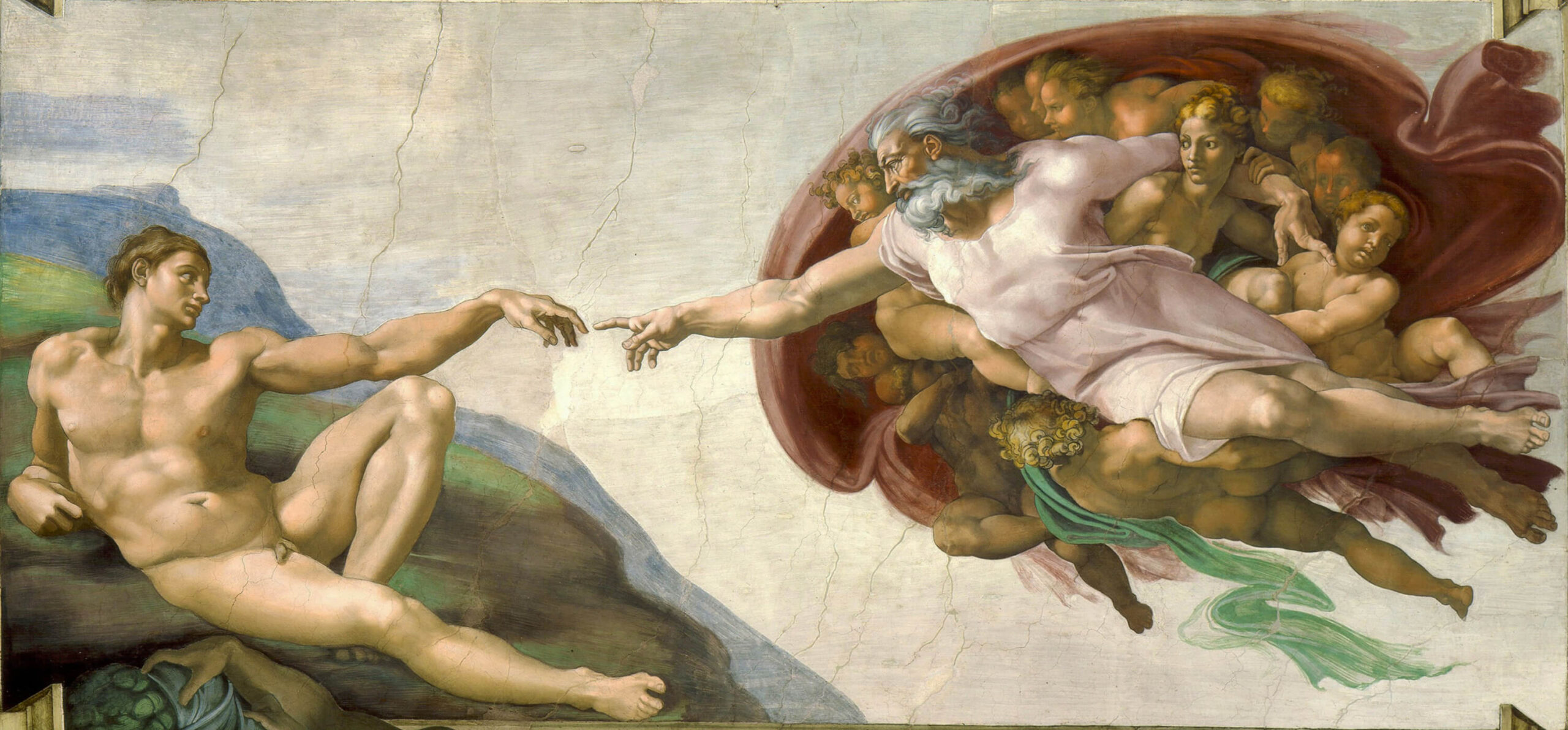
Everyone knows the fingers.
One hand reaches out with easy confidence, while the other droops a little; the tiny gap between them is about to be closed, and mankind will soon spring to life. The Creation of Adam is probably the most reproduced image in Western art, and the Sistine Chapel is so famous that you feel like you know it before you even arrive.
But there’s much more to this incredible place than you might think. From the outside it is a forbidding and fortified brick building. Inside, its walls preserve the work of some of the greatest painters of the early Renaissance, while Michelangelo’s ceiling and monumental Last Judgment transformed the chapel into one of the defining artistic achievements of the Western world.
There is history behind the masterpieces, too. The chapel was built to serve the papacy: its decoration speaks to the ambitions of the popes who commissioned it, and it remains the place where new popes are elected.
What follows are ten things you need to know before you visit, from the story of the building itself to the details that are easy to miss when you’re standing beneath Michelangelo’s extraordinary ceiling.
 Want to explore the Sistine Chapel with a guide?

Michelangelo’s ceiling is only part of the story. Our Vatican tours put the Sistine Chapel’s frescoes into context, while also introducing you to the extraordinary art and history of the Vatican Museums.
Vatican Tours
Visit the Sistine Chapel!

Its story begins with a Renaissance pope, a ruined medieval chapel and a team of crack painters from Florence.
The Sistine chapel takes its name from Pope Sixtus IV (born Francesco della Rovere) who in the late 1470s rebuilt a medieval chapel in the Vatican as a grand ceremonial space for the papal court. Designed by the architects Giovannino de’ Dolci and Baccio Pontelli, its carefully constructed proportions – around three times as long as it is wide – deliberately alluded to the biblical description of Solomon’s Temple.
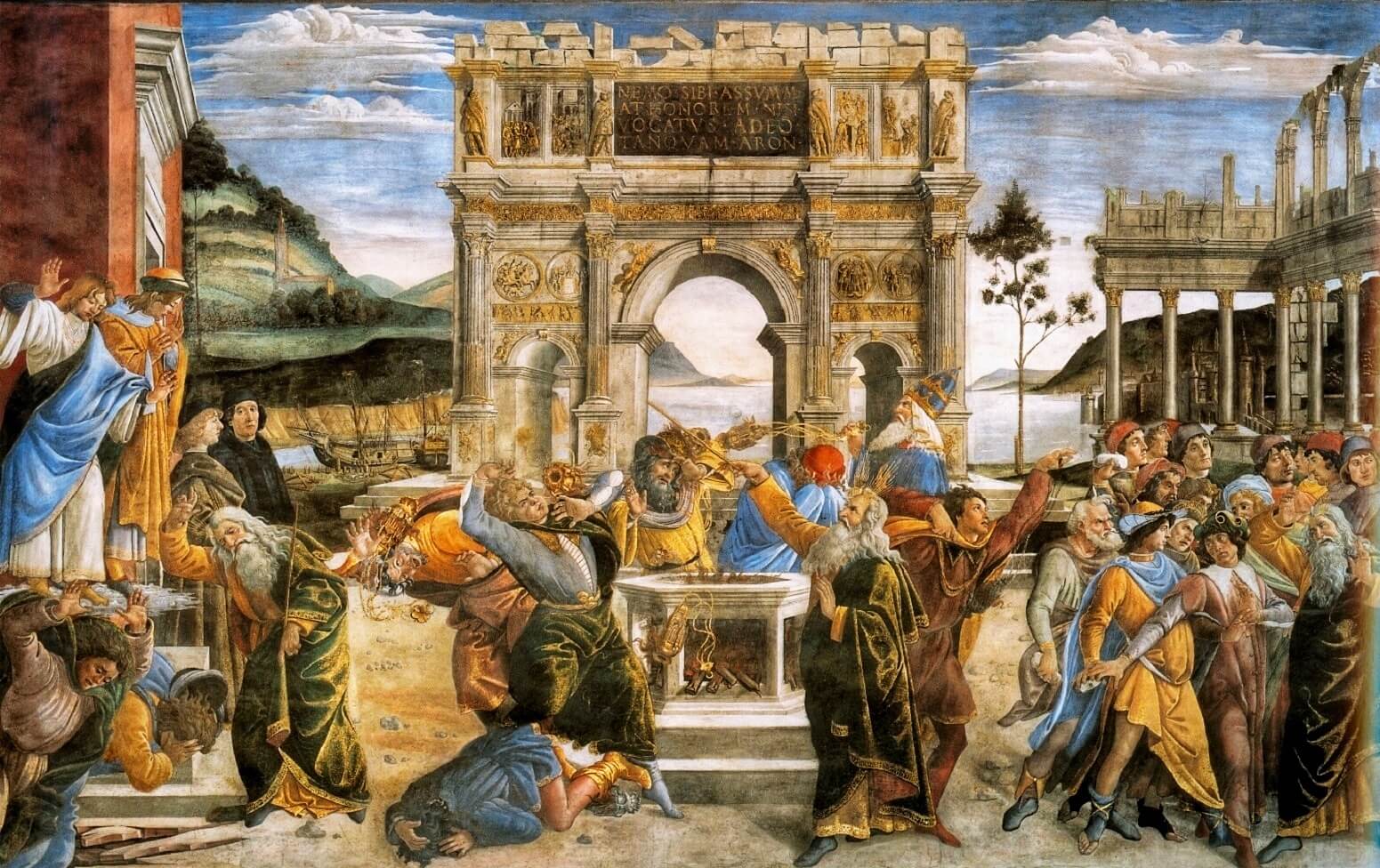
The decoration came next, along with some politics. In 1478 the Pazzi conspiracy had left Lorenzo de’ Medici’s brother dead in Florence Cathedral and led to war between Florence and the papacy. When peace came, several of Florence’s finest painters headed south to work for the pope – among them were Botticelli, Ghirlandaio and Cosimo Rosselli as well as Perugino, who was already in Rome.
Some scholars argue that the artistic exchange was itself part of the peace deal: call it diplomacy at the point of a paintbrush.
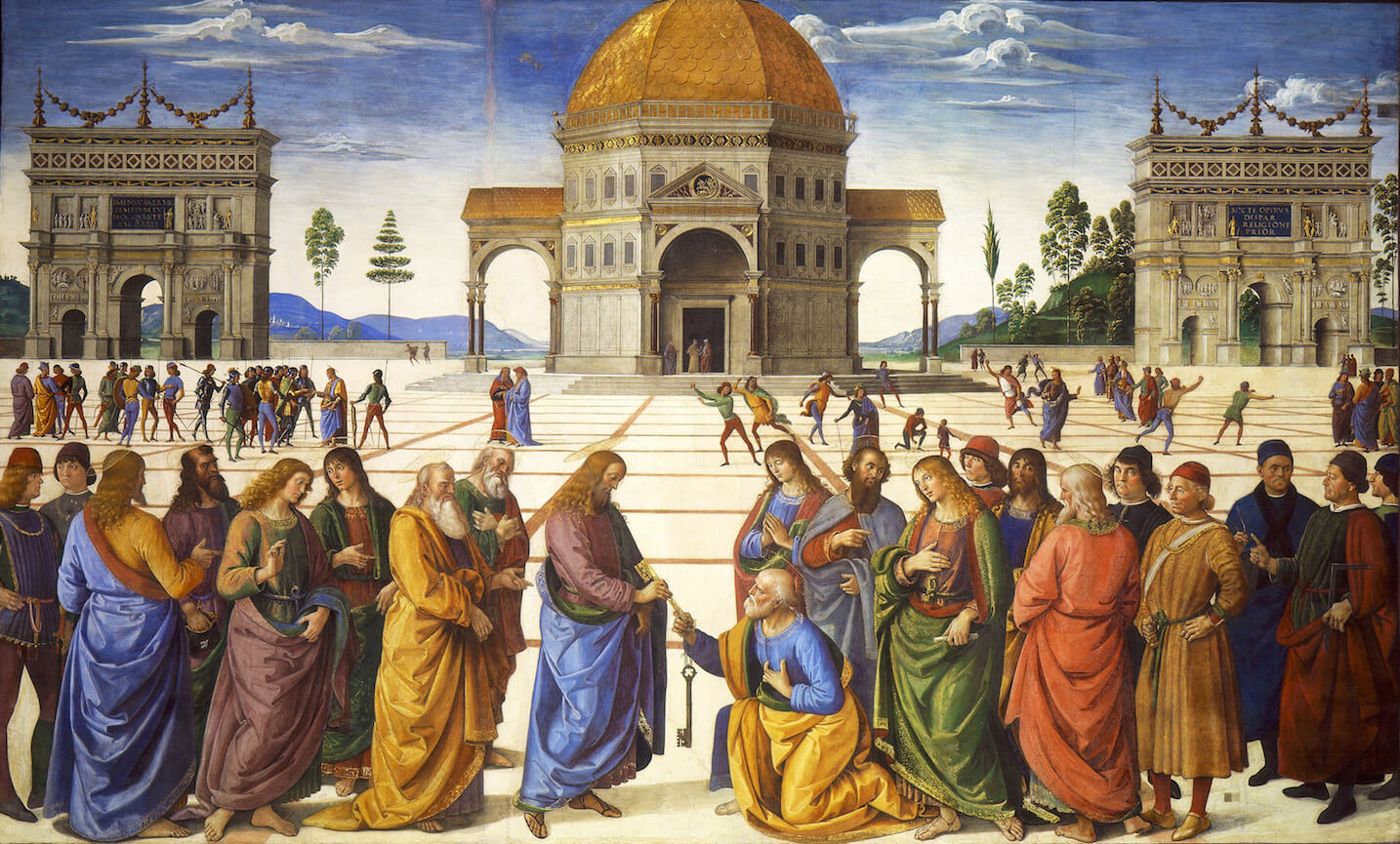
Between 1481 and 1482 the team covered the walls with two matching cycles: scenes from the life of Moses on one side, scenes from the life of Christ on the other, paired episode for episode. The programme was carefully conceived, conveying the message that the pope’s authority ran in an unbroken line from Moses to Christ to Saint Peter and on to Sixtus himself. Perugino’s Christ Handing the Keys to Saint Peter makes the point in no uncertain terms.
The first Mass was celebrated on August 15, 1483, on the Feast of the Assumption. Michelangelo, born in 1475, was just eight years old.


The ceiling we know today was not what Pope Julius II initially had in mind.
The original Sistine Chapel ceiling featured a blue sky flecked with gold stars. In May 1504 a long crack opened across it, probably caused by works ongoing nearby at St. Peter’s. Bramante tried to remedy the situation by binding the structure together with iron ties, but the painted sky had suffered too badly to be salvaged.
By this time Sixtus’s nephew Jullius II was on the papal throne. Never a man for half measures, he decided to take advantage of the situation by calling on Michelangelo to paint him a replacement.
The initial idea was comparatively modest: portraits of the twelve apostles in the triangular sections of the ceiling known as pendentives, with ornamental motifs filling the rest of the vault. Michelangelo soon rejected the proposal as lacking in ambition, and persuaded Julius to let him loose on a scheme more befitting of the grand sacred space.
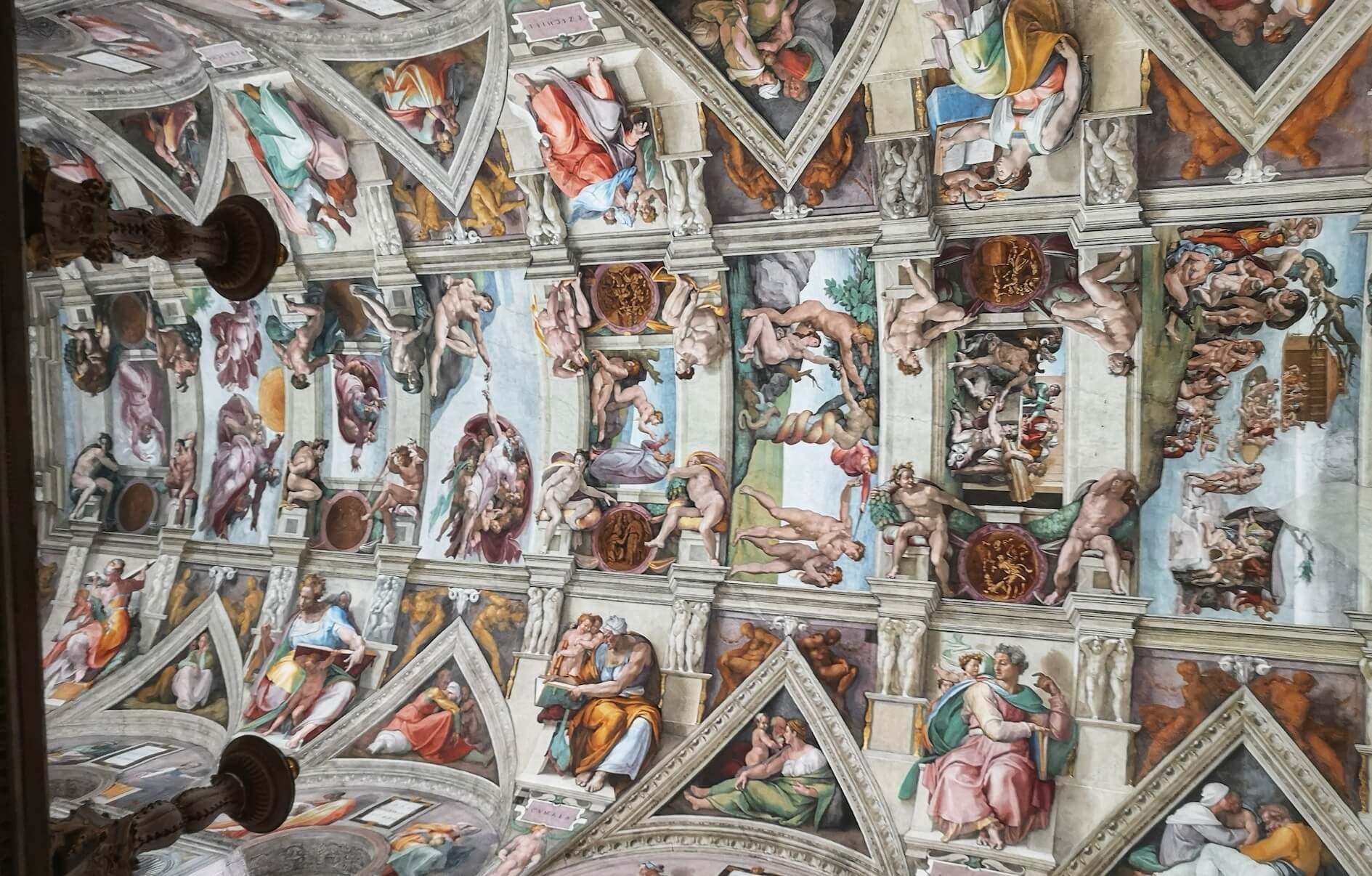
What he painted was remarkable in scope: a vast Biblical account of Creation, the Fall and the early story of humankind. At its centre are nine scenes from Genesis surrounded by monumental Old Testament prophets and sibyls who heralded the Saviour’s coming to the ancient world. Christ’s ancestors meanwhile occupy the spaces above the windows.
Julius was not a patient patron. According to early biographers, when Michelangelo stonewalled the pontiff’s pestering demands about the progress of his work Julius is said to have countered with a whack of his staff. Despite Julius’ impatience, Michelangelo completed the task in double-quick time considering the scale of the undertaking. After four years of work, Julius celebrated Mass beneath the finished ceiling on All Saints’ Day, November 1, 1512. He died less than four months later.

The popular image of the artist flat on his back beneath the ceiling is wrong, though the real working conditions were hardly comfortable.
The popular image of Michelangelo lying flat on his back as he painted is a myth popularized by the 1960s Charlton Heston blockbuster The Agony and the Ecstasy. Instead he worked from scaffolding of his own design, which rested on brackets set into the walls near the top of the windows allowing masses to be celebrated in the chapel below even as Michelangelo continued his work.
That doesn’t mean the work was easy, or comfortable. Michelangelo had to paint with his head tilted back awkwardly as he applied pigment to the plaster above him, arm stretched high overhead for hour after tortuous hour.
He described the experience himself in a poem written to his friend Giovanni da Pistoia in 1509: he had grown a goiter from the strain, he said, like the cats of Lombardy. His stomach was squashed up under his chin, his beard pointed at the sky as paint dripped from his brush onto his face until it looked like a decorated floor. He ends with the famous declaration that he was no painter, alongside a sketch of himself painfully contorted, brush in the air.
The poem is often treated as proof that Michelangelo hated the Sistine Chapel commission. It’s certainly a vivid expression of his frustration – the artist was primarily a sculptor and was furious that he was no longer able to work on the sculptural commission for Julius’ II tomb – but it’s also a witty performance by a talented poet who was known for exaggerating his own misery to anyone who would listen.
Look past the famous fingertips and the ceiling emerges as a carefully constructed account of humanity’s place in the divine order.
The Creation of Adam is so familiar that it can be easy to gloss over the larger composition that surrounds it. Down the center run nine scenes from the Book of Genesis that trace the story from the separation of light and darkness to the life of Noah. The sequence explores the creation of the world, the arrival of humanity and the consequences of disobedience, building a compelling narrative that moves from divine order to human fallibility.
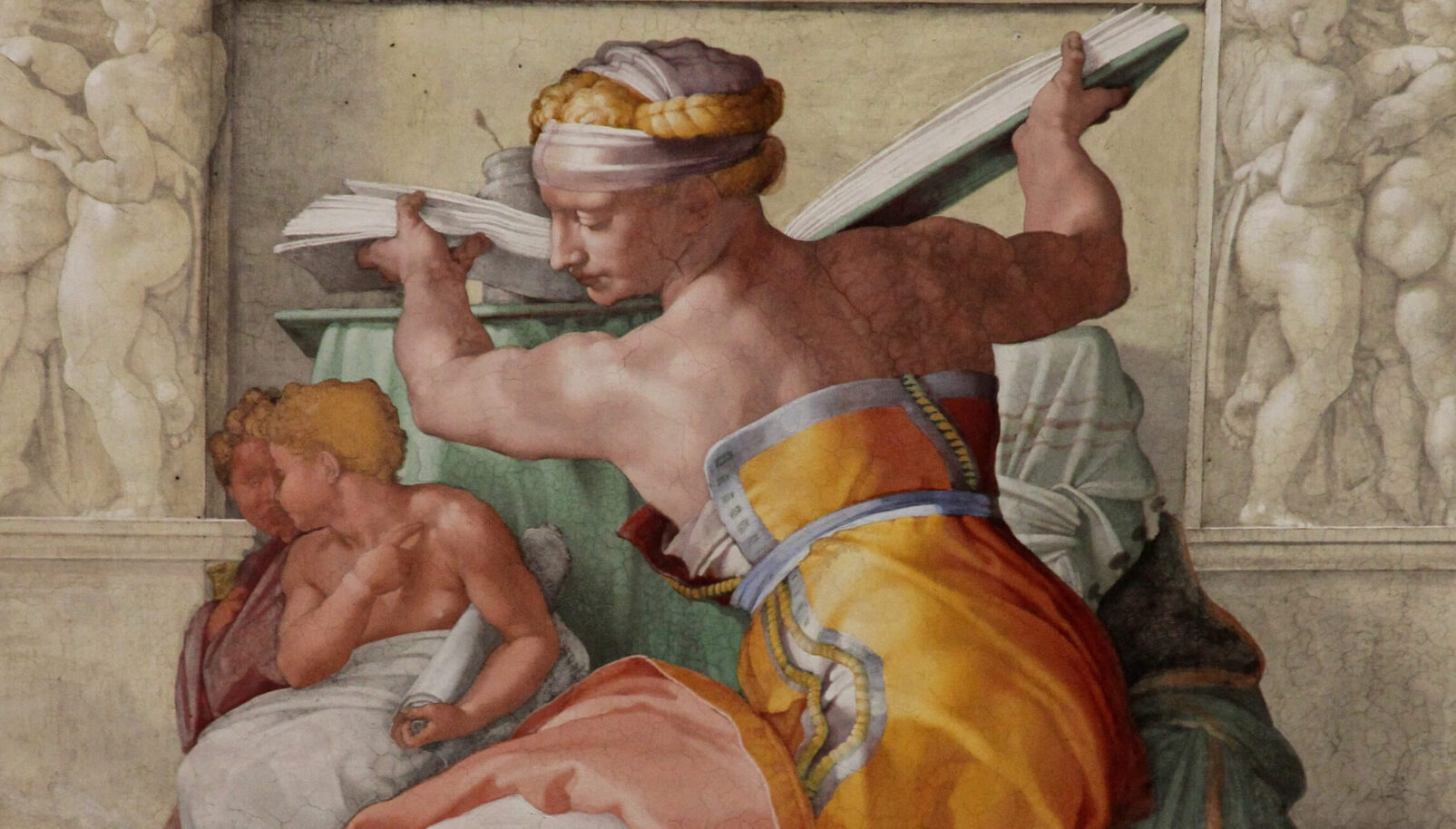
Equally fascinating are the figures of the twelve prophets and sibyls who recline on monumental thrones around the frames of each scene. Sibyls were fortune-telling seers in antiquity; these pagan figures might seem an odd choice for a papal ceiling, but Renaissance thinkers believed the coming of Christ had been allusively pointed to in ancient sources.
The ceiling also contains details that have prompted centuries of interpretation. In 1990 the American physician Frank Meshberger argued that the cloak and angels surrounding God in the Creation of Adam form a cross-section of the human brain, a coded message that God was giving Adam intellect. Two decades later, researchers at Johns Hopkins thought they spotted a brain stem in God’s neck in the Separation of Light and Darkness.
While it’s true that Michelangelo had dissected corpses as a young man and had a deep-seated knowledge of human anatomy, the theories have more than a little of Dan Brown fantasy to them: early sources and Michelangelo’s own writings are entirely quiet on the subject, and most art historians are skeptical of the supposed hidden messages.
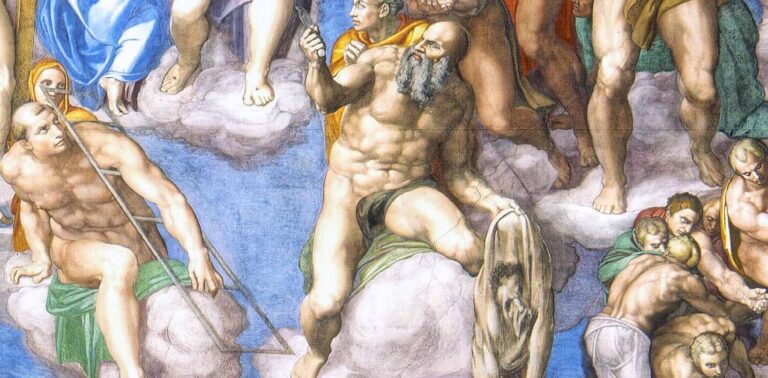
In the Last Judgment, one of the artist’s most revealing self-portraits appears in a form that is as unsettling as it is memorable.
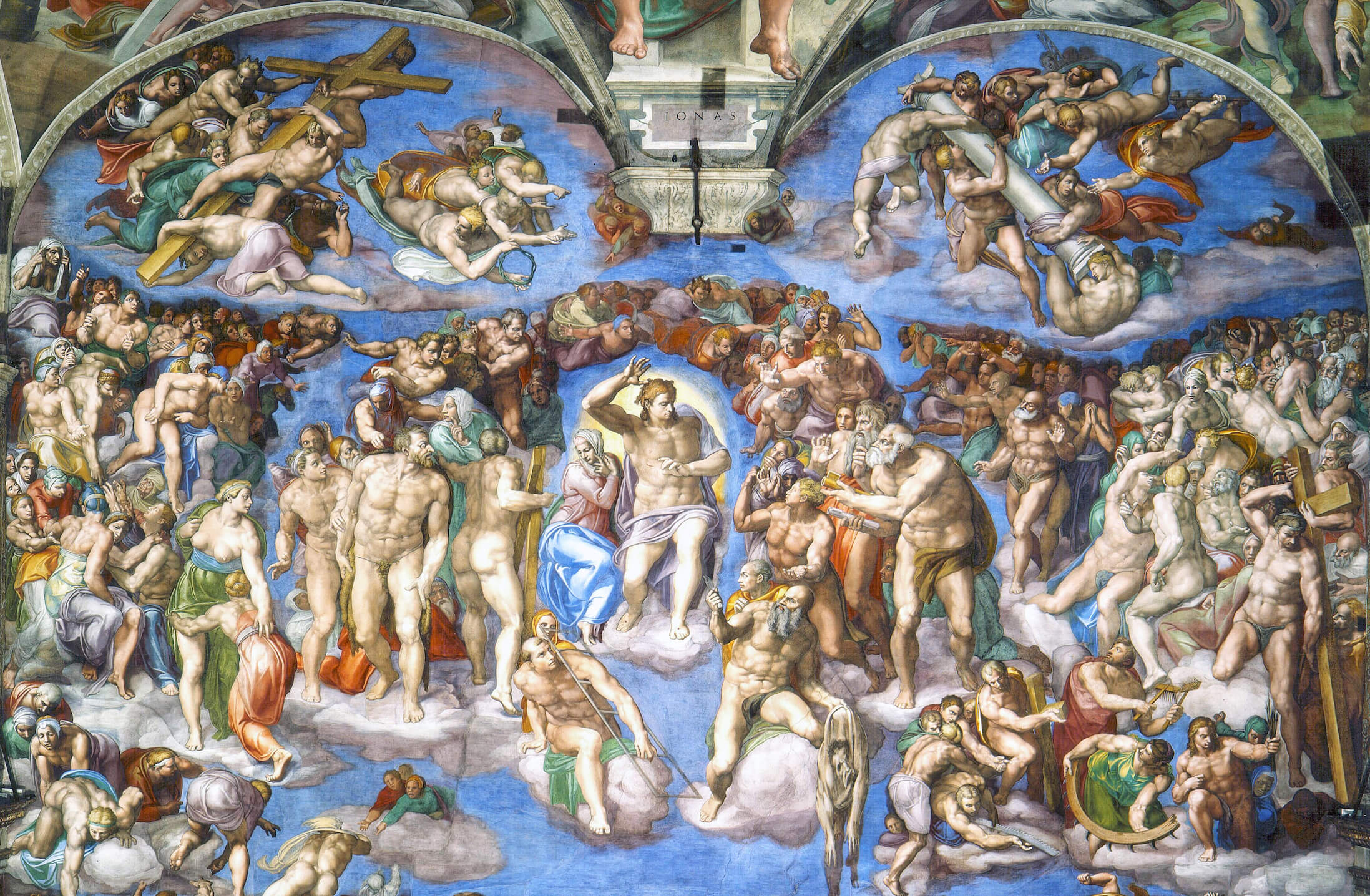
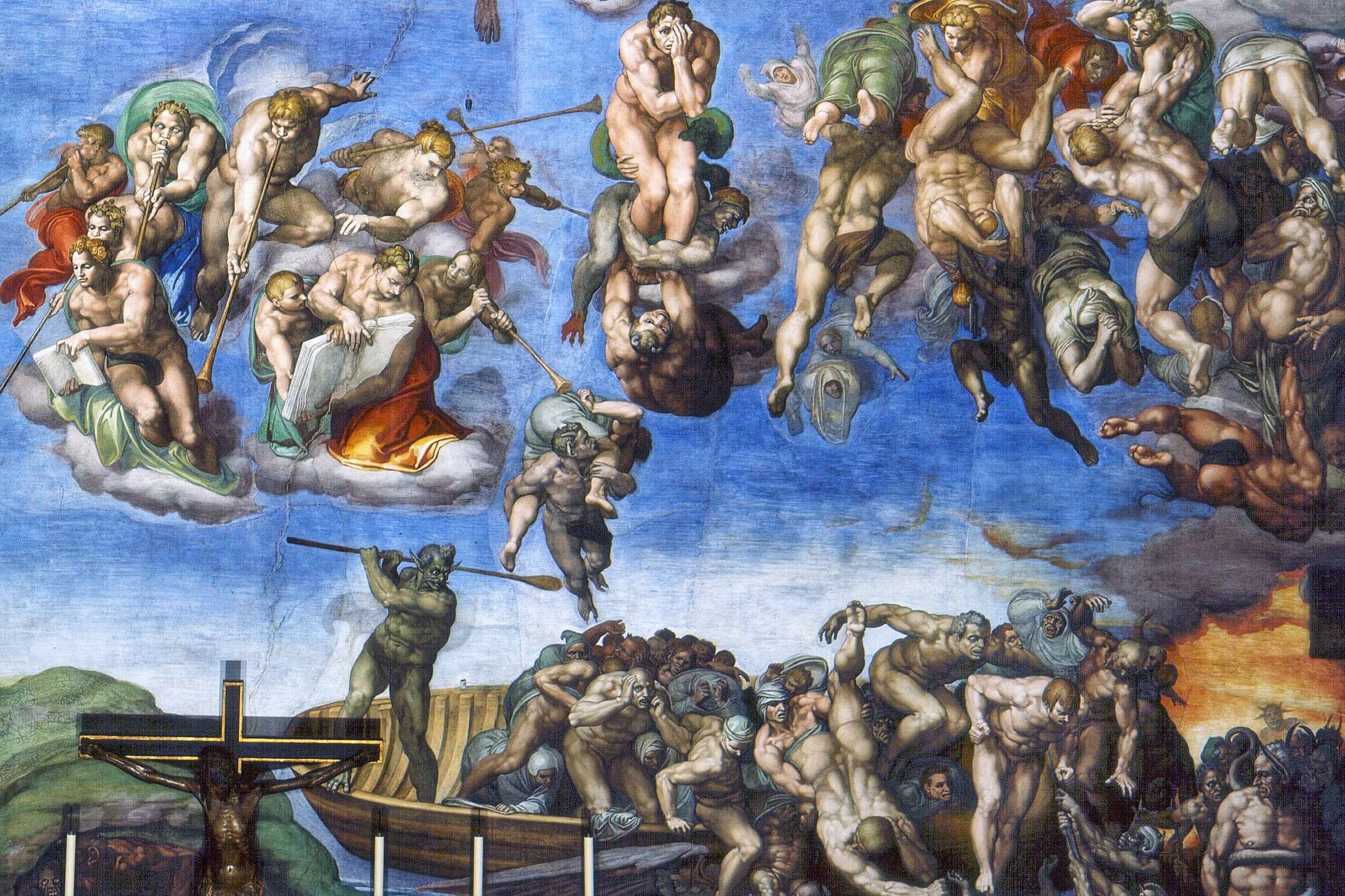
On the altar wall of the chapel, Michelangelo’s Last Judgment presents the end of time as a turbulent vortex of salvation and damnation. Christ occupies the centre with one arm raised in apparent judgement, surrounded by saints and the resurrected dead. Below, the blessed rise towards heaven while the damned are dragged kicking and screaming down to the fires of hell.
Among the crowded and disorientating cast of figures stands Saint Bartholomew, who was flayed alive according to Christian tradition. Here he stands seemingly unperturbed, holding the offending knife in one hand and his own empty skin in the other. Take a close look at the face on that hanging skin: the saint’s features are unmistakably those of Michelangelo himself.
Why would an artist portray himself in such a bizarre manner? We don’t know for certain. The image has been interpreted as an expression of spiritual anguish or a bleak reflection on the artist’s own unworthiness before divine judgment. There might be a more profound theological subtext, too. Later in life Michelangelo came to view the human body as a temporary prison for the spirit that would ultimately be stripped away to leave one’s eternal soul exposed before God.
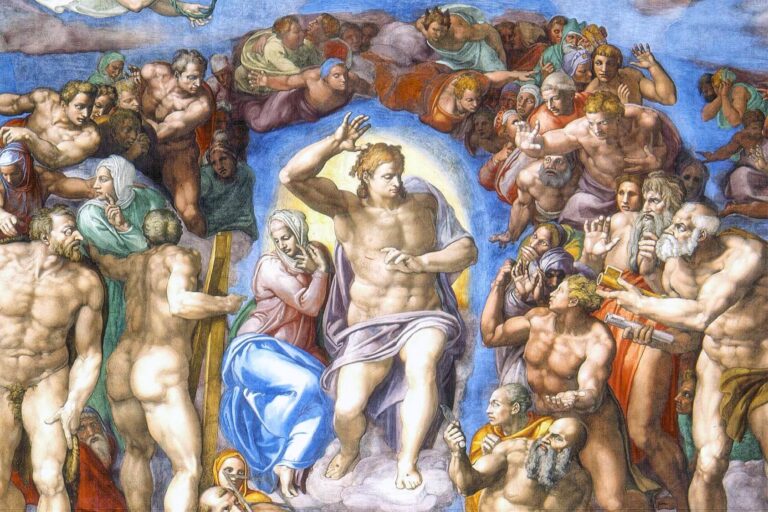
Michelangelo’s nudes provoked a controversy that continued long after the fresco was finished.
Not everyone approved of the swirling mass of monumental nude figures that newly populated the Pope’s chapel. The papal master of ceremonies Biagio da Cesena fulminated over the perceived breach of decorum, stating that the decorations were better suited to a bathhouse or tavern than a sacred space.
Michelangelo answered the slight by painting Biagio’s face onto a figure in the underworld, complete with donkey’s ears and a snake gnawing at his genitals. When Biagio objected, Pope Paul III reportedly replied that as his jurisdiction didn’t extend into hell there was nothing he could do. The portrait stayed.
Later popes were less amused. The puritanical Paul IV is said to have called the fresco “a stew of nudes” and wanted it destroyed. After the conclusion of the Counter-Reformation Council of Trent in 1564, the year after Michelangelo’s death, something had to be done. The most indecent figures were given painted loincloths by Michelangelo’s friend Daniele da Volterra, who acquired the nickname Il Braghettone, or “the breeches-maker” as a result. Further coverings were added over subsequent centuries.
The great restoration that ended in 1994 removed some of the later additions, but many of Daniele’s remain – now an indelible part of the fresco’s history.

The muscular, airborne Creator of the Sistine Chapel ceiling has proved enormously influential.
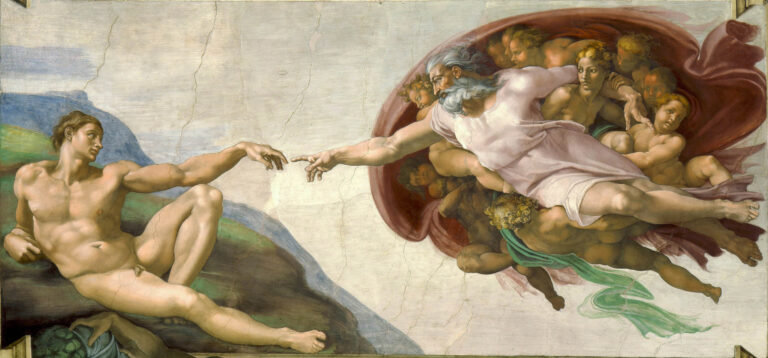
Look at Michelangelo’s Creation of Adam and the image is instantly recognisable: an elderly, bearded God, his arm outstretched as he reaches towards the first man. The two fingers almost meet, capturing the moment of creation in a gesture that has become one of the most iconic in the history of art.
Michelangelo didn’t invent the familiar image of God as a bearded old man, but his virile airborne Creator was an extraordinary reinvention of the type. Rather than presenting the Creator enthroned in majesty or appearing as a distant, symbolic presence, Michelangelo presents us with a muscular body in motion, carried forward by a billowing cloak and a flurry of figures.
His treatment of God helped establish a powerful visual model for later artists, fixing the image of an embodied creator in the collective unconscious. It is a remarkable artistic achievement: an image of divine power made compellingly human, which has helped shape how generations of viewers imagine God the Father. Once you see Michelangelo’s version of God, it’s hard to think of a more valid alternative.

For all its fame as an artistic destination, the chapel remains a working part of the Catholic Church.
As you make your way through the Museums, it’s important to remember that the Sistine Chapel is not simply a gallery of Renaissance masterpieces. It remains a functioning chapel, and it is here that cardinals gather in conclave to choose a new pope. The notorious Borgia pontiff Alexander VI was the first to be elected here in 1492, although the chapel only became the permanent site of conclave in the nineteenth century.
The college of cardinals most recently walked into the chapel in May 2025. The master of ceremonies called out “Extra omnes,” Latin for “everybody out,” and the doors closed. During a conclave, the cardinals vote in strict seclusion. The outside world waits for news gathered in St. Peter’s square, all eyes on the world’s most famous chimney.
After each round of voting the spent ballots are burned. Chemicals are used to produce smoke from the chapel’s chimney: black smoke indicates that no candidate has secured the required majority, while white smoke carries the news that a new pope has been elected. This time around white smoke drifted into the Roman sky on the second day of voting, with Cardinal Robert Prevost becoming Pope Leo XIV – the first from the United States.
The setting suits the business. The chapel’s art is about judgment, sin and redemption, and the cardinals vote with Christ in Michelangelo’s Last Judgment glaring down at them. Choose wisely!

Put your phone away before you enter: the photography ban is strict, and silence is expected.
Photography is permitted in most areas of the Vatican Museums, but the Sistine Chapel is an exception. Visitors are forbidden to take photographs or videos, and if staff catch you taking some surreptitious snaps they will make you delete them.
The photography ban has its origins in copyright arrangements connected with the chapel’s famous restoration in the 1990s. The restoration was funded by the Nippon Television Network Corporation of Japan, who were granted exclusive reproduction rights in return for their investment. The terms of the agreement expired long ago, but the Vatican has maintained the blanket ban since for good reason. If every visitor arriving in the Sistine Chapel were permitted to break out the long lens, an already crowded situation would soon become unbearable.
The strict rules are actually a blessing in disguise. The ceiling is so vast that a photograph taken from floor level cannot convey its scale or the relationships between the different scenes. Trying to get the perfect photo is a distraction from the more important business of engaging with Michelangelo’s masterpiece directly.

The frescoes are vulnerable to the conditions in which they are displayed – and your breath is part of the problem.
The Sistine Chapel’s frescoes have survived for over half a millenium, but preserving them is a continuing challenge. Dust, environmental deposits and the effects of thousands of visitors make regular maintenance essential. A controversial restoration in the 1990s removed the accumulated soot and grime of centuries, revealing what many scholars maintained was Michelangelo’s original vibrant color palate – though this was fiercely contested by other experts.
More recently the Vatican Museums carried out extraordinary maintenance on the Last Judgement in Spring 2026 to remove an almost invisible whitish film that had dulled the fresco’s colours and softened its contrasts, likened it to “a sort of cataract” by the museum’s curator.
Apparently we were all part of the problem. When we sweat and breathe we release lactic acid into the air, which reacts over time with calcium on the surface of the fresco to form the pesky film. Sistine Chapel each year you’ll get a sense of the scale of the issue.
Conservation is rarely as dramatic as Michelangelo’s painting – the cure in this case was a gentle treatment with Japanese paper and deionized water – but it is essential to the chapel’s survival. These days the chapel also boasts a state-of-the-art air-conditioning system with cameras that count heads and adjust the air, along with some 7,000 LED lights.
To get an in-depth understanding of Michelangelo’s extraordinary masterpieces in context, join one of Through Eternity’s Vatican and Sistine Chapel tours. With over 25 years of experience and a team of expert guides, there’s no better way to visit the Sistine Chapel!
Plan Your Vatican Visit Today!