When Michelangelo unveiled the ceiling of the Sistine Chapel in 1512, the history of painting changed overnight.
Nobody who arrives at the spectacular climax of the Vatican Museums remains unmoved by what they see: Spanning over 500 square metres and teeming with over 300 figures, Michelangel’s frescoed ceiling is as much a theological epic as it is a visual masterpiece. Painted over four intense years, the frescoes present a sweeping vision of divine creation, human frailty, and the hope of salvation – but they don’t exactly hand over their meaning on first glance.
Behind the hypnotic beauty lies a tightly constructed narrative, one that draws from the Biblical Book of Genesis, classical antiquity, and the shifting spiritual currents of the Renaissance. Between the prophets, sibyls, nude youths and dramatic central scenes, it’s easy to feel overwhelmed by the sheer density of symbolism. If you’ve ever found yourself dazzled but confused by the mass of figures populating Michelangelo’s iconic vault, you’re not alone.
That’s why we’ve put together this guide to the iconography of the frescoes. Read on to find out exactly what’s happening up there – and why every detail matters.
MORE ARTICLES IN THIS SERIES
- 5 Things You Need to Know About the Sistine Chapel
- The Sistine Chapel Before Michelangelo
- Michelangelo and the Warrior Pope Julius II
- How Michelangelo Painted the Sistine Chapel Ceiling
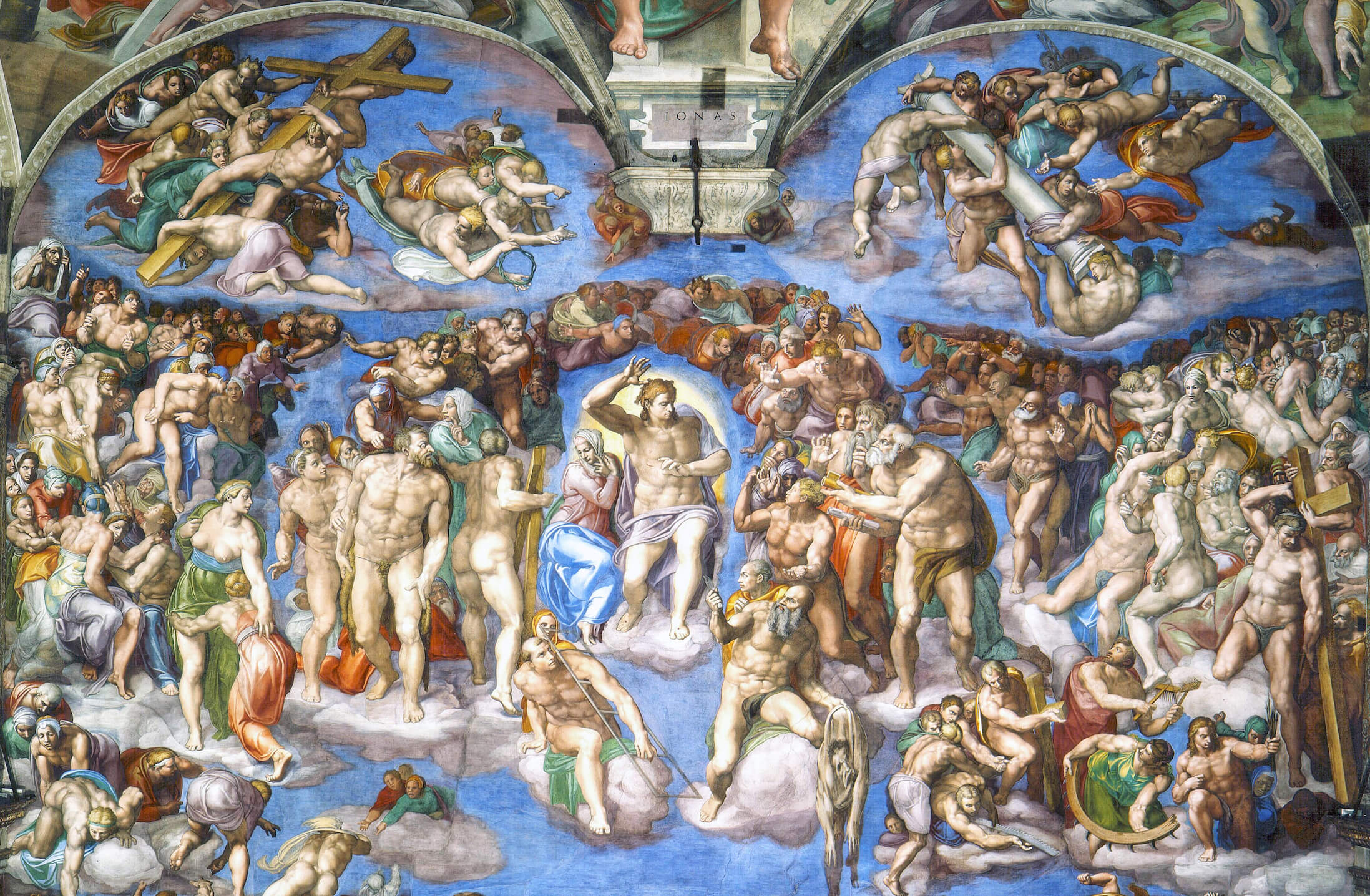
- The Last Judgement in the Sistine Chapel
 Want to understand Michelangelo's Sistine Chapel frescoes?

From the Creation of Adam to the Last Judgment, Michelangelo transformed the chapel into one of the greatest achievements of Renaissance art. Our Vatican tours reveal the stories, symbolism, and ambition behind the frescoes.
Discover the Sistine Chapel
Join a Vatican Tour

The themes of Michelangelo’s work are extremely complex and require a little unpacking if you want to appreciate the full extent of his achievement as you gaze up at the distant ceiling from the ground far below. Originally, Pope Julius II expected the artist to paint the twelve apostles surrounded by ornamental designs, but Michelangelo ultimately came up with something far more radical: an elaborate vision of divine creation, human frailty and the hope of salvation, built around the opening chapters of the Book of Genesis.
The nine central scenes tell the story from the creation of the world to the life of Noah, but they are only the beginning. Around them, Michelangelo arranged seven Old Testament Prophets and five pagan Sibyls, twenty muscular nude youths known as ignudi, the Ancestors of Christ above the windows, and four corner scenes depicting the miraculous deliverance of the people of Israel. A painted architectural framework binds these different elements into a single, astonishingly complex composition.
The scale of the undertaking is simply extraordinary: more than 300 figures populate the ceiling’s vast expanse. Scholars continue to debate how the theological programme was devised, and whether a theologian at the papal court helped Michelangelo develop it or whether the artist himself was responsible for its overall conception. This would have been unusual, but given Michelangelo’s deep knowledge of the Bible, his formidable intellect and his tendency to do things his own way, it’s far from impossible.
What is clear is that the result is much more than a series of biblical illustrations. The ceiling connects the creation of humanity, its fall into sin and the long history leading towards Christ, bringing together biblical tradition, classical antiquity and Michelangelo’s extraordinary understanding of the human body.


The Sistine Chapel ceiling tells a Christian story, but Michelangelo includes some decidedly unexpected characters in his narrative. Seated on monumental thrones around the central Genesis scenes are seven Old Testament Prophets and five ancient Sibyls. Together they make the traditional argument that the coming of Christ had been foretold both by the Hebrew prophets and, in a more allusive fashion, by voices from beyond the Jewish world in antiquity. Each clutches the book or scroll that recorded their prophecy.
Each figure has a name inscribed beneath the throne on which they sit. Michelangelo gives each a distinct personality, using the elegant twist of a torso, the turn of a head or the weighing of a book to suggest a mind at work. Some are absorbed in private revelation, while others appear to be still trying to make sense of the divine knowledge they have just received.
The Prophets
The prophets are a particularly impressive bunch. Jonah is flung vertiginously backwards in a spectacular feat of foreshortening as his body apparently defies the real curve of the ceiling. The story goes that Jonah was swallowed whole by a whale (which you can see next to the prophet). His emergence after three days in the belly of the beast was interpreted as a prefiguration of Christ’s death and Resurrection, explaining his prominent position directly above the altar.
Jeremiah meanwhile sits with his head bowed and his hand at his beard, lost in thought. Ezekiel twists around in startled animation, as if a voice has interrupted him mid-sentence. These figures are the biggest in the Chapel, and were lauded for their beauty by contemporary authors as soon as the Ceiling was unveiled.
The Sibyls
The Sibyls are no less fascinating. In classical antiquity, they were believed to deliver prophetic utterances, often in ecstatic states. Christian writers later argued that the Sibylline prophecies allusively predicted the coming of Christ, justifying Michelangelo’s decision to incorporate these pagan figures into the chapel’s Christian vision of salvation.
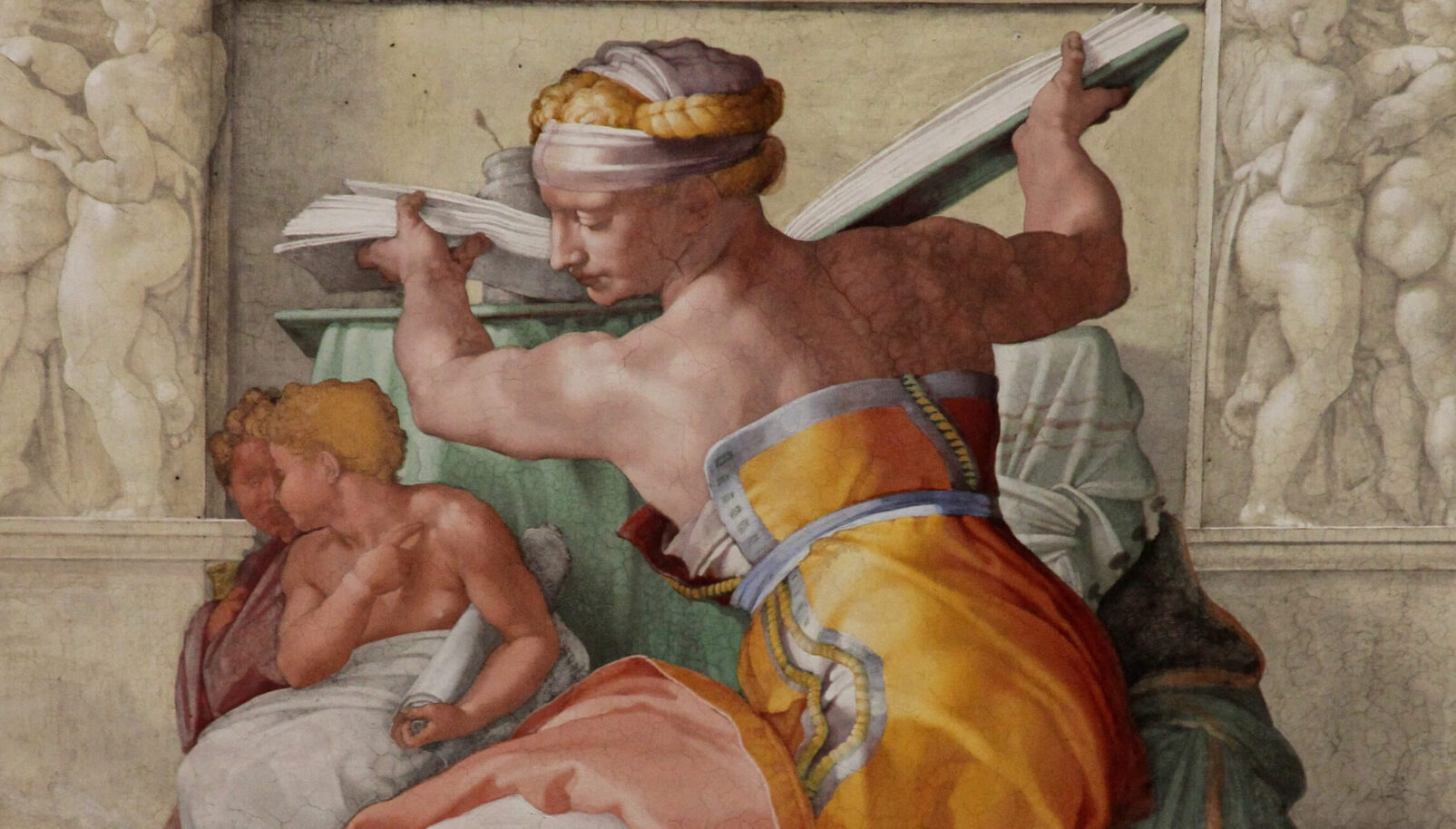
The Delphic Sibyl looks alert and almost startlingly youthful, while the Cumaean Sibyl is an altogether more formidable presence, her massive arms and deeply lined face suggesting a lifetime of accumulated wisdom. The Libyan Sibyl, twisting to lift a great book behind her, is one of the ceiling’s most extraordinary studies of the human body in motion.
Michelangelo’s women are hardly delicate creatures, and frequently divide modern opinion. Their formidable physiognomies have sometimes prompted complaints that he has given them the bodies of male athletes, but that misses something fundamental about his art. Their muscular physiques were certainly not accidental or the result of incompetence: Michelangelo was interested in the body as an instrument of expression, and for him the monumental human form symbolized mankind’s potential perfection as created in the image of God himself.

Look beyond the monumental prophets and sibyls and another part of Michelangelo’s programme begins to emerge. The lunettes above the windows and the smaller spandrels above them feature portraits of Christ’s ancestors, drawn from the genealogies that connect Jesus to the generations that came before him.
These are not heroic figures in the manner of the prophets, and nor do they perform miracles or deliver grand prophecies. Instead, Michelangelo gives us families: men and women sitting, resting, turning towards children or seemingly absorbed in their own thoughts. Their poses can feel almost casual beside the theatrical energy of the ceiling’s central scenes. Some look outwards; others seem entirely oblivious to the monumental story taking place above them.
This part of the ceiling is often overlooked because of its apparent ordinariness, but it showcases a fascinating other side of Michelangelo’s great vision. Where the central panels show the creation of humanity, its fall and the devastation of the Flood in scenes of drama and derring-do, these quieter groups point to the long, imperfect human history that follows. The vast history of salvation has been given its all-important human scale.

At the heart of Michelangelo’s Sistine Chapel ceiling lies the story of Genesis, from the creation of the universe to the final episodes in the life of Noah. Across nine central panels, the artist brings the opening book of the Bible to life with monumental figures, sweeping gestures and scenes that range from the sublime to the distinctly human. The result is both a visual account of humanity’s beginnings and a showcase for Michelangelo’s extraordinary imagination.
The panels are arranged in biblical order when read from the altar towards the entrance, beginning with the creation of the world and ending with Noah’s drunkenness. Michelangelo, however, painted them in the opposite direction, starting with the Noah scenes and working towards the altar. As he progressed, his figures grew larger and his compositions more direct, giving us a remarkable record of an artist developing his style as he worked.
The Drunkenness of Noah

The Drunkenness of Noah was the first scene Michelangelo painted on the ceiling. The patriarch has discovered winemaking but, unfortunately, is ignorant of its powerful effects, and passes out naked to sleep off the hooch.
The sozzled Noah is discovered in his reduced state by his sons, and the episode turns into a family feud. Ham sees his father naked and tells his brothers, Shem and Japheth, who approach backwards to cover him without looking.
When Noah wakes and learns what has happened, he curses Canaan, Ham’s son. The scene’s almost humorous tone might seem out of place with the seriousness of the other images on the ceiling, but it conceals powerful symbolism: many in the 16th century saw in Ham’s jeering reaction to his father’s inebriation a foreshadowing of the mocking Christ endured on his way to crucifixion.
The Flood

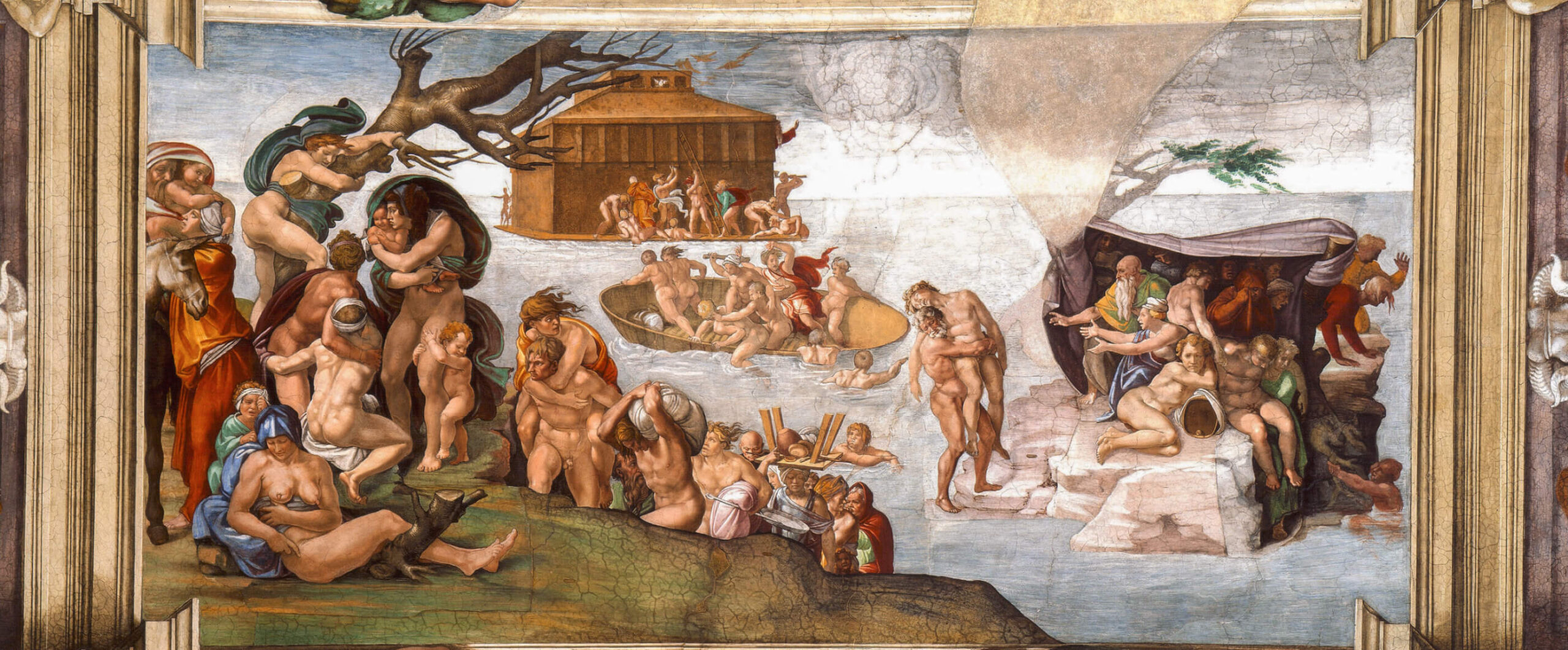
The next scene Michelangelo painted technically occurs before the drunken episode: this is the Deluge, in which humanity is punished with a devastating flood for the state into which it has fallen. Noah is chosen by God to build an ark, preserve animal life and give the faltering project of humanity another chance. The fresco is one of the most visceral scenes on the ceiling, full of desperate figures struggling to escape a catastrophe they cannot control.
Groups of distraught, naked people seek refuge on higher ground as the waters rise. One figure clings hopelessly to the dead trunk of a blasted tree as the storm whips at her garments. A boat capsizes in the swirling waters, sending its occupants to their deaths; in the distance, the hull of Noah’s Ark remains secure against the onrushing flood. The contrast is brutal: the people in the foreground scramble for survival, while the tiny vessel carrying the future of humanity rides out the destruction.
The composition is crowded with incident, and the individual groups almost compete for our attention. That density is part of the fresco’s power, but it also distinguishes it from the more monumental, simplified compositions Michelangelo painted later in the project. As he gained confidence and moved his scaffolding towards the altar, his figures would grow larger and his visual language more commanding.
The Sacrifice of Noah

Completing the three Noah scenes is the Sacrifice of Noah, in which the patriarch gives thanks to God for his deliverance from the flood. Having emerged from the Ark with his family, Noah builds an altar and offers a sacrifice, marking the beginning of humanity’s renewed relationship with God.
It is perhaps the least immediately dramatic of the three Noah frescoes, but its position in the larger cycle matters. The destruction of the Flood gives way to thanksgiving and the possibility of renewal. In the Christian reading of the ceiling, the waters also carried a deeper significance: they could be understood as a prefiguration of baptism, through which humanity might be cleansed and reborn.
Adam and Eve in the Garden of Eden

After the three Noah frescoes, Michelangelo moved his scaffolding and looked at the effect he had created– and was not entirely satisfied. The scale of the images were too small to have their desired impact on viewers craning up their necks from so far below, And so he changed his approach: for maximum impact, his figures needed to become larger and his compositions simpler. The more monumental style that would define his mature work was beginning to emerge.
This new ideal is clearly reflected in the next fresco, which combines two pivotal episodes in the story of Adam and Eve: The Fall and their Expulsion from the Garden of Eden. The scene brings together the Biblical moments that describe the entrance of sin and suffering into the world, setting into motion mankind’s tribulations over the entire course of human history.
The iconic scene needs little explanation: at the centre, a serpent with a female human form coils around the Tree of the Knowledge of Good and Evil, offering the forbidden fruit to the willing Eve, who lounges provocatively on the rocks below. Adam has a part to play too, reaching up greedily towards the tree-boughs as he is drawn into the act of disobedience. This is just before the fall and so they are naked, feeling no shame in the purity of the beautiful bodies God has created for them.
Their innocence is short-lived, and the inevitable result of their transgression takes place on the right where an angel drives the grief-stricken couple from the paradise of Eden at the point of a sword. Adam turns away in anguish, while Eve wrings her hands in despair. Michelangelo compresses temptation, disobedience and punishment into a single powerful image where the same bodies that once embodied divine perfection now index the consequences of human fallibility.
The Creation of Eve

The next images take us further back in time to where it all began for the human race, when things were looking so promising. According to Genesis, God decided that it wasn’t fair to let the newly created Adam go it alone in the world, and so resolved to furnish him with a mate. He takes a somewhat eccentric approach to the situation, putting Adam into a deep coma, splitting open his thorax and pulling out a rib, out of which he fashions Eve.
Here the venerably bearded God takes a more hands-off approach, keeping his distance as Eve emerges from the out-for-the-count Adam’s side at the response of a single wave of the creator’s imperious hand. Michelangelo gives the episode a solemn simplicity, with Eve rising and turning towards God in a gesture of reverence. Rather than depicting the physical act of creation, Michelangelo focuses on the moment when Eve becomes a conscious participant in the world, acknowledging the divine power that has brought her into being.
The Creation of Adam

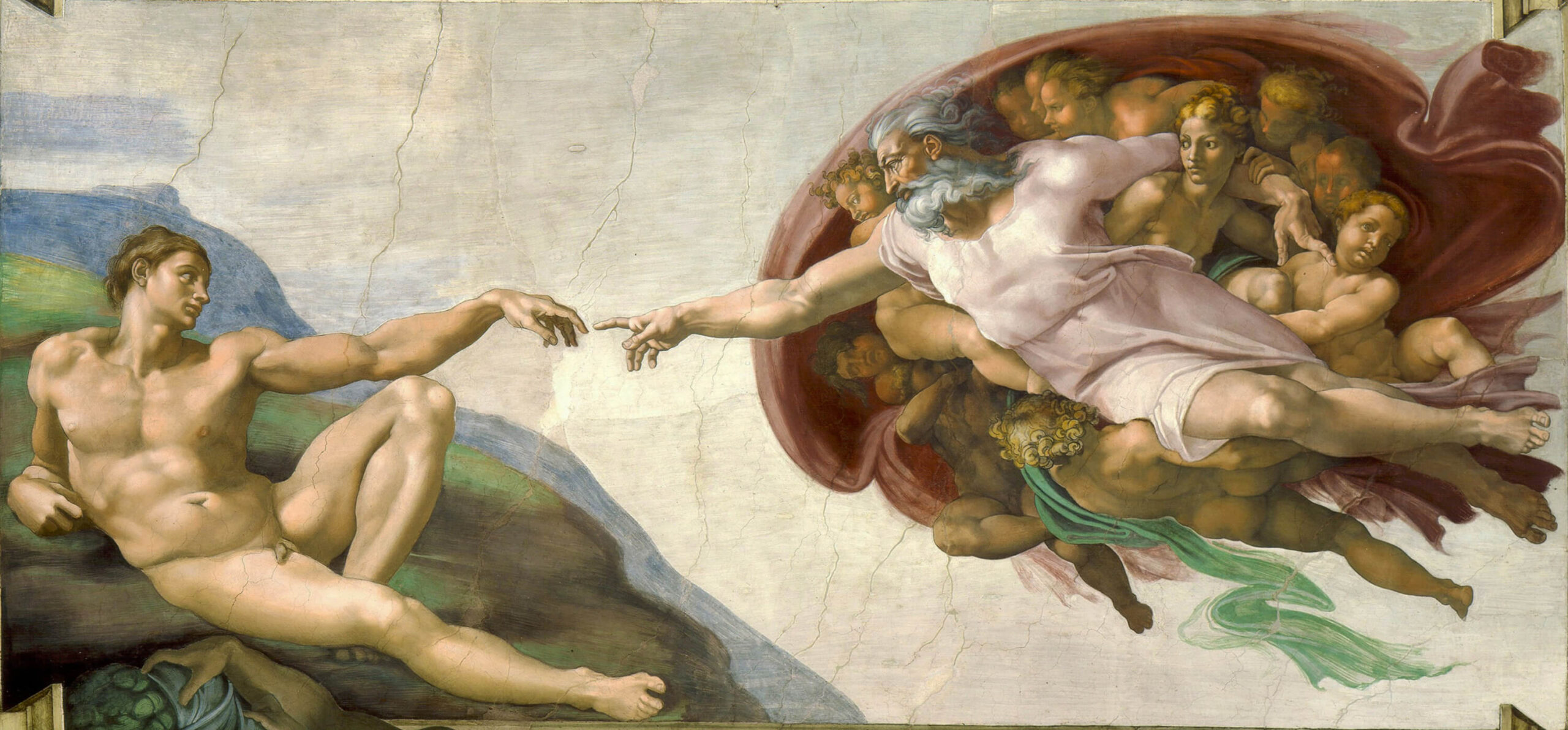
As we’re moving backwards in time, no prizes for guessing what comes next. At the very fulcrum of Michelangelo’s epic biblical narrative is the single most iconic gesture in the history of Western art: the trace contact between the fingers of God and Adam that breathes life into the world and begins the long story of humankind. Michelangelo has captured God right at the moment of creation itself, when Adam has already taken on his fully realised and perfect human form, but remains still a lifeless sculpture.
But Michelangelo the divine painter does something Michelangelo the sculptor could never quite achieve – he sets blood pumping in Adams veins, transforms his inert body into living flesh, and seems on the cusp of turning that lifeless body into a living, breathing, thinking being. God sweeps towards him, borne aloft by a billowing mantle and surrounded by figures who seem caught up in the force of his movement. The Creator reaches out with extraordinary purpose, while Adam raises his hand in response. The tiny space between their fingers carries the whole drama of the encounter.
You’re probably so familiar with this image of two ideal bodies reaching towards each other with hands outstretched from its ubiquitous presence in popular culture that you might think it can’t surprise you. And yet gazing up at Adam’s sinuous and muscular form as light flickers into his eyes for the first time is a spellbinding experience.

The final three scenes in Michelangelo’s painting sequence take us back to the first moments of the universe, where God appears as a monumental, all-powerful figure conjuring the world into existence. These panels are dominated by the Creator, whose sweeping gestures and extraordinary foreshortening turn the act of creation into a physical feat. They also show how dramatically Michelangelo’s style evolved over the course of the project: the crowded scenes near the entrance have given way to compositions of astonishing simplicity and scale.
The Separation of Land and Water

In the Separation of Land and Water, God flies directly towards the viewer, his body foreshortened as he stretches out his hand to divide the earth from the waters. The gesture seems to forge the contours of the world itself. Michelangelo makes the Creator’s body the engine of the composition, with the powerful movement of his limbs conveying the force required to bring order to the primordial landscape.
The Creation of the Sun, Moon and Plants
In the Creation of the Sun, Moon and Plants, Michelangelo paints God twice within the same scene. Seen from behind on the left of the composition, the Creator leans towards the earth to bring forth the world’s first plants from the soil. In the other he turns towards the viewer, raising his arm as he launches the massive disc of the sun into the sky. Look closely and you’ll see the moon’s orb ready for dispatch just behind him.
The two appearances capture different acts of creation in a single sweeping movement. The figure is immense, his purple robes caught in the wind, his body twisted with effort. Michelangelo uses the same physicality that animates his human figures to make divine power visible. Creation is not an abstract process here: it is an act of explosive energy worthy of Oppenheimer as atoms are split and matter surges through the cosmos – all expressed through the movement of a body that seems to fill the heavens.
The Separation of Light from Darkness

The final scene Michelangelo painted is also the first in the biblical sequence: the Separation of Light from Darkness. God raises himself upwards, arms lifted as he divides light from darkness and brings first order to the primordial aether. The figure swoops through the air in extreme foreshortening, his chest and arms twisting with exertion as he soars through the darkness.
Giorgio Vasari, the Renaissance’s first and most celebrated art historian, admired this fresco as a supreme demonstration of the artist’s powers. It is an extraordinary achievement: the composition is dominated by a single figure, yet the force of his movement seems to fill the entire space. After four years of work, Michelangelo brought his vast cycle to a close with an image of creation reduced to its most elemental form.
And so Michelangelo’s extraordinary depiction of mankind finishes just where the story of the world begins in a majestic piece of circular logic, past, present, and future colliding in the extraordinary labor of the master’s brush. The epic narrative of origins and being as outlined in the Genesis story had found its most iconic expression in the creative vision of the only artist with the skill, ambition, and sheer bloody-mindedness to pull it off.

One of the cleverest things about Michelangelo’s ceiling is the way he uses painted architecture to organise what might otherwise be an overwhelming jumble of figures and biblical episodes. Elaborate cornices, ledges and supports create the illusion of a framework dividing the vault into distinct compartments. The nine scenes from Genesis occupy the centre, while the Prophets and Sibyls sit on monumental thrones along the sides, and the Ancestors of Christ fill the spaces above the windows.
Perched on the painted supports around the central scenes are twenty muscular, completely naked youths known as the ignudi (literally, “nudes”). They twist, stretch and lounge in a bewildering variety of poses, sometimes holding ribbons or garlands, sometimes simply seeming to enjoy the opportunity to show off their physiques. They have no obvious role in the biblical narrative, and their precise meaning remains a matter of much debate. They may have a symbolic significance, but their presence also gives Michelangelo freedom to explore the human body in all its complexity.
In the large curved fields known as pendentives situated at the four corners of the ceiling, meanwhile, Michelangelo paints a series of dramatic episodes in which the people of Israel escape destruction. Easily overlooked, they depict David and Goliath, Judith and Holofernes, the Punishment of Haman, and the Brazen Serpent. Each tells a story of danger and deliverance, in which an apparently hopeless situation is overturned through divine intervention or the courage of an unlikely hero.
Together, the painted architecture, pendentives and the ignudi help turn the ceiling into a unified composition rather than a collection of separate pictures. Figures strain against the boundaries of their compartments, limbs project into space, and bodies seem almost to spill out of the painted framework.

The Sistine Chapel ceiling can be overwhelming on a first visit. There are hundreds of figures, biblical stories unfolding in different directions, and a wealth of detail competing for your attention. Don’t try to take everything in at once. Here’s what we recommend:
Start with the big picture
Before concentrating on individual figures, take a moment to look at the ceiling as a whole. Notice how Michelangelo’s painted architecture divides the vault into distinct sections, with the nine scenes from Genesis running down the centre like a spine and the Prophets, Sibyls and other figures arranged around them. Once you are familiar with this underlying structure, the apparent jumble begins to make sense.
Follow the central story
The iconic image of God reaching towards Adam is only one episode in a much larger narrative. The central panels trace the creation of the world, the origins of humanity, the Fall and the story of Noah. Looking at them as a sequence helps you understand how Michelangelo connects the beginnings of human life with the Christian promise of salvation.
Look beyond the famous scenes
The prophets and sibyls are among the ceiling’s most commanding figures, while the smaller family groups above the windows offer a striking contrast to the drama unfolding overhead. The muscular nude youths known as the ignudi are magisterial exemplars of Michelangelo’s ability to render the body beautiful.
Prepare before you enter. Having a basic understanding of the ceiling before you arrive means you can spend less time trying to work out what you are seeing and more time appreciating how Michelangelo brought the whole composition together. If you would like help making sense of the ceiling as you explore the Vatican Museums, a knowledgeable guide can bring the stories, symbolism and artistic decisions into focus.
Ready to visit the Sistine Chapel?
Book Your Tour Here!