
If you’re planning a trip to Europe in 2026 — or have already booked one — there are some significant changes to how you’ll cross into the Schengen Area that you need to know about.
After years of delays and preparation, the European Union’s new digital border control system went fully live on 10 April 2026.
The system is enduring some teething troubles, with the opening days brought queues of up to three hours at major airports across the continent, stranded passengers, and missed flights.
This guide will tell you exactly what has changed, what to expect at the border, and how to make sure your arrival and departure in Europe goes as smoothly as possible.
We will also cover the next phase of EU border reform: the ETIAS travel authorization, expected to launch in late 2026. As a tour operator based in Rome with visitors arriving from across the world every day, this is something we care about deeply, and we want to make sure you arrive ready and relaxed rather than stressed and jet-lagged in an airport queue.
A quick road map: the EU is implementing two separate but linked border systems. The first — the Entry/Exit System (EES) — is already operational. The second — the European Travel Information and Authorization System (ETIAS) — is not yet live, but will be required for most visitors from late 2026 onwards. We will deal with each in turn.
Best Italy Tours




What are the new systems regulating entry into the EU for third country nationals?
Starting in 2026, the European Union is introducing two separate new systems that will govern border security in the region. The first, known as the EU Entry Exit System, or EES, is an automated electronic system that will replace manual passport checks and stamps. The second, known as the the European Travel Information and Authorization System, or ETIAS, is a visa waiver scheme that will be required for non EU nationals entering the region for short-term stays (90 days or fewer) from certain visa-exempt countries (including the USA) from late 2026. Keep reading for more information on both.
1. The EU Entry/Exit System (EES)
What is the EES and what do I need to do?

The EU Entry/Exit System is a digital border management system that replaces manual passport stamping at the external borders of 29 European countries that make up the Schengen Area plus Cyprus.
As of 10 April 2026, the EES replaces the stamping of passports, allowing the automatic detection of overstayers — travellers who have exceeded the maximum duration of their authorised stay.
In practical terms: where a border officer used to flip through your passport, find a blank page, and thump a stamp into it, you will now be registered in a centralized digital database.
Biometric information such as facial images and fingerprints, along with personal data from the travel document being used, will also be recorded the first time you use the system.
The system’s stated goals are to strengthen border security, make the 90-day stay limit easier to track and enforce, reduce identity fraud through the use of biometrics, and — eventually — make border crossings faster.
That last ambition is one that early evidence does not yet support, as we explain below.
Who Does the EES Apply To?
The EES applies to non-EU/Schengen citizens going to Schengen or EU countries for short stays of up to 90 days in a 180-day period. This includes UK citizens, as well as visa-exempt travellers, regardless of whether they are travelling for tourism or business.
To put it plainly: if you are visiting Europe from the United States, the United Kingdom, Australia, Canada, or any of the approximately 60 countries whose citizens currently enjoy visa-free travel to the Schengen Area, the EES applies to you every time you enter or exit.
Some people are exempt. EU and Schengen citizens do not need to register. People with long-term visas or EU residence permits are also exempt.
Ireland and Cyprus are not part of Schengen and thus exempt from using EES, which means that they will continue with manual passport checks.
Crew members on international journeys, diplomatic passport holders, and citizens of the micro-states of Andorra, San Marino, Vatican City and Monaco are also not required to register.
One important nuance for families travelling with children: children under 12 don’t have to provide fingerprints, but still need to have a photo taken.
Under the EES, every member of your travelling party needs their own individual passport — the old practice of children travelling on a parent’s passport has ended.
What Happens at the Border on First Registration?
The first time you cross an EES-enabled Schengen border, the registration process works as follows. If you have a biometric e-passport (the kind with a small chip symbol on the cover), you can use self-service kiosks at the airport to scan your passport and provide your biometrics — a facial image and your fingerprints.
After the kiosk step, you will still see a border officer, but the process is intended to be quicker than starting everything from scratch at the desk.
If you do not have a biometric passport, you must go directly to a manned booth, where an officer will take your photograph and fingerprints manually. This takes longer and has contributed to much of the congestion seen at airports in the weeks since full launch.
You don’t have to register in advance for the EES, as registration happens at the border when you arrive at the EU. There is, however, an optional app worth knowing about. The EU’s official “Travel to Europe” mobile app allows you to pre-register your passport details and a facial image up to 72 hours before you arrive, which can reduce the time you spend at the kiosk.
Currently, it is available only in some countries like Portugal and Sweden, with plans to expand the app across the EU. Check whether it is available for your entry point before your trip.
Once you have registered, your data is stored for three years (or until your passport expires, whichever is sooner). On subsequent entries to the Schengen Area within that period, the process is significantly faster — only a facial scan is required, rather than the full fingerprint registration.
The Reality: Expect Delays in 2026
We want to be direct with you here rather than reassuring in the vague way of official communications: the EES rollout has been seriously disruptive, and you need to build significant extra time into your airport schedule, especially this summer.
The EU’s new Entry/Exit System brought significant disruption and delays to airport border control over the first weekend, with queues of up to three hours and reports of stranded passengers missing flights.
The problems were not confined to one airport or one country. At Milan’s Linate airport, there were 156 passengers booked on an EasyJet flight to Manchester. After facing hours-long queues, only 34 boarded the aircraft, leaving 122 behind who “watched their plane depart without them.”
Individual countries have responded differently to the teething problems. Greece temporarily exempted UK nationals from biometric registration entirely, reverting to traditional passport stamps for British visitors. Spain is tweaking kiosk rules rather than suspending. Italy is applying EES unevenly across airports.
The practical upshot: do not assume your experience at the border will be identical to a friend’s experience at a different airport a week earlier. The system is still being consolidated, and implementation remains uneven.
Practical Advice
How to Minimise Border Delays in 2026
These are the steps that genuinely make a difference, based on the latest available advice from airports, airlines, and experienced travellers:
Arrive much earlier than usual.
The old rule of thumb of two hours before an international flight is no longer sufficient for non-EU travellers in 2026. Industry experts now advise non-EU travelers to arrive at least three to four hours before departure for international flights. This applies both on arrival into Europe and on departure from it — the EES checks happen in both directions.
Download the Travel to Europe app if it’s available.
If your entry airport in Europe supports the official pre-registration app (currently only Portugal and Sweden, but this will expand), download it and register your details up to 72 hours before you travel. It will not eliminate queuing, but it reduces the time you spend at the kiosk. Search “Travel to Europe” in the App Store or Google Play — only download from official EU government sources.
Have your passport ready immediately.
Remove it from any holder or wallet and have it open to the photo page before you reach the front of any queue. Remove glasses and ensure your face is uncovered well before you reach the front of the line to save those crucial extra seconds. Every saved second per passenger, multiplied across hundreds of people in the same queue, matters.
Do not book tight connections through Schengen hubs.
If you are transiting through Frankfurt or Amsterdam to onward Schengen destinations, aim for a minimum three-hour layover right now. A two-hour connection that worked perfectly a year ago could easily result in a missed onward flight today.
Check your specific airport’s status before you travel.
Several major airports now publish real-time border queue updates on their websites and social media. In Spain, AENA publishes queue data every 30 minutes on its website. A quick check before you leave for the airport can tell you whether to pad even more time.
Refuse-to-register is not an option.
Travellers who refuse to provide biometric data will automatically be refused entry. The registration is mandatory.
Finally, it will get better.
The disruption of spring 2026 is partly the result of every first-time registrant needing the full biometric enrolment simultaneously. As the proportion of registered returning travellers increases, average processing times should fall. The chaos of the first weeks is not a permanent condition, but it will take some months to stabilise.

2. ETIAS: Coming Late 2026
What is the new Visa Waiver ETIAS Travel Authorization document?
The European Travel Information and Authorization System (ETIAS) is the second major component of the EU’s border modernisation.
Where the EES is a border-crossing registration system, ETIAS is a pre-travel authorization — something you apply for before you leave home, similar to the US ESTA or the UK’s ETA. The EU’s official reporting updated on April 22, 2026, confirms that ETIAS is scheduled to launch in the last quarter of 2026.
ETIAS is not a visa. It is an online authorization that visa-exempt travellers will complete before boarding their flight, involving a brief form and a fee. Once approved, it will be electronically linked to your passport.
Who Will Need ETIAS?
ETIAS will apply to nationals from approximately 60 countries that currently enjoy visa-free access to the Schengen Area — including citizens of the United States, the United Kingdom, Canada, Australia, New Zealand, Japan, South Korea, and dozens of others. It will cover 30 European countries: the 29 Schengen member states plus Cyprus.
Ireland remains outside both the EES and ETIAS frameworks.
If you are a citizen of a country that currently requires a Schengen visa, ETIAS does not affect you — you continue to need a visa.
What is the timeframe for the introduction of the ETIAS?
The timeline has a few phases that are worth understanding clearly:
The ETIAS portal is expected to open and begin accepting applications in October–December 2026. ETIAS will not go from “optional” to “mandatory” overnight. The rollout happens in three phases: a launch period, a transitional period of six months during which entry will not be denied to those who have not yet applied, and then full mandatory enforcement — not expected until around April 2027 for most travellers.
In practical terms: if you are travelling to Europe in 2026, you do not need ETIAS yet. If you are travelling in early 2027, you should apply as soon as the portal opens to be safe.
A word of warning about scams: fraudulent websites are already operating, claiming to process ETIAS applications and charging fees far above the official rate. Red flags include: any site asking for €50, €80, or €100; sites accepting applications now (the system is not yet live); and sites not ending in .europa.eu for official information. The only legitimate ETIAS application portal will be at travel-europe.europa.eu. Any third-party processing service you find online today is either an overpriced intermediary at best, or an outright fraud at worst.
How Do You Apply For the ETIAS Travel Authorization?
After the system has been launched, applying for your ETIAS Visa Waiver via the official website will be very straightforward. You will need to pay a fee of €20 to apply (applicants who are under 18 or above 70 years of age don’t have to pay) and be in possession of a valid passport not more than 10 years old. You’ll also have to provide the following information on the online form:
- Travel document details;
- Personal information including your full name, date and place of birth, nationality, home address, parents’ names, email address and phone number;
- Details about your level of education and current occupation;
- Details about your intended travel and stay in any of the countries requiring ETIAS (this only applies to your first trip, and can change);
- Details about any criminal convictions, any past travels to war or conflict zones, and whether you have been subject of a decision requiring you to leave the territory of any country (so-called return decisions).
How Much Does ETIAS cost?
The European Travel Information and Authorisation System (ETIAS) fee will be €20, confirmed by the European Commission on 17 July 2025.
This increase from the previously stated €7 aims to cover the operational costs of ETIAS, taking into account all its functionalities and inflation rates, and aligns the EU fee with those of other countries that have similar travel authorisation programmes.
Exemptions apply: travellers under 18 and over 70 do not pay the fee, though they still need to complete the application.
How Long Is the Travel Authorization Valid For?
The ETIAS travel authorization is valid for three years, or until your current passport expires, whichever comes sooner. You’ll be able to travel as many times as you want to EU countries in this period – you won’t need to reapply for new trips, or provide further information about new travel plans – the travel information that you provide when you apply is only required to process your application. After 3 years or your passport expires you’ll need to complete the application process again.
Which Countries are Participating in the New ETIAS Travel Authorization?
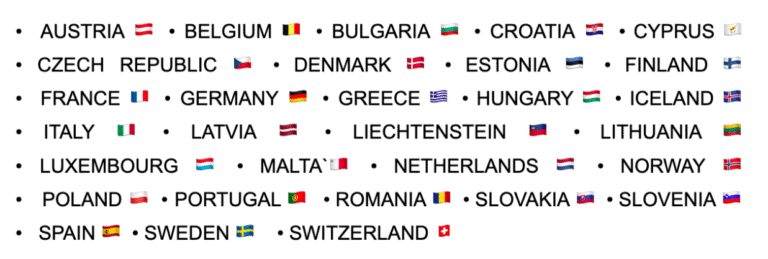
With the exception of Ireland (you won’t require an ETIAS travel waiver to visit the Emerald Isle, but will if you plan on any onward travel to other European destinations), all member states of the European Union as well as the Non-EU members of Schengen will require ETIAS Travel Authorization for entry. Here’s the full list:
How Long Will It Take for my ETIAS Application to be Processed?
It is envisaged that approval for the ETIAS will be very quick. In most cases processing the application will only take a few minutes. You’ll receive an email confirming that your application has been successful, and from that moment you’ll be ready to travel!
In some cases the process might take longer, but you should receive a confirmation within a maximum of 96 hours.
You will be informed via email if more information is required to process your application, but this will only occur in a very small number of cases.
For the vast majority of travelers, the system will not entail major headaches. Nonetheless, it will be sensible to obtain your ETIAS well in advance of your travel dates.
EES and ETIAS FAQ
Do I need to do anything before travelling to Europe right now (May 2026)?
If you are a visa-exempt traveller (US, UK, Australian, Canadian etc.), you do not need to apply for or register anything before you travel. Registration happens at the border on your first EES crossing. You do not need ETIAS yet — it is not yet operational. The only action required before you travel is allowing significantly extra time at the airport.
Do I need to register for EES every time I enter Europe?
No. Once you have completed your first full biometric registration, your data is stored for three years (or until your passport expires). On subsequent crossings within that period, you will only need a facial scan at the border rather than the full fingerprint and photo registration. Processing will become substantially faster for returning visitors.
What if the biometric system is down when I arrive?
Border agents have fallback procedures for system outages, including manual registration. You will not be turned away because of a technical issue.
Does EES apply to children?
Yes, all travellers entering the Schengen Area on a short stay must be registered under EES. Children under 12 do not need to provide fingerprints but still need a facial photo. Every child needs their own individual passport.
When will ETIAS be mandatory?
ETIAS is expected to launch in Q4 2026 and will enter a transitional period of approximately six months. Full mandatory enforcement is not expected until around April 2027. Confirm with official EU sources nearer your travel date.
Will I Need to Bring a Copy of the Travel Authorization With Me?
No. The ETIAS certification is electronically linked to your passport, so border controls will know that you are in possession of a valid visa waiver when your passport is scanned.
Can I be refused entry because of EES?
EES itself does not determine whether you can enter — it just records the data. Border officers make entry decisions based on your documents, the purpose of your visit, and whether you have met all entry requirements. Since the EES rollout, more than 24,000 people have been refused entry due to reasons like expired and fraudulent documents, or not being able to fully justify the reason for their visit.
Does ETIAS guarantee entry into Europe?
No. ETIAS authorization does not guarantee entry — it only establishes pre-travel eligibility. Border officials make the final decision on entry upon arrival.
Is Ireland included?
No. Ireland is not part of the Schengen Area and does not participate in either EES or ETIAS. If your trip includes Ireland only, neither system applies. If you travel onward from Ireland to any Schengen country, EES (and eventually ETIAS) will apply from that point.
Where can I find the official information?
The European Commission maintains official information at home-affairs.ec.europa.eu for EES, and travel-europe.europa.eu for ETIAS. These are the only authoritative sources.
Book Your Italy Experience