When you come to Rome, there are certain places that you simply can’t afford to miss.
St. Peter’s Basilica is the most important church in the Catholic world and one of history’s greatest architectural achievements. Whether it’s your first time in the Eternal City or you’re making your umpteenth trip back, you always owe a visit here – because no matter how many times you’ve been, St. Peter’s always has something new to offer.
With a history stretching back to the Emperor Constantine in the 4th century, the basilica has been a destination for visitors and pilgrims for nearly 1,700 years. But it’s about far more than faith and history: St. Peter’s is also one of the greatest and most highly concentrated showcases of Renaissance and Baroque art anywhere on earth.
As an art historian living in Rome, I’ve been to St. Peter’s more times than I can count — and I’m always discovering something new. The scale alone takes multiple visits to absorb; the art takes a lifetime. If you’re only here for a day, though, read on for the ten things you absolutely cannot leave without seeing.
 Want to explore St. Peter's Basilica with an expert?

From Michelangelo’s Pietà to Bernini’s baldachin, St. Peter’s is filled with masterpieces that reveal centuries of papal history and ambition. Our expert-led tours bring the basilica’s art and architecture to life.
Visit St. Peter's Basilica
Our Vatican Tours
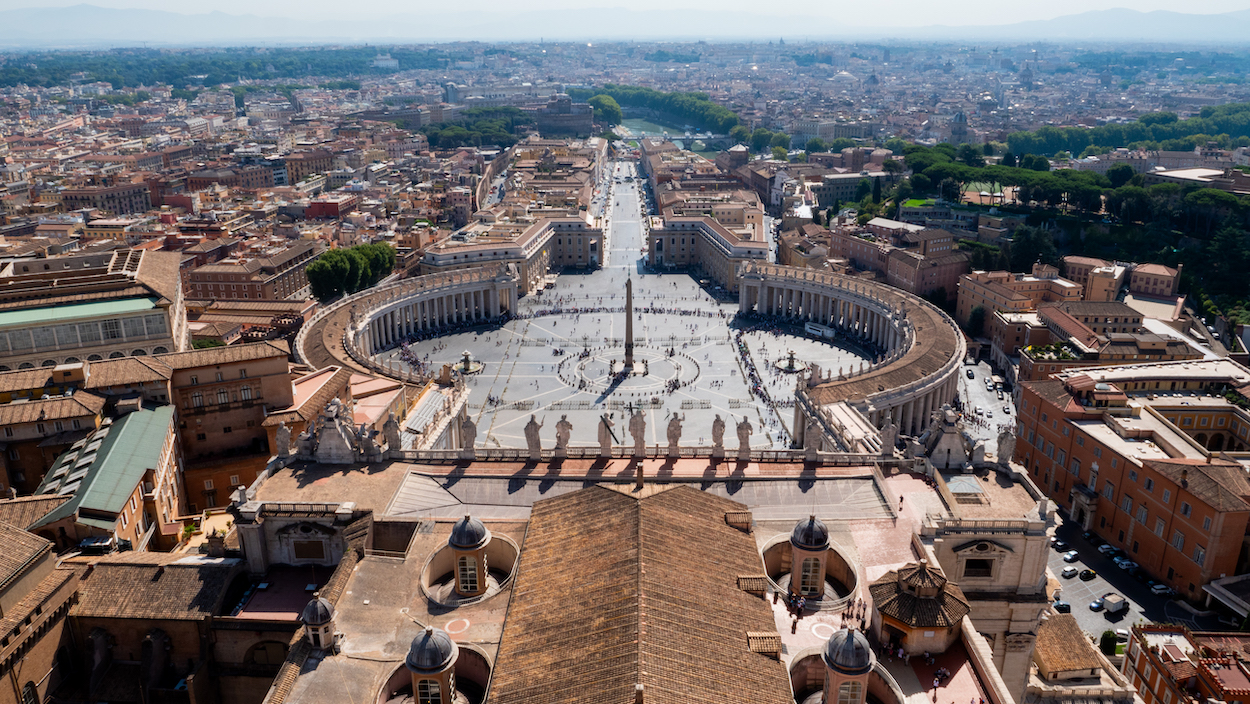
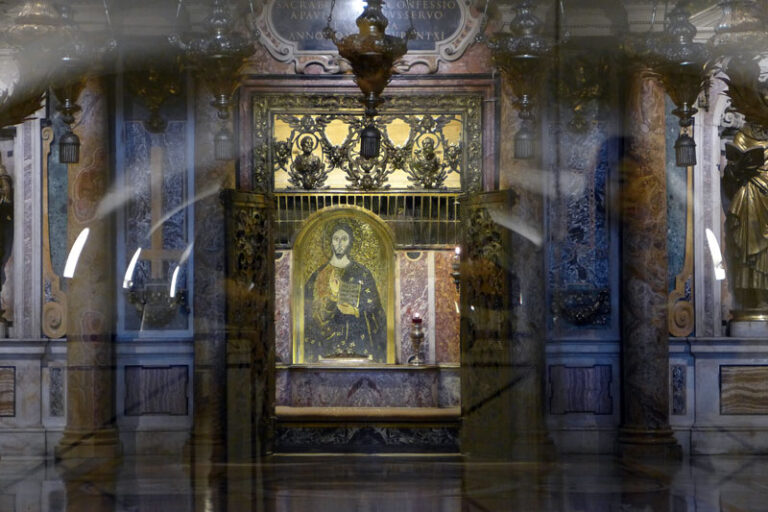
Why it’s unmissable: The foundation of the entire Basilica — and of 2,000 years of the Christian Church — buried beneath the altar that marks the heart of the building.
“And I tell you that you are Peter, and upon this rock I will build my church.”
If you’re familiar with the Gospel of Matthew, you’ll recognise this famous passage in which Jesus gives his apostle Simon, a humble fisherman from Galilee, the new name of Peter, which literally means “rock.” And that rock is what St. Peter’s Basilica is built upon.
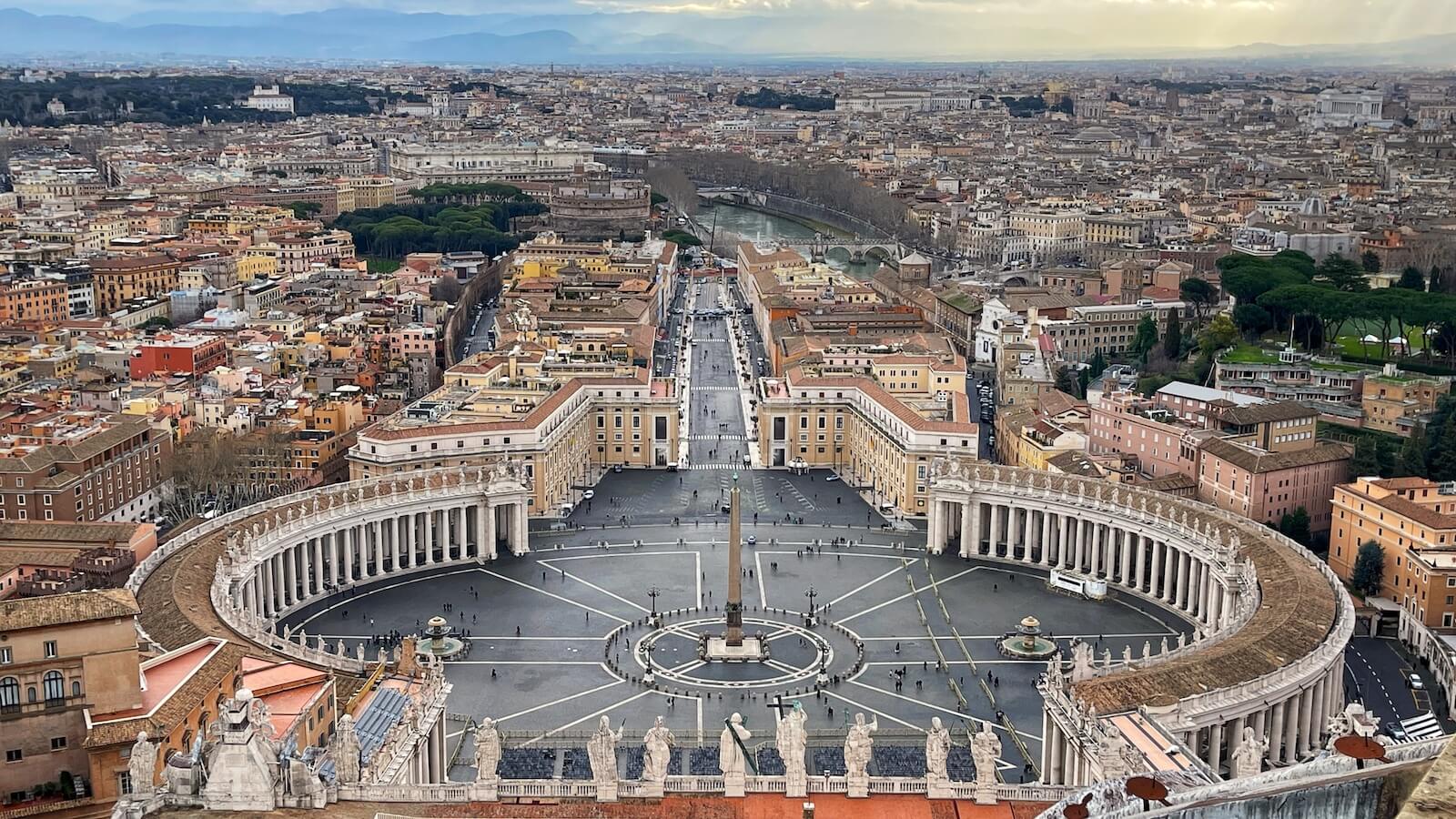
Peter was martyred during the reign of the Emperor Nero, around 67 or 68 AD, during the first organised persecution of the Christians. According to tradition, he was crucified upside down — deeming himself unworthy to die in the same manner as Christ — in the Circus of Nero, on the precise ground where the Basilica and St. Peter’s Square stand today.
After his death, he was buried in a nearby cemetery on the Vatican hill. The grave was simple and humble, and for two centuries the Christian community marked it with only a modest shrine.
Almost 300 years after Peter’s martyrdom, the Emperor Constantine, who had legalised Christianity across the Roman Empire, built a proper basilica on top of the apostle’s grave. That early church was gradually demolished from 1506, when Pope Julius II commissioned the magnificent new building we see today.
Finding Peter’s grave inside the Basilica is straightforward: from outside, it is marked by the golden cross on top of the dome. Inside, it is marked by Bernini’s great bronze baldacchino over the main altar. The altar itself sits directly above a small chapel, and beneath the chapel lies the humble tomb that tradition (though not universal scholarly consensus) identifies as Peter’s actual burial place.

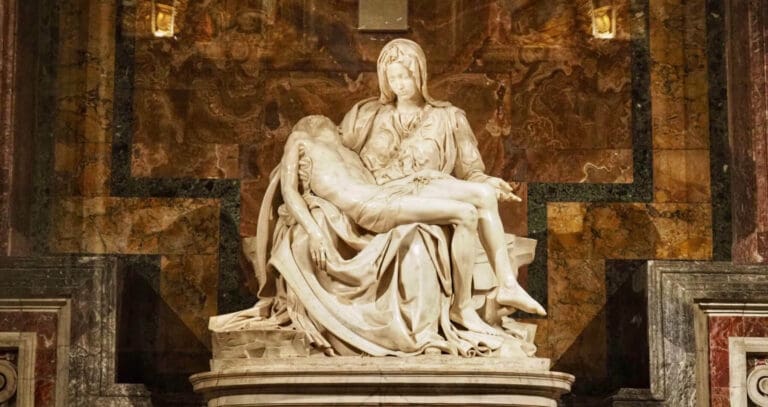
Why it’s unmissable: Carved when Michelangelo was 23 years old, this is by common consent the most perfectly executed sculpture in the history of Western art.
In the first chapel to the right as you enter, enclosed behind bulletproof glass since a vandal attacked it with a hammer in 1972, stands what many consider the most perfect sculpture ever carved: Michelangelo’s Pietà.
The work was commissioned in 1498 by the French cardinal Jean de Bilhères de Lagraulas as a monument for his own tomb. Michelangelo, just 23 years old at the time, completed the masterpiece that would establish his reputation in Rome in little over two years.
The subject is drawn from a late-medieval devotional tradition dedicated to the sorrows of the Virgin Mary, who we see cradling the body of the dead Christ across her lap. But Michelangelo’s interpretation was startlingly original. For starters the Virgin is strikingly youthful, more youthful even than her own son. Though this puzzled some contemporaries, it was a choice which reflected a sophisticated argument: Mary’s purity had kept her untouched by age.
The technical accomplishment on show is breathtaking. Drapery falls in folds of almost impossible delicacy, while the weight of Christ’s lifeless body is rendered with complete physical conviction. Look at his hand, draped across Mary’s knee, and the way his shoulder sinks toward the marble — Michelangelo’s preternatural grasp of human anatomy is astonishing. More than mere anatomical accuracy, however, the sculpture’s true greatness lies in its ability to make cold marble appear vulnerable, soft, and profoundly human.
Look out for Michelangelo’s signature emblazoned on the sash across the Virgin’s chest; it was the only work he ever signed. According to legend, Michelangelo overheard visitors at the sculpture’s inauguration attributing the work to another artist. Scandalized, he returned by night to carve his name into history. In the wake of the Pietà’s unveiling he became so famous that no further signatures were necessary.
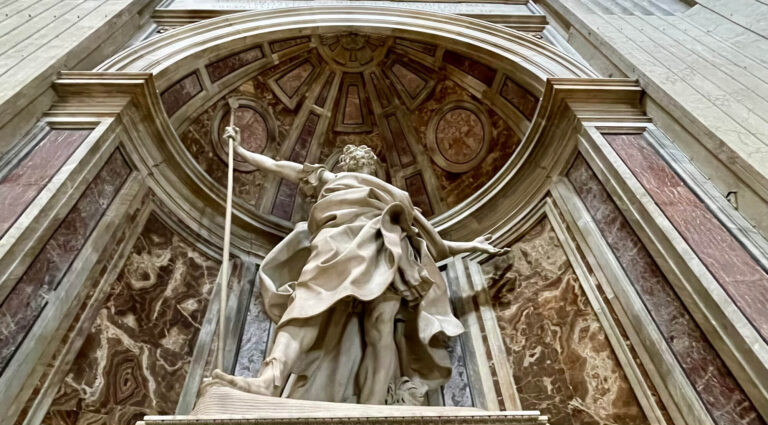
Why it’s unmissable: Four of the Baroque age’s most emotionally charged masterpieces, each one standing guard over a relic at the physical and spiritual heart of the Catholic world.
If Michelangelo’s Pietà represents the pinnacle of Renaissance sculpture, the crossing of St. Peter’s is where you come to understand the age of the Baroque. Four enormous niches in the massive crossing piers each contain a statue marking the presence of a priceless relic stored in the pier above, and together the four form one of the most dramatic sculptural ensembles in Western art.
The dominant presence belongs to Bernini’s St. Longinus. Longinus was the Roman centurion who experienced a dramatic conversion at the very moment he pierced Christ’s side with a lance during the Crucifixion. Standing at over four metres tall, he is one of the most emotionally charged figures in 17th-century sculpture.
Bernini captures him at the precise instant of that transformation: arms flung wide, cloak billowing, head tilted back in an expression of overwhelming revelation. The relic his statue guards — the Lancea Longini, the lance itself — is preserved in the pier above.
The other three figures are no less remarkable. St. Andrew, martyred on an X-shaped cross (the cross of St. Andrew’s flag to this day), gestures toward it with something that reads simultaneously as acceptance and exaltation.
Here too is the Empress Helena: the devout mother of Constantine, tradition relates that Helena discovered the True Cross on which Christ was crucified during a relic-hunting stint in Jerusalem. That’s her claim to fame here, where she embraces a cross while a fragment of the actual sacred object is concealed above.
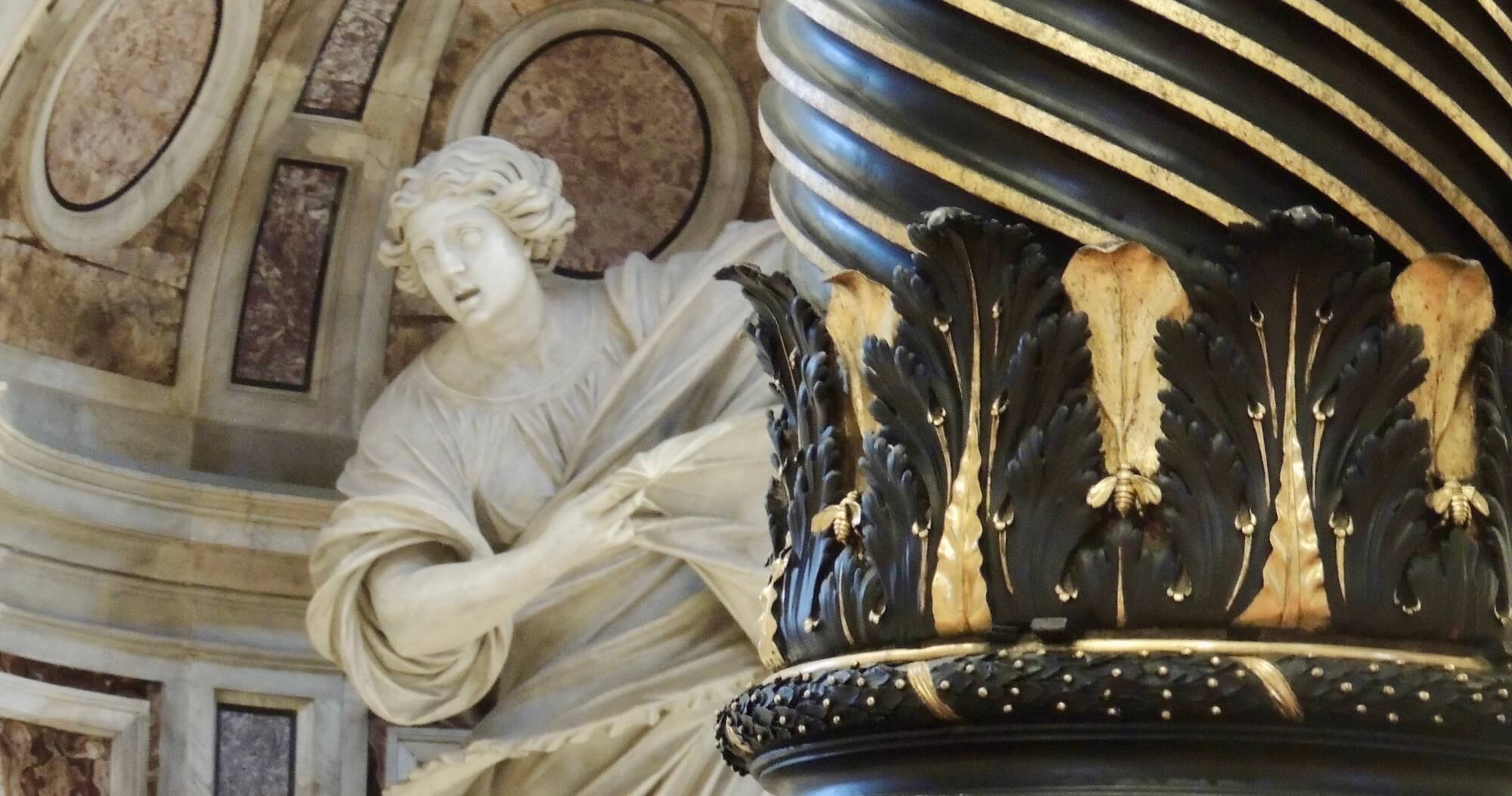
Francesco Mochi’s St. Veronica, meanwhile, is perhaps the most theatrically Baroque of the four. The saint seems almost to lunge forward as she displays the Veil for which she is famous; this is the cloth on which Christ’s face is said to have been miraculously imprinted on the road to Golgotha, preserved in the Vatican to this day and displayed to the faithful for just a few hours each year.
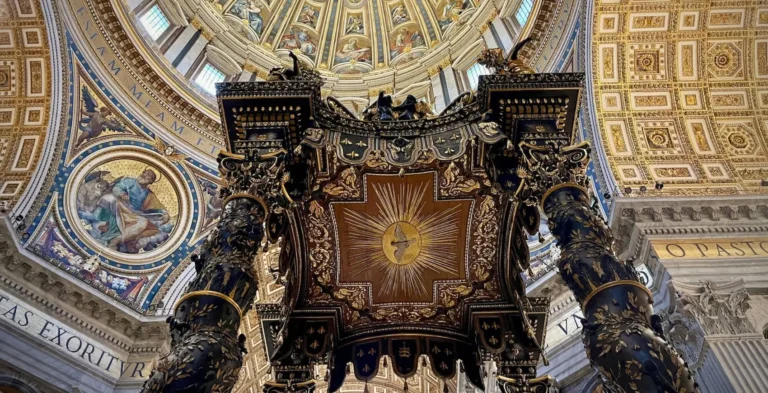
Why it’s unmissable: The largest bronze object ever cast — rising 29 metres directly over the tomb of the Apostle — and Bernini’s definitive statement of Baroque ambition.
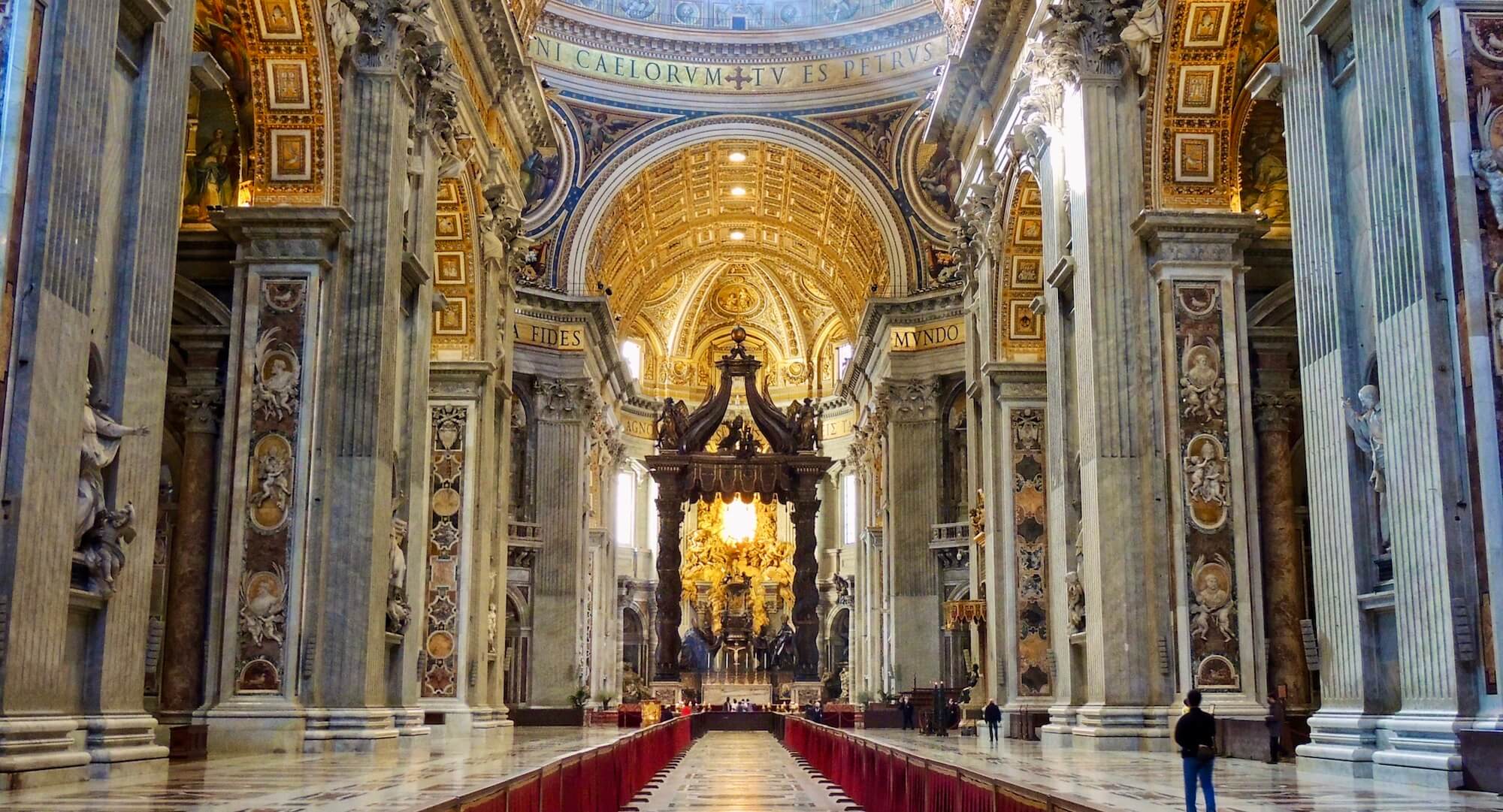
Once your eyes have adjusted to the overwhelming scale of the interior, the first thing to catch your eye when you step into St. Peter’s is the enormous bronze canopy at the far end of the nave. Bernini’s baldacchino is the centrepiece of the Basilica in every sense: structurally, visually, and liturgically.
At a staggering 29 metres tall, the baldacchino is the largest bronze object ever cast. Four spiral columns twist upward in a design deliberately recalling the ancient columns of Solomon’s Temple, their surfaces climbing with vine leaves and bees (the heraldic emblem of the Barberini family, whose pope, Urban VIII, commissioned the work in 1624).
At the top, four angels and cherubs preside over the structure, which is surmounted by a gilded sphere and cross. Above all of this, framed by the baldacchino’s columns as if in a stage set designed precisely for the purpose, rises Michelangelo’s dome. It’s worth climbing the dome of St. Peter’s for a fascinating view down onto the top of Bernini’s canopy.
The baldacchino’s purpose is simultaneously practical and symbolic: it marks the main altar — reserved exclusively for the Pope — which sits directly over St. Peter’s grave. The structure bridges heaven and earth, the ancient and the modern, the intimate and the cosmic, in a way that is the definitive statement of Baroque sensibility. Bernini spent a decade on its construction.
But where did all this bronze come from? Pope Urban VIII had pretty unorthodox ways of acquiring the materials he needed for his monuments: for the construction of the canopy, he took bronze from ancient buildings in Venice, Livorno and, according to tradition, even from the roof of the Pantheon in Rome. The pope’s infamous act of cultural plunder provoked one of Rome’s most enduring satirical remarks: Quod non fecerunt barbari, fecerunt Barberini — “What the barbarians did not do, the Barberini did.”
Scholars have debated the extent to which Pantheon bronze actually made it into the baldacchino (there is no doubt that the pope did indeed pillage the bronze, but it’s now thought that most of it was reused to forge new papal cannons), but the Romans have never quite let the Barberini forget it.
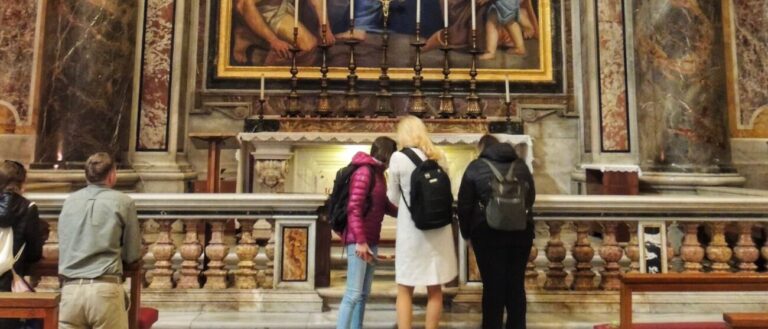
Why it’s unmissable: The final resting place of one of the most beloved popes in history, and one of the most actively visited places of pilgrimage in the Basilica.
A few steps past the Pietà, along the right aisle, is the Chapel of Saint Sebastian. On most days you’ll find people here on their knees, praying in silence in front of the white marble altar. The inscription is simple and in capital letters: SANCTVS IOANNES PAVLVS PP. II — Saint John Paul II.
With a pontificate spanning 27 years — the third longest in history — the Polish pope was one of the most consequential and beloved figures of the 20th century. At his funeral in St. Peter’s Square on 8 April 2005, the crowd of hundreds of thousands spontaneously began chanting “Santo subito!” — Make him a saint now! The demand was unusually swift but the Church acted on it: just nine years later, on 27 April 2014, Pope Francis canonised John Paul II in St. Peter’s Square, in front of more than 500,000 people.
His triple coffin — one layer of cypress, one of zinc, one of chestnut, sealed with golden nails — was originally buried in the Vatican Grottoes beneath the Basilica. It was moved to the Chapel of Saint Sebastian in 2011 when he was beatified, and after his canonisation in 2014 the marble altar above his tomb was inscribed with the title “saint” — making him the most recently canonised pope whose relics rest in the Basilica.
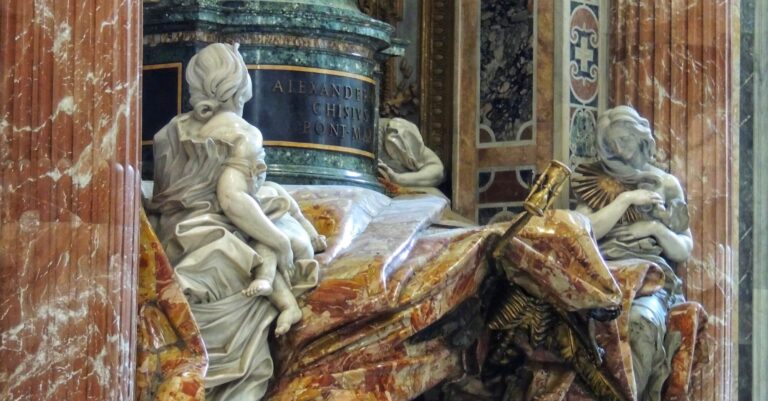
Why it’s unmissable: Bernini’s last great work — a skeleton, a golden hourglass, and a political message in marble that has been setting its foot on England for 350 years.
Tucked to the left of the Baldacchino, in the south transept, is a monument so full of theatrical invention and dark wit that visitors who find it often linger for a long time. This is Bernini’s last great sculptural work — the Monument to Pope Alexander VII — and it is one of the most remarkable things he ever made.
Pope Alexander VII commissioned the monument himself at the very start of his pontificate in 1655, haunted by thoughts of mortality. He never saw it. He died in 1667, and construction did not begin until 1671. The monument was completed in 1678, eleven years after the Pope’s death, when Bernini was around 80 years old and would himself die just two years later.
The composition is extraordinary. At the apex, the Pope kneels in prayer, his papal tiara beside him. Below him, four massive female allegories represent the virtues that the pope liked to think defined his reign: Charity, Truth, Justice and Prudence, their white marble forms tumbling in Baroque profusion.
But the figure that commands all attention is barely visible at first sight: from beneath the vast draped drapery of Sicilian jasper — the deep reddish-purple stone that billows and falls across the base of the monument — a gilded bronze skeleton rises into view, holding an hourglass aloft. This is Death herself, measuring out the Pope’s allotted time with the indifference of pure physics.
The detail that contains a political message is the foot of Truth, which rests on a globe. Look closely and you’ll see she is pressing her heel specifically on England — Bernini’s way of permanently recording Alexander VII’s failed attempts to suppress Anglicanism. It is a quiet, devastating act of commemoration: an ambition frozen in marble, setting its foot for eternity on the country that never came back.
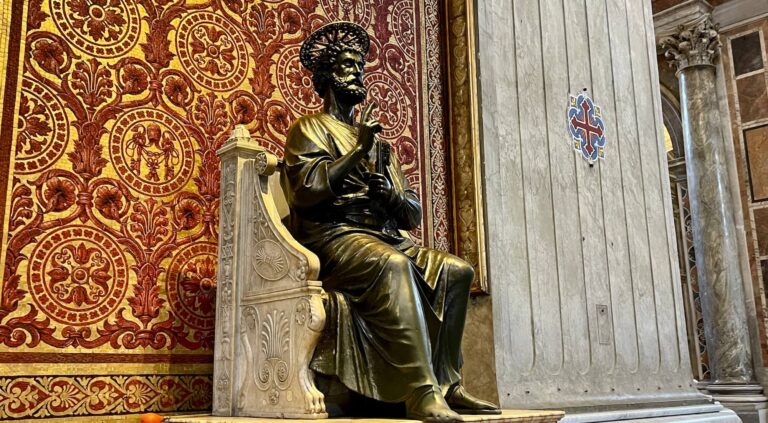
Why it’s unmissable: An 800-year-old bronze portrait worn flat by centuries of kisses — one of the most tangible and human connections to Christian history that exists anywhere in Rome.
As you walk along the nave toward the crossing, you might notice a queue of people waiting at a dark bronze statue. Then, when you get close enough, you’ll see that most of them are touching, or kissing, the statue’s right foot. The foot is worn smooth and almost flat, as if the metal itself has been gradually consumed. And in a sense, it has been by 800 years of veneration.
This is the famous portrait of Saint Peter, long attributed to a 5th-century date but now almost unanimously given to the great Tuscan sculptor Arnolfo di Cambio, who had a central role in building the Florence Cathedral and who worked in Rome in the late 13th century. Here the Prince of the Apostles sits on a marble throne with absolute authority, his left hand holding the keys of Heaven, his right raised in blessing, his gaze severe and calm.
The tradition of touching or kissing the foot is ancient — its exact origins are lost, but it has been practised continuously for at least 700 years, which accounts for the physical transformation of the bronze.
Once a year, on June 29th — the feast day of Saints Peter and Paul — the statue is dressed in full papal vestments and crowned with the papal tiara, a ceremony that re-enacts, visually and symbolically, Peter’s identity as the first pope.
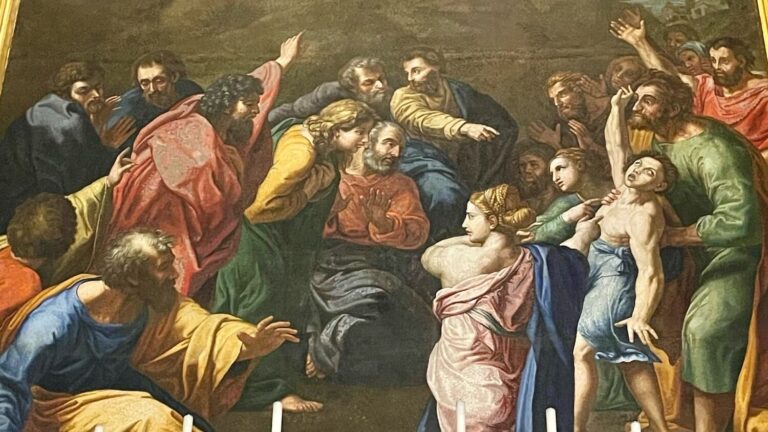
Why it’s unmissable: Most visitors assume the Basilica’s altarpieces are paintings. They aren’t — and the reason why is one of the most fascinating stories in St. Peter’s.
Walk through St. Peter’s and you’ll find yourself standing before what appears to be a sequence of large oil paintings: Raphael’s Transfiguration, Guercino’s colossal Saint Petronilla, Domenichino’s Last Communion of Saint Jerome, and others.
They are nothing of the kind. Every single altarpiece in the Basilica is a mosaic — an extraordinarily faithful copy executed in millions of tiny glass tesserae, many barely a millimetre across, by craftsmen of the Vatican’s own mosaic studio, the Studio del Mosaico Vaticano, which has operated continuously since 1727.
The reason is entirely practical. St. Peter’s, for all its magnificence, is a damp building — the humidity that rises from the ground and hangs in the vast interior is slowly lethal to oil paint. By the late 17th century, the original paintings that had decorated the altars since the Basilica’s completion were visibly deteriorating.
The decision was taken to replace them, one by one, with mosaic copies of such fidelity that they would deceive the eye entirely, and to move the originals to safe storage. Today most of those originals hang in the Vatican Pinacoteca — you can see Raphael’s Transfiguration and Caravaggio’s Entombment there, knowing that in St. Peter’s, copies made of coloured glass are standing in for them.
The deception is impressive to say the least. Get close to any of the altarpieces and you’ll begin to notice the slight shimmer that betrays the mosaic surface; from a normal viewing distance, the technique is essentially perfect.
The craftspeople who executed these copies spent years on each panel, working from full-scale cartoons painted by the leading artists of their day. Amazingly the studio is still active, and still responsible for the more than 10,000 square meters of mosaics that decorate the basilica.
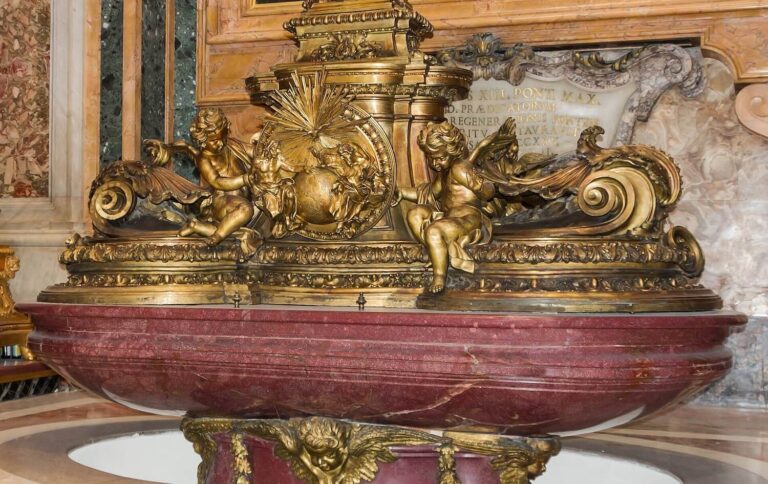
Why it’s unmissable: An ancient porphyry sarcophagus lid, reputedly from the tomb of the Emperor Hadrian himself, transformed into the vessel for the sacrament of Christian baptism.
Near the entrance of the Basilica, in the last chapel on the left aisle, stands the baptismal font of St. Peter’s. The basin is a single piece of deep red porphyry — the imperial stone quarried in the Egyptian desert and reserved, in antiquity, exclusively for emperors and their families. It is ancient, and it is almost certainly not originally a baptismal font.
The most plausible account holds that this is the lid of a Roman imperial sarcophagus, removed from Hadrian’s Mausoleum — the great circular tomb on the bank of the Tiber that we know today as the Castel Sant’Angelo — sometime in the medieval period and eventually repurposed for its current sacramental function. The lid was simply turned upside down, the hollow interior becoming a basin, and bronze relief panels of a dancing child and a naval battle (of obscure significance) were attached to the exterior.
Whether the sarcophagus it once covered was Hadrian’s own remains debated, but the attribution is old and widely repeated, and the visual reality is remarkable either way: an object made to contain an emperor’s remains now used to admit the newly baptised into the Christian Church.
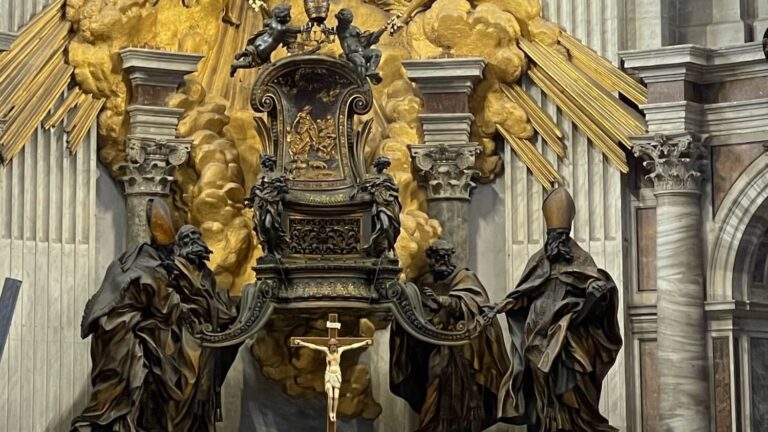
Why it’s unmissable: The visual climax of the entire Basilica: a golden throne, four Church Fathers, a dove of the Holy Spirit, and Bernini operating at the absolute height of his powers.
When you have absorbed everything else in St. Peter’s — the Pietà, the Baldacchino, the vast nave — walk all the way to the far end of the apse and prepare for one final, overwhelming act of Baroque theatre. Bernini’s Cathedra Petri, completed between 1657 and 1666, is in many ways the most spectacular thing in the Basilica.
At its physical centre is an ancient wooden chair — a simple throne traditionally believed to be the actual episcopal chair of Saint Peter, and venerated as such since at least the 9th century.
Bernini enclosed it in a colossal bronze reliquary chair of gilded bronze, hoisted aloft and seemingly supported by four enormous figures: the Doctors of the Church, two from the Latin West (Saints Augustine and Ambrose) and two from the Greek East (Saints Athanasius and John Chrysostom). The choice is deliberate and theological: the Chair of Peter, and the authority it represents, belongs equally to both halves of Christianity.
Above the throne, an oval window — the only natural light source at the Basilica’s far end — blazes with afternoon sun filtered through alabaster panels of honey-gold. At its centre, barely visible within the radiance, is a small dove: the Holy Spirit, presiding over the whole.
Around the window, gilded bronze clouds and rays expand outward in every direction, populated with dozens of bronze angels and cherubs in varying degrees of finish and agitation. The whole ensemble swirls and billows as if caught mid-motion by some celestial force.
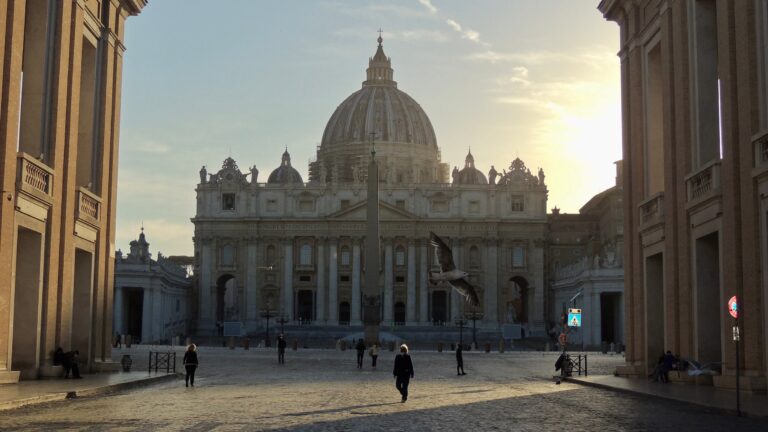
What is the most famous artwork in St Peter’s Basilica?
The most famous artwork in St. Peter’s Basilica is widely considered to be the Pietà by Michelangelo. Sculpted when the artist was just in his twenties, the marble masterpiece shows the Virgin Mary holding the body of Christ with remarkable serenity and technical brilliance.
Is St Peter’s Basilica free to enter?
Yes. Entry to St Peter’s Basilica is free, although all visitors must pass through security screening. In recent years, timed-entry reservations with an audio guide have also become available for a small fee, allowing visitors to skip the longest lines.
How long does it take to visit St Peter’s Basilica?
Most visitors spend 45 minutes to 1.5 hours inside the basilica. If you also plan to climb the dome or explore the papal tombs beneath the church, you should allow two hours or more.
Can you take photos inside St Peter’s Basilica?
Photography is generally allowed for personal use inside the basilica, though flash and tripods are prohibited. Some areas may occasionally restrict photography during services.
Tickets and Reservations
Entry to St Peter’s Basilica is completely free, but in recent years the Vatican has introduced an online reservation system with timed entry and an audio guide, allowing visitors to choose a time slot and enter through a shorter queue. This option typically costs a small fee and can significantly reduce waiting times compared with the general line, which may stretch for an hour or more in busy periods.
Guided tours are another popular option, often using dedicated entrances and providing deeper insight into the basilica’s extraordinary artworks and history.
Opening Hours
The basilica is generally open daily from 7.00am – 7.10pm, though hours can vary depending on liturgical events and seasonal schedules. Access may also be limited during major ceremonies or papal celebrations.
When to Visit St Peter’s
Early morning is usually the best time to visit, when the basilica is quieter and the light filtering through the vast interior feels particularly atmospheric. Try to skate in just around when the church opens for the day. Late afternoon can also be calmer after the largest tour groups have departed. Wednesdays and major religious holidays tend to be busier due to papal events.
Practical Tips for Your Visit
Visitors must pass through airport-style security screening, and a strict dress code applies – shoulders and knees must be covered. While your focus will sure to be on masterpieces like Pietà or Baldacchino, it’s worth allowing time to explore the papal tombs below and, if possible, climb the dome for one of the most spectacular views in Rome.
For detailed advice on reservations, dome tickets, and the best ways to avoid the crowds, see our complete guide to visiting St Peter’s Basilica below:
We hope you enjoyed our guide to 10 of the most important artworks in Saint Peter’s Basilica. The landmark cathedral conceals an array of artistic masterpieces, and the best way to see them is in the company of an expert guide: join us on our Vatican Tours and see for yourself!
Ready to visit St. Peter's?
Book Your Tour Here!