Rome might be our favourite city in the world, but we’d be the first to admit that things can be a little chaotic in Caput Mundi.
It does drama, and beauty, and history piled so thick you can barely move for it. It does the furious music of a Baroque fountain and the roar of a Vespa and the thousand overlapping voices of a thousand different languages ricocheting off ancient stone. What it does not typically do is quiet.
Yes, for all its splendour and all its charm, the Eternal City is an all out assault on the senses that can overwhelm even the most seasoned of travellers.
But the quiet is there, if you know where to look. Tucked behind the facades of churches, hidden in the depths of monastic complexes, and occasionally concealed in plain sight a few meters from the most crowded piazzas in the city, Rome harbours some of the most beautiful and peaceful enclosed gardens in the world.
Medieval cloisters — the enclosed garden courtyards that formed the contemplative heart of monastic life — survive throughout the city in varying states of preservation and accessibility, many of them freely or cheaply accessible and almost none of them crowded.
When things get a little much for us in Rome, slipping into one of these spaces to recharge our batteries with only the sound of church bells and warbling birds for company is our preferred strategy. Here are seven of our favourites.
Rome Tours
Explore a Hidden Side of the Eternal City
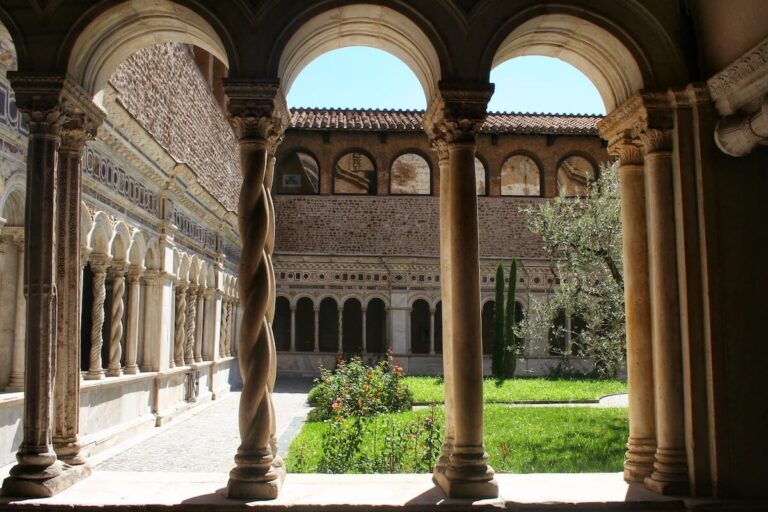
One of Rome’s genuine hidden gems: the 13th-century cloister of the Lateran Basilica offers a window into the glittering world of medieval artistry with few equals in the city. And while the Basilica itself — which is technically the cathedral of Rome, the Pope’s own church, and older than any other in the city — draws reasonable crowds, surprisingly few visitors find their way through to the cloister tucked behind it.
The cloister was the masterwork of the father-and-son duo Pietro and Niccolò Vassalletto, who were among the finest practitioners of the Cosmatesque style in which medieval Roman craftsmen specialised: intricate geometric patterning in polychrome marble, applied to columns, floors and architectural surfaces with extraordinary precision and visual daring.
The cloister’s paired columns are each subtly different from those adjacent — spiral-fluted, plain, twisted, set with patterned marble inlay — while the frieze above them runs with a continuous band of mosaic in gold, green and red that catches the light magnificently when the sun moves around in the afternoon.
In the centre of the garth, a modest fountain is surrounded by fragments of ancient and medieval sculpture recovered from earlier versions of the basilica and displayed with the casual accumulation that characterises Rome’s relationship to its own past. Wander around the perimeter at leisure and simply look at things; you will keep finding new details.
Entry is €5 and worth every cent.

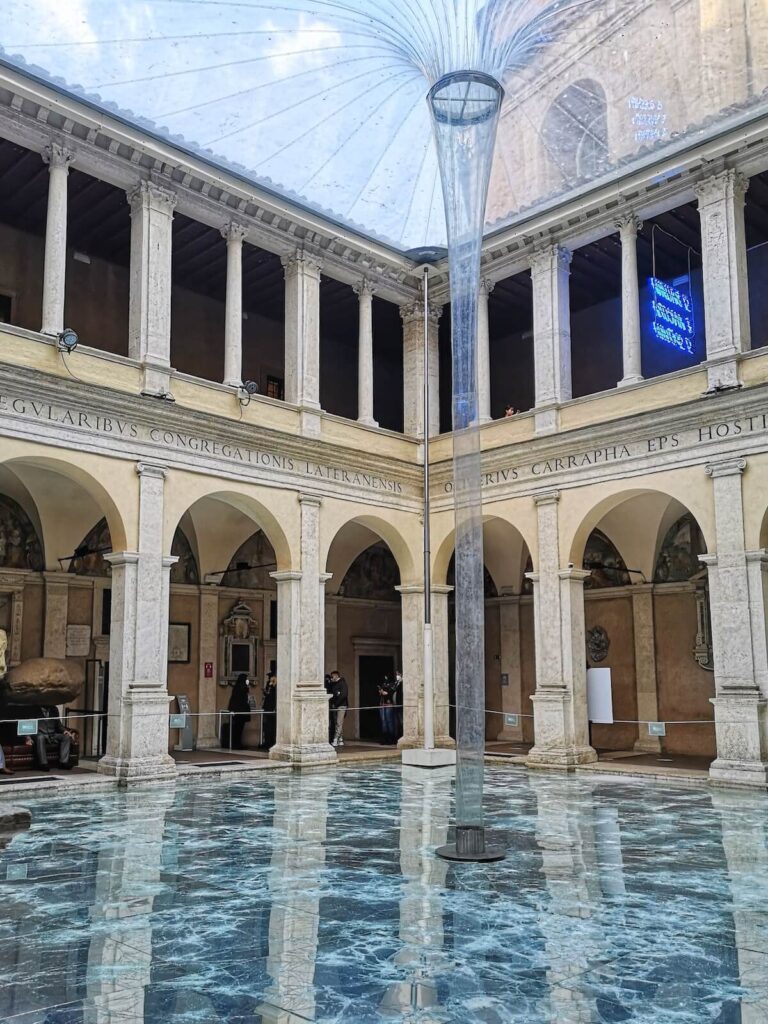
Nobody had a bigger hand in bringing the Renaissance to Rome than architect Donato Bramante, a bitter rival of Michelangelo.
Besides being tasked with designing new St. Peter’s basilica and coming up with the first circular church to be built since antiquity at San Pietro in Montorio, Bramante also used his formidable skills and grasp of proportion to create a series of stunning courtyards in private palaces and religious institutions across the city.
One of the finest is the cloister adjoining the church of Santa Maria della Pace in downtown Rome. Commissioned by the powerful Cardinal Oliviero Carafa, the square cloister was originally the centrepiece of a monastic complex, and unfolds across two levels.
The lower level comprises an arcaded portico featuring delicate Ionic columns, whilst the open-air upper gallery is divided by Corinthian pilasters and columns. The beautiful courtyard perfectly showcases Bramante’s knowledge of ancient architecture and his ability to synthesise it into a new language of light, space and harmony that would soon become one of the most identifiable features of Renaissance Italy.
Today Bramante’s cloister is part of an exhibition space featuring major shows throughout the year. The upper gallery is given over to a lovely cafe – the perfect spot to unwind after a day exploring central Rome.
Keep a look out too for Raphael’s Sibyl frescoes in the church next door, which are visible from a viewing platform in the cafe’s inner room.
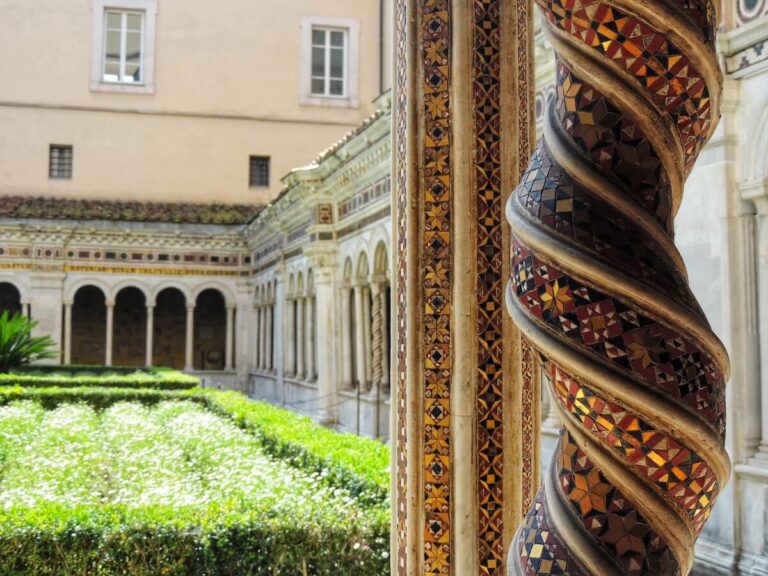
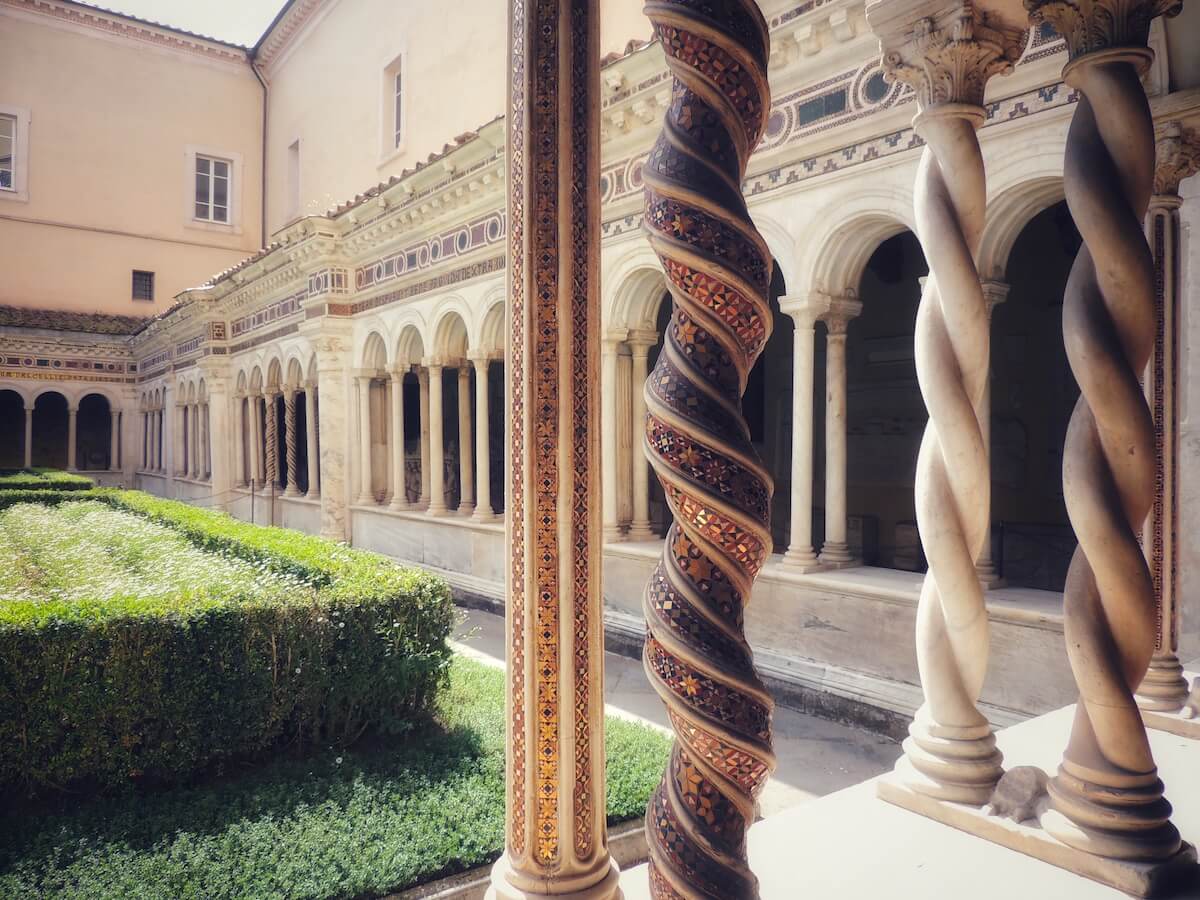
San Paolo le Mura is one of Rome’s most venerable churches, founded in the time of Constantine to mark the legendary site of St. Paul’s tomb. The interior is well worth a visit in its own right, but when here make sure to duck into the spectacular early 13th-century cloister of the adjacent monastery, another masterpiece of medieval craftsmanship gifted to us by the Vassalletti family.
A round-arched arcade of slender, delicately carved columns joined in pairs runs along all four sides of the central garden, where rose bushes, hedges and palm trees complete the idyllic scene.
Take a closer look at the columns and marvel at their infinite variety: some spiral like thick tresses of braided hair, whilst others are inlaid with stunning Cosmatesque mosaic-work. Above, relief carvings depict overtly religious subjects like Adam and Eve alongside more ambiguous sculptures of sphinxes, three-headed kings and other mythical beings.
It’s a beautiful spot to stop and meditate, accompanied only by the cooing of doves and the odd peal of the bells from the nearby campanile.
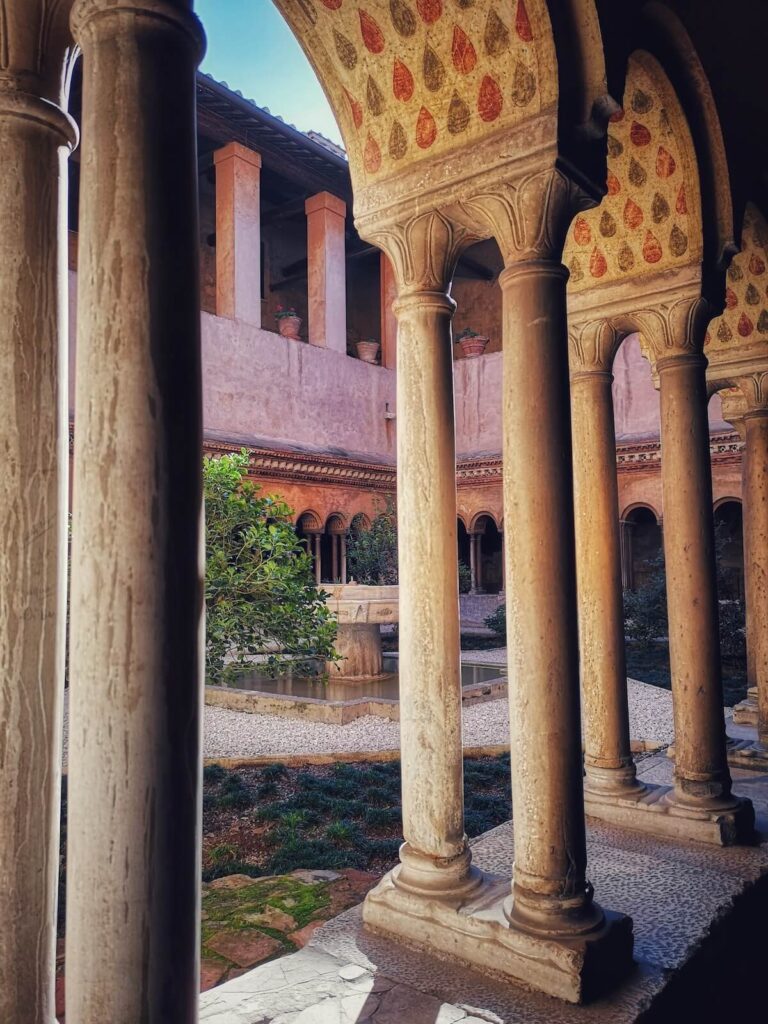
The fortified monastic complex of Santi Quattro Coronati is a maze-like jumble of chapels, dormitories and courtyards surrounding the eponymous church, built in the early 12th century under the patronage of Pope Paschal II after an earlier basilica was burned to the ground by Norman invaders in 1084.
Penetrate into the deepest recesses of the complex and eventually you’ll emerge blinking into the sunlight of its early-13th century cloisters, reputed by many to be the most peaceful in Rome.
Designed by the Cosmati, a renowned family of medieval artists known to posterity for their virtuoso use of a marble inlay technique known as Cosmatesque in their honour, the rectangular cloister features walkways on all four sides chock-full of ancient and medieval carvings and inscriptions – the products of thousands of years of restorations and re-buildings that have taken place here.
The slender paired columns hold up a series of round arches, and you can still see the remains of medieval frescoes decorating their undersides. The walkways surround a central garden, where a squat fountain sits in a shallow pool.
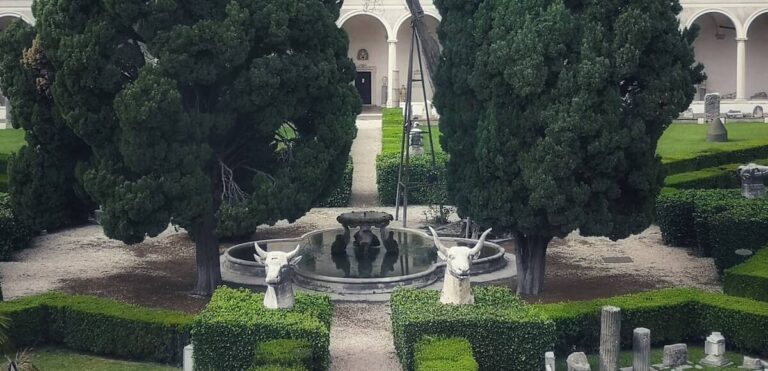
The transformation of Rome’s ancient monuments into medieval and Renaissance building sites is one of the great recurring themes of the city’s history, and nowhere is it more immediately legible than in the complex of Santa Maria degli Angeli and the Museo Nazionale Romano at the Baths of Diocletian.
Michelangelo was commissioned in 1561 to convert the vast frigidarium of the ancient baths into a church — which he did by the ruthlessly simple expedient of inserting a floor and an altar into the existing structure, leaving the massive ancient vaults essentially untouched.
Surrounding the church are the grounds of the Carthusian monastery that occupied the baths complex from the 16th century, and at their centre is the Great Cloister: an enormous quadrangle of whitewashed arcades and ochre-tiled roofs traditionally attributed (on uncertain evidence) to Michelangelo as well, whose lawns are scattered with hundreds of ancient sculptural and architectural fragments.
Look out for the extraordinary animal heads displayed around the garden: a trumpeting elephant, a pair of colossal oxen, a deer and a ram. These are the only surviving fragments of the decorations that once adorned the Temple of the Divine Trajan, one of ancient Rome’s most celebrated monuments, long since demolished and stripped for building materials.
The cloister is accessed through the adjacent Museo Nazionale Romano — the ticket also includes entry to the museum, which holds some of the finest ancient Roman sculpture and painting in the world and is wildly undervisited given its quality.
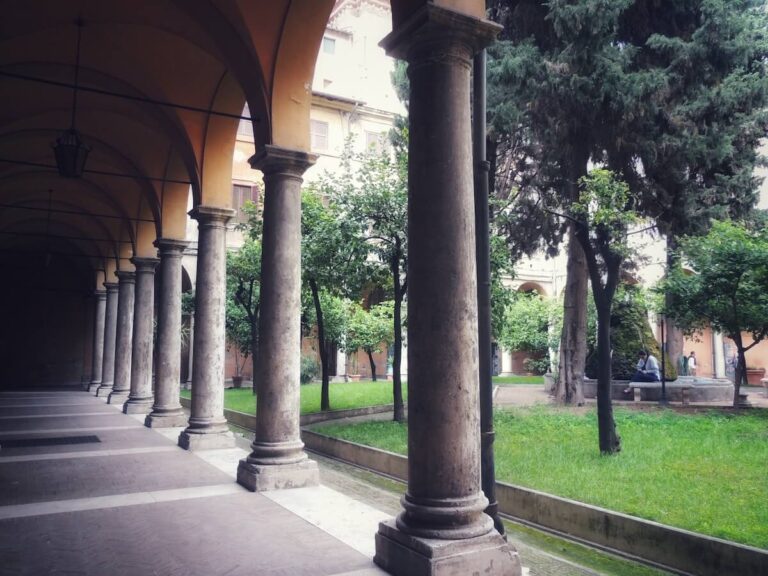
An oasis of calm just yards away from the frenetic bustle of the Spanish Steps, the peaceful cloister garden of Sant’Andrea delle Fratte is characterised by the orange and loquat trees hanging heavy with fruit that provide welcome shade even in the height of summer.
The cloister forms part of a convent belonging to the 15th-century Minim order, and is accessed via the right-hand transept of the church. The church is more interesting than its relatively undistinguished facade suggests. Inside, it contains two of Bernini’s original Angels — the ones he made for the Ponte Sant’Angelo, later replaced by copies because the Vatican wanted to preserve the originals — and a miraculous image of the Virgin Mary associated with the conversion of the Jewish banker Alphonse Ratisbonne in 1842, an event that subsequently made the church a place of pilgrimage.
But it is the small cloister garden behind the church that brings us here: shaded by orange trees and a great evergreen magnolia, and almost always empty. Look out for the lunettes of the archways that surround the cloister garth, decorated with fine 17th-century frescoes depicting the miracles performed by San Francesco di Paola, the founder of the Minim order.
Fish carp merrily in a central fountain taking the form of a lichen-covered rock.
Adding to the peaceful feeling, you’ll frequently hear the harmonious strains of violins and cellos emanating from the halls of a music academy located to one side of the cloister. For ten minutes or half an hour, it is possible to feel that Rome is, at heart, a very quiet place.
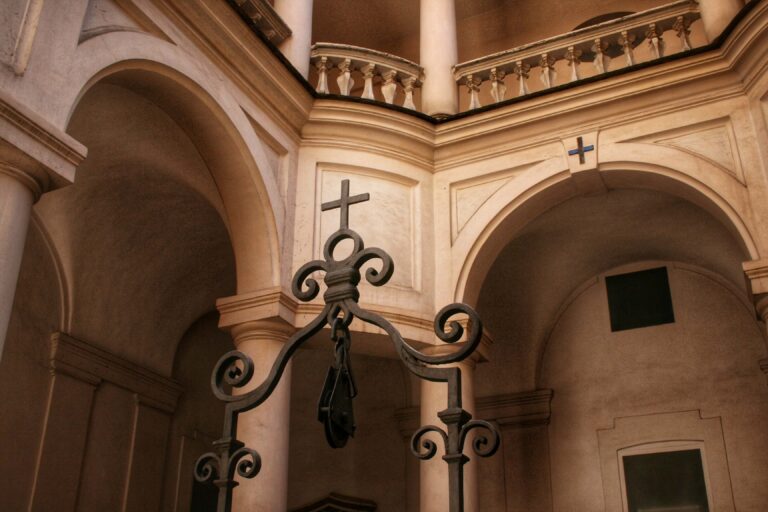
Ask any architecture buff for their favourite places in Rome, and Francesco Borromini’s extraordinary, diminutive church of San Carlo alle Quattro Fontane is likely to be near the top of the list.
The entire façade of this tiny church could fit inside a single supporting pier of St. Peter’s enormous dome, and yet entering San Carlino remains a dizzying experience. Shapes morph into one another. A convex curve suddenly becomes concave, and it is impossible to determine exactly how or when the transformation took place.
Borromini sculpted with space, dematerialising his architectural constructions in a way few architects had attempted before or since.
Equally dizzying is San Carlino’s little cloister, reached via a passageway at the back of the church. It’s not easy to determine exactly what shape the two-storey cloister takes, as the constantly shifting walls are bevelled at the edges and perforated with arches, creating a subtle but continuous sense of movement.
At the centre, an octagonal well provided the Trinitarian friars who lived here with a ready supply of fresh water.
Through Eternity Tours offer award-winning, expert led itineraries in Rome. From the jaw-dropping highlights of the Vatican Museums and the Colosseum to off-the-beaten-path gems that only locals know, join our small-group and private tours of Rome to discover the Eternal City at its best.
Dive Deeper into Rome