A short train ride south of Rome, the picturesque town of Marino sits among the vineyards and volcanic hills of the Castelli Romani. Every autumn, its historic center becomes the setting for one of Lazio’s most gloriously over-the-top celebrations: the Sagra dell’Uva, or Grape Festival.
Towns and villages the length and breadth of the Italian peninsula celebrate local festivals each year, an excuse for communities to get together to eat, drink and chew the fat. From the opulent festival of Saint Agatha in Catania, where the object of the celebrants’ attention are sweet buns shaped to represent the breasts of their patron saint (a bizarre homage to Agatha’s brutal martyrdom) to Ivrea’s battle of the oranges and Alba’s white truffle fair, food and drink in all its weird and wonderful variety is almost always at centre stage.
But few can match Marino’s annual wine festival for sheer bacchanalian fervour. Here, for a few hours each year, the fountains run with wine.
And plenty of it.
The Sagra has been a fixture in Marino since 1925, when the poet and playwright Leone Ciprelli devised a festival celebrating the town, its wine and its grape harvest. More than a century later, the tradition is still going strong: the 2026 festival will be the 102nd edition.
If you happen to be in Rome in early October, it is a wonderfully Roman way to spend a day outside the city. Read on to discover all you need to know.
Best Rome Tours
Explore the Best of Rome
Marino and the Castelli Romani
The heart of Roman wine country
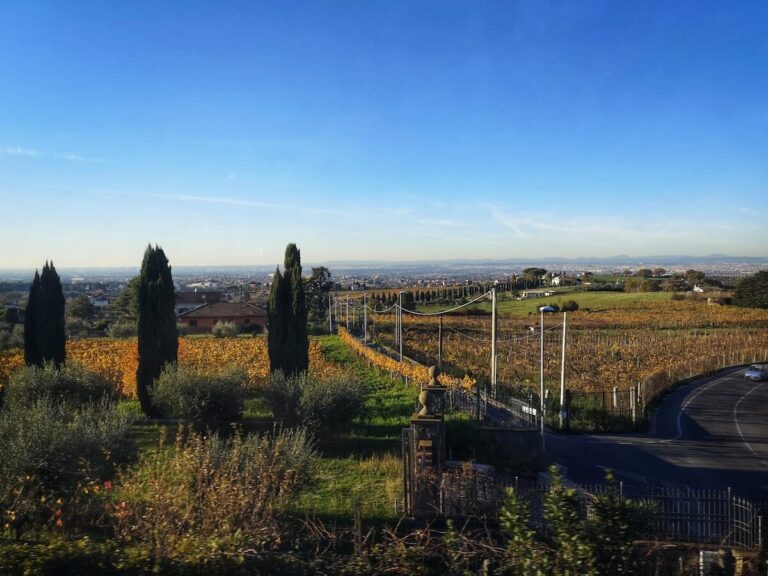
Marino is at the heart of the wine-producing region of the Castelli Romani, which since ancient Roman times has provided the Eternal City with copious quantities of Bacchus’ nectar. In Marino, wine really is the only game in town – so important is viniculture to the local economy that over the centuries a miraculous 12th century effigy of the Virgin Mary housed in the town’s cathedral has frequently been called upon to ensure a decent grape harvest.
Each year, the first week of October sees the town’s historic centre transformed into a great open-air wine cellar showcasing the local varietal. Statues and fountains are festooned with great swaying bunches of grapes hanging from their mouths, shoulders and limbs, whilst vines are strewn across the narrow cobbled streets. Best of all, for a glorious half hour at the height of the festivities, the town’s fountains run free not with water, but with wine. Tens of thousands of revellers throng the streets to partake in the miracle – enough to make a believer out of even the most sceptical visitor after the fourth glass.

Origins of the Marino Wine Festival
Marino’s wine, history and traditions come together in one extraordinary celebration.

Although Marino’s modern Sagra dell’Uva was first staged in 1925, the festival owes its existence to a far more distant moment in the town’s history. In October 1571, the largest naval battle since antiquity raged in the Ionian sea’s Gulf of Patras, when a coalition of the major naval fleets of Catholic Europe allied together in an attempt to repel the advance of the Ottoman Empire into the Mediterranean.
The commander of the Papal ships and hero of the hour was a young aristocrat by the name of Marcantonio Colonna, scion of one of Lazio’s most powerful families. The symbolic turning point of the battle came when Colonna successfully captured the flagship of the Turkish fleet commanded by Ali Pasha – the defeated admiral was slain aboard his galley, and his decapitated head was gruesomely hoisted high onto a pike above the battle.
Colonna also happened to enjoy the title of Lord of Marino, and the townsfolk (including his wife, Felice Corsini, and their children) awaited news of the battle on tenterhooks. Word finally came through of the local boy’s glorious role in the victory, and Marcantonio hotfooted it back to Marino where he arrived to a hero’s welcome.
Pope Pius V wasted no time in establishing a religious festival of thanksgiving in on the back of the Lepanto triumph, dedicated to the Madonna of the Rosary under whose banner the Christian troops fought. Pius ordered the feast to be celebrated every year on the 7th of October – the day on which the Papal fleets triumphed at Lepanto, and the festivities in Marino were as much a celebration of the feats of the victorious admiral as they were a religious obligation.
So much for Marino’s most famous son; but where does the wine come in? For that, we need to fast forward around 350 years: in 1925, the writer Leone Ciprelli, well-known for his plays and poems in Roman dialect, decided to honour the town of his birth by revitalising the annual religious festival and combining it with a celebration of Marino’s most important product. Inspired by the exploits of the town’s most important patron 350 years earlier, Ciprelli explicitly dedicated the updated festival to the memory of Colonna, creating a celebration equal parts sacred and profane in the process. The Sagra was an immediate hit from the beginning, and has been going ever since.
The Miracle of the Wine-Giving Fountains
The festival’s famous “miracle” is exactly what it sounds like.
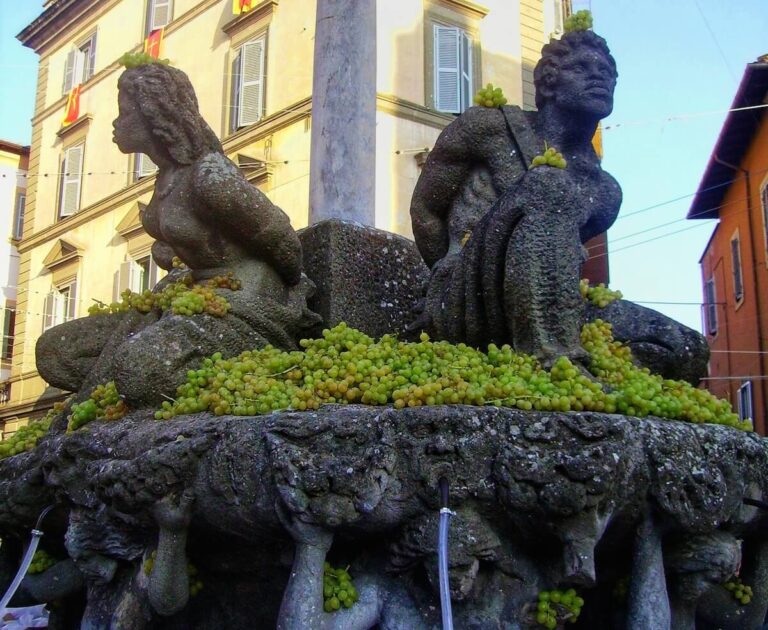
The real highlight of the festivities takes place on Sunday evening when, in a ‘miracle’ as delicious as it is sacrilegious, the fountains of Marino’s centro storico will spew forth wine instead of water for one glorious half hour between. The miracle has formed a central part of the festival since the beginning, when Leone Ciprelli was inspired by legendary tales of the luxurious parties that the Colonna held in their palace, in which statues and fountains would gush with wine to the delight of the family’s guests.
Providing a more decorous framing for the event, the miraculous transformation is officially down to the good offices of the Madonna of the Holy Rosary, whose feast day is celebrated on the same day with a procession of her statue through the streets of the town. Generously, the Virgin shows her gratitude to the devotion of the townspeople by dousing them with free wine.
The miracle took on new dimensions in 2008, when a technical error meant that the wine destined for the fountain had been accidentally directed into pipes leading to the kitchen taps of nearby apartments – delighted residents were convinced that this really was a miracle as they merrily stocked up on the free-flowing hooch, although local priests quickly poured cold water on the idea.
Although a number of the town’s fountains take part in the miracolo delle fontane che danno vino, the centrepiece is the grand Fontana dei Quattro Mori – the Fountain of the Four Moors – erected in the town back in the 17th century to celebrate (you guessed it) the defeat of the Turks at Lepanto. If you find the crowds here too thick to penetrate, then try your luck at the Fontana del Tritone in nearby piazza San Barnaba or the Fontanile Comunale on via Castrimeniense.
Understandably given the fact that thousands of litres of it are being given away for free, the wine emanating from Marino’s fountains is fairly rough and ready. But if your tastes run more towards finer vintages, fear not. Marino’s entire centro storico will be given over to wine tastings and meetings with some of the region’s most renowned producers for the duration of the festival, so you can get a real taste of what the wines of the Castelli are all about.
There’ll be plenty of stands offering local meats, cheeses and breads to keep you going as you chart your oenological course through the streets and squares as well. Make sure to grab yourself a panino con porchetta – this delectable spit-roasted pork is a Castelli specialty.
The Historic Procession of Marcantonio Colonna
Wine is only half the story. The festival also brings Marino’s Renaissance past vividly back to life.
Although wine is the star of the show, the Sagra dell’Uva also boasts no shortage of pageantry and spectacle. The highlight is a fabulous parade on Sunday afternoon that recreates the return of Marcantonio Colonna and his troops from the Lepanto campaign. One of the oldest parades in period costume in Italy, the recreation was first staged in 1929 and features elaborate allegorical floats, historical music and 400 participants in Renaissance costumes specially crafted for the occasion.
The procession unfolds in two parts: from one end of the town Colonna (usually impersonated by a well-known actor) and his troops march along Corso Vittoria Colonna, whilst a second group featuring the duke’s wife, children and retinue head out from Palazzo Colonna to meet them. The two groups meet in the middle at piazza Giacomo Matteotti in front of the Fontana dei Quattro Mori – just in time for its star turn in the miracolo.
Continue the Journey
Want to see more of the Castelli Romani?
The Sagra is one reason to head into the hills, but Marino is part of a much larger landscape of vineyards, hill towns and volcanic lakes. Take a look at our video exploring the Castelli Romani.
How to Visit the Sagra dell'Uva
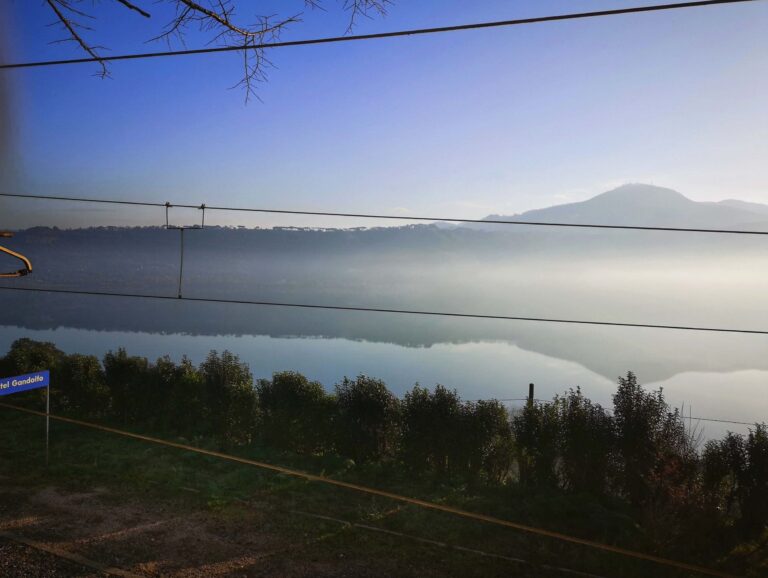
Marino is around 20 kilometres southeast of Rome and is easy to reach by train. Direct regional trains run from Roma Termini to Marino Laziale on the FL4 line, with the journey taking around 35 minutes. The same line continues to Castel Gandolfo, meaning it’s easy to combine a visit to the two towns. Services run regularly throughout the day.
The railway station sits below the historic center, so you’ll need to walk uphill or take the local bus. Trenitalia’s treno + bus service connects Marino Laziale station with the town center, with the bus departing from the station forecourt.
The Sagra traditionally centers on the first Sunday of October, although the modern festival now extends over several days. In 2026, the celebrations are scheduled for September 26–27 and October 3–5, with the historic procession taking place on Sunday, October 4.
Frequently Asked Questions
When is the Sagra dell’Uva in Marino?
The Sagra traditionally takes place around the first Sunday of October. The 2026 edition runs across September 26–27 and October 3–5, with the main historic procession scheduled for Sunday, October 4.
Does wine really flow from the fountains in Marino?
Yes. During the festival, wine is directed through the town’s fountains instead of water. The tradition dates to the first Sagra in 1925, when the Fontana dei Mori became the first fountain to dispense wine.
How old is the Sagra dell’Uva?
The modern festival was founded in 1925 by Leone Ciprelli. The 2026 celebration is the 102nd edition; the festival marked its centenary in 2025.
What is the Sagra dell’Uva celebrating?
The festival celebrates Marino’s grape harvest and wine-making tradition while incorporating the town’s older connection to the Battle of Lepanto, Marcantonio II Colonna and the religious celebrations of the Madonna del Rosario.
Can you get to Marino from Rome by train?
Yes. Marino is connected to Rome by regional rail services, and the Castelli Romani are easy to reach from the capital by train, bus or car. Check current Trenitalia schedules before travelling, particularly during the festival.
What else can you visit in the Castelli Romani?
Marino is only one of several historic towns in the Alban Hills. Frascati, Castel Gandolfo, Ariccia, Nemi, Grottaferrata and Rocca di Papa all make interesting excursions from Rome, each with its own history, food traditions and landscapes. See our guide to the Castelli Romani or our broader guide to the best hill towns in Lazio.
Book Your Rome Experience