Want to see the great masterpieces of Rome’s High Renaissance, but prefer not to join the crowds thronging the Sistine Chapel and the Vatican Museums?
When in Rome, make straight for the Villa Farnesina in Trastevere. This airy, sunlit pleasure palace on the banks of the Tiber contains frescoes by Raphael and his contemporaries every bit as extraordinary as anything in the nearby Vatican palaces, but it receives a tiny fraction of the visitors.
On a good morning, you may find yourself almost alone with Raphael’s most exuberant secular masterpiece. For art lovers, it is one of the great hidden gems of the Eternal City: intimate, brilliantly illuminated, and charged with the particular warmth and earthly delight of the Renaissance at its glorious peak.
Here is everything you need to know about the Villa Farnesina — who built it, why, what to look at when you get there, and how to visit.
Rome Tours
Explore Raphael's Masterpieces
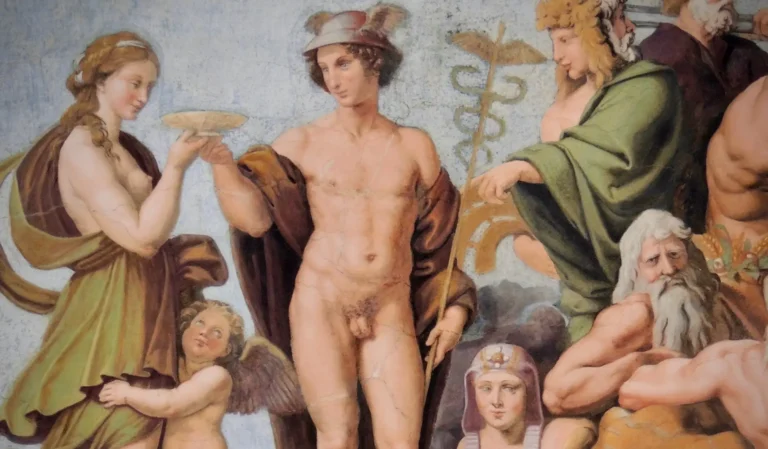
What happens when the vast wealth of the Pope’s personal banker joins forces with the talents of some of the greatest artists of the Italian Renaissance – amongst them Raphael, a man thought by contemporaries to have been sent from heaven by God himself to beautify the world?
The spectacular answer is the Villa Farnesina: a sumptuous pleasure palace built on the banks of the Tiber for Agostino Chigi, financier to the popes and by most reckonings the richest man in 16th-century Europe, at the very dawn of the High Renaissance.
Blessed with a limitless supply of ready cash and an abundance of good taste, Chigi spared no expense in realising his vision of a relaxing country retreat on the very doorstep of the city, a ‘suburban villa’ from where he could effectively run his business empire and throw lavish parties that epitomised the “bella figura” of a golden age.
Chigi came from a long dynasty of Sienese bankers, and had enriched the family fortune by lending enormous sums of money to Europe’s popes and princes — among them both the Borgias and the Medicis.
His star reached its highest point when the warrior-pope Julius II (patron of both Michelangelo and Raphael) ascended to the papal throne.
In exchange for the financial backing that Julius needed to pursue his military and artistic ambitions, Chigi was appointed Treasurer to the Vatican and forged a close personal friendship with the Pope — two men bound together by a shared love of art, antiquity, learning and money.
At the height of his power, Chigi employed an estimated 20,000 people and controlled a fleet of a hundred ships operating across the Mediterranean and beyond.
The age of global trade had arrived, and Chigi was its most energetic beneficiary: he had offices in every major city in Europe, and his bank — headquartered in the shadow of the Vatican — was the essential lubricant of European political and religious life. He was, in the fullest sense of the term, the first global businessman.
Agostino’s private life matched his luxury-loving public persona, and a whirlwind romance with Imperia, the city’s most renowned courtesan who counted cardinals and bishops amongst her always-satisfied clientele, was merely his most famous feat of amor.
Imperia died — by suicide, according to the most compelling rumour — in 1511, reportedly after losing the affections of the banker she loved.
After her death Chigi quickly formed a new relationship with Francesca Ordeaschi, a young Venetian woman of humble origins with whom he scandalously cohabited, unmarried, for years, fathering four children before finally making their relationship official with an extravagant wedding ceremony presided over by the Medici Pope Leo X in 1519.
The regular parties thrown in the halls and gardens of Chigi’s riverside villa were highlights of the early 16th-century social calendar, attended by the most renowned writers, princes and ecclesiastics of the Roman Renaissance.
Amidst poetry readings and theatrical performances, Chigi dispensed legendary acts of largesse – during a particularly notorious banquet thrown to celebrate the baptism of his son Lorenzo in 1518, the banker demonstrated his contempt for the material world and the irrelevancy of petty affairs of money by ordering his servants to collect the priceless silverware and gold used by his guests after each course and fling them into the Tiber’s murky depths.
But Chigi didn’t become one of the world’s richest men by literally throwing money away – apparently the cagey banker had installed strategically placed nets just beneath the water’s surface in order to retrieve the precious crockery after his drunken guests had disappeared into the Roman night.

In commissioning the Villa Farnesina, Chigi turned to the Sienese architect and painter Baldassare Peruzzi — who would later be buried in the Pantheon alongside his friend Raphael — and asked for something completely unlike anything else in Rome. The result was genuinely revolutionary.
Roman palaces of the Renaissance era were typically designed as fortified blocks looming over the narrow streets of the city, with thick walls, small windows and all the visual warmth of a tax office.
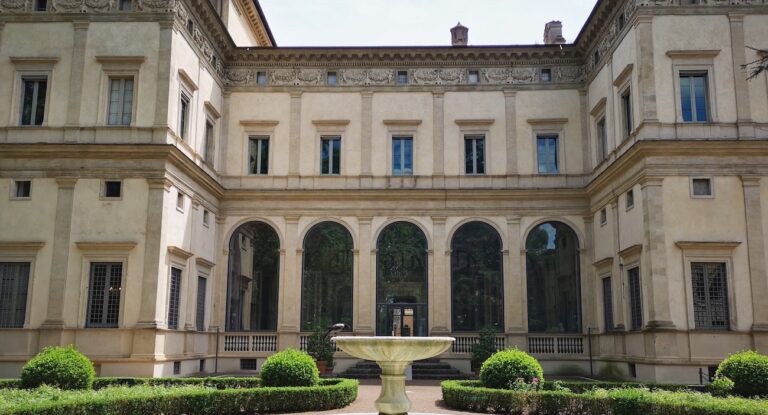
Peruzzi rejected this model entirely, designing instead a U-shaped building open at its south side towards the garden, its wings embracing a central courtyard and an open loggia facing the river.
The building reads less like a fortress than like a country house — airy, light, surrounded by nature — which was precisely the point: Chigi wanted a villa suburbana, a suburban retreat from which he could conduct his business empire and throw spectacular parties in an atmosphere of aristocratic ease.
The garden, which has diminished from its original extent, once ran down to the bank of the Tiber; Chigi would entertain guests by boat.
In addition to Peruzzi, Chigi called upon the services of Raphael, Giuliano Romano, Sebastiano del Piombo and Il Sodoma, and the villa’s every wall is covered in priceless works of High Renaissance art.
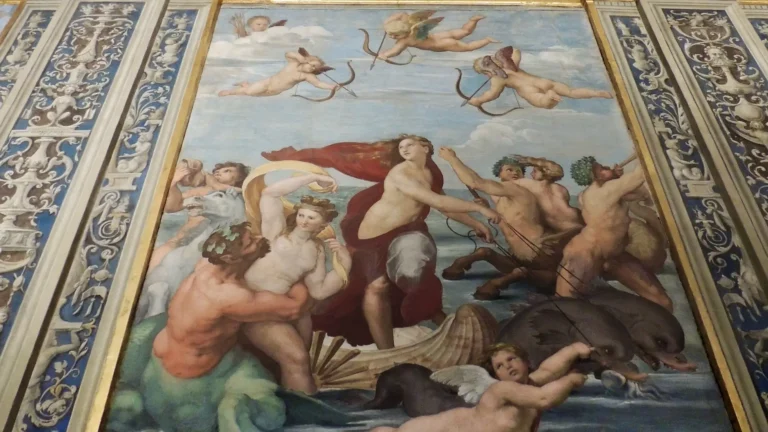
Raphael’s Triumph of Galatea (c. 1512) occupies the left-hand wall of the loggia: a riotous, exuberant celebration of the sea-nymph Galatea, who skims across the waves in a shell chariot pulled by two dolphins, surrounded by a cavalcade of sea-gods blowing conches to herald her voyage and playful sea-centaurs and cupids aiming their arrows from above.
The composition is a masterclass in controlled energy: every figure is in motion, every glance and gesture locked into a system of forces that nevertheless feel completely spontaneous.
Galatea herself — eyes raised to the heavens, wind in her hair, drapery flying — was described by Raphael in a famous letter as a beauty conceived not from any living woman but from an “ideal of beauty” that existed in his mind. Looking at her, you understand exactly what he meant.
The story behind the painting has a characteristically bittersweet Roman edge. Galatea was loved, hopelessly and unrequitedly, by the one-eyed giant Polyphemus, whose lovelorn serenades she found laughable.
Amused by his clumsy courting, the refined and flighty Galatea sped away from her admirer with her watery retinue.
The story has a dark end: the jilted Cyclops murdered Galatea’s lover, and in her grief the nymph transformed his blood into the river Acis in Sicily.
According to the gossipers of 16th-century Rome, Galatea’s face bears the features of none other than Imperia, the ill-fated courtesan who poisoned herself after losing the affections of Chigi.
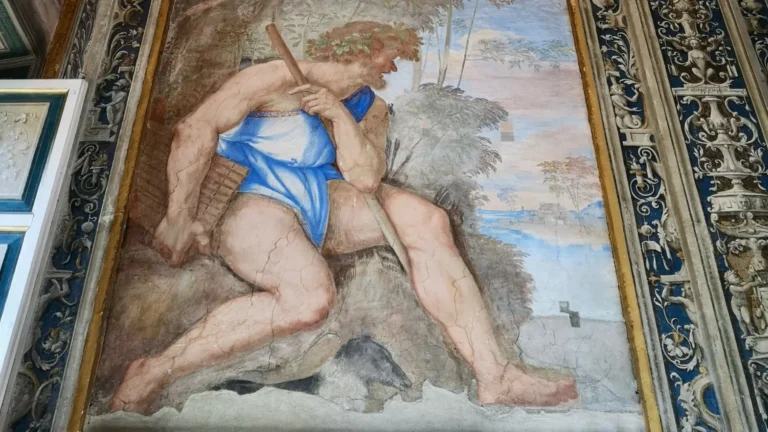
In the adjacent fresco, the doomed Polyphemus stares after his departing nymph with a peculiarly melancholy expression as he grips his panpipes, on which he had composed a rustic paean to his undying passion.
This work is by Sebastiano del Piombo, a rival of Raphael and great ally of Michelangelo who was one of the most talented Venetian painters of his generation.
Chigi had deliberately placed the two artists in competition — Raphael’s Florentine disegno (drawing and design) pitted against Sebastiano’s Venetian colore — in the same room. The dialogue between the two works is one of the most subtly illuminating things you can study in Roman Renaissance painting.
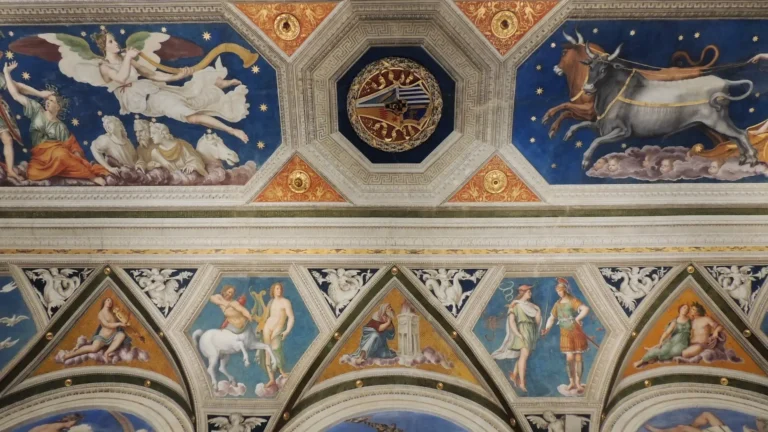
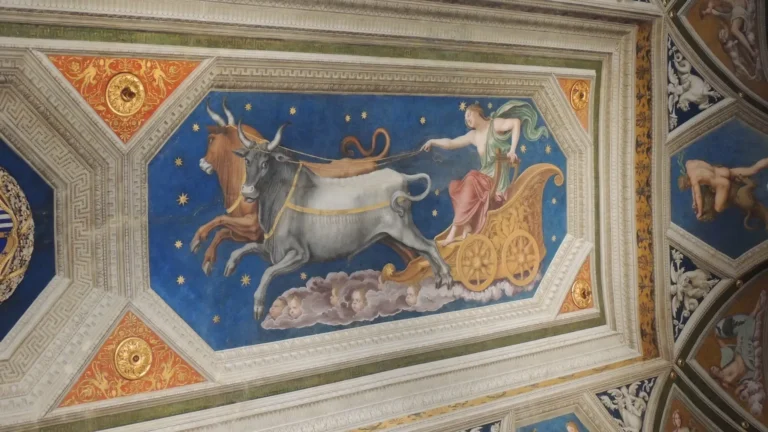
Before moving through the Villa, lift your eyes to the ceiling of the Loggia of Galatea. Peruzzi covered it with an elaborate astrological horoscope for Chigi — who was an enthusiastic follower of celestial portents — depicting the positions of the planets and constellations at the precise moment of his birth on 29 November 1466 (even the exact time, 9:30 PM, is encoded in the ceiling’s two main panels).
The patron had been so committed to astrological auspices that he refused to begin construction of the Villa until the stars aligned favourably, finally laying the foundation stone on 22 April 1506 — the legendary anniversary of the founding of Rome.
His resident astrologer Cornelio Benigni designed the horoscope, and it is a characteristically 16th-century document: every planet and sign, naturally, predicts a life of outstanding talent, easy charm, excellent taste and limitless prosperity.
Personifications of constellations and the zodiac combine in a stunning and complex symbolic display that reasserted the magnificence of the worldly banker for those who knew how to decipher it.
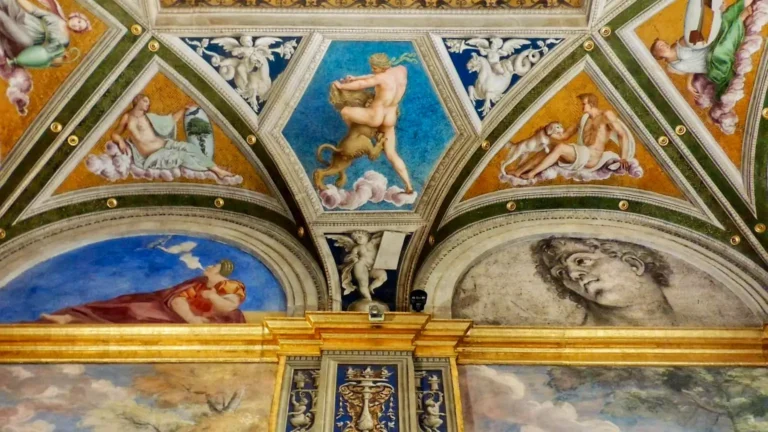
Look out for the small black-and-white portrait head inserted into one of the lunettes on the far wall — a mysterious intrusion into the otherwise unified decorative scheme.
For generations it was rumoured to be by Michelangelo himself. The story goes that Michelangelo, rather busy in his own right at the time just a mile away in the Sistine Chapel, was curious what Raphael was getting up to, and, aided and abetted by Sebastiano, managed to sneak into the villa one day to take a look.
Impressed by what he saw, the great man decided to leave a mark in the villa himself, rapidly painting a monochrome portrait of a youth in one of the lunettes of the palace as if to remind Raphael that there was more than one master in town.
It’s a tale that’s been told in Rome for centuries, and while there’s no evidence for any of this, one thing is certain:with its rich modelling and assured design, the masterful black and white portrait (above the landscape of the right) is worthy of Michelangelo himself!
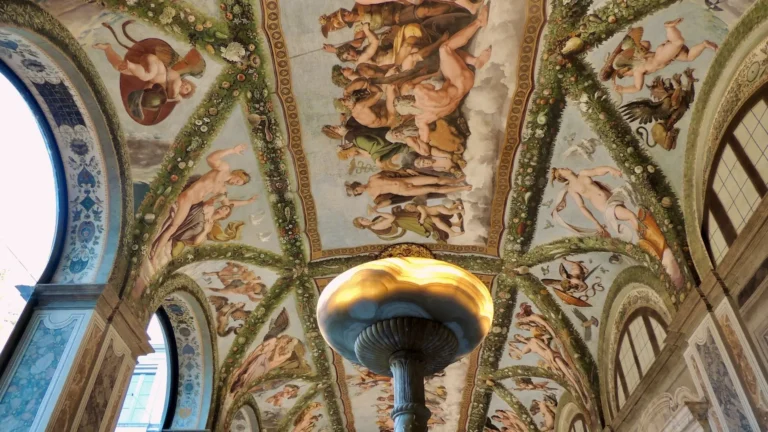
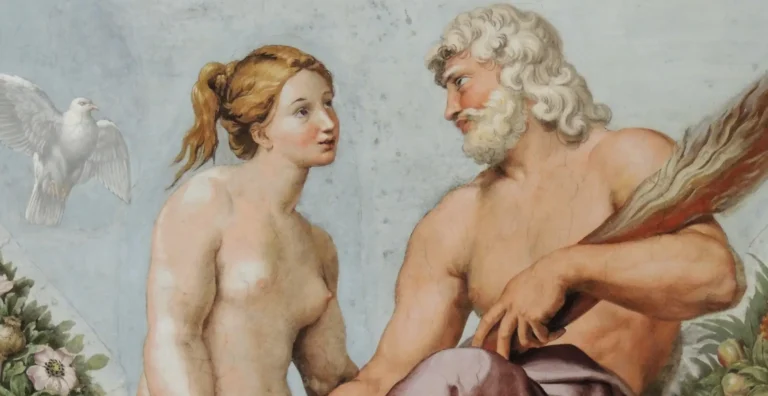
In 1517, Raphael returned to the Villa to decorate the airy entrance loggia — at the time open directly to the garden beyond — with the commission that is arguably his greatest secular work.
Love was in the air: Chigi was finally preparing to marry his long-time partner Francesca, and he wanted decorations that reflected the mood of the impending nuptials.
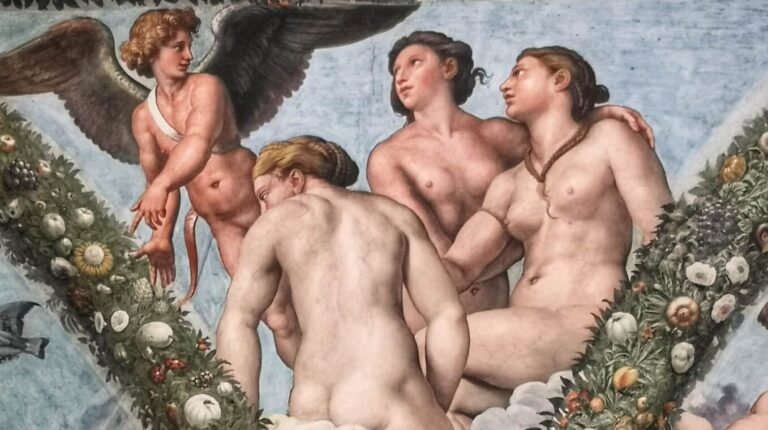
Raphael and his greatest pupils — Giulio Romano, Giovan Francesco Penni and Giovanni da Udine — chose as their subject the ancient tale of Cupid and Psyche as recounted from Lucius Apuleius’ Golden Ass.
Psyche was a mortal princess of such extraordinary beauty that the goddess Venus herself grew jealous and set out to destroy her.
Things go predictably pear-shaped when Cupid, Venus’ son who had been commanded to act as the architect of the princess’ downfall, himself falls head over heels in love with Psyche.
Furious, Venus proceeds to persecute Psyche further before love and the intervention of the gods finally bring the star-crossed couple to happiness.
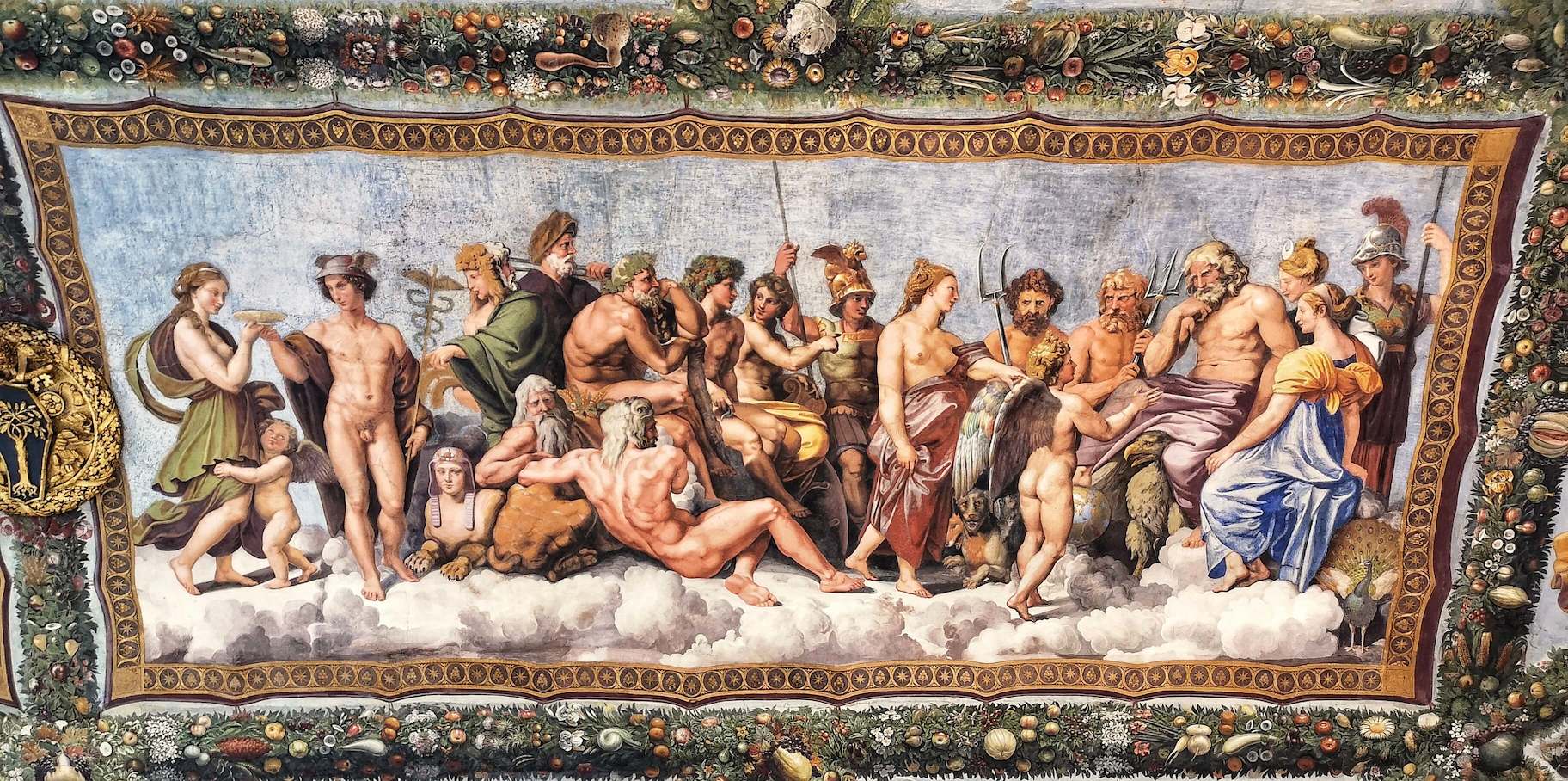
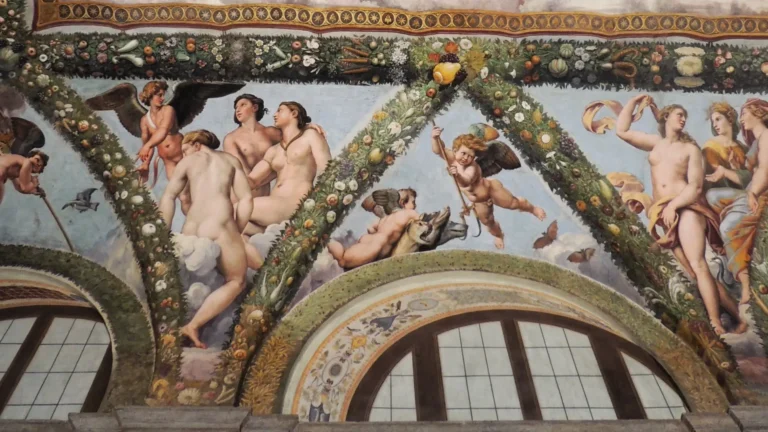
Along the walls of the loggia, the tale is told in a series of exuberant scenes in which the naked gods of antiquity cavort through fantastical garlands of vegetables, flowers, and some extremely suggestive fruits — pomegranates, squash, melons, bunches of grapes, a throbbing aubergine — that frame the scenes like the most extravagant natural trellis ever devised.
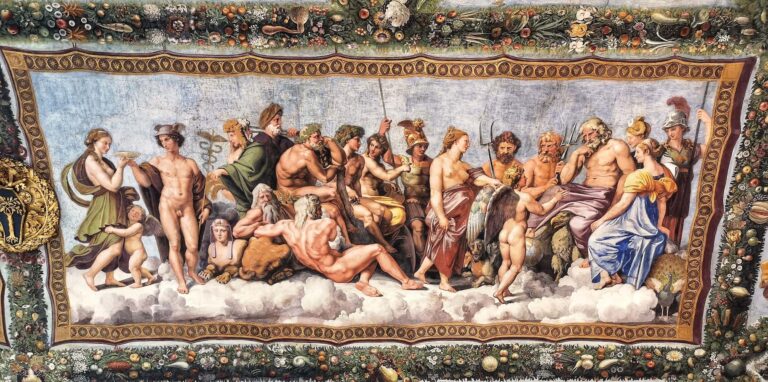
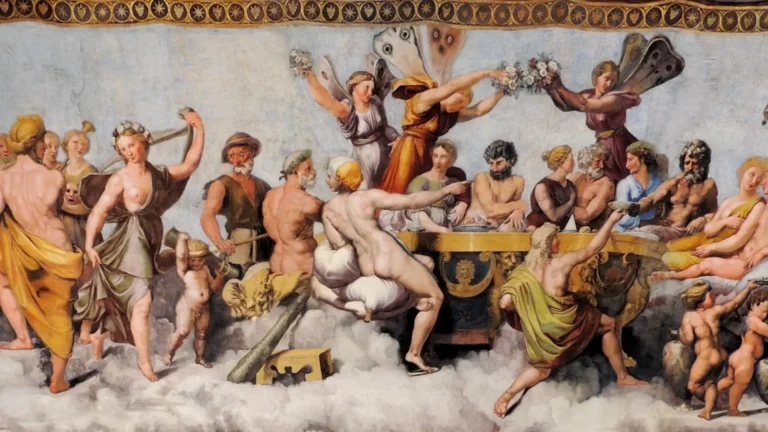
After Psyche overcomes the series of apparently impossible trials set her by the vindictive goddess of love all along the walls of the hall, the two massive central ceiling panels show the story’s triumphant resolution.
In one, Jupiter convenes a council of the gods and orders Venus to cease her persecution of Psyche. In the other — a sumptuous wedding banquet where gods and mortals feast side by side — Cupid and Psyche are finally married in the celestial realm.
The parallels with the impending wedding of Chigi and Francesca would have been unmistakable to every guest at the actual 1519 wedding banquet that was subsequently held in this very loggia.
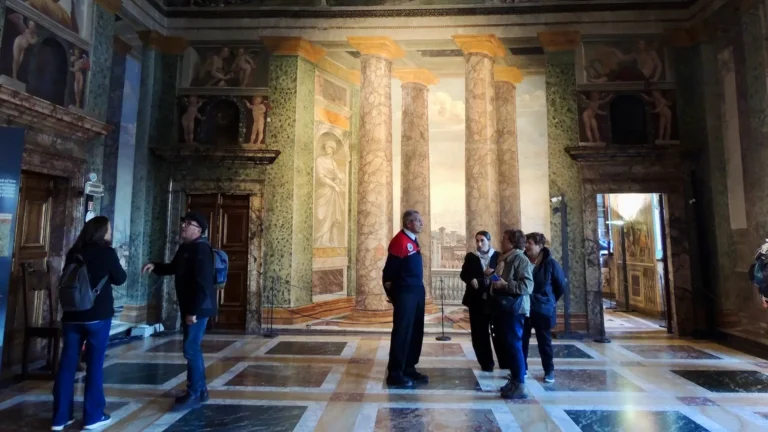
The Villa’s upper floor contains two further extraordinary rooms.
The first, the Sala delle Prospettive (Room of Perspectives), was decorated by Peruzzi himself with a brilliant trompe-l’oeil fresco that appears to dissolve the room’s walls entirely — replacing them with a painted colonnade that opens onto sweeping panoramic views of Rome and the surrounding countryside. From within the room it is almost impossible to tell where the real architecture ends and the painted illusion begins.
It was here that Chigi and Francesca actually hosted their 1519 wedding banquet, in a space where the boundary between interior and exterior, between art and reality, had been artfully erased.
The splendid decorations continue upstairs, where in the appropriately named Room of the Perspective Views Peruzzi created a wonderful illusionistic decoration that appears to dissolve the walls of the room and create a fictional colonnade that leads on to peaceful country landscapes through a clever trick of perspective known as trompe-l’oeil. It was here that Chigi and Francesca actually celebrated their lavish wedding banquet in 1519.
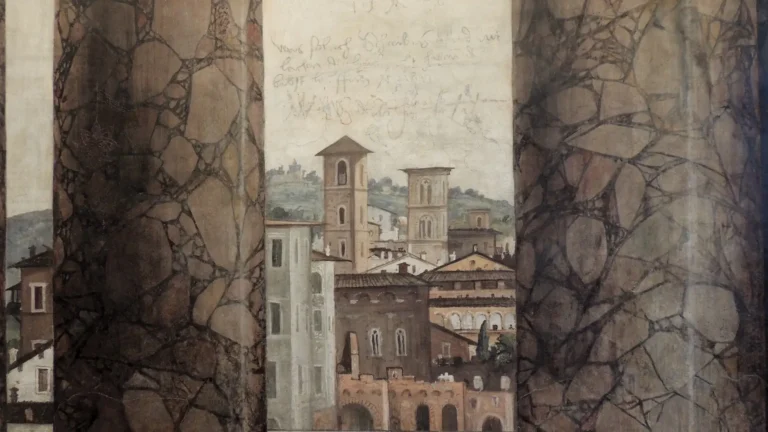
Look closely at the walls of this room and you will also find something sobering: 16th-century graffiti scratched into the painted surface by the soldiers of the Holy Roman Emperor Charles V during the catastrophic Sack of Rome in 1527, which followed the death of Chigi in 1520 by just seven years.
The fearsome landsknechts occupied the villa for over a year, and the inscription tells us plenty about their state of time during this dark time for the city.
The text reads: “”Was sol ich schreibenn und nit lachen, die lanzknecht haben den babst lauffen machen” – roughly translated into English, “Why should I write and not laugh; the Landsknechts have the Pope on the run.”
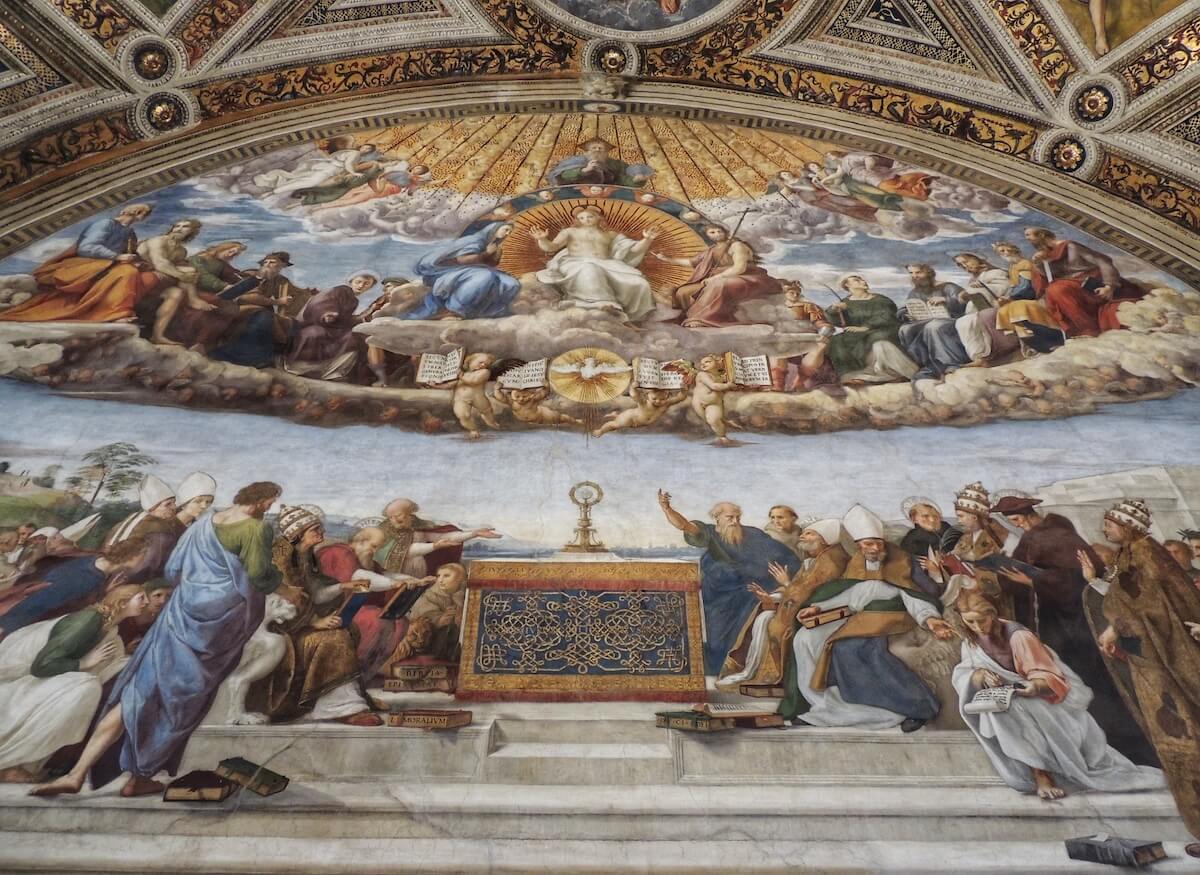
There is no clearer reminder of how quickly the golden world of the High Renaissance was extinguished, just a few short years after Raphael and his contemporaries completed one of its greatest testaments. And it’s not the only Landsknecht-penned graffiti carved into a Roman fresco – Raphael’s Disputa in the Vatican got the same treatment, with the “LUTHER” carved into the painting still visible today.
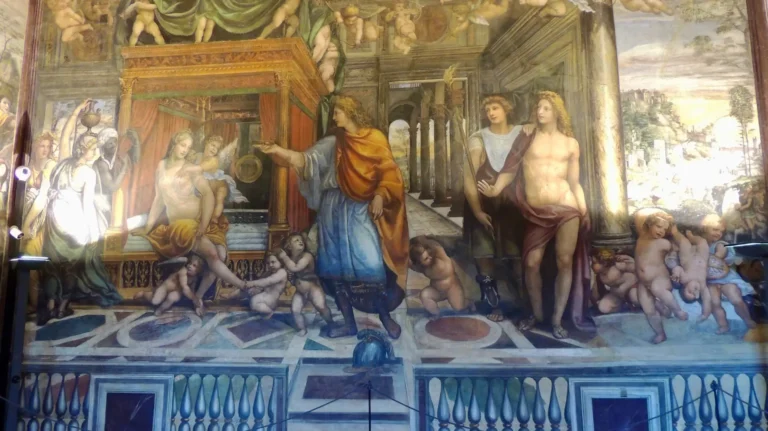
The adjacent bedchamber was decorated by the Sienese artist known as Il Sodoma with a massive fresco of the Wedding Night of Alexander the Great and Roxanne (c. 1511-12): the conqueror of the known world, still in his armour, hurries toward his new bride as she reclines on a canopied bed, surrounded by cheeky putti who tug at Alexander’s cloak and pull at his armour in their eagerness to hasten the union.
It is one of the most overtly erotic paintings of the 16th century — and for Chigi and Francesca, lounging in their own bed beneath this scene of martial desire transformed into love, the message could hardly have been clearer.
Address: Via della Lungara 230, Trastevere, Rome
Opening hours: Monday to Saturday, 9:00 AM to 2:00 PM. Closed Sunday and public holidays.
Tickets: Standard admission is €12 for adults. Reduced rates are available for students and over-65s. Tickets can be purchased at the door or booked in advance online through the official website of the Accademia Nazionale dei Lincei, which now administers the Villa.
Getting There: The Villa Farnesina is in Trastevere, on the right bank of the Tiber. From the historic centre, it is a pleasant 20-25 minute walk across the Tiber (cross at Ponte Sisto or Ponte Mazzini). By bus, Lungotevere della Farnesina is served by lines 23 and 280. There is no metro station nearby.
Guided Tours: Through Eternity offers private guided tours of the Villa Farnesina with expert local guides who bring the stories of Chigi, Raphael and the Renaissance to life. Click here to find out more.
Photography: Photography for personal use is permitted without flash.
How Long to Allow: A thorough visit takes approximately 60 to 90 minutes. For a deep-dive into the frescoes, allow two hours.
The partnership of Agostino Chigi and Raphael produced not only the Villa Farnesina but two other significant works in Rome that can be visited today:
The Chigi Chapel in Santa Maria del Popolo
Chigi’s funerary chapel in the church at the northern entrance to the city, for which Raphael designed the architectural scheme and the mosaic of God the Father Setting the World in Motion in the dome.
The chapel was later completed by Gianlorenzo Bernini, who added two of his greatest sculptures — Daniel and Habakkuk and the Angel — as well as the extraordinary skeletal floor mosaics. It is one of the most extraordinary artistic collaborations across the centuries in Rome.
The Chigi Chapel in Santa Maria della Pace.
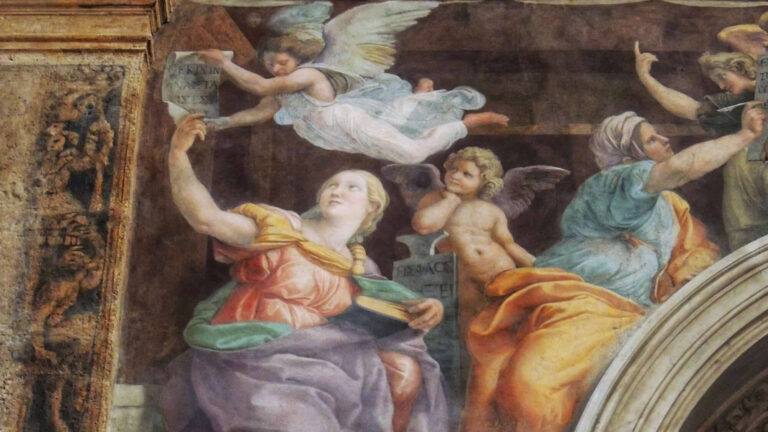
A smaller Raphael commission near Piazza Navona, containing his fresco of the Four Sibyls (c. 1514), one of the most Michelangelesque works he ever produced. On the outer wall of the Chigi chapel, the first on the right as you enter the church, Raphael painted the ancient Greek mythological seers who according to Christian thought predicted the coming of Christ to the pagans of antiquity.
The four sibyls (the Cumaean, the Persian, the Phrygian, and the Tiburtine) surround the chapel’s upper entrance arch, studiously taking down prophecies dictated to them by angels swooping from heaven above.
Who built the Villa Farnesina?
The Villa was built for Agostino Chigi, the Sienese banker and financier to the popes, between 1506 and 1511. It was designed by the architect and painter Baldassare Peruzzi.
Why is it called the Farnesina?
The Villa was originally known simply as “the villa of Agostino Chigi.” After Chigi’s death in 1520, the property passed through various hands before being acquired by the Farnese family in 1577 — hence the name Farnesina (the “little Farnese” villa, to distinguish it from the great Palazzo Farnese across the river). In 1927 it became the property of the Italian state.
Did Raphael paint everything in the Villa Farnesina?
No. The major Raphael works are the Triumph of Galatea fresco in the Loggia of Galatea and the fresco cycle of Cupid and Psyche in the entrance loggia. Raphael designed the latter but left much of the actual painting to his skilled studio assistants, particularly Giulio Romano and Giovanni da Udine. Other rooms in the Villa were frescoed by Peruzzi, Sebastiano del Piombo and Il Sodoma.
Is the Villa Farnesina worth visiting?
Absolutely — it is one of the finest artistic experiences Rome has to offer. The combination of exceptional frescoes, the intimate domestic scale of the building, and the relative absence of crowds makes it quite unlike a visit to the Vatican or the Borghese Gallery. It is particularly recommended for anyone who has already seen Raphael’s work in the Vatican Museums and wants to experience it in a completely different and more personal register.
Is the Villa Farnesina near the Vatican?
Yes, it is very close — about a 15-minute walk north along the Lungotevere from the Vatican walls. It makes an excellent pairing with a Vatican visit.
Dive Deeper into Rome