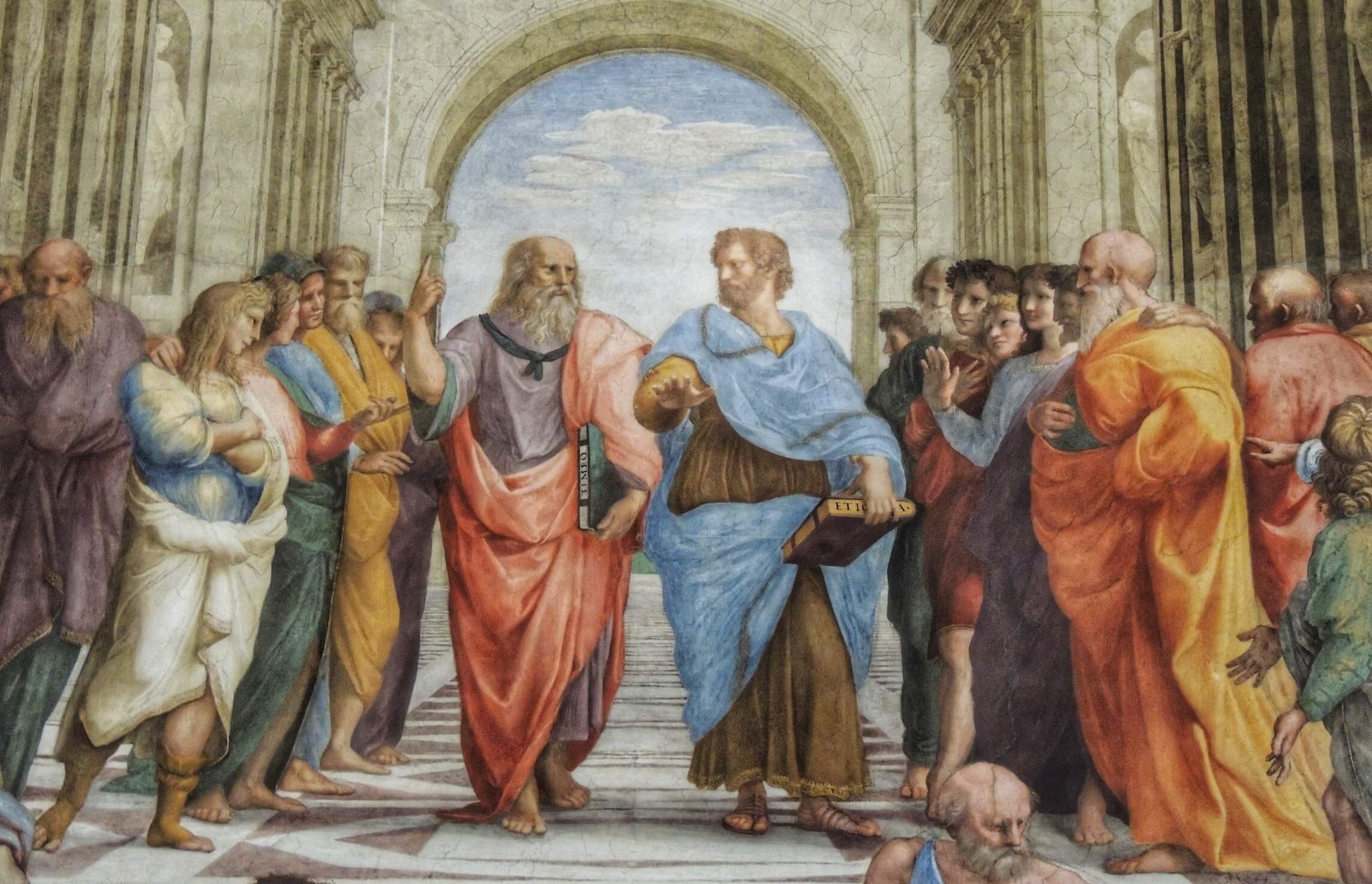
Most visitors enter the Vatican Museums with Michelangelo’s Sistine Chapel firmly in their sights, but a short distance away lies another of the Renaissance’s great artistic achievements. The Raphael Rooms, a suite of papal apartments transformed by Raphael and his workshop, are filled with philosophers, poets, saints, emperors and popes, all brought together in one extraordinary painted world.
Commissioned by Julius II and continued under Leo X, the frescoes reveal the ambitions of Renaissance Rome at the height of its confidence: a world in which the wisdom of ancient Greece could stand alongside Christian theology, and the history of the papacy could be presented as a continuation of Rome’s imperial destiny. From the unforgettable School of Athens to the turbulent battle scenes of the Hall of Constantine, our guide gives you the lowdown on what to look out for in Raphael’s Vatican masterpiece.
 Want to see the Raphael Rooms with a guide?

The School of Athens is only one part of Raphael’s extraordinary Vatican fresco cycle. Our tours explore the rooms in context, revealing the artists, ideas, and papal ambitions behind some of the Renaissance’s greatest paintings.
Discover the Raphael Rooms
Our Vatican Tours
Known as the ‘Prince of Painters’, Raphael was idolised during his lifetime and treated with a reverence enjoyed by few artists before or since. Amazingly precocious, the Urbino-born painter was recognised for his extraordinary abilities from an early age. Apprenticed to the renowned Renaissance artist Perugino, one of the leading figures in the first decorations of the Sistine Chapel, Raphael soon developed a style that was unmistakably his own. By his twenties his paintings were in demand throughout Italy, and he was already regarded as one of the most promising artists of his generation.
Unlike the cantankerous Michelangelo, poster boy for the archetype of the troubled artistic genius, Raphael was at ease rubbing shoulders with cardinals and aristocrats, princes and popes. His charm and social intelligence made him a natural at court, and his talents soon brought him to the attention of Pope Julius II, one of the most ambitious and formidable pontiffs ever to occupy the papal throne.
If you’ve joined us in the Sistine Chapel on one of our in-depth Vatican tours, you’ll know the story of how Julius cajoled, threatened and bribed Michelangelo into decorating the papal chapel. But the insatiable Julius wasn’t content with leaving his patronage there. Dissatisfied with the apartments he had inherited in the Vatican Palace, he called on the young hotshot Raphael and his workshop to transform them with a spectacular cycle of frescoes.
There was a political dimension to the project, too. Julius was determined to distinguish his pontificate from that of his predecessor, Alexander VI, the notorious Borgia pope whose apartments had been decorated by Pinturicchio. Julius had little affection for the Borgias, to put it mildly, and replacing their artistic legacy with a new, more ambitious programme was another way of stamping his authority on the Vatican.
The work began in 1508, with Raphael initially concentrating on the room that would become known as the Stanza della Segnatura. The project continued under Julius’s successor, Leo X, and eventually extended across four rooms. Raphael died in 1520, aged just 37, but his workshop continued the enterprise, bringing the final room to completion after his death.
The result is one of the most extraordinary artistic programmes of the Renaissance. Each room has its own identity, but together they offer a remarkably revealing portrait of papal ambition, Renaissance learning and Raphael’s evolving artistic vision.

The first room to be decorated was the Stanza della Segnatura, and many regard it as the high point of Raphael’s achievement in the Vatican. The room takes its name from the Segnatura Gratiae et Iustitiae, the papal tribunal that later occupied it, but under Julius II it served as a private library and study.
Raphael’s decorations follow an ambitious intellectual programme, bringing together four great branches of human knowledge: theology, philosophy, poetry and justice. The walls are dominated by the Disputa, the School of Athens and the Parnassus, while the ceiling reinforces the same themes through allegorical figures. Taken together, they express the Renaissance conviction that human reason, classical learning and Christian revelation could form parts of a harmonious intellectual universe.
The School of Athens

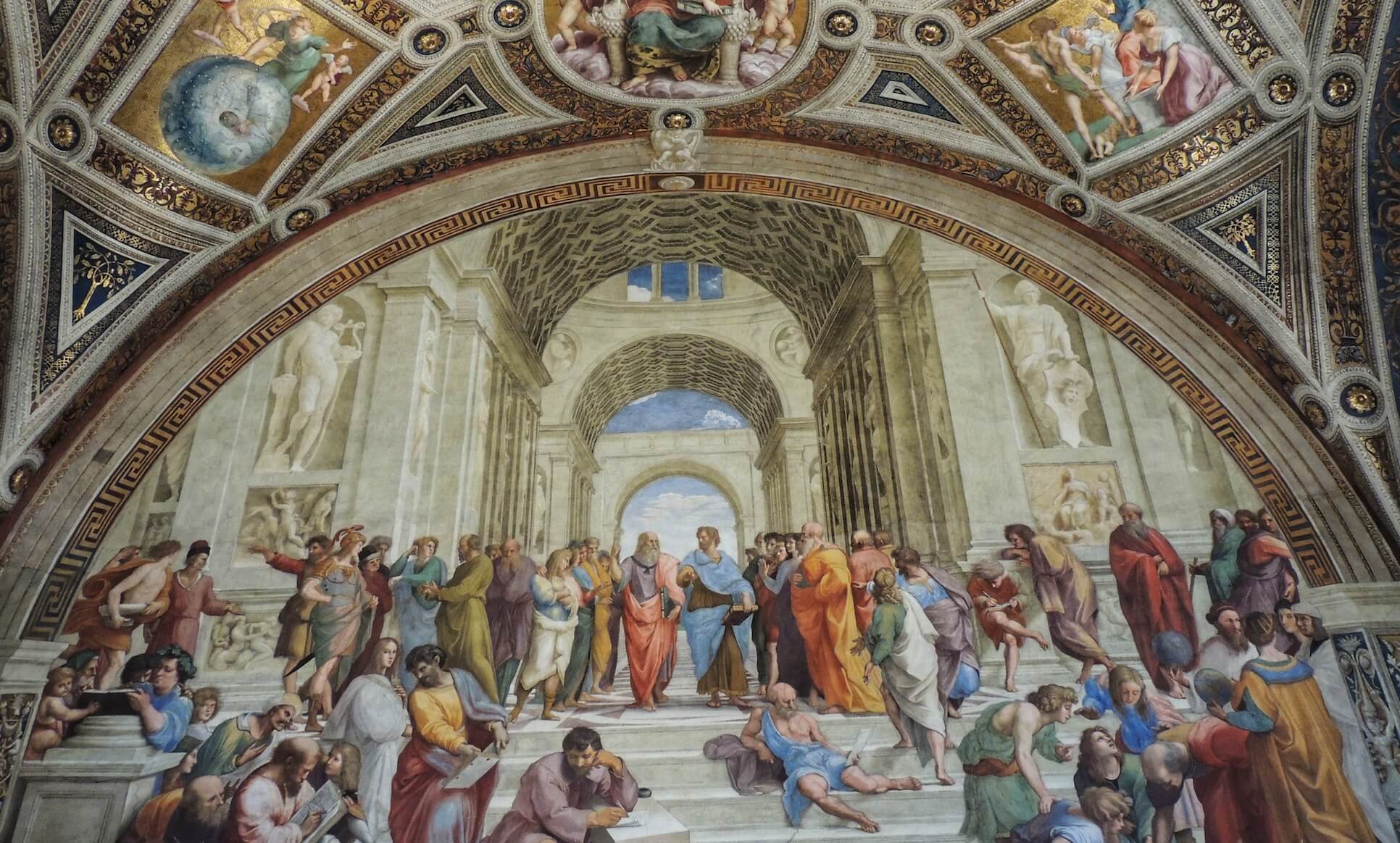
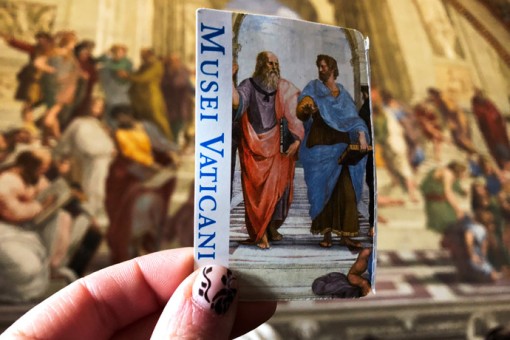
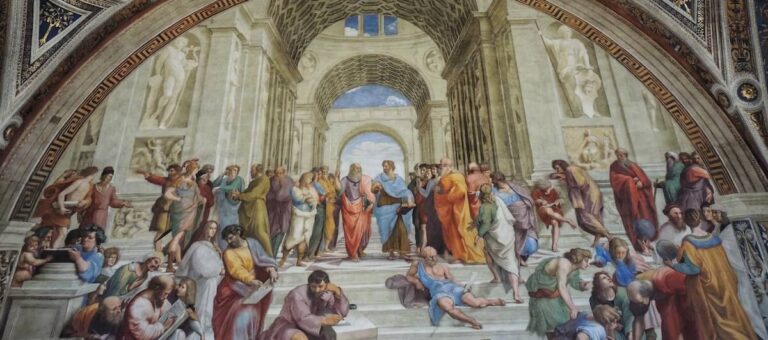
Raphael’s rational, harmonious style is perhaps best appreciated in the School of Athens, one of the most celebrated paintings in the history of Western art. The fresco presents an assembly of ancient philosophers gathered within a magnificent architectural setting, their animated discussions unfolding beneath soaring arches and a vast barrel-vaulted ceiling.
At the centre stand Plato and Aristotle, the two towering figures of ancient Greek philosophy. Plato gestures upwards as he expounds his belief in a higher realm of ideal forms beyond the visible world, while Aristotle extends his hand towards the earth, emphasising the importance of observation and the material world. Their contrasting gestures provide a wonderfully concise visual summary of two very different approaches to understanding existence.
The architecture is every bit as impressive as the philosophers themselves. Its monumental arches and coffered vaults recall the grandeur of ancient Roman building, and the vast perspective draws our eyes towards the two central thinkers. The setting has been convincingly associated with Bramante’s designs for the new St Peter’s – then under construction – although Raphael’s architecture is an idealised creation rather than a literal representation of a single building.
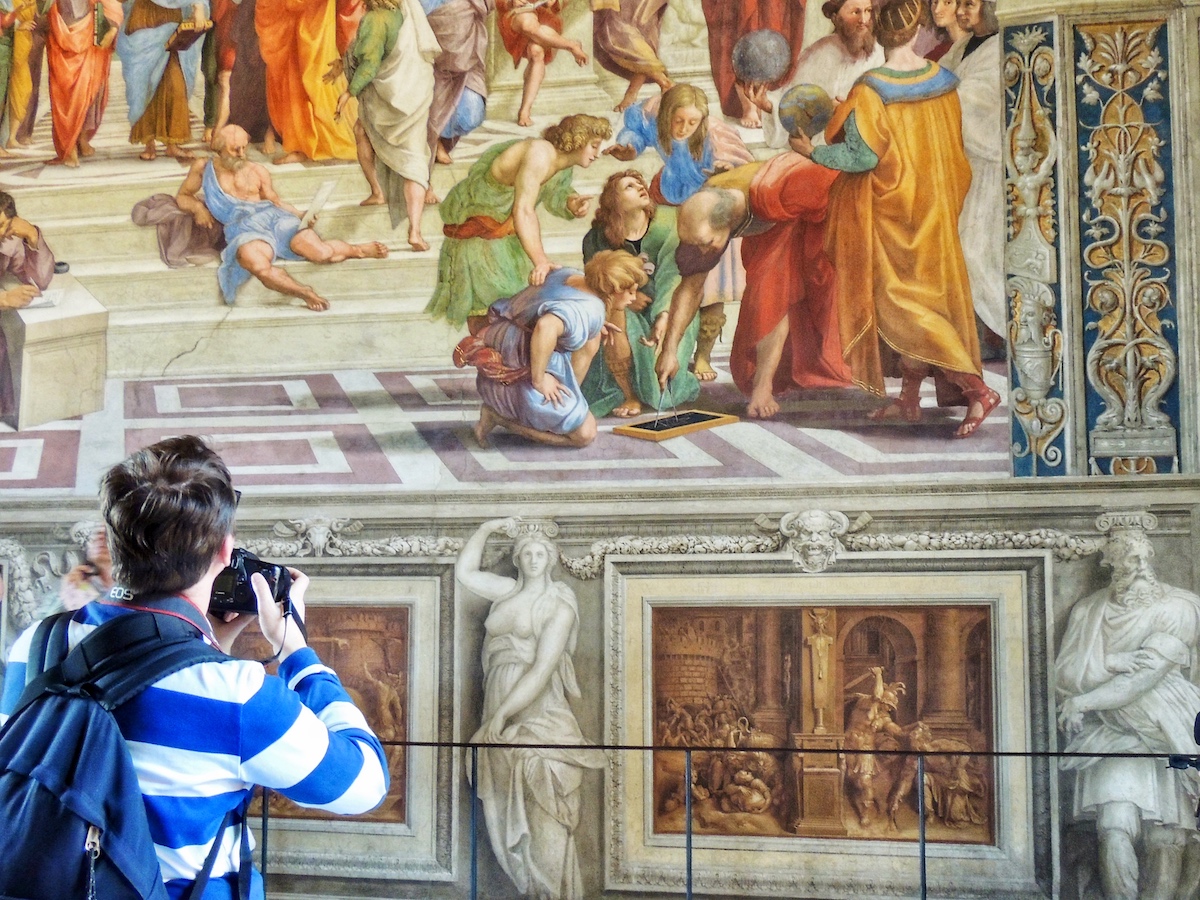
Take a closer look at the cast of philosophers crowding the fresco and you’ll notice that Raphael has given many of them the faces of his contemporaries. In Plato’s features we can recognise those traditionally identified as Leonardo da Vinci, while Euclid, bent over his geometric demonstration in the foreground, is generally identified as Raphael’s friend Bramante, one of the great architects of the Renaissance.
Heraclitus, meanwhile, lounges on the steps in distinctive leather boots, looking rather more melancholy than his companions. The figure is almost certainly a portrait of Michelangelo, Raphael’s formidable rival. The story goes that Raphael was so impressed by what he saw of Michelangelo’s work in the Sistine Chapel that he added this homage to the fresco at the last minute. Whether or not the anecdote is strictly true, the inclusion of Michelangelo is a lovely acknowledgement of the artistic rivalry that helped drive the extraordinary achievements of Renaissance Rome.
Keep an eye out, too, for the dapper young man in the green cap on the right of the scene who locks his gaze on ours. That’s Raphael himself, slipping into the company of the ancient thinkers and quietly positioning his own generation as the heirs to classical antiquity.
The Disputa
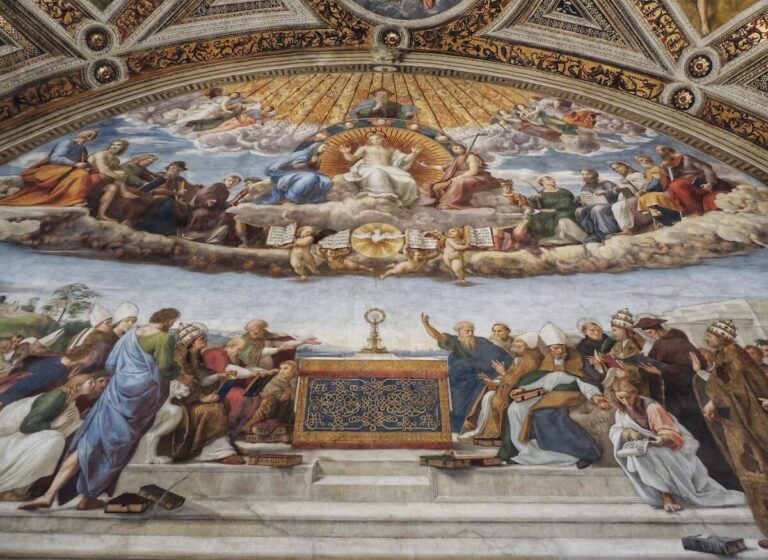
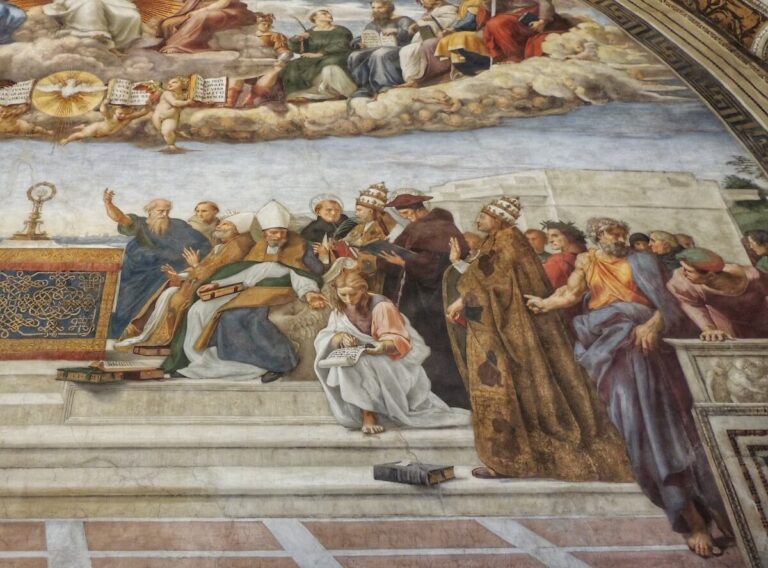
On the opposite wall of the stanza, The Disputation of the Holy Sacrament reads like a Christian mirror-image of the School of Athens, expounding on the nature of theological rather than rational truth. The painting unfolds on both heaven and earth: Christ reigns in the celestial sphere, where he is joined by the Virgin and John the Baptist. Key players from both the Old and New Testaments surround them: dam crosses his legs as he chats to St. Peter, whilst Moses holds open the stone tablets of the law entrusted to him atop Mount Sinai as he exchanges a sidelong glance with St. Lawrence.
Arrayed around the dove of the Holy spirit, four winged angels hold open the four gospels – the divine word of God is seemingly accessible to the faithful only through the mediation of these holy figures. Illuminating everyhthing is God himself, who appears in a celestial sky of blinding gold, rows of cherubim bursting forth from the clouds like so many rays of divine light.
Beneath, in the world of men, an altar at the painting’s perspective centre plays host to a golden monstrance containing the holy host, the unleavened bread that miraculously transforms into the body of Christ and is the centrepiece of the mass in Catholic religious ceremony. Ascending the steps in their attempts to get closer to the altar, the great theologians and doctors of the Church engage in learned debate about the true nature of the miracle of transubstantiation. One points to the celestial vision in the sky, as another gestures to the earthly presence of God in the sacrament.
Where the School of Athens featured the portraits of Raphael’s fellow artists, amongst the popes and prelates populating the Disputa further famous faces can be made out. Look out for the chiselled features of Dante, depicted in sober profile, wearing a laurel wreath in recognition of his reputation as Italy’s greatest poet. Half-hidden in the pious throng, here too is the hooded form of the firebrand Florentine preacher Savonarola. Burned at the stake only a decade earlier, he is probably included here as a mocking gesture from the Pope towards the hated Borgia Pope Alexander VI, who had ordered the monk’s immolation.
The Parnassus
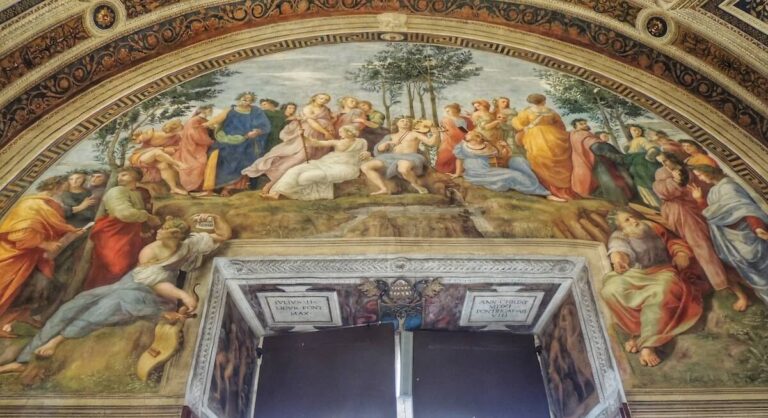
A rather more cheerful subject occupies the third great wall of the room. In the Parnassus, Apollo presides over the poetic arts on the slopes of Mount Parnassus, the legendary home of the Muses. Seated beneath a laurel tree, the god of music plays his lyre, surrounded by poets from antiquity and Raphael’s own day.
The composition is a celebration of poetry as a source of inspiration and elevated knowledge, and the gathering brings together an extraordinary literary company. Blind Homer appears near the centre, accompanied by the Roman poet Virgil and the Greek lyric poet Sappho, who holds a scroll bearing her name. Dante makes another appearance, once again identifiable by his laurel wreath and distinctive cap, while other figures represent the great traditions of classical and Renaissance literature.
The fresco is a delightful counterpart to the philosophical and theological debates elsewhere in the room: poetry too has a privileged role in the pursuit of truth and beauty, capable of transporting the human mind beyond the everyday world. By bringing the great poets of antiquity together with contemporary Italian writers, Raphael explicitly presents Renaissance culture as the natural continuation of the classical golden age.
With the next room, the tone changes considerably. The Stanza di Eliodoro was decorated after the Segnatura, principally between 1511 and 1514, and served as an audience chamber for Julius II. Its frescoes are concerned with the protection of the Church, the power of divine intervention and the authority of the papacy at a time when Julius was engaged in an often precarious struggle to defend the Papal States.
Where the Segnatura had celebrated the harmony of human knowledge, the Heliodorus cycle is more urgent and political. Its biblical and historical episodes show the faithful protected against their enemies, with Julius himself appearing in several scenes as a contemporary witness to the continuing power of God.
Expulsion of Heliodorus from the Temple

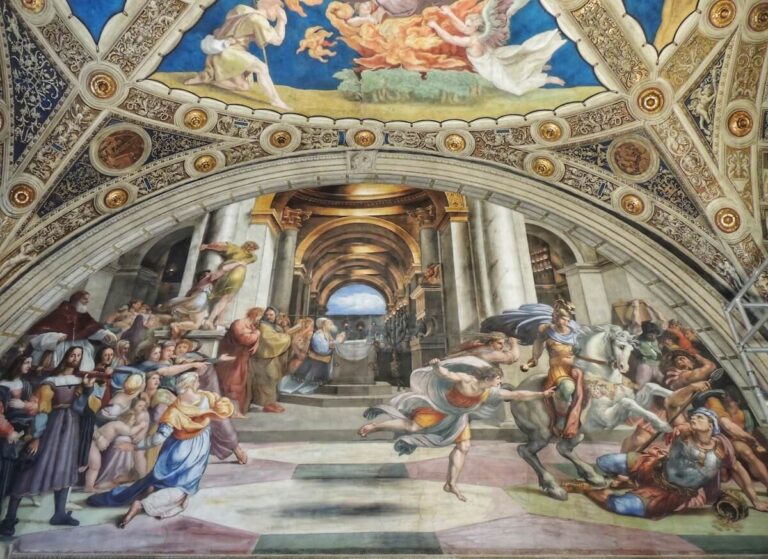
The room’s principal fresco depicts the Expulsion of Heliodorus from the Temple, a dramatic episode from the Second Book of Maccabees. Heliodorus, sent by the Syrian king Seleucus IV to seize the treasures of the Temple in Jerusalem, is thwarted by a miraculous intervention. After the high priest Onias appeals to God for help, a magnificent horseman appears with two heavenly companions and drives the would-be thief from the sacred precinct.
Raphael has turned the biblical episode into a piece of spectacular theatre. Heliodorus is thrown into confusion on the right, his body twisted as the celestial horseman bears down upon him, while the high priest remains at the altar in prayer. The scene is filled with rushing movement, dramatic gestures and sharply contrasting emotions, all arranged around the architectural setting of the Temple.
To the left, meanwhile, Pope Julius II watches the episode from a sedan chair carried by attendants. The event supposedly took place centuries before his birth, but Julius has been inserted into the scene as a contemporary witness, making the message rather difficult to miss: just as God protected the treasures of the Temple, so too would he defend the Church and its possessions.
The choice of subject was particularly pointed. Julius was engaged in a determined effort to secure the territories and revenues of the papacy, and the fresco presents the defence of ecclesiastical property as something with divine sanction.
The Liberation of Saint Peter

In the Liberation of Saint Peter, Raphael pulls off one of the most remarkable feats of illusionism in the entire suite. The chained apostle is freed from prison by an angel, while the armoured guards sleep soundly around him, oblivious to the supernatural intervention taking place under their noses.
The scene is based on the account in the Acts of the Apostles, in which Peter is imprisoned by Herod and rescued by an angel who leads him past the sleeping sentries and out through the prison gates. Raphael compresses several moments of the story into a single composition, showing the angel appearing to Peter, leading him from his cell and passing the guards as they remain sunk in sleep.
What makes the fresco so extraordinary, however, is its treatment of light. The angel glows with an almost unearthly radiance, illuminating Peter and the prison interior, while the moon shines down upon the guards and the surrounding architecture. Beyond the bars, the first hints of dawn begin to emerge. Raphael has effectively painted three different kinds of light within the same scene, using them to distinguish the supernatural from the ordinary world.
The result is a nocturnal atmosphere of extraordinary subtlety, quite unlike the brilliant, open spaces of the School of Athens. The angel’s light seems almost to dissolve the darkness around him, while the guards’ armour catches the moonlight in cold metallic flashes. It is a bravura demonstration of Raphael’s technical range, and one of the most memorable passages in the entire Vatican Palace.
There is a political message here, too. Peter, the first pope according to Catholic tradition, is delivered from captivity through divine intervention. For Julius II, the episode offered a powerful image of the protection afforded to the Church and its head, and Raphael has made that assurance quite literally shine out of the darkness.
The Mass of Bolsena
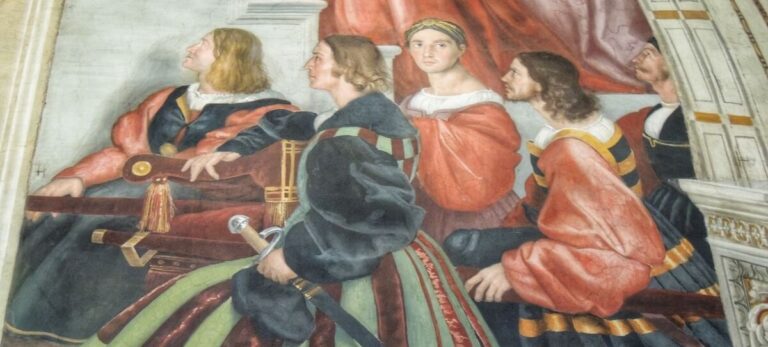
The Mass of Bolsena brings us to a Eucharistic miracle said to have taken place in the Italian town of Bolsena in 1263. According to the traditional account, a priest from Bohemia who was troubled by doubts about the doctrine of transubstantiation was celebrating Mass when blood began to seep from the consecrated host, staining the corporal on the altar. The event was understood as a miraculous confirmation of the real presence of Christ in the Eucharist.
Raphael depicts the priest at the moment of the miracle, his expression registering a mixture of astonishment and reverence as the blood appears before him. Around the altar, witnesses respond with varying degrees of wonder and devotion, while the composition is anchored by the solemn architecture and ritual of the Mass.
Pope Julius II appears once again, kneeling prominently on the right-hand side of the fresco. As with the other historical episodes in the room, the pope has been transported back in time to witness an event that took place long before his birth. The episode also had a wider historical resonance. The traditional account of the miracle is associated with the establishment of the Feast of Corpus Christi, which celebrates the Eucharist and its central place in Catholic worship.
Raphael’s fresco thus combines religious devotion with a statement about the authority of the Church and the miraculous foundations of its sacramental life.
Encounter of Leo the Great with Attila
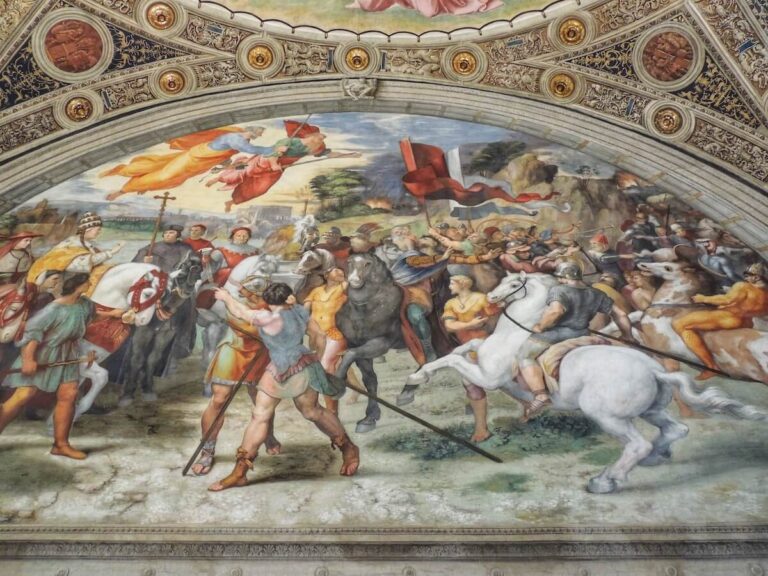
The final fresco in the room takes us to 452 AD, when Pope Leo I, later known as Leo the Great, met Attila the Hun in an attempt to prevent his advance into Italy. According to the traditional account, the pope’s intervention persuaded Attila to withdraw from his threatened march on Rome. Raphael adds a supernatural dimension to the episode, showing Saints Peter and Paul appearing in the sky with swords in hand, helping to turn the barbarian leader’s marauding horde away from the Eternal City.
The composition is full of dramatic contrasts. Attila and his mounted followers approach from the left, their movement checked by the papal delegation, while the heavenly apostles hover above the scene. The city of Rome appears in the background, with the Colosseum recognisable among its monuments.
More time-bending papal aggrandisement is on show here too, although the identity of the pontiff has changed. By the time Raphael painted the fresco, Julius II had died and his successor Leo X had taken over the commission. The new pope was keen to make his own mark on the room, and the central figure of Leo the Great bears the features of Leo X himself. The historical pope has effectively been replaced by his Medici namesake, allowing the reigning pontiff to associate himself with the great defender of Rome.
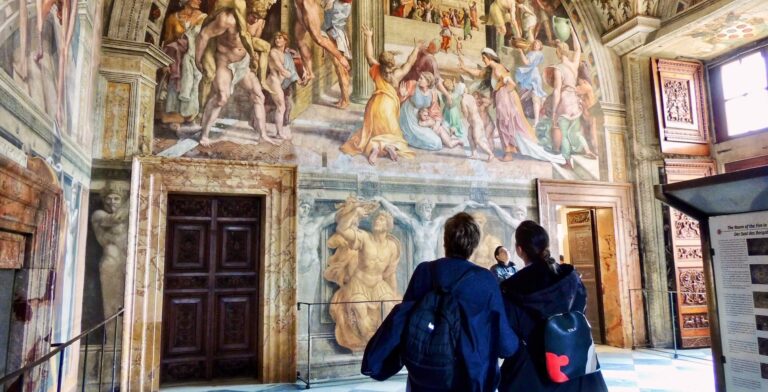
The next room, the Stanza dell’Incendio del Borgo, was decorated during the pontificate of Leo X and served as the pope’s dining room. Its frescoes recount episodes associated with earlier popes named Leo, allowing the Medici pontiff to draw parallels between his own reign and the achievements of his illustrious predecessors.
By this stage Raphael was increasingly occupied with a vast range of commissions, and his workshop played a more substantial role in executing the Vatican decorations. The paintings retain the master’s designs and artistic direction, but the style becomes more elaborate and animated, with a growing emphasis on theatrical gestures, muscular bodies and complex compositions – hallmarks of the emerging Mannerist style.
Fire in the Borgo
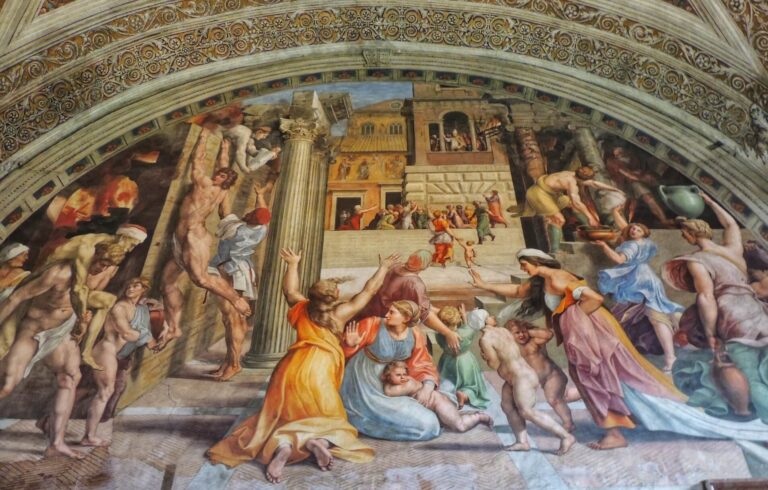
The room takes its name from the Fire in the Borgo, a spectacular fresco depicting a conflagration that broke out in the neighbourhood surrounding the Vatican in 847 AD. According to the account, Pope Leo IV appeared on the loggia of the old St Peter’s Basilica and extinguished the flames with a single blessing of his hand.
Raphael has transformed the episode into a scene of high drama. Citizens scramble to escape the flames, mothers plead for help, and desperate figures clamber over walls in an effort to save themselves and their families. The pope appears in the background, calmly raising his hand in blessing as the fire miraculously subsides.
Look out for the massively muscular naked man clinging desperately to the wall in the foreground. His twisting body and exaggerated musculature are a clear homage to Michelangelo’s work in the Sistine Chapel, and a reminder that the artistic rivalry between the two masters continued to shape the visual language of Renaissance Rome.
On the left, a young man carries an elderly figure on his back, a reference to the Trojan hero Aeneas escaping the burning city of Troy with his father Anchises. The episode was one of the foundational stories of Roman identity, since Aeneas was regarded as an ancestor of the Roman people.
Raphael has fluently woven classical myth into the Christian historical narrative, drawing a parallel between the survival of Troy and the miraculous preservation of Rome. The group also anticipates a composition that would later be explored by Bernini in his Aeneas, Anchises and Ascanius, now in the Borghese Gallery.
The Battle of Ostia
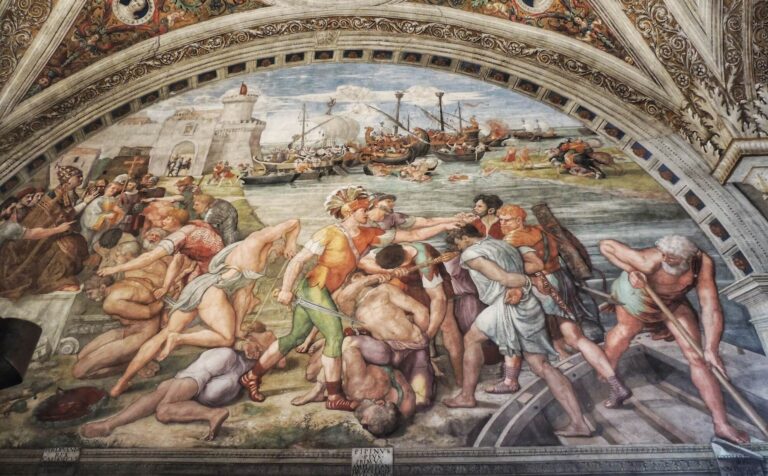
The Battle of Ostia takes us to 849 AD, when a coalition of Italian maritime forces defeated a Saracen fleet off the coast near Rome. The victory was associated with Pope Leo IV, whose authority and prayers were understood as contributing to the defence of the Christian city against its Muslim attackers.
Raphael’s composition is dominated by the defeated enemy, with prisoners being dragged ashore and brought before the victorious Christian forces. The scene is less concerned with the mechanics of naval warfare than with the humiliation of the defeated and the restoration of papal authority. The pope himself appears in the background, receiving the captives as a symbol of the Church’s triumph.
The historical event was more complicated than the fresco suggests: the naval victory involved the forces of several southern Italian cities, including Naples, Amalfi and Gaeta. But the painting deliberately concentrates the achievement in the person of Leo IV, turning a collective military success into a celebration of papal leadership.
For Leo X, the subject offered another opportunity to associate his own pontificate with the defence of Rome and the Christian faith. The pope’s namesake had protected the city against a formidable external threat, and the Medici pontiff could present himself as the inheritor of that same responsibility.
The Crowning of Charlemagne

The Crowning of Charlemagne depicts one of the most consequential moments in medieval European history: the coronation of the Frankish king as emperor by Pope Leo III in St Peter’s Basilica on Christmas Day, 800 AD.
The event is traditionally regarded as the foundation of the medieval Holy Roman Empire, although the political relationship between the papacy and the emperors that followed was to become considerably more complicated. In Raphael’s fresco, however, the scene is presented as a magnificent act of cooperation between Church and state, with the pope conferring imperial authority upon the kneeling ruler.
Once again, contemporary politics intrudes into the historical narrative. Charlemagne’s features are generally understood to resemble those of Francis I, King of France, with whom Leo X had recently concluded an agreement. The fresco thus celebrates a new alliance between the papacy and the French crown, using the great coronation of 800 as an ideal model for the political relationship of the present.
The scene is also a reminder of how Raphael’s Vatican commissions increasingly functioned as elaborate instruments of papal diplomacy. The paintings may recount events from the distant past, but their intended audience would have recognised the contemporary implications immediately.

The final room in the suite is the Sala di Costantino, or Hall of Constantine, the largest of the four apartments. Its decoration was begun during Raphael’s lifetime, but the frescoes were largely executed by his pupils after his death in 1520, following his designs. Giulio Romano, one of Raphael’s closest collaborators, played a particularly important role in bringing the ambitious cycle to completion.
The room celebrates the life and achievements of Constantine the Great, the Roman emperor traditionally regarded as the first Christian ruler of the empire. The choice of subject was highly significant. Constantine’s conversion and support for Christianity had transformed the fortunes of the early Church, while his association with the foundation of the papal basilicas made him an especially useful figure for the Renaissance papacy.
The cycle presents a sequence of episodes in which Constantine’s military victory, conversion and relationship with the Church are woven into a larger argument about the legitimacy of papal authority. It is also the most overtly political of the four rooms, culminating in a scene that would become one of the most consequential forgeries in European history.
The Battle of the Milvian Bridge
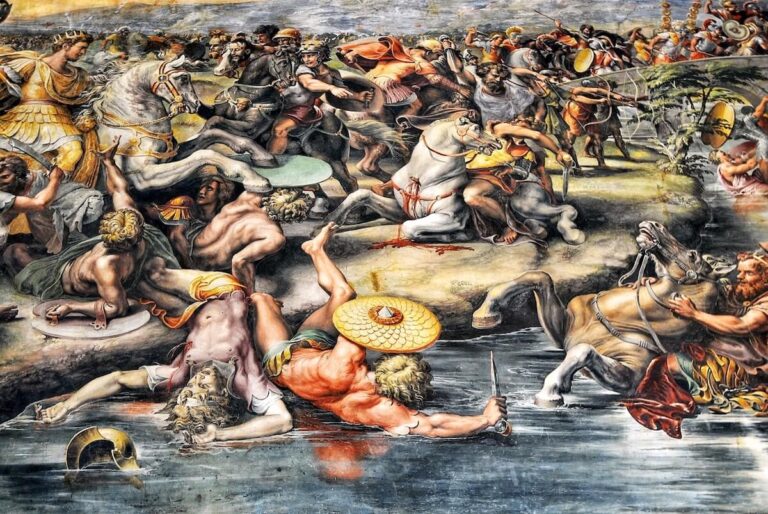
The Battle of the Milvian Bridge depicts Constantine’s decisive victory over his rival Maxentius in 312 AD, an event that paved the way for his eventual sole rule of the Roman Empire. According to the traditional Christian account, Constantine experienced a vision of a cross in the sky before the battle, accompanied by the words In hoc signo vinces — ‘In this sign you will conquer.’
Raphael’s workshop has turned the battle itself into a magnificent tangle of bodies, horses, weapons and swirling banners. The Tiber forms the backdrop to the chaos, with Maxentius and his forces driven towards the river as Constantine’s army presses its advantage. The emperor, wearing a crown and mounted on a white horse, dominates the composition, while his defeated rival is shown tumbling into the water.
The scene is one of the most energetic paintings in the entire suite, with the tumult of battle conveyed through a dense interlocking mass of figures. It is generally attributed to Giulio Romano, working from Raphael’s designs, and gives us a sense of how the master’s workshop was able to translate his monumental compositions into increasingly dramatic and muscular forms.
The historical significance of the victory is enormous. Constantine’s defeat of Maxentius helped establish the conditions for the legal toleration of Christianity, culminating in the policies associated with the Edict of Milan in 313. The fresco therefore presents the triumph of Constantine as a turning point in the history of the Church, and a foundational moment in the relationship between Christianity and imperial power.
The Baptism of Constantine

The next fresco depicts Constantine’s baptism, traditionally believed to have taken place shortly before his death in 337 AD. The emperor kneels in a font as Pope Sylvester I performs the ceremony, surrounded by members of the clergy and imperial attendants.
The setting is particularly interesting. Raphael’s workshop has placed the scene inside the Lateran Baptistery, a building associated with Constantine himself and one of the earliest great centres of Christian worship in Rome. The architecture reinforces the connection between the emperor’s conversion and the establishment of Christianity as a major force within the Roman world.
The historical account of Constantine’s baptism is more complicated than the fresco suggests. He was baptised only near the end of his life, and the traditional association with Pope Sylvester is not securely established. But the painting is concerned less with reconstructing the precise circumstances than with presenting Constantine’s conversion as a defining moment in the history of the papacy.
The Donation of Constantine

The final fresco, the Donation of Constantine, depicts the emperor kneeling before Pope Sylvester and presenting him with a golden statue, symbolising the transfer of imperial authority over Rome and the western territories to the papacy.
The scene is based on a document known as the Donation of Constantine, which purported to record the emperor’s grant of extensive temporal powers and privileges to the pope. For centuries the text was used to support papal claims to political authority, making it one of the most consequential documents in the history of the medieval Church.
There was just one rather significant problem: the Donation never happened. The document was a medieval forgery, exposed as such by the fifteenth-century humanist Lorenzo Valla through his analysis of its language and historical inconsistencies. The fresco was nevertheless painted in the early sixteenth century, when the Donation still formed part of the historical argument for papal temporal power. It is a wonderfully revealing final note to the entire suite.
Across these four rooms, Raphael and his workshop have celebrated the relationship between classical learning, Christian revelation, imperial history and the authority of the papacy. Here, that authority is given a foundation in a document that was entirely fictitious.
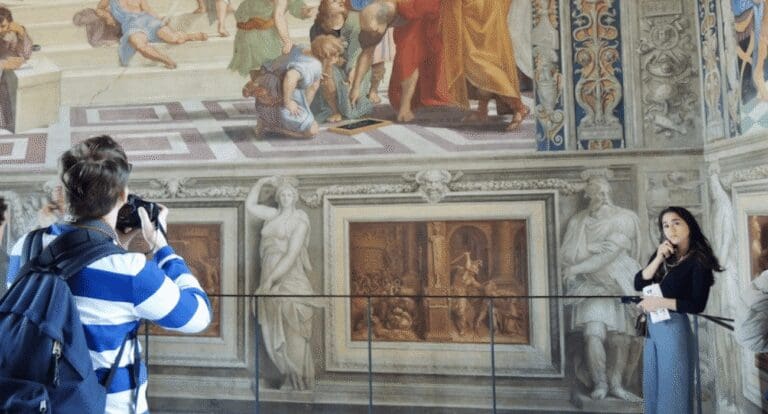
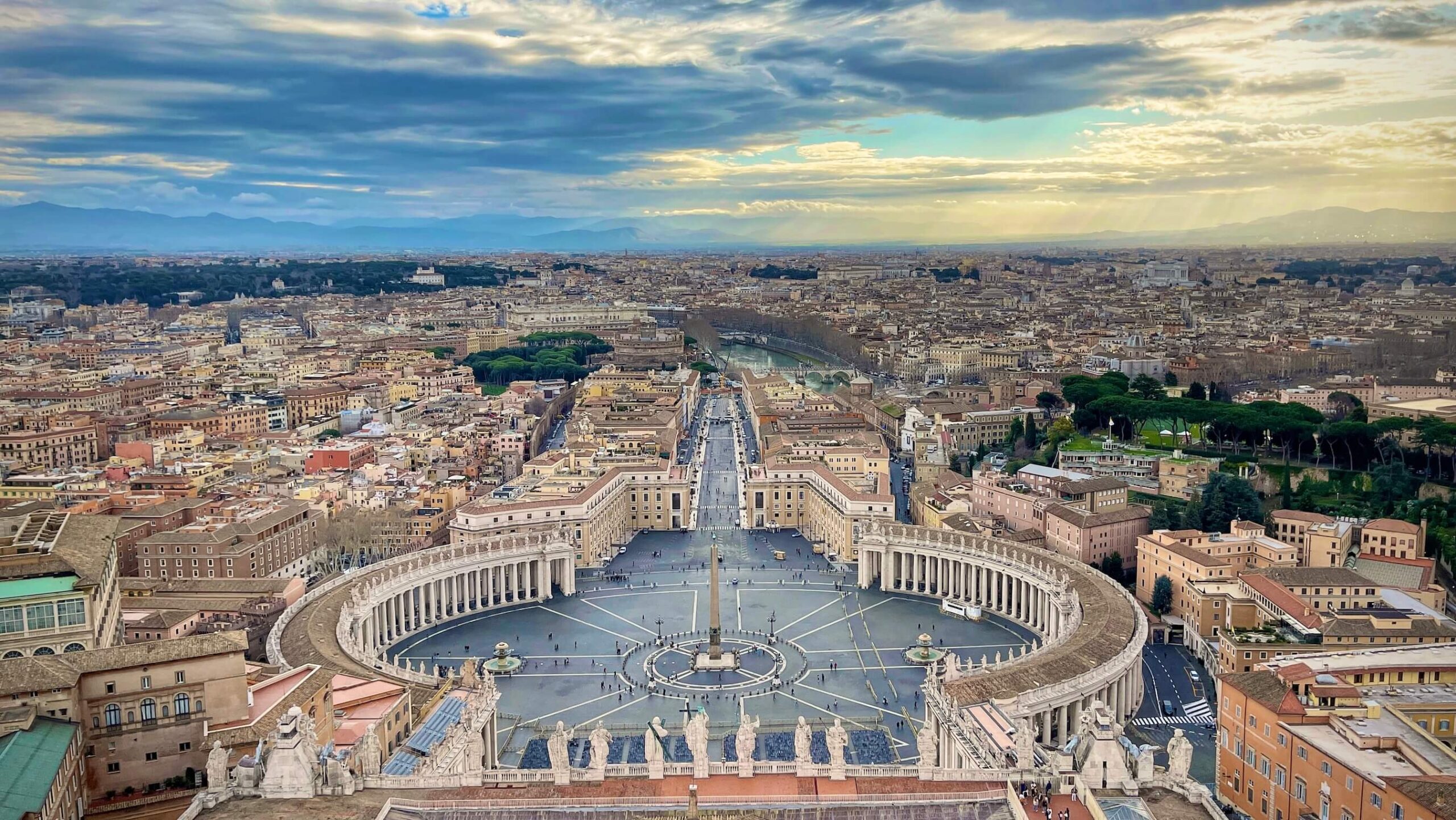
The Raphael Rooms are located inside the Vatican Museums and are included in a standard Vatican Museums admission ticket. They form part of the visitor route towards the Sistine Chapel, so most visitors encounter them as they make their way through the galleries. Allow at least 20–30 minutes to appreciate the principal frescoes, and longer if you want to explore the details and relationships between the different rooms.
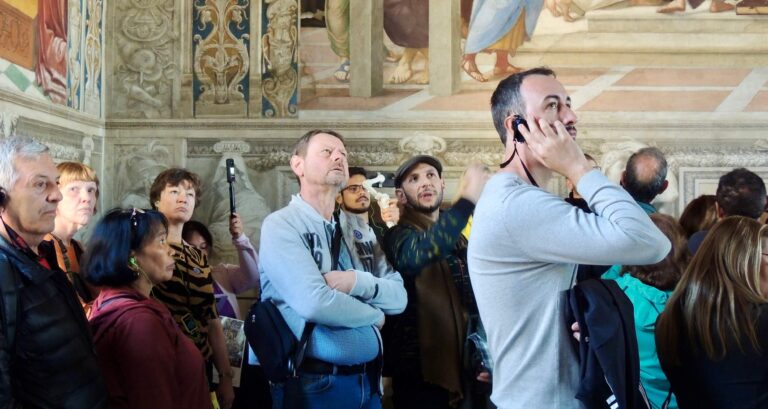
The rooms can become busy, particularly during peak visiting periods, so it is worth pausing where you can rather than trying to take in every detail at once. A knowledgeable guide can help make sense of the recurring figures, historical references and papal symbolism that connect the frescoes into a much larger programme, so consider joining a guided tour to get the most out of your visit.
What are the Raphael Rooms?
The Raphael Rooms, or Stanze di Raffaello, are four rooms in the Vatican Palace decorated by Raphael and his workshop for Popes Julius II and Leo X. They contain some of the most celebrated frescoes of the Italian Renaissance.
Where are the Raphael Rooms?
The Raphael Rooms are inside the Vatican Museums in Vatican City, forming part of the visitor route towards the Sistine Chapel.
What are the four Raphael Rooms called?
The four rooms are the Stanza della Segnatura, Stanza di Eliodoro, Stanza dell’Incendio del Borgo and Sala di Costantino, also known as the Hall of Constantine.
What is the most famous painting in the Raphael Rooms?
The School of Athens, in the Stanza della Segnatura, is generally regarded as Raphael’s most famous fresco in the Vatican. It depicts the great philosophers of antiquity gathered within an idealised Renaissance architectural setting.
How long does it take to visit the Raphael Rooms?
Allow around 20–30 minutes to see the principal frescoes, although visitors interested in art and history may wish to spend considerably longer.
Did Raphael paint all the frescoes himself?
No. Raphael designed and painted important parts of the cycle, but he worked with a large workshop of assistants. The Hall of Constantine was largely executed by his pupils after his death in 1520, following his designs.
Can you visit the Raphael Rooms with a Vatican Museums ticket?
Yes. Access to the Raphael Rooms is included in a standard Vatican Museums admission ticket.
Why are the Raphael Rooms important?
The rooms are important both for Raphael’s artistic achievements and for the ambitious programme of ideas they express. Their frescoes bring together classical philosophy, Christian theology, poetry, papal history and political authority, offering a remarkable picture of Renaissance culture and the ambitions of the papacy.
We hope you enjoyed our guide to the fabulous frescoes of the Raphael Rooms! If you’d like to see these masterpieces of the Renaissance for yourself in the company of an expert art-historian, then be sure to check out Through Eternity’s range of small-group Vatican tours and private Vatican itineraries!
Ready to visit the Raphael Rooms?
Book Your Tour Here!