Walking along the Tiber at night, the idle wanderer will inevitably come across a miraculous sight as they follow the river's bend.
A team of heavenly angels, their gleaming white forms shining in the dark, spans the waters between the city centre and the Vatican. At their end stands a massive hulk of brick and stone, high atop which looms their captain, the Archangel Michael, his outstretched wings illuminated against the night sky.
This is Castel Sant’Angelo — the Castle of the Holy Angel. An ancient imperial tomb turned medieval fortress turned papal palace turned opera backdrop, the site is very much worth visiting during the day, but after dark one’s imagination can really glimpse the surreal beauty of its nineteen centuries of history.
Seeing Castel Sant’Angelo at night, one can almost sense the ghosts of the Roman emperors buried within its massive walls, and hear the cries of the thousands of papal prisoners who languished in its dungeons.
It is, in short, one of those places that only Rome could have produced: extraordinary in itself, extraordinary in its history, and extraordinary in its view.
Rome Tours
Explore a Hidden Side of the Eternal City
Castel Sant'Angelo
History at a Glance
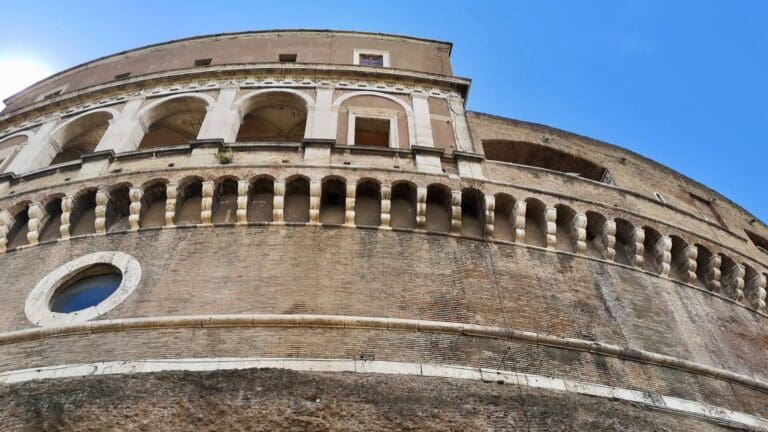
Few buildings in the world contain as many layers of human history as Castel Sant’Angelo.
In nearly two thousand years, this single structure has been an imperial mausoleum, a medieval fortress, a papal prison, a Renaissance palace, a Napoleonic citadel, and is now a state museum that draws hundreds of thousands of visitors a year.
To walk through it is to walk through Rome’s entire history in a single afternoon.
The building began as a tomb — the grandest private tomb in the ancient world. It became a castle when Rome’s medieval defenders recognised its military potential.
It was decorated as a palace when Renaissance popes retreated here from enemies and summer heat alike. It imprisoned scholars, saints and soldiers in its dungeons. And it was immortalised as the setting for one of the most famous scenes in all of opera.
Every century has left its mark, and every mark is still visible.

Hadrian's Mausoleum
The Ancient Beginning
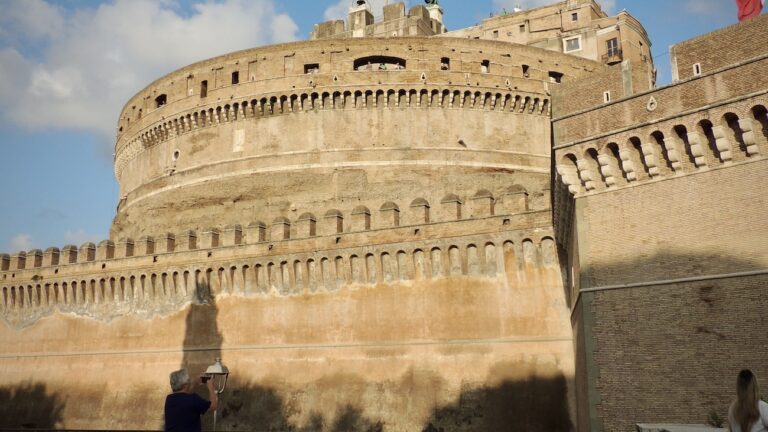
Long before the Church took possession of this great structure, it was a major monument honouring the pagan emperors of Rome.
The Emperor Hadrian — one of the greatest rulers of the High Empire, traveller, intellectual, architect, and builder of the villa at Tivoli — constructed an immense cylindrical sepulchre on the west bank of the Tiber in the 130s AD.
Designed in form and scale to rival the great Mausoleum of Augustus further downstream, it was intended to serve as the dynastic tomb of the Antonine imperial dynasty, and eventually housed the remains of emperors from Hadrian himself to Caracalla.
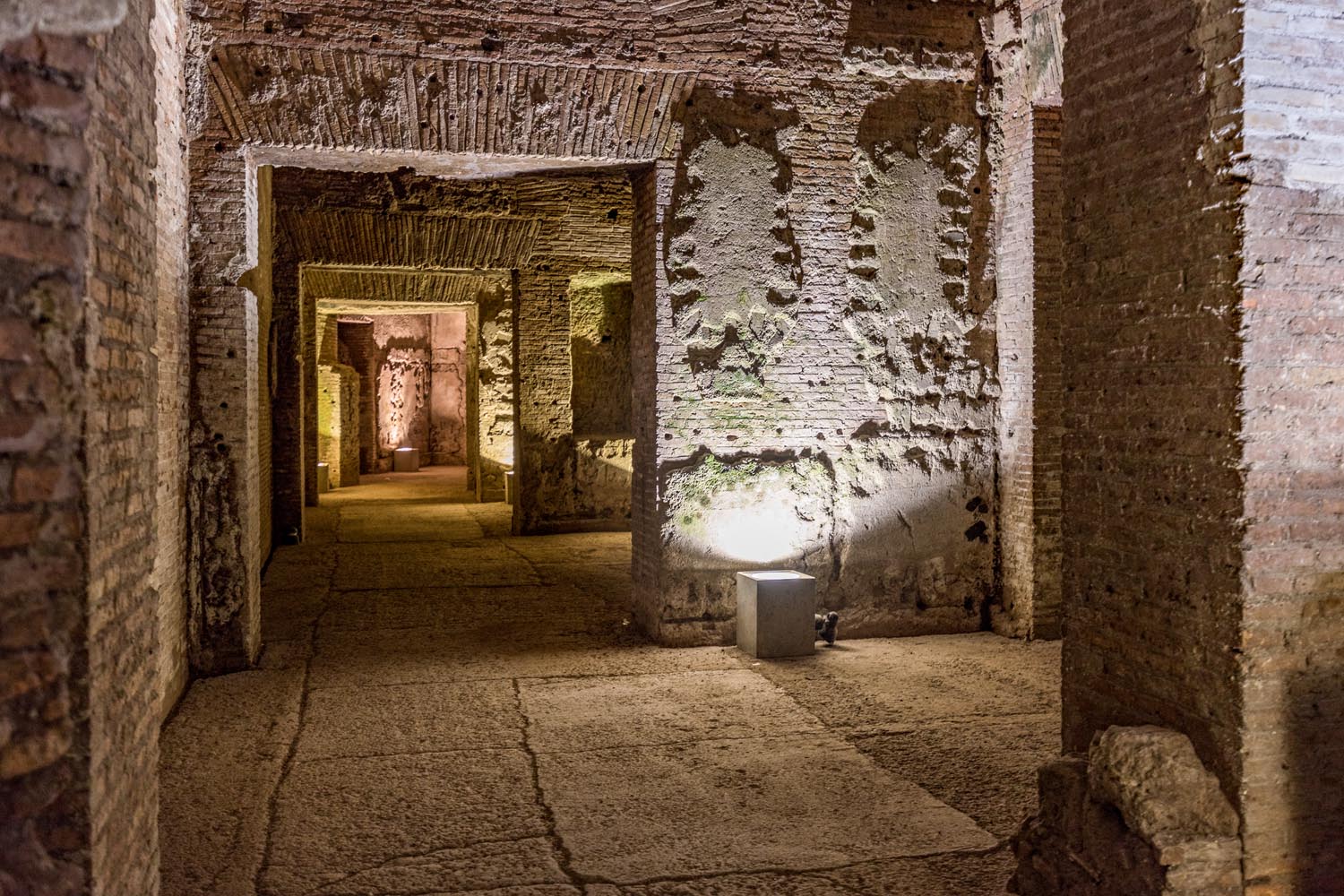
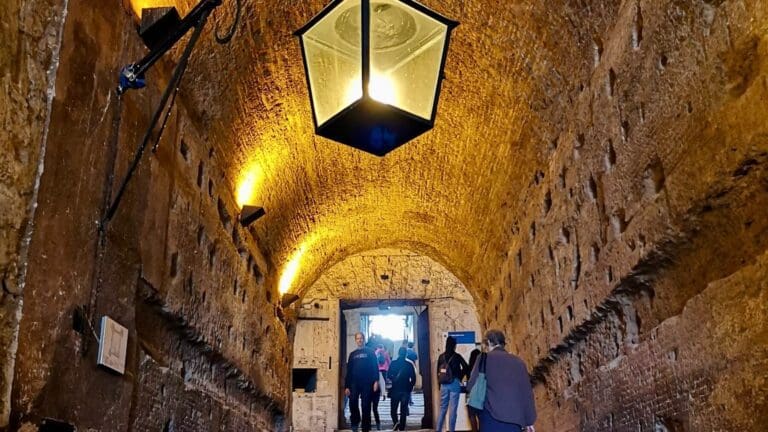
Hadrian’s major architectural innovation was the great spiral ramp that coils inside the massive drum of the tomb, ascending through the concrete structure to the burial chambers above.
Even today, in order to reach the medieval and Renaissance levels of the modern castle, you must walk through the ancient mausoleum. Entering the massive antechamber — once covered in precious marble, its walls lined with niches — you can still make out the space where a colossal statue of the emperor himself once stood.
From there, the giant ramp begins: a slow, rising spiral deep into what feels, counterintuitively, like a descent into the underworld.
At the heart of the structure is the imperial burial chamber itself. Nothing remains of its rich decoration, but the spaces reserved for the sarcophagi of the imperial family are still clearly legible.
Only one ancient object has survived, in unexpected form: the purple porphyry lid of a sarcophagus, believed by some to have been Hadrian’s own, was removed centuries ago and now serves — flipped upside down — as the baptismal font of St. Peter’s Basilica across the river.
An emperor’s tomb providing the vessel for Christian baptism: it is the kind of detail that only Rome, in its endless recycling of the past, could offer.
The Legend of the Angel and the Plague
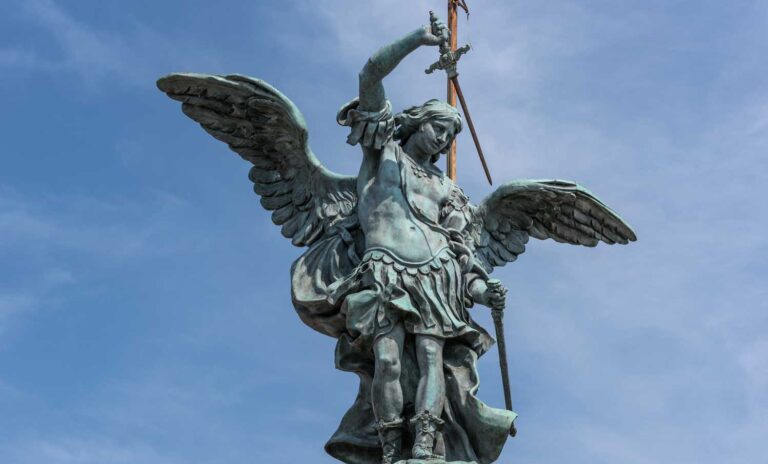
The fortress takes its famous name from a legend dating to the darkest days of the early Middle Ages.
At the end of the 6th century AD — after Rome’s fall, with the city shrunken to a fraction of its ancient size, streets that had once thronged with a million inhabitants now choked with disease and the bodies of the dead — a terrible plague fell upon what remained of the city.
Pope Gregory the Great, who would later earn the epithet that history has given him, led a solemn procession through Rome, praying to God to spare those who still lived.
As the procession passed the old mausoleum of Hadrian — long fallen into disuse and ruin, its ancient splendours forgotten — Gregory looked up and had a vision of a radiant figure standing atop the massive tomb.
It was an angel, glowing with divine light and brandishing a drawn sword; as the Pope watched, the angel lowered his weapon and sheathed it. The meaning was clear: God’s wrath was satisfied, the plague was ending, and mercy had been granted to the city.
The building has been known as the Castle of the Holy Angel — Castel Sant’Angelo — ever since. The statue of the Archangel Michael that crowns the building today is a bronze version from the early 18th century, replacing earlier marble and bronze versions that stood in the same spot from the early medieval period.
It serves as a reminder, in this resolutely Catholic capital, that divine mercy is present even in the worst of times.
From Tomb to Fortress
The Medieval Transformation
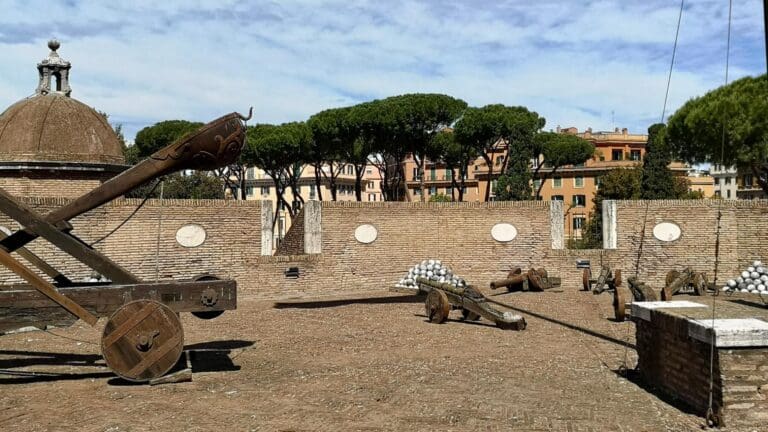
The urban history of Rome is fundamentally a history of re-use, with medieval and Renaissance citizens making pragmatic use of whatever the ancient world had left behind.
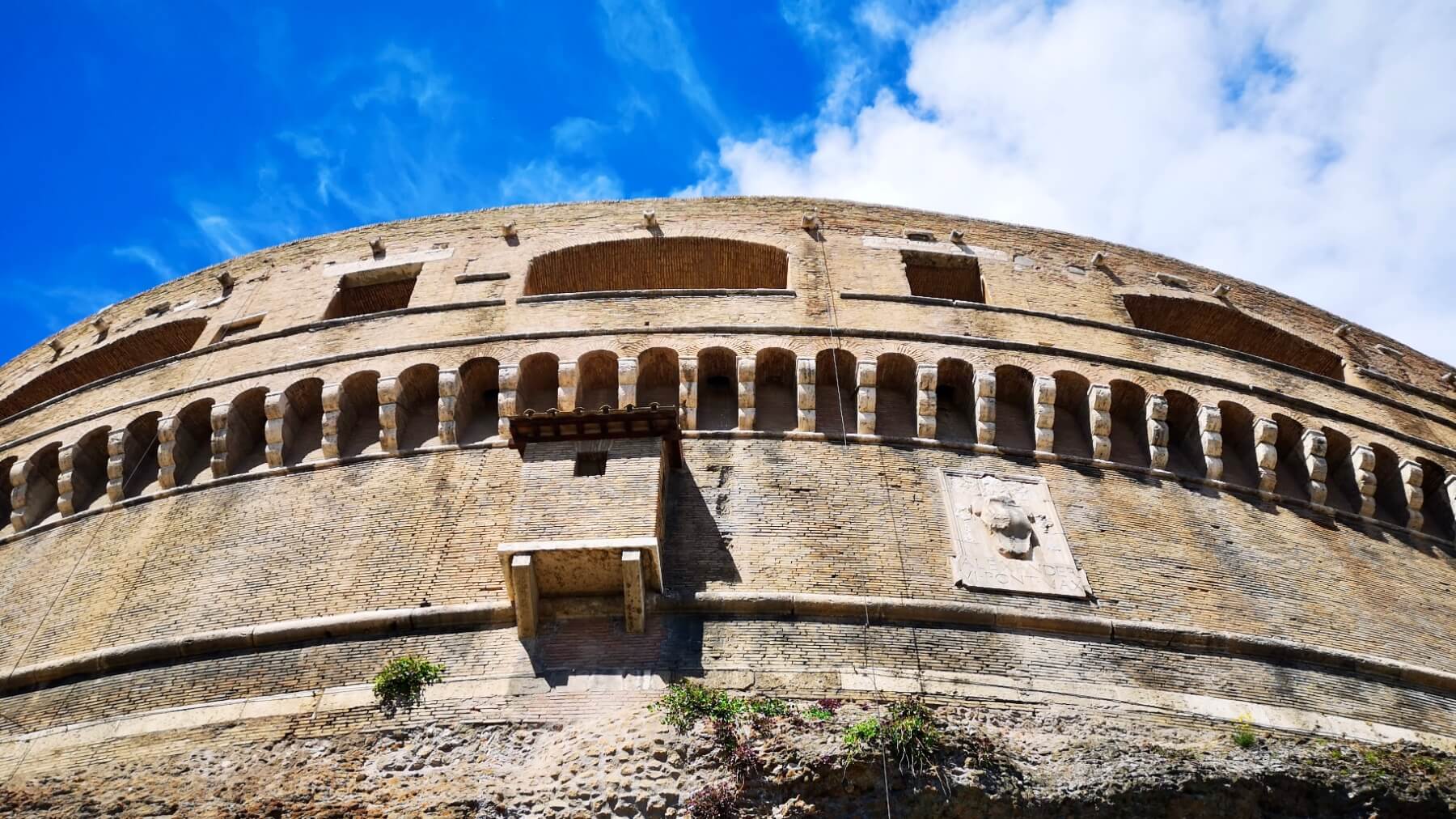
Hadrian’s mausoleum, standing 160 feet high on the bend in the Tiber with sheer walls of concrete and brick, was a natural defensive stronghold. Its position on the river bend had been chosen by Hadrian to maximise its visibility; for the Papacy under military threat, it was the perfect place for a fortress.
The tomb was fortified progressively from the late 4th century onwards. Its long history as a military installation produced some of its most atmospheric surviving spaces.
The medieval levels of the building contain vaulted storerooms, guard chambers, and — most notoriously — a series of prison cells where some of the most illustrious names of the Renaissance era were held, including the sculptor and memoirist Benvenuto Cellini, who describes his imprisonment here in vivid, characteristic detail in his famous Autobiography.
The Passetto del Borgo
The Pope's Secret Escape Route
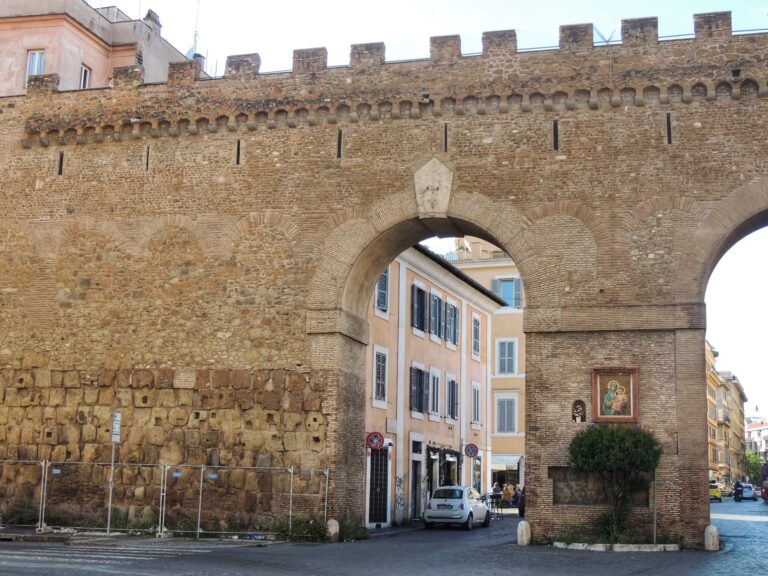
One of Castel Sant’Angelo’s most extraordinary features is invisible from outside and largely unknown to visitors who haven’t looked for it: the Passetto di Borgo, a concealed elevated corridor running directly from the Vatican to the castle along the top of the Leonine Wall, allowing the Pope to reach the fortress from St. Peter’s without setting foot in the open streets below.
The Passetto’s most famous use came in 1527, during the catastrophic Sack of Rome by the troops of the Holy Roman Emperor Charles V.
As the imperial army poured through the city’s gates and its soldiers began a nightmare of looting, killing and destruction that would take months to exhaust itself, Pope Clement VII fled through the secret corridor to Castel Sant’Angelo.
The escape was barely managed in time: almost the entire battalion of Swiss Guards who held off the attackers to buy the Pope his head start were massacred on the steps of St. Peter’s, and Clement watched the pillage of his city from the battlements above until a ransom could be negotiated.
The Passetto can be walked by visitors today on selected open days. Even without entering it, the sight of the elevated corridor connecting castle and Vatican — visible from the river and from several points around the Borgo neighbourhood — is one of the most quietly dramatic features of this part of Rome.
A Palace in a Fortress
The Renaissance Interior
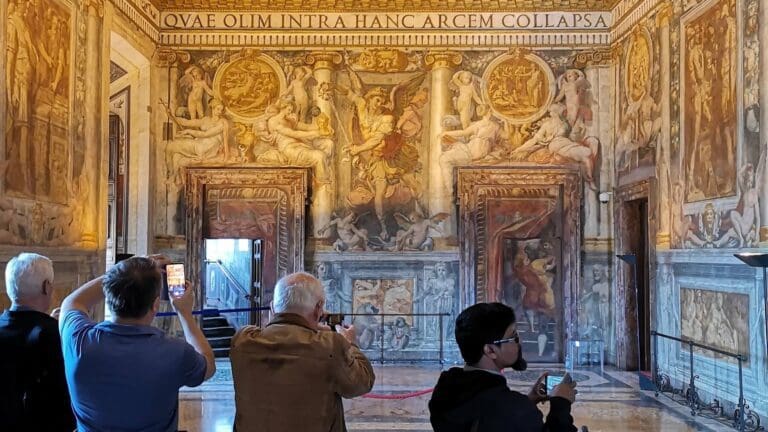
Despite its military function, and its continuing role as the Papacy’s ultimate last resort, Castel Sant’Angelo was progressively beautified and refined across the Renaissance period until its upper levels bore considerably more resemblance to a palace than a fortress.
Much of the finalised fortification work was carried out under Pope Alexander VI Borgia, and the interior decorations continued under later popes as styles and tastes shifted from Renaissance to Mannerist.
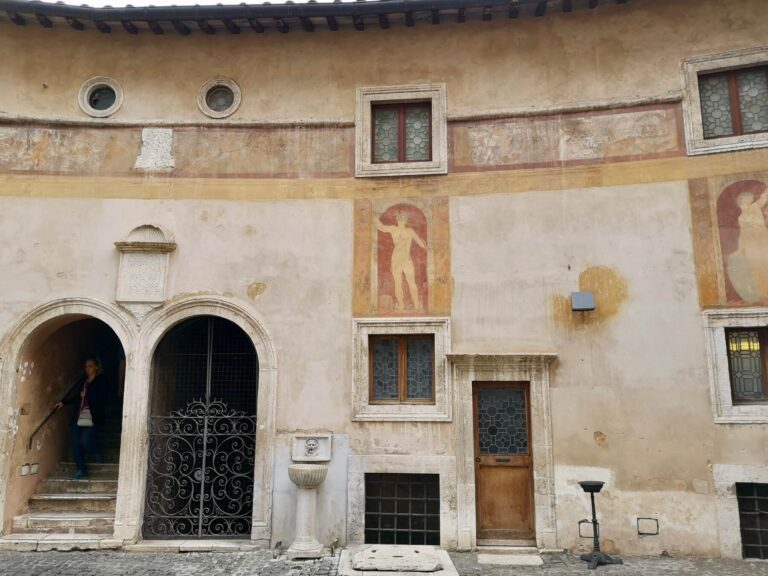
Pope Leo X commissioned Michelangelo to design the facade of one of the interior courtyards — one of several significant Renaissance artistic presences in the building.
The Sala Paolina, decorated under Paul III Farnese in the 1540s, is among the most spectacular rooms, its walls covered in illusionistic frescoes of a quality that would not shame any of Rome’s great palaces.
By the late 16th century the upper levels of the castle had been so thoroughly transformed that the popes were using them as a summer residence, enjoying the breezes off the Tiber during the brutally hot Roman summers.
Today the castle’s interior offers an extraordinary vertical journey: from the ancient burial chambers in the heart of Hadrian’s mausoleum, up through medieval fortifications and Renaissance courtyard gardens and frescoed papal apartments, to the open terrace at the very summit.
It is one of the most architecturally layered experiences in a city built entirely on layers.
The Rooftop Terrace
A Panorama and an Opera
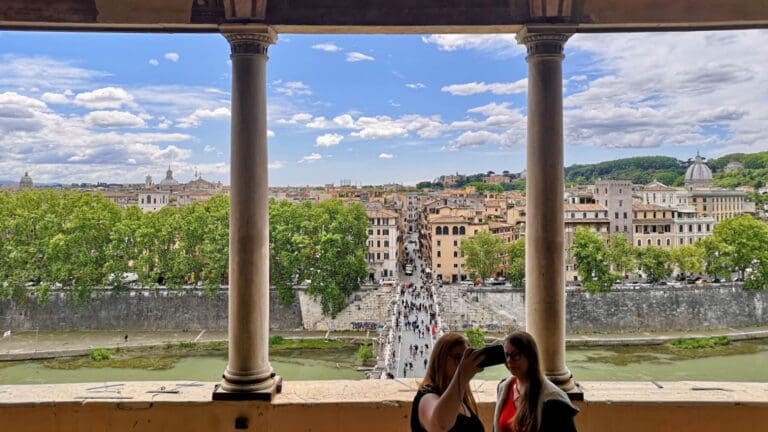
Having ascended through an ancient tomb, medieval fortifications and palatial Renaissance rooms, the pinnacle of Castel Sant’Angelo is an even greater reward. Just below the great bronze angel, the top of the castle opens onto a large panoramic terrace with one of the most dramatic views over the entire city.
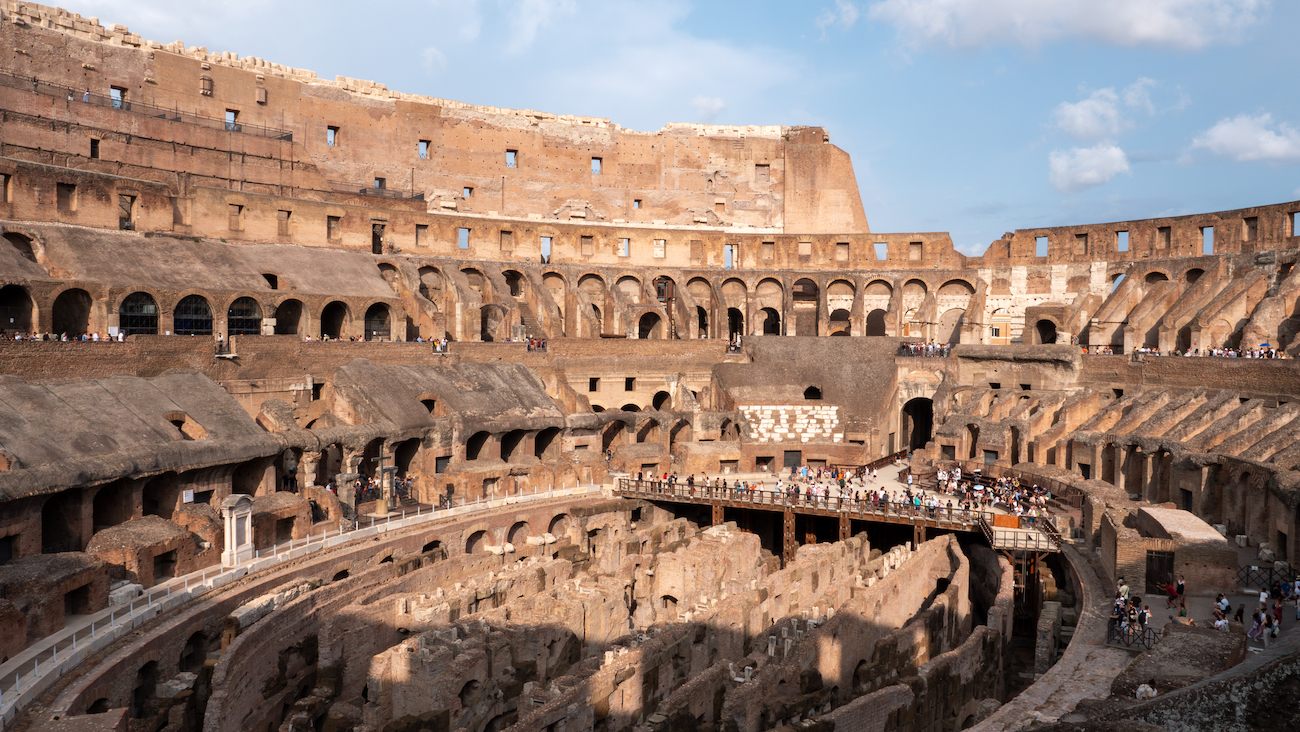
To the north-east, those with sharp eyes can make out the top of the Spanish Steps; to the south-east, the distant mass of the Colosseum; and directly westward, more magnificent than from any other viewpoint, the great dome of St. Peter’s Basilica rises against the Roman sky.
Yet while the view from Castel Sant’Angelo’s terrace is reason enough to make the ascent, this exact terrace is also hallowed ground for opera lovers across the world.
On stages from Milan to New York, this precise setting — the battlements, the angel statue, the city spread below — is recreated for Act III of Giacomo Puccini’s Tosca.
It is here that the opera reaches its climax: the painter Cavaradossi has been executed on these battlements; his lover Floria Tosca, having killed the chief of police to save him, discovers that she has been deceived and that Cavaradossi is dead; she throws herself from the parapet rather than face capture.
Puccini set his emotional finale here because he understood that the view from Castel Sant’Angelo — ancient, sublime, and charged with history — was just about the only thing that was a match for his bombastic music.
The Bridge of Angels
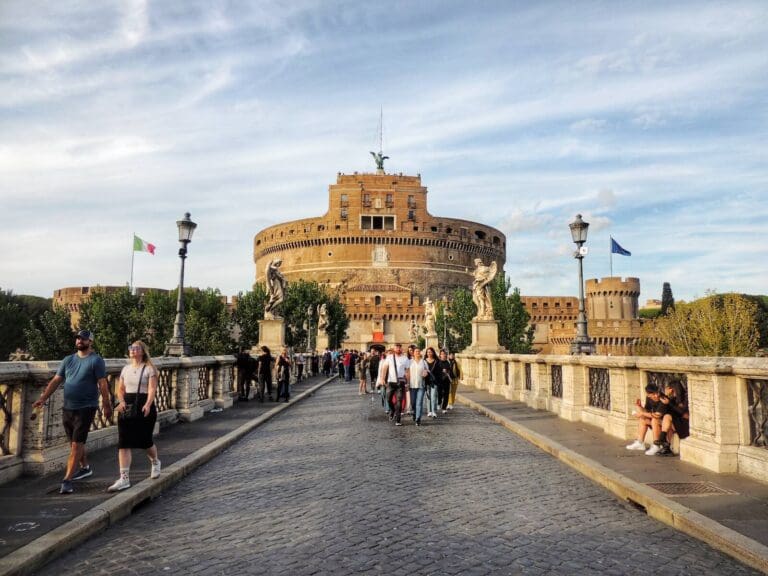
The Ponte Sant’Angelo connecting Castel Sant’Angelo to the historic centre is one of the most beautiful bridges in Rome, and one of the most remarkable.
The bridge’s ancient structure dates from Hadrian’s reign — the emperor built it specifically as a ceremonial approach to his mausoleum — and its foundations are thus nearly as old as the castle itself.
The ten marble angels that line the parapet were designed by Gianlorenzo Bernini in the 1660s and executed by his pupils, each carrying one of the instruments of the Passion of Christ.
Two of the original angels — the ones Bernini designed himself — were deemed too beautiful to be exposed to the weather and were removed to the church of Sant’Andrea delle Fratte, where they can still be seen; the bridge’s current angels are high-quality copies.
Crossing the Ponte Sant’Angelo towards the castle at night, when the angels are illuminated and the Tiber flows darkly below, is one of the great atmospheric experiences of Rome.
How to Visit Castel Sant'Angelo
Address: Lungotevere Castello 50, Rome (on the west bank of the Tiber, between the historic centre and the Vatican)
Opening hours: Tuesday to Sunday, 9:00 AM to 7:30 PM. Closed Mondays. Last entry one hour before closing. The castle is sometimes open for special evening visits in the summer — check the official website for current seasonal hours.
Tickets: Adult admission is approximately €15–18 (subject to change — confirm current prices at the ticket desk or official website). Combined tickets with other state museums are sometimes available. If you’re not taking a guided tour of Castel Sant’Angelo then the audio Guide is recommended: the building’s complex layering of history is easy to navigate with contextual explanations.
Note for visitors with mobility difficulties: As a historic fortress and mausoleum, Castel Sant’Angelo presents challenges for visitors with mobility issues. The ancient spiral ramp is manageable but long; several of the upper levels involve stairs. Contact the museum directly for up-to-date accessibility information.
Getting there:
- Metro: Line A to Ottaviano or Lepanto, then approximately 10–15 minutes on foot.
- Bus: Lines 40, 62, 64 and 280 stop on Lungotevere or Corso Vittorio Emanuele II, within easy walking distance.
- On foot: From Piazza Navona, about 10 minutes. From St. Peter’s Square, about 5 minutes. The best approach remains the one Gregory the Great would have taken: across the Ponte Sant’Angelo from the historic centre.
Tours: We offer guided tours of Castel Sant’Angelo. Click here for more information.
Castel Sant'Angelo FAQ
How old is Castel Sant’Angelo?
The original structure — Hadrian’s Mausoleum — was built in the 130s AD, making it nearly 1,900 years old. The castle has been in continuous use, in various forms, ever since.
Can you go inside Castel Sant’Angelo?
Yes. The Museo Nazionale di Castel Sant’Angelo occupies the entire building, and you
can explore from the ancient burial chambers in the heart of the mausoleum all the way up to the panoramic rooftop terrace and the bronze angel itself.
Is it worth visiting Castel Sant’Angelo?
Absolutely. It combines Roman antiquity, medieval history, Renaissance art and one of the finest views in Rome in a single visit. For anyone interested in the full sweep of the city’s history — rather than just the ancient period — it is unmissable.
How long does a visit to Castel Sant’Angelo take?
Allow at least 90 minutes for a thorough visit. With an audio guide and careful exploration of all the levels, two hours is comfortable.
What is the best time to visit Castel Sant’Angelo?
The castle is less crowded than the major Vatican sites, so any time of day is manageable. The rooftop terrace is at its most magnificent in the late afternoon, when the light on St. Peter’s dome is extraordinary. The bridge is at its most atmospheric at night.
Is the Passetto di Borgo open to visitors?
The Passetto opens occasionally for special visits and guided tours. Check the museum’s official website for current scheduled access.
Dive Deeper into Rome