Ah my Piazza Navona!…This is no square, but the great outdoors, a stage, a festival, purest glee.
– Gioacchino Belli
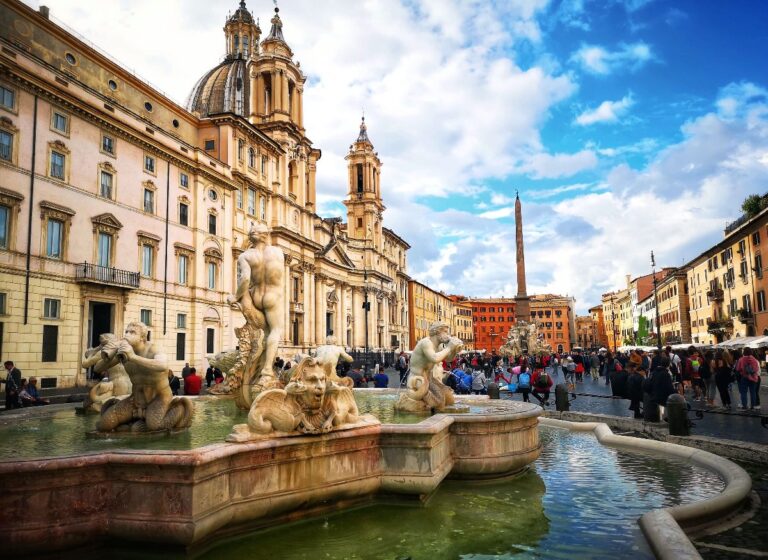
There is nowhere in the world quite like Piazza Navona. Rome’s greatest and most theatrical public space, its story stretches back to antiquity when the Emperor Domitian’s stadium rose on this very site around 86 AD.
Nearly two thousand years later, that distinctive elliptical footprint still defines the piazza’s shape, a living imprint of the ancient city pressed into the modern one.
But it is the golden age of the Baroque that gave Piazza Navona its true character, and at the glittering heart of that transformation stands one of the most extraordinary works of art in the western world: Gianlorenzo Bernini’s Fountain of the Four Rivers.
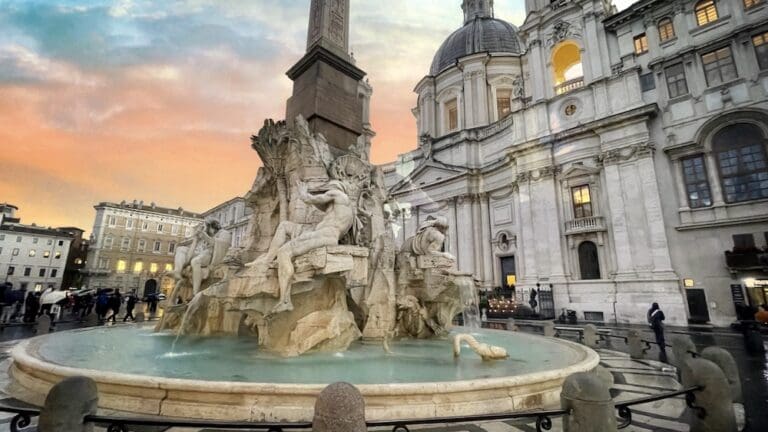
Unveiled in June 1651, the Fontana dei Quattro Fiumi is the Baroque at its most exuberant and most audacious. Personifications of the world’s four great rivers recline on a rocky crag that seems to defy gravity, supporting a towering Egyptian obelisk that soars improbably into the Roman sky above.
 Want to Visit Piazza Navona With a Guide?

Piazza Navona is a fountain, a monument, a political statement and an act of pure artistic showmanship all rolled in to one. Visit the iconic square on our Introduction to Rome tour.
Rome Tours
Explore Rome's Iconic Piazzas and Fountains
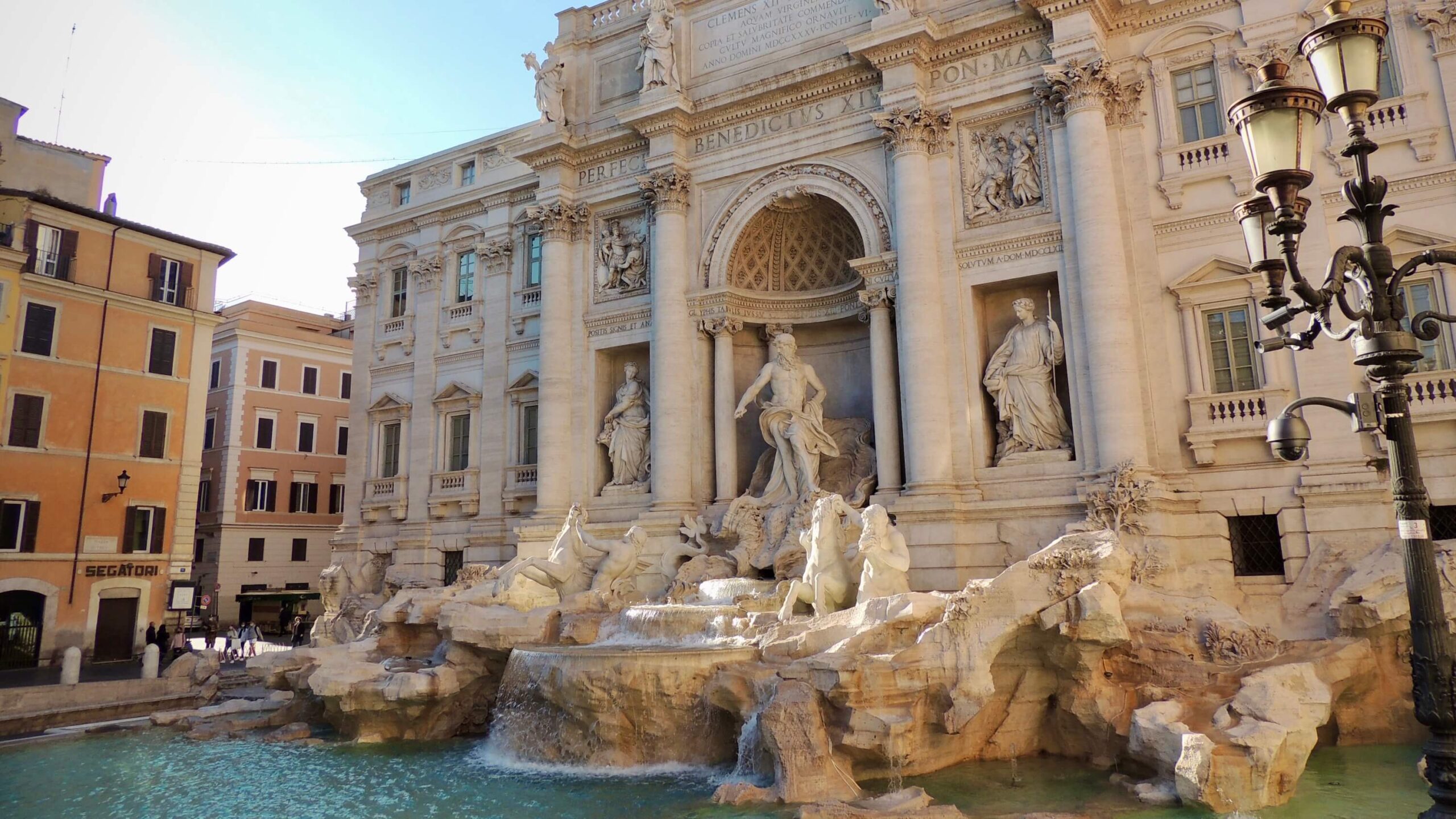
Constructed between 81 and 86 AD, the elliptical Stadium of Domitian was in all likelihood the site of foot-races and athletic events, and was the first building of its type in the Eternal City. But for much of its later history, the square served rather more everyday purposes. By the seventeenth century, it was a bustling marketplace, with vegetable stalls, street vendors and festivals occupying the broad space once reserved for Roman spectators. A long drinking trough at its center slaked the thirst of animals that brought goods into the city.
The piazza was already changing, however. Along its western side, the powerful Pamphilj family was developing a grand new palace, an unmistakable declaration of its growing influence in Rome. When Giambattista Pamphilj became Pope Innocent X in 1644, the family’s ambitions acquired a new and even more powerful champion. He had plans to transform the whole square, dismantling its rough-and-ready marketplace and creating a monumental setting worthy of both the papacy and the Pamphilj name.
At the heart of that transformation would stand Bernini’s Fountain of the Four Rivers, a work whose theatrical energy would make it one of the defining monuments of Baroque Rome.

Who Commissioned the Fountain of the Four Rivers?

Pope Innocent X Pamphilj wanted Piazza Navona to proclaim the power and prestige of his family. His grand project took shape around three principal buildings: the Palazzo Pamphilj, the Fountain of the Four Rivers and the church of Sant’Agnese in Agone.
The palace was designed by Girolamo Rainaldi and became the residence of Innocent’s sister-in-law and closest confidante, Olimpia Maidalchini. A formidable political operator, Olimpia was deeply involved in the affairs of the papal court, and the palace placed her household at the center of the family’s new urban stage.
After the completion of the grandiose Palazzo, the pope ordered the construction of a sumptuous adjoining church that doubled as the family’s chapel. Begun in 1652 and principally designed by Rainaldi, his son Carlo and subsequently Francesco Borromini, the church’s voluptuously undulating facade and flamboyant marble encrusted-interior make Sant’Agnese in Agone one of the foremost exemplars of Baroque architecture in Rome.
Before work on the church began, the Pope commissioned the third major aspect of his redevelopment of Piazza Navona: an enormous fountain in the centre of the square surmounted by an ancient Egyptian obelisk which was lying in pieces along the Appian Way. It had lain there since the collapse of Emperor Maxentius’s circus in the early 4th century. Innocent X commissioned the Jesuit scholar Athanasius Kircher to oversee its reassembly and reinterpretation. The result united Rome’s imperial past with the authority of the seventeenth-century papacy, all beneath the Pamphilj dove.
How Did Bernini Get The Commission?
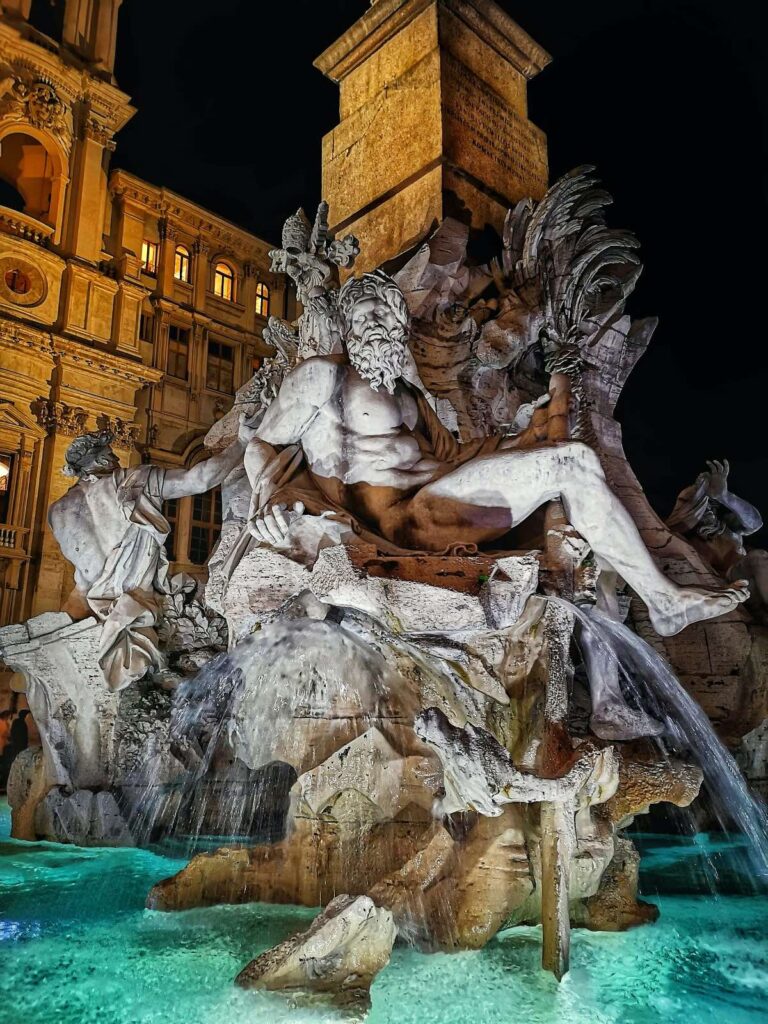
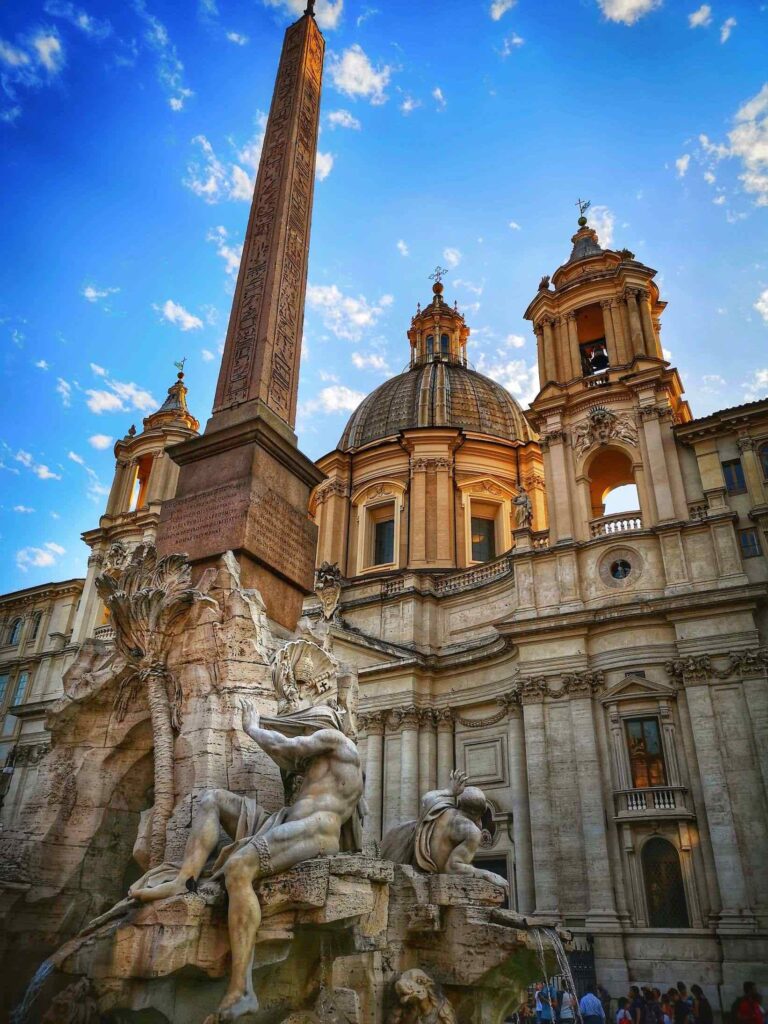
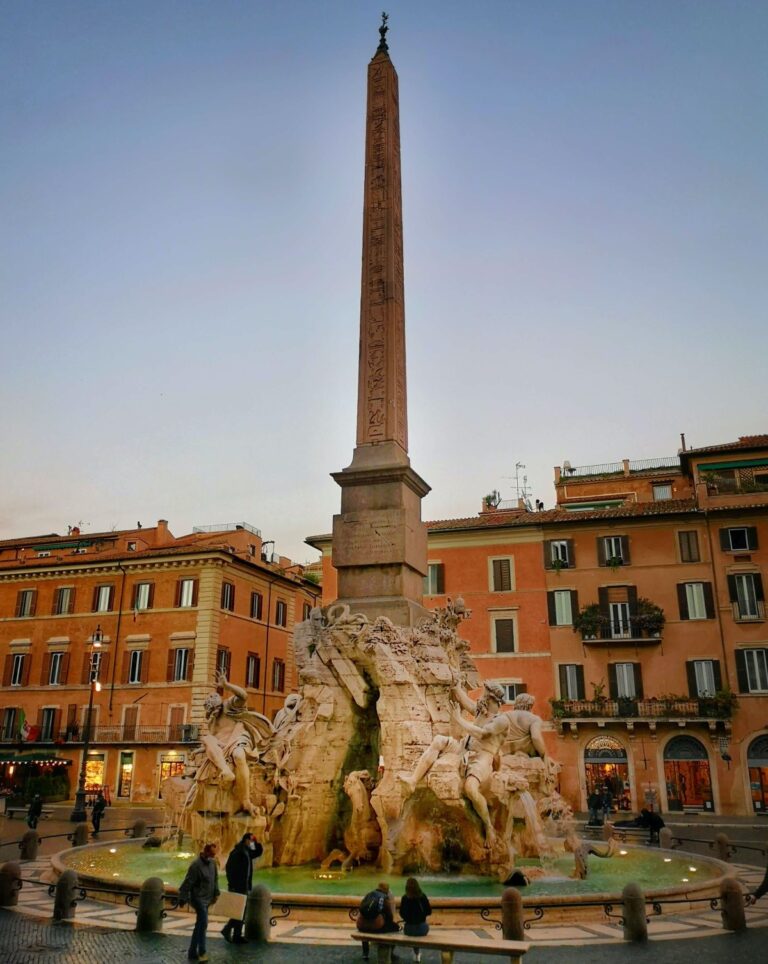
The entrusting of the fountain to Bernini was far from inevitable, and the story of how he landed the commission is one of Rome’s great artistic intrigues.
Bernini had been the darling of Innocent X’s predecessor, Pope Urban VIII Barberini, and that association proved deeply problematic when the Pamphilj pope took the throne.
Urban and Innocent had been bitter enemies, and Bernini’s intimate links with the Barberini clan made him politically toxic. Four difficult years in the wilderness followed, during which Innocent denied him any papal patronage.
Adding to his woes, Bernini’s reputation had also taken a serious hit over the bell towers he designed for the facade of St Peter’s Basilica. Cracks appeared in the masonry, raising concerns about the stability of the structure. In 1646, Innocent ordered the unfinished towers dismantled, turning a structural failure into a very public humiliation for the architect.
It was a humiliation that his implacable rival Francesco Borromini had done everything in his power to exploit, helping to fuel the criticism that threatened to undermine Bernini’s standing. The two men had history stretching back decades. Borromini, the reclusive Swiss-born architectural genius, and Bernini, the charming, socially adroit Neapolitan sculptor-architect, embodied two radically different approaches to art and to life. Their rivalry was bitter, personal, and creatively explosive.
Borromini was a central figure in the Papmphilj project to remake the square, and so when Innocent announced a competition for the new fountain it was hardly surprising that Bernini was pointedly excluded from the list of invited artists. None of the proposals submitted, however, quite set the pope’s pulse racing.
Sensing an opportunity, Bernini’s well-connected friend and ally Prince Niccolò Ludovisi, who was related to Innocent by marriage, arranged for a scale model of Bernini’s unsolicited design to be installed in the Palazzo Pamphilj, where the pope could hardly fail to see it on his daily walks.
Upon encountering it, Innocent was immediately won over. “Those who do not want to employ Bernini,” the pope reportedly quipped, “should take care not to look at his work.”
Borromini was characteristically furious. But Bernini’s career was emphatically back on track, and in 1647 work on the fountain officially began.
Which Rivers are Represented in Bernini's Fountain?
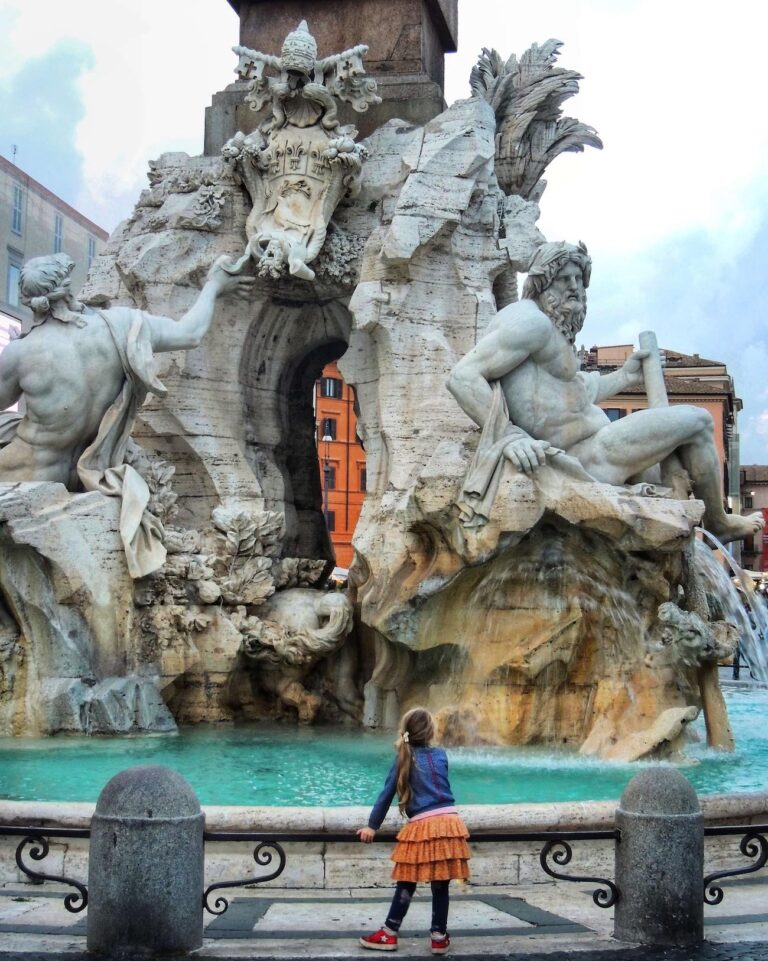
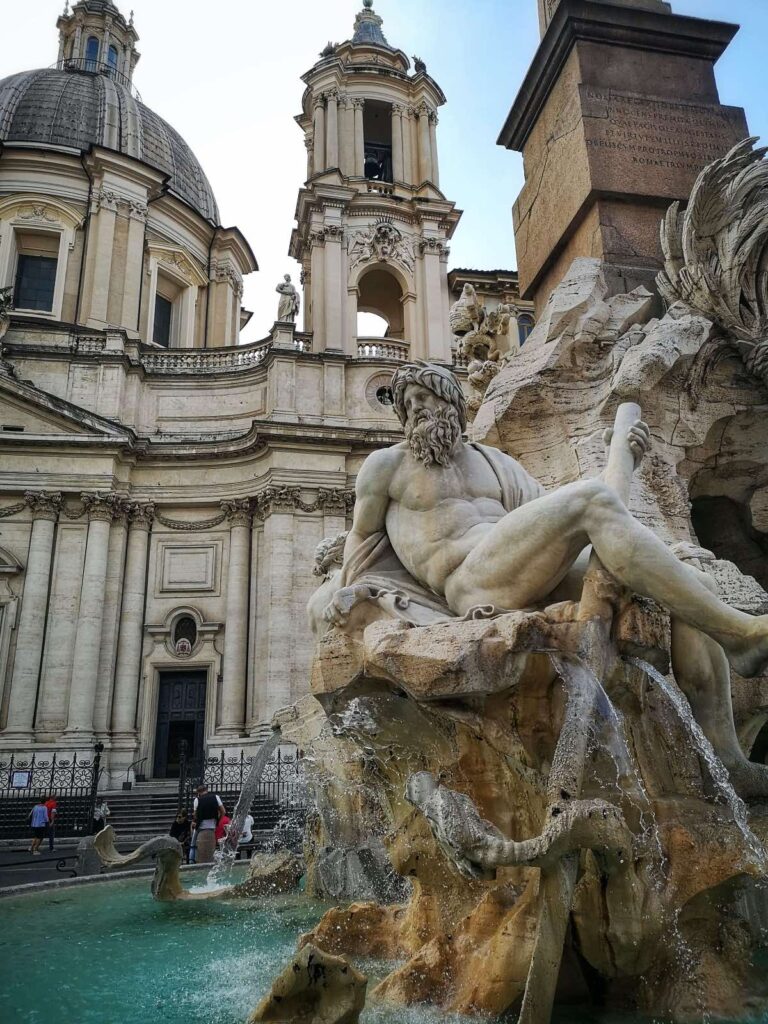
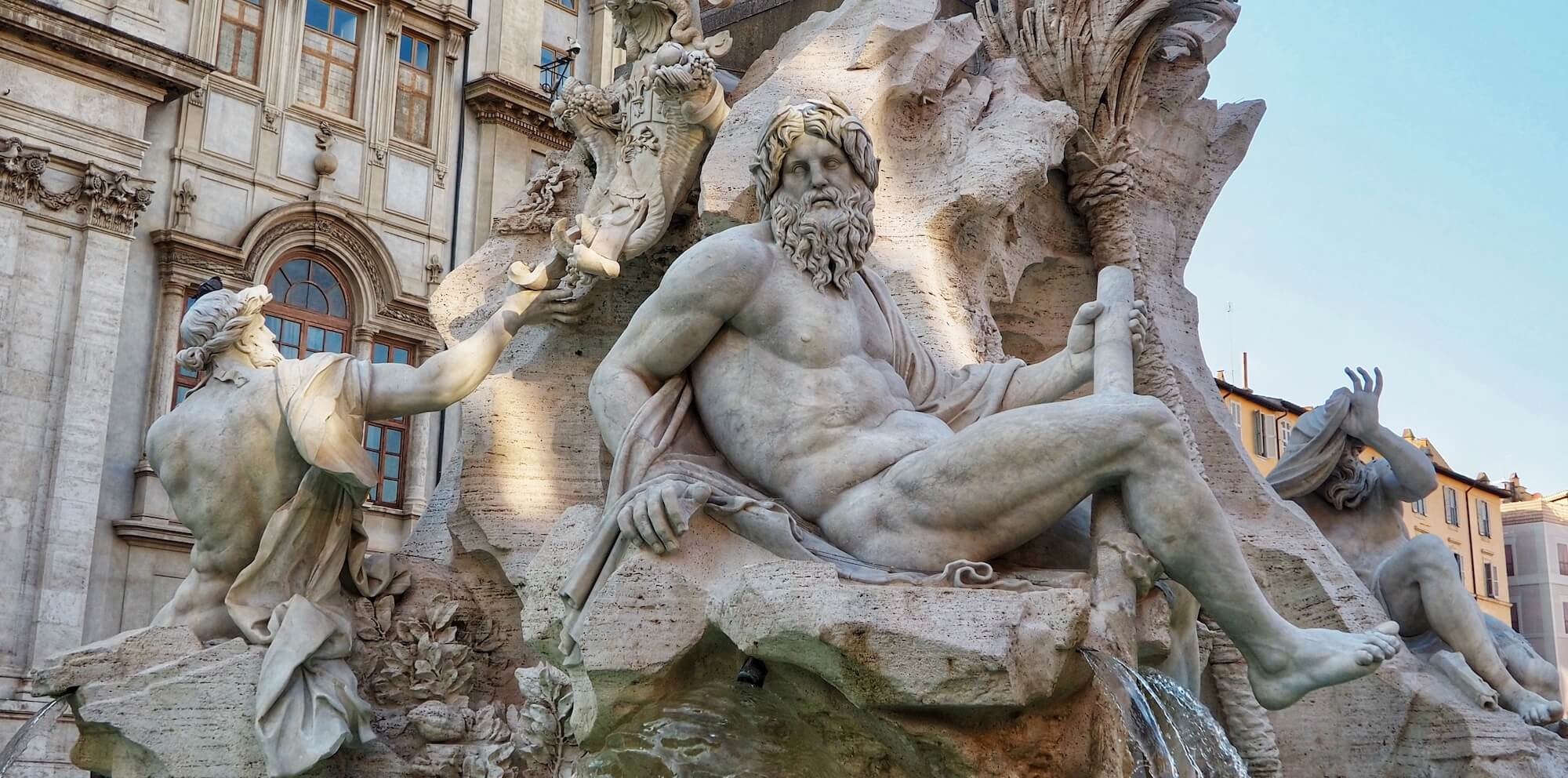
Looking at Bernini’s design for the Four Rivers Fountain today, it’s not difficult to see why the reluctant pope was won over. The four great river gods that recline across the travertine rockscape of the fountain represent the four continents of the known world in the mid-17th century – each one carrying its own rich freight of symbolism and allegory.
The Nile (Africa) is the most intriguing of all four figures. His head is draped with a loose piece of cloth that covers his face entirely, a reference to the fact the source of the Nile was unknown to 17th-century Europeans – a geographic mystery immortalised in stone. Some Romans could not resist a more theatrical interpretation: that the Nile was shielding his eyes from the sight of Borromini’s nearby church, Sant’Agnese in Agone. The delightful story is almost certainly apocryphal, as the church was barely begun when the fountain was unveiled. It nonetheless captures something true about the spirit in which later Romans viewed their relationship: two geniuses perpetually goading one another from opposite sides of the square. The Nile figure was carved by Giacomo Antonio Fancelli.
The Ganges (Asia) reclines lazily on his rocky perch, straddling a long oar that symbolises the river’s legendary navigability – something that was of great importance to European missionaries seeking to penetrate the subcontinent. A serpent writhes at his feet, and a palm tree sways in an invisible breeze nearby. The Ganges was the work of Claude Poussin (no relation to the painter Nicolas Poussin).
The Danube (Europe) reaches upward to touch the papal coat of arms, formed from the Pamphilj family’s dove and olive branch, which surmounts the obelisk above. This gesture acknowledges the Danube as the great river closest to Rome among the four, and celebrates the reach of papal authority across the continent. The Danube was carved by Antonio Raggi.
The Río de la Plata (the Americas) sprawls amidst a scatter of coins, a reference to the legendary silver wealth of the New World (plata means “silver” in Spanish). He is accompanied by an armadillo, one of the most exotic creatures the Old World had yet encountered from the Americas. The river’s hands are thrown up in apparent surprise: local wags later apocryphally asserted that Bernini made this unusual choice as another subtle dig at his rival Borromini, with Rio being fearful that the architect’s church might at any moment topple over and crush him. The figure was created by Francesco Baratta.
All four statues were designed by Bernini but executed by other sculptors, while the dramatic travertine rockscape base is the work of Giovan Maria Franchi.
What Is The Symbolism of Bernini’s Fountain?
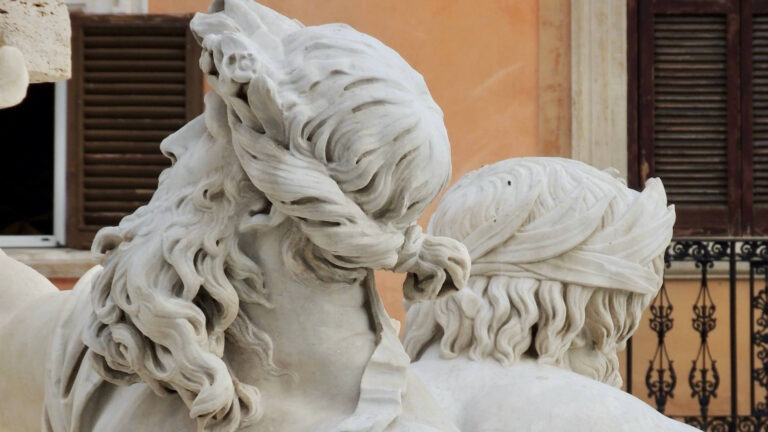
The four rivers represent more than the waterways themselves. As personifications of the four continents then known to Europeans, they transform the fountain into a miniature image of the entire world gathered around the monument at its center. The message was unmistakably political as well as religious: under the papacy’s vision, Rome stands at the heart of a universal Christian order, with the Catholic Church aspiring to carry its faith to every corner of the globe.
There may be a further layer to the symbolism. The four rivers have also been interpreted as an allusion to the rivers of Paradise described in Genesis, which flow out of the Garden of Eden. Bernini’s composition thus links the geographical reach of the Church with the biblical origins of the world itself, situating Innocent X’s Rome within a much older story of creation and divine order.
Rising above the river gods, the 17-meter tall obelisk is an extraordinary centerpiece in its own right. Fashioned in a faux-Egyptian style under the Roman emperor Domitian in the first century AD, it later found its way to the Circus of Maxentius on the Appian Way where it lay in fragments for centuries before being brought to Piazza Navona for Innocent X’s ambitious new fountain.
Bernini reassembled the five broken sections and crowned the obelisk with a dove clutching an olive branch, the emblem of the Pamphilj family. With its wings spread, the bird seems poised to take flight above the city in a clever fusion of the family’s heraldry with the fountain’s message of papal supremacy.
The obelisk’s hollow base is one of the fountain’s most celebrated architectural tricks. Rather than resting on a solid pedestal, the ancient monolith rises from a hollowed hunk of travertine rock carved into a cavernous grotto, pierced by openings that allow light and air to pass through. The effect is undeniably dramatic: the towering shaft appears to balance above a void, as though Bernini has found a way to make stone defy gravity.
The Unveiling

On June 12, 1651, Piazza Navona became the stage for one of the great spectacles of Baroque Rome. The unveiling of Bernini’s fountain was carefully orchestrated to impress on the citizenry the magnificence of Innocent X’s papacy. Curtains theatrically veiled the monument, and women dressed as the personifications of Fame and Curiosity exhorted Romans to make their way to the square.
When the fountain was finally revealed and the water began to flow, Rome’s collective jaw hit the floor. Contemporary accounts describe the astonishment of spectators confronted by the towering obelisk, the colossal river gods and the apparent impossibility of the whole composition. Bernini had contrived to make the ancient monolith seem to be carried by a structure that looked too delicate to support it.
The fountain’s unveiling wasn’t the end of the drama. According to Domenico Bernini’s biography of his father, some remained convinced that the obelisk was bound to come crashing down, so precariously balanced did it appear above the hollowed mass of rock. Bernini’s detractors had questioned his engineering skills ever since the bell towers fiasco at St Peter’s, and the fountain seemed to present another situation in which the flamboyant master was courting disaster.
Domenico relates that the sculptor answered his critics in characteristically theatrical fashion. As a thunderstorm broke over Rome, Bernini swept into Piazza Navona in his carriage, where a crowd had gathered to watch for the supposedly inevitable collapse. Leaping out in apparent panic, he warned everyone to keep their distance. Then he produced four silk laces and four tiny nails, and ordered the onlookers to use them to secure the enormous obelisk to the surrounding buildings.
The joke landed. With his point made and the crowd laughing, he climbed back into his carriage and disappeared into the storm. The story may have grown in the telling, but it was a fitting bit of Baroque theatre: Bernini answering his critics with a performance of his own.
Bernini’s Legacy
But not everyone in Rome was cheering. The fountain had been constructed at huge expense at a time when the city was still feeling the effects of a famine that hit the Papal States a few short years earlier. Critics protested that the pope was spending money on grand monuments while ordinary citizens struggled to feed their families.
One anonymous protest affixed to the great stone blocks standing at the ready when the fountain was still being built put the matter bluntly: “We do not want Obelisks and Fountains, it is bread that we want. Bread, Bread, Bread!” Innocent’s response was hardly conciliatory: he had the authors thrown in prison and deployed spies on the streets to look out for signs of further dissent.
The fountain also marked the end of Piazza Navona’s life as a bustling marketplace. The street sellers who had long traded in the square were driven out as Innocent remade it into a monumental setting for the Pamphilj family. They resisted their eviction, and papal police had to force them to leave. For those who had depended on the market, Bernini’s masterpiece was no unalloyed triumph: the old ramshackle square that had sustained their livelihoods was giving way to a grand stage of papal power.
For Bernini, the commission marked a decisive return to papal favour. The artist who had fallen out of grace under Innocent X was once again shaping the appearance of Rome, and the Fountain of the Four Rivers became one of the defining works of his career. Its success helped restore his standing after the controversy at St Peter’s, and its theatrical audacity showed just how completely he understood the ambitions of Baroque Rome.
Fountain of the Four Rivers FAQ

Who created the Fountain of the Four Rivers?
The fountain was designed by Gian Lorenzo Bernini and unveiled in 1651. Bernini was the most famous and influential sculptor of Baroque Rome, and transformed the visual landscape of the city over the course of an extraordinarily long and fertile career.
Who commisioned the Fountain of the Four Rivers?
The Four Rivers Fountain was commissioned by Pope Innocent X Pamphilj as part of his grandiose plans to redevelop Piazza Navona into an urban centre reflecting the glorious rise of his family.
What do the four figures on the fountain represent?
Each figure represents one of the four great rivers of the known world — and by extension, one of the four continents: the Nile (Africa), the Ganges (Asia), the Danube (Europe), and the Río de la Plata (the Americas).
Is the story about Bernini mocking Borromini true?
Almost certainly not. The fountain was completed in 1651, but Borromini’s work on the adjacent Sant’Agnese in Agone did not begin until 1653. The gestures of the river gods have straightforward iconographic explanations that predate any connection to Borromini.
Can you go inside the fountain?
The fountain sits in the open piazza and can be viewed and walked around freely. You cannot enter or touch the fountain itself, but you can get quite close to examine the sculptural details.
What is the obelisk on top of the fountain?
Known as the Agonal Obelisk, the obelisk crowning Bernini’s fountain is a Roman commission with Egyptian origins. Made from granite quarried at Aswan in Egypt, the blank monolith was brought to Rome under Emperor Domitian in the first century AD and decorated with hieroglyphics praising the emperor. It was later moved to the Circus of Maxentius on the Appian Way before Bernini incorporated it into this composition.
The Fountain Today: How to Visit
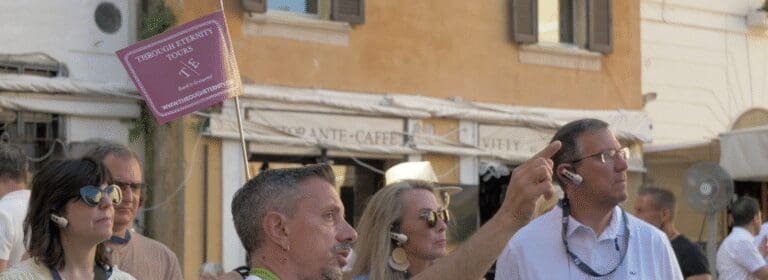
The Fountain of the Four Rivers sits at the centre of Piazza Navona, which is one of Rome’s most visited public spaces and is free to enter at any time. The piazza never fully closes, though the early morning — before the café terraces fill up and the street artists set up their easels — offers the best experience.
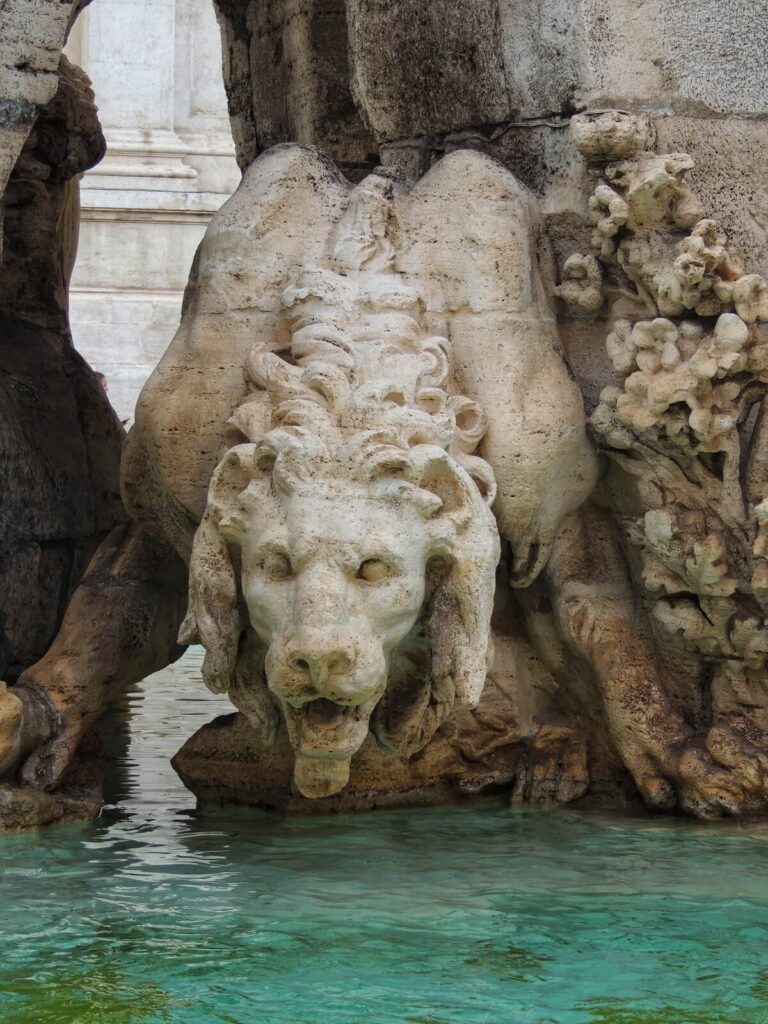
The fountain is best seen by circling it slowly, taking in each river god in turn. The detail rewards close attention: look for the armadillo half-hidden behind the Río de la Plata figure, the lion emerging from the rock near the Nile, and the horse bursting through the travertine above the Danube.
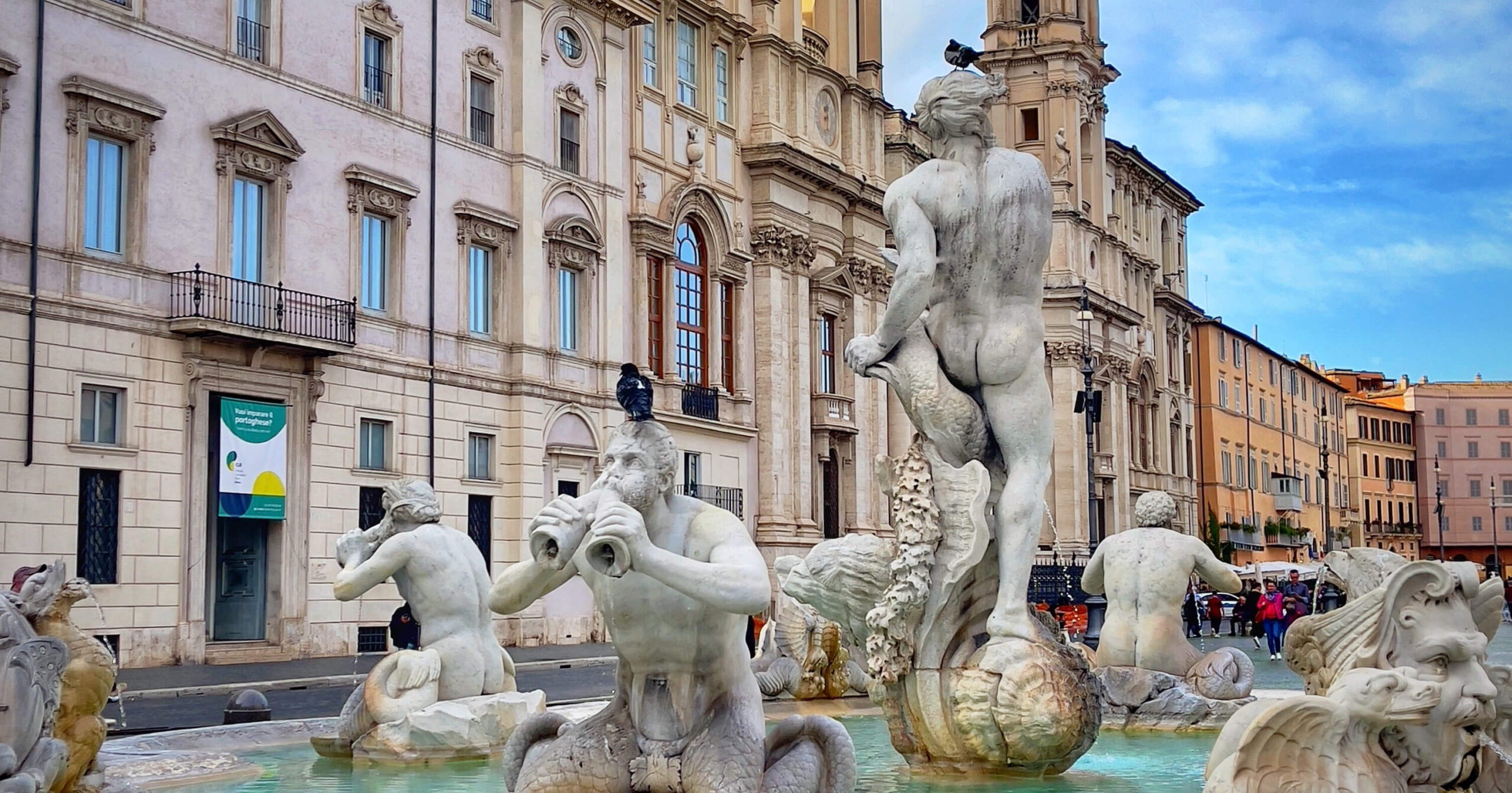
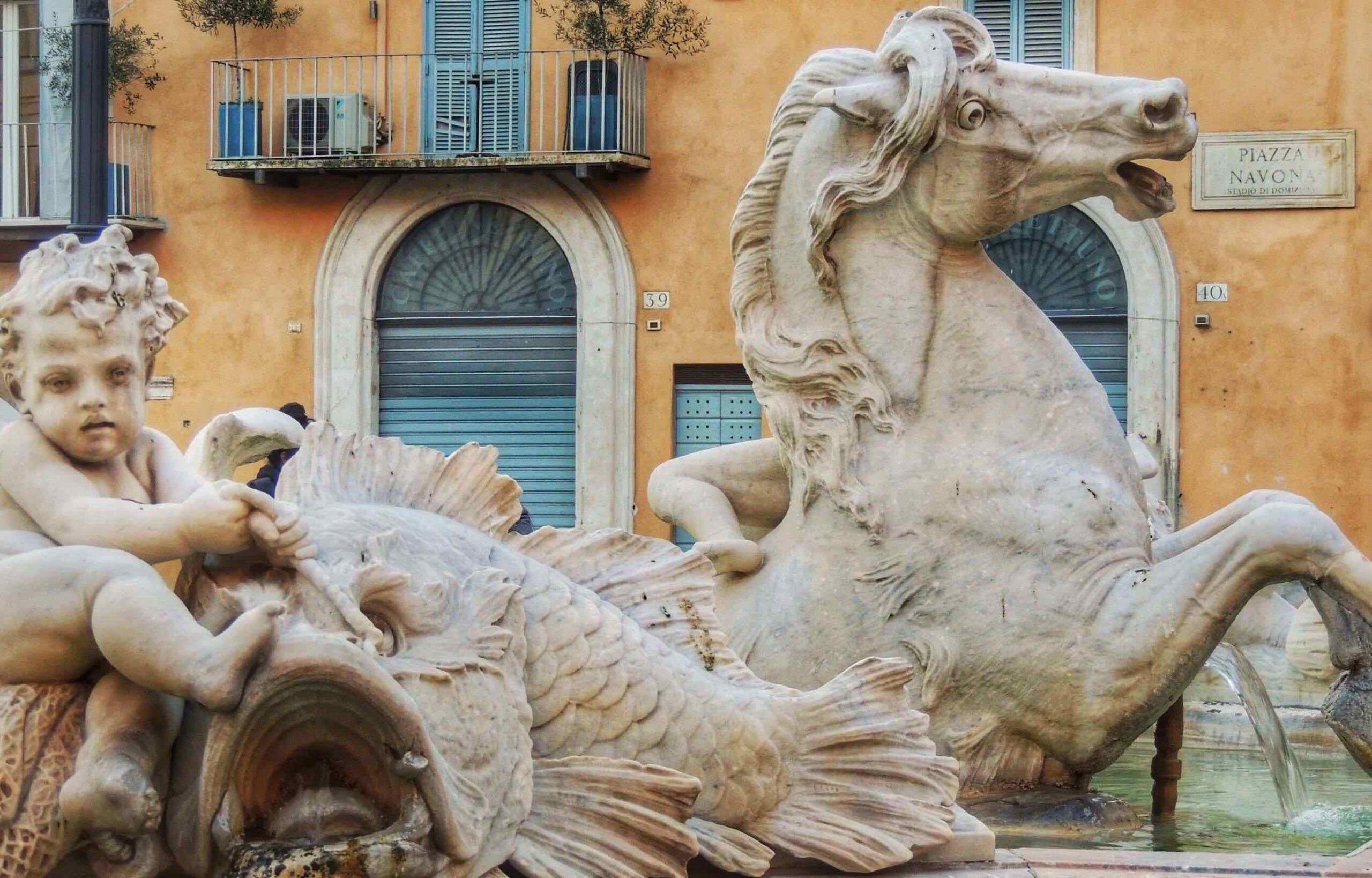
At each end of the piazza stand two smaller fountains — the Fontana del Moro (also by Bernini, at the south end) and the Fontana del Nettuno (at the north end). Neither is quite in the league of the Four Rivers, but both contribute to the ensemble that makes Piazza Navona one of the most satisfying public spaces in Europe.
Dive Deeper into Rome