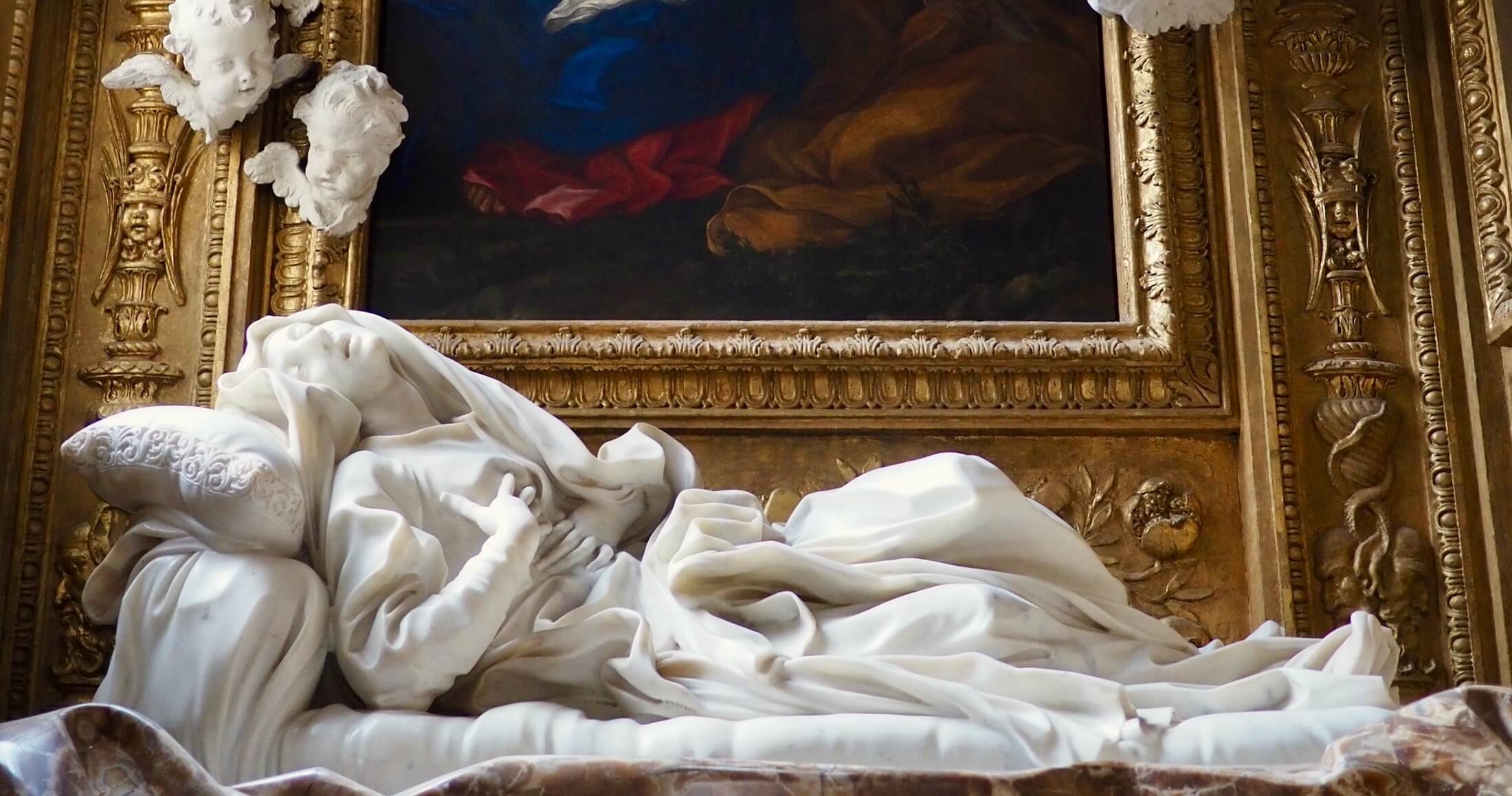
She lies on the cusp between two worlds, her head thrown back, her eyes turned heavenward as one hand clutches at her breast. Her lips are parted as though she is about to sigh, speak, or take one last breath. The cushions beneath her look soft enough to sink into, while the great folds of marble drapery billow and twist around her body as if stirred by some invisible force.
This is Gian Lorenzo Bernini’s Blessed Ludovica Albertoni, one of the most extraordinary sculptures in Rome and one of the great works of the sculptor’s final years. It is also an unusually intimate vision of death.
Ludovica appears to be at the point of dying, yet the expression on her face suggests that she is experiencing something beyond physical agony: an overwhelming encounter with the divine that carries her beyond the limits of the body. Is this the moment of death, or the ecstasy of a mystic lost in communion with God? The ambiguity is part of what gives the sculpture its extraordinary power.
Rome Tours
Explore a Hidden Side of the Eternal City

Who Was Ludovica Albertoni?

But first, some context. Ludovica Albertoni’s story is a classic tale of female piety in Renaissance Italy. Born in Rome in 1473 into an aristocratic family, she married the nobleman Giacomo della Cetera and had three daughters before being widowed in 1506. After her husband’s death, she devoted herself increasingly to religious life and charitable work, becoming a Franciscan tertiary and associating closely with the friars of San Francesco a Ripa in Trastevere. Her reputation for holiness grew above all from her concern for Rome’s poor, to whom she devoted much of the wealth that remained to her after her husband’s death.
Her charitable reputation became particularly powerful during the catastrophe of the Sack of Rome in 1527, when imperial troops descended upon the city and thousands of Romans were left wounded, displaced or destitute in the wake of the slaughter. Ludovica opened her home to those in need and cared for the sick and wounded, earning a reputation as a protector of the poor of Trastevere. Later traditions embroidered her charitable activities with memorable stories, including the tale that she concealed coins inside loaves of bread before distributing them, allowing her to help the destitute without making a public display of her generosity.
There was another side to Ludovica’s reputation, however, and it was this mystical dimension that would eventually make her such a compelling subject for Bernini. Accounts of her life describe extraordinary experiences during prayer, including states of religious ecstasy and communion with God, as well as reports that she levitated during moments of spiritual rapture.
When she died of fever on 31 January 1533, at the age of about sixty, she was buried at San Francesco a Ripa, where devotion to her developed rapidly. Her tomb became a focus of local veneration and her reputation for sanctity continued to grow among the people of Trastevere and within her own family. Yet it would be more than a century before the Church officially recognized her cult.

Recognition & Beatification

Ludovica’s eventual elevation took place in the very particular world of seventeenth-century Roman patronage, where family prestige, papal favour and religious devotion could become remarkably difficult to disentangle. By the time her cult was formally ratified during an elaborate beatification ceremony at St. Peter’s Basilica in 1671, the Albertoni family had become closely connected to one of the most powerful dynasties in Rome.
The crucial figure was Cardinal Paluzzo Paluzzi degli Albertoni. Through the marriage of his nephew Gaspare to Laura Caterina Altieri, a niece of the future Pope Clement X, the Albertoni and Altieri families became closely intertwined. When Emilio Altieri was elected pope in 1670, taking the name Clement X, Paluzzo became the pope’s powerful cardinal-nephew. The Albertoni family subsequently adopted the Altieri name, strengthening an already formidable alliance between the two families.
The ratification of Ludovica’s cult by Clement X on 28 January 1671 brought official recognition to a devotion that had existed at San Francesco a Ripa for generations. The timing inevitably enhanced the prestige of the family that had worked to preserve her memory, and Paluzzo soon turned his attention to creating an appropriate memorial for his newly beatified ancestor.
For this purpose, the Albertoni-Altieri family had a rather obvious choice. Rome’s greatest living sculptor had spent much of his career finding ways to turn spiritual experience into physical drama, and more than twenty years earlier he had already created one of the most famous images of religious ecstasy in Western art.
Bernini's Commission

By the early 1670s Gian Lorenzo Bernini was no longer the dazzling young prodigy who had transformed Roman sculpture under Pope Urban VIII. He was in his seventies, and although he remained enormously productive, he was increasingly working on the projects that would define the final phase of his career. The Blessed Ludovica Albertoni, begun around 1671 and completed in 1674, was to become his last great sculptural work.
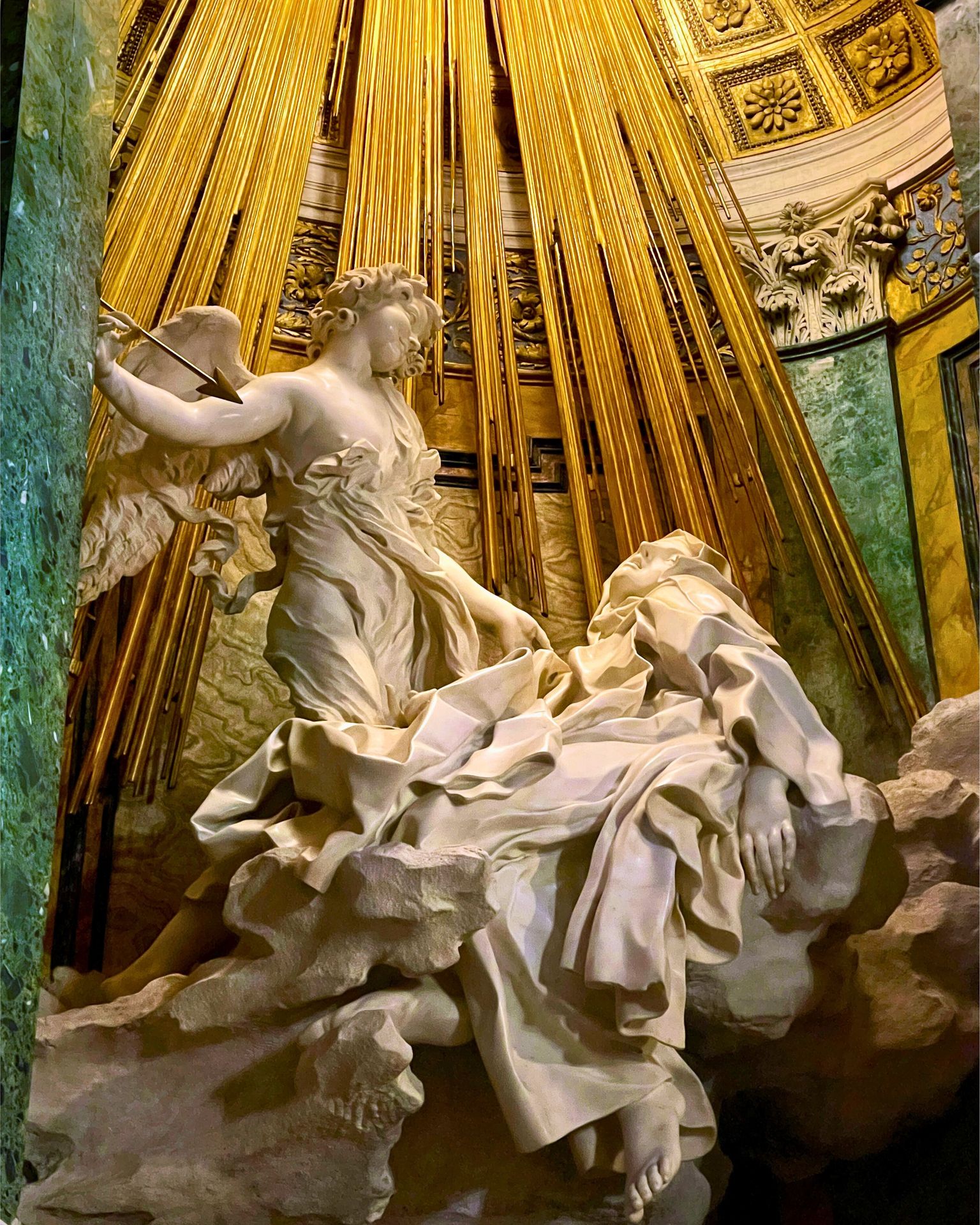
Bernini was particularly well suited to the commission because he had already explored the extraordinary territory where religious revelation and bodily sensation overlap. In the Ecstasy of Saint Teresa in the Cornaro Chapel at Santa Maria della Vittoria, completed more than twenty years earlier, the Spanish mystic swoons as an angel pierces her heart with a golden arrow. Teresa’s own descriptions of mystical union with God are intensely physical, and Bernini transformed that language into marble, giving the invisible experience of divine love a startlingly corporeal form.
The Ludovica belongs to the same family of ideas, although the atmosphere is considerably darker and more private. There is no angel hovering beside her and no golden arrow announcing the source of her experience. Instead, Bernini gives us Ludovica herself: her head falling backwards onto the pillow, her eyes turned upwards, her mouth slightly open and her hand pressed against her breast. Her body seems to be surrendering to something that has overwhelmed it, while the agitated folds of her clothing appear to transmit the same invisible force through the marble.
Ludovica’s body appears to be failing while her spirit seems to be moving beyond it, and the very physicality of Bernini’s sculpture allows him to suggest something that cannot itself be seen. The hand clutching her breast, the parted lips, the exposed face and the extraordinary agitation of the fabric make the scene intensely corporeal, yet that corporeality is precisely what allows the sculptor to suggest the passage from earthly existence towards the divine.
Family Scandals

The commission arrived at an unusually awkward moment in Bernini’s personal life, because his family was once again embroiled in scandal. His younger brother Luigi had already been involved in one notorious episode with Gian Lorenzo decades earlier, when both brothers became romantically entangled a married woman by the name of Costanza Bonarelli.
When Gian Lorenzo discovered that Luigi was also involved with Costanza, the jealous sculptor reacted with shocking violence, ordering an accomplice to slash her face and attacking his brother with an iron bar. An extraordinary and passionate portrait of Costanza sculpted by Bernini at the height of their torrid affair and now housed in the Bargello in Florence.speaks vividly of the young artist’s violent passion.
For his part, Luigi was forced to remain in exile for a few years. But, proving blood is thicker than water, he was eventually reconciled with his brother and collaborated with him frequently over the following decades. By the time the time the 1670s rolled around, the venerable Gianlorenzo was no longer the firebrand of his youth – but Luigi’s behaviour went from bad to worse. Making good use of the family connection, Luigi had managed to get himself put in charge of reconstructing the Sala Regia in the Vatican, where Gianlorenzo was busily working on his equestrian portrait of the emperor Constantine. It wasn’t to end well.
In the gloomy shadows of the building site, Luigi was to commit a terrible crime. Unleashing a brutal sexual assault one of the boys hired to help out on the works, Luigi reportedly left his victim with 16 broken bones. It was left to Gianlorenzo to pick up the pieces and salvage the family honour. Luigi fled to Naples in order to escape justice, whilst Gianlorenzo did everything in his power to smooth over the scandal.
Bernini’s influence with the Roman elite was, for once, proving insufficient to securing his brother’s pardon. Cardinal Paluzzo had taken an uncompromising stance against forgiving Luigi for his wicked crimes, and this is where the story of the Ludovica becomes particularly intriguing. A gossipy Roman avviso (a kind of informal news sheet through which information and rumour circulated through seventeenth-century Rome) of February 1674 reported that Bernini had agreed to execute the work without payment, and rumours were rife that the great man had agreed to carve the monument for free in the hopes of securing Luigi’s pardon.
At the distance of over 450 years it’s impossible to say exactly where gossip ends and facts begins, but the theory is difficult to exclude: Bernini had little reason to donate a major work of this importance unless there was something considerable to be gained in return. It gives the serene little chapel at San Francesco a Ripa an unexpectedly sordid backstory. Behind the marble vision of a dying saint was a very Roman mixture of family ambition, papal power, scandal and artistic patronage.
The Chapel Becomes a Stage

Bernini did much more than carve a statue and install it in an existing chapel. Instead he completely redesigned the small Altieri Chapel around Ludovica, using architecture, light, painting, stucco and coloured marble to turn the entire space into a setting for the sculpture. The chapel is physically modest, but angled walls and the arrangement of the architectural elements create a telescoping effect that draws the eye towards the figure at the far end.
The lighting is particularly ingenious. Bernini arranged hidden windows behind the altar wall so that natural light would fall directly upon the white marble, allowing Ludovica to emerge from the relative darkness of the chapel. The effect is theatrical without being ostentatious: from the nave, the chapel appears in subdued light, and then the sculpture catches the eye as though illuminated by a source belonging to another world.
Behind Ludovica, Giovanni Battista Gaulli, (the man better known as Baciccio and most famous for the jaw-dropping ceiling frescoes of the Gesù across town), painted the Virgin and Child with Saint Anne, while stucco angels gather around the architectural framework. The contrast between the dark colours of the painting and the brilliant white marble of the sculpture heightens the sense that Ludovica is having a vision of the heavenly world behind her. Other decorative motifs, including flowers and flaming hearts, reinforce the themes of charity, divine love and religious devotion that surround her story.
The result is an exceptionally concentrated example of Bernini’s idea of the bel composto, his conception of the different arts working together as a single experience in a unified scenographic ensemble. Architecture determines how we encounter the sculpture; light picks out the figure; painting provides a heavenly backdrop; coloured marble creates the luxurious surface beneath her body; and the sculpture itself supplies the emotional centre of the entire composition.
Yet for all this theatrical orchestration, something remarkably private is happening at the centre. Ludovica does not look towards the visitor, and she does not appear to acknowledge the elaborate world that surrounds her. She is absorbed in an experience that belongs entirely to herself. We are close enough to study her face and hands, yet whatever she sees remains inaccessible to us.
Making marble move

The extraordinary drapery is one of the clearest signs of Bernini’s virtuosity. Throughout his career he had delighted in making marble imitate materials that ought to be impossible to reproduce in stone – flesh, hair, feathers, clouds and fabric – but in the Ludovica he pushes the illusion to an almost extravagant degree.
The veil around her head curls around her face before falling towards her hand, while the clothing around her body breaks into deep folds and turbulent ridges. The fabric seems to gather and twist in currents, as though some invisible force has caught it in motion. Even the comparatively narrow strips of cloth between her legs participate in this restless movement, giving the entire lower half of the sculpture an extraordinary sense of energy. The marble drapery becomes almost a physical manifestation of the spiritual experience passing through her.
Bernini’s treatment of the face is subtler. The carving around the eyelids, mouth and cheeks is delicate enough to make the marble seem almost translucent, and her expression refuses to settle comfortably into either pain or pleasure. There is suffering in it, certainly, but also surrender and rapture. The result is neither a straightforward depiction of physical agony nor an uncomplicated image of heavenly bliss. It occupies the uneasy territory between the two, which is precisely where the meaning of the sculpture resides.
Bernini’s late masterpiece
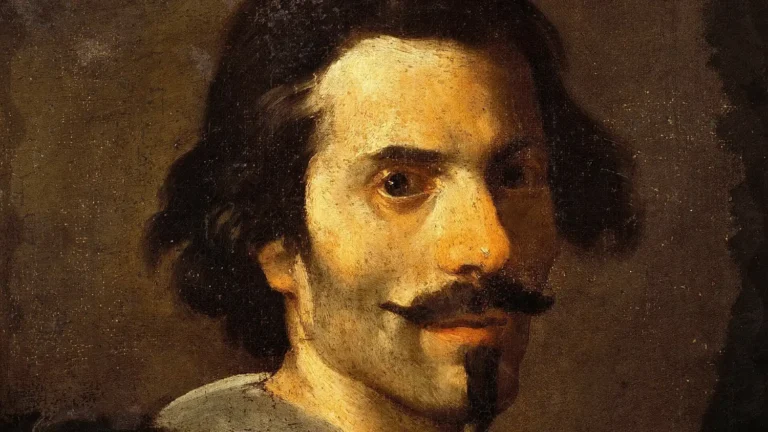
Bernini completed the Blessed Ludovica Albertoni in 1674, when he was around seventy-six years old, at a moment when he was simultaneously working on other major projects including the tomb of Alexander VII and the Chapel of the Blessed Sacrament in St Peter’s. The sculpture was thus produced during an extraordinarily demanding final period of his career, and its quality and ambition make it difficult to think of it as the work of an artist quietly winding down.
The aged master pulled out all the stops in order to please the Papal nephew; unlike many large commissions of the period, where Bernini would design the work and leave substantial portions of its execution to assistants, the Ludovica appears to have received an unusually high degree of personal attention from the sculptor himself.
And it shows. The subtly undulating features of Ludovica’s face are nothing short of captivating; despite the brilliant white sheen of the marble, the expiring beata seems made of flesh and blood, and the contrast between the frailty of her body wreathed in those voluminous draperies with the spiritual profundity of her heaven-bound expression speaks more eloquently of her spiritual state than any hagiography ever could. As ever, Bernini’s sculpture is a direct window deep into the recesses of the human soul.
When the sculpture was completed in 1674, it was immediately hailed as one of the greatest sculptural masterpieces of the age. It also feels like a summation of the ideas that had occupied him throughout his career. The young Bernini had demonstrated how sculpture could explode into movement, making marble appear to capture the body at the precise instant when action was taking place. Here, in one of his final great works, he achieved something more inward and subtle.
Ludovica may be dying; she may be caught in one of the mystical ecstasies for which she was famous; she may be experiencing both at once. The physical signs of death and the language of spiritual rapture overlap until it becomes impossible to separate them completely. After a career spent discovering ever more ingenious ways to make stone breathe, Bernini turned his attention to the moment when that breath is finally about to stop – and imagined that, at the same instant, another kind of life might be beginning.
How to Visit the Blessed Ludovica Albertoni
Bernini’s Blessed Ludovica Albertoni is in the Altieri Chapel inside the Church of San Francesco a Ripa in Trastevere, at Piazza di San Francesco d’Assisi 88. The church is free to enter, and you can simply walk in and make your way towards the left-hand side of the nave, where the Altieri Chapel occupies the transept. The church is currently open daily from 7:30am to noon and from 4pm to 7:30pm, although, as with any working church in Rome, access can occasionally be affected by religious services.
Give yourself more than a quick glance at the sculpture once you reach the chapel. Bernini designed the space as a carefully orchestrated setting for Ludovica, and the effect changes according to where you stand. From the nave, the sculpture appears within the architecture of the chapel, framed by Baciccio’s painting and the surrounding decoration, while moving closer allows you to appreciate the extraordinary carving of Ludovica’s face, hands and turbulent drapery. It is worth doing both: first take in the entire chapel and its theatrical play of light, then approach the sculpture to look at the marble at close quarters.
Bernini and Ludovica Albertoni FAQ

Who was Ludovica Albertoni?
Ludovica Albertoni was a fifteenth-century Roman noblewoman who became a Franciscan tertiary and was renowned for her charity towards the poor and her mystical religious experiences. She died in 1533 and was beatified in 1671.
Why did Bernini sculpt Ludovica Albertoni?
Bernini was commissioned to create a memorial for the newly beatified Ludovica Albertoni in the Altieri Chapel at San Francesco a Ripa. He designed not only the sculpture but the surrounding chapel as an integrated work of architecture, painting, sculpture and light.
When did Bernini sculpt the Ludovica Albertoni monument?
Bernini completed the sculpture in 1674, when he was about seventy-six years old. It is considered one of the major works of his late career.
What other Bernini sculptures can you see in Rome?
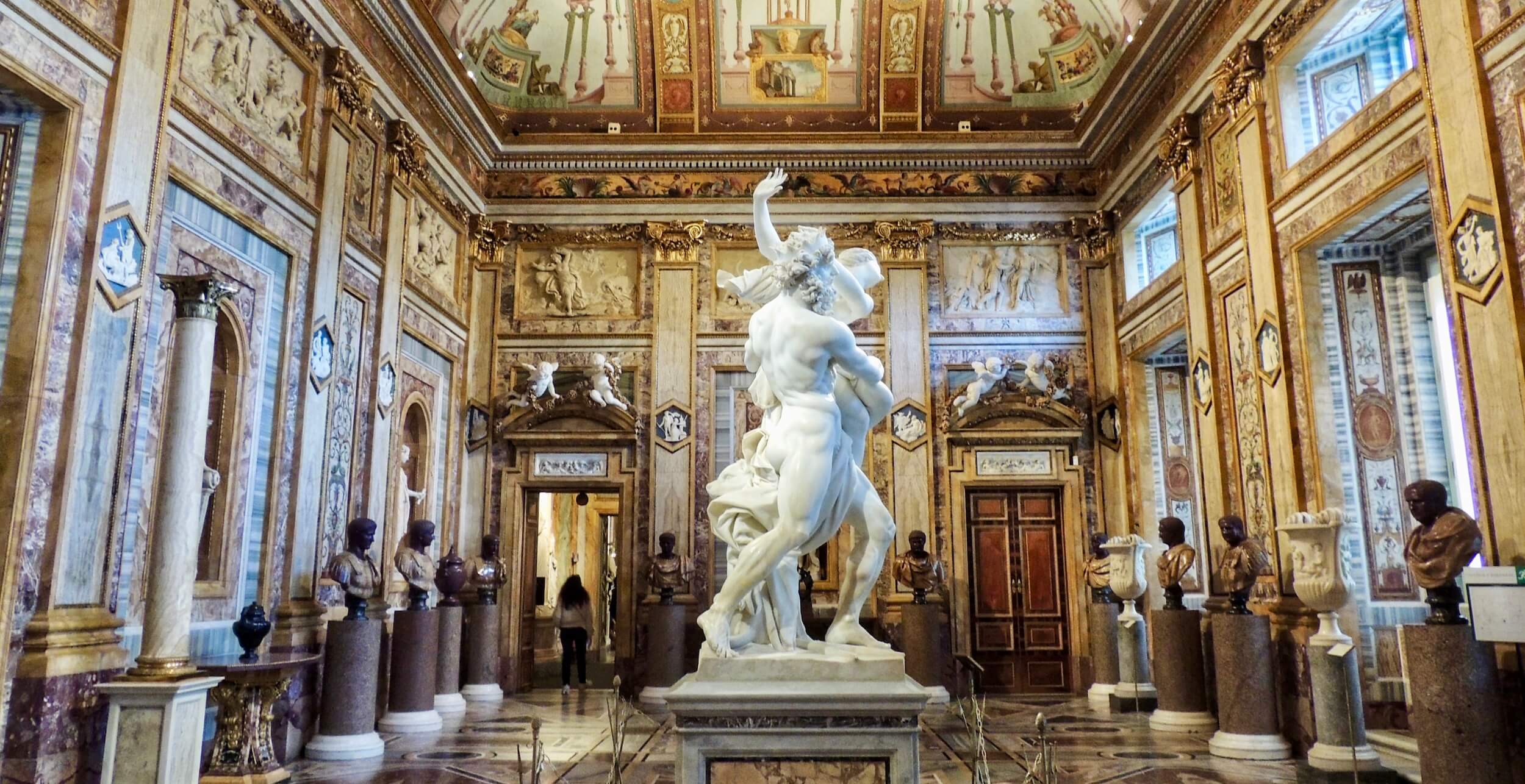
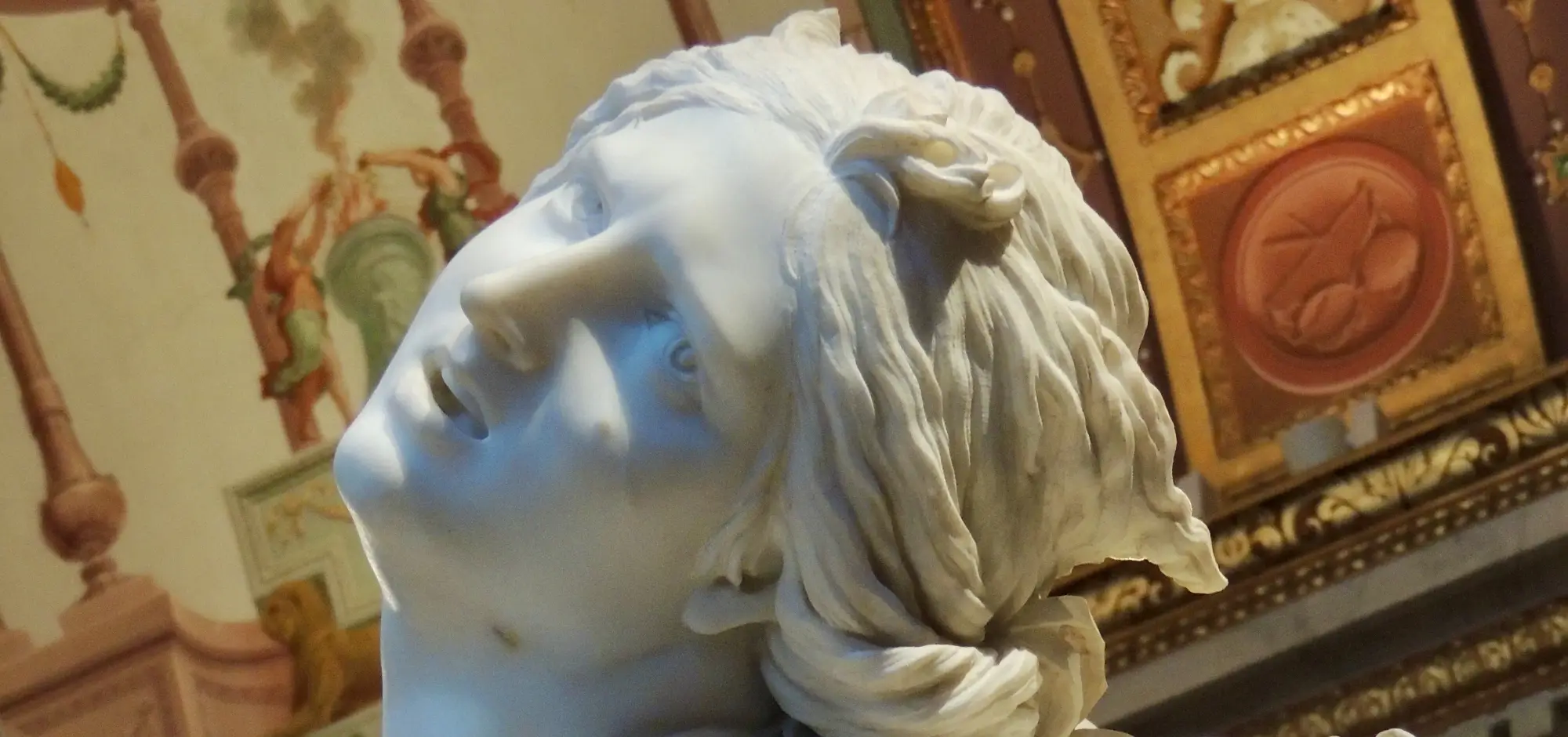
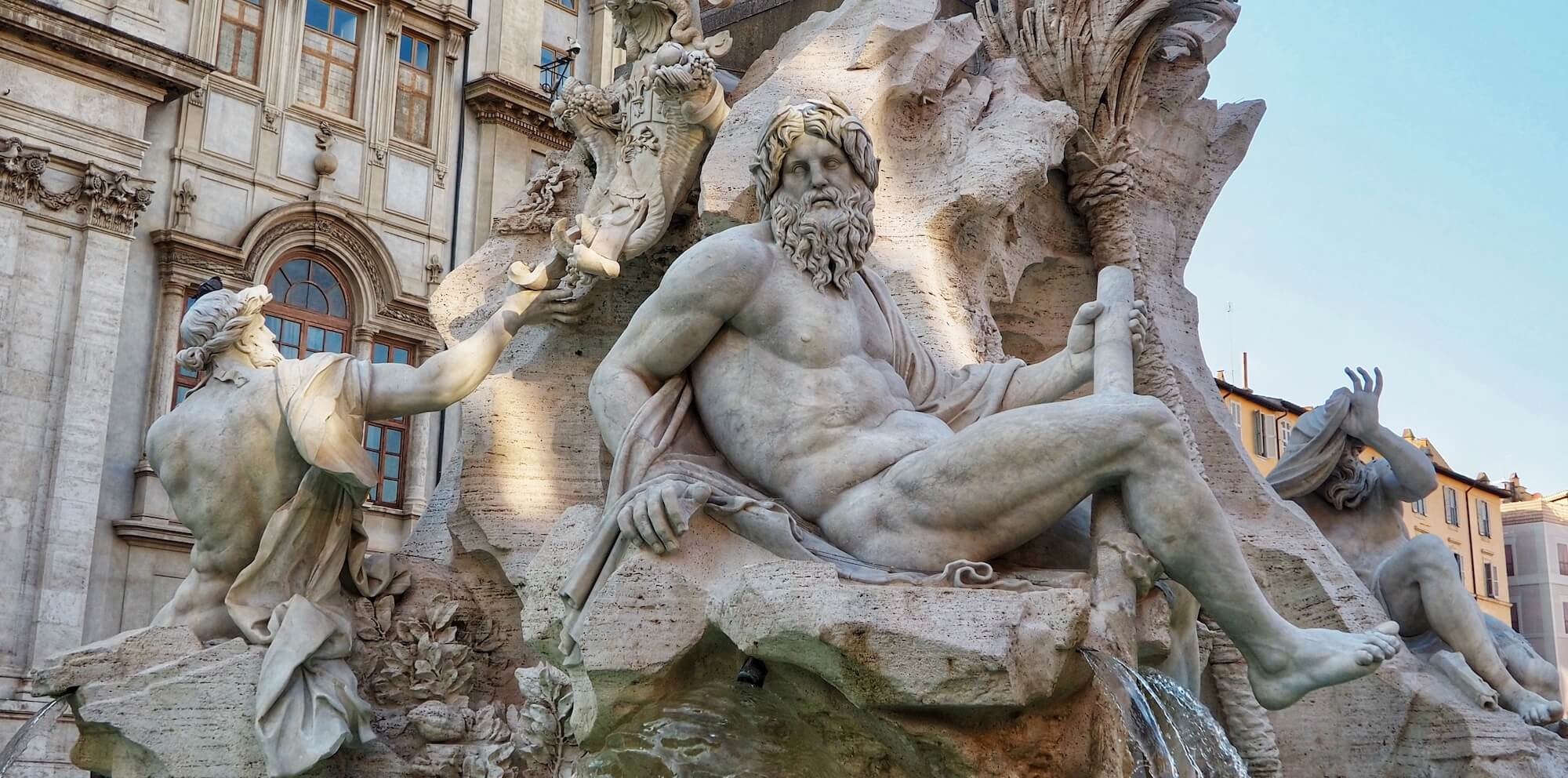
Rome is filled with Bernini’s work, including the Ecstasy of Saint Teresa at Santa Maria della Vittoria, Apollo and Daphne at the Borghese Gallery, and the Four Rivers Fountain in Piazza Navona.
Dive Deeper into Rome