|
|
 |
| Through Eternity Tuscany |
Through Eternity is made up of a group of historians, art historians and archeologists. They are native English speakers or those with speak excellent English, who know and love the history and art of this city. We at Through Eternity will help you understand the formation and historical significance of the sites we bring you to discover. These places, the architecture, with its artworks, are important for what took place there, for the sense and the functions that they had in the past, for the changes that they mark in history, for the new ideas in politics, religion, and art that produced them, and which they represent and express. We at Through Eternity know the value of travel, we know that it is a dream and a great opportunity for discovering other cultures, great art, and the great events of history. But only with the kind of knowledge and enthusiasm that we want to share with you, can such a dream come true.
Our Florence tours are a journey into the Renaissance, to discover the ideas, passions, and inventions that characterized the time of Leonardo da Vinci, Michelangelo, and Raphael without which their names would not stand for genius.
Our Florence tours are a way to understand what profound cultural renewals the Renaissance, with its new centrality of man and his physical nature and intellectual qualities, brought to all fields of human activity, from politics to religion, from art to science.
Our Florence tours to retrace the changes that began in the 13th century and made Florence one of the most active centers in all of Europe in the 15th century, to follow the social rise of the merchant class, the development and extension of commerce, and the creation of banking and financial houses by many Florentine families, leading to their rise to politics, propaganda, and the conquest of power.
Our Florence tours because a visit to Florence can be a great occasion to approach art and appreciate it, to understand it and have an emotional response in front of a work of art.
Our Florence tours help you to understand the deep ties between politics and art and the ways in which art was also political propaganda for the great merchant and banking families from the Medici to the Pazzi, who commissioned palaces, chapels, and works of art from the great artists of the time.
Our Florence tours will to interest you in the lives of the great artists of Renaissance Florence from Brunelleschi to Donatello, from Botticelli to Michelangelo, following them through the crucial phases, formation, difficulties, and ideals in the cultural context of the time.
Our Florence tours enable you to discover how people lived at the beginning of the 15th century and at the end of the 16th century, to discover how daily life and modes of living changed, at least for certain social classes, with the influx of cultural renewals and technical innovations that spread through society at that time from the printing press to the use of soap and the introduction of the fork, from gun-powder to clocks and to mirrors.
|
|
 |
 |
|
 |
|
 |
 |
 |
|
 |
|
 |
 |
 |
|
 |
|
 |
 |
 |
Florence of the Artists
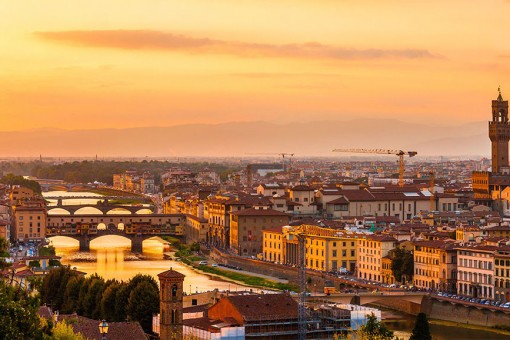
Many artists from all over the world have been coming to Florence for centuries and they have recounted their discovery of the city, their enthusiasm for a city where time past has left a clear memory of itself in the shape of the medieval alleys, in the tabernacles at street corners, the grand palaces of the rich Renaissance families, and the great art. Many artists from North and Central Europe came on the Grand Tour to discover the land of classical art and the Mediterranean ways of life. Among them was the 19th century French writer Stendhal, an excerpt of whose travel memoirs we want to include here. He came to Italy frequently and lived here for some years, first in Milan and then in Civitavecchia. But it was Florence that left him half dazzled by the art of the city, and he lived a kind of ecstatic and intense experience that today we call the "Stendhal syndrome," a state of being enraptured in a tempestuous sea of emotions in front of a work of art.
Stendhal wrote:
"Florence, paved with great blocks of white stone in irregular shapes, is of rare cleanliness: in her streets one breaths I do not know what extraordinary perfume. With the exception of some Dutch villages, Florence is perhaps the cleanest city in the universe, and certainly one of the most elegant. Her greco-gothic architecture has all the clean elegance of a lovely miniature. Fortunately for the material beauty of Florence, her inhabitants lost, along with their liberty, the necessary energy for raising large buildings. For this reason, the eye is not irritated by those disgraceful facades in the style of Piermarini, and nothing disturbs the beautiful harmony of these streets, where wafts the ideal beauty of the Middle Ages. In twenty different places in Florence, as for example in descending from Ponte della Trinita' and passing by palazzo Strozzi, the traveler can believe himself to be in the year 1500."
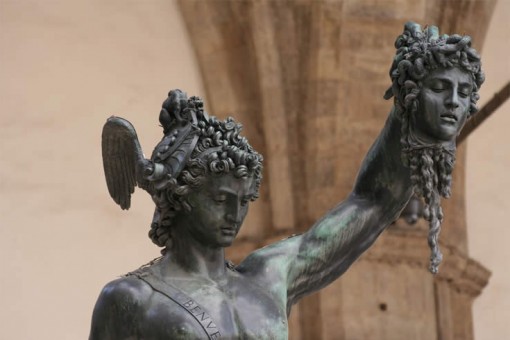
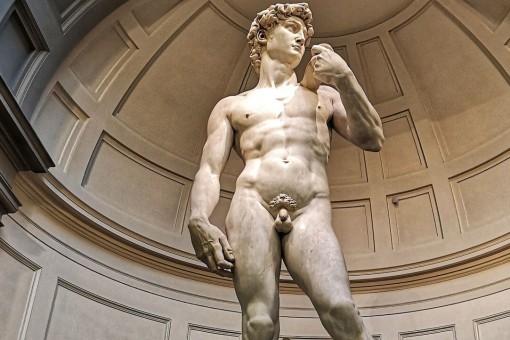
"But notwithstanding the great beauty of many streets full of majesty and of melancholy, nothing can compare to Palazzo Vecchio. This fortress, constructed in 1298 with the voluntary contributions of the merchants, proudly lifts her brick battlements and her walls to immeasurable heights, not in some secluded corner, but in the midst of the most beautiful piazza of Florence. To the south there is Vasari's beautiful gallery, to the north the equestrian statue of a Medici, at the foot of the building Michelangelo's David, Cellini's Perseus, the enchanting Loggia of the Lanzi, in short all the masterpieces of art in Florence and the entire gamut of her civilization. Fortunately this piazza is for the city like the Boulevard de Gand, the place where one passes continually. What building of Greek architecture could say as much as this Medieval fortress, full of the roughness and force of its century?"
Stendhal, Florence January 23, 1817 (our translation)
|
 |
 |
|
|  |