Rome is, among many other things, the greatest repository of Christian sacred objects in the world.
For nearly two thousand years, pilgrims have come here from every corner of the globe. They have come as emperors and saints, as popes and ordinary believers — and over the centuries they have left behind an extraordinary legacy: a vast and varied collection of sacred objects, preserved in hundreds of churches across the city.
Some are as magnificent as one might expect: the bones of saints encased in jeweled reliquaries, fragments of the True Cross set in gold, altarpieces built to frame and exalt holy images of the Virgin.
Yet alongside these runs another, more curious thread. Rome’s relic culture has always made room for the unusual — for objects that sit at the edge of belief, where faith and credulity begin to blur, and where the desire to encounter the sacred in tangible form has, at times, produced things that strike the modern eye as distinctly strange.
From the seriously revered to the seriously implausible, the ten relics that follow are all hiding in plain sight in the churches of Rome – waiting for the curious visitor who knows to look.
Rome Tours
Experience the Magic of Rome
San Giovanni in Laterano
A clammy tomb and rattling bones foretell the death of the current pontiff
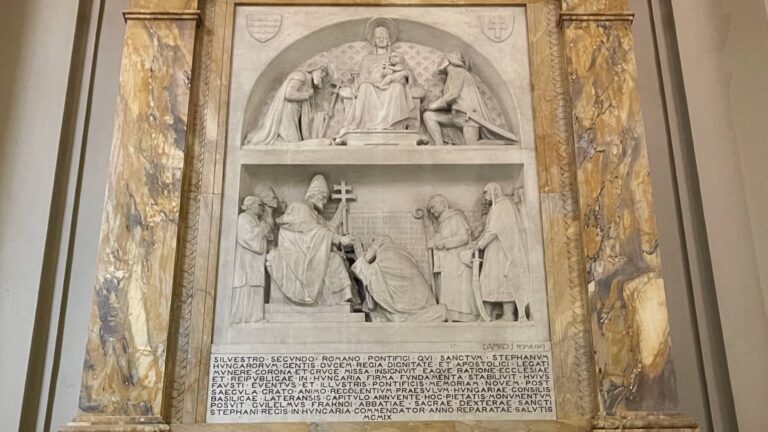
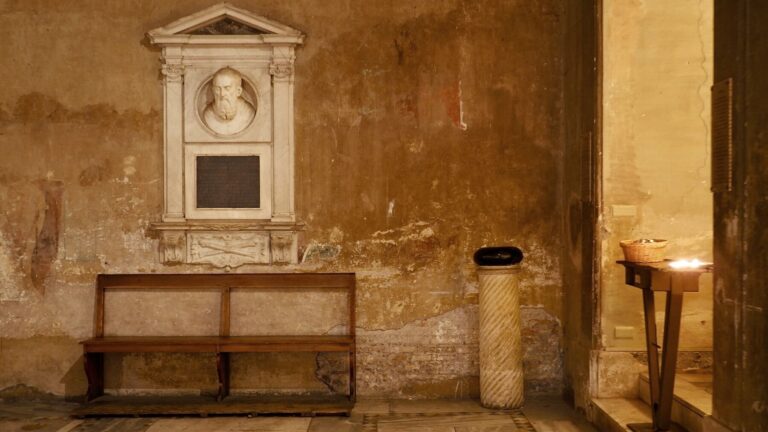
In the vast cathedral of San Giovanni in Laterano — the oldest and highest-ranking church in Rome, mother church of all Christianity — a curious marble monument hides in plain sight just behind one of the nave’s pillars.
It marks the funeral cenotaph of Pope Sylvester II, the scholar-pope who led the Church from 999 to 1003 and who remains one of Rome’s most intriguing medieval figures.
Sylvester was gifted with a remarkable intellect. One of the most learned men of his age, he was credited with introducing advanced mathematics and astronomical knowledge to Western Europe, having spent time studying in the Islamic world and absorbing its far more developed scientific traditions.
But his formidable reputation led some contemporaries to view him with deep suspicion. Stories circulated that he had studied esoteric arts, built strange mechanical devices, and even made a pact with the devil.
From this blend of admiration and fear came the peculiar legend tied to his cenotaph here at the Lateran. According to a long-standing tradition, the marble inscription slab of Sylvester’s tomb would sweat or grow clammy at the approach of a pope’s death. Some accounts went further still, claiming that the bones themselves would begin to rattle — a skeletal alarm system, as it were, for the impending vacancy of the Holy See.
These days the cenotaph might no longer draw anxious glances from the clergy, but the legend lingers on. In Rome, nothing is ever quite as it seems.

Santa Maria in Cosmedin
A flower-crowned relic and the surprisingly complicated origins of a global feast
Most visitors come to Santa Maria in Cosmedin for the ancient marble mask in the church’s portico — the Bocca della Verità, the Mouth of Truth, whose hollow eyes and open jaws have been threatening the dishonest since antiquity.
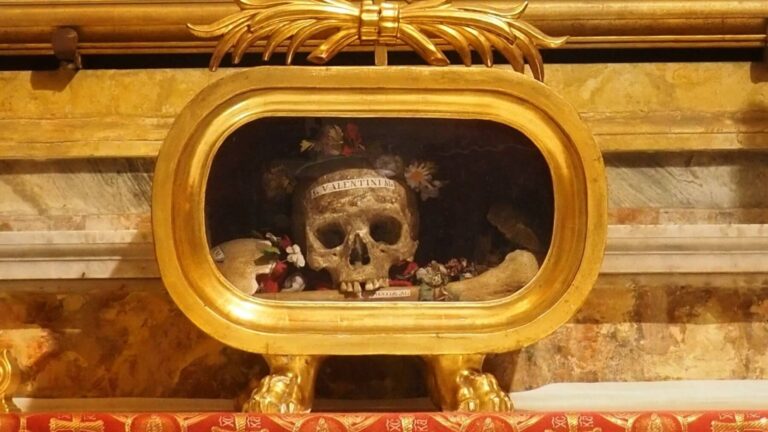
Fewer step inside the church itself, and fewer still notice what is modestly displayed along the left-hand wall: the skull of Saint Valentine, preserved in a gilded reliquary and crowned with flowers.
The figure behind the relic is considerably more complicated than the modern holiday suggests. Valentine was a third-century Christian martyr — possibly two martyrs whose stories became tangled over time: a Roman priest and a bishop from Terni, both said to have been executed on the Via Flaminia under Emperor Claudius II around 269 AD.
Early sources tell us little about either beyond their refusal to renounce their faith. Neither of them is associated in any early document with lovers, romance, or spring. For centuries, Valentine was venerated not as the patron of the lovelorn but of beekeepers and epileptics.
The romantic association entered the tradition much later, primarily through the poetry of Geoffrey Chaucer, who connected Valentine’s feast day with the mating of birds in The Parliament of Fowls around 1382. By the time Shakespeare referenced the day as a lovers’ occasion in A Midsummer Night’s Dream, the connection had become permanent.
Here in Santa Maria in Cosmedin, stripped of sentimentality and commercial gloss, the crowned skull is a reminder that Rome’s most familiar traditions often rest on the most improbable foundations — shaped as much by poets as by popes, and as much by popular imagination as by historical fact.
Santa Sabina
A basalt relic that still bears the marks of a legendary confrontation
At first glance, the object near the entrance of the Basilica of Santa Sabina seems unremarkable: a rounded black stone, smoothed by the passage of time and set atop a modest twisted column. Yet this stone has carried an extraordinary reputation for eight hundred years.
Known as the lapis diaboli — the devil’s stone — it testifies to a legendary act of satanic fury that allegedly took place within these ancient walls, its dark surface bearing what the faithful have long identified as the marks of the devil’s own hand.
The story centers on Saint Dominic, founder of the Dominican Order, who lived and prayed at Santa Sabina in the early thirteenth century after Pope Honorius III granted the friary to his new brotherhood.
According to the tradition, Dominic was kneeling in deep prayer one night on a marble slab that covered the bones of martyrs when Satan, provoked beyond endurance by such concentrated holiness, chose to intervene. In a rage, the devil hurled a massive black stone at the praying saint.
The malign spirit missed — Dominic being evidently protected by something more reliable than luck — but the stone shattered the marble slab beneath him.
The slab, later pieced back together and still visible in the sacristy, bears the repair seams of its reassembly. The stone itself remained, a trophy of thwarted malice whose supposed clawed marks became focal points for the faithful and curious alike.
Scholars suggest the stone may simply be a Roman lapis aequipondus, a counterweight used in ancient scales – a plausible explanation supported by similar examples in other Roman churches – but we prefer to suspend our disbelief and think about that long ago encounter between Dominic and the devil.
Santa Francesca Romana
Basalt stones that preserve the imprints of some very holy kneecaps
According to early Christian tradition, one of the most dramatic confrontations in the history of Rome unfolded not with weapons or political speeches but with prayer.
Simon Magus — a celebrated pagan sorcerer whose name has given English the word simony — attempted to prove his divine power to the Roman crowd by levitating in front of them near the Forum. As Simon rose into the air, the Apostle Peter fell to his knees and prayed that God would expose the fraud.
The prayer was immediately answered: Simon plummeted to his death, his powers undone, his humiliation complete.
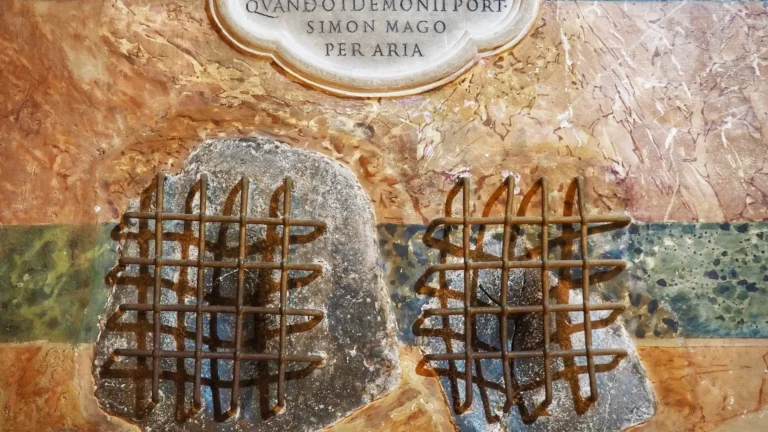
The spot where Peter was believed to have knelt was identified in the early centuries of the Church, and a pair of dark basalt slabs — bearing what look, with some imagination, like shallow depressions at knee height — were venerated as the very stones into which apostolic weight had pressed at the moment of divine intervention.
Those stones are preserved today in the Basilica of Santa Francesca Romana, tucked behind a simple iron grate in the south transept. The basilica itself is one of Rome’s hidden gems, sitting atop the Roman Forum in a position of quite extraordinary historical layering — the Christian Middle Ages built directly onto the pagan classical world, which is, in a sense, the whole story of Rome in a single image.
The kneeprints, as physical objects, are modest. As focal points for a tradition that has been running for eighteen centuries, they are immense.
Santi Vincenzo e Anastasio
Where the hearts and organs of dead popes were laid to rest for three centuries
For over three hundred years, when a pope died in Rome, his body was not buried whole. Within twenty-four hours of death, the pontiff was ritually opened, embalmed, and prepared for the extended period of public display that papal protocol required.
The organs removed in the process — heart, lungs, liver, and viscera — were sealed into containers and carried in solemn procession to a small, rather severe church near the Trevi Fountain.
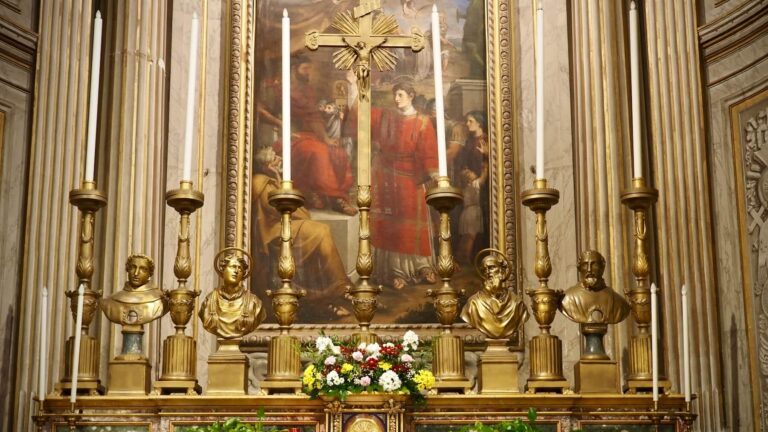
That church is Santi Vincenzo e Anastasio, long known as the parrocchia pontificia (the papal parish) thanks to its proximity to the Quirinal Palace, the papal residence from the sixteenth century until Italian unification.
Beginning with Pope Sixtus V in 1590, and continuing without interruption until the death of Leo XIII in 1903, the internal organs of at least twenty-two popes were deposited here ad perpetuam rei memoriam — as a permanent reminder of mortality at the very heart of papal power.
The remains — known officially as the precordi — are still conserved today in sealed loculi beneath the high altar, in a subterranean chapel closed to the public. The Roman people, however, were less restrained in their language. They called them the sacre budella – the sacred guts — and nicknamed the church itself the chiesa delle frattaje, or the church of offal.
The popular poet Giuseppe Gioachino Belli immortalised the custom in verse, listing with brutal clarity the lungs, heart, liver, spleen, and guts of the popes arranged below like a butcher’s inventory.
The practice was finally abolished by Pope Pius X in the early 20th century. But the organs remain. Just steps from the Trevi’s theatrical waters, Rome keeps a quieter reminder that even the Vicar of Christ was, in the end, made of flesh.
Santa Croce in Gerusalemme
The relic that recalls an apostle’s doubt made suddenly certain
The story of Saint Thomas is familiar even to many who know little else of the Gospels. Confronted with news of the Resurrection, the apostle demanded evidence — physical, tangible, undeniable contact with the wounds of crucifixion. “Unless I see the print of the nails in his hands, and put my finger into the print of the nails,” Thomas declared, “I will not believe.”
Christ duly appeared, invited him to investigate, and Thomas’s doubt evaporated in an instant: ‘My Lord and my God’.
It is one of the great dramatic scenes of the New Testament, immortalized by Caravaggio with characteristic anatomical directness: the probing finger, the livid wound, the expression of a man whose intellectual resistance has just been demolished.
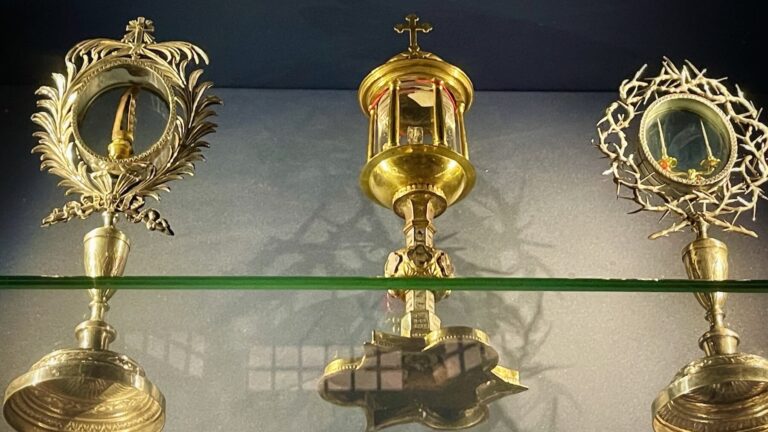
The very finger in question is supposedly preserved in Rome at the church of Santa Croce in Gerusalemme, enshrined in a dedicated chapel alongside an extraordinary collection of Passion relics that includes fragments of the True Cross, the Titulus Crucis (the inscription board from the Cross), and thorns from the Crown of Thorns.
The path to Rome was, as you might expect, eventful. The main body of Thomas’s relics had long been associated with Ortona in Abruzzo, where his bones arrived in the fourteenth century.
According to tradition, when on pilgrimage in Italy the Swedish mystic Saint Birgitta received a vision in which the apostle appeared and promised her a treasure. At that moment, a fragment of his finger emerged from the tomb of its own accord.
Birgitta, demonstrating the practical instinct that characterizes so many of the Church’s most effective mystics, pocketed the relic immediately and carried it to Rome, where it was entrusted to Santa Croce.
It is displayed today in a crystal reliquary, the bone held upright by a finger-shaped support: a monument to doubt and to doubt conquered.
Santa Maria Sopra Minerva
Italy’s patron saint was dismembered in an unseemly competition for her mortal remains
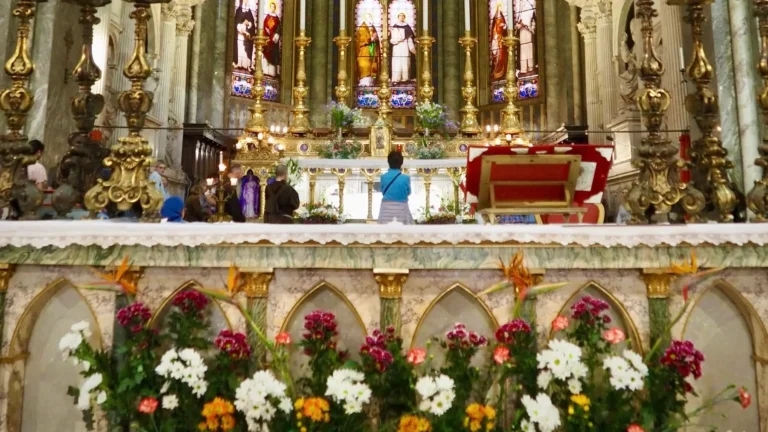
Entombed beneath the high altar of Santa Maria Sopra Minerva — Rome’s only Gothic church, built over the ruins of a temple to Minerva and housing, as a bonus, Michelangelo’s Risen Christ — Italy’s co-patron saint Catherine of Siena occupies the most prominent possible position in one of Rome’s finest sacred interiors.
Or rather, most of her does.
The problem arose in 1380, when Catherine died in Rome at the age of thirty-three, having spent the last years of her life in the city attempting to stabilize a papacy in crisis.
The Sienese were deeply unhappy that their most celebrated daughter was to be buried on what they considered foreign soil, and they made their feelings known with more practical urgency than diplomatic subtlety.
According to the enduring account of events, a delegation of Sienese managed to detach Catherine’s head from her body — not as irregular a proceeding as it sounds, since the division of relics and their separate veneration was standard medieval practice — and attempted to carry it out of Rome concealed in a bag.
When Roman guards stopped and searched them, the story goes, the bag was opened to reveal not a saint’s head but a profusion of rose petals. The delegation continued unmolested to Siena, where the head was deposited in the Basilica of San Domenico; it is still venerated there to this day.
Sober historians note that the head was almost certainly transferred to Siena with the knowledge and approval of the relevant Roman authorities, and that the rose petal story is a later elaboration.
But the basic fact is verifiable: Catherine is simultaneously in Rome and in Siena, and venerated with equal fervor in both.
San Pietro in Vincoli
A relic that bridges two prisons, two cities, and two thousand years of faith
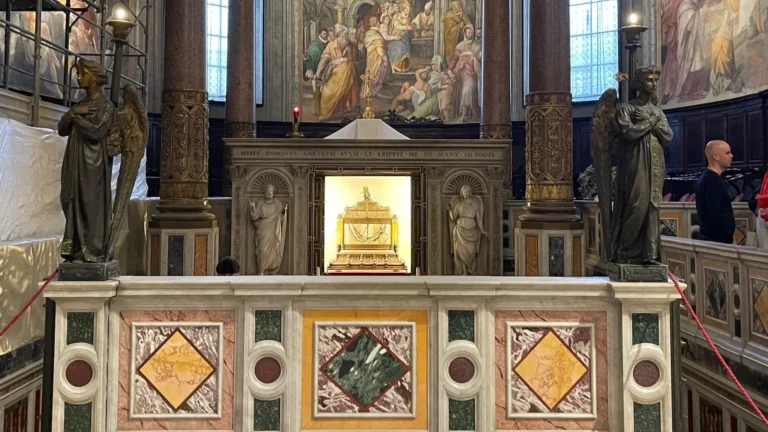
Just a short walk from the Colosseum, the church of San Pietro in Vincoli houses one of the most theologically charged objects in the city: the chains that once bound Saint Peter. The church’s name — Saint Peter in Chains — announces its treasure without ceremony, and the treasure itself is displayed simply: two sections of iron chain joined in a gilded shrine above the altar, their links dark with age.
The history behind them is a story of miraculous conjunction. According to Christian tradition, Peter was imprisoned by King Herod in Jerusalem to await execution, and was freed by an angel who appeared in the night and caused his chains to fall.
The chains remained in Jerusalem for centuries, venerated by pilgrims. In the fifth century, the Empress Eudocia — wife of Theodosius II and a devoted collector of holy relics — sent a portion of the Jerusalem chains to Rome as a gift to Pope Leo the Great.
Pope Leo already possessed another set of chains in Rome: those said to have shackled Peter in the Mamertine Prison before his execution in the city around 67 AD. When the two relics were brought together and the links touched each other, the story goes, they fused into a single continuous chain, inseparable, as if the iron itself recognized the connection between the two imprisonments.
The church built to house this united relic is worth a visit in its own right — it also contains Michelangelo’s great tomb of Pope Julius II, dominated by the terrifyingly vital marble Moses, which was meant to be one element of a vastly more ambitious funerary monument that Michelangelo spent decades failing to complete.
The chains are in the crypt-like space beneath the altar; Moses is in a chapel to the right. Between them, the church contains two of Rome’s most remarkable objects within a hundred meters of each other.
Sant’Alessio
Harry Potter had nothing on this saint who lived unrecognized under the stairs of his parents’ house
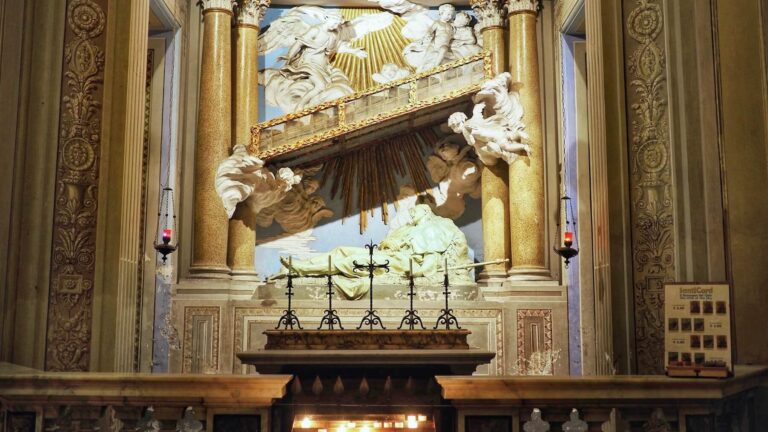
In a baroque chapel just off the nave of the quiet church of Sant’Alessio on the Aventine hill is one of Rome’s strangest relics: a wooden staircase.
According to legend, Saint Alexius, son of a wealthy Roman family, renounced his inheritance to live as a penniless pilgrim and wandering holy man. After decades of wandering the earth for his faith, the future saint returned to Rome and arrived at his own father’s house unrecognized.
Alessio decided against revealing his identity to his own kith and kin, and spent the next seventeen years humble living beneath the household stairs as an anonymous beggar. He was recognized only after his death when a written account of his identity was found clutched in his hand.
The worn wooden steps preserved in the church are said to be the very ones beneath which he sheltered. The historicity of this particular relic might be difficult to swallow, but the story has an appealing logic: a life of deliberate invisibility, lived in the space that everyone uses and no one notices, a saint who chose to hide in plain sight in his own home.
The basilica itself is a place of considerable charm. Its origins lie in the fourth century, while its current form is largely medieval, with a handsome Romanesque campanile and a cloister of quiet beauty.
The church is almost always empty, and is located in one of Rome’s most peaceful neighborhoods. The Aventine Hill is an ancient and slightly detached corner of the city that also contains the Garden of Oranges, the Knights of Malta keyhole and the very beautiful Benedictine basilica of Sant’Anselmo.
San Giovanni in Laterano
Twenty-eight marble steps, still climbed on bare knees — and the moment Martin Luther walked away
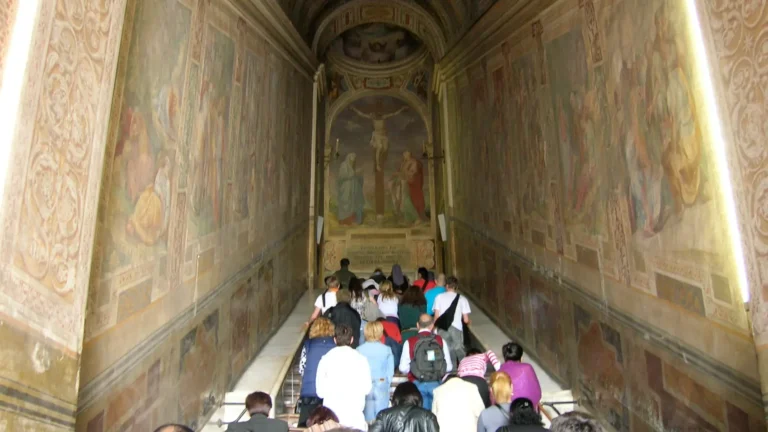
We conclude our list with another staircase. Just east of the great basilica of San Giovanni in Laterano, twenty-eight white marble steps rise gently to a landing on which stands a small, ancient chapel. The steps are protected under polished wood, worn smooth by centuries of use. They are to be climbed exclusively on one’s knees.
This is the Scala Santa — the Holy Staircase said to be the very steps that Jesus climbed to face Pontius Pilate’s judgment in Jerusalem before his crucifixion.
According to tradition, they were brought to Rome in the fourth century by the Empress Helena — mother of Constantine and the most dedicated relic hunter in the history of the Church — who had them transported from Jerusalem and installed at her Lateran palace.
They have been climbed by penitents seeking indulgences ever since, their authenticity endorsed by a long succession of popes and their marble surface worn to a concavity that testifies, whatever you believe about their origins, to an extraordinary weight of human devotion.
The most famous person to have climbed them on his knees — and to have stopped — was Martin Luther. The future reformer, then a young German Augustinian friar, came to Rome in 1510 and dutifully mounted the steps as a pious exercise, pausing on each one to recite a prescribed prayer.
Somewhere near the middle, Luther is said to have stood up, walked down, and returned to his lodgings in a state of profound unease. ‘Who knows if this is true?’ he reportedly muttered.
The question, once asked, did not go away. It followed him back to Germany, and eventually contributed to the theological reckoning whose first public act was the nailing of ninety-five theses to a church door in Wittenberg in 1517.
The steps continue to draw thousands of penitents each year. Watching people climb them on their knees, lips moving in silent prayer, is one of those experiences that Rome reserves for the visitor who takes time to look beyond the obvious.
Whatever you believe about the steps’ origins, the devotion they inspire is entirely real, a living thread that transports us back to the origins of Christianity itself.
What is a relic in Catholic tradition?
In Catholic theology, a relic is a physical object associated with a saint or with Christ — typically a bone, a piece of clothing, or an object touched by or used by the holy figure. First-class relics are parts of the saint’s own body; second-class relics are items the saint owned or used; third-class relics are objects that have touched a first-class relic. The veneration of relics has been central to Catholic practice since the earliest centuries of the Church, though the Reformation produced fierce arguments about the theological legitimacy of the practice.
What is the most unusual relic in Rome?
Opinions will vary sharply on this, but the preserved organs of twenty-two popes at Santi Vincenzo e Anastasio — kept in sealed chambers beneath the altar just steps from the Trevi Fountain, and referred to by Romans for centuries as the sacre budella (sacred guts) — have a strong claim. The sweating cenotaph of Pope Sylvester II at San Giovanni is a close second.
Are these relics open to the public?
Most are freely accessible during normal church opening hours. The papal organs at Santi Vincenzo e Anastasio are in a subterranean chapel closed to visitors, though the church itself is open. The finger of Saint Thomas and the Passion relics at Santa Croce in Gerusalemme are displayed in a dedicated chapel that you can access via a flight of stairs located in the left transept
Is the skull at Santa Maria in Cosmedin really that of Saint Valentine?
It is claimed to be. The historical evidence for the specific identification is, as with most relics of this age, not conclusive. What is certain is that a relic identified as Saint Valentine’s skull has been kept and venerated at the church for a long time. The Mouth of Truth in the portico, which gets far more visitors, has equally uncertain historical credentials.
Can I climb the Scala Santa on my knees?
Yes — the Scala Santa at San Giovanni in Laterano is open daily for pilgrims who wish to ascend the steps on their knees, as prescribed by the tradition. The wooden covering over the original marble steps was restored after the 2019 opening; a wooden staircase to either side allows non-penitential visitors to reach the chapel at the top.
Venice Tours
Discover the Magic of Rome