Think you’ve seen the Roman Forum and Palatine Hill? Think again. Beyond the well-known sites and famous ruins lie a series of restricted spaces — the so-called SUPER sites — where ancient Rome still feels startlingly alive. These exclusive areas, accessible only with a special ticket, take you beyond the main pathways to uncover frescoed chambers, hidden temples, imperial halls, and cutting-edge excavations that reveal new stories about the city every year. Step inside the richly painted House of Augustus and the elegant House of Livia, where vivid wall frescoes still shimmer with the colours of imperial luxury. Wander through Santa Maria Antiqua, a Byzantine jewel hidden beneath the Palatine, or ascend the grand Imperial Ramp to see the emperor Domitian’s lost palace.
In this guide, we’ll show you exactly what the SUPER sites are, why they’re so special, and how to visit them — your key to unlocking a deeper, more in-depth experience of Rome’s most extraordinary archaeological zone.
Ancient Rome Tours
Explore the Ancient City
The SUPER sites – officially known as S.U.P.E.R. (Seven Unique Places to Experience Rome, altough currently more than 7 sites are on the itinerary) – are a curated collection of remarkable archaeological locations within the Roman Forum and Palatine Hill that go beyond what most visitors see on the standard ancient Rome route. Rather than just walking among ruins, the SUPER sites give you access to buildings, houses, museums and tucked‑away spaces that reveal how emperors lived, how private and public life intersected, and how art and architecture evolved over time.
Here’s a quick overview of the current core SUPER sites included in the itinerary that we will cover in detail below:
- House of Augustus: The residence of Rome’s first emperor, with remarkable frescoes and imperial architecture.
- House of Livia: A beautifully decorated house associated with Augustus’ wife, known for its intimate frescoes.
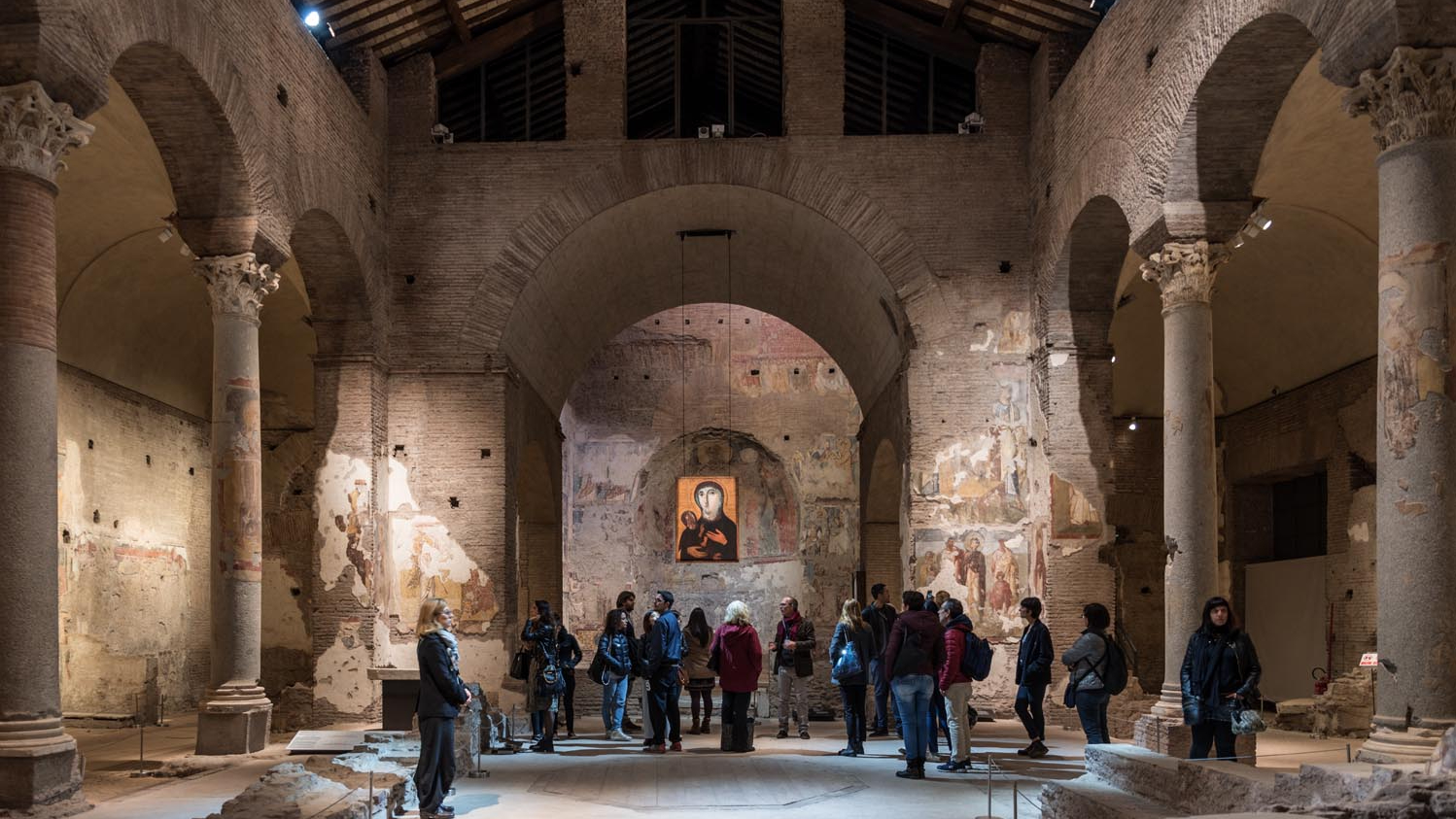
- Santa Maria Antiqua: One of Rome’s oldest churches filled with early Christian and medieval frescoes.
- Imperial Ramp of Domitian: A monumental sloping corridor built to connect the Palatine Hill with the Roman Forum
- Domus Tiberiana: Museum‑like spaces on the Palatine showcasing archaeological finds and displays.
- Palatine Museum: Displays artefacts recovered from excavations on the Palatine Hill.
- Cryptoporticus of Nero: A vaulted substructure built by Nero to support his Palatine palace.
- Domus Transitoria: The lavish early imperial residence of Nero that set the stage for the later Domus Aurea.
- Aula Isiaca & Loggia Mattei: A ceremonial hall and loggia featuring richly decorated interiors.
- Horrea Piperataria: Ancient grain and goods storehouses that help illustrate the economic workings of the city.
- Curia Julia: The Senate House where Rome’s leaders debated and shaped the Republic and Empire.
Read on for a detailed breakdown of all the sites!

The circumstances of the birth of the man who would become the first Roman Emperor augured well for his future prospects – Gaius Octavius was born into a respectable family in 63 BC on a relatively humble house on the Palatine Hill, where the story of Rome began with the mythical founding legend of Romulus and Remus. Although he spent his earliest years in his father’s hometown of Velletri to the south of Rome, fate would soon return Octavian to the Palatine Hill, where he took up residence at the beginning of his political career under the protection of Julius Caesar.
In contrast to his successors to the Imperial throne, who chose to ostentatiously symbolize their power with luxurious palaces, Augustus remained content with his comparatively humble house after rising to the role of Emperor in the wake of the Roman Civil War, extending it where necessary to fulfill the demands of his office.
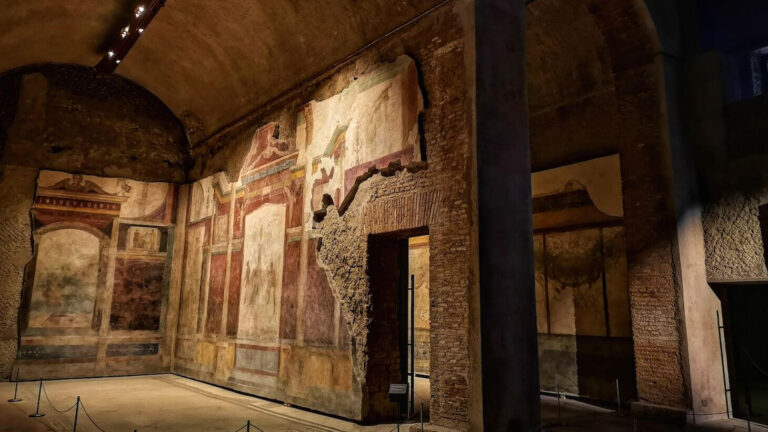
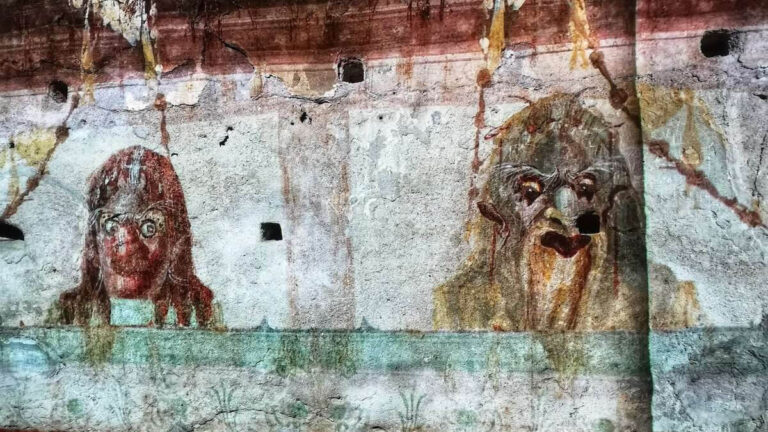
Incredibly, the house where Suetonius writes that the modest Augustus ‘slept in the same bedroom in winter and summer for 40 years’ is still standing today. But although many ancient sources insisted on the thriftiness of the emperor’s living quarters, the House of Augustus contains some of the best surviving examples of ancient Roman painting anywhere. Indeed, not all of his contemporaries were convinced that the emperor lived as frugally as he liked to make out. Ovid described Augustus’ residence as ‘a house worthy of a god,’ and visiting its succession of beautifully painted rooms today it seems like the ancient poet wasn’t far wide of the mark.
The frescoes are painted in what is known as the second Pompeiian style, which is comprised of vibrant splashes of color, complex geometric motifs, and slender architectural elements, which, through the use of perspectival techniques, are given a sense of depth and three-dimensionality.
Next door to the House of Augustus is the no-less impressive House of Livia, somewhat tenuously identified as the dwelling of the emperor’s wife thanks to an inscription found on a lead pipe in the 19th century. Discovered during excavations on the Palatine Hill in 1839, the refined two-storey domus is in reality more likely to be another wing of the House of Augustus, centred around a quadrangular atrium.
Rooms leading off the atrium feature fabulously refined frescoes on the walls, whilst original black and white mosaic floors gleam underfoot. The decorations in the House of Livia also date from the so-called Second Style, and feature fictive architecture, imaginary landscapes and mythological scenes – including the story of the doomed love of the cyclops Polyphemus for the beautiful sea nymph Galatea – framed by fantastic geometrical motifs.
After important restoration works, the House of Livia is open to the public once again, so you’ll be able to visit it on a SUPER sites tour in 2026.
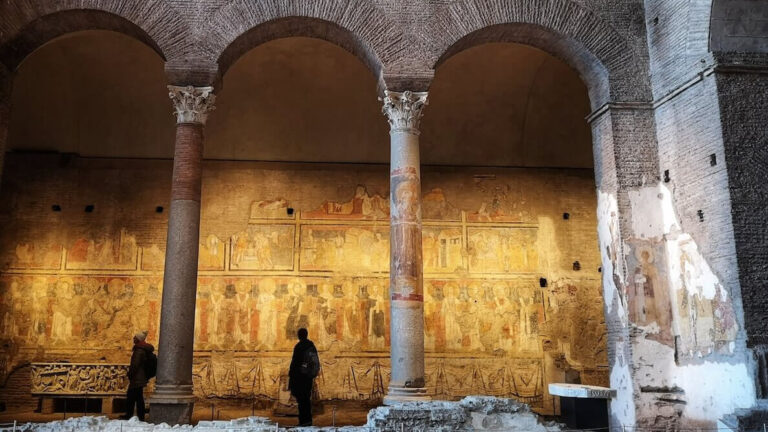
Situated just at the base of the Palatine Hill, the venerable church of Santa Maria in Antiqua is one of the oldest Christian buildings still standing in the Eternal City largely unaltered. Originally part of the palatial imperial complex, the building was transformed into a church in the early-Christian period. Abandoned in the 9th century and buried below ground by a devastating earthquake, the church was only rediscovered and restored in the early 20th century. But what its discoverers found was breathtaking.
Unlike so many other churches from the early centuries of Christianised Rome, Santa Maria Antiqua’s thousand-year interment has meant that it has come down to us without any major stylistic or architectural accretions over the centuries, meaning that it offers an unparalleled and unobstructed window into the distant world of early Christianity.
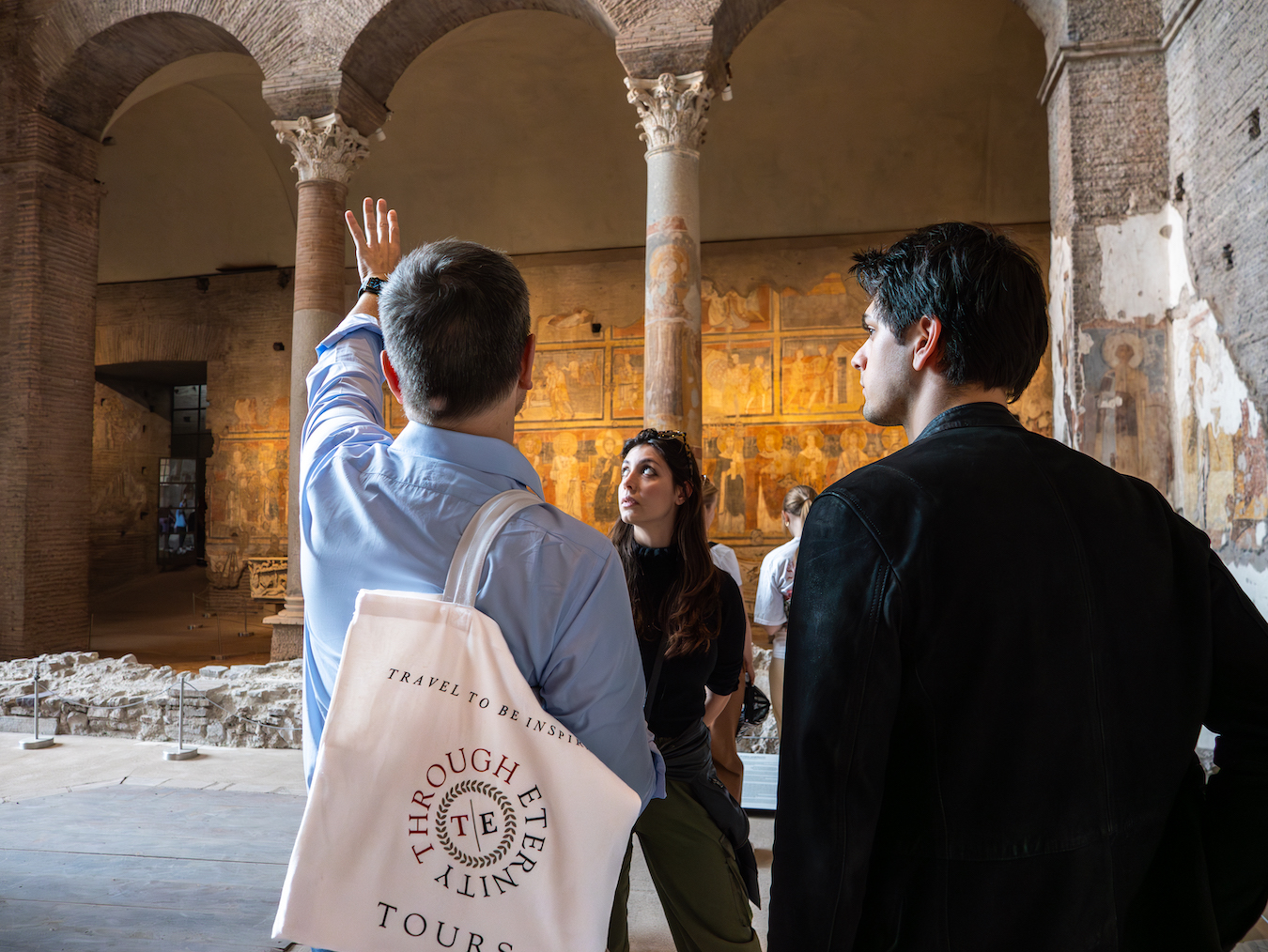
The extraordinary 6th to 8th century frescoes that line its walls are amongst the most important and rarest late antique artworks in Rome, and occupy a unique position in the artistic and cultural evolution of the city after the fall of the Roman empire. A rich tapestry of saints and popes, martyrs and royalty, the frescoes paint a marvellously rich portrait of a society in transition, when the splendours of the Imperial court and the spirituality of the still-young religion existed side-by-side in the city.
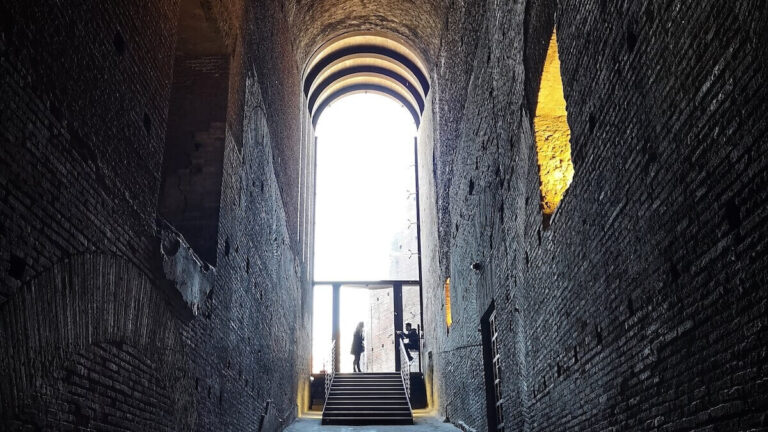
Built by the emperor Domitian to connect his opulent imperial palace on the Palatine hill to the political and bureaucratic centre of the Roman empire in the Roman Forum below, this imposing monumental ramp originally rose through seven levels over 35 metres. High walls carry a soaring vault as the ramp snakes its way in gentle turns up the side of the hill, an incredible feat of ancient engineering that also dramatically symbolises the transition of power in Rome from the democratic administration of the Republican era to the centralised might of the empire in the Imperial age. The spectacular ramp was discovered in the opening years of the 20th century by archaeologist Giacomo Boni, and only opened to the public in 2015.
Don’t miss the entrance aula, which was converted into an oratory commemorating a squadron of 40 Roman soldiers who, after converting to Christianity, were frozen to death in an icy lake. The spectacular frescoes depicting the gruesome event are masterpieces of late-antique artistry.

Recently reopened to the public after being closed to visits for more than 50 years, the Domus Tiberiana is the latest exciting addition to the sites included on the special SUPER ticket at the Roman Forum and Palatine Hill. Although the massive imperial residence is named after the emperor Tiberius, we now know that Nero actually inaugurated the works a few decades later simultaneously with his madcap project at the nearby Domus Aurea. Sometimes one gargantuan palace just isn’t enough!
Nero didn’t live to see the palace completed, and it’s to his successor Domitian that we owe the lion’s share of the complex. After the fall of the Roman empire the vast dwelling was used by the popes before falling into disrepair until the Farnese family transformed the site into one of the Renaissance’s finest gardens.
The entrance to the Domus Tiberiana takes us along the Imperial ramp, and it’s an incredibly exciting experience to arrive at the great palace via the exact same route that the emperor himself would have taken 2,000 years ago. Only in Rome!
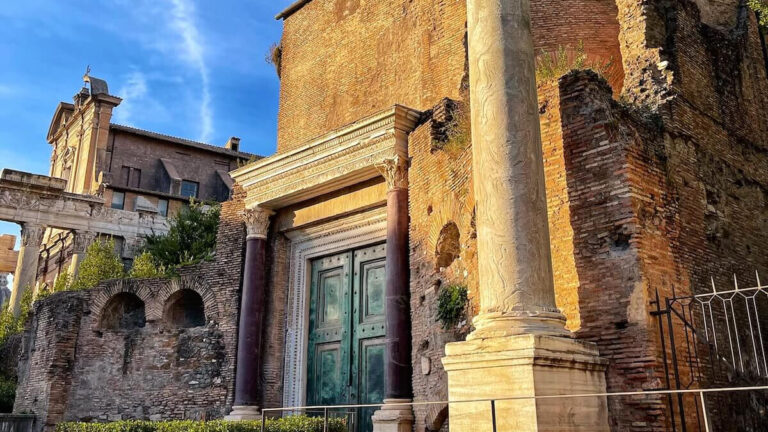
This impressive brick temple was constructed to honour one Valerius Romulus, the young son of the emperor Maxentius who died prematurely in 309 AD. The distraught emperor wasted little time in raising his son to the ranks of the divine, and the facade of the stunning rotunda would originally have featured statues to the newly deified Romulus in the now empty niches that flank the imposing bronze doorway. Take a closer look at these impressive doors, shining green with the passage of time – they are the temple’s original doors, and amazingly still open with the original, massive key.
Ironically, the temple was completed by Maxentius’ mortal enemy Constantine after the latter deposed and killed him, and the building was finally converted into the vestibule of the church of Santi Cosma e Damiano in the 6th century, ensuring its survival into the Christian era. Enter the church today and you can peek down into the Temple of Romulus from above for a great view of its architecture. The temple itself is regularly the host of special exhibitions in the Roman Forum. Currently no exibition is on, but we’ll update this page when the next show is announced.
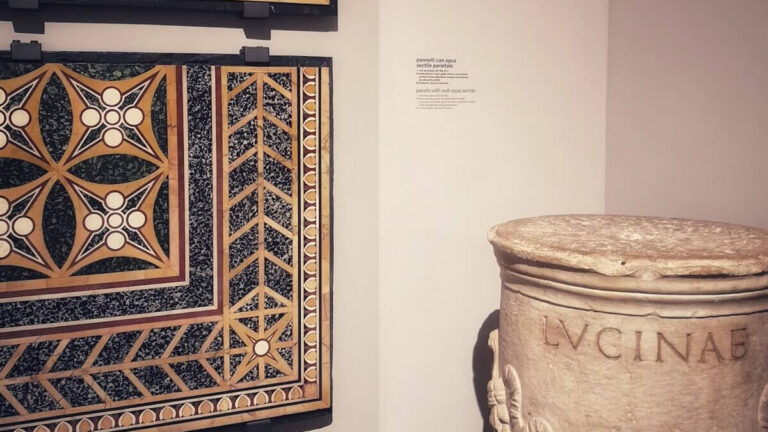
Located in the rooms of a former monastery that was built over the ruins of Domitian’s Imperial palace in the 19th century, the so-called Antiquario Palatino displays the numerous archaeological fragments, sculptures and artefacts that have been unearthed on digs on the Palatine Hill over the last century. The history of the Palatine Hill, from the first settlements of the nascent Rome through to the splendours of the Imperial era, is recounted in displays and multimedia installations. The real highlights, though, are the artworks – in particular the wonderfully vivid frescoes and mosaics recovered from Nero’s Domus Transitoria.
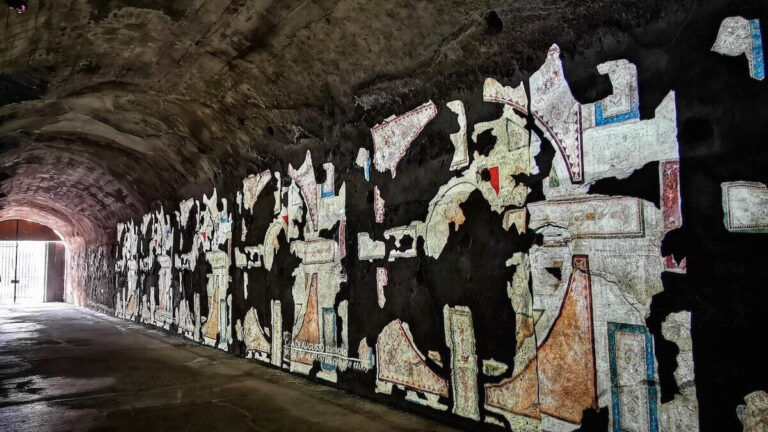
This 130-metre long underground corridor beneath the Palatine Hill conceals a fascinating history. Originally built to connect the southern end of the Domus Tiberiana to the House of Livia sometime in the Neronian age, the cryptoporticus provided a convenient and secluded way for members of the Imperial household to get from one end of the vast palatial complex to the other, as well as a place to cool off on during the stifling days of the Roman summer.
And of course, the hidden passageway was the ideal location for some good old cloak-and-dagger intrigue: it’s thought that this dimly lit corridor (or an adjacent one) was where the mad emperor Caligula met his sticky end, his doomed attempt to flee his assassins terminating in a hail of dagger blows delivered by members of his own Praetorian guard.
The vault of the cryptoporticus was originally covered with white stucco sculpted into floral decorations accompanied by cupids (now replaced with a copy – the original is in the nearby Palatine Museum) , whilst the floors were lined with mosaic. During the Renaissance the cryptoporticus, along with the Domus Tiberiana, was buried beneath the fabulous Horti Farnesiani gardens constructed at the behest of powerful cardinal Alessandro Farnese.

The luxurious Domus Transitoria was built by the emperor Nero around the year 60 AD as a fittingly grand palace that reflected his Imperial-sized ego. The massive complex extended from the Palatine hill all the way to the Esquiline hill, although the main living quarters were on the Palatine, centred around a large peristyle courtyard flanked on three sides by elegant porticoes. Gardens, pavilions, fountains, a large nymphaeum and even a dedicated art gallery all played to the refined aesthetic tastes of the notoriously louche emperor.
Sadly, the Domus Transitoria was largely destroyed in the Great Fire of Rome of 64 AD (rumoured to have been started, or at least fanned by Nero himself). Undaunted, the emperor soon set about rebuilding the already enormous palace on far more extensive and elaborate grounds – the result was the unimaginably Domus Aurea, perhaps the most gargantuan testament to one man’s ego ever constructed. You can visit Nero’s Golden House on a special guided tour here.
Please note that the Domus Transitoria is currently closed to visits.
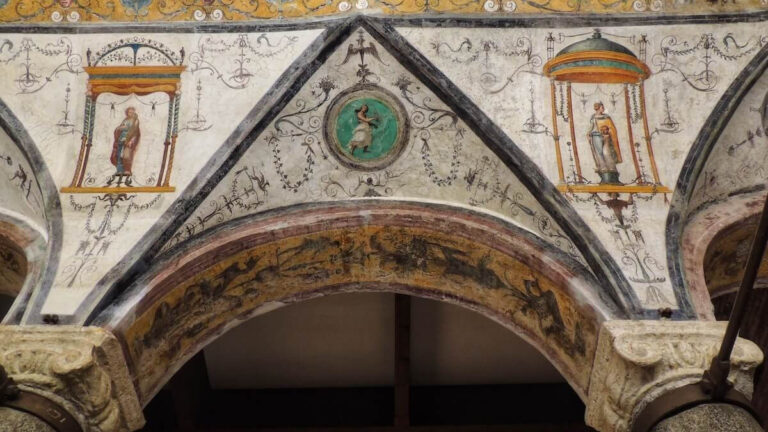
A beautifully frescoed subterranean room that originally formed part of the house of Augustus, the decorations of the Aula Isiaca showcase the craze for all things Egyptian that swept the Roman empire in the first century BC. Frescoes depict exotic North African flora and fauna like lotus flowers and snakes, alongside symbolism associated with the goddess Isis, whose cult flourished in Rome.
Next to the Aula Isiaca is the Mattei Loggia, the remains of a luxurious sixteenth-century villa designed and frescoed by the renowned Renaissance architect and artist Baldassare Peruzzi (also responsible for Alessandro Chigi’s magnificent riverside Villa Farnesina across town). Although much of the finest decorations have been destroyed or dispersed around the world – fine wall frescoes depicting the story of Venus and Adonis now grace the Hermitage in St. Petersburg – the surviving paintings on the vault portraying the Wedding of Hercules and other mythological subjects – vividly evoke the splendours of the Roman cinquecento aristocracy.
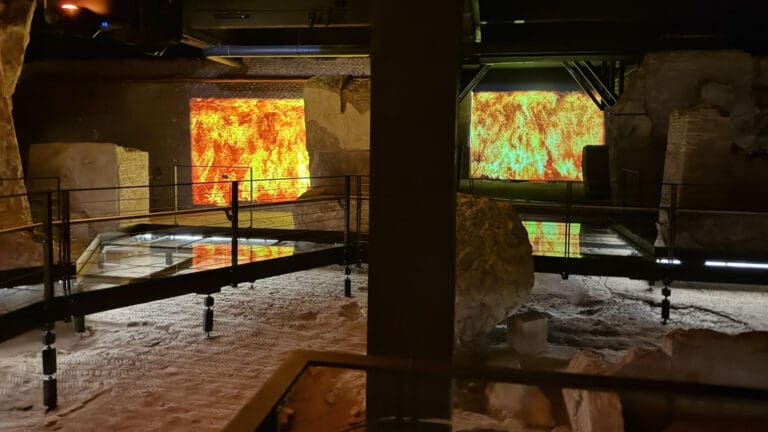
Situated along the northern edge of the Roman Forum, the Horrea Piperataria stand as one of the most tangible reminders of the economic machinery that underpinned the Eternal City. These ancient storehouses – part of a complex of granaries and goods depots – were designed to safeguard Rome’s essential supplies, from grain to spices, olive oil, and other commodities that kept the city fed and functioning.
The Horrea Piperataria offer a vivid glimpse into the sophistication of Roman trade and logistics. Their robust brick-and-concrete construction, with multiple levels and carefully planned internal chambers, reflects the scale and organization required to manage the immense flow of goods that arrived from across the empire.
Archaeological investigations reveal evidence of meticulous record-keeping and standardized storage practices, hinting at the bureaucratic precision that kept Rome’s population supplied and the markets stable. Rome was a city that thrived not only on imperial spectacle but on the quiet, disciplined work of provisioning millions.
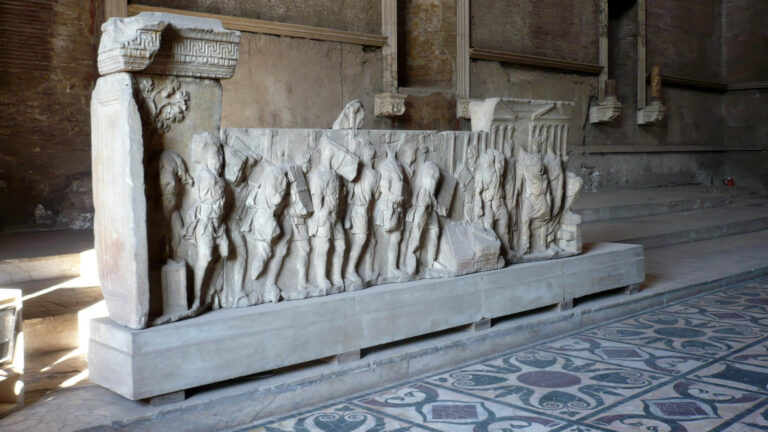
The Senate House of ancient Rome, the construction of the Curia Julia was begun on the orders of Julius Caesar in 44 BC to replace an older fire-damaged edifice and was completed by Octavian after his assassination. In reality ‘curia’ simply meant ‘meeting house,’ and there were a number of these institutions in the ancient city where the Senate might meet. The Curia Julia was, however, by far the most important.
Thanks to its conversion to a church in 630 AD, the Curia is in an impressive state of preservation, and inside, you can still admire the stunning opus sectile floor – a technique where colored stones are combined in complex geometric patterns – installed as part of a restoration by Diocletian in the year 238.

Tickets
The SUPER sites are included on various ticket options for the archaeological parks of Ancient Rome:
- Forum Pass SUPER — €18
This standalone ticket gives you one day’s access to the archaeological areas outside the Colosseum, including the Roman Forum, Palatine Hill, Imperial Fora and all the designated SUPER sites such. It’s valid for one entry to the Forum/Palatine/Imperial Fora circuit and does not include the Colosseum. Reduced price (€2) is available for EU citizens aged 18–25
- Colosseum + SUPER Sites (included in Full Experience tickets) — €24
The Full Experience family of tickets — including the versions with access to the arena floor, underground hypogeum or attic panoramic level — all include SUPER site access in addition to standard entry to the Colosseum, Roman Forum, Palatine Hill & and Imperial Fora. These tickets are valid for two consecutive days and offer the richest way to experience the archaeological park and the amphitheater together. Reduced price (€2) applies for EU citizens aged 18–25.
- Supplement for SUPER Sites (with basic Colosseum ticket) — ~€4
If you already have a standard 24‑hour Colosseum ticket (which includes Forum and Palatine but not the SUPER sites), you can sometimes purchase a SUPER site supplement for around €4 to upgrade that ticket so it also grants access to the special areas within the Forum/Palatine circuit. This needs to be used within 24 hours of your Colosseum visit.
You can also choose to join an expert-led tour that includes the SUPER sites.

Opening Hours
- From 26 October 2025 to 29 March 2026, the SUPER sites are open from 9.30am – 4.30pm, with the exception of the Horrea Piperataria which closes at 3.30pm. Last entrance to the SUPER sites is typically half an hour before closing.
- The House of Augustus is closed on Mondays, and the House of Livia is closed on Tuesdays.
- The Horrea Piperataria is open on Monday, Wednesday, Friday and Sunday.
- The Curia Julia is open from Tuesday to Friday.
- All the SUPER sites remain closed on days of free admission to the Roman Forum.
Book Your Ancient Rome Experience