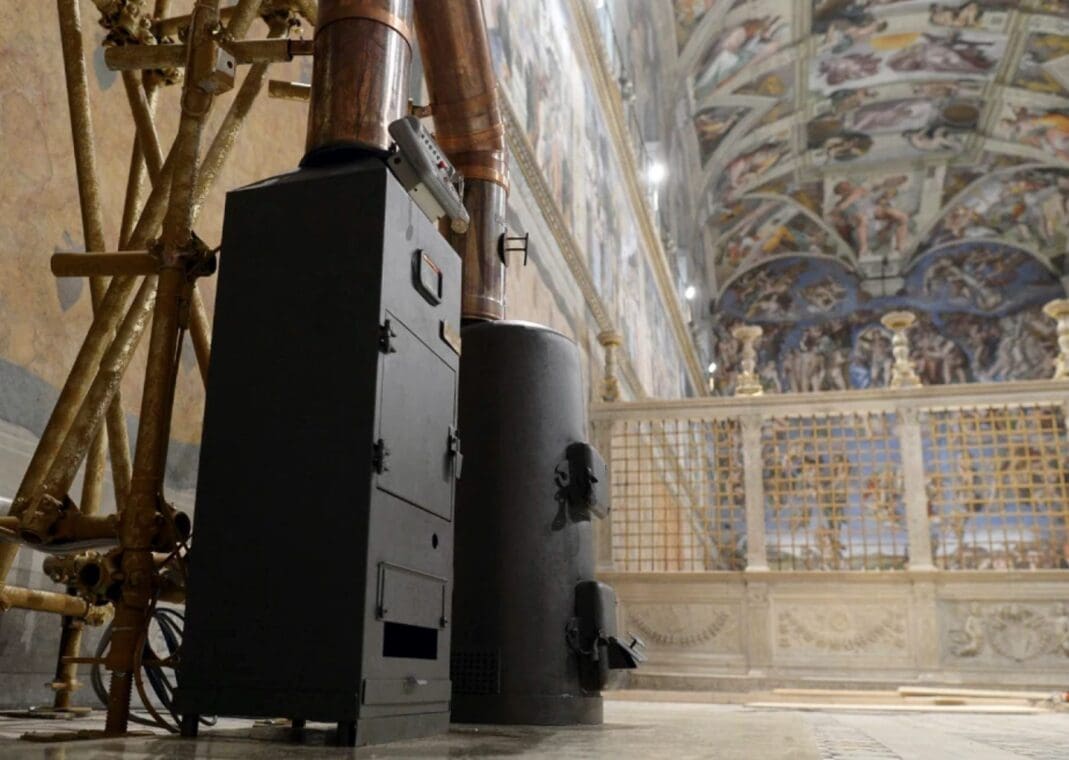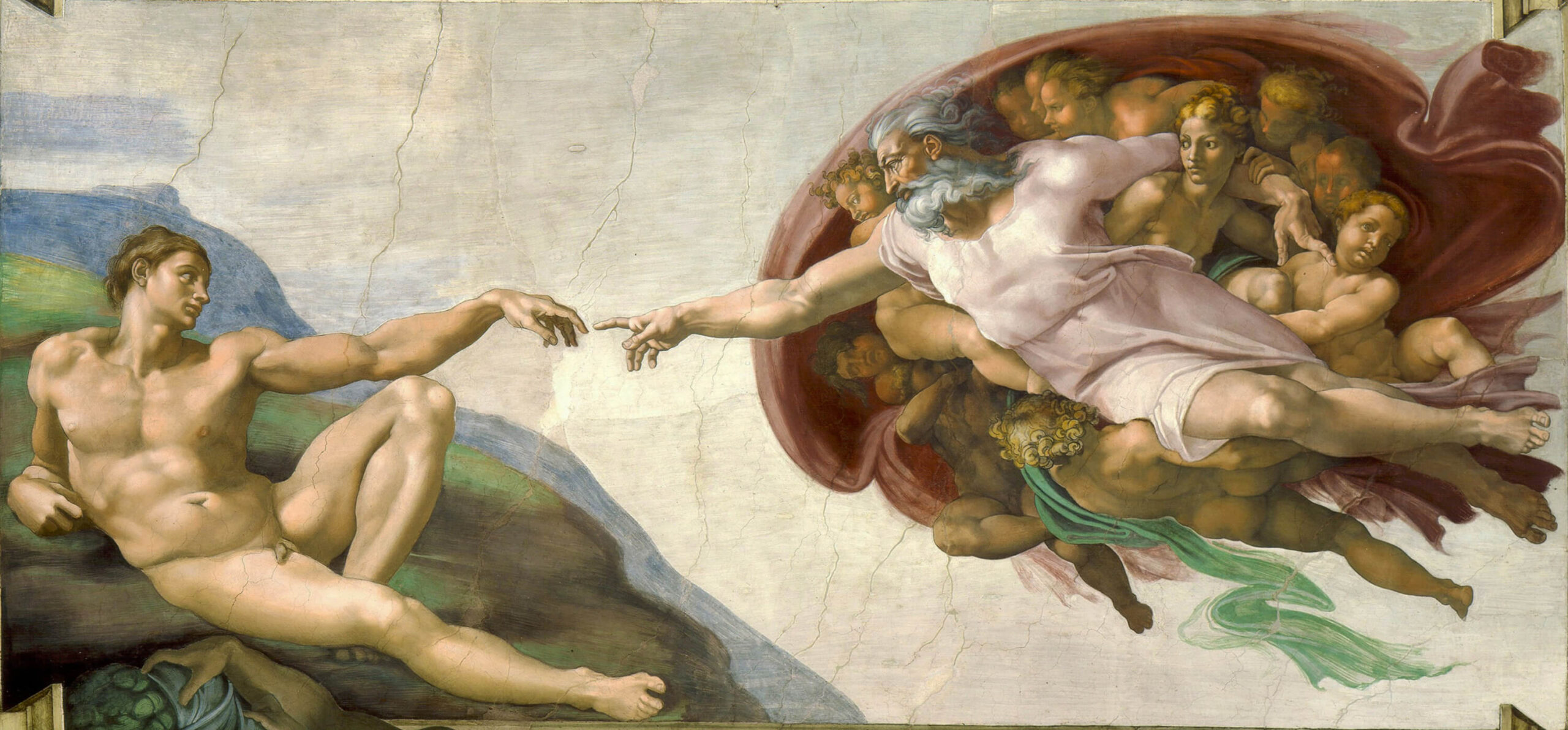
Few works of art are as instantly recognisable – or as mythologized – as the ceiling of the Sistine Chapel.
Painted by Michelangelo over four gruelling years between 1508 and 1512, it stands as a monument not just to the brilliance of the Renaissance, but to the outer limits of human effort and ingenuity. Goethe once said that “without having seen the Sistine Chapel, one can form no appreciable idea of what one man is capable of achieving.” But what exactly was involved in that achievement? And how much of what we think we know about Michelangelo and his ceiling is actually true?
Behind the beauty lies a story of painstaking labour, technical brilliance, and more than a few enduring myths. How did Michelangelo, a sculptor by trade and a reluctant painter, end up transforming the ceiling of the pope’s private chapel into the world’s foremost temple of art?
Read on to uncover with us the processes and techniques that made possible one of the greatest artistic feats in history!
 Want to understand Michelangelo's Sistine Chapel frescoes?

From the Creation of Adam to the Last Judgment, Michelangelo transformed the chapel into one of the greatest achievements of Renaissance art. Our Vatican tours reveal the stories, symbolism, and ambition behind the frescoes.
Our Vatican Tours
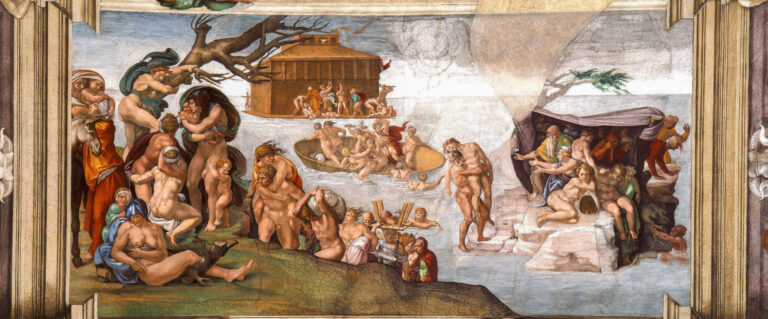
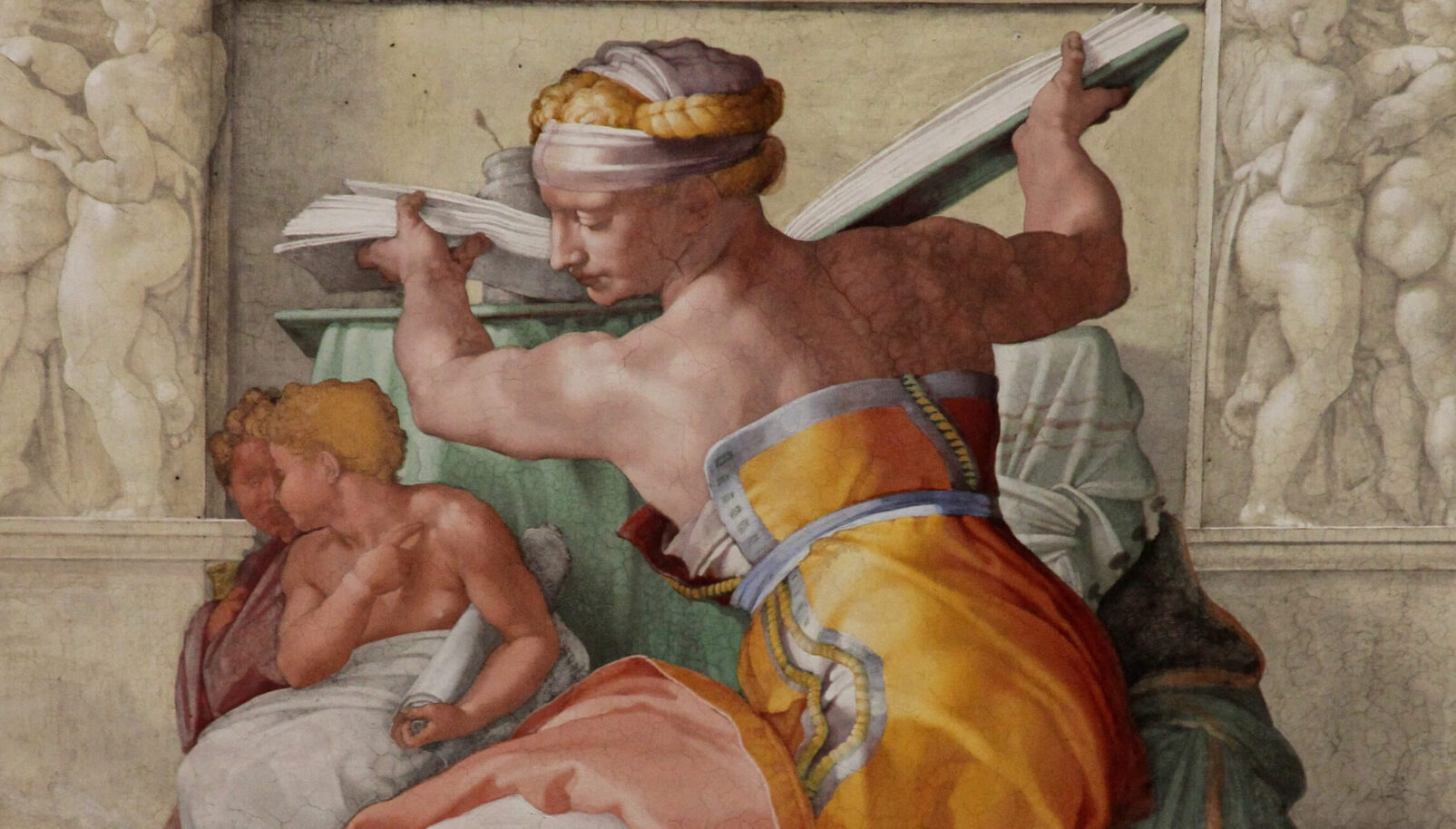
Michelangelo painted the entirety of the Sistine Chapel ceiling in the medium of fresco. One of the most popular methods of painting during the Renaissance, fresco means “fresh” in Italian and involves painting directly onto a layer of freshly laid, still-wet lime-based plaster.
As the plaster dries, a chemical process called carbonation transforms the lime into calcium carbonate, incorporating the pigment into the surface and helping to form an exceptionally durable image. Properly executed fresco is highly resistant to the ravages of time and environment, making it an ideal medium for covering enormous expanses of wall and ceiling with painted decoration.
Although highly effective, painting in fresco was time-consuming and demanding. To make things even more difficult for Michelangelo, the surface of the Sistine Chapel ceiling was already covered in fresco: a lovely depiction of the starry night sky painted by Piermatteo d’Amelia during the first round of Sistine Chapel decorations in the 1480s.
This old decoration had to be removed before the new scheme could begin. Michelangelo and his team therefore had to chip away at Piermatteo’s fresco, sending fragments of plaster and clouds of dust spiralling into the vast space of the chapel before work on the new scheme could get underway.
With the old fresco removed, the ceiling could be prepared for Michelangelo’s decorations. First, a coarse layer of plaster known as the arriccio was applied to provide a base for the painting. Once this layer had dried sufficiently, the artist’s preparatory designs could be transferred to the surface. Then, at the beginning of each working session, a much finer layer of plaster called the intonaco was applied to the section about to be painted. This fresh surface had to be worked while still damp, before it dried and the opportunity to paint into it passed.
The intonaco was smoothed by the plasterer, leaving a suitable surface for the paint. Michelangelo then had to work quickly to cover the fresh plaster with his images: once it dried too far, the pigment could no longer become properly incorporated into the surface. Each section of fresh plaster intended to be painted in a single working session is known as a giornata, from the Italian word for a day’s work. If you look closely at the ceiling, you can still make out the subtle joins between these sections, traces of the daily rhythm of Michelangelo’s work.

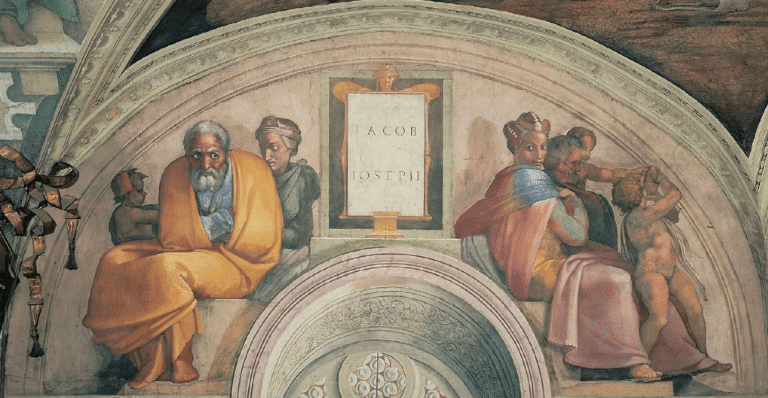
As you can see, painting in fresco was a complex and specialised business, and at this point in his career Michelangelo was not an experienced painter. The great man was by training a sculptor, and only reluctantly took on the task of decorating the Sistine Chapel when left no other option by Pope Julius II, for whom the artist had originally been engaged to sculpt his funerary monument.
Michelangelo’s protestations to the pontiff about his reassignment fell on deaf ears, and so he had to master the subtleties of his new medium as the project progressed. Unsurprisingly, his initial steps were somewhat faltering. The first plaster mix he used was defective, and the frescoes he began painting on it quickly developed mould.
A despairing Michelangelo blamed the local stone used to make the lime for the plaster and demanded once more to be relieved of the commission. But the advice of a local expert sent by the pope to investigate the problem led him to adjust his mixture, and the rest is history.
As he progressed, Michelangelo became quicker and more adept at the technique. The visible lines dividing each giornata – the section of fresh plaster applied for a day’s work – allow us to reconstruct how he organised the painting and how much he completed in each session. The evidence also points to a change in his working methods: as the project advanced, he increasingly used incision to transfer his designs, rather than relying so heavily on the slower process of pricking full-size cartoons and dusting their outlines onto the plaster. In some passages he worked more freely, resolving details directly in paint.
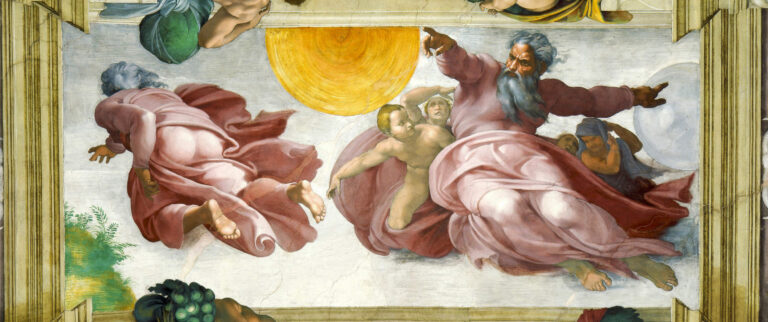
By the final scenes, Michelangelo had become remarkably fluent in the demanding business of fresco painting. The last image, The Separation of Light from Darkness, is traditionally said to have been painted in a single giornata — a day’s work on fresh plaster. Whether or not the entire scene was completed in quite so spectacular a sprint, the broad, energetic brushwork and increasingly economical technique show just how far he had come since those first, mouldering experiments.
Elsewhere we have examined in detail the subject matter and composition of the Sistine Chapel ceiling frescoes, which were worked out in detail in advance. But how did Michelangelo transfer his designs from preparatory sketches onto the actual surface of the wall itself? Traditionally there were two principal methods of transferring drawings made on paper in the studio (known as cartoons) to the surfaces of walls and ceilings to be frescoed.
The first, called pouncing, entailed making a full-size drawing before pricking the outlines of the design with a series of pinholes. The drawing was then set against the surface to be painted, and charcoal dust was forced through the pinpricks, transferring the outlines onto the plaster. The second method, known as incision, involved holding the cartoon against the fresh plaster, or intonaco, and using a sharp stylus to trace the outlines, imprinting them into the surface beneath.
Although pouncing was a time-consuming technique, this was the method Michelangelo relied on extensively during the earlier stages of the Sistine Chapel project. Fascinatingly, however, the surviving evidence reveals a change of approach as work progressed. Michelangelo increasingly turned to incision, which was a quicker way of transferring his designs onto the plaster. In some passages he worked more freely still, resolving forms and details directly in paint, sometimes with only summary preparatory drawing to guide him.
The change is particularly revealing in the later scenes of the Creation, where Michelangelo appears to have gathered speed and become more economical in his working methods. The physical traces left on the ceiling show that he could vary his approach even within a single fresco, combining transferred outlines, preparatory drawing and adjustments made as he painted. His increasing fluency in the demanding art of fresco undoubtedly helped him work faster, but the process was not simply a matter of throwing away his cartoons and trusting entirely to inspiration. Rather, he was refining the way he used them, cutting down on laborious preparation while retaining the ability to plan and control his compositions.
The shift also helped him meet the immense challenge of completing the ceiling. In fresco painting, the plaster had to be painted while still wet, and mistakes could be difficult to correct once it had dried. A quicker, more flexible approach gave Michelangelo greater freedom to work at speed, although this courted greater risks and allowed less room for mistakes to be rectified.
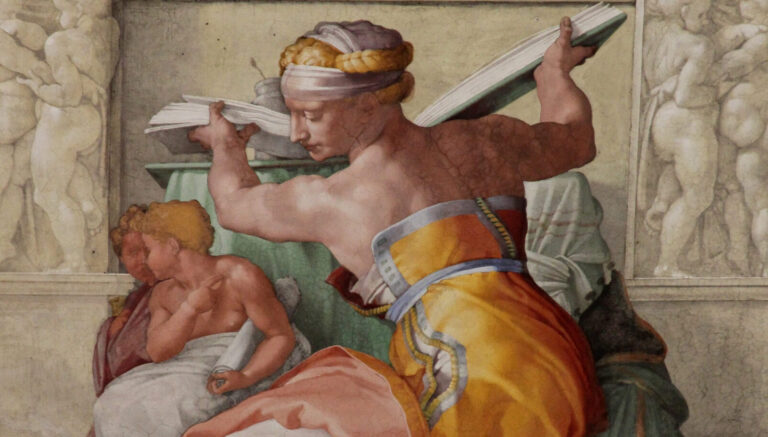
One problem remains for us to uncover: the Sistine Chapel ceiling soars over 60 feet into the air, and it would be no mean feat to physically get up there to do the actual painting. What was more, a conventional fixed scaffold was a non-starter, as it would have obstructed the chapel’s aisles, and masses and ceremonies had to continue to be observed even while Michelangelo’s work was ongoing.
The task of solving this problem initially fell to Donato Bramante, the pope’s architect and one of Michelangelo’s great rivals. According to Giorgio Vasari, Bramante proposed suspending a scaffold from the ceiling itself, with ropes passed through holes drilled into the vault. Michelangelo was appalled: how, he wanted to know, would the holes be dealt with once the painting was finished? Bramante apparently suggested that they could worry about that later. Michelangelo went straight to Pope Julius II to explain why the arrangement wouldn’t do, and was given permission to devise an alternative.
And so Michelangelo came up with an ingenious system of scaffolding projecting from bracketed supports high up in the walls, leaving the floor free. His colleague Piero Rosselli, a master builder engaged for the project, was responsible for the practical work of constructing the scaffold and preparing the ceiling for painting. The surviving records confirm Rosselli’s role, although the precise design of the structure is less certain than Vasari’s dramatic account might suggest.
Don’t listen to anyone who tells you that Michelangelo painted lying on his back, as immortalised in the schlocky Hollywood tale The Agony and the Ecstasy, where a scene-chewing Charlton Heston takes on the role of the thundering artist. In fact, Michelangelo painted from a standing position, stretching his brush high over his head to reach the wet plaster above.
Nonetheless, it must have been incredibly claustrophobic to be wedged in the tiny space between scaffolding and ceiling vault, craning his head upwards for hour after hour as he painted at an extreme angle that could have given him little idea of exactly how the work was progressing. The physical strain was considerable, and Michelangelo himself complained of the discomfort in a poem written during the project.
Michelangelo’s poem vividly describes how his ‘beard was turned to heaven,’ his ‘belly touched his chin,’ his brain was ‘crushed in a casket’ and streams of paint rained down endlessly on his face. The plaintive conclusion remains hard to believe for anyone who has seen what Michelangelo achieved on the Sistine Chapel ceiling: ‘My painting is dead…I am not in the right place – I am not a painter.’
If only we could all paint as poorly as Michelangelo!
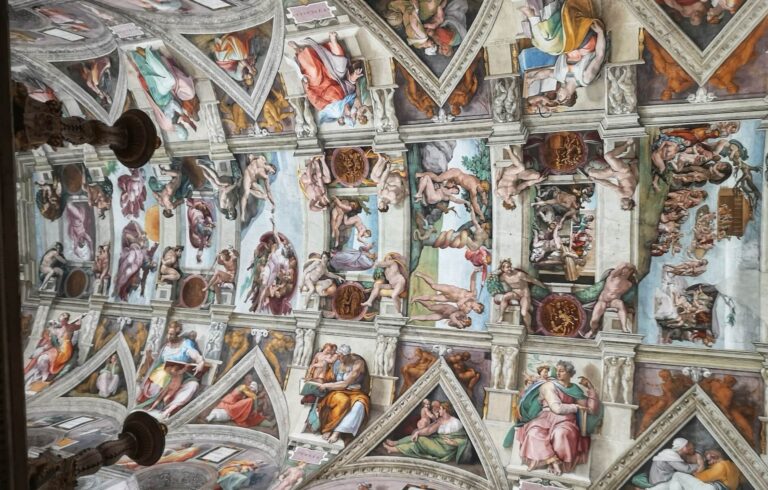
As we have seen, the old tale that Michelangelo painted the entire vault by himself is not quite true. He did have help from assistants, and not just with menial tasks such as mixing plaster, grinding pigments, moving scaffolding and aligning cartoons.
Knowing he would need help with a project of such staggering scale, he turned to his old friend Francesco Granacci to recruit a team of painters from Florence, many with connections to the workshop of Domenico Ghirlandaio, where Michelangelo himself had trained.
Among those summoned were Giuliano Bugiardini, Agnolo da Donnino and Jacopo del Tedesco, alongside Granacci and other Florentine painters. They brought practical experience to a commission that demanded an enormous amount of work, from preparing the surfaces to executing the intricate painted decoration. They were, however, relatively poorly paid for their efforts, and their precise contributions to the finished ceiling remain difficult to establish.
Michelangelo was a notoriously exacting employer, and the arrangement did not run smoothly. According to Giorgio Vasari, he put his assistants’ work to the test, only to find it far below the standard he wanted. In frustration, he eventually dismissed them and shut himself away on the scaffolding to continue alone.
The reality was probably less straightforward than Vasari’s dramatic account suggests. William Wallace has demonstrated that Michelangelo’s assistants were involved in the prjoect for extended periods, and the surviving decoration offers clues to the collaborative work behind the finished ceiling – the architectural detailing, ornamental motifs like oak leaves and various putti show clear signs of multiple hands, for example.
But even if the legendary story of nobody handing Michelangelo so much as a proverbial nail during his titanic task isn’t literally true, there is more than a kernel of truth to it. Unlike many of his contemporaries, Michelangelo never relied on a workshop of collaborators to carry out much of the actual painting, and he was notoriously unwilling to delegate.
For the great majority of the labour, Michelangelo ploughed a lonely furrow, driven by an extraordinary commitment to leaving a permanent stamp on the history of art.
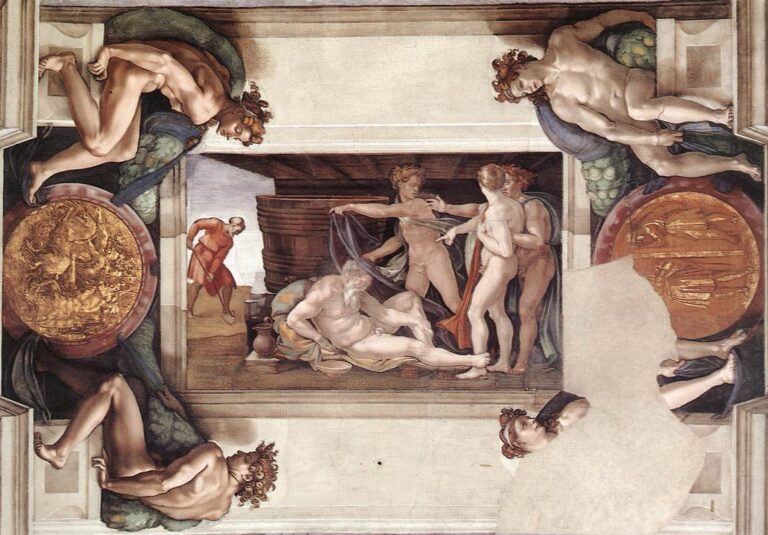
The story of how Michelangelo created the Sistine Chapel ceiling is filled with technical challenges, artistic ambition, and enduring myths. Here are quick bitesize answers to some of the most common questions about this extraordinary work.
How long did it take Michelangelo to paint the Sistine Chapel?
Michelangelo worked on the ceiling of the Sistine Chapel between 1508 and 1512, completing the immense fresco cycle in roughly four years under the patronage of Pope Julius II.
Did Michelangelo paint the Sistine Chapel lying down?
No. Despite the popular myth, Michelangelo painted the ceiling standing on specially designed scaffolding, reaching upward to apply pigment to wet plaster.
What is depicted on the Sistine Chapel ceiling?
The ceiling presents a vast biblical narrative centered on scenes from the Book of Genesis, including the famous The Creation of Adam, surrounded by prophets, sibyls, and monumental architectural framing.
What technique did Michelangelo use?
Michelangelo painted the ceiling using buon fresco, applying pigments to wet plaster so the colors chemically bond with the wall surface.
How big is the Sistine Chapel ceiling?
The painted surface covers roughly 500 square meters (over 5,000 square feet) and contains more than 300 figures, making it one of the most ambitious fresco cycles ever created.
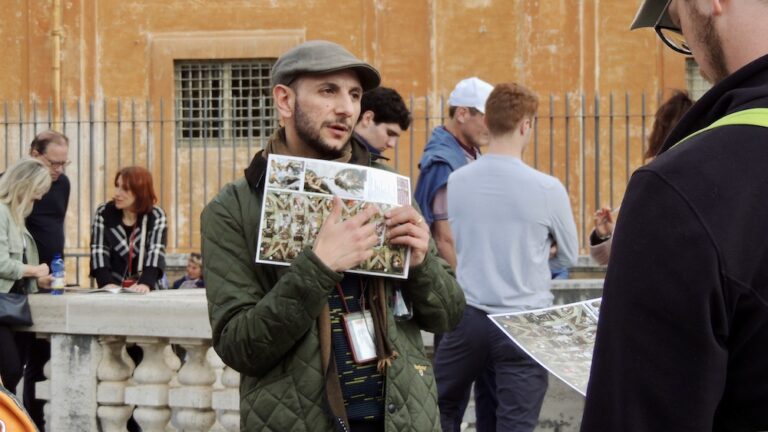

Tickets
The Sistine Chapel is part of the Vatican Museums, so you’ll need to purchase a ticket to the museums to visit the chapel. Tickets to the Museums cost €20 (plus booking fee of €5). Book your ticket in advance online from the official Vatican museums website to allow you to skip the lines, or join of Through Eternity’s expert-led Vatican Museum Tours.

Opening Hours
The Vatican Museums are open Monday to Saturday from 8am to 8pm with final entry at 6pm. The Museums are closed on Sundays, with the exception of the last Sunday each month when the Vatican offers free entry from beteen 9am and 12.30pm (the museums close their doors at 2pm on these days.)
Ready to visit the Sistine Chapel?
Book Your Tour Here!