"I not only bribed the Trevi, as everyone does, I also—and I invented this myself—dipped my hand into the Bocca della Verità at Santa Maria Cosmedin and vowed to return."
- Sigmund Freud
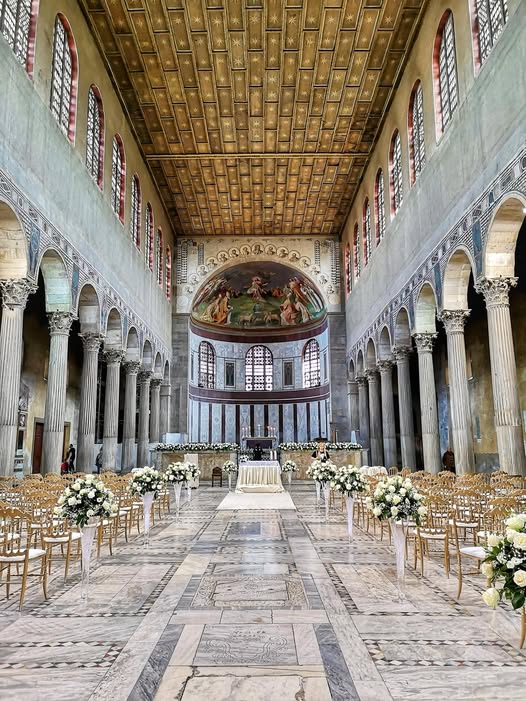
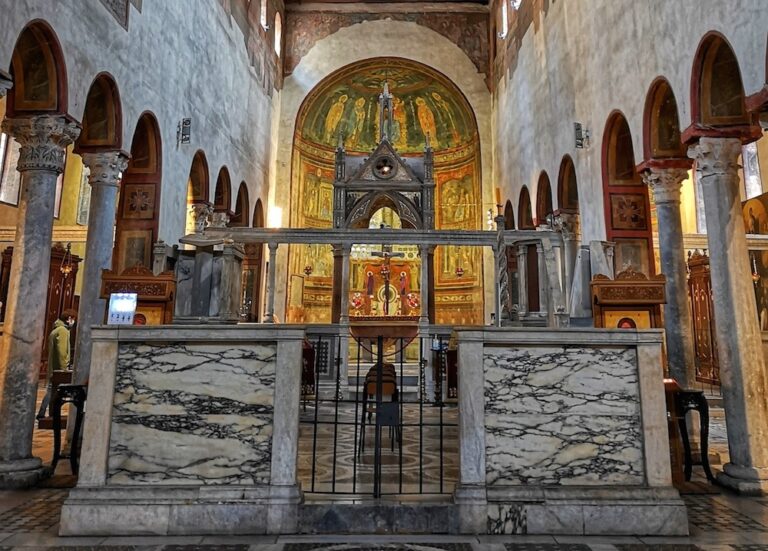
Walking along the banks of the Tiber in central Rome on a stormy autumn evening, I decided to take a quick detour to one of my favourite places in the city. You might not have heard of the slightly ramshackle church of Santa Maria in Cosmedin, with its magnificent Cosmatesque floor, medieval schola cantorum and 13th-century baldacchino altar.
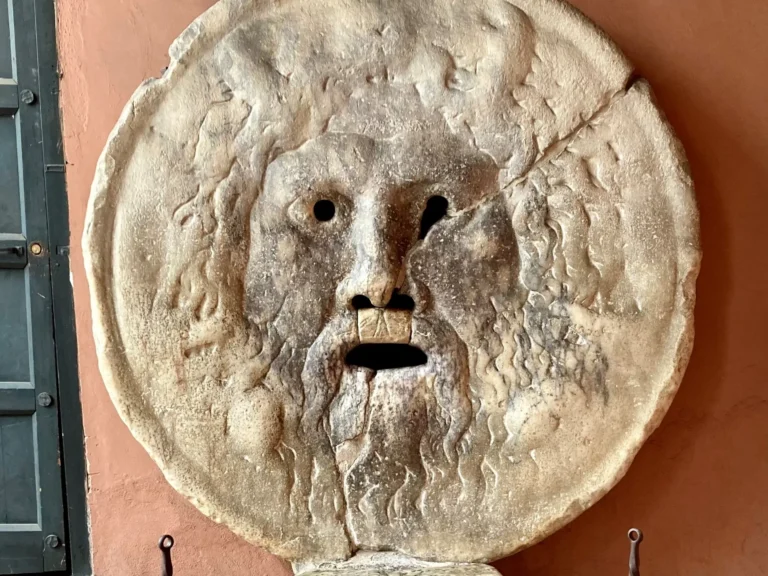
But you’ve almost certainly been to its entrance portico — it’s here that the iconic and mysterious Bocca della Verità, or Mouth of Truth, glowers at the endless streams of visitors who come to risk everything by sticking their hands into the ancient bearded mouth.
According to legend, the priceless pavonazzetto marble face punishes liars by biting off the offender’s limb, and so was drafted in as an arbiter when deals were struck in the medieval city, or when a mistrustful husband’s doubts about his wife’s fidelity needed settling.
Rich with legendary accretions and historical symbolism, the Bocca della Verità conceals a tangled skein of fact and fiction behind its weather-beaten features. Read on for our complete guide to everything you need to know.
Rome Tours
Explore a Hidden Side of the Eternal City
The Face Was Probably Originally a Drain Cover
Given the exalted position the Bocca della Verità holds in the Roman cultural imagination, it may come as something of a surprise that its origins are rather humble.
The exact original function of the massive marble disc is still open to question, but given its shape, size and the wear patterns in the stone, the most plausible hypothesis holds that this huge decorated face was originally a ceremonial drain cover — most likely for the nearby Cloaca Maxima, ancient Rome’s vast main sewer, whose still-extant channel flows into the Tiber just a short distance from Santa Maria in Cosmedin.
Elaborately carved marble drain covers taking the form of faces were not unknown in antiquity. In the 16th century a mask very similar to the Bocca was set into the floor of the Palazzo della Cancelleria, sparking a brief fashion among Rome’s grander households for displaying recovered ancient drain covers as objects of prestige.
The face likely represents the sea-god Oceanus, identifiable by what appear to be the god’s distinctive crab-claw “horns” above his ears. As the mythological source of all water on earth, Oceanus was a fitting guardian for the city’s water infrastructure.
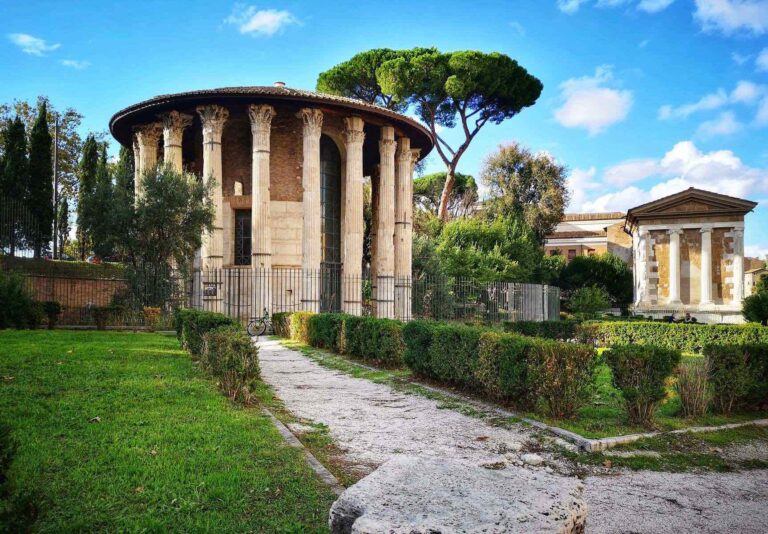
This is just one hypothesis, however. Other scholars argue that the symbolic weight of the face suggests it originally belonged to a cult building rather than a sewer — perhaps the nearby circular Temple of Hercules Victor, just visible from the church entrance, or the ancient Ara Maxima, the altar of Hercules that once occupied the very site on which Santa Maria in Cosmedin later stood.
In antiquity this was a place where oaths were taken, contracts sealed and vows made before the gods — a function that resonates with the mask’s later legendary role as a detector of liars. We simply cannot say which hypothesis is correct.
What we can say is that the disc is an extremely fine piece of Roman sculpture, carved in pavonazzetto (Phrygian marble), measuring about 1.75 metres in diameter and weighing approximately 1,300 kilograms — significantly heavier than it looks.

The Bocca della Verità Was Only Moved to its Current Location in the 1630s
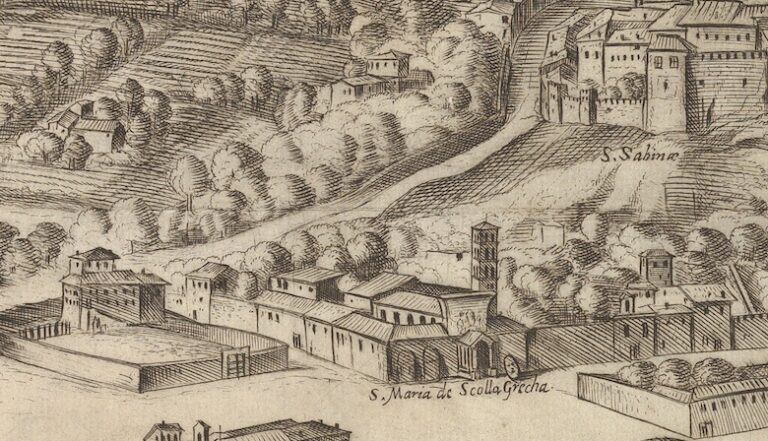
Despite the many learned and plausible hypotheses about its ancient origins, we know absolutely nothing certain about the Bocca’s history before 1450, when it first appears in the historical record leaning against the side of the church.
In Antonio Tempesta’s meticulous 1590s map of Rome, the huge face is clearly visible propped against the facade — a familiar landmark rather than a new arrival.
It seems likely that the mask had lain somewhere in the immediate vicinity for centuries before this; 12th-century decorations within the church depict masks strikingly similar to the Bocca, suggesting it was a known feature of the site long before the written record picks it up.
At some point in the early 17th century the marble was mounted against the church facade, and in 1631 it was finally given its current position set into the covered narthex (entrance porch) of Santa Maria in Cosmedin, where it has glowered at visitors ever since.
The Bocca della Verità Has Been an Arbiter of Truth for Over 500 Years
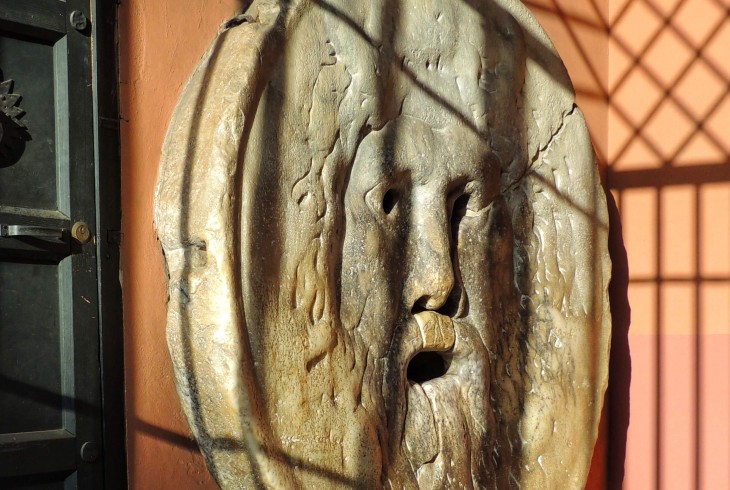
Whatever its murky ancient history, by the 15th century the mask had taken on a new symbolic life in the cultural imagination of the city.
Perhaps lending credence to the theory that the Bocca originated at a site where oaths were made, 15th-century sources record that the weighty marble face was believed to have the magical power to detect liars — particularly adulterous wives — by biting off the perjuror’s hand thrust into its mouth, in a bizarre echo of medieval trial-by-ordeal.
Whether the usually cynical Romans genuinely believed this is debatable; as lovers of a good story, many probably relished the legend without taking it literally.
By the late 18th century the Bocca was arbitrating on all manner of disputes beyond marital fidelity, and its role as a lapidary lie-detector had been firmly established in popular imagination. Even Sigmund Freud, not generally a man given to superstition, felt compelled to try it.
No Hands Have Ever Been Recorded Lost in the Gaping Mouth
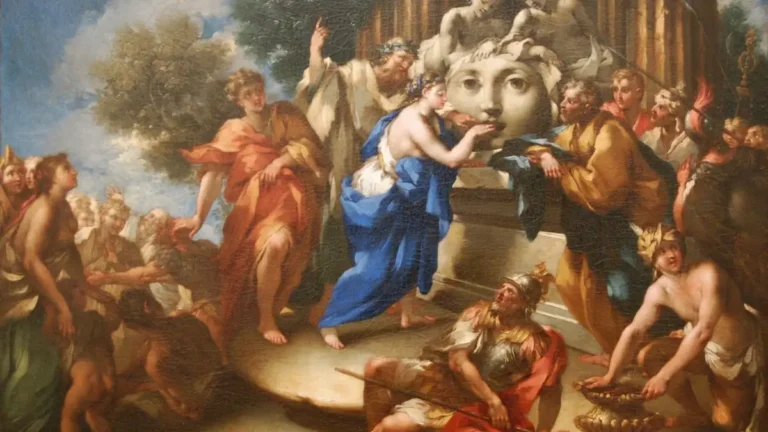
According to some of the more fanciful legends to have come down to us about the mouth, the Bocca della Verità really did have the ability to snap off the hands of malefactors – albeit via nefarious human means.
The theory goes that if the presumed oath-breaker was already known to be guilty, confederates of the accuser or associated agents of justice would be secretly lying in wait behind the mask with hot brands, irons or knives at the ready.
When the liar thrust their hand into the mouth, the concealed characters would set about the task of invisibly injuring the offending limb with gusto, proving to those watching on the dangerous power of the dread mask to deal judgement on deceivers.
Most accounts ascribe this practice to antiquity; given that the mask only took on its role as the scourge of deceivers after it was already leaning against the wall of the church in the 1450s the tale is clearly nonsense.
Nonetheless it was frequently peddled to visitors to Rome on the Grand Tour by local guides in the 18th century, who never let the truth stand in the way of a good story.
There Were Ways to Get Around the Mouth’s Dread Judgement
Despite the seeming omniscience of the truth-dealing Mouth, popular legends recount that there were ways to confound its judgement.
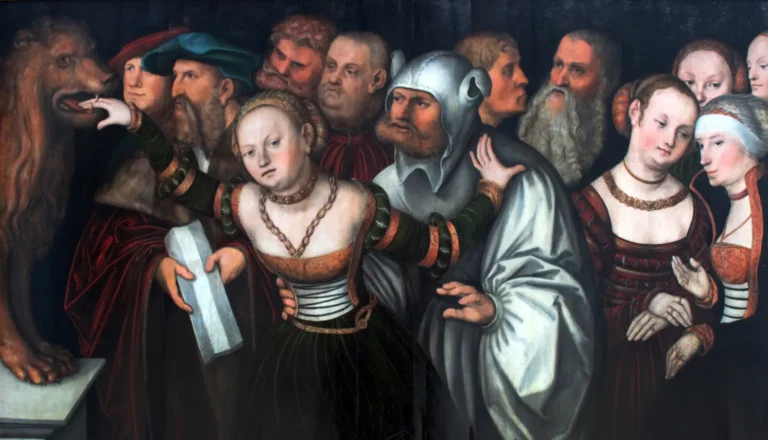
One of the most well-loved tales concerning the Bocca della Verità is a Renaissance tale recounting the story of a young Roman bride who took a lover in the frequent absences of her husband.
Lacking the requisite discreetness to carry out the affair effectively, the woman soon aroused the suspicions of her prurient neighbours who wasted little time in bringing their concerns to her cuckolded spouse.
Despite her protestations of innocence, the husband demanded a public examination of her fidelity via the means of the Mouth, and so it seemed her fate was sealed.
But the wife and her lover quickly hatched an audacious plan to get her off the hook. As she was being brought towards the site of her examination, her young paramour approached her in the street disguised as a madman, embraced her whilst spouting gibberish and carried on his seemingly-insane way.
When the wife arrived at the Mouth, she swore that the only men who had ever touched her were her husband and that madman everyone had just observed accosting her. Thrusting her hand into the Mouth’s gaping maw, she remained unharmed, her honour secured.
The legend is depicted in a remarkable painting by the German Renaissance master Lucas Cranach, now housed in the Germanisches Nationalmuseum in Nueremburg.
Visitors Have Always Treated the Mask with Scepticism
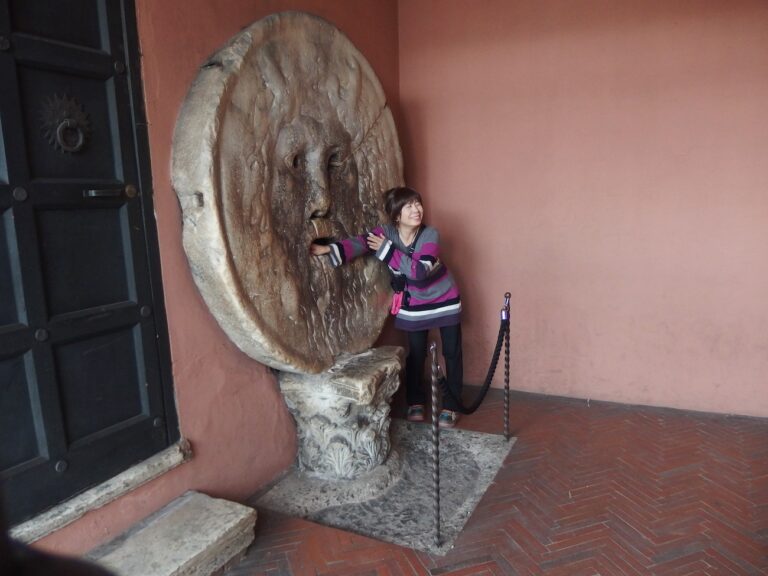
Although the legend of the Bocca della Verità is a venerable one, the elevation of the Mouth to one of Rome’s most-revered tourist attractions is a relatively modern phenomenon.
The Grand Tourists of centuries past often noted and dismissed the face in their journals, chalking the legend down as just one more example of Roman Catholic gullibility.
In his Voyage of Italy from 1670, Richard Lassels captured the skepticism of many of his peers when he wrote that ‘I rather believe it served in some old building for a gutter spout: I know Truth may speak loud, had have a Wide Mouth, but he that takes every wide mouth for the mouth of Truth is much mistaken.’
In an age of populists, misinformation campaigns, AI slop and rampant fake news, perhaps we would do well to pay credence to Lassels’ caution.
These days a new generation of cynics attribute the popularity of the site with tourists from across the world to the fact that tour busses can stop right outside (a rarity in Rome), but the real reason for its popularity is due to the lure of the silver screen…
The Bocca della Verità is One of the Eternal City’s Biggest Movie Stars
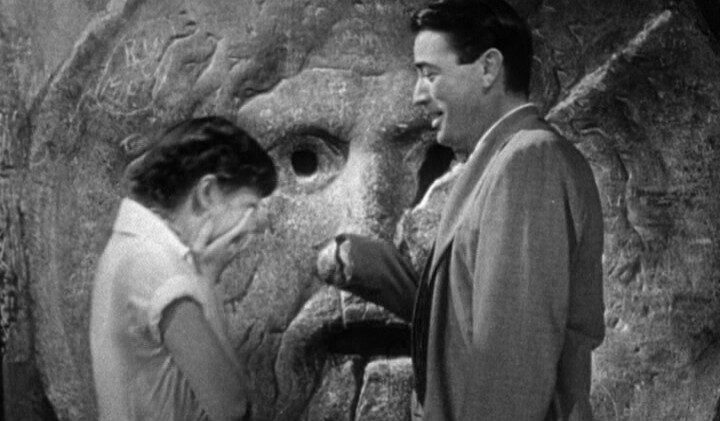
Right up there alongside Anita Ekberg’s nocturnal plunge into the Trevi Fountain in Fellini’s La Dolce Vita, it is one of the most iconic moments in the cinema of Rome: midway through William Wyler’s Roman Holiday (1953), Gregory Peck’s hard-boiled American reporter Joe takes princess-on-the-run Audrey Hepburn on a whistle-stop tour of the Eternal City on his Vespa.
Stopping off at Santa Maria in Cosmedin, Joe recounts the legend of the Mouth, whereupon a nervous Hepburn gingerly inserts her hand. Nothing happens.
When it is Peck’s turn, he inserts his hand and immediately begins roaring in apparent agony, pulling out what appears to be a stump — before quickly revealing that his hand was simply tucked into his sleeve.
According to a pleasing piece of cinematic legend, the ruse was entirely improvised and genuinely frightened Hepburn — hence her entirely authentic look of shock and relief.
The scene was not in the original script. Peck improvised it on the day, and Wyler kept it in because Hepburn’s reaction was too real to discard.
And Finally, Make Sure You Visit the Church Too!
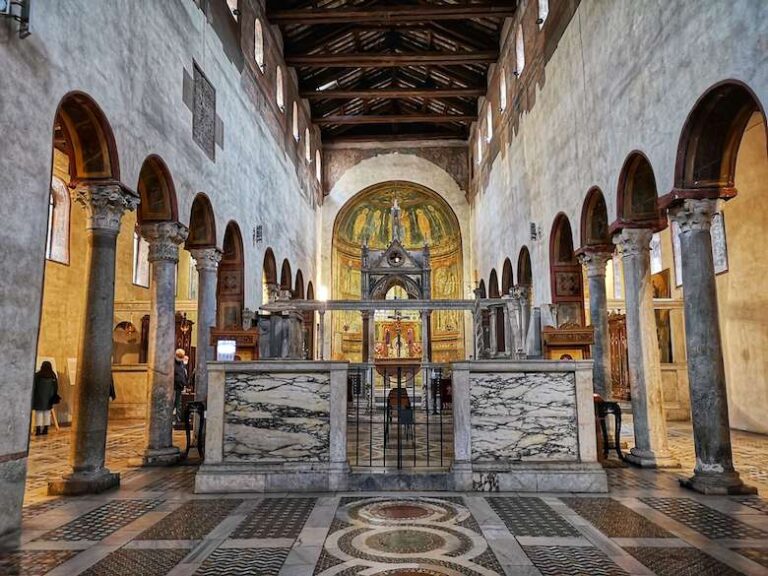
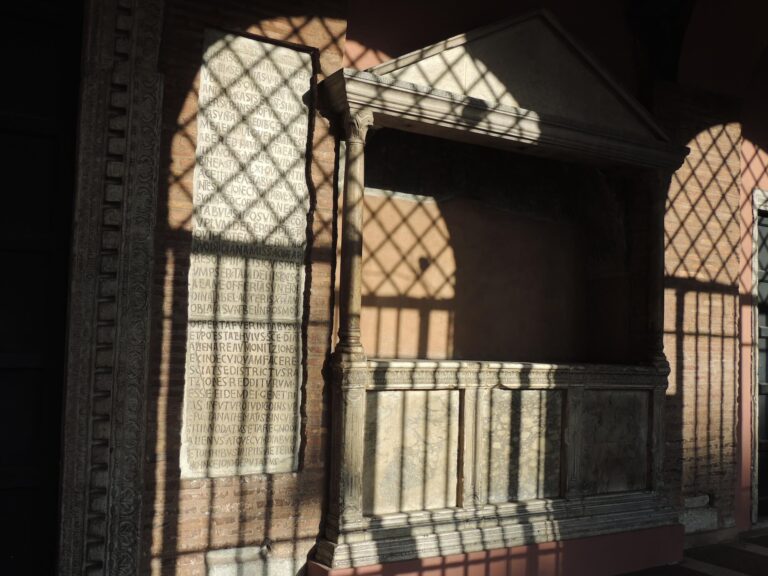
The vast majority of visitors that line up in the narthex of Santa Maria in Cosmedin to have their photo taken with their hand thrust into Oceanus’ mouth barely give the church itself a second thought, and certainly don’t bother stepping inside. Don’t make their mistake! Santa Maria in Cosmedin is one of the finest examples of medieval ecclesiastical architecture in Rome, and a church that deserves to be far better known.
The brick campanile, rising in elegant tiers studded with decorative discs of purple and green marble, is one of the most beautiful medieval bell towers in the entire city.
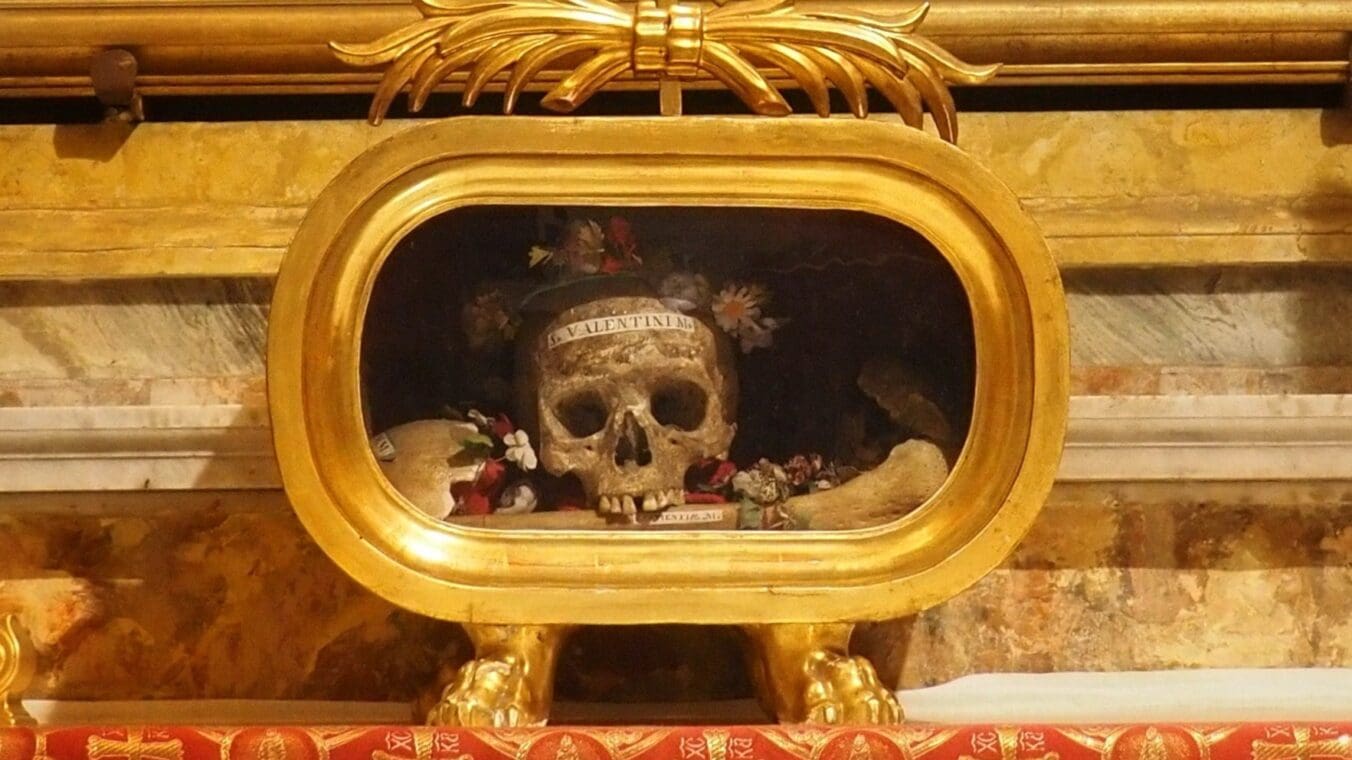
The interior is remarkable: repurposed and mismatched ancient Roman columns divide the nave and side aisles in the manner typical of early Christian churches. An altar in the left hand aisle of the church conserves the reputed skull of Saint Valentine, one of the city’s most interesting relics.
The floor is a masterpiece of Cosmatesque craftsmanship — that characteristically Roman medieval style of geometric patterning in polychrome marble — and the raised schola cantorum at the centre of the nave, a liturgical enclosure reserved for the choir, is one of the very few surviving examples of this once-universal feature of medieval church architecture.
Don’t miss the Gothic baldacchino over the altar, the medieval frescoes, or the extraordinary 8th-century crypt below, carved directly into the surviving remains of the ancient Ara Maxima — the altar of Hercules — beneath the church floor.
And while you are in the narthex, don’t rush past the impressive monument to Cardinal Alphanus on the left-hand wall, one of the finest medieval tomb sculptures in Rome.
The extremely tall brick campanile is one of the most beautiful in all of Rome, studded with decorative disks of purple and green marble. Don’t miss the impressive monument to the 12th century papal chamberlain Cardinal Alphanus in the narthex.
How to Visit the Bocca della Verità
Address: Piazza della Bocca della Verità 18, Rome (at the church of Santa Maria in Cosmedin)
Opening Hours: The church is generally open daily from 9:30 AM to 6:00 PM (10:00 AM to 5:00 PM in winter). Hours may vary for religious services — as an active church, closures can occur without warning.
Entry: Visiting the Bocca della Verità and taking a photo with the mouth requires a small voluntary donation (typically €1–2). Visiting the church and crypt is free.
Queues: There is almost always a queue to have your photograph taken with the Bocca. To minimise waiting time, visit early in the morning (by 10:00 AM) or later in the afternoon. Midday tends to be the busiest period.
Getting There: The Bocca is in the Circus Maximus area on the left bank of the Tiber, close to the Aventine Hill. The nearest metro station is Circo Massimo on Line B, about 5–10 minutes’ walk. The Circus Maximus itself is visible from the piazza. By bus, lines 44, 81, 160, 170, 716 and 781 all stop nearby.
The Neighbourhood: This is one of the less-visited parts of central Rome, and well worth lingering in. Just a few steps away is the Arch of Janus, the Temple of Hercules Victor (one of the best-preserved circular temples from antiquity), the Temple of Portunus, and the picturesque medieval bridge of the Ponte Rotto. The ancient forum of the cattle market — the Forum Boarium — where the Bocca originally stood in some capacity, surrounded all of these monuments.
Bocca della Verità FAQ
What is the Bocca della Verità?
The Bocca della Verità (Mouth of Truth) is an ancient Roman marble mask, approximately 1.75 metres in diameter, now mounted in the entrance porch of the medieval church of Santa Maria in Cosmedin in Rome. According to legend, it bites off the hand of anyone who tells a lie while placing their hand in its mouth.
How old is the Bocca della Verità?
The disc is believed to date from around the 1st century BC to the 1st century AD. Its precise origins are uncertain, though it most likely served as a decorated drain cover or manhole cover in antiquity.
Is the Bocca della Verità free to visit?
Access to the Bocca requires a small voluntary donation (typically €1–2).
Why is the Bocca della Verità in a church?
The mask was moved to its current position in the narthex of Santa Maria in Cosmedin in 1631. Its earlier history is largely unknown, though it appears to have been leaning against the church facade since at least the 15th century.
Is there a queue for the Bocca della Verità?
Almost always, particularly in the late morning and afternoon. Arrive early in the morning to minimise waiting time.
What god does the Bocca della Verità represent?
Most scholars believe the face represents the sea-god Oceanus, identifiable by the crab-claw appendages above his brow. Other proposals include Faunus (the god of the forests), a river deity, or simply an anonymous decorative face.
Dive Deeper into Rome