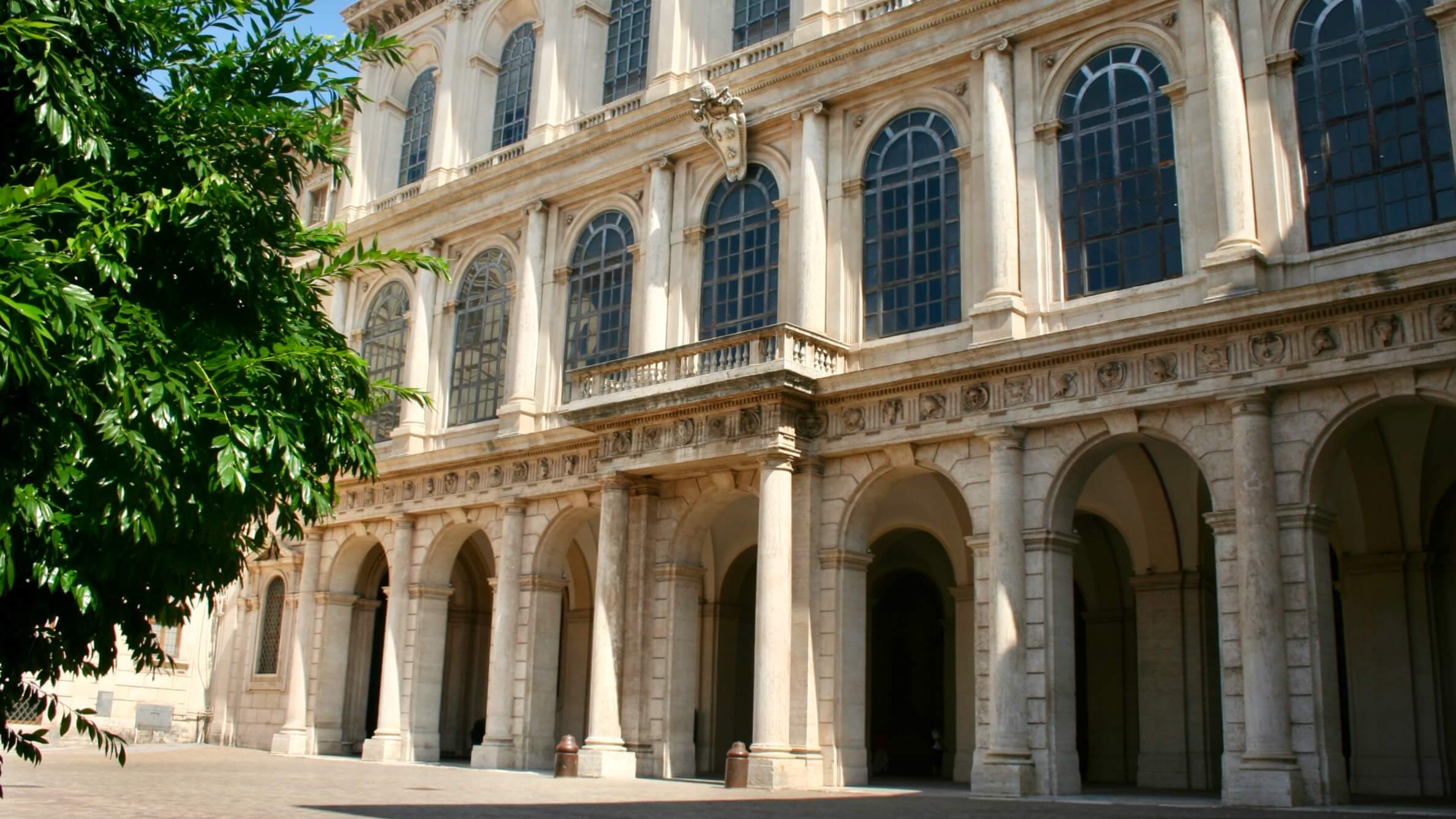
Amongst Rome’s glittering pantheon of Baroque palaces, Palazzo Barberini might just be the most spectacular. Built by the powerful Barberini clan when the family reached the height of its fame in the early seventeenth century, this sprawling residence was designed to set the standard for luxurious domestic architecture in Rome for centuries to come.
When Maffeo Barberini was elected Pope as Urban VIII in 1623, the newly elevated pontiff lost little time turning his family’s good fortune into an artistic statement of breathtaking ambition. He commissioned renowned architect Carlo Maderno to design a residence fit for his dynasty, bringing in Gian Lorenzo Bernini and Francesco Borromini to help realise the sprawling project after Maderno’s death.
The result was a palace that manages to be both a family home and a monument to papal power, its grand staircase, theatrical architecture and spectacular frescoes providing an appropriately extravagant setting for the Barberini’s collection of art.
Today, the palace houses the Galleria Nazionale d’Arte Antica, one of Rome’s most important art galleries, with masterpieces spanning the Renaissance and Baroque periods. There is plenty here to keep even the most demanding art lover occupied, from Caravaggio’s startlingly naturalistic canvases to Raphael’s intimate portrait of a supposed lover and a portrait of Henry VIII that has travelled further than its subject ever did.
Here are ten highlights to look out for on your visit.
Rome Tours
Explore Baroque Rome!
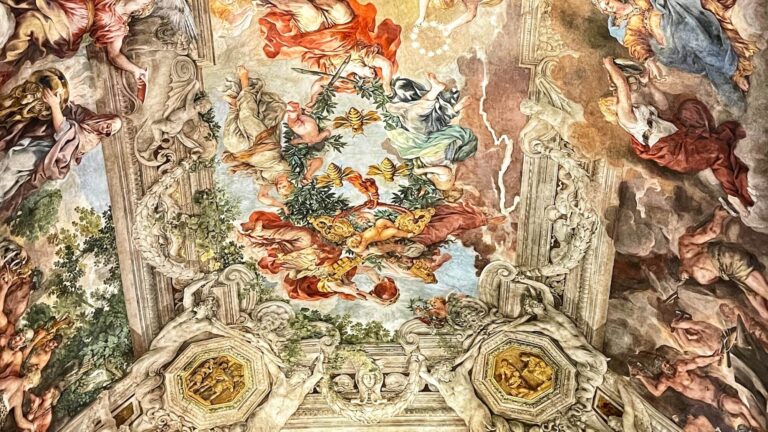
The Barberini family receives the ultimate endorsement: a spectacular heavenly vision confirming that their rise to power was divinely ordained.
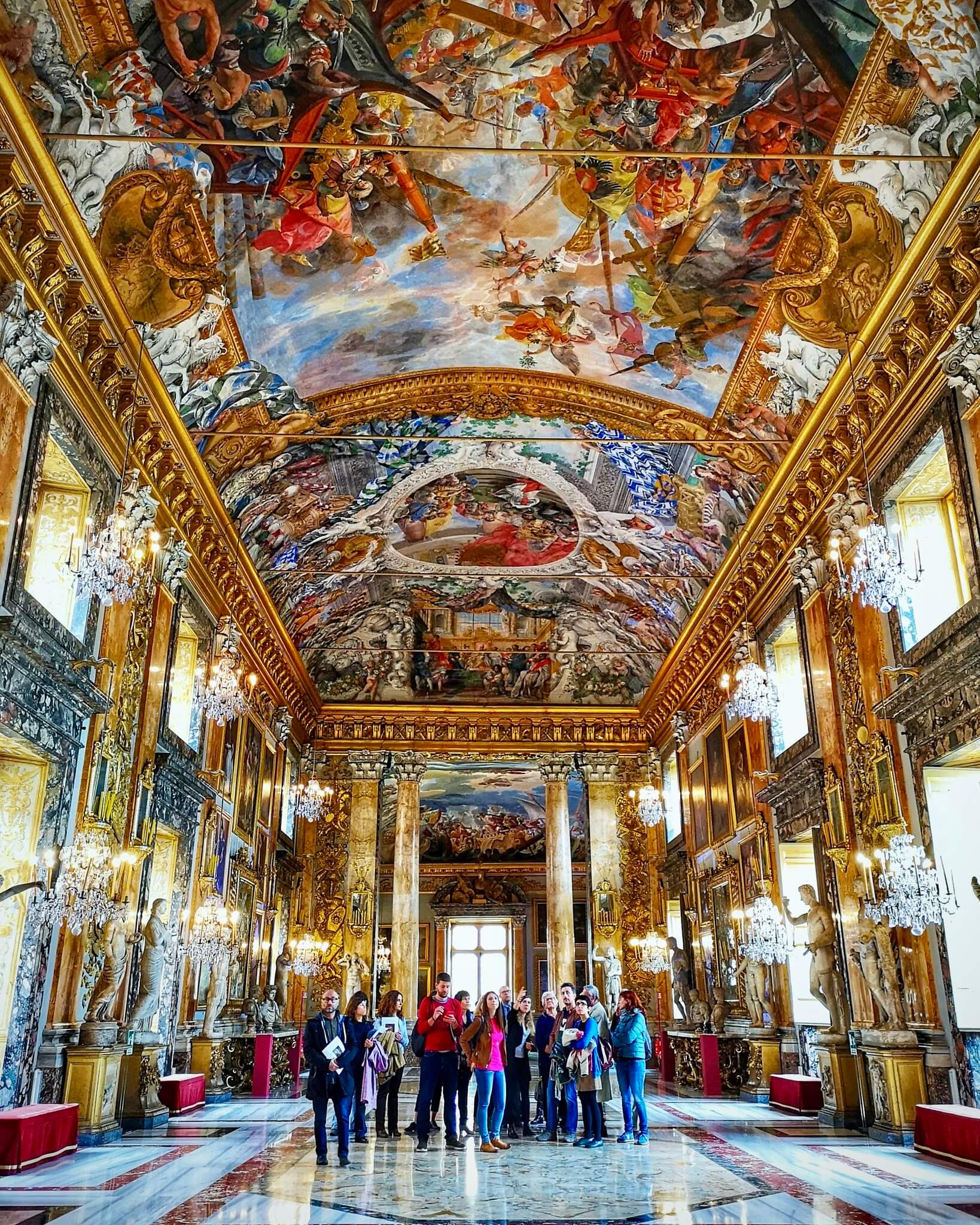
The show-stopping highlight of the Barberini collection is one painting that has been here since the beginning. As Palazzo Barberini was reaching completion in the 1630s, Urban VIII called on Tuscan artist Pietro da Cortona to immortalise the fame of the commissioning family in the palace’s yawning great hall.
The result is one of the absolute masterpieces of Baroque painting, dematerialising the Salon’s ceiling in a logic-defying act of illusionism. In place of the architectural surface above our heads, we see open sky extending towards the heavens, where a multitude of figures gather around the personification of Divine Providence. The Barberini’s emblematic bees are borne aloft, accompanied by the family’s heraldic devices and a celestial crown of glory.
This type of complex illusionism was a favourite trick of Baroque artists, and Cortona’s ceiling is amongst the most spectacular examples of the technique known as quadratura. Architecture appears to dissolve into painted space, with figures and clouds spilling across the fictive framework in a dazzling display of artistic bravura.
There is, however, a rather more earthly purpose to all this heavenly activity. Divine Providence presides over the proceedings with an approving eye, making clear that the Barberini’s exalted status was no mere accident. Their rise to power, we are invited to understand, was sanctioned by God himself.
It was a particularly convenient conclusion for Urban VIII, whose family had gone from mid-level Florentine nobility to the very summit of Roman society in a remarkably short space of time. The ceiling is an extraordinary work of art, but it is also a piece of dynastic public relations on a truly epic scale. The Barberini were evidently not inclined to do things by halves.

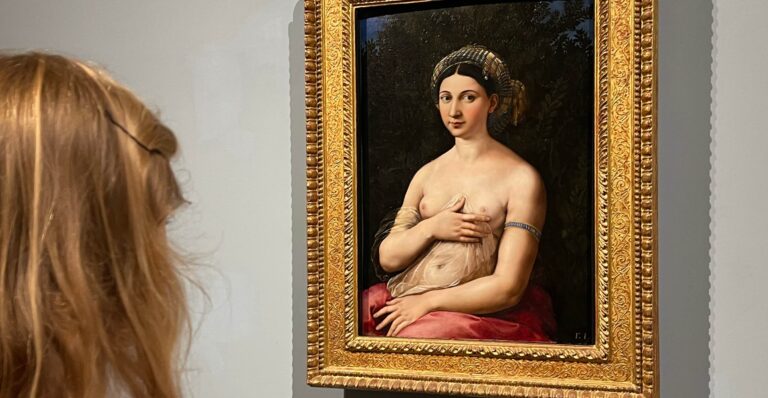
An intimate, enigmatic portrait brings us tantalisingly close to Raphael’s private life.
Few paintings in the Barberini collection feel quite as personal as Raphael’s La Fornarina. A young woman meets our gaze with an unnervingly direct expression, her bare torso framed by a dark background and a translucent veil. She wears a turban, a jewelled armband inscribed with Raphael’s name, and a little string of pearls threaded through her hair. The effect is intimate, even provocative: this is not the polished courtly beauty we might expect from a Renaissance portrait.
The traditional story identifies her as Raphael’s lover Margherita Luti, the daughter of a baker – hence La Fornarina, “the baker’s daughter.” The identification is old, but far from certain. Raphael’s biographer Giorgio Vasari claimed that the artist was passionately attached to a woman who distracted him from his work, and later generations eagerly connected her with the mysterious beauty in this painting. Whether she really was Raphael’s lover is impossible to prove with certainty, but the identification is certainly persuasive.
What is impossible to dispute is the painting’s sensuality. Raphael has deliberately drawn attention to the woman’s body, while the jeweled armband boldly places his own name on her skin. That detail has prompted endless speculation about possession, intimacy and the relationship between artist and model, including rumours of a secret marriage.
The painting was probably made around 1518–19, late in Raphael’s career, and its confident sensuality is striking when set beside the idealized Madonnas and formal portraits for which he is better known.
Look closely at the woman’s face and the slightly enigmatic smile: whatever her relationship with Raphael, she refuses to behave like a conventional Renaissance portrait sitter. She looks back at us as though she knows exactly what we are thinking.
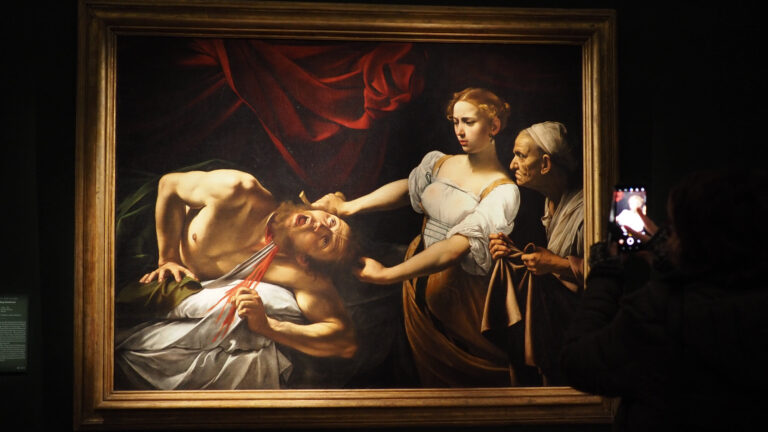
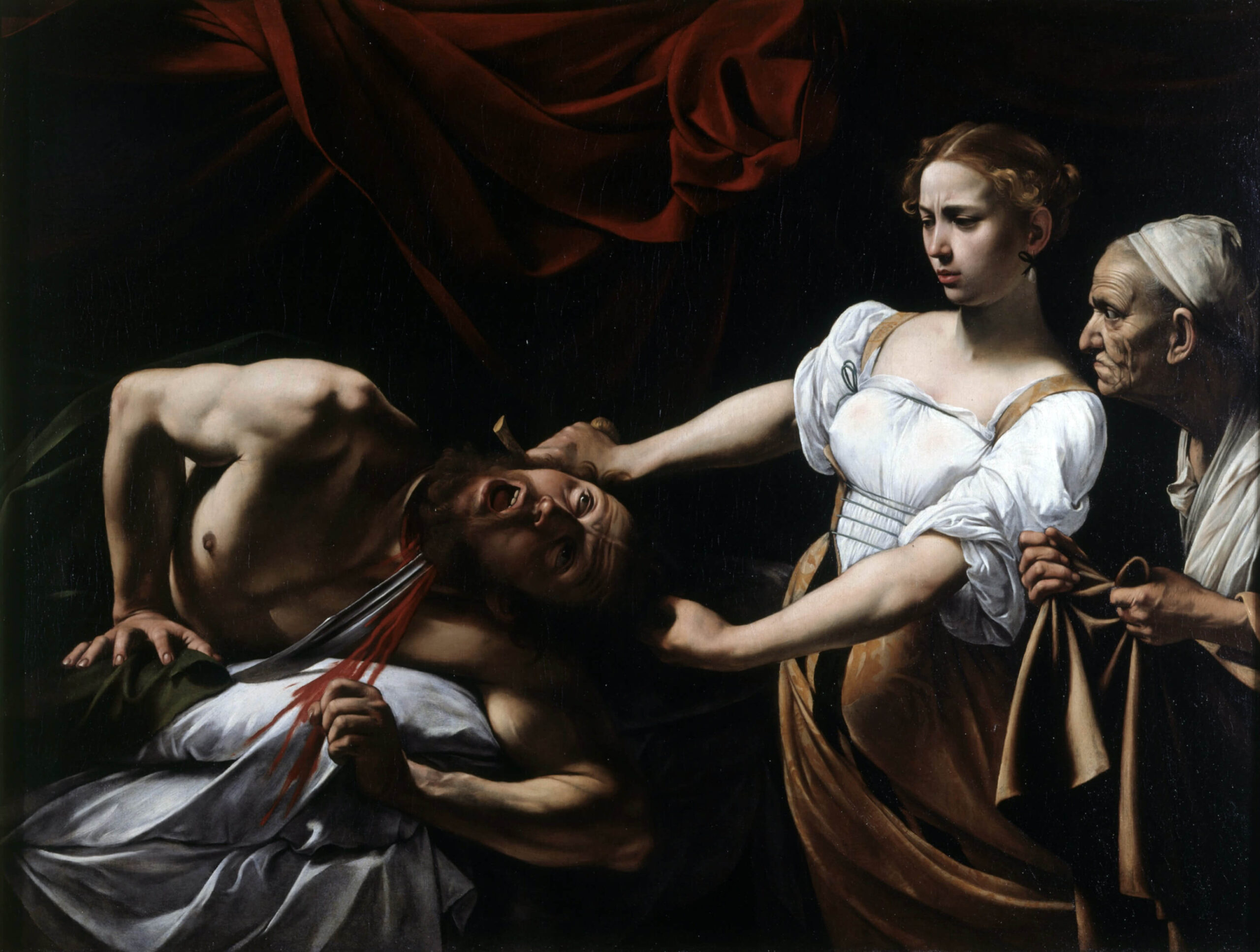
Caravaggio turns one of the Bible’s bloodiest episodes into a gripping cocktail of sex and violence.
This is one femme fatale you don’t want to mess with. The subject matter is one of the Bible’s juiciest tales: Judith, a beautiful young widow, seduces the brutal Assyrian general Holofernes, whose army is intent on razing her native city of Bethulia to the ground.
The lustful thug fatally drops his guard because of his desire for Judith, who wastes no time getting him drunk before decapitating him with the aid of her faithful maidservant. Popular with artists for its innately dramatic potential, the tale proved the perfect subject for Caravaggio, the greatest interpreter of violence and human conflict of his generation.
Caravaggio’s painting is an audacious combination of the ancient and the modern. Caravaggio’s painting is an audacious combination of the ancient and the modern: sexy Judith seems more 16th-century prostitute than religious paragon, and her wrinkled companion is more procuress than maid. Holofernes, meanwhile, is caught in the appalling instant when he realises what is happening, his mouth open in a final scream as blood sprays across the white sheets.
Sex and violence mingle in a potent cocktail which unsurprisingly divided Caravaggio’s contemporaries, with traditionalists finding his painting’s conflation of sacred past and seedy present an indecorous and unforgivable provocation. Caravaggio was courting controversy, but the cocksure Lombard cared little for the opinions of his peers, safe in the conviction that he had found a winning formula – the often brutal world of the Bible had found its most uncompromising and original interpreter.
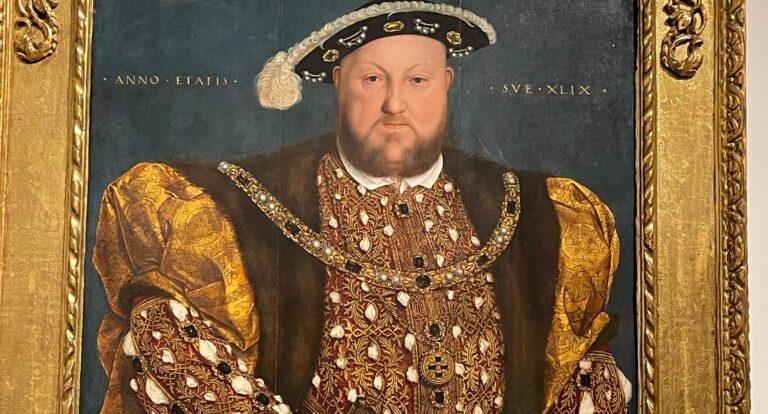
The most recognisable face in Tudor history makes an appearance in Rome, radiating the formidable authority of a king who answered to nobody.
It might surprise you that one of the most iconic depictions of England’s most notorious monarch isn’t to be found in the halls of Buckingham Palace or London’s National Gallery, but instead in the gilded surrounds of Rome’s Palazzo Barberini.
The German artist Hans Holbein the Younger became painter to Henry VIII’s Tudor court in 1536, and produced the famous image of the ruler for the privy chamber at the Palace of Whitehall. The original work was destroyed in a fire in 1698, but its composition survives through copies and related versions, including this stunning later painting in Rome.
Heavy of jowl and severe in expression, Holbein’s Henry projects the kind of no-nonsense authority you’d expect from a man who defied the Pope and had little compunction in dispatching enemies – and wives – to their maker. Robed in the luxurious finery appropriate to Henry’s station, Holbein’s magnificent portrayal perfectly demonstrates the autocratic power and grandeur that came as part and parcel of any Renaissance king.
The portrait was painted when the sovereign was 49 years old to mark the occasion of his marriage to Anne of Cleves, Henry’s fourth wife (of six). Anne didn’t last much longer than her predecessors, and the marriage was annulled a mere six months later – although thankfully she escaped with her head.
The original Whitehall image was itself part of a larger dynastic composition, showing Henry alongside his father, Henry VII, and their wives. Its purpose was to present the Tudor succession as a secure and legitimate line, with the formidable younger Henry embodying the strength of the dynasty.
Holbein’s extraordinary ability to render fabrics, jewellery and facial features with almost forensic precision makes the portrait a vivid window into the world of the sixteenth-century Reformation court.
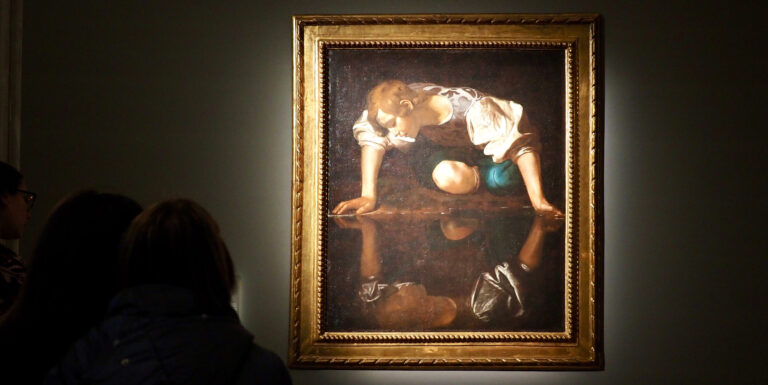
Beware the man in the mirror: Caravaggio captures the fatal moment when admiration turns into obsession.
The classical myth of the unfortunate Narcissus is one of literature’s great cautionary tales. As the beautiful young hunter wanders through the woods, he catches sight of his own reflection in a pool of water. Immediately overcome by the startling beauty of the watery figure before him, Narcissus falls head over heels in love with the ephemeral reflection.
Vainly awaiting for his love to be reciprocated, Narcissus descends into a fatal stupor of self-absorption, and is destined never to leave the poolside again – he ends his days transformed into a flower by the water’s edge.
Caravaggio’s virtuoso interpretation of the myth takes the form of a perfect mirror image, and captures Narcissus peering desperately into the inky waters of the pool, his hands resting on the bank as his lips part in a sigh of unrequited love. The composition is so tightly focused that the surrounding world seems to disappear, leaving us alone with the hunter and his impossible love affair.
The painting turns on the naked knee of the handsome young man, one of the most beautiful figures in Caravaggio’s oeuvre, and the strange intimacy of the encounter. The reflection is at once his double and his unattainable beloved, an image that draws him ever closer whilst keeping him forever at a distance.
It is tempting to read the painting as a warning about vanity, but Caravaggio gives the story a more unsettling psychological dimension. Narcissus is not simply admiring himself; he is trapped by the act of looking, unable to distinguish the image he desires from the person he is. For an artist so fascinated by the relationship between appearance and reality, it was a subject made to measure.
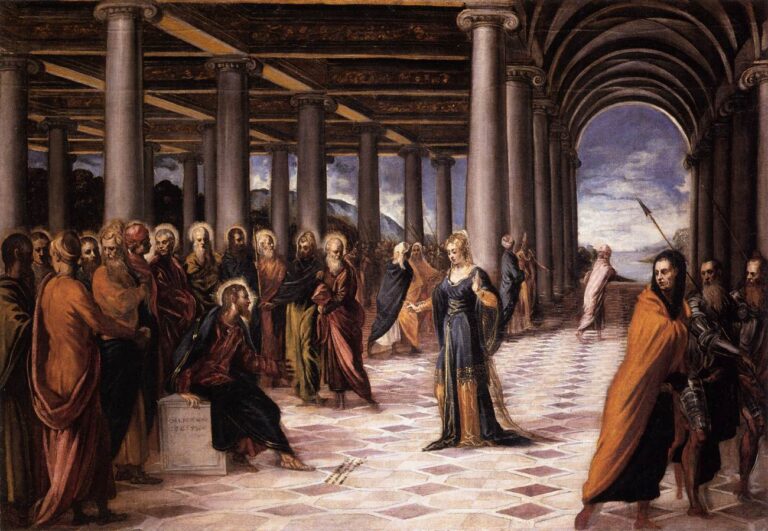
“Let him who is without sin cast the first stone” becomes a dazzling Venetian drama of hypocrisy, mercy and theatrical perspective.
It’s one of the Bible’s catchiest proverbs, and owes its fame to the moment when Christ silences the Pharisees clamouring for the condemnation of an adulterous woman by pointing out their own hypocrisy in casting judgement on matters of sin and punishment.
In Tintoretto’s dramatic imagining of the subject from around 1550, Christ and the woman take centre stage, surrounded by the bustling architecture of a densely columned portico. The apostles gather around their Messiah, whilst the visibly deflated Pharisees appear to lose their confidence as Jesus delivers his unanswerable rebuke.
Tintoretto was renowned for his virtuoso use of light and vertiginous spatial logic, and the Barberini canvas is no exception. The dramatically receding architecture is a striking testament to the artist’s mastery of perspective, drawing our eyes deep into the scene and giving the biblical encounter the atmosphere of a contemporary Venetian street.
The contrast between Christ’s composure and the restless crowd is particularly effective. The woman stands exposed to public judgement, yet the men who have brought her forward are themselves placed under scrutiny. The moral authority of the scene shifts quietly away from the accusers and towards the figure who refuses to condemn her.
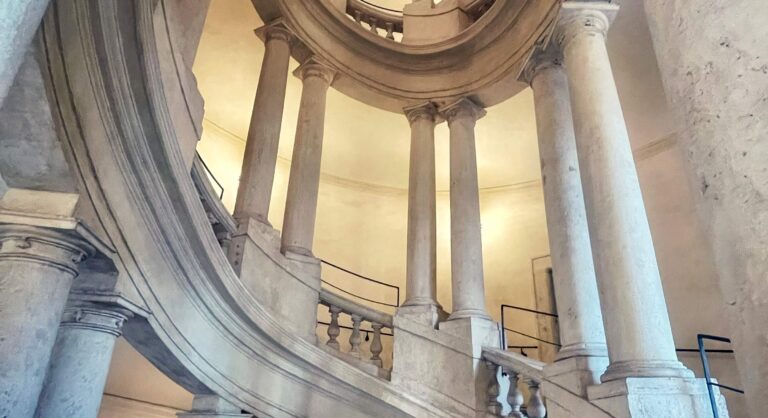
An extraordinary oval staircase turns the business of getting upstairs into a feat of Baroque architectural invention.
Given Palazzo Barberini’s spectacular architecture, it would be remiss of us to limit our highlights list to the art of the painter’s brush. One of the most striking architectural features of the palace is the beautiful spiral staircase that serves the southern wing, linking to Cardinal Francesco Barberini’s private suite of rooms.
The oval-shaped staircase spirals upwards in sinuous curves, its Doric columns decorated with the family’s bees, whilst natural light pours in through the oculus above. The effect is both elegant and slightly disorientating, as the architecture seems to wind around itself in a continuous movement towards the upper floors.
As one of the most ambitious and inventive architects of the Baroque era, Borromini left his mark on every corner of the Eternal City, and the staircase at Palazzo Barberini is one of the most revealing examples of his ability to make geometry feel alive.
Borromini’s architectural language was often characterised by complex curves, carefully controlled proportions and an interest in the possibilities of space that could make even a relatively confined interior feel extraordinary. Here, the staircase is also a practical expression of the palace’s social hierarchy, providing access to the cardinal’s private apartments.

Bernini answers Borromini’s sinuous invention with a grand architectural gesture worthy of the Barberini family’s new status.
If Borromini’s staircase is an exercise in elegant movement, Bernini’s is a declaration of power. This monumental square staircase occupies the palace’s northern wing, rising through a sequence of broad flights framed by paired columns and imposing architectural forms.
Bernini had succeeded Carlo Maderno as the principal architect overseeing the palace in 1629, and his contribution to the Barberini project extended well beyond this staircase. He was Urban VIII’s favoured artist, a relationship that would help shape the appearance of Rome for decades. The palace was one of the great stages on which their partnership played out.
The contrast with Borromini is irresistible. Bernini’s staircase is ordered, expansive and ceremonial, designed to impress anyone ascending towards the family’s apartments. Borromini’s, by comparison, is more intricate and exploratory, its oval geometry encouraging the eye to follow the architecture around and upwards.
We should resist the temptation to read the two staircases as a simple contest between two sworn enemies: both men worked within the same ambitious building project, and their professional relationship was more complicated than the familiar story of artistic rivalry suggests. Yet standing between the two staircases, it is difficult not to appreciate the different approaches adopted by the two virtuosi.
The Barberini wanted a palace that announced their arrival among Rome’s ruling elite, and Bernini and Borromini gave them two very different ways of doing precisely that.
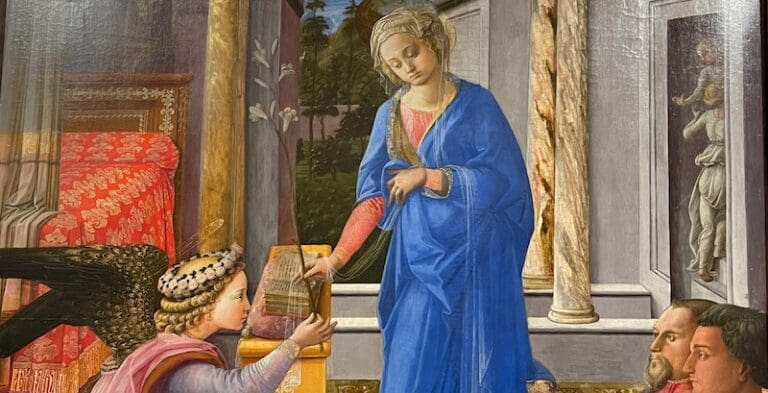
A sumptuous Renaissance interior, complete with a pair of women disappearing up the stairs, brings everyday life into a sacred encounter.
Filippo Lippi’s Annunciation with Two Donors offers up a truly dazzling vision of an opulent Renaissance interior. Painted around 1440–45, the work belongs to the generation that helped shape the visual language of the early Renaissance, when artists were exploring perspective, architecture and the convincing representation of the human world with ever greater confidence.
Here marble surfaces gleam, a canopy bed beckons us towards a bedroom at the back left, whilst a lush garden opens out beyond an open doorway. Gabriel, garlanded with flowers and wings flecked with gold, proffers a lily to the serene Mary, framed by the arch of a colonnade.
Two kneeling donors lean on a wooden balustrade, seamlessly integrated into the composition. They are witnesses to the sacred event, but their presence also gives the painting something of the character of a private devotional space, as though we have been allowed a glimpse into the home of its patrons.
My favourite detail, though, is the pair of young women caught in the act of disappearing up a staircase to the right. It is just the kind of naturalistic observation drawn from life that typified Lippi’s ability to integrate the quotidian into sacred narrative. The extraordinary event of the Annunciation unfolds in a world that feels inhabited, furnished and entirely recognisable.
Lippi’s own life was hardly conventional. A Carmelite friar turned celebrated painter, he led a tumultuous existence that included a relationship with the nun Lucrezia Buti, whom he met while working in Prato. The couple had a son, Filippino Lippi, who would himself become one of the most distinguished artists of the Renaissance.
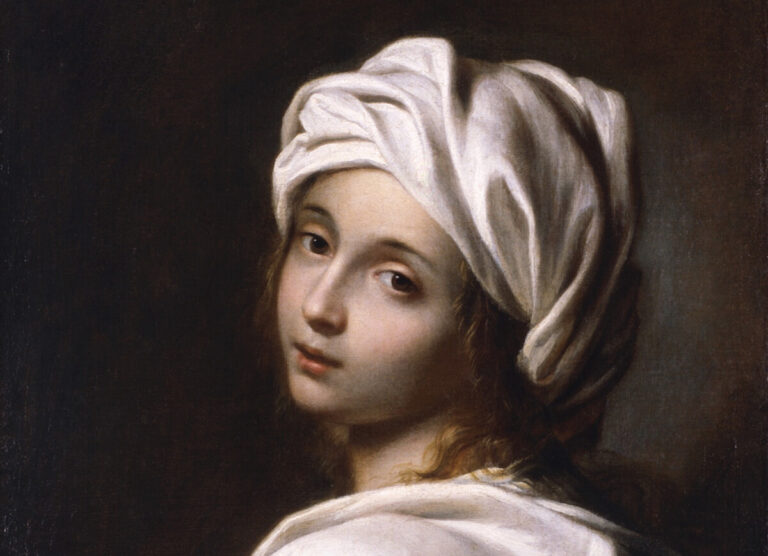
A haunting young face carries the weight of one of Rome’s most notorious stories, although the identity of both sitter and painter remains uncertain.
Few portraits in Rome have acquired a legend quite like this one. The young woman in the pale turban has traditionally been identified as Beatrice Cenci, the beautiful Roman noblewoman executed in 1599 for her part in the murder of her abusive father. For generations, the painting was attributed to Guido Reni and celebrated as an image of Beatrice herself, captured shortly before her tragic death.
The story behind that identification is one of the darkest in Roman history. Beatrice belonged to a wealthy but deeply troubled family, dominated by her father Francesco Cenci, whose cruelty and alleged sexual abuse of his children became notorious. In 1598, Francesco was murdered at the family’s castle in Petrella Salto. Beatrice, her stepmother Lucrezia and her brother Giacomo were arrested and tried for the crime.
The case divided Rome. Patricide was regarded as an especially abhorrent offence, but the allegations of abuse and the family’s desperate circumstances generated widespread sympathy for Beatrice. Despite public appeals for mercy, Pope Clement VIII refused to spare her. On September 11, 1599, Beatrice, Lucrezia and Giacomo were executed in Rome.
The portrait’s association with the young woman became particularly powerful in the eighteenth and nineteenth centuries. The poet Percy Bysshe Shelley was deeply moved by the image, praising its simplicity, dignity and sorrow, and the story helped inspire his tragedy The Cenci. The painting came to embody the idea of a beautiful young woman destroyed by the cruelty of the world around her.
There is, however, a problem with the traditional story. Guido Reni was probably not in Rome at the time of Beatrice’s execution, and modern scholarship has questioned both the attribution and the identification of the sitter. The painting is now often associated with the Bolognese artist Ginevra Cantofoli, although the question remains debated.
debated.

Descend beneath modern Rome to explore a sanctuary where worshippers once gathered to celebrate the mysterious god Mithras.
There is another extraordinary chapter in the history of the Barberini neighbourhood, although you won’t find it amongst the palace’s paintings and sculpture. Beneath the nearby building now occupied by the Armed Forces Officers’ Club lies the Barberini Mithraeum, an ancient sanctuary dedicated to the god Mithras, discovered during construction work in 1936.
The sanctuary is a compact, vaulted space, with benches running along its sides where members of the Mithraic community would have gathered for ritual meals and ceremonies. Like other mithraea, it evokes the cave associated with the god’s birth and his sacrifice of the sacred bull, creating an enclosed world quite unlike the public temples of traditional Roman religion.
At the heart of the decoration is the tauroctony, the scene of Mithras slaying the bull, accompanied by the torchbearers Cautes and Cautopates. Around it, zodiac signs and other celestial imagery give the sanctuary a powerful cosmic dimension. The precise meaning of individual elements remains a matter of scholarly interpretation, but the overall effect is unmistakable: this is a religious space in which architecture, ritual and the heavens were closely intertwined.
The Barberini Mithraeum reopens to visitors on October 3, 2026, with guided tours every Saturday at 10 a.m., 11 a.m. and noon. Visits last approximately 45 minutes and are limited to 20 people. The Mithraeum requires a separate ticket, although an integrated ticket is available for visitors wishing to combine it with the palace and Galleria Corsini.
debated.

Palazzo Barberini is located at Via delle Quattro Fontane 13, a short walk from Piazza Barberini and the Barberini metro station on Line A. The gallery is open Tuesday to Sunday, 10 a.m. to 7 p.m., with the ticket office closing at 6 p.m. It is closed on Mondays, December 25 and January 1.
Your ticket covers both Palazzo Barberini and Galleria Corsini, although the two museums are in different parts of Rome and are best treated as separate visits. The combined ticket remains valid for 20 days, so there is no need to rush from one to the other on the same afternoon.
Allow around 90 minutes to two hours for Palazzo Barberini itself if you want to see the principal works without racing through the galleries. The museum occupies a substantial Baroque palace, and the collection is spread across several floors, so allow longer if you want to explore the building as well as the paintings.
If you would prefer to explore the collection with an art historian, Through Eternity can arrange a custom private visit to Palazzo Barberini, tailored around the works and periods that interest you most.
The Barberini Mithraeum, which reopened in October 2026, is a separate experience rather than part of the normal gallery route. It can be visited on Saturday mornings by guided tour, with visits currently scheduled at 10am, 11am and noon. The tours last about 45 minutes and are limited to 20 people. Separate tickets are available, or the Mithraeum can be added to the combined Barberini–Corsini ticket. Check the museum’s official website before visiting for any temporary gallery closures or changes to access.
Frequently Asked Questions
Is Palazzo Barberini worth visiting?
Absolutely, particularly if you enjoy Renaissance and Baroque art. The collection includes works by Raphael, Caravaggio, Pietro da Cortona, Holbein, Tintoretto and Filippo Lippi, while the palace itself is a major architectural achievement of seventeenth-century Rome.
What are the most famous works in Palazzo Barberini?
Among the best-known highlights are Pietro da Cortona’s Allegory of Divine Providence, Raphael’s La Fornarina, Caravaggio’s Judith Beheading Holofernes and Narcissus, and the portrait of Henry VIII associated with Hans Holbein the Younger.
How long should I spend at Palazzo Barberini?
Allow around 90 minutes to two hours for a first visit. Art lovers may want to spend considerably longer, particularly if they plan to explore the palace architecture and temporary exhibitions as well as the permanent collection.
Is Palazzo Barberini the same as Galleria Corsini?
No. They are two separate museum sites belonging to the Gallerie Nazionali di Arte Antica. The same standard ticket covers both, with validity extending for 20 days after first use. Palazzo Barberini is on Via delle Quattro Fontane; Galleria Corsini is in Trastevere, on Via della Lungara. The Corsini is located near the Villa Farnesina, so can make a good addition to a morning exploring Raphael’s masterpieces there.
Can you visit the Barberini Mithraeum with a normal palace ticket?
The Mithraeum has its own guided-tour ticket, separate from ordinary admission to Palazzo Barberini. An integrated ticket is available for visitors who wish to combine the underground visit with access to the palace and Galleria Corsini.
What is the best way to get to Palazzo Barberini?
The simplest option is Metro Line A to Barberini station, from which the palace is a short walk. Several city bus routes also serve the area. The museum’s address is Via delle Quattro Fontane 13, Rome.
Is Palazzo Barberini open on Mondays?
No. The gallery is normally open Tuesday through Sunday, from 10 a.m. to 7 p.m., and closed on Mondays. Check the official website for holiday arrangements and temporary changes to access.
Plan Your Rome Visit Today!