Not all of the most beautiful artworks in Rome are hidden away in art galleries and museums.
One of the most startling and beautiful things you can do in the Eternal City costs absolutely nothing and takes about twenty minutes — yet it is something a large proportion of the city’s visitors never encounter.
Simply walk into the church of Sant’Ignazio in central Rome, stand at a small circular marble disc set into the floor of the nave, and look up.
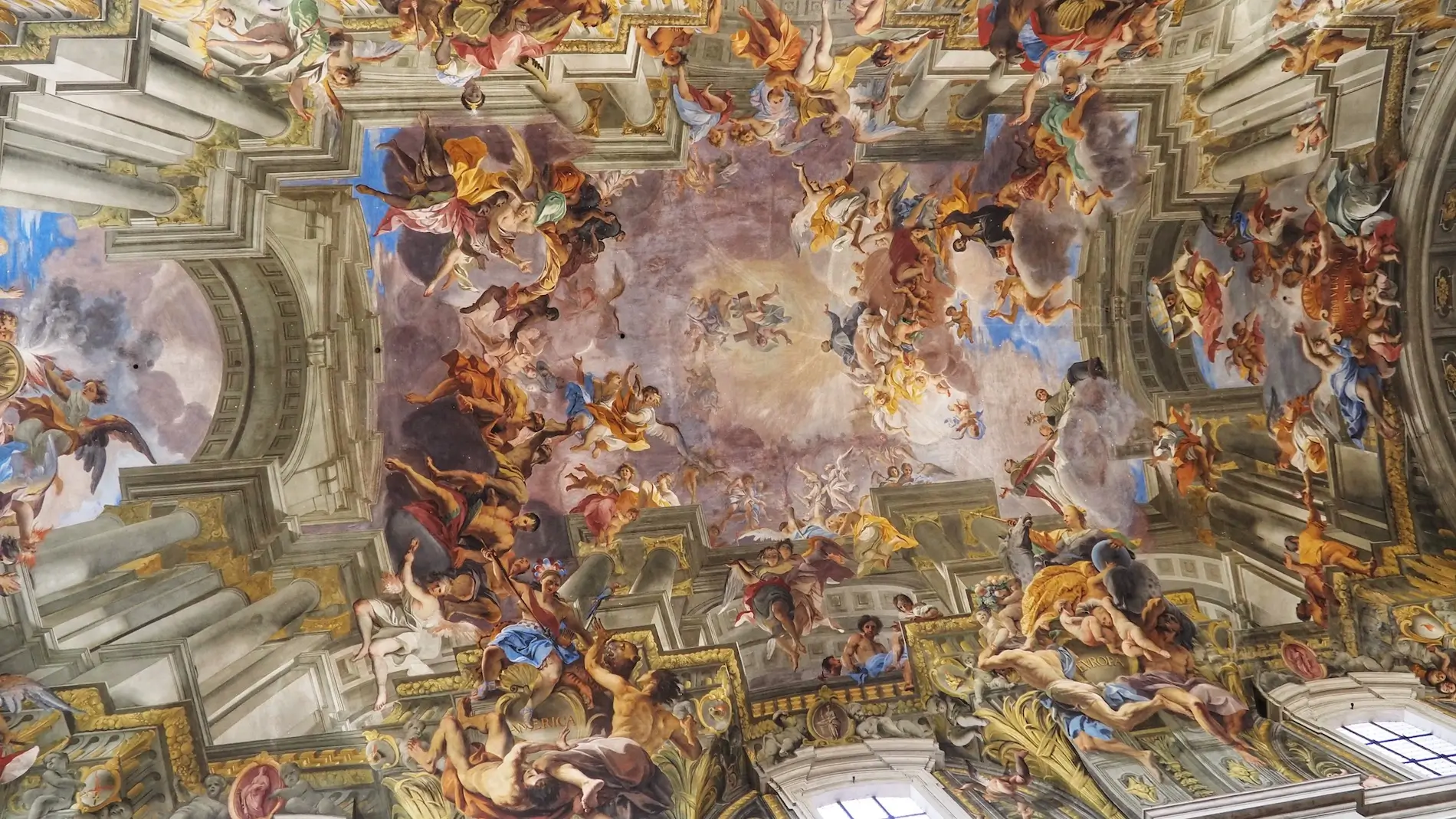
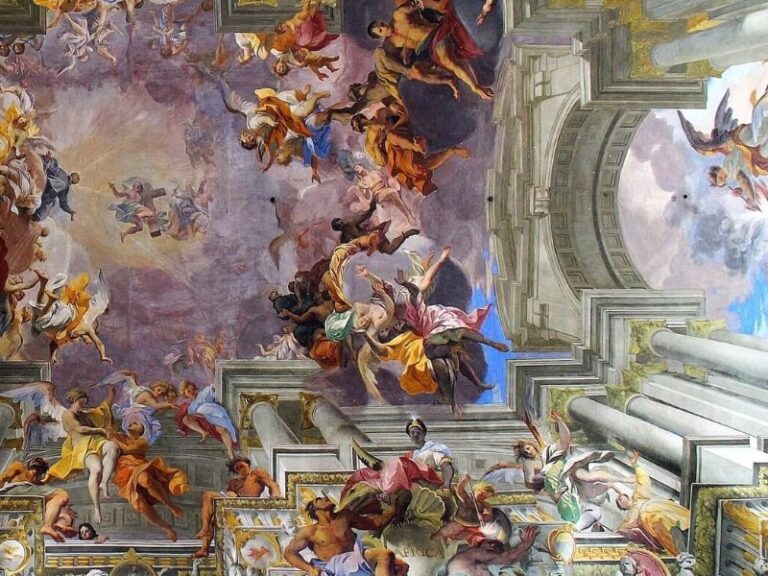
What you will see is one of the greatest illusions ever painted: a ceiling that opens, apparently, directly into the heavens.
The dazzling frescoes celebrating the holiness and missionary vision of the Jesuit order’s founder Ignatius Loyola were the brainchild of Andrea Pozzo, a Jesuit lay-brother and painter who dedicated 15 years of his career to the church in the late 17th century. Discover these highlights of the Roman Baroque with us!
Rome Tours
Discover Rome's Hidden Treasures
Many of Rome’s largest and most impressive churches owe their genesis to the 17th century, when a wave of increasingly powerful religious orders — founded to spread the Catholic message across the world — began making their mark on the Eternal City with a series of grand new buildings.
The most important of these orders was the Jesuits. Emerging from the feverish intellectual and theological turmoil of the Protestant Reformation, the Society of Jesus had been founded in 1540 by a Spanish soldier turned mystic, Ignatius of Loyola, as a kind of spiritual special forces: highly educated, deeply disciplined, trained in rhetoric and theology, and prepared to travel to any corner of the world in service of the Catholic faith.
The Jesuits were the shock troops of the Counter-Reformation — the Catholic Church’s fierce and ultimately successful response to the challenge of Protestantism — and by the late 16th century they had spread to every continent on earth, establishing missions in China, Japan, India and the Americas.
You may already have visited their mother church in Rome, the magnificent Il Gesù not far from the Pantheon: built in 1568, it’s a glittering essay in Baroque splendour, its interior encrusted with gold and precious marbles, its extraordinary ceiling fresco by Giovanni Battista Gauli a swirling vision of heavenly triumph.
But Il Gesù, spectacular as it is, does not prepare you for what the Jesuits did next.

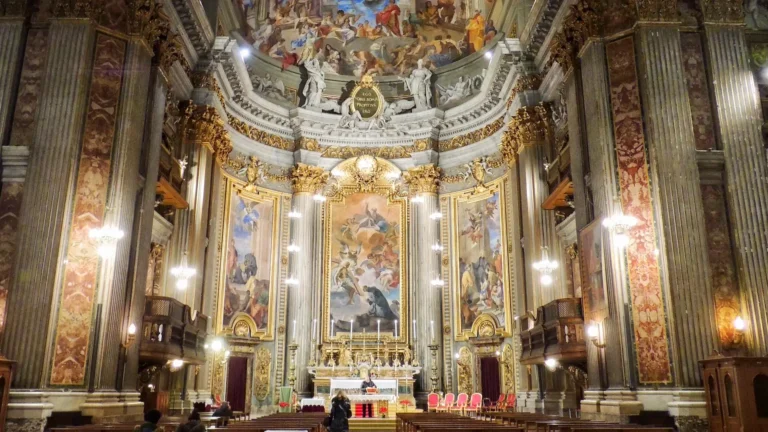
In order to fuel the endless supply of missionaries required for their worldwide conversion programme, the Jesuits ran a series of colleges across Italy where they trained young men in theology, rhetoric, science and philosophy.
The most important of these was their Roman College, and as the college grew in fame and influence the Order found itself urgently in need of a new church to serve the spiritual needs of its students.
Following the canonisation of Ignatius of Loyola in 1622, a papal grant funded the construction of an enormous new church to be built across the road from the college — a church that would honour the Order’s founder and serve as a second great Jesuit hub in the city. The project was, as these things tend to be, vastly more expensive and complicated than anyone had planned.
The money ran out repeatedly. Construction dragged on for decades.
The most celebrated casualty of the funding crisis was the dome. Plans for a magnificent cupola to crown the church’s crossing had been drawn up and approved; the drum that was meant to support it was built. But when the money finally ran out in 1642, the dome itself was simply unaffordable.
But the ever-inventive Jesuits weren’t to be denied their spectacular centerpiece. Rather than leaving the crossing bare, in place of the out-of-their-price-plan dome, they commissioned lay brother Andrea Pozzo to paint a fake one onto the flat ceiling instead. The result fooled everyone — and it still fools plenty of visitors today.
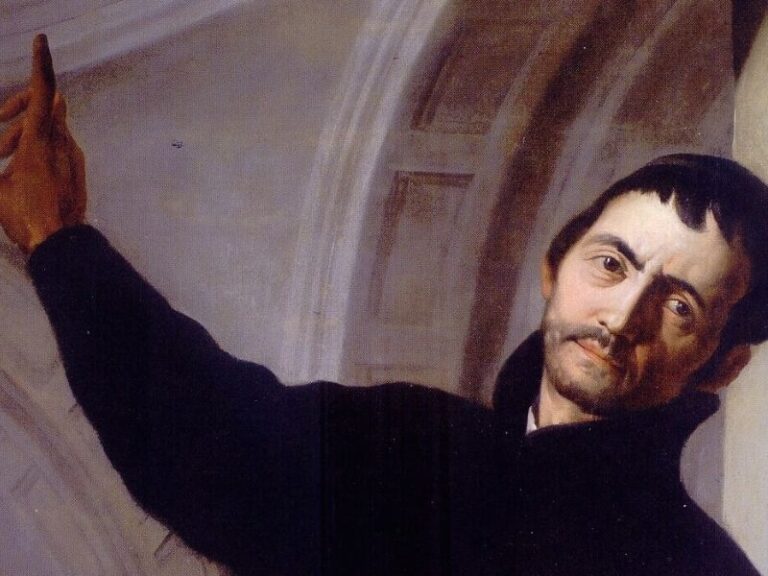
Andrea Pozzo (1642-1709) is the kind of figure who defies easy categorisation. A devout Jesuit lay brother who dedicated his life to the service of the Church, he was simultaneously a working professional artist of the first rank, a mathematician, and a theorist whose published Perspective in Architecture and Painting (1693) would be translated into seven languages and read across Europe for more than a century.
He was, in short, a polymath — but one whose intellectual gifts were always in service of a single overriding purpose: the greater glory of God and the Catholic faith.
Over the course of his career Pozzo travelled extensively across the contested territories of central Europe, where the battles of the Reformation and Counter-Reformation were still being fought — in Austria, Bavaria and Bohemia, as well as across the Italian peninsula — painting frescoes and altarpieces for churches and palaces committed to the Catholic cause.
His expertise in mathematics gave him a particularly nuanced understanding of perspective, and his treatise on the subject — written in part to help other Jesuit brothers decorate their own churches — became one of the most widely used practical handbooks in the history of art.
When he was given charge of the interior decorations at Sant’Ignazio in 1684, Pozzo had everything he needed to stage the most audacious artistic illusion of the century.
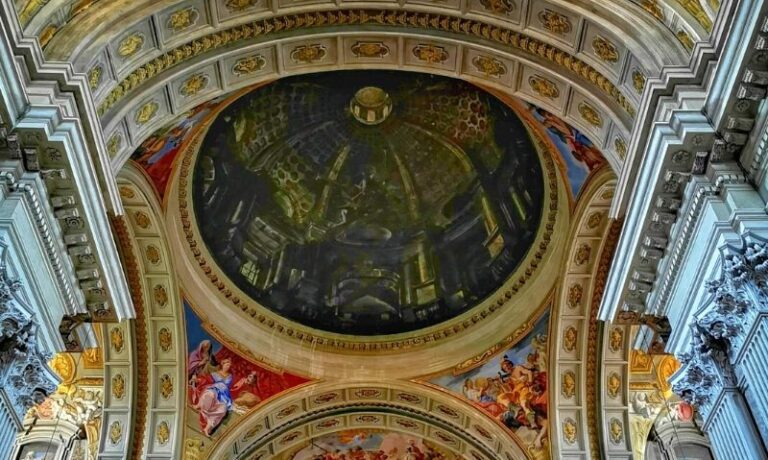
Entering the church’s broad nave, you might notice nothing out of the ordinary. There is a dome ahead of you at the crossing — you can see its ribs, its supporting columns, the lantern at the top letting light into the cupola.
It looks entirely real.
Start walking towards the altar, and the dome comes progressively into view. It still looks completely convincing — and continues to do so until you step too close to the altar, at which point everything falls apart.
Stand directly beneath the crossing and look straight up, and the dome simply ceases to exist. What you are looking at is a perfectly flat ceiling with a painting on it. It’s a bit like peering behind the Wizard of Oz’s curtain.
The illusion is achieved through a precise manipulation of perspective. Pozzo placed the vanishing point of his composition at a specific location further down the nave — not at the centre of the fictive dome — so that the illusion is perfectly convincing from a specific viewing position but collapses when you step past it.
To help visitors find this magic spot, the Jesuits embedded a small circular marble disc in the floor of the nave: stand on it, look up, and the dome springs back into three-dimensional existence. Step off it, and you’re looking at a painting again.
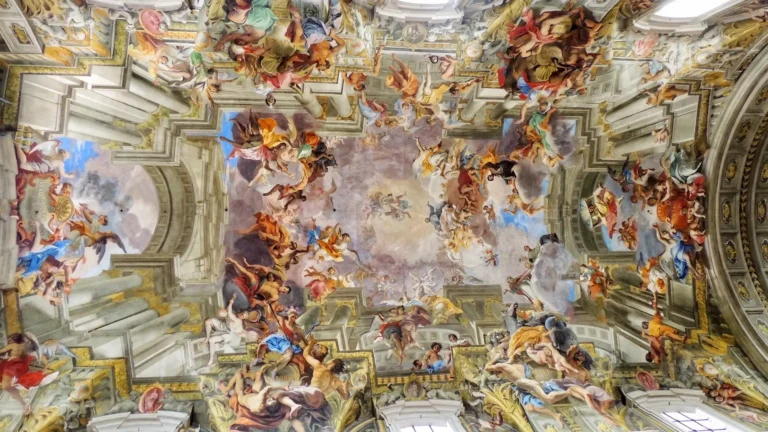
Not content with fooling visitors with a fake dome, Pozzo also painted the enormous illusionistic fresco that covers the entire vault of Sant’Ignazio’s nave — one of the most ambitious single painted surfaces of the Baroque era.
The composition is structured around the same perspectival principles as the fake dome. Pozzo illusionistically extended the real architecture of the church vertically upwards into the painting, making the basilica appear to be roughly twice its actual height. This fictive architecture then dissolves into the heavens, opening a panoramic view into the celestial realm.
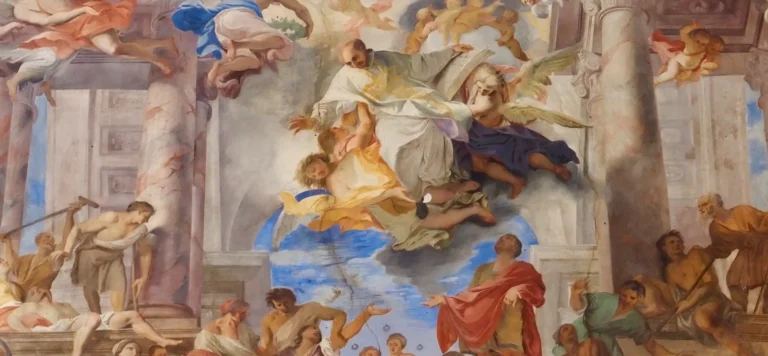
At the centre of this painted sky, the Jesuit founder Ignatius of Loyola floats on a cloud carried aloft by angels, ascending towards God’s divine realm in a blaze of supernatural light. As Ignatius ascends, the sinners and heretics of the world tumble downward in the opposite direction, their faces contorted with terror and despair.
Around the four sides of the composition, four personifications of the world’s known continents bear witness to the scene: Asia (on a camel), Africa (seated on a crocodile), America (wearing a feathered headdress, holding a bow), and Europe (crowned, bearing a sceptre).
The programme is explicit in its intent. A contemporary Jesuit biography explains that Pozzo wished to represent “the great zeal of St. Ignatius in propagating the Catholic faith throughout the world” — meaning that the four continents are here not merely as exotic spectacle but as territories awaiting or already receiving the Catholic mission.
Europe gazes on the ascending Ignatius in adoration from the position of natural authority; the other three continents look up from below, still in process of conversion.
The age of global exploitation had well and truly begun — and this extraordinary ceiling is its painted theology.
How to Visit Sant’Ignazio: Sant’Ignazio al Campo Marzio is located just a few minutes’ walk from the Pantheon, in the heart of Rome’s historic centre.
Address: Piazza di Sant’Ignazio, Rome (near Piazza della Rotonda / the Pantheon)
Entry: Free of charge. You’ll need to make a small donation if you’d like to look at the ceiling via the large mirror in the nave, or take a selfie with it.
Opening hours: The church is generally open daily from 7:30 AM to 7:00 PM on weekdays, with slightly adjusted hours on weekends. Hours may vary for religious services.
Getting there: Sant’Ignazio is a short walk from the Pantheon — head east from Piazza della Rotonda along Via del Seminario and turn right. It is also close to Piazza Venezia, the Gesù, and the main Corso Vittorio Emanuele bus corridor.
Photography: Non-flash photography is permitted inside the church.
Best time to visit: Early morning or late afternoon, when the church is less crowded and the light through the windows gives the painted ceiling a particularly dramatic quality. Avoid visiting during services.
The floor disc: Don’t miss the small white marble disc embedded in the floor of the nave, approximately in the middle of the space. Standing on it gives you the optimal viewpoint for both the fake dome and the vault fresco. It is the one spot in the church from which every illusion is simultaneously complete.
While you’re here: Piazza di Sant’Ignazio itself is worth a moment of appreciation — a tiny, beautifully proportioned Baroque square designed by Filippo Raguzzini in 1728, whose curved facades create a theatrical sense of enclosure that feels almost stage-managed. From here, the Gesù is five minutes’ walk, and the Pantheon barely ten.
Where is the church of Sant’Ignazio?
Sant’Ignazio al Campo Marzio is located in the historic centre of Rome, very close to the Pantheon. The address is Piazza di
Sant’Ignazio, near Via del Corso.
Is Sant’Ignazio free to visit?
Yes. Entry to the church is free of charge. Donations are welcome and support the church’s upkeep. You’ll need to queue and pay a small donation if you want to take a selfie in the large mirror in the nave.
Who painted the frescoes at Sant’Ignazio?
All the major frescoes — the fake dome and the vault fresco — were painted by Andrea Pozzo, a Jesuit lay brother, mathematician and artist. He worked on the church between approximately 1684 and 1700.
Is the dome of Sant’Ignazio real?
No. The dome of Sant’Ignazio is a trompe-l’oeil painting on a completely flat ceiling, created by Andrea Pozzo. The illusion is convincing from a specific viewing position (marked by a marble disc in the floor) but collapses when you stand directly beneath the crossing.
How long does it take to visit Sant’Ignazio?
A thorough visit takes about 20-30 minutes. If you want to spend time studying the iconography of the vault fresco in detail and look at all the altars, allow up to an hour.
Is Sant’Ignazio near the Pantheon?
Yes — it is about a 5-minute walk from the Pantheon, making it an ideal pairing with a visit to the ancient temple.
Rome Tours
Discover the Magic of the Eternal City