Not every descent into Rome's past is metaphorical.
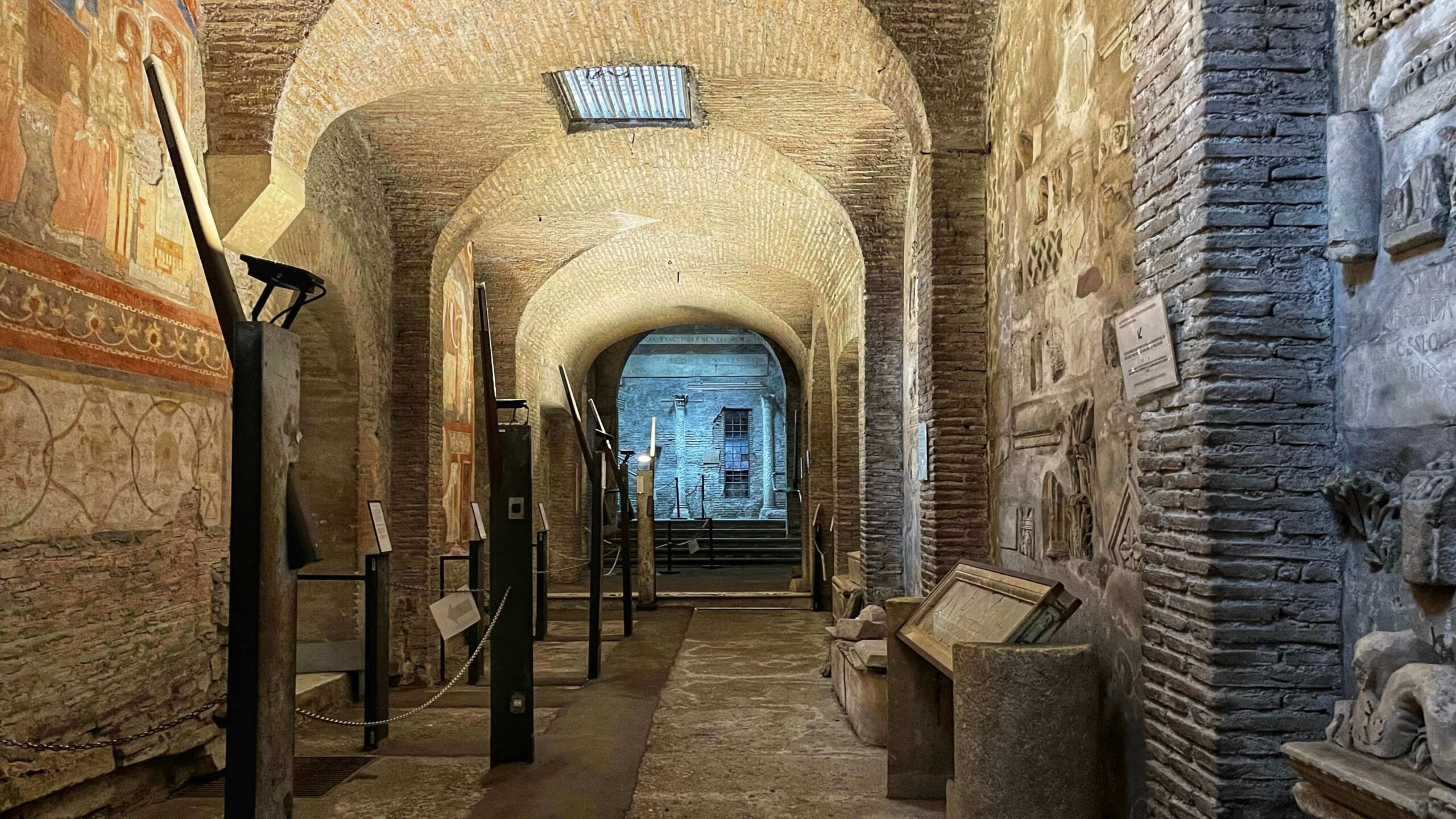
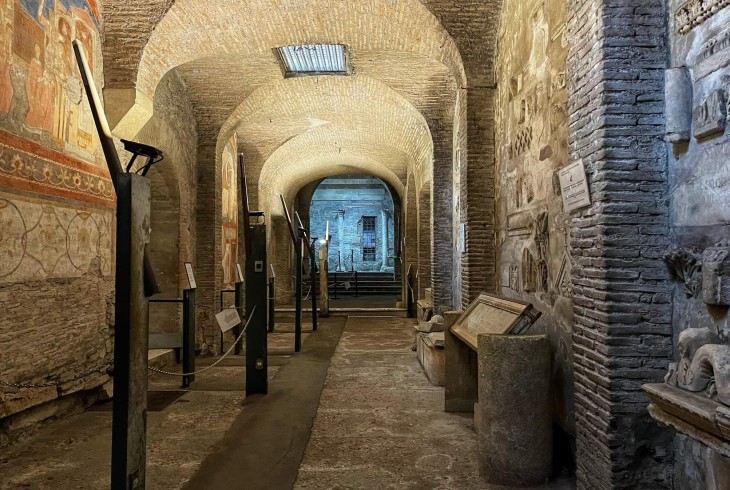
At San Vitale, it is literal: a steep flight of stone steps drops off Via Nazionale and deposits you, blinking, in front of a set of elaborately carved wooden doors, well below the surface of the modern street.
Down here, the noise of the city above recedes, the light thins, and something older takes over. This little-known church is one of the strangest spaces in Rome — not for any famous artwork it contains, nor for the grandeur of its architecture, but for the deeply unsettling things that reveal themselves, very gradually, as your eyes adjust to the dark.
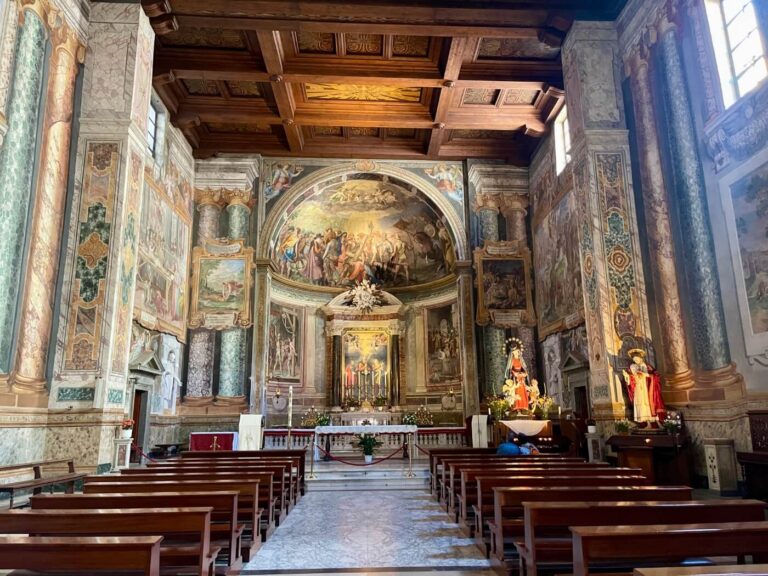
San Vitale is the kind of place that repays patience. First visits tend to produce a general impression of dim, musty air and walls entirely covered with frescoes — landscapes, to judge by the sweeping trees and luminous skies. Look more carefully, though, and the landscapes begin to give up their secrets.
Hidden within those peaceful arcadian scenes, almost lost among the hills and trees, are scenes of extreme violence: men nailed to pines, bishops torn apart by lions, bodies hacked and drowned and burned. The longer you look, the more you see, and the more you see, the more disquieting the whole enterprise becomes.
This is Jesuit art as propaganda, and it is among the most psychologically calculating things ever painted in Rome.
Best Rome Tours
Explore the Best of Rome
The Church
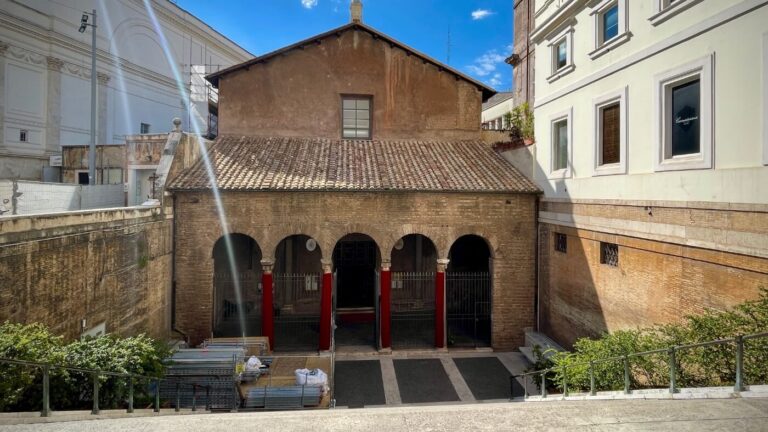
San Vitale’s origins lie in the early fifth century — making it one of the oldest continuously functioning churches in the Eternal City. The centuries of urban growth that raised the level of the city around it explain why only the rooftop now sits at street level; rather than being simply built over, as happened to the more famous San Clemente, San Vitale was gradually enclosed as the surrounding terrain rose, preserving it almost intact as a living relic of a much earlier Rome.
Descend those steps and the modern city truly does fall away.
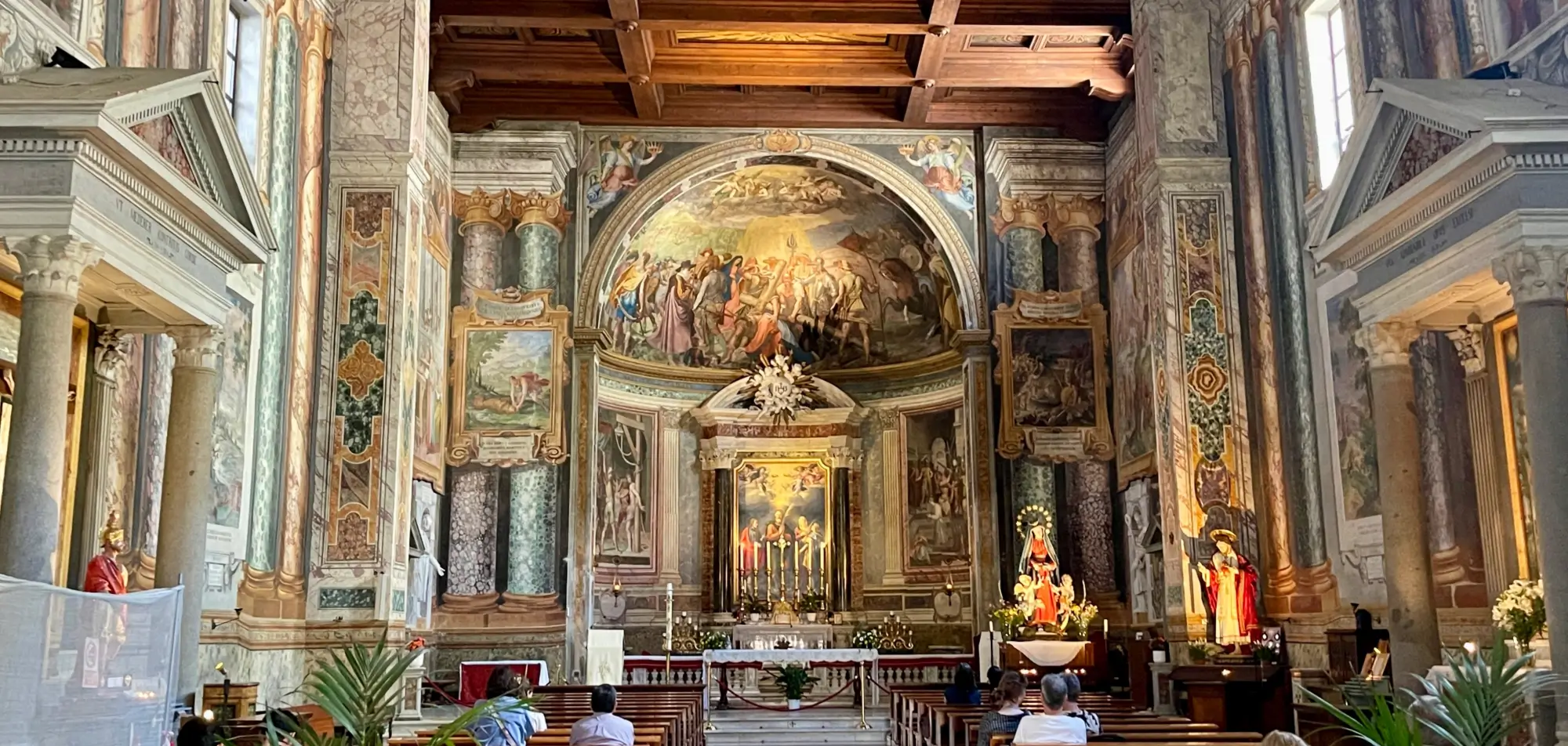
The interior is dim and almost invariably quiet, inhabited more by devout parishioners than curious tourists. Every inch of the walls is covered in decoration, the product of a restoration carried out in the dying years of the sixteenth century — a moment which, as we shall see, had very specific demands to make of religious imagery.
As your eyes adjust, the dominant impression is of those sweeping, atmospheric landscapes: soaring trees, crystalline lakes, golden Italian skies. It looks, at first, like a rather beautiful anthology of the Roman campagna at its most serene.

The Frescoes
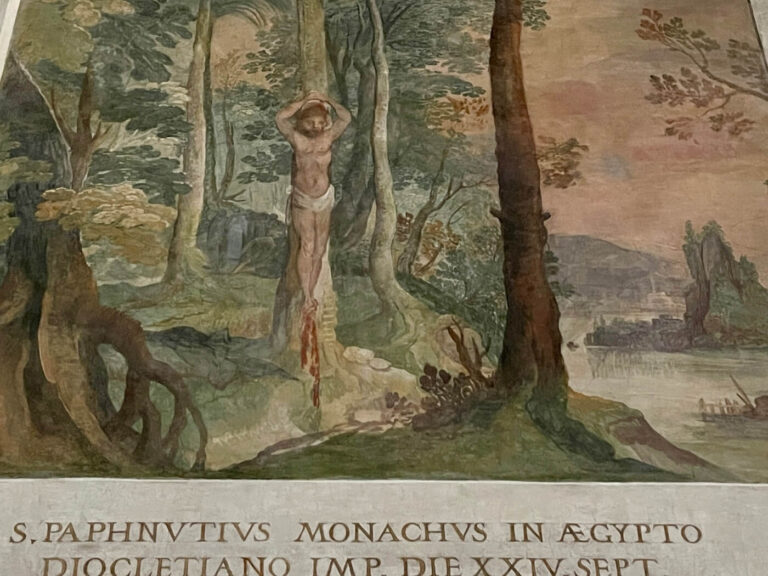
Then a detail catches the eye, and the serene resolution of the scene begins to tremble. In one fresco, what appeared to be a tranquil grove overlooking a sunlit lake resolves itself on closer inspection into a scene of execution: a man, nearly naked, his skin almost the same tone as the bark, has been nailed to one of those soaring pines.
A livid patch of crimson, evidence of the bloody deed, slowly oozes down its trunk.
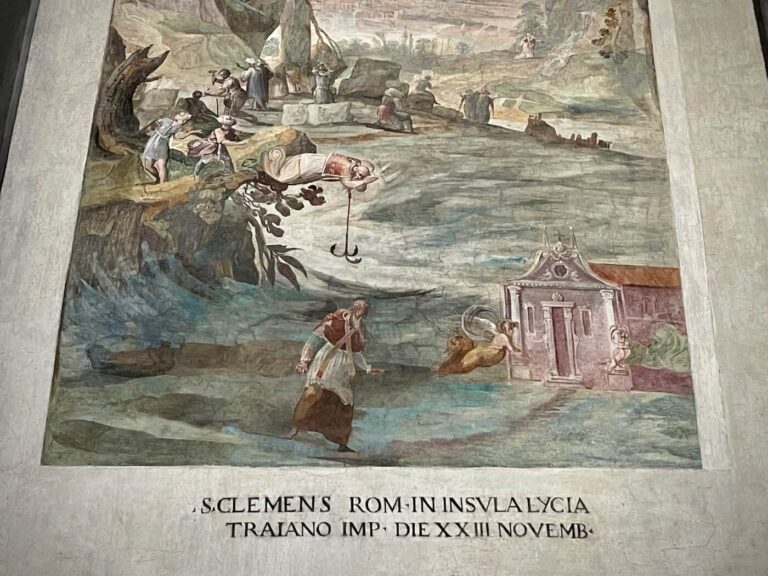
In another, a bishop in full ecclesiastical regalia is being savagely torn apart by lions in front of the picturesque ruins of an ancient amphitheater silhouetted against the setting sun.
A decapitation here. A drowning there. Forest clearings that turn out to be killing grounds.
There is something irrepressibly disquieting about these paintings, even something perverse. Gentle landscapes shouldn’t conceal such nasty surprises.
We are all taught that in the grand narrative of Renaissance and Baroque art the landscape is a less demanding, more tranquil relative to the serious business of ‘history’ painting. Michelangelo was famously alleged to have remarked that landscapes were fit objects of contemplation only for children, whilst Raphael usually delegated the landscape elements of his works to assistants.
Yet here the modes have been decisively confused, and our preconceptions disturbed. Here the violence is embedded in the landscape — miniaturised, almost camouflaged, waiting to be found rather than presented for immediate consumption. The encompassing scenery is enormous; the suffering figures are tiny. At those moments of the day when sunlight streams through the high windows, the details emerge with arresting clarity. In the gloom, they lurk.
What could be the purpose of transforming scenes of such beauty into scenes of terror?
The Jesuits and the Purpose of Fear
We must not think of these paintings as purely aesthetic objects. The frescoes that we encounter in this dark and musty space 50 feet below the street level of the modern city were not painted simply for the visual delectation of the patricians and cardinals that were the great connoisseurs of their day.
This was not a place for members of the Catholic hierarchy to amaze the world with the material splendours of the resurgent, triumphant Counter-reformation Church. Much like the church of Santo Stefano Rotondo across town, San Vitale was instead a Jesuit novitiate, a place where young novices were sent to learn about the spiritual path that they had chosen.
For the master propagandists of the Jesuit order, a picture really was worth a thousand words, and thus the frescoes that adorn its walls were above all meant to teach, instruct and inform.
Spiritual Lessons
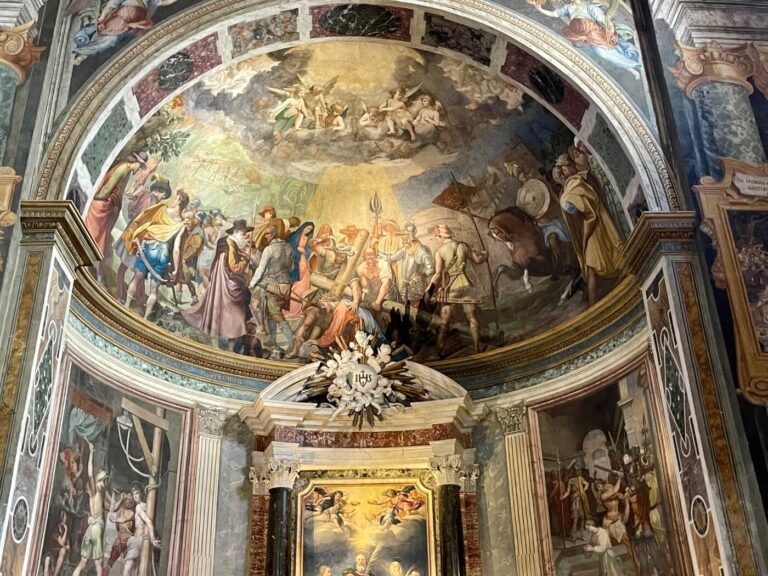
But what spiritual lessons could these gruesome pictures convey? Most of us today are rather ill-equipped to unravel their spiritual and scholastic messages. For the 16th-century novices, however, interpretative help was at hand in the form of the explanatory Latin captions and texts that surround each image.
For the young missionaries, the process of understanding these paintings was an exercise in scholarly deduction in which their capacity for visual, verbal and intellectual acuity were all being tested.
From the documentary captions beneath each image, they would learn that the men being tortured and killed all around them were their spiritual forebears, the early Christian missionaries who were persecuted for spreading the word of God throughout the still pagan Roman Empire.
The Jesuits had been tasked by their founder Ignatius of Loyola to resume the missionary work of Christ’s first followers in the rapidly expanding world of the 16th century.
Like the now distant paragons commemorated on the walls of their novitiate, these new warriors of Christ must expect to be persecuted for their beliefs in distant lands. This, it is now clear to the young Jesuit novices, is their inevitable fate, the ultimate sacrifice they must pay to ensure their eternal salvation.
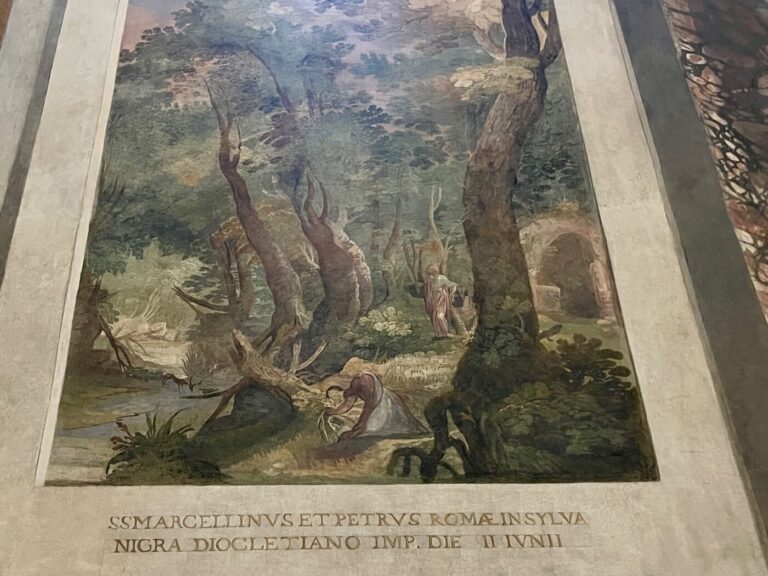
But surely the biggest challenge that these didactic paintings posed for the young prospective missionaries was a psychological one. Pain and persecution insidiously invades the apparently safe world of the pastoral landscape, indeed invades the very walls of their spiritual home.
For those called to such a life in the service of God, there will never be a moment of comfort, there will never be a safe-haven, on this terrestrial earth. Perhaps that is why these images are so fascinating and disquieting even today, in a far more secular world where the concept of Christian martyrdom leaves us cold.
In these images the modern viewer is not confronted by the terrible reality of the suffering that awaits him, but there remains something uncanny, something upsetting about these familiar and comfortable landscapes, such as we see in almost every art gallery in the world, metamorphosing into sinister scenes of pain and suffering in the gloom of this forgotten church.
San Vitale FAQ
Where is the church of San Vitale?
San Vitale is located on Via Nazionale in central Rome, near the Piazza della Repubblica. The entrance is reached via a steep flight of steps that descend below street level — easy to miss if you’re not looking for it.
When was San Vitale built?
The original church dates to the early fifth century, though the current structure and its fresco decoration reflect a major restoration carried out in the closing years of the sixteenth century, when the church became a Jesuit novitiate.
Who painted the frescoes?
The frescoes were painted in the late sixteenth century as part of the Jesuit renovation of the church. Whilst the large paintings in the sanctuary were painted by Antonio Temptesta, the authorship of the landscape martyrdoms remains a matter of dispute. They form part of a wider cultural moment in Counter-Reformation Rome in which the depiction of martyrdom became a significant and widely commissioned art form.
How does San Vitale compare to Santo Stefano Rotondo?
San Vitale and Santo Stefano Rotondo represent two sides of the same Jesuit impulse: both churches were Jesuit novitiates, both were decorated with martyrdom imagery in the same period, and both use the graphic depiction of suffering as a tool of spiritual instruction. San Vitale is arguably the stranger and more subtle of the two, concealing its violence within apparently serene landscapes. Santo Stefano Rotondo makes no such attempt at concealment.

Book Your Rome Experience