Raphael spent the last twelve years of his life in Rome, and the city became the stage for an artistic career of almost bewildering ambition. Summoned to the papal court while still in his mid-twenties, he soon found himself painting for popes, designing chapels for wealthy bankers and decorating pleasure palaces for some of the most influential figures of the Renaissance. By the time of his untimely death in 1520, aged just 37, he had established himself alongside Michelangelo and Leonardo da Vinci at the summit of Renaissance art.
Rome remains the best place to appreciate the extraordinary range of his achievement. From the philosophical debates of the Vatican frescoes to the intimate sensuality of La Fornarina, from the mythological exuberance of the Villa Farnesina to the celestial vision of his final masterpiece, Raphael’s work offers a remarkable portrait of Renaissance Rome at its glorious apogee. Here are ten places to encounter the master in the Eternal City.
Rome Tours
Explore Renaissance Rome!
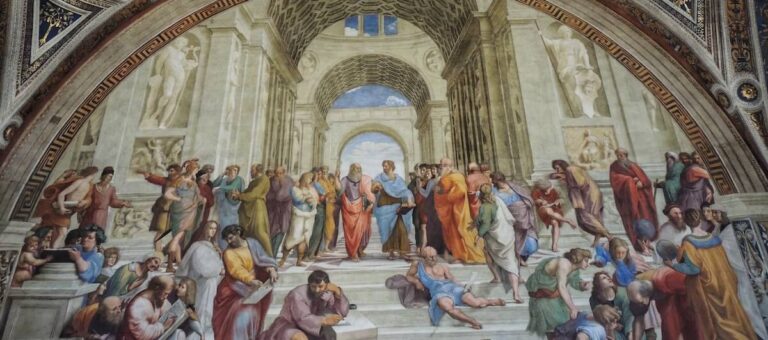
Raphael transforms the private apartments of a Renaissance pope into a dazzling theatre of philosophy, faith and papal ambition.
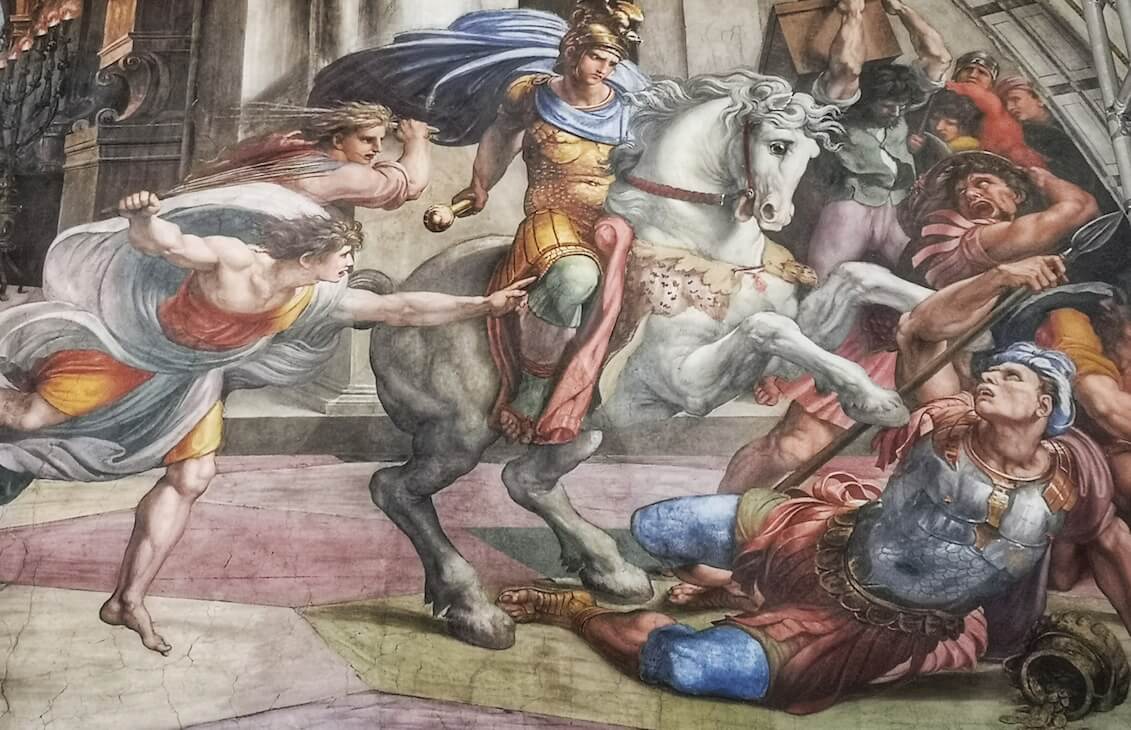
In 1508 Raphael, still only in his mid-twenties, was given the opportunity of a lifetime. Not content with commissioning Michelangelo to redecorate his private Sistine Chapel, the worldly Pope Julius II decided that his own apartments weren’t up to scratch, and so called on Raphael to adorn them with frescoes. Julius was keen to upstage the suite of rooms that Pinturicchio frescoed for the notorious Borgia Pope Alexander VI only a decade earlier, whom Julius loathed with a passion. Raphael was to amply repay his faith.
The huge commission was to make Raphael’s career, and the paintings that he came up with to adorn the suite of four rooms – the Stanza della Segnatura, the Stanza d’Eliodoro, the Stanza dell’Incendio and the Stanza di Costantino – would occupy him on and off for the remainder of his life. Running the gamut from historical scenes lauding the limitless power and authority of the Pope to contemplative allegories of learned humanist endeavour, Raphael’s Vatican frescoes are the most vivid evocations of life at the Renaissance court in existence.
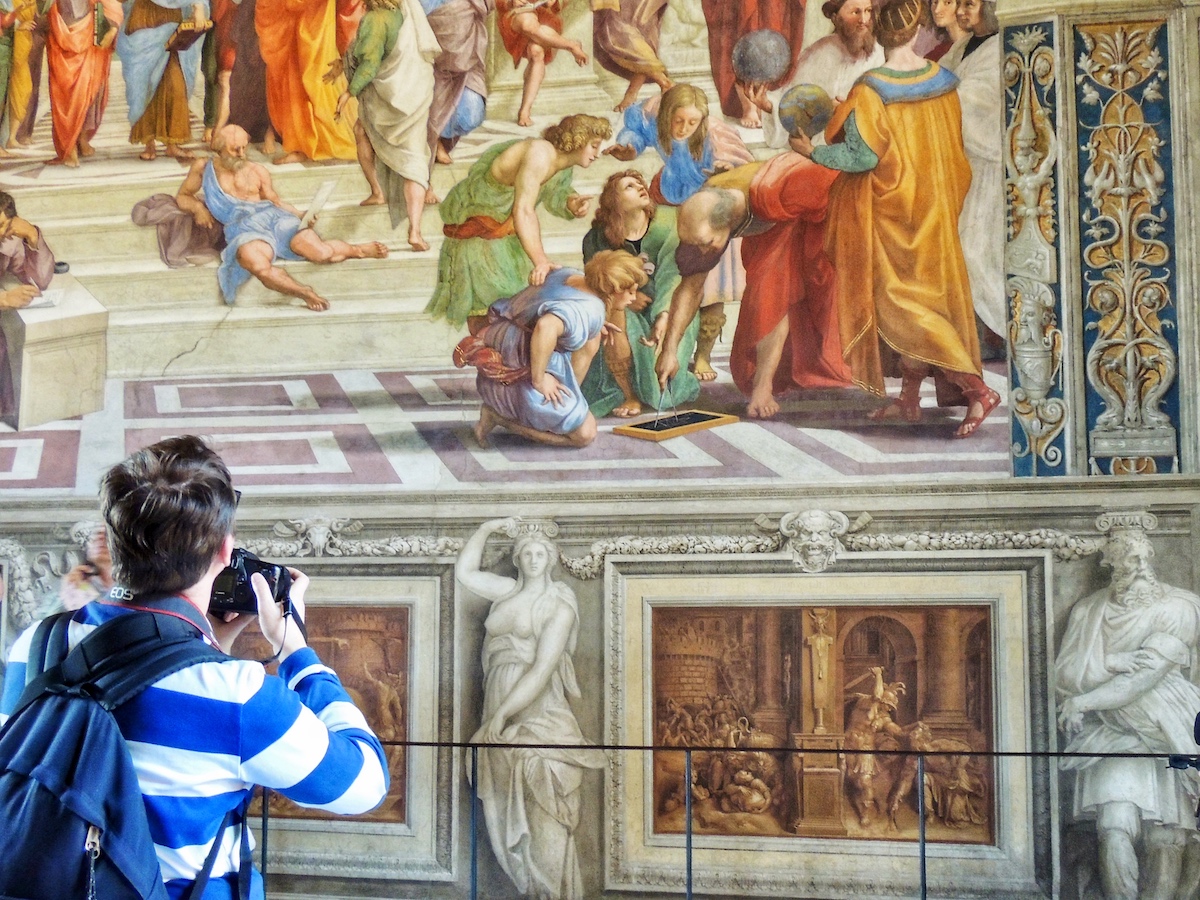
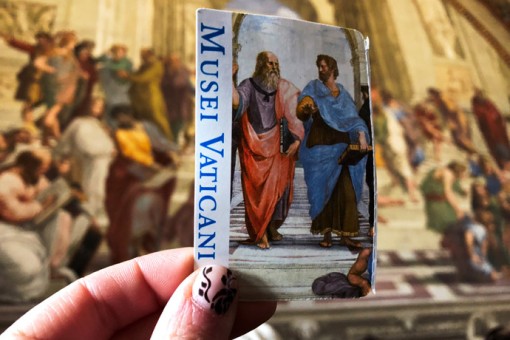
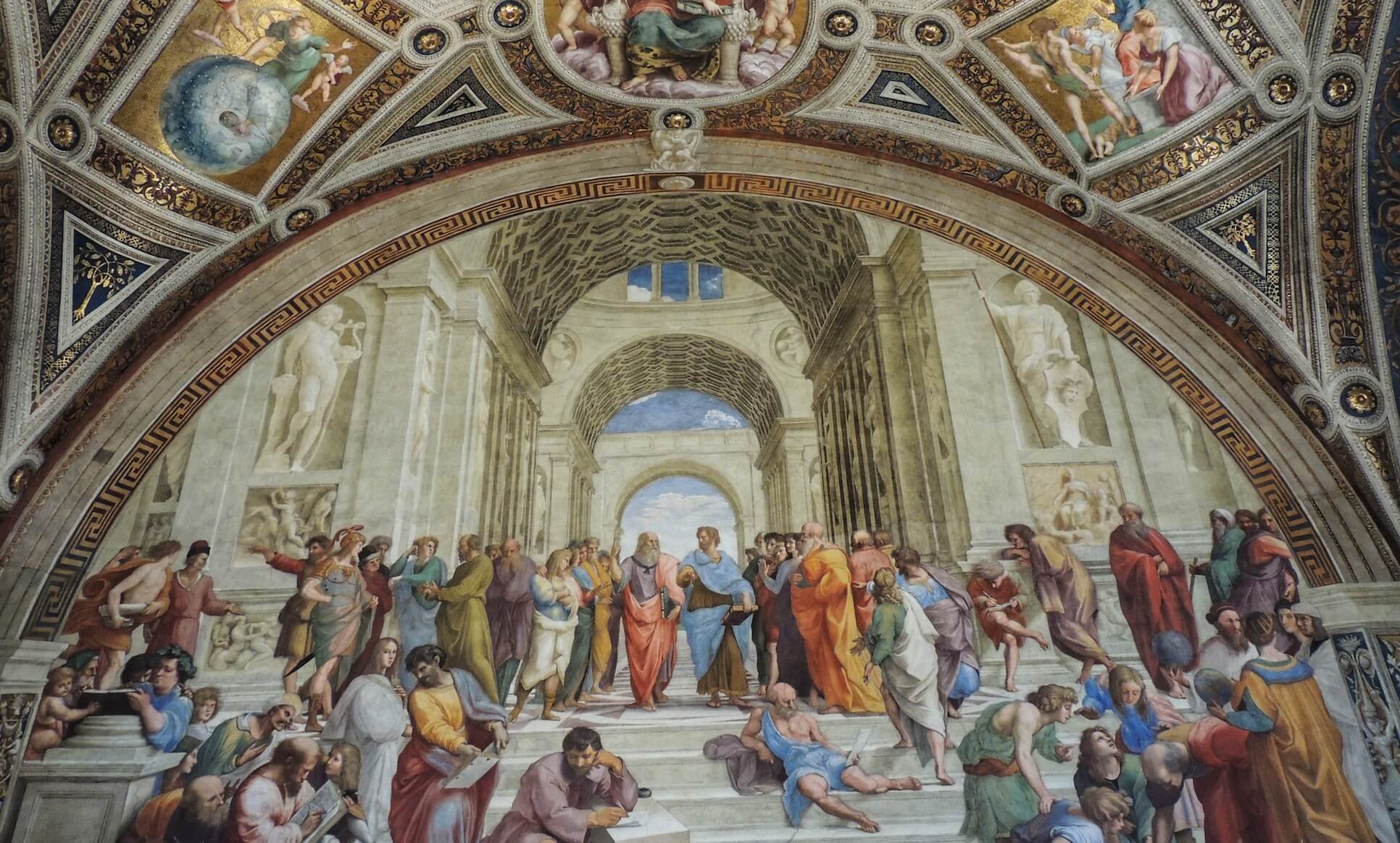
Each of the works that adorn the walls of the Raphael Rooms is a masterpiece in its own right, but the Stanza della Segnatura’s iconic School of Athens is the undisputed showstopper. In the deeply recessed fictive space of a magnificent but apparently unfinished classical structure – probably meant to invoke the new St. Peter’s Basilica that was being constructed by Raphael’s friend Bramante nearby – dozens of ancient philosophers are locked in debate concerning the nature of knowledge and being.
At the centre, just at the perspectival construction’s vanishing point, are the unmistakeable figures of Plato and Aristotle. Plato points towards the sky, indicating his belief in a world of ideal celestial forms; Aristotle meanwhile gestures stubbornly downwards towards the ground in demonstration of his materialist terrestrial philosophy. One of the most fundamental fault-lines of Western philosophy is summed up in just a few, masterful brushstrokes.
It seems that Raphael couldn’t resist painting the philosophers with the faces of his contemporaries, linking Renaissance thought with classical ideals: Plato bears the features of Leonardo da Vinci, whilst the great geometer Euclid has been cast as Bramante, whose own grasp of geometry was fundamental to Renaissance architecture.
Michelangelo, meanwhile, makes an appearance as the brooding Heraclitus, lounging on the steps in the foreground. The story goes that Raphael was so overcome by what he saw in a sneak preview of the Sistine Chapel that he felt compelled to add this last-minute homage to his rival. One portrait is not in doubt: the dapper young man in the green cap on the right of the scene who locks his gaze on ours is Raphael himself.

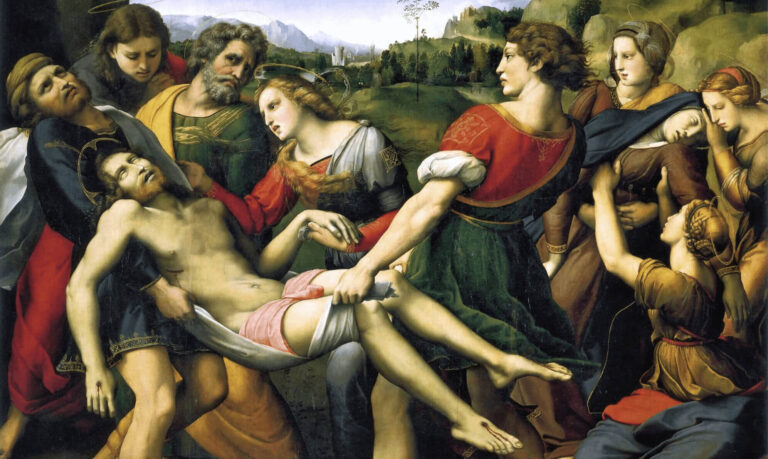
An act of family revenge becomes one of the most moving and ambitious paintings of Raphael’s early career.
As the 16th century dawned over the rolling Umbrian hills, Perugia was in a ferment. The Baglioni and Oddi families were engaged in a brutal turf war for control of the city, and their bitter rivalry was spilling out onto the city streets. Blood was being shed with alarming regularity, culminating in the knifing of the thuggish young Baglione scion Grifonetto in broad daylight one July day in 1500 at the hands of his own cousin Gian Paolo. In mitigation, Grifonetto had attempted to murder his assailant and much of his family the night before in a failed family coup.
Grifonetto bled out in the arms of his weeping mother Atalanta, who moments earlier had refused him refuge, so disgusted was she by his betrayal of the family. Still grieving, some years later she called on Raphael to paint an altarpiece depicting the transportation of Christ’s body to the tomb for the family chapel in Perugia’s San Francesco al Prato, in honour of her murdered son.
The young Raphael jumped at the chance to paint a large-scale narrative painting; according to Leon Battista Alberti’s influential theory of Renaissance art, this type of painting, known as an istoria, was the final proving ground for a painter seeking to demonstrate his mastery of the field. After an extraordinary series of preparatory drawings, the final composition Raphael came up with was as original as it was unforgettable.
Two men struggle mightily with the dead weight of Christ in the foreground as they haul his body away from Golgotha, where the crosses of martyrdom are still visible in the background. A series of biblical figures express varying stages of grief around the Messiah’s lifeless body. Beautiful Mary Magdalene takes Christ’s hand in hers with an expression of infinite sadness; St John stares at the empty eyes of Jesus, his hands clasped in prayer, whilst the elderly Nicodemus involves us in the ancient scene by fixing us with his penetrating and despairing gaze.
Most touchingly of all, the Virgin Mary collapses in a swoon of anguish, overcome by the sight of her dead son. The scene must surely have evoked for Atalanta the moment she held the body of her own dying son on the streets of Perugia seven years earlier. The striking young man at the centre of the composition, struggling with Christ’s legs, is often interpreted as an idealised portrait of Grifonetto himself.
The painting was soon hailed as a masterpiece, and remained one of the most prized works in Italy until the avaricious and unscrupulous Cardinal Scipione Borghese sent a gang of hired goons to strip it from its altar in 1608 and bring it to his Roman villa, where it still hangs to this day.

Two Renaissance intellectuals pause their conversation to meet our gaze across five centuries.
In addition to his talents as a painter of epic historical frescoes, pious altarpieces and riotous scenes from ancient mythology, Raphael was also one of the greatest portraitists ever to pick up a brush. His extraordinarily realistic depictions of popes and cardinals, poets and diplomats are probing psychological analyses that still bring their distant sitters vividly to life five centuries later.
One of the finest is the remarkable double portrait of Agostino Beazzano and Andrea Navagero, now housed in Rome’s Palazzo Doria Pamphilj. The fashionably attired sitters were both Venetian men of letters and diplomats who came to Rome in 1516, and Raphael’s painting captures them looking up from their learned conversation to stare us directly in the eye.
The portrait was intended as a gift for the renowned humanist Pietro Bembo, who could thus virtually take part in the discussion with his magnificently portrayed friends. It is a wonderfully intimate encounter with the intellectual world of Renaissance Rome, in which friendship, literary ambition and political life were often closely intertwined.
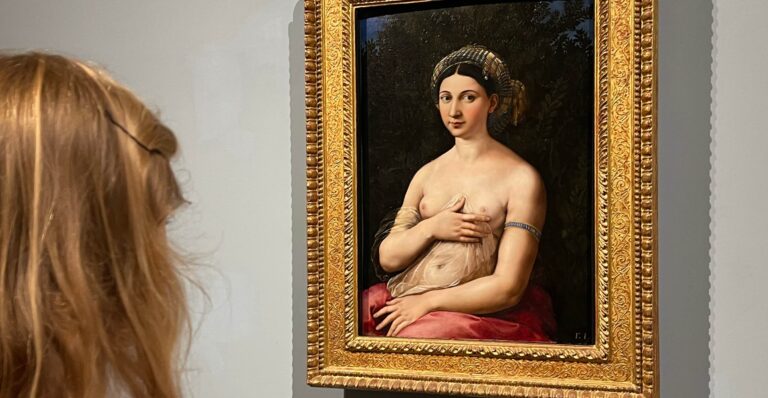
An intimate, enigmatic portrait brings us tantalisingly close to Raphael’s private life.
Here’s to the baker’s daughter. Raphael’s startlingly realistic portraiture wasn’t limited to the rarefied circles of powerful men. The disarmingly intimate portrait known as La Fornarina, now hanging in Rome’s Palazzo Barberini, shows a dramatically different side of the painter.
A young woman wearing an exotic headdress stares frankly out at us as she ineffectually covers her bare breasts with a transparent veil, whilst a bracelet on her left arm bears Raphael’s own signature. The intimacy of the portrait is unlike almost anything else in Raphael’s oeuvre, and for good reason: the sitter is widely thought to be Margarita Luti, the daughter of a local baker and Raphael’s lover at the time of his death in 1520.
Raphael was apparently utterly besotted by Margarita, to the degree that Agostino Chigi arranged for her to live at the Villa Farnesina while Raphael was working there in a desperate bid to keep the artist focused on the grand commission. Some contemporary accounts even suggested that Raphael’s untimely demise was brought on by a particularly over-eager lovemaking session with Margarita.
Giorgio Vasari takes up the story with gusto in his near-contemporary Lives of the Artists, describing how Raphael returned home one night from Margarita’s bed with a raging fever. Too embarrassed to tell his doctors what had happened, the artist allowed them to treat him by bleeding him, which hastened his demise.
There is at least a kernel of truth to the story: Raphael certainly died after a short illness accompanied by a high fever, which his physician made worse by adopting the medically dubious technique described by Vasari. Whether the saucy cause of the fever claimed by the historian has any truth to it is of course impossible to establish, as is the claim that the two were secretly married on the basis of the ring the sitter wears on her finger.
Whatever the truth, the ambiguous Fornarina is one of the great portraits of Renaissance art, and a fascinating insight into the private world of Raphael.

Raphael answers Michelangelo’s monumental grandeur with a prophet of astonishing physical power and grace.
Whilst he was working on the Vatican frescoes, the amazingly industrious Raphael also found time to paint a fresco depicting the prophet Isaiah for the altar of the learned German Augustinian monk Johann Goritz in the church of Sant’Agostino, across the road from Piazza Navona. Andrea Sansovino had already provided a beautiful sculpture of St Anne, the Virgin Mary and the Infant Christ for Goritz’s altar, and Raphael’s thundering prophet was a worthy addition to the ensemble.
Isaiah is a monumental figure, obviously influenced by the powerful style pioneered by Michelangelo in the Sistine Chapel. Twisting with extraordinary force as taut muscles and sinews stretch and strain beneath his garments, the prophet’s exposed left leg has given rise to one of the great quips in the history of art.
According to legend, Goritz complained to Michelangelo about the high price Raphael had charged for the fresco, to which the great master irritably replied: “The knee alone is worth the price.”
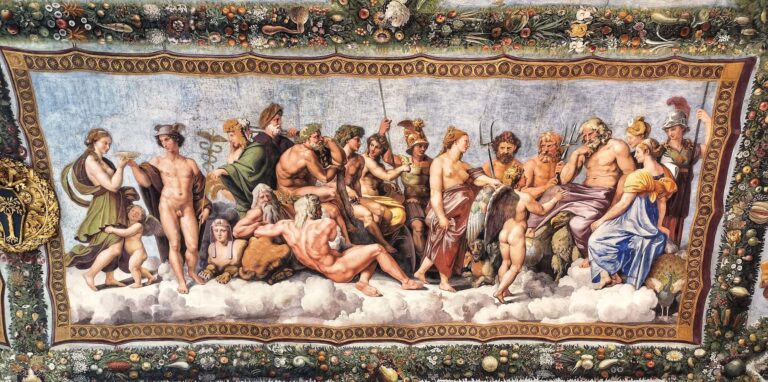
A papal banker’s riverside pleasure palace becomes a setting for the loves of gods and mortals.
What happens when the vast wealth of the Pope’s personal banker joins forces with the talents of the greatest painter of the Italian Renaissance? The spectacular answer is the Villa Farnesina, a sumptuous pleasure palace built on the banks of the Tiber for the fabulously wealthy Agostino Chigi, financier to the popes, at the start of the sixteenth century.
Blessed with an apparently limitless supply of ready cash, Chigi spared no expense in realising his vision of a country retreat on the very doorstep of the city, a suburban villa from where he could effectively run his business empire and throw lavish parties that epitomised the bella figura of a golden age.
Chigi engaged Raphael to provide the interior decorations, and the fresco of Galatea in the villa’s principal hall is one of the artist’s most enduring creations. Raphael’s treatment of classical mythology is a riot of movement and invention. The sea nymph Galatea is pursued by the blundering one-eyed Cyclops Polyphemus, who has fallen hopelessly in love with her, only to be rejected in favour of the handsome shepherd Acis. The story is told in ancient poetry, notably by Theocritus and Ovid, and Raphael gives it a contemporary visual exuberance all its own.
Galatea leaves the lovelorn and furious monster far behind as she races over the waves in a shell drawn by dolphins, whilst putti and sea gods herald her journey. The composition is a dazzling celebration of the body in movement and the chromatic possibilities of the fresco medium, with Raphael demonstrating that his command of classical antiquity extended well beyond the philosophical solemnity of the Vatican.
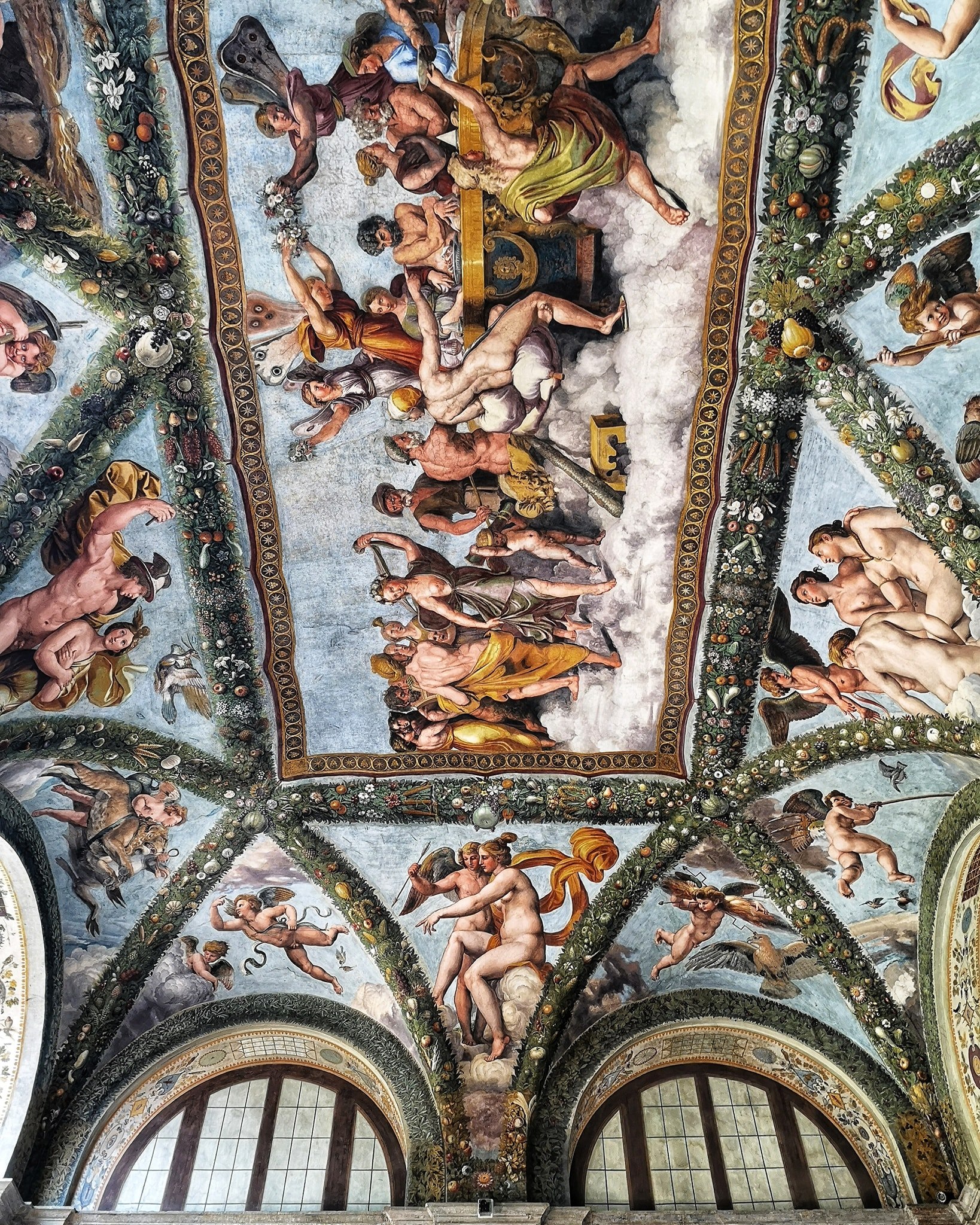
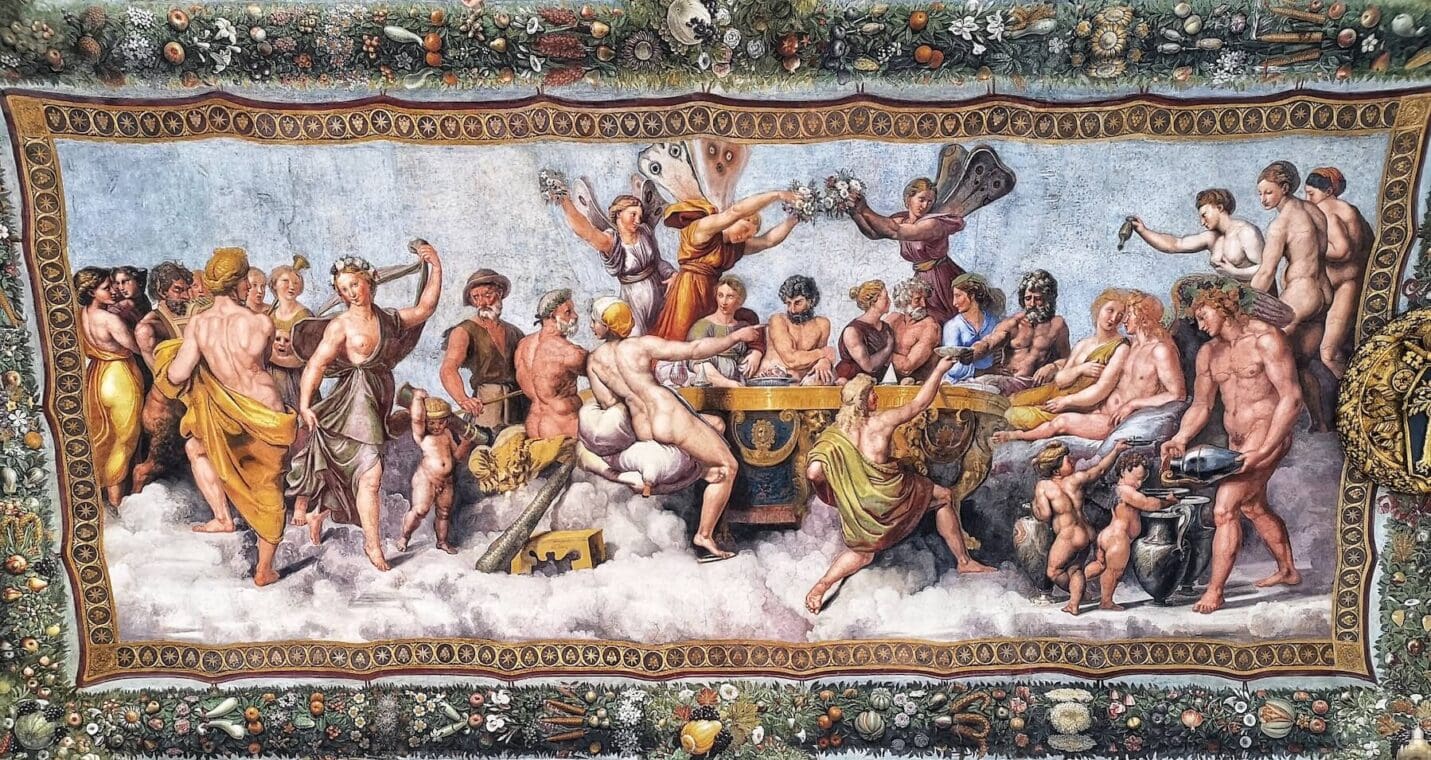
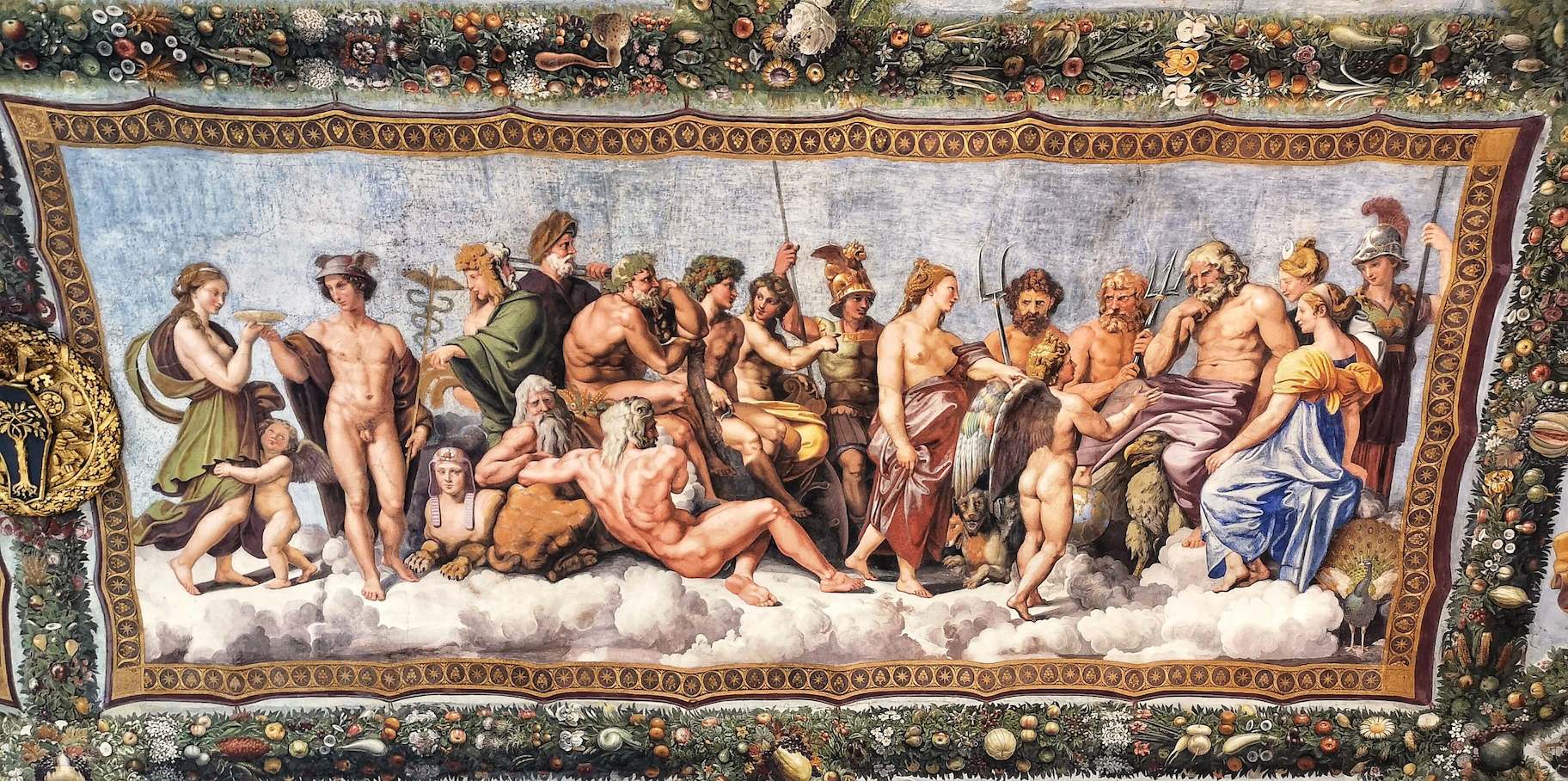
As stunning as the Galatea fresco is, the Raphael-designed Loggia of Cupid and Psyche leading out into the villa’s garden might be even more spectacular. Depicting the love story of Cupid and Psyche from Apuleius’ Metamorphoses (better known as The Golden Ass), the elaborate fresco cycle weaves through illusionistic pergolas of fruits and flowers as it traces the fortunes of the star-crossed lovers, whose trials ultimately lead to Psyche’s welcome among the gods.
Raphael and his assistants decorated the loggia when Chigi was preparing to marry his mistress Francesca Ordeaschi. The magnificent scene of the celestial wedding banquet of Cupid and Psyche is a brilliant foreshadowing of the upcoming nuptials, one of the most important social events in sixteenth-century Rome, attended even by the Pope himself.

Raphael the painter becomes Raphael the architect, designing a miniature universe in marble, mosaic and celestial geometry.
The sumptuous Villa Farnesina wasn’t the only commission entrusted to Raphael by the fabulously wealthy Chigi. If the riverside mansion was a magnificent expression of Chigi’s lust for life and terrestrial verve, then the brooding mortuary chapel that he had Raphael design for him in the beautiful church of Santa Maria del Popolo is testament to the banker’s concern for his eternal soul. This time Raphael wasn’t just responsible for the decorations – the painter had become architect.
Where the Villa Farnesina is light, airy and full of the joys of love, the Chigi Chapel is more sombre, weighed down by the spectre of death. The innovatively designed mausoleum is surmounted by a miniature version of the Pantheon’s dome. In place of the oculus at its centre, a mosaic of God the Father sets the universe in motion. The tomb of Chigi himself takes the form of a flattened pyramid of marble, a traditional symbol of eternity.
To Raphael we also owe the design of the sculpture of Jonah, executed by Lorenzetto, although the chapel’s most impressive statues – those of Daniel and Habakkuk – were added by Baroque master Bernini over a century later, who completed the ensemble.
Raphael died before the chapel was completed, but his connection with the project has an extraordinary final twist. Agostino Chigi died just five days after Raphael himself, in April 1520. The chapel therefore became a monument to both patron and artist, completed after their deaths but still preserving Raphael’s vision of a unified space in which architecture, painting, sculpture and mosaic work together to express the Chigi family’s hopes for immortality.
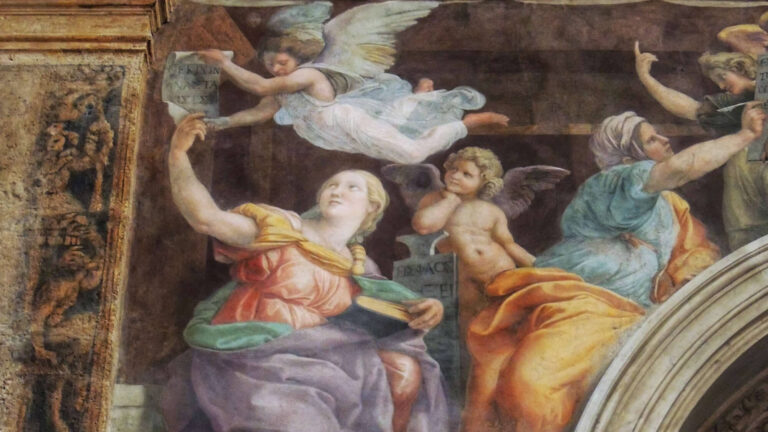
Four ancient prophetesses announce the coming of Christ in a composition that answers Michelangelo on his own terms.
Continuing the dynamic partnership between the most in-demand painter of the Renaissance and the 16th-century’s richest man, Chigi also employed Raphael to fresco the family chapel in Santa Maria della Pace in 1514. The pint-sized church itself is tucked away in one of the historic centre’s most charming piazzas, and is notable for Pietro da Cortona’s elegantly curving Baroque façade as well as Bramante’s stunning Renaissance cloister.
Inside, what the church lacks in size it more than makes up for in artistic heritage, boasting works from the likes of Baldassare Peruzzi, Orazio Gentileschi, Antonio da Sangallo and, most impressively, Raphael himself.
On the outer wall of the Chigi chapel, the first on the right as you enter the church, Raphael painted the ancient Sibyls – Greek mythological seers who according to Christian thought predicted the coming of Christ to the pagans of antiquity. The four sibyls (the Cumaean, the Persian, the Phrygian, and the Tiburtine) surround the chapel’s upper entrance arch, studiously taking down prophecies dictated to them by angels swooping from heaven above.
The Sibyls had been immortalised in the story of art with the unveiling of Michelangelo’s Sistine Chapel ceiling just two years earlier, and the long shadow of Michelangelo is apparent in Raphael’s work. The more harmonious Raphael has however tempered the exaggerated musculature of Michelangelo’s monumental prototypes, painting the Sibyls as young women in billowing garments – powerful and yet still imbued with the artist’s ever-present sense of grace and beauty as they float charmingly above the Chigi chapel.
Tip: climb up to the upper floor of Bramante’s adjacent cloister to find one of the city’s most evocative aperitivo bars at the top. Make your way into a side room and be rewarded with a great view of Raphael’s frescoes from a window looking down into the interior of the church.

Raphael the painter becomes an architect, creating a tiny Renaissance temple whose elegant geometry still survives in the heart of the city.
Raphael’s ambitions in Rome extended well beyond the walls of the Vatican. By the middle of the 1510s he was increasingly involved in architecture, and one of the most charming reminders of his work in this field is the tiny church of Sant’Eligio degli Orefici, tucked away beside the river Tiber on Via Giulia.
The church was commissioned by Rome’s guild of goldsmiths and silversmiths, who wanted a new headquarters and place of worship dedicated to their patron saint, Eligius of Noyon, himself a celebrated goldsmith. Raphael was called upon to design the building, drawing heavily on the classical vocabulary of his friend and mentor Bramante.
The result is a remarkably elegant little Greek-cross church, conceived almost like a miniature ancient temple. Four substantial piers organise the compact interior, whilst the dome rises above the crossing on a circular drum. The restrained geometry and classical proportions give the building an architectural clarity that feels very different from the exuberance of the Villa Farnesina or the monumental spectacle of the Vatican, but the same fascination with the architecture of antiquity is everywhere apparent.
Raphael did not live to see the church completed. Work continued after his death, with Baldassarre Peruzzi and Bastiano da Sangallo among those involved in bringing the project to fruition, and the dome itself was completed only after Raphael’s lifetime. The building also suffered serious damage over the centuries, including a major collapse in 1601, followed by restoration.
Despite all this, Sant’Eligio retains much of the character of Raphael’s original conception, and offers a vivid glimpse of the Raphael who was increasingly turning his attention to the buildings of ancient Rome and to the possibilities of Renaissance architecture.

Raphael’s final masterpiece brings heavenly revelation and earthly suffering together in one astonishing vision.
“Christ was transfigured before them, and his face did shine as the sun, and his raiment was white as light.”
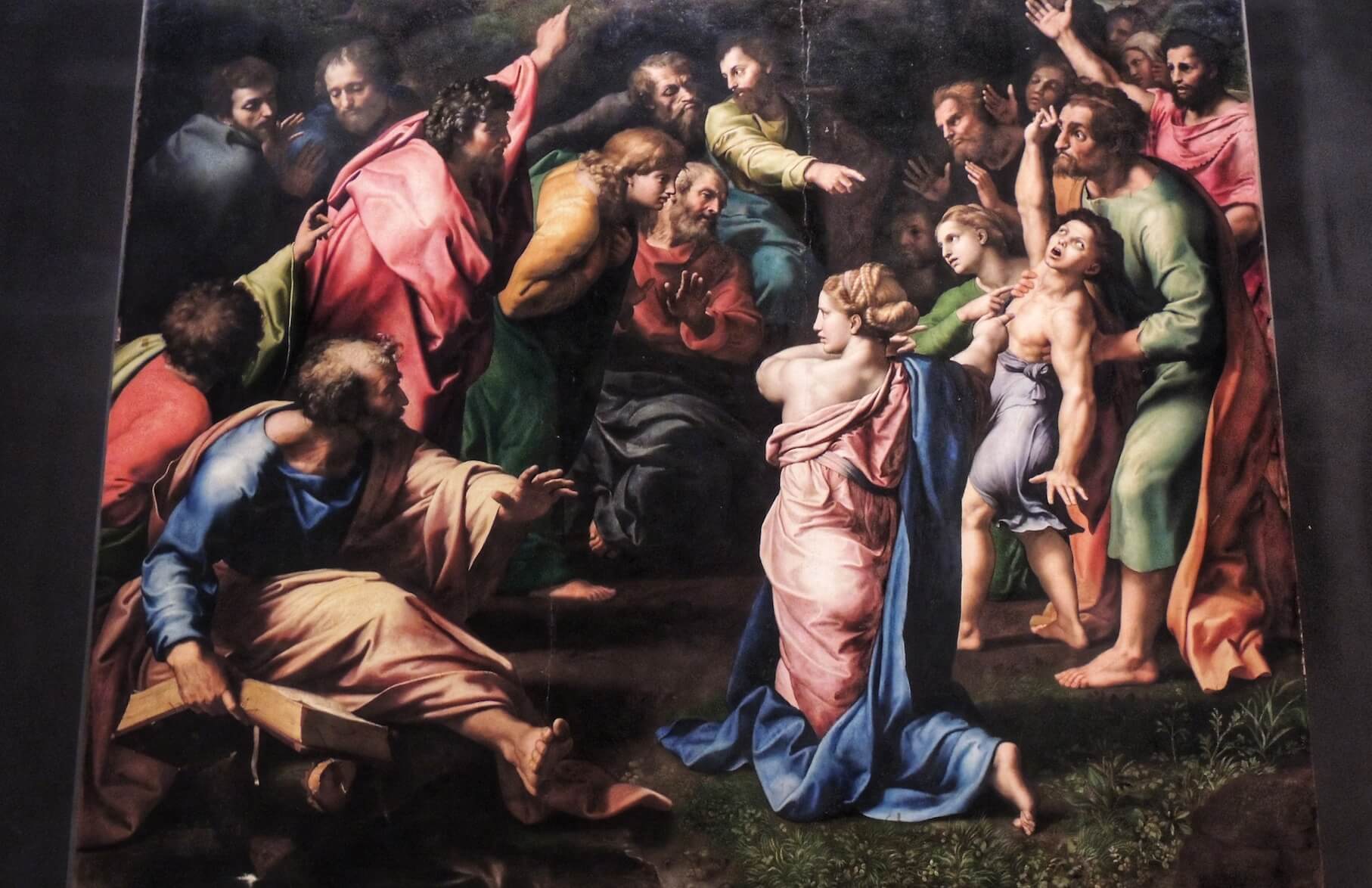
The last work Raphael was destined to paint in his illustrious but tragically short career is considered by many to be his finest. Commissioned by Giulio de’ Medici – the future Pope Clement VII – the massive altarpiece was intended to adorn the cathedral of Narbonne in France, where Giulio was archbishop.
The subject is a dramatic moment in the New Testament, when Jesus has gone with his disciples to pray on a mountainside. The Messiah is suddenly surrounded by a halo of blinding white light, whilst the apparitions of Moses and Elijah appear beside him and a voice from the sky proclaims him the Son of God.
In order to depict this fundamentally mysterious miracle, Raphael resorts to a virtuoso harnessing of the power of light. We can almost feel the blinding celestial rays illuminating the mountaintop, whilst Peter, James and John recoil in astonishment at the vision before them.
Raphael in fact combines the events of the Transfiguration with the subsequent Gospel narrative, when Christ’s apostles struggle in vain to cure a young boy possessed by a demon. The boy would have to wait for Jesus’ return from the mountain to be healed.
A masterpiece of composition and colouring, the contrast between the celestial world of divine revelation, suffused with blinding white light, and the terrestrial world below, where extraordinarily realistic figures gesture desperately around the suffering boy, shows Raphael as the master of two very different artistic registers. The result is both a theological statement and a profoundly human drama.
When the raging fever that carried Raphael to his grave struck the painter, the Transfiguration was all but finished. According to legend, it stood at the foot of his deathbed as his condition worsened, a silent last will and testament to the man who would be hailed as the “God of Art” upon his death.
Today, the painting hangs in the Vatican Pinacoteca, where its extraordinary combination of celestial grandeur and earthly anguish provides a fitting culmination to any exploration of Raphael’s art in Rome. The Pinacoteca also preserves another extraordinary chapter in Raphael’s Roman career: the great tapestries of the Acts of the Apostles. Commissioned by Leo X for the lower walls of the Sistine Chapel, the series was based on enormous preparatory cartoons designed by Raphael and his workshop, depicting episodes from the lives of St Peter and St Paul.
The cartoons were sent to Brussels, where the celebrated weaver Pieter van Aelst transformed them into sumptuous tapestries woven with precious threads. The tapestries were designed to be displayed in the Sistine Chapel itself, where they would have hung beneath Michelangelo’s famous ceiling and created a remarkable dialogue between the two great rivals of Renaissance Rome.

Some of Raphael’s most ambitious Roman projects survive behind doors that most visitors will never pass through.
For all the extraordinary riches of Raphael’s Rome that remain open to visitors, some of the artist’s most intriguing projects are frustratingly difficult to see. Behind the closed doors of papal palaces and Renaissance villas survives the larger world that Raphael was helping to create when he died at just 37. Two in particular hint at the extraordinary architectural and decorative world Raphael was creating for the papal court in the final years of his life.
Villa Madama
On the slopes of Monte Mario, overlooking the Tiber, stands Villa Madama, one of the grandest Renaissance villas in Rome. Raphael was commissioned to design the villa for Cardinal Giulio de’ Medici, the future Pope Clement VII, and conceived an ambitious complex inspired by the monumental country villas of ancient Rome. The plan included terraces descending towards the river, a great circular courtyard and a spectacular loggia drawing on the architecture of the Roman baths.
Raphael died before the project could be completed; Antonio da Sangallo the Younger took over the construction, while Raphael’s pupils Giulio Romano and Giovanni da Udine were responsible for much of the extraordinary decoration. The surviving loggia is particularly magnificent, with elaborate stucco work, frescoes and grotesque ornament inspired by the ancient Roman decorations recently rediscovered in the ruins of Nero’s Domus Aurea.
The villa’s later history was almost as eventful as its creation. It passed through the hands of the Medici, Farnese and Bourbon families before eventually becoming state property and the representative headquarters of Italy’s Ministry of Foreign Affairs. It is also tantalisingly off limits. Villa Madama is currently closed to ordinary tourist visits, with access restricted by its institutional use and security requirements. Very occasionally visits can be organised by special permission.
The Vatican Loggia
Even closer to the heart of Raphael’s papal world is the magnificent Loggia in the Apostolic Palace. Raphael took over the project after Bramante’s death and transformed the long corridor overlooking the San Damaso courtyard into one of the most extraordinary decorative schemes of the Renaissance.
Here Raphael and his workshop covered the walls and vaults with delicate grotesques, small biblical scenes, illusionistic architectural details and an astonishing variety of botanical and ornamental motifs. The inspiration came from the recently rediscovered ancient Roman decorations of the Domus Aurea, and the effect helped launch the fashion for grotesque ornament that would spread across Europe.
The Loggia was also a measure of Raphael’s extraordinary status at the papal court. By this stage he was no longer simply a painter summoned to decorate a room: he was directing a large workshop, advising on architecture and antiquities, and shaping the visual language of the papal palace itself.
Unfortunately for the curious visitor, the Loggia is part of the Apostolic Palace rather than the ordinary Vatican Museums route and is not normally open to the public. In 2026 the Vatican began a major five-year conservation project on the Loggia, underlining both the importance of the decoration and the fragility of the five-hundred-year-old paintings.

Raphael’s works are scattered across the city, and seeing them all involves a little planning. The Vatican Museums are the natural starting point, with the Raphael Rooms and The Transfiguration in the Pinacoteca offering two very different encounters with the artist. Both are included in the museum visit, although the Pinacoteca is easy to overlook if you follow the crowds directly towards the Sistine Chapel.
From there, several of Raphael’s most rewarding works can be found in the historic centre. Sant’Agostino and Santa Maria della Pace are close to Piazza Navona, whilst Palazzo Doria Pamphilj lies along Via del Corso. Santa Maria del Popolo, with its Chigi Chapel, is at the northern end of the historic centre near Piazza del Popolo.
The Galleria Borghese requires a separate visit and advance reservation, while Palazzo Barberini and the Villa Farnesina have their own admission arrangements. Churches may close for religious services or outside their usual visitor hours, so it is worth checking access before setting out, particularly if you are hoping to see a specific fresco.
And then there is the Pantheon, where Raphael himself is buried. He died in 1520 at just 37, yet his reputation was already so extraordinary that he was given a place of burial inside one of ancient Rome’s most revered buildings. His tomb, beneath the elegant marble Madonna del Sasso by his friend and collaborator Lorenzetto, is a surprisingly intimate place to end a Raphael itinerary. The famous epitaph attributed to Pietro Bembo declares that Nature feared to be defeated by Raphael while he lived and to die when he died. It is an extravagant claim, but perhaps no more extravagant than the career of the young artist lying beneath it.
You could spend several days following Raphael through Rome, but even a handful of these encounters reveals the remarkable range of his imagination: the philosophical ambition of the Vatican, the sensuality of the Farnesina, the private emotions of his portraits and the extraordinary technical assurance of his final works.

Where can I see Raphael’s art in Rome?
Raphael’s works can be seen at the Vatican Museums, Galleria Borghese, Palazzo Doria Pamphilj, Palazzo Barberini, Sant’Agostino, Villa Farnesina, Santa Maria del Popolo and Santa Maria della Pace. The Vatican Museums contain the Raphael Rooms and his final masterpiece, The Transfiguration.
What is Raphael’s most famous work in Rome?
The School of Athens in the Vatican’s Stanza della Segnatura is probably Raphael’s best-known work in Rome. Its gathering of ancient philosophers, monumental architecture and carefully constructed perspective have made it one of the defining images of the Italian Renaissance.
Can I see Raphael’s frescoes in the Vatican Museums?
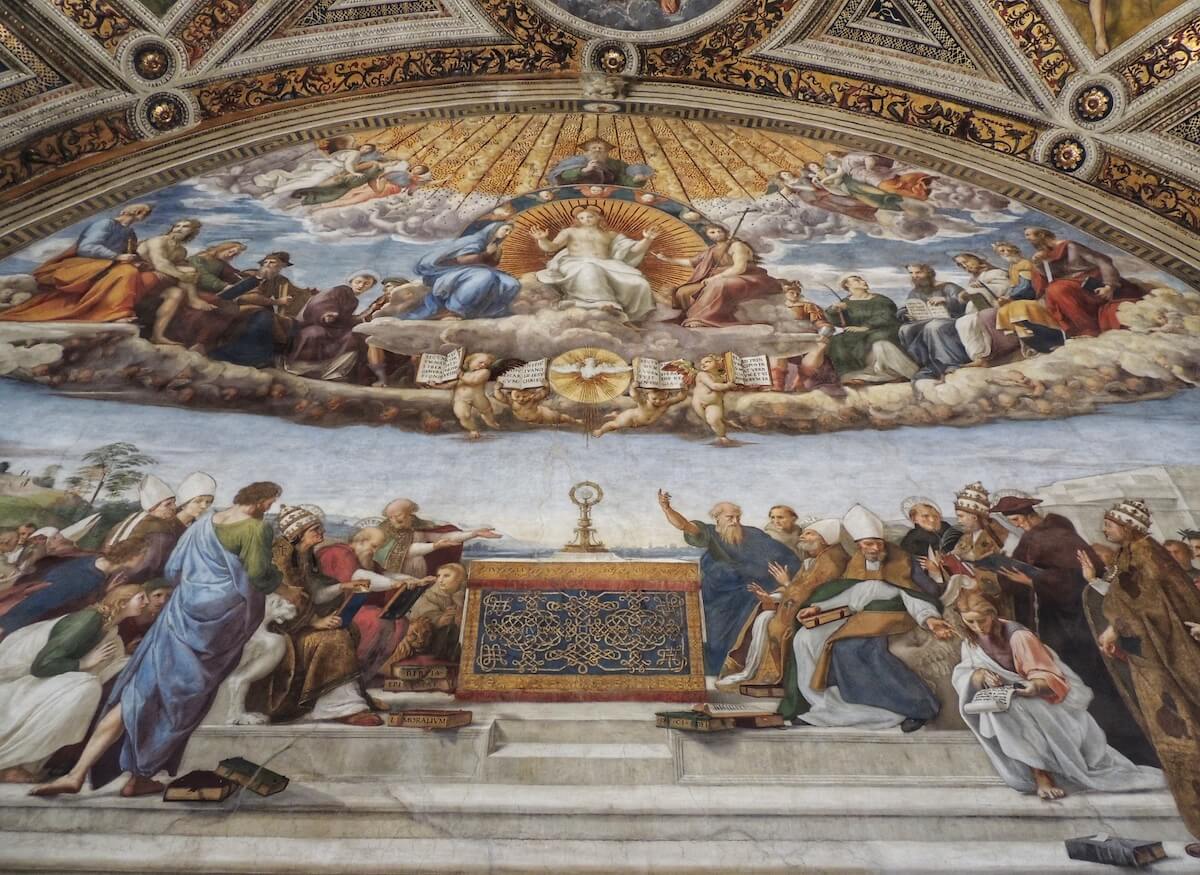
Yes. The Raphael Rooms contain some of his most celebrated frescoes, including The School of Athens, The Disputa, The Expulsion of Heliodorus and The Liberation of Saint Peter. The rooms form part of the Vatican Museums visitor route.
Where is Raphael’s The Transfiguration?
Raphael’s The Transfiguration is displayed in the Vatican Pinacoteca, the picture gallery within the Vatican Museums. It was the artist’s final major painting and was left almost complete at the time of his death in 1520.
Where can I see Raphael’s Galatea?
The fresco of Galatea is in the Villa Farnesina in Trastevere, a Renaissance villa commissioned by the wealthy banker Agostino Chigi. Raphael’s mythological frescoes and the Loggia of Cupid and Psyche are among the villa’s principal attractions.
Do I need tickets to see Raphael’s works in Rome?
The Raphael Rooms and The Transfiguration are included in a standard Vatican Museums ticket. The Galleria Borghese, Palazzo Barberini and Villa Farnesina require separate admission, while access to Raphael’s works in churches depends on their opening arrangements. Check current ticketing and visitor information before your visit.
See Raphael on a Rome Tour