In Rome's extraordinary constellation of great public spaces, Piazza Navona sits right at the summit.
An ancient racetrack transformed over two millennia into the Eternal City’s most spectacular open-air stage, it is the piazza that has everything: extraordinary Baroque fountains and churches, layers of history stretching back to the Roman Empire, a lively arts market and some of the best café terraces in the city.
This is the place to see and be seen in Rome — and yet, for all its fame, it rewards careful looking. There is far more here than at first meets the eye.
In 2024, ahead of Rome’s major Holy Year Jubilee celebrations in 2025, the entire piazza underwent a thorough restoration. Years of accumulated grime were stripped away, and the fountains now gleam as they must have looked in Bernini’s and Borromini’s own day.
If you visit Rome in 2026, you’re seeing the piazza at its very best. Here are the seven things you absolutely must not miss.
Rome Tours
See the Best of the Eternal City
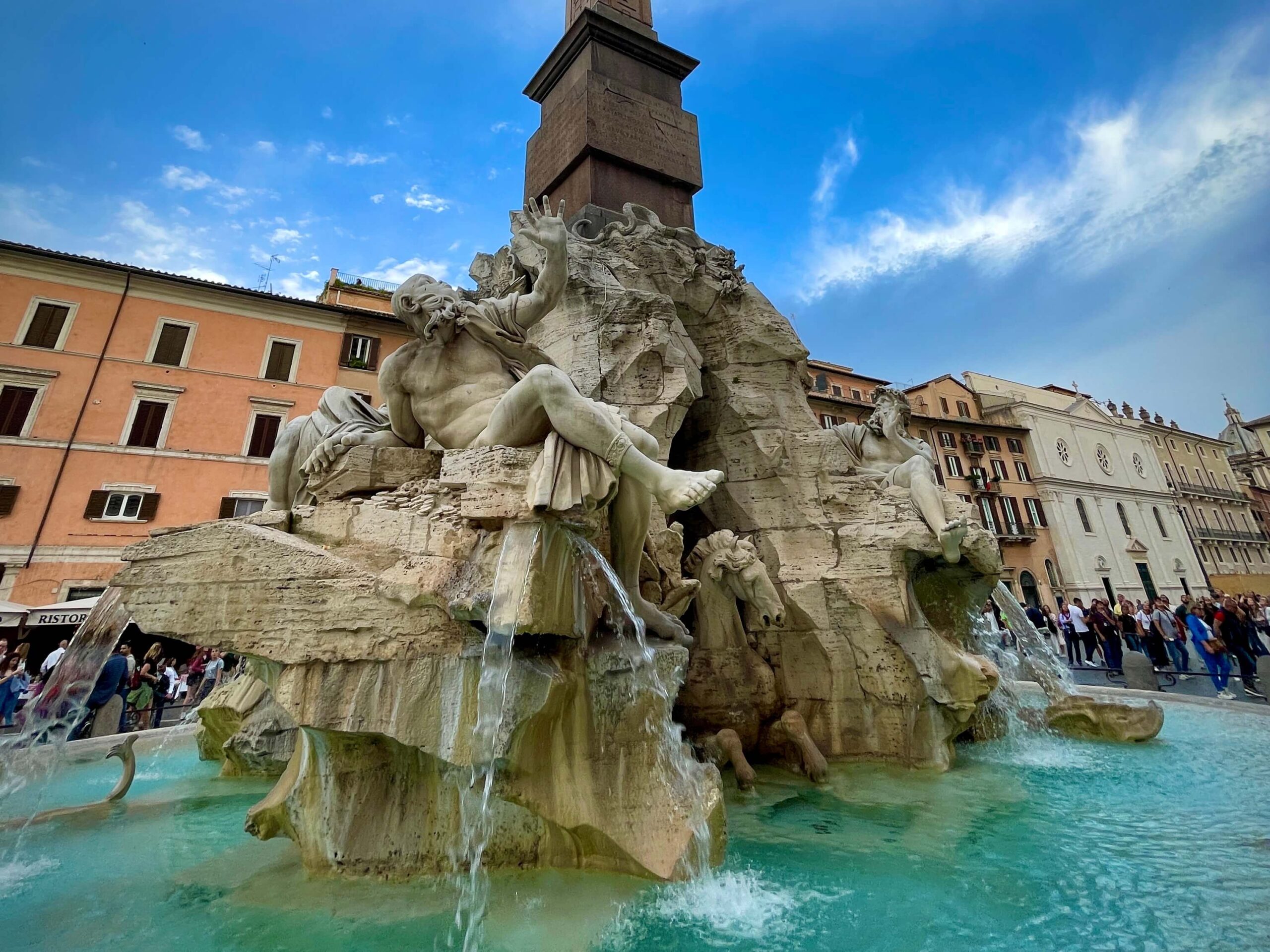
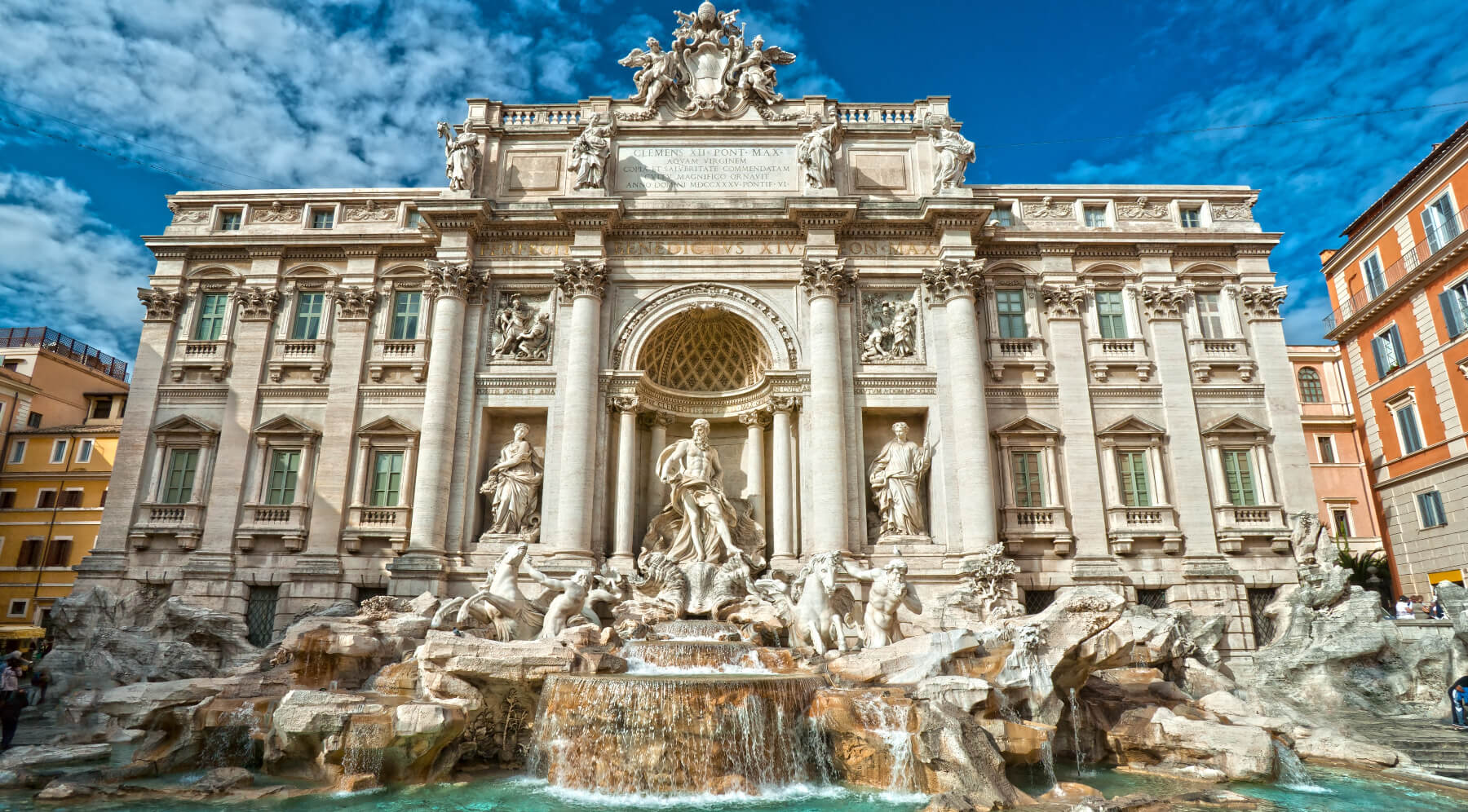
Dominating the very center of Piazza Navona, the barnstorming Fountain of the Four Rivers stands alongside the Trevi as Rome’s finest fountain. Commissioned by the Pamphilj Pope Innocent X as part of a sweeping transformation of the piazza into one grandiose monument to his powerful family, the fountain was designed by Baroque master Gianlorenzo Bernini.
Despite his status as Italy’s most sought-after artist at the time, Bernini had been previously snubbed for commissions by the Pamhilj family due to his relationship with the Barberini.
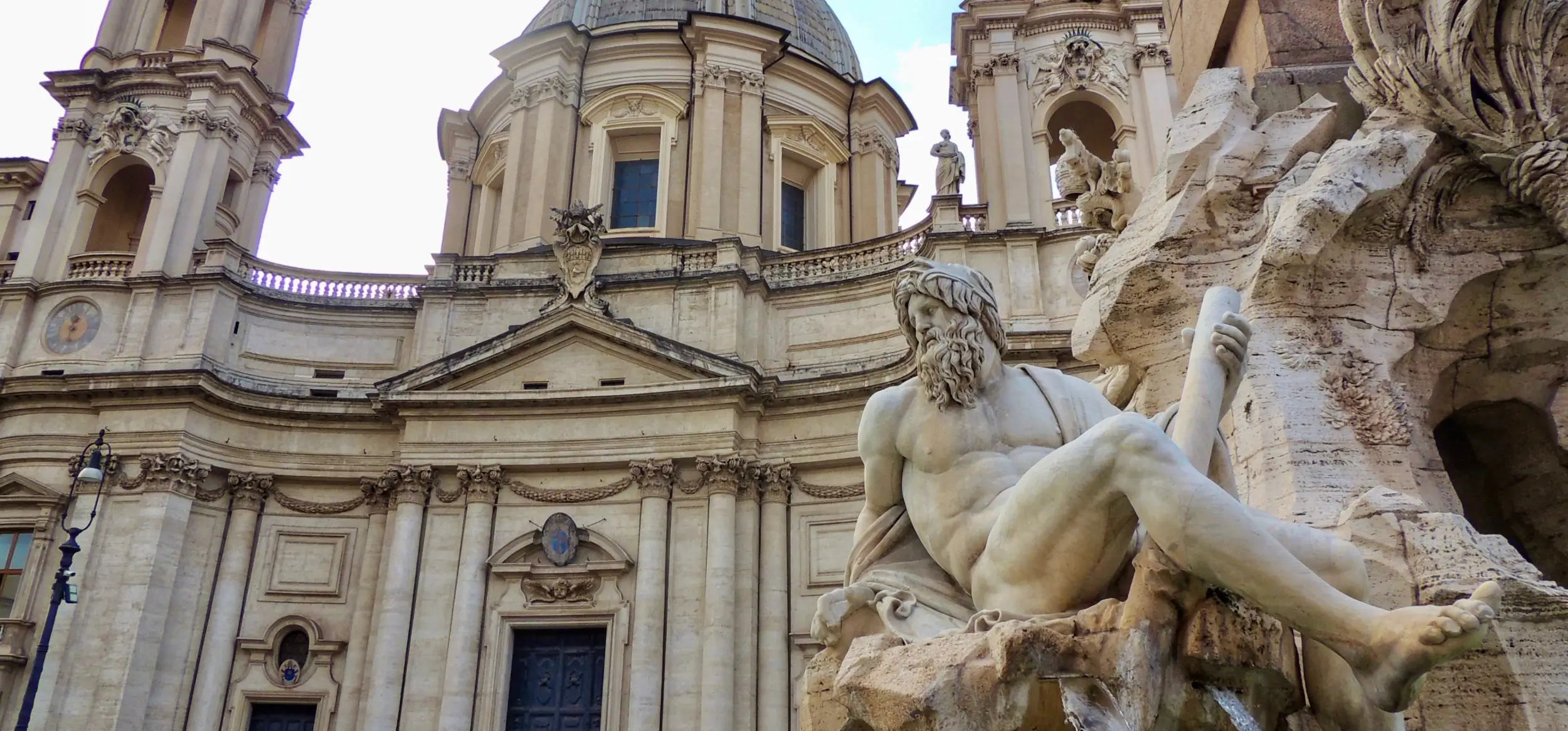
Taking the opportunity with both hands, Bernini wowed the world with an extraordinary sculptural ensemble featuring personifications of the known continents’ most important rivers holding up an Egyptian obelisk: the Danube, the Nile, the River Plate and the Ganges.
The massive figures seem to defy gravity as they float above the waters of the fountain, a perfect example of Bernini’s unique ability to astonish the viewer with virtuoso feats of artistic trickery. To read about the Fountain of the Four Rivers in more detail, check out our dedicated article here:


Standing directly opposite the Fountain of the Four Rivers, the undulating facade of Sant’Agnese in Agone is one of the most extraordinary pieces of architecture in Rome.
The church was begun in 1652 by Girolamo Rainaldi and his son Carlo as the Pamphilj family chapel, but it was Francesco Borromini who — taking over from the Rainaldis in 1653 — gave it the sensational form we see today.
The concave facade, with its twin towers flanking a bold central dome, is a masterpiece of Baroque spatial drama; it seems to breathe, as though the building itself is inhaling.
The name “in agone” does not, as is widely claimed online, refer to the painful martyrdom of the young saint Agnes — it means “at the site of the competitions,” a reference to the piazza’s ancient origins as Domitian’s racetrack.
The church marks the legendary location of Agnes’s martyrdom in the 3rd century, during the reign of Diocletian. Inside, the Greek-cross plan is topped by Ciro Ferri’s fresco of the Apotheosis of Saint Agnes in the dome above — uplifting even for the non-religious.
Entry is free. Hours: Tuesday–Sunday 9:30am–12:30pm, 3pm–7pm.

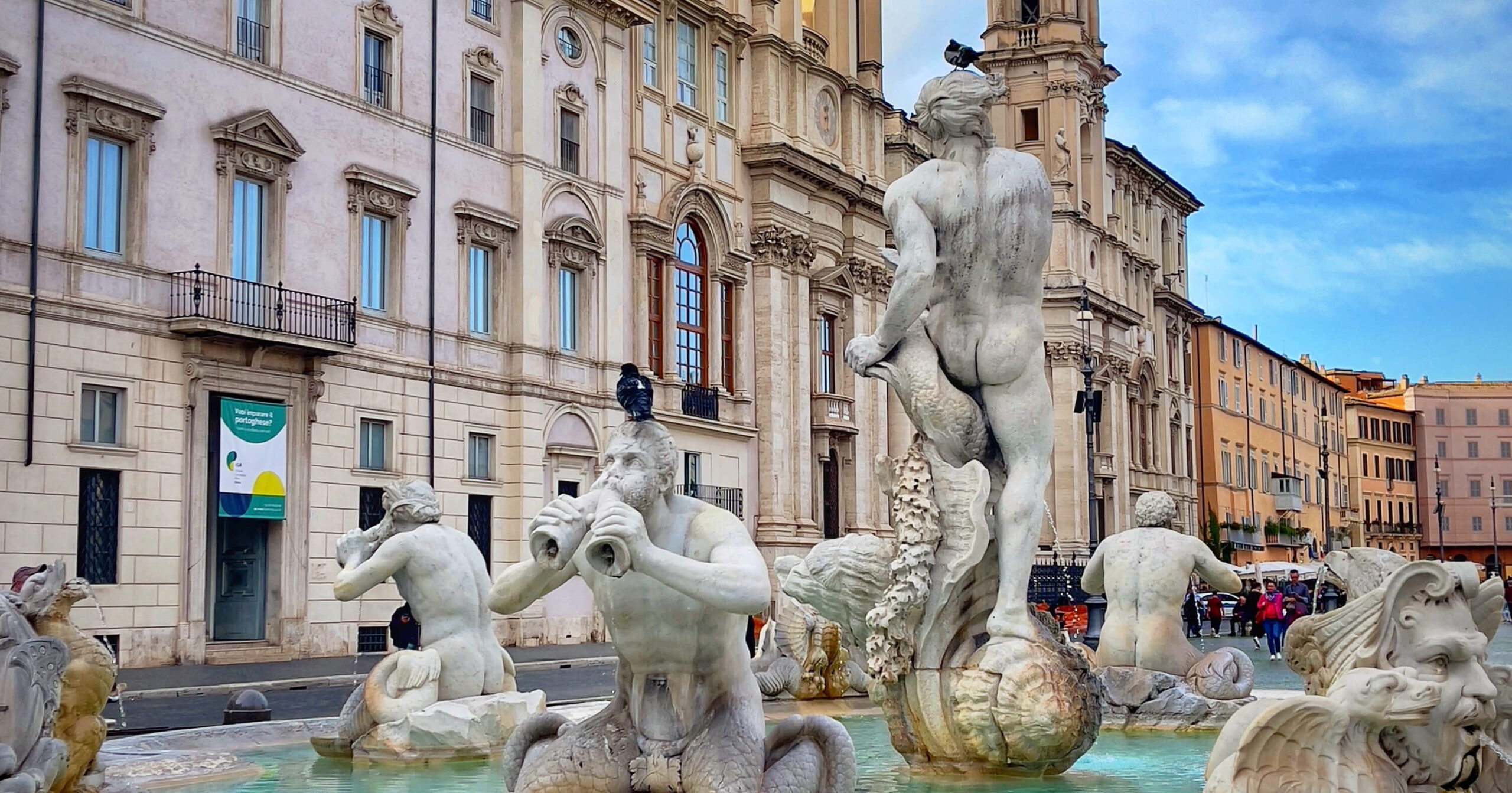
Situated at the southern end of Piazza Navona, the Fontana del Moro was begun in 1575, when Pope Gregory XIII had Giacomo della Porta design the fountain decorated with sculptures of tritons, dragons and theatrical masks.
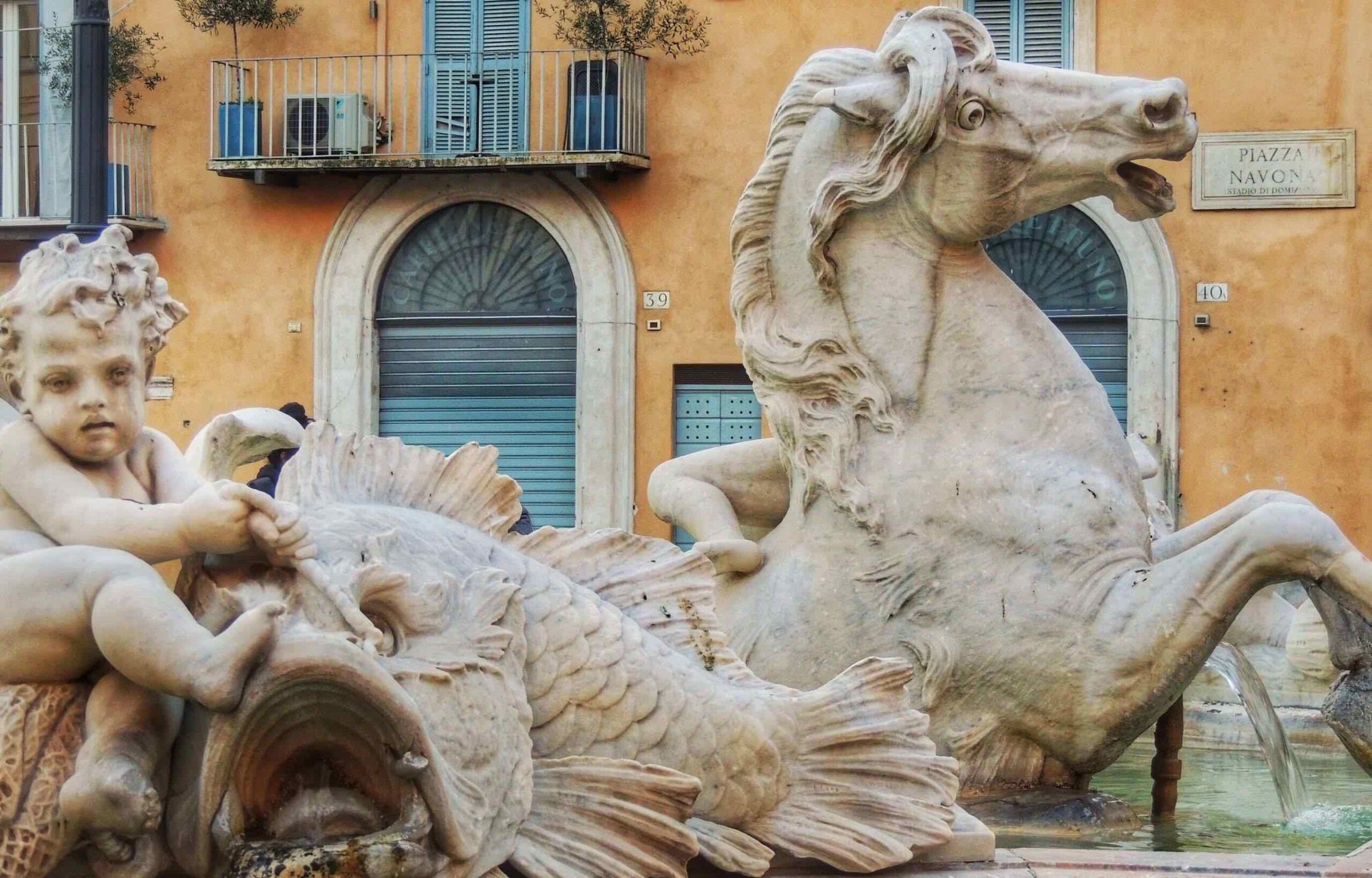
In the middle of the next century the Pamphilj pope Innocent X entrusted Gianlorenzo Bernini with redesigning the fountain – Bernini’s vision of two dolphins supporting a snail wasn’t well received, and he quickly had it replaced with the maritime figure we see today gripping a dolphin’s tail.
Despite the fountain’s title, it seems that the identification of the figure with a Moor is a much later accretion; it isn’t certain that Bernini originally meant to represent a North African here at all, and the figure was referred to as Triton or Neptune in contemporary sources.
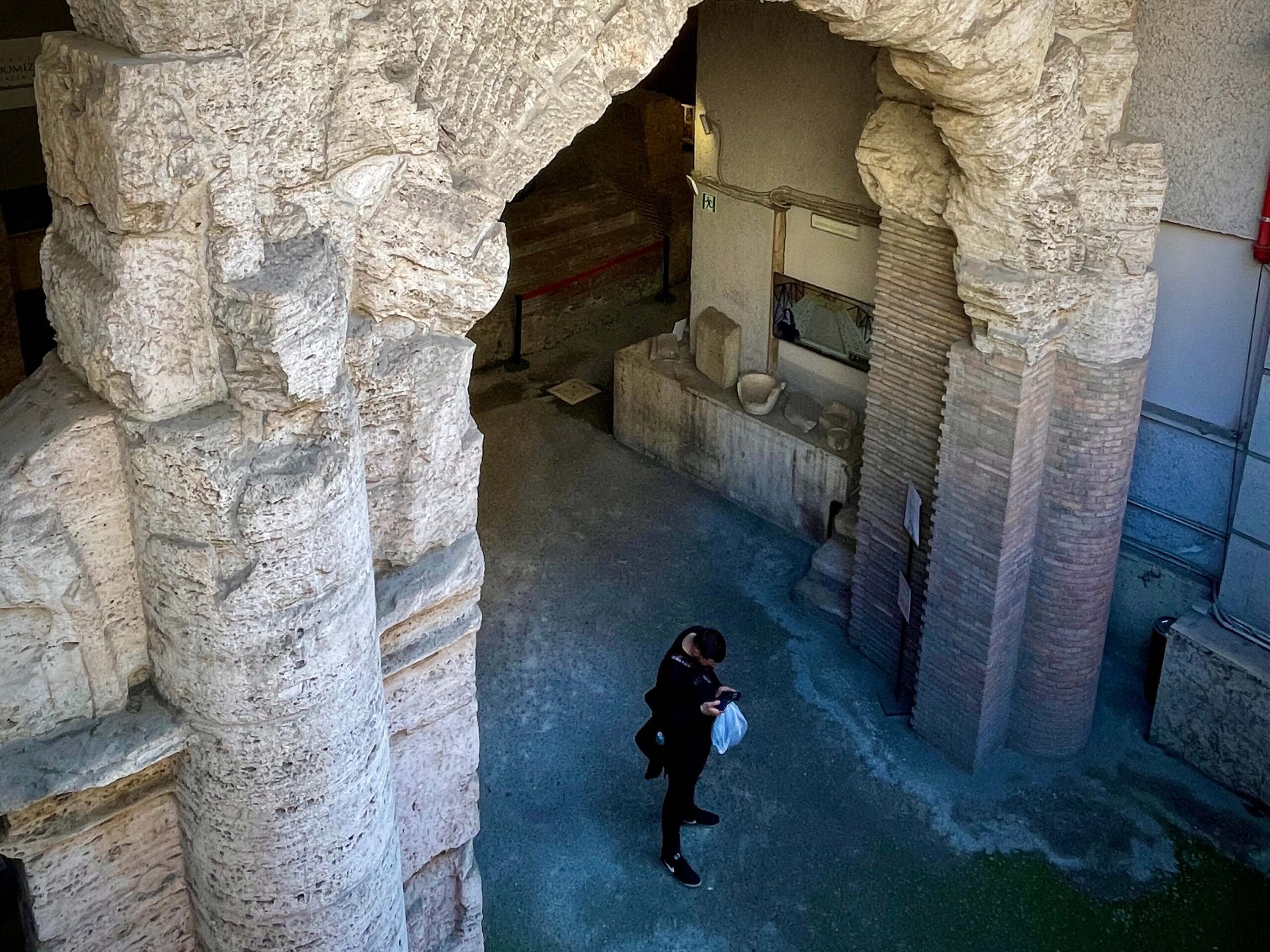
Piazza Navona owes its distinctive elliptical shape to its original function in antiquity as a racetrack – for foot races rather than chariot races – known as the Stadium of Domitian. Domitian was the final emperor in the Flavian dynasty, succeeding Vespasian and Titus, who were responsible for the construction of the Colosseum across town.
Domitian was a prolific builder, and transformed the city with dozens of large-scale infrastructural projects during his reign including this athletics venue which was completed around 86 AD. It’s estimated that the stadium could accommodate up to 30,000 people.
“Stadion” was a unit of measurement in antiquity, corresponding to around 180 meters, and refers to the standard length of races.
Although it’s impossible to get a sense of the impressive scale and architectural refinement of the long-disappeared structure, you can visit the ancient remains of the stadium’s seating area located about 15 feet below the surface of the modern piazza, which have been extensively excavated since the 1930s.
The Museum of the Stadium of Domitian is located at Piazza Tor Sanguigna 3, just off the northern end of the piazza. Open daily, 10am–7pm. Admission €9.
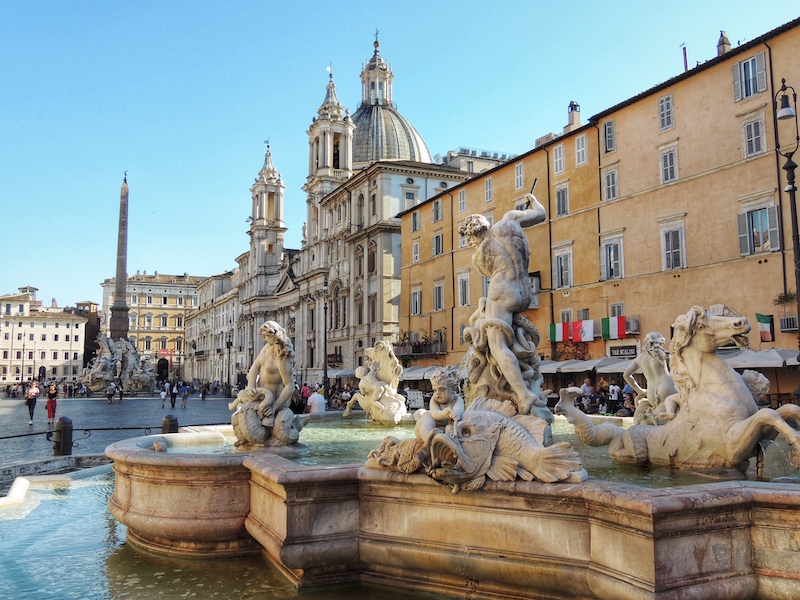
It might be less famous than the two Bernini-designed fountains that stud Piazza Navona, but the Fountain of Neptune at the northern end of the square loses nothing in dramatic force compared to its more renowned neighbors.
Here, in a dynamic display of mythological derring-do, the god of the sea wrestles fiercely with a formidable sea monster, his muscular form commanding attention amidst the swirling chaos.
Designed originally in 1574 by Giacomo della Porta, this basin was initially a simple drinking fountain, a far cry from the theatrical spectacle that greets us today. It wasn’t until the 1870s that sculptors Antonio della Bitta and Gregorio Zappalà brought the fountain to life with its vivid ensemble.
Neptune, sculpted by della Bitta, takes center stage, locked in combat with a giant octopus. Surrounding him, Zappalà added striking touches: a sea nymph arches her back, her expression a mix of terror and awe, while a rearing horse churns the water with frenzied hooves.
Though less renowned than the piazza’s central Fountain of the Four Rivers or the southern Fountain of the Moor, the Fountain of Neptune is a masterpiece in its own right.
Against the backdrop of Francesco Borromini’s graceful Church of Sant’Agnese in Agone, it offers a scene that is both dramatic and steeped in history—an unmissable stop for any visitor exploring this lively Roman square.

Running almost the entire length of Piazza Navona’s western side, the enormous Palazzo Pamphilj is the building from which the whole 17th-century transformation of the piazza was directed.
Commissioned by the newly elected Pope Innocent X in 1644 from architect Girolamo Rainaldi, it quickly became the effective centre of Pamphilj power, serving as the residence of Olimpia Maidalchini — the pope’s sister-in-law, whose influence over the pontiff was such that contemporary satirists nicknamed her “Pimpaccia di Piazza Navona” (the vile woman of Piazza Navona).
Pietro da Cortona painted the magnificent frescoed gallery inside in the 1650s, one of the great Baroque interior decorations of Rome. The palazzo has been the Brazilian Embassy since 1920 and is therefore not normally open to the public, though occasional cultural events grant limited access.
Standing at the base of the palace and looking up at its façade while simultaneously looking at the fountain Innocent X commissioned across the piazza gives you a vivid sense of how seventeenth-century papal politics played out in stone and water.

Almost entirely overshadowed by the bombastic Baroque drama of Sant’Agnese in Agone across the square, not many visitors venture into the church of Sacro Cuore that faces it across Piazza Navona.
The fact that it’s practically hiding in plain sight makes it an ideal spot to escape the crowds when the bustle of the square gets too much, however. Stop off here to be enveloped in almost total tranquility in the gloomy but interesting interior.
Built on the site of an earlier house of worship that was devoted to serving the city’s Spanish community, the church lost many of its most precious artworks when the Spanish national church was relocated to Santa Maria in Monserrato degli Spagnoli in the 17th century.
Some interesting artefacts remain, however, including a beautiful Renaissance statue depicting St. James by Jacopo Sansovino as well as dynamic 16th-century frescoes by Pellegrino Artusi, a pupil of Raphael.

Piazza Navona is freely accessible at all hours — it is a public square. There is no admission fee to enter and no tickets required to see the fountains.
The piazza is at its most atmospheric in the early morning (before 9am) and in the evening after around 6pm, when the tour groups have thinned and the light is at its most flattering.
The cafés on the square itself tend to be expensive; the bars on surrounding streets offer better value. The piazza is easily reachable on foot from the Pantheon (10 minutes), Campo de’ Fiori (10 minutes) and Castel Sant’Angelo (20 minutes).
Is Piazza Navona free to visit?
Yes. It is an open public square with no admission charge.
What are the opening hours for Piazza Navona?
The piazza itself is open 24 hours, but individual attractions within and around it have their own hours (see individual entries above).
Can you visit the Stadium of Domitian?
Yes — the excavated underground remains are open to visitors from the entrance on Piazza Tor Sanguigna, on the northern side of the piazza.
How long should I spend in Piazza Navona?
Allow at least an hour to look at the fountains, churches and principal sights in detail. Combined with the surrounding neighbourhood, half a day is entirely justified.
What is the best time of day to visit Piazza Navona?
Early morning (before 9am) for quiet contemplation, or evening after 6pm for atmosphere and lower crowd density.
What is the meaning of “in agone” in Sant’Agnese in Agone?
It means “at the site of the competitions” and is a reference to the piazza’s ancient use as Domitian’s stadium, not (as is often claimed) to the saint’s martyrdom.
Rome Tours
Discover the Magic of the Eternal City