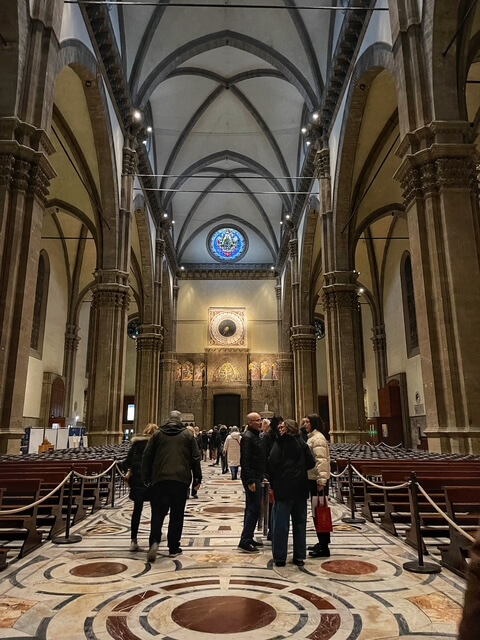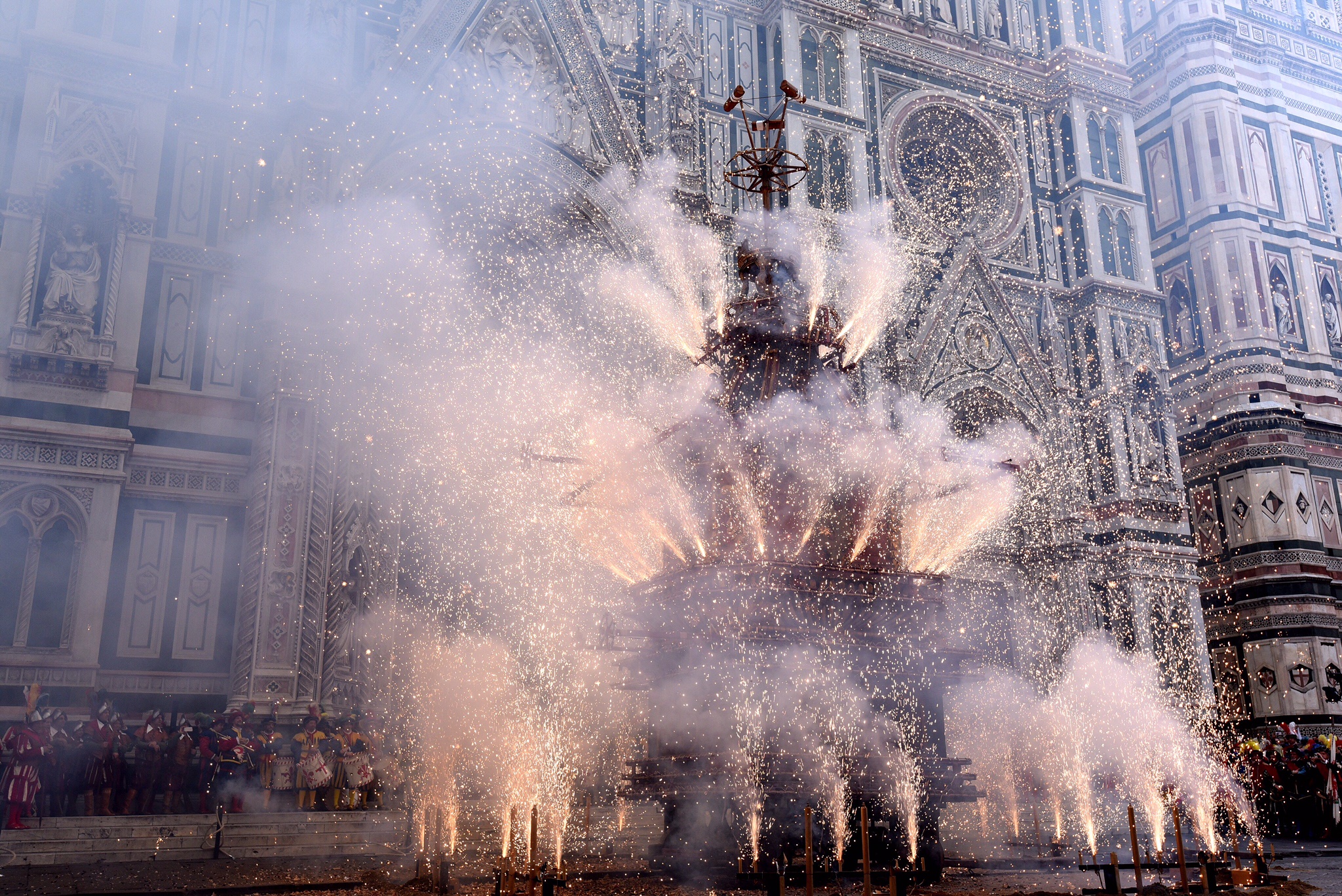
Every Easter Sunday morning, the people of Florence gather in Piazza del Duomo to watch something explode.
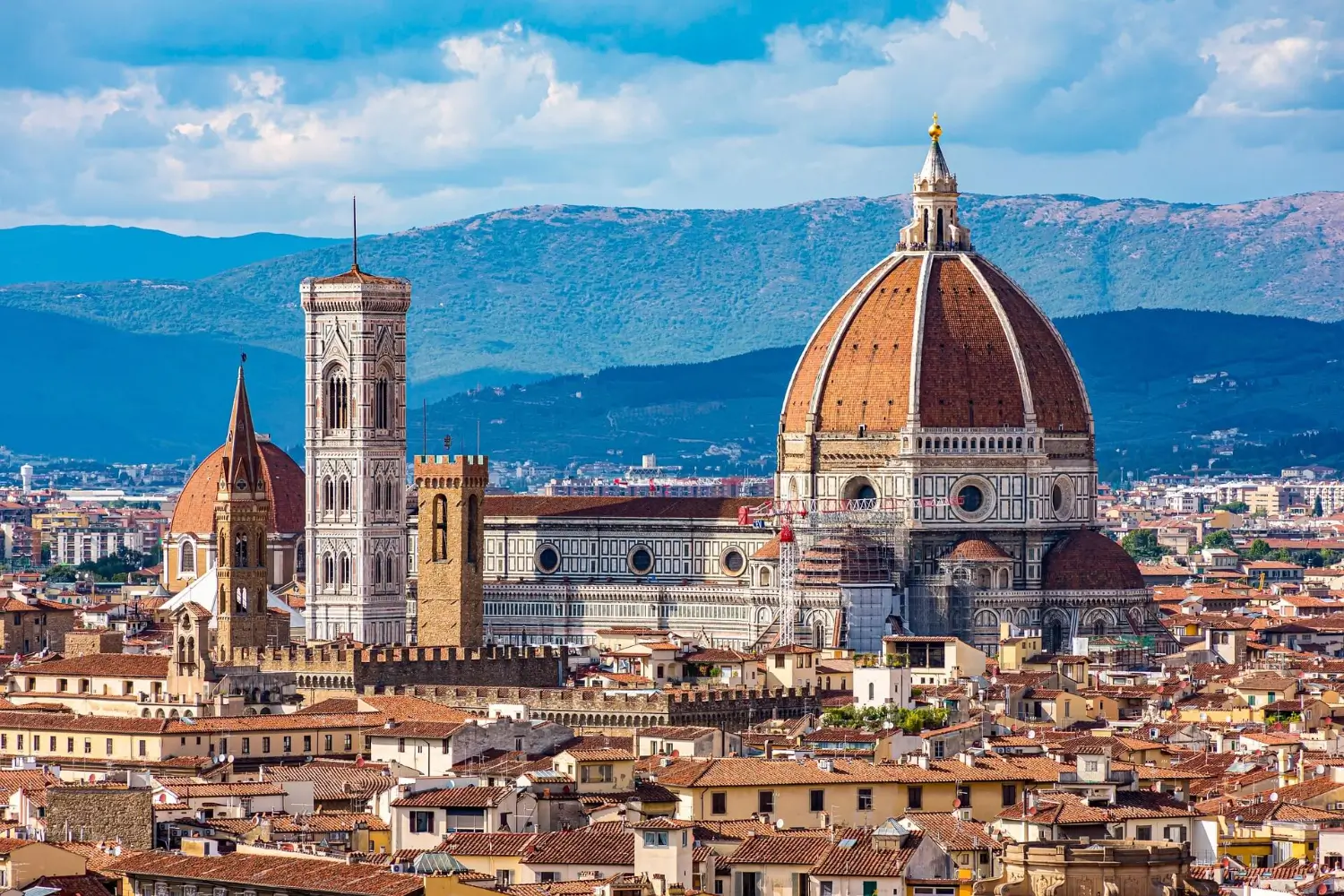
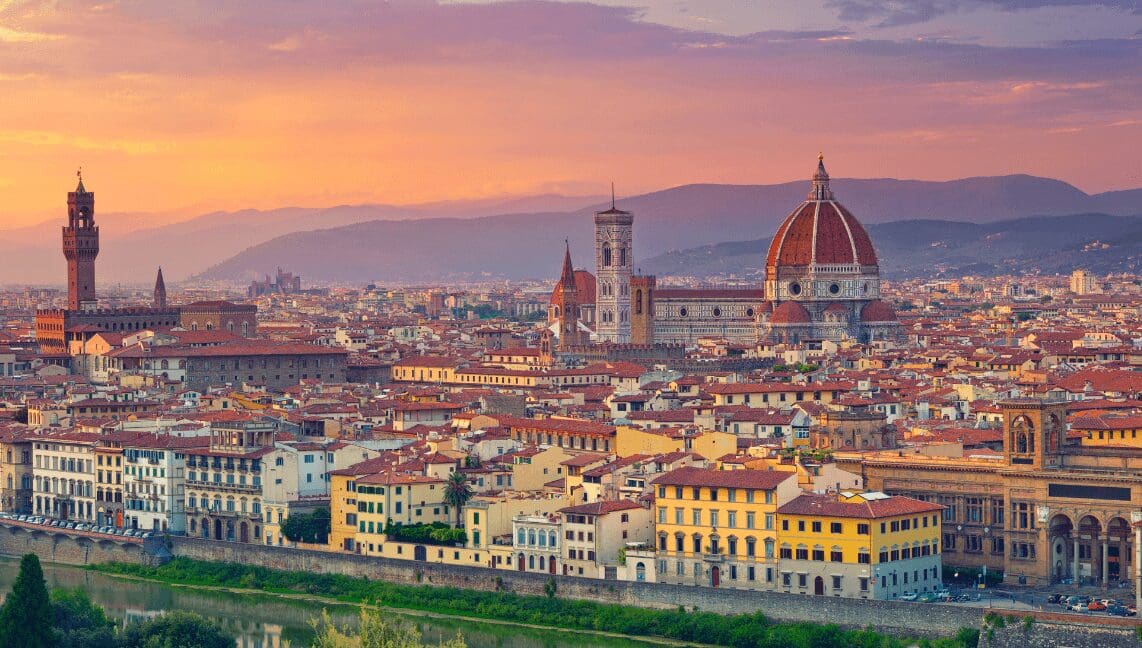
This is not a metaphor. At eleven o’clock precisely, as the choir inside the cathedral strikes up the Gloria in Excelsis Deo, a mechanical dove ignites along a wire stretched 150 metres from the high altar of Santa Maria del Fiore to a towering, intricately decorated wooden cart loaded with fireworks that stands in the space between the Baptistery and the Cathedral facade.
The dove – the colombina – reaches the cart in a matter of seconds and sets off a sequence of pyrotechnics that fills the piazza with smoke, colour, and noise. Three banners unfurl from the top of the cart – the arms of the Arte della Lana, the lily of Florence, and the coat of the Pazzi family – and flutter in the smoke and spring air above the Duomo.
This is the Scoppio del Carro, or the Explosion of the Cart, and it has been happening in this square for five centuries. It’s the centerpiece of Easter in Florence, but the event is merely the final act of a much larger story, deeply woven into Florence’s past.
It’s an Easter tradition you won’t want to miss if you are in Florence! Discover the fascinating full story with us.
Florence Tours
Experience the Magic of Florence
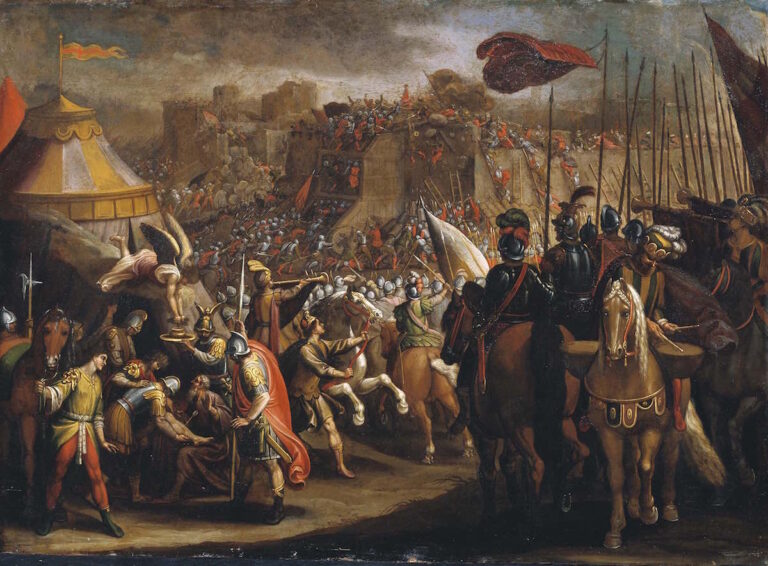
The story of the Scoppio begins not in Florence but in Jerusalem, in the summer of 1099, when the armies of the First Crusade breached the walls of the holy city after a long and brutal siege.
Among the Crusaders was a Florentine captain named Pazzino de’ Pazzi, a member of one of the city’s most powerful noble families.
According to tradition – which here, as so often in Florence, is part history and part civic mythology – Pazzino was the first man to scale the walls (with his bare hamds, no less) and plant the Christian standard on the battlements.
For his courage, Goffredo di Buglione, the Crusade’s commander, presented him with three fragments of stone from the Holy Sepulchre itself.
But why these stones? It is said that on Holy Saturday, after the liberation of Jerusalem, the Crusaders gathered in prayer at the Church of the Resurrection. There, they kindled a sacred fire from the flames of the Holy Sepulchre, passing it among themselves using torches and candles.

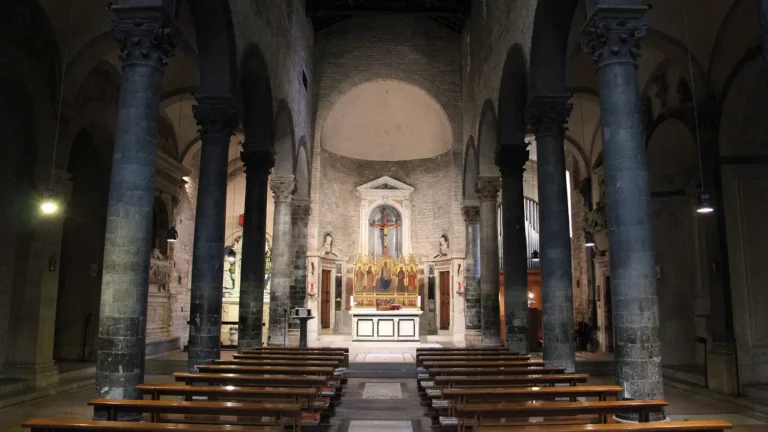
Pazzino brought the stones back to Florence, where they were received with ceremony and preserved, eventually finding their home in the small church of the Santi Apostoli — where, remarkably, they remain to this day, kept in a reliquary behind the altar.
From the beginning, the stones were used for a specific liturgical purpose: to strike a fuoco nuovo, a new fire, for the lighting of the Easter candle. Every Holy Saturday, using flint struck from the fragments of the Sepulchre, the fuoco santo — the sacred fire — was kindled and distributed to the clergy and people of Florence, who carried it home to relight their hearths.
The Holy Fire was transported around the city in an exquisite Renaissance silver lantern, which is still preserved in the Church of Santi Apostoli alongside the sacred stones. Over the following centuries, the ceremony of distributing the sacred fire grew more elaborate. A cart was constructed to carry it through the streets. The cart grew larger. The Pazzi family, whose fortunes the tradition had always tied to the ceremony, invested in increasingly spectacular pyrotechnic displays.
By the 15th and 16th centuries the ceremony had settled into something approaching its current form, and from around 1515, under the pontificate of the Medici pope Leo X, the cart was given a fixed position between the Duomo and the Baptistery where it has stood ever since.
Today, the fire is lit on Holy Saturday on the Cathedral’s parvis, and the ancient reliquary lantern is carried in procession the following day.
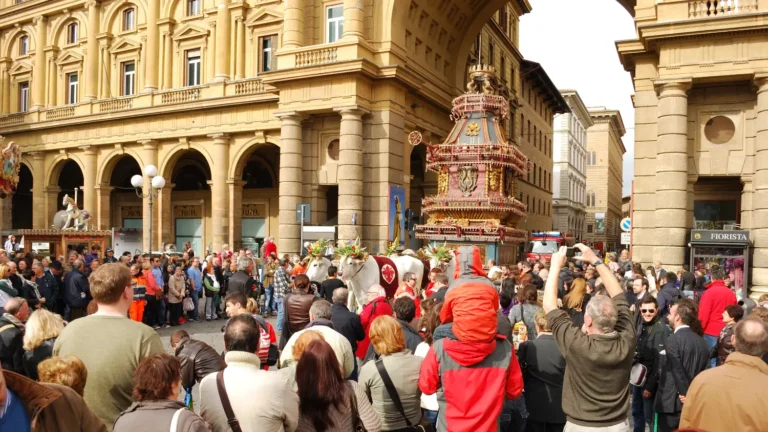
The monumental Carro di Fuoco that we see today – a towering, three-tiered wooden cart – was constructed in the 17th century with funds provided by the Pazzi family. Affectionately known as Il Brindellone, this massive structure was the brainchild of one of the most extraordinary figures in early-modern Florence. Bernardo Buontalenti was an architect, theater-designer, expert in pyrotecnics, renowned gourmet and possibly inventor of gelato, who also gave Florence the Boboli Gardens grottos and the Uffizi Tribune.
Amigst all this, Buontalenti managed to work up the designs to the monumental Easter firework cart. The current cart stands 8.7 metres tall without its pinwheel and 11.6 metres with it, articulated across three distinct floors, each decorated with gilded wooden elements: on the upper tier, gilded masks; at the summit, four reversed dolphins holding a gilded mural crown with their tails. On the sides, the flags of Florence’s four historic quarters – the same quarters whose representatives compete each June in the Calcio Storico, the historic football match that is the other great civic ceremony of the Florentine calendar.
But why brindellone? In Florentine slang the term describes a person who is tall, ungainly, somewhat unsteady, and even a bit shabby—yet regarded with a certain affectionate sympathy. The association between this term and the cart dates back to a celebration held by the Florentine Mint in honor of its patron, Saint John the Baptist. On June 24th, a hay cart would leave from the Mint’s tower and travel through the city, carrying a man dressed in rags representing the saintly hermit.
This figure, dubbed the brindellone due to his swaying movements – all the more unsteady after indulging in the celebratory feast – became synonymous with ceremonial carts in Florence, a tradition that still endures.
The cart lives for most of the year in a warehouse in Via il Prato, on the western edge of the city centre. The building boasts what is claimed to be the tallest door in civilian use in Europe, since the Brindellone will fit through nothing smaller. In January 2026, following restoration of the warehouse door, the city held a special open day at which Florentines queued to pay their respects to the cart in its winter quarters.
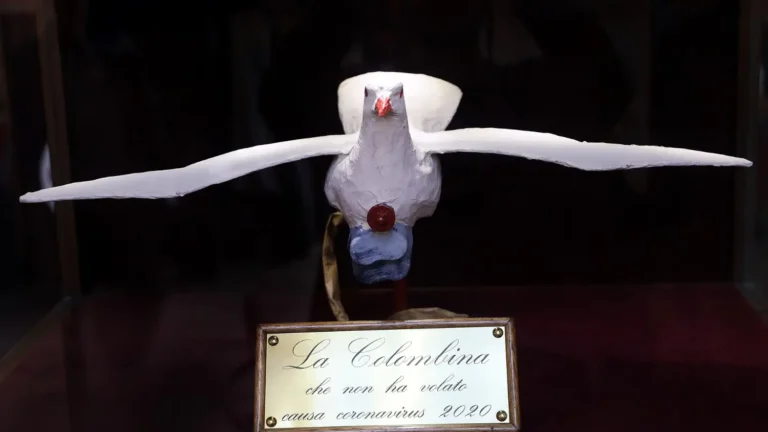
The mechanical dove – the colombina – that travels the wire from the cathedral altar to the Brindellone is a small masterpiece of theatrical engineering, but its role in the ceremony is not primarily theatrical. It is prophetic.
For centuries, Florentines have read the fortunes of the coming year in the flight of the colombina. A clean, straight flight in which the dove reaches the cart quickly and ignites the fireworks fully, promises a good harvest, a prosperous year, and general benevolence from the universe.
A slow flight, a stumble, or even a failure to ignite the cart cleanly are clear signs of difficulty ahead, to be taken seriously and discussed with some anxiety in the days following. In a city built on commerce, a bad year for the harvest was a bad year for everyone; the colombina was a collective forecasting instrument as much as a religious symbol, the community using the moment of the ceremony to take the temperature of its own future.
The dove symbolism connects the ceremony to the Easter story directly – the dove of the Holy Spirit descends at the moment of the Resurrection – but also to the older symbolism of the dove as a messenger and harbinger of omens that runs through Mediterranean cultures from Homer onward.
Florence has always been comfortable with this layering of the Christian and the ancient, the liturgical and the superstitious. The colombina is both the Holy Spirit and a form of civic divination.
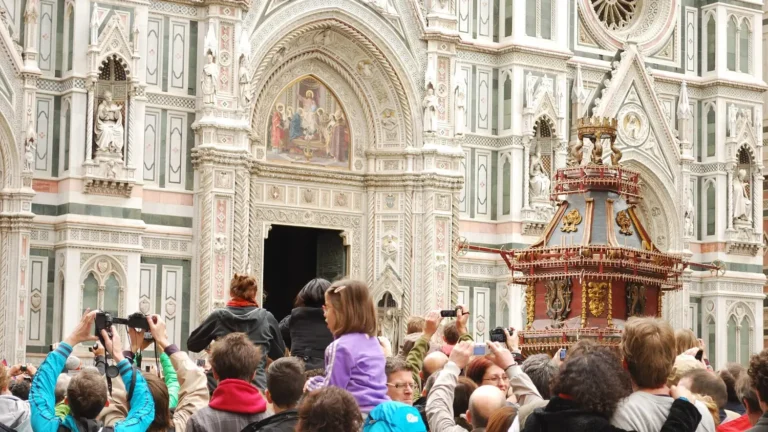
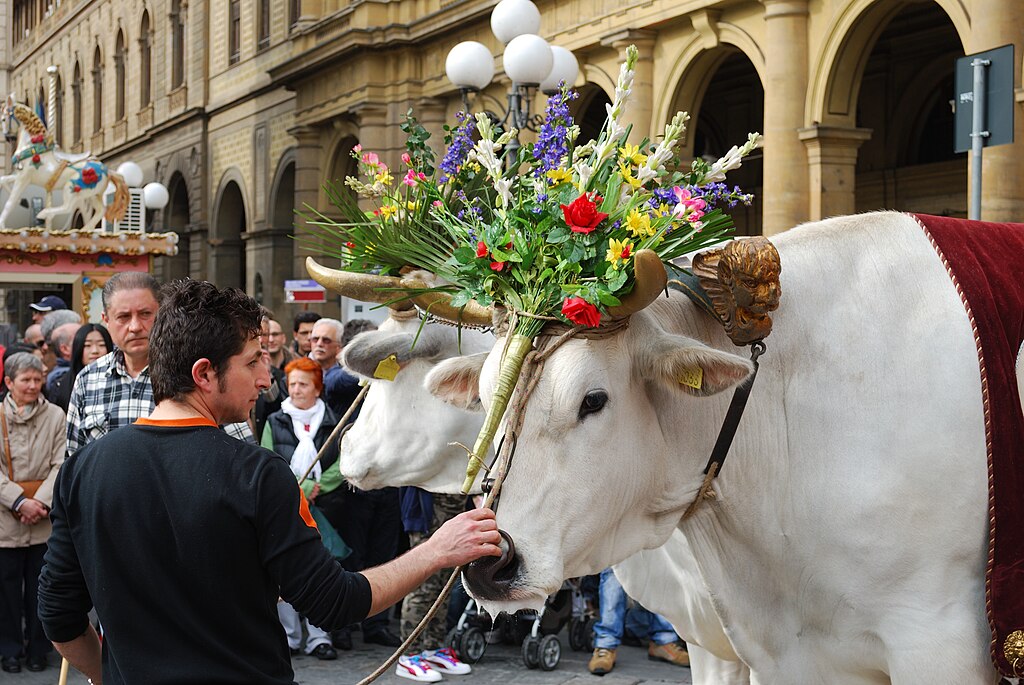
The Brindellone departs from the Piazzale del Prato, escorted by 150 soldiers, musicians and flag-throwers of the Historic Cortege of the Florentine Republic, drawn by two pairs of white oxen decorated with garlands of flowers.
The procession moves through the streets of the city toward the Duomo at a stately, ceremonial pace: the white oxen are unhurried, the flag-throwers perform their acrobatic routines with the precision of long practice, the sound of the drums and trumpets of the medieval musicians filling the streets.
The cart arrives in the piazza between the Baptistery and the Cathedral and is positioned with careful exactness in the space known as the spiazzo del Paradiso (the Paradise space). A seven-meter pole is erected in front of the High Altar inside the Cathedral, connected by a steel cable to the cart outside.
As the Gloria in Excelsis Deo is sung during the ensuing mass, the Archbishop of Florence lights the Colombina with the Holy Fire, and sends it whistling swiftly along the cable, down the nave of the Cathedral, through the central portal, and finally striking the cart in the square, triggering an explosion of dazzling fireworks.
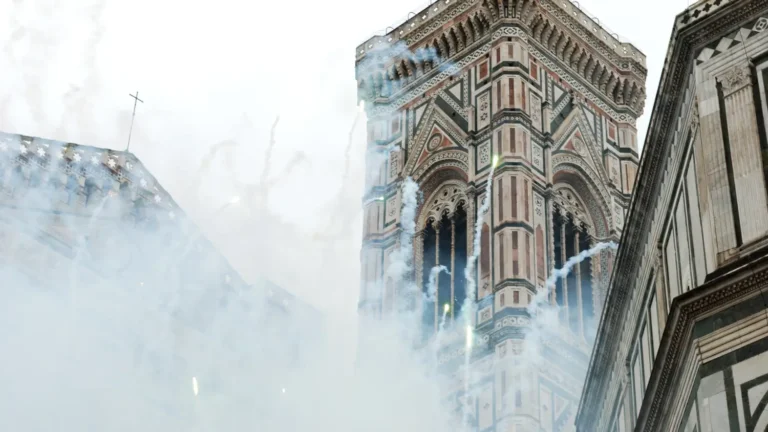
The fireworks display consists of rockets, firecrackers, spinning wheels, and fountains of light arranged across the three levels of the cart, igniting in a dramatic crescendo from bottom to top. At the moment of the explosion, a pinwheel at the summit of the cart causes three banners to unfurl: the arms of the Arte della Lana, the symbol of the Opera di Santa Maria del Fiore; the arms of the Pazzi family, in memory of Pazzino; and the lily of Florence.
The three together tell the whole story of the ceremony in a single image: faith, family, and the city, bound together in one annual act of collective identity.
The Scoppio del Carro in 2026 takes place on Easter Sunday, 5 April. The procession departs at 10am; the explosion occurs at around 11am. Entry to the piazza is free and open to all, but the square fills well before the event — arrive by 9am at the latest for a good position, earlier if you want to be close to the cart itself.
The piazza is large but the viewing areas around the cart fill quickly, and the smoke from the explosion means that a slightly elevated position — on the steps of the surrounding buildings, or toward the edges of the square — can offer clearer views than being immediately in front. The full display lasts approximately twenty minutes.
The procession itself, as it moves through the streets toward the piazza, is worth watching from the route if you can: the white oxen and the medieval cortege moving through the morning streets of Florence is spectacular.
The tradition is also intertwined with another great Florentine spectacle – Calcio Storico Fiorentino, the city’s historic football tournament, born in 1530 as an act of defiance against the Spanish occupation of Florence. As the last sparks from the Scoppio del Carro fade, another moment of anticipation takes center stage.
The upcoming Calcio Storico tournament matchups are drawn just minutes before the explosion, adding another thrill to a day already steeped in history and tradition.
By Brenda Vaiani
Florence Tours
Immerse Yourself in the Magic of Florence!