In much of the Christian world, Easter has become a gentle domestic affair – chocolate eggs, spring flowers, a family lunch, maybe a guest appearance by the Easter bunny. But in Italy the festival remains something rather more serious, and considerably more spectacular.
The week that precedes Easter Sunday, known as the Settimana Santa, is one of the great annual occasions of Italian life, a period when the country’s deep and ancient relationship with the Catholic faith comes to the surface in ways that are vivid, sometimes overwhelming, and utterly unique.
Best Italy Tours
Explore Italy with Us!
But there’s a lot more to Easter in Italy than fulfilling a religious obligation. The Easter traditions of Italy are also expressions of local identity, of regional pride, of a relationship between community and ceremony that has been forming for centuries. In a country whose geography, history and culture have always produced a thousand local variations on every theme, Easter is perhaps the most vividly regional of all Italian celebrations.
Easter in a fishing town in western Sicily bears almost no resemblance to what takes place in a Pugliese hill town, which in turn is utterly different from the grand, bombastic ceremonies that define the period in the great cities of Rome, Florence and Venice: different traditions, different foods, different rituals, and different ways of marking the movement from darkness to light that lies at the heart of the whole season.
What follows is an attempt to give a sense of that extraordinary variety: the great processions of the south, the popular rituals that predate Christianity and have survived within it, the grand celebrations of major cities and the food of the Easter table; and above all, the sheer conviviality of a country where a sense of community is the most important thing of all.

1. Sicily
Good Friday Theater and a Dance with the Devil
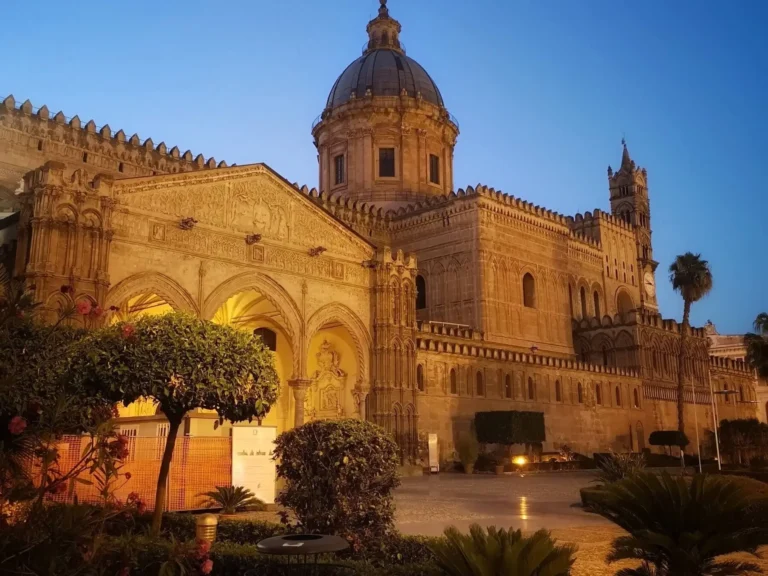
Settimana Santa in Sicily is a week-long explosion of processions, representations and ritual that draws on layers of Greek, Byzantine, Arab and Spanish influence accumulated over three millennia of occupation and exchange to form something uniquely Sicilian.
Trapani
The Processione dei Misteri
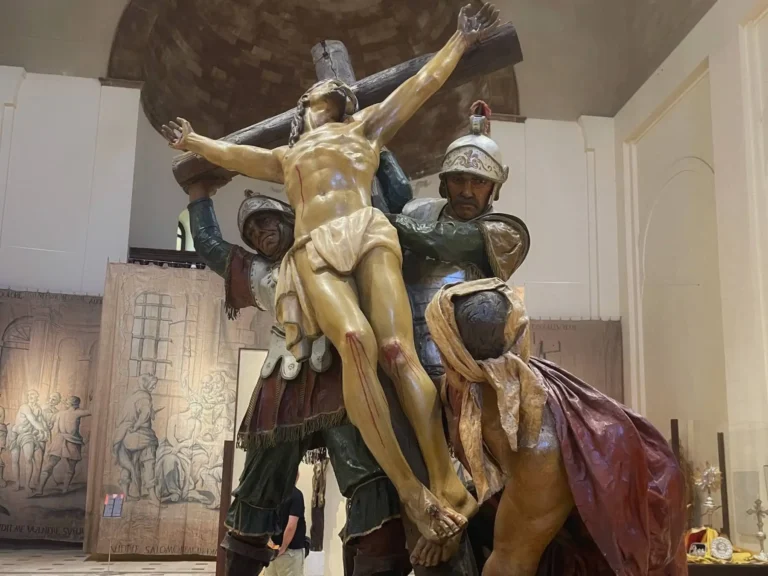
A processional statue stands ready for Holy Week in a Trapani church.
The tradition of the Spanish-influenced processione dei Misteri – the procession of the Mysteries, in which enormous, elaborately carved and painted wooden statues depicting scenes from the Passion of Christ are carried through the streets on the shoulders of confraternity members – is the visual heart of Sicilian Holy Week.
The greatest of these is at Trapani, where twenty heavy groups of statues known as the Misteri, some dating to the 17th century and each a masterwork of Baroque craftsmanship, are carried through the streets of the city in a procession that begins on Good Friday afternoon and continues uninterrupted until the following morning.
The bearers, known as massari, move in a characteristic, rhythmic swaying known as the annacata; following the tempo of the funeral marches played by the bands behind them, it has an almost hypnotic effect. The sound of the wooden ciaccole (a kind of castanet made exclusively by hand in Trapani) marks each slow step.
People line the streets through the night, grandmothers in folding chairs, children asleep on shoulders, the whole town awake and watching. Only when the head of the massari sounds the final beat of the ciaccola after the group finally arrives back in the church on Easter Satuday are the processional statues laid to earth once more, 24 hours after they had first been raised.
Enna
Good Friday Procession
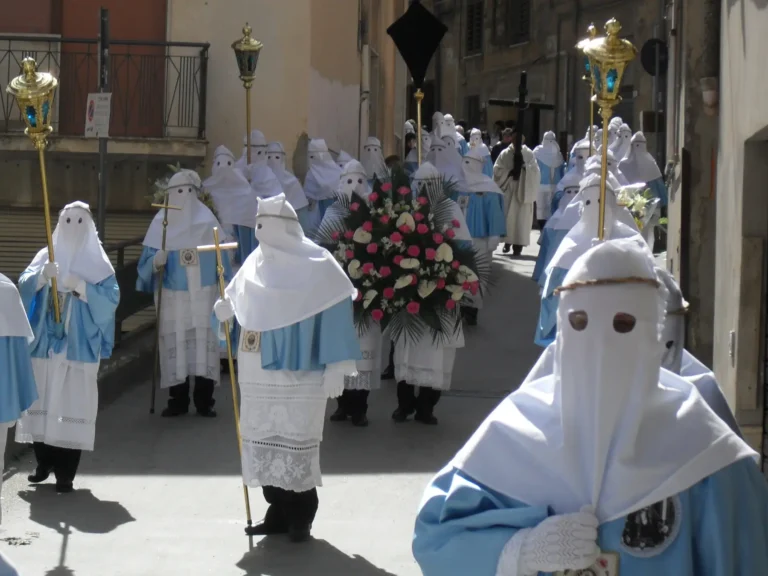
A holy week procession in Enna, Sicily. Ph. Max Ponzi, via wikimedia commons, CC 3.0
High in the island’s mountainous interior, Enna – its streets still cold even in April – plays host to a Good Friday procession featuring over two thousand members of the city’s ancient confraternities, each dressed in the colours and costume of their guild, their faces hooded.
They carry the twenty-five symbols of the Martyrdom of Christ through the streets, and they walk in striking silence for the duration of the ceremony, accompanied only by sorrowful music performed by the marching band behind them.
At the center of the procession is the spectacular urna del Cristo morto, an imposing reliquary containing a representation of Christ’s lifeless body that is carried aloft by dozens of participants on a mighty wooden bier.
It’s a fascinating sight: two thousand hooded figures, the medieval streets, the candlelight, and the rhythmic sound of the slow march of feet on stone.
Prizzi
The Dance of the Devils
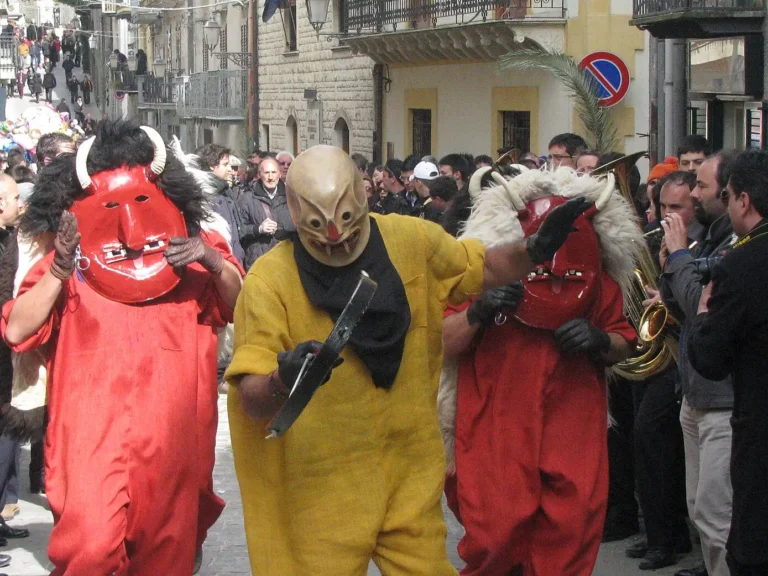
The Ballo dei Diavoli in Prizzi. Ph. Cgcprod via wikimedia, CC BY-SA 3.0
In Prizzi, in the mountains south of Palermo, Easter Sunday morning brings the extraordinary Ballo dei Diavoli, or the Dance of the Devils. In this startlingly energetic medieval popular drama, figures dressed as devils and death attempt to prevent the Easter Sunday encounter between the risen Christ and his mother.
Thankfully, a happy ending is in store: the angels protecting the statues fend them off, good defeats evil, and the crowd erupts. The whole ceremony is performed according to precise choreographic rules that have been laid down over many centuries.
It’s a collision of Christian theology and something much older: the pre-Christian drama of winter defeated by spring, of light overcoming darkness and the promise of new life.
2. Calabria
Flagellants and Albanian Dances
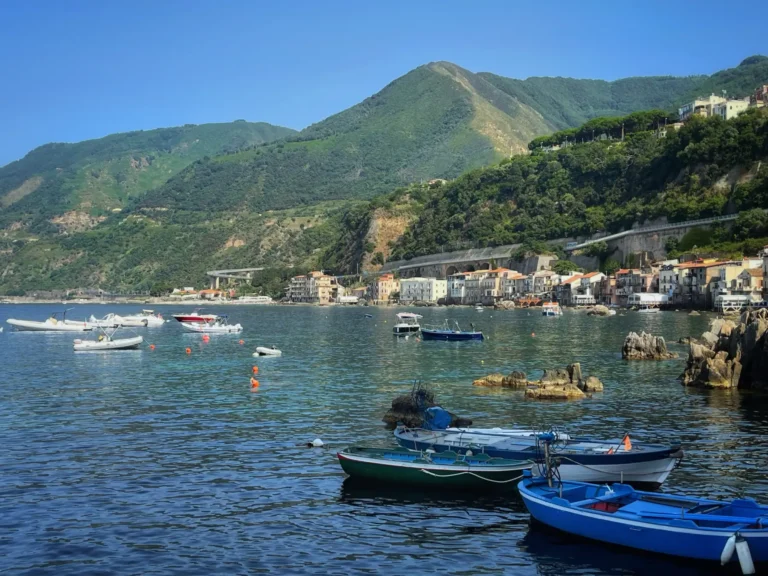
Cross the strait of Messina to the toe of the Italian peninsula and the character of Holy Week shifts again, becoming darker and more physically visceral in a landscape of wild mountains and ancient communities.
The Affruntata
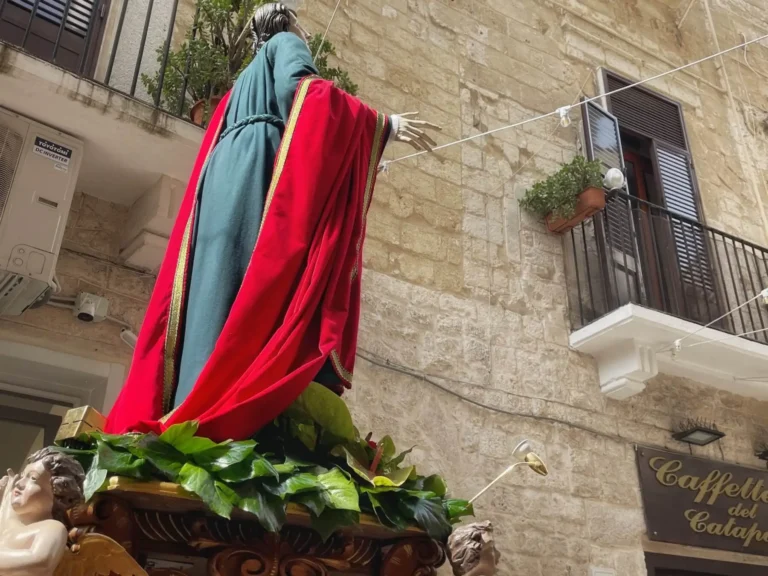
Mary arrives to meet Christ in the Affrunta tradition in Calabria.
The central drama of the Calabrian Easter is the affruntata, or the encounter, a ceremony of extraordinary theatrical power that takes place in town squares across the region on Easter Sunday morning. The word describes the moment when the processing statue of the Risen Christ meets the statue of the Sorrowful Virgin.
The Virgin’s black mourning robes are stripped from her as she sees her son alive: the joy of the resurrection expressed not in words but in tangible, physical gesture.
The origins of the tradition are Spanish and date to the 16th century, but in Calabria it has acquired its own intensely local character, where the statues are carried by men who have trained for this moment all year and who take the weight and the responsibility of the encounter with complete seriousness.
Nocera Terinese
The Vattienti
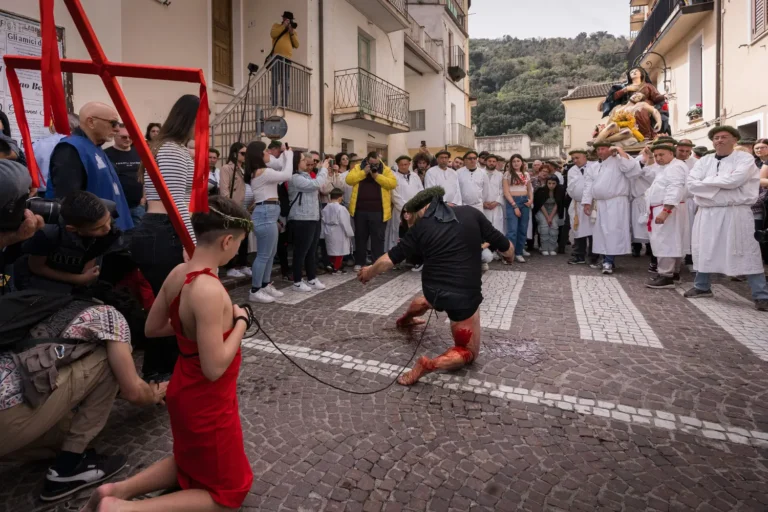
Flagellants in Calabria, Italy. Ph. Rossella Gaudio, CC BY-SA 4.0, via Wikimedia Commons.
At Nocera Terinese, on Holy Saturday, a tradition of an entirely different kind survives: the Vattienti, in which men process through the streets performing ritual self-flagellation in an act of collective, bloody devotion that might seem barbaric to our modern eyes.
Certainly it’s confronting, and not for everyone. But it’s also a profoundly sincere, if extreme, expression of the penitential impulse that runs through all of Settimana Santa.
Çifti and the Arbëreshë
The Vallje Dances
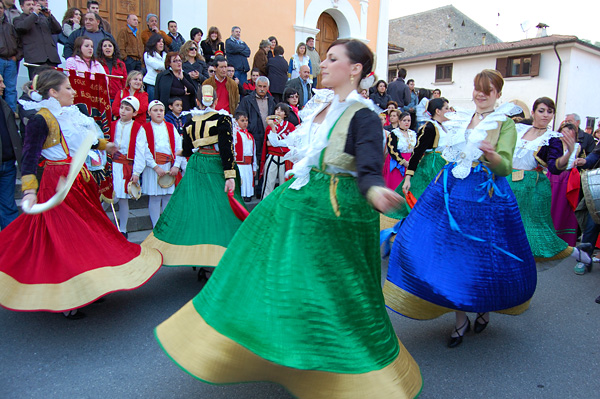
An Easter vallje dance in the Arbëreshë town of Çifti in Calabria.
In the villages and hamlets that dot the Pollino National Park near the Calabrian-Basilicata border, the Tuesday after Easter brings the Vallje – a traditional Albanian dance performed by the Arbëreshë, an Albanian community who settled in these mountains in the 15th century and have maintained their language, traditions and dances intact ever since.
Women in robes of pink and gold silk form and move in choreographies intended to evoke the tactics of their Albanian military hero Skanderbeg, who repulsed the Ottoman army on the Tuesday after Easter in 1467. It has nothing to do with Easter in any conventional sense, and everything to do with what Easter means in this particular place: identity and the survival of a community far from home.
3. Puglia
A Woman Made of Rags and Time
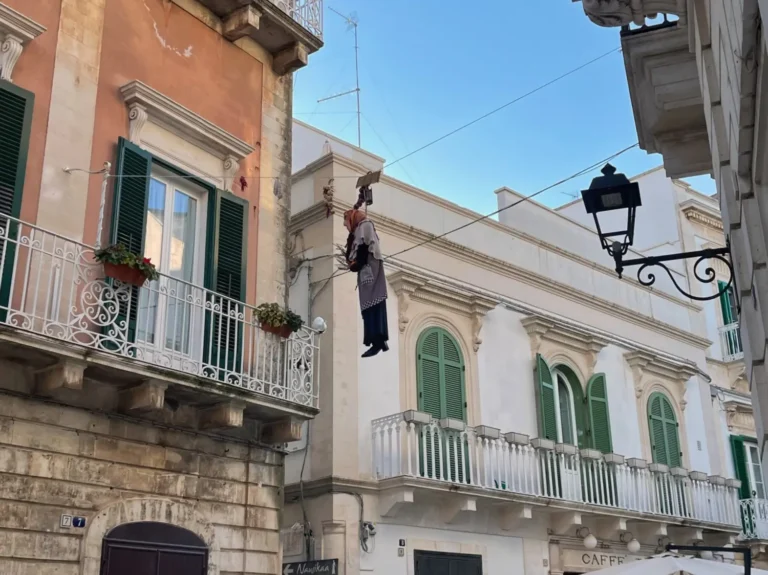
In the towns and villages of Puglia, Lent begins not with the imposition of ashes but with the appearance of a mysterious figure. She is hung from balconies and stretched across the narrow streets on washing lines, an elderly woman dressed in rags.
Martina Franca
The Quarantana
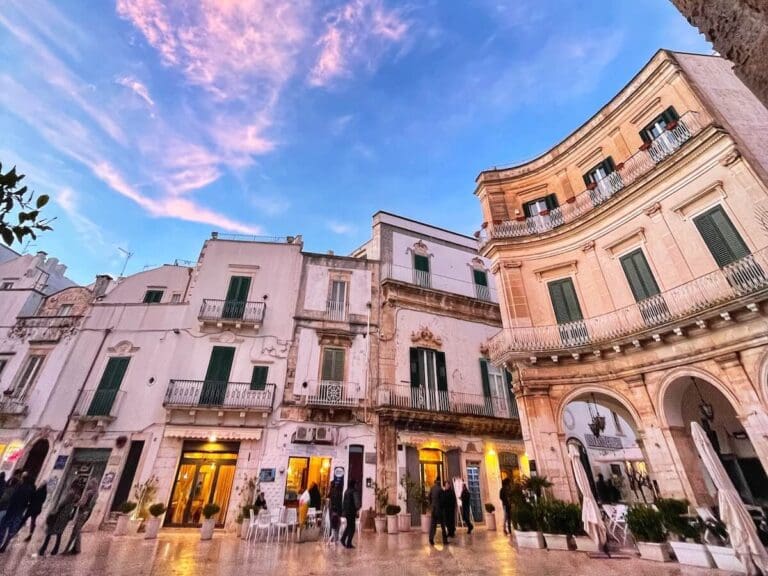
The beautiful main piazza of Martina Franca in Puglia.
This is the Quarantana, the widow of Carnival, and she has been watching over the forty days of Lent in this part of the world for longer than anyone can precisely say. Her symbolism is dense and tangled. The Quarantana is Carnival’s wife, mourning her husband’s death at the end of the festive season. She carries a spindle, emblem of the passage of time and the labour of women.
On her head she wears seven feathers – one for each week of Lent – or holds a pomegranate with seven feathers stuck into it, the fruit representing the winter that is ending. She has a single white feather among the others, representing Easter itself. And on each Sunday in Lent, one feather is removed.
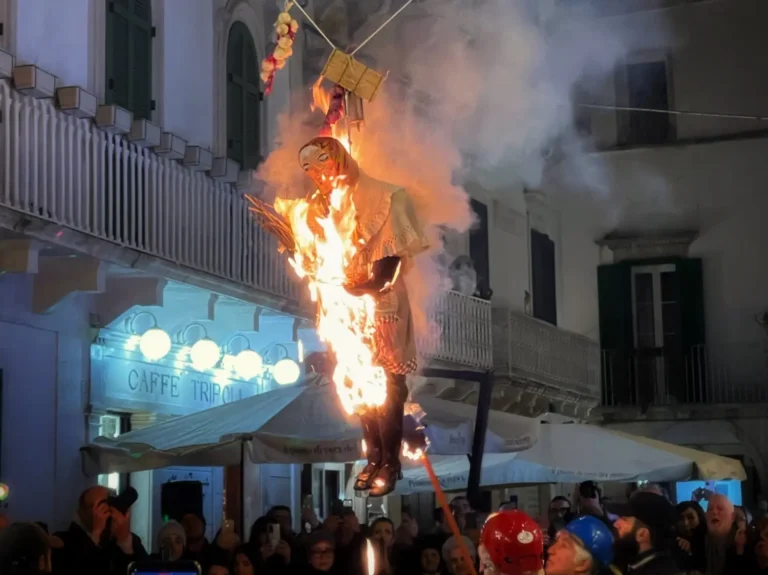
In Martina Franca, the quarantana burns on Easter Saturday.
The towns of the Bari hinterland and the Val d’Itria practise the most elaborate version of the tradition. In Martina Franca, the Quarantana tradition reaches its climax on the evening of Easter Saturday in the town’s stunning central piazza, when the Quarantana suspended above the square is suddenly set alight.
The scoppio della Quarantana – the explosion of the Quarantana – is a moment of pure communal release: the figure of abstinence, of waiting, of winter goes up in flames and sparks, and the crowd cheers not just for Easter but for the end of Lent’s forty days of privation, which was traditionally strictly observed in Puglia.
When the Quarantana burns, Spring has officially arrived.
4. Rome
Easter at the Heart of the Church
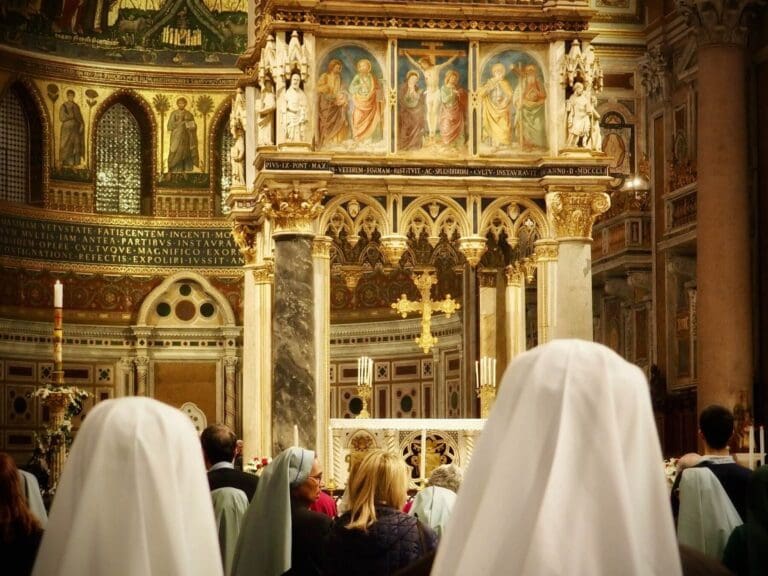
Rome has been the capital of Easter for two thousand years — which means, among other things, that it has had more time than anywhere else to develop its own particular relationship with the season, simultaneously grand and intimate, theatrical and sincere.
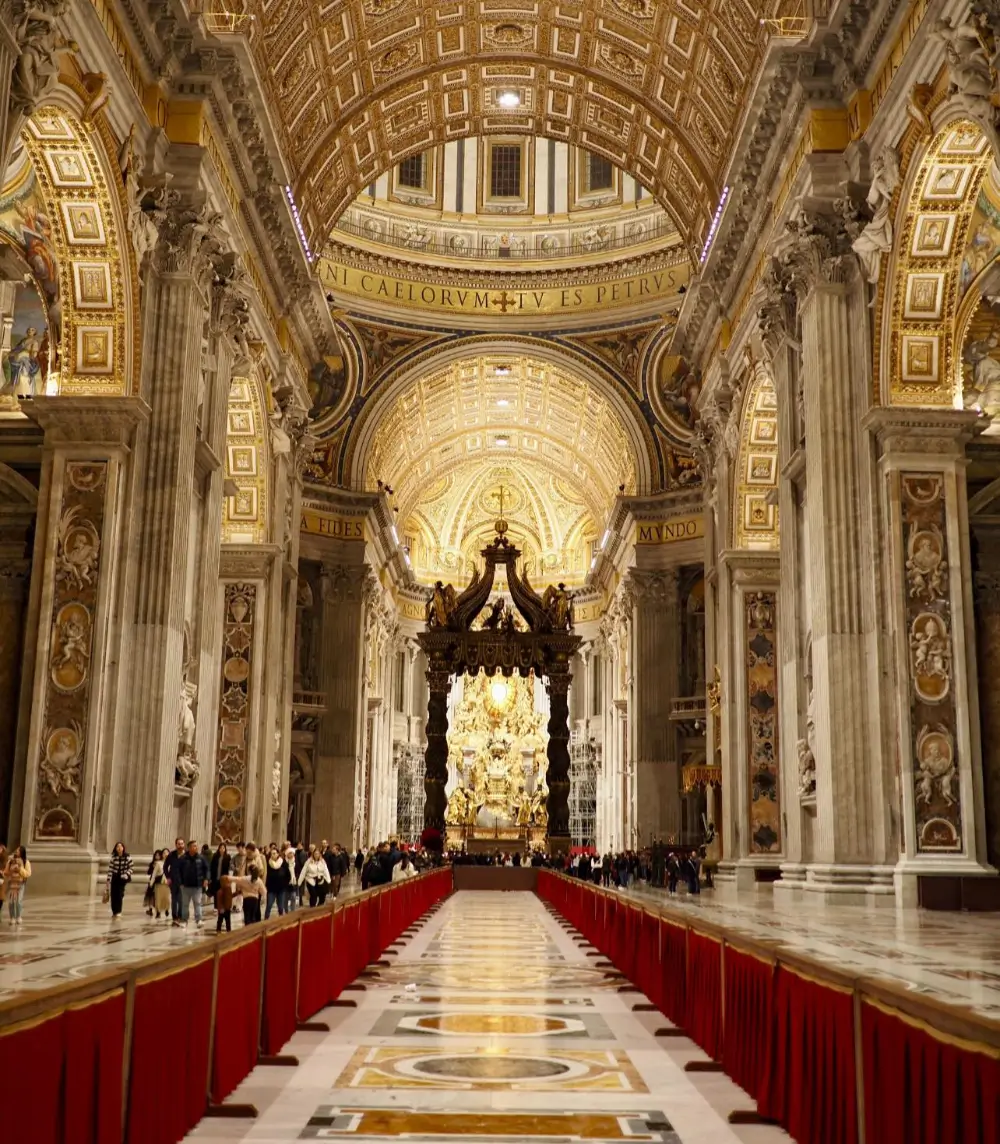
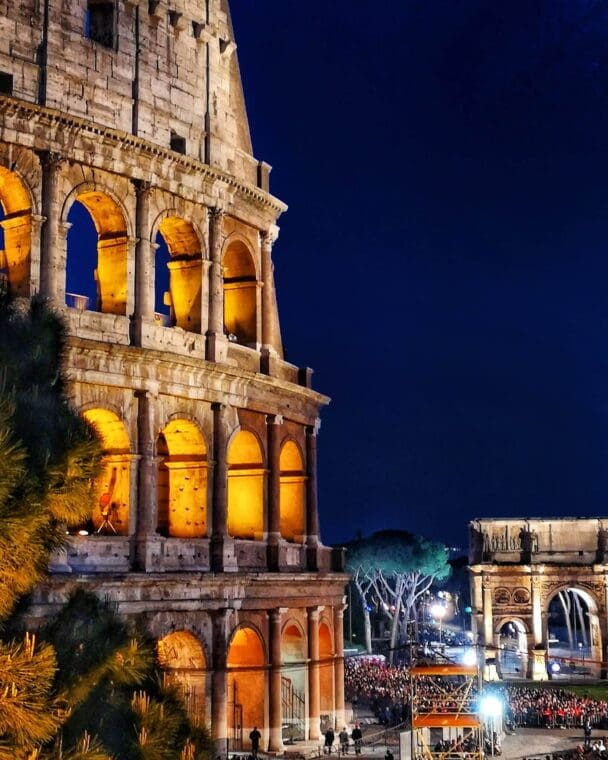
The great public ceremonies – the Papal Mass in St Peter’s Square, the torchlit Via Crucis at the Colosseum on Good Friday evening – are experiences of a scale that no other city in the world can offer: hundreds of thousands of people gathered in spaces of breathtaking beauty participating in ceremonies whose essential forms have been observed since the earliest centuries of the Church.
There is nothing else quite like the Easter Sunday Urbi et Orbi, the Pope’s address to Rome and to the world delivered from the central balcony of St Peter’s, the great square below him full to the edges and the broadcast reaching hundreds of millions of people simultaneously. You don’t have to be a believer to be impressed.
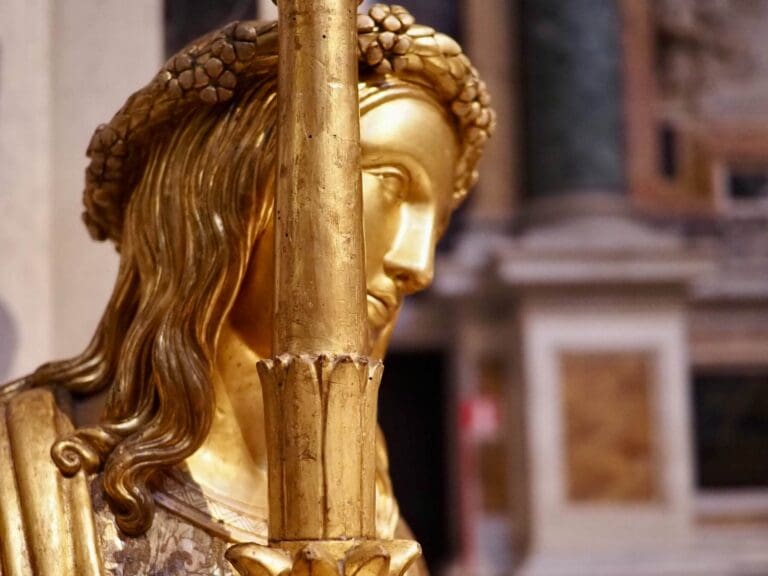
A majestic angel carries a candlestick in Santa Maria Maggiore.
But the Rome of Easter is not only the Rome of the papacy. It is also the Rome of the neighbourhood churches where Holy Thursday evening sees Romans visiting the altari della reposizione, altars where the Blessed Sacrament is kept through the night.
It is the Rome of bustling markets piled high with artichokes and broad beans, and the Rome of trattorie full to bursting with families tucking into Easter Sunday lunch. It’s all this and much more.
For a full account of Easter in Rome, where we explore the ceremonies, the traditions, the food and a practical guide to being here, check out our dedicated Easter in Rome guide here.
5. Florence
When Easter Explodes
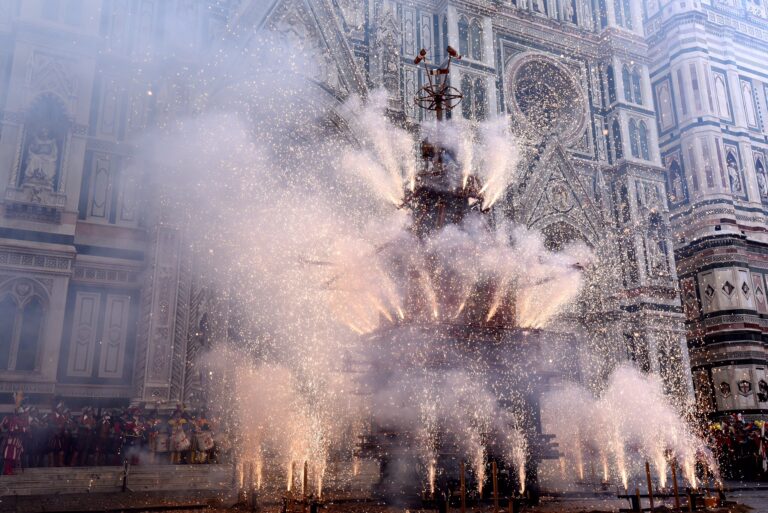
Florence does Easter with a bang – literally.
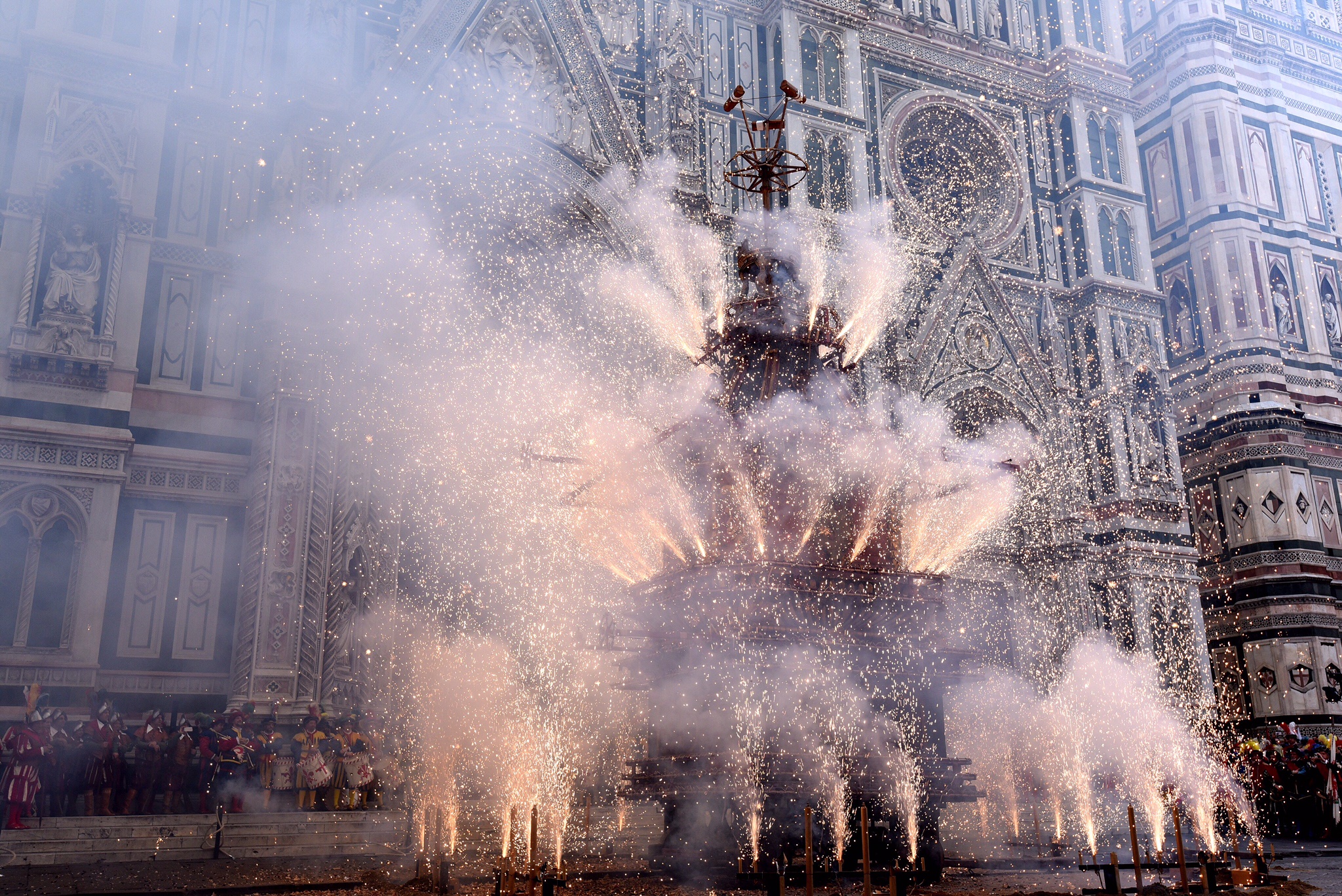
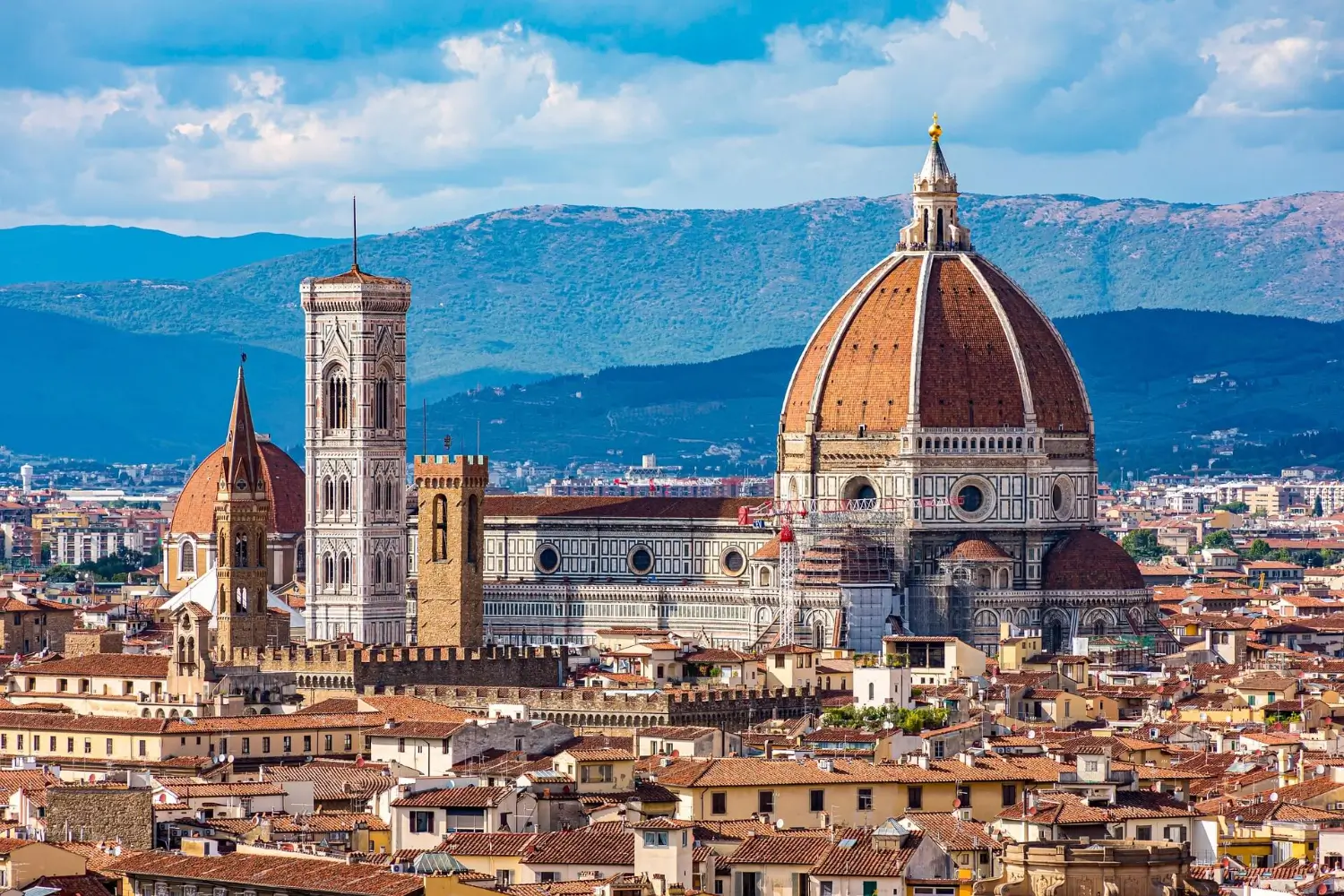
On Easter Sunday morning in Piazza del Duomo, a cart piled with fireworks is ignited by a mechanical dove that travels along a wire from the high altar of the cathedral, and if the explosion is sufficiently spectacular it is taken as a good omen for the year ahead.
The Scoppio del Carro – the Explosion of the Cart – is one of the most extraordinary popular celebrations in Italy, a tradition rooted in the First Crusade that has been happening in this square, in this form, without interruption for several centuries.
We have a dedicated article on the Scoppio del Carro that tells the full story of the Brindellone, as the great decorated cart is known, and the ancient ceremony that surrounds it. Read more below:
6. Venice
Easter on the Water
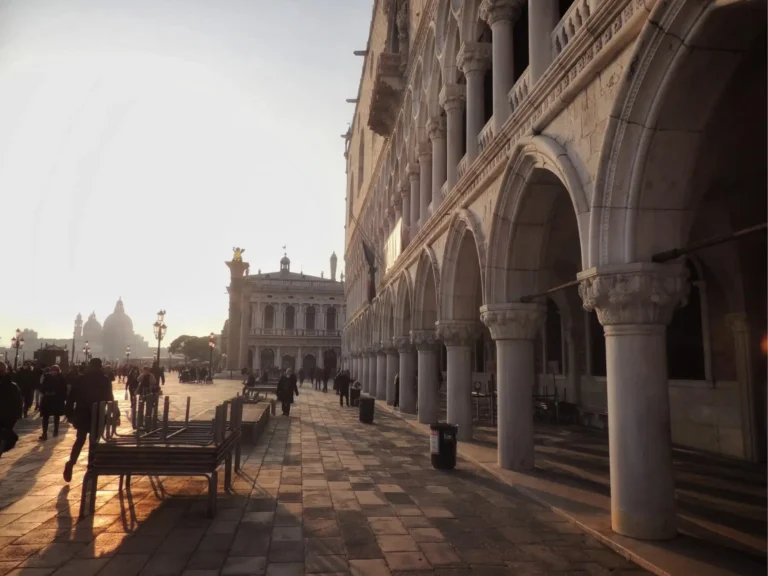
There is an old Venetian proverb that announces Easter with characteristic directness: Xè Pasqua, xè Pasqua che caro che gò, se magna ea fugassa, se beve i cocò – ‘It’s Easter, it’s Easter, and I am so happy; we eat the focaccia and we drink the eggs.’
The sentiment is typical of a city that has always found its deepest pleasures in the immediate and the sensory: food, the company of friends, the return of the light after winter.
For centuries the centrepiece of the Venetian Easter was not a procession or a ceremony in the piazza but an act of ducal devotion. On Easter Sunday morning, the Doge and his dignitaries would process from the Palazzo Ducale to the church of San Zaccaria. There he was received by the abbess of the adjacent convent and her nuns, who presented him with a gilded ducal cap known as the corno ducale in an exchange that formalised the ancient relationship between the republic and one of its oldest religious houses.
The church of San Zaccaria is still there; its magnificent 15th-century facade by Mauro Codussi is one of the finest examples of Venetian Renaissance architecture, and Giovanni Bellini’s luminous Sacro Conversazione hangs in the north aisle within, painted in 1505 for this very space.
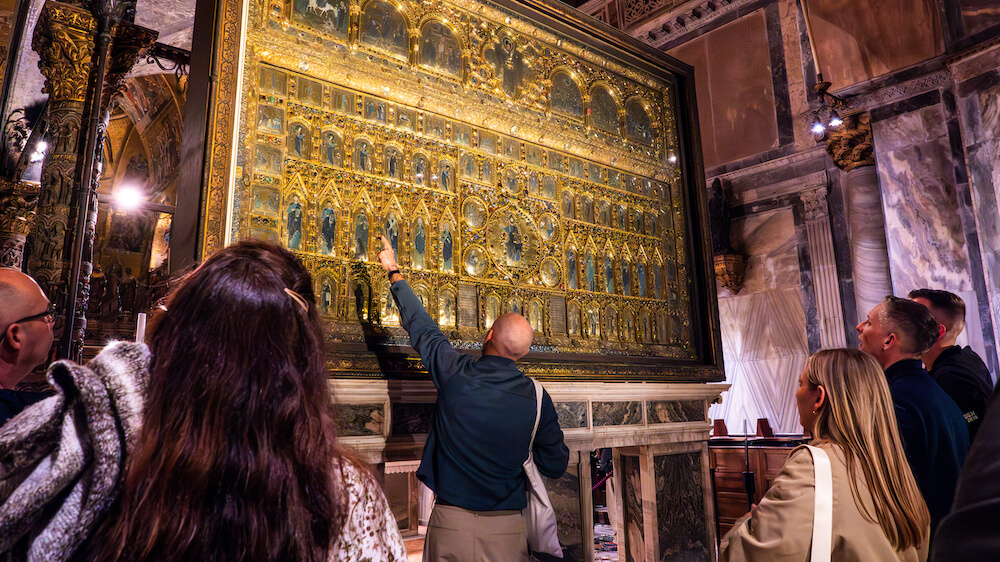
The Easter Mass at the Basilica of San Marco too retains something of this old ceremonial grandeur. To sit in the golden interior of the Basilica on Easter Sunday morning, with the mosaics catching the candle light as they have for nine centuries and the music from the ancient choir of San Marco filtering through the church, is unforgettable.
7. Italian Easter Food
Italy's Most Seasonal Meal
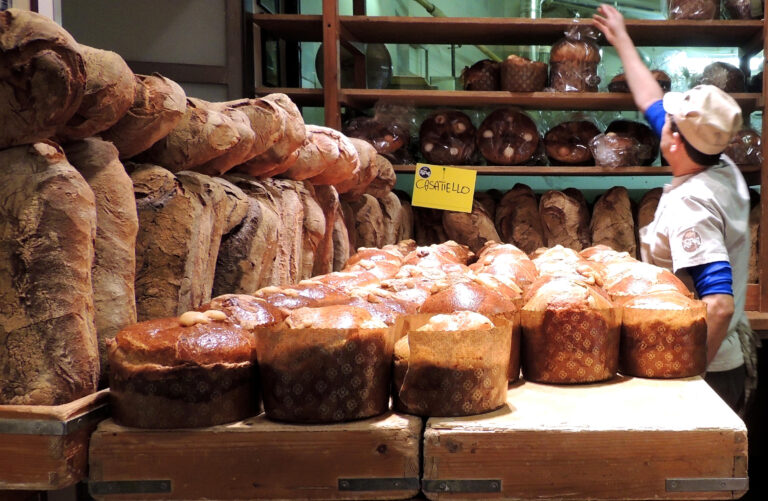
The processions and ceremonies of Holy Week are just one side of the Easter story in Italy. Just as important, you guessed it, is its food! In fact, the two are more closely connected than they might appear. The rhythms of the Lenten fast have profoundly shaped what gets eaten at Easter: foods banned during those 40 days of abstinence are now suddenly, joyfully permitted.
Lamb
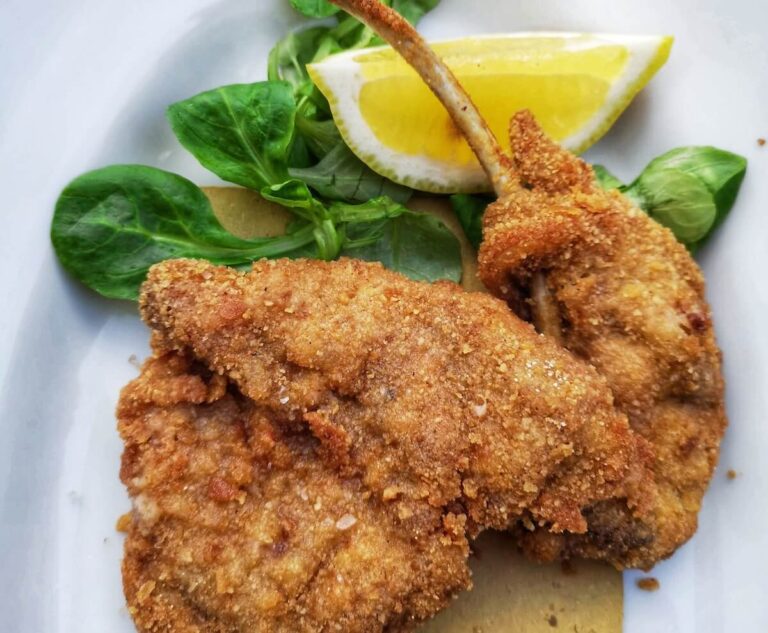
As with other parts of the Christian world, lamb is central everywhere. The symbolism of the lamb at Easter is ancient and layered: the Passover lamb of the Old Testament, the Lamb of God of the New, the actual spring lamb of the Italian countryside arriving in the markets at precisely this moment of the year.
In Rome it’s called abbacchio – milk-fed spring lamb from the Castelli Romani, roasted with potatoes and rosemary or grilled scottadito style over charcoal. In Sardinia it is agnello in umido, braised slowly with artichokes and wild fennel. In Sicily it appears alongside pasta or in the guise of marzipan confections known as pecorelle di pasta reale, little lambs of almond paste.
Eggs
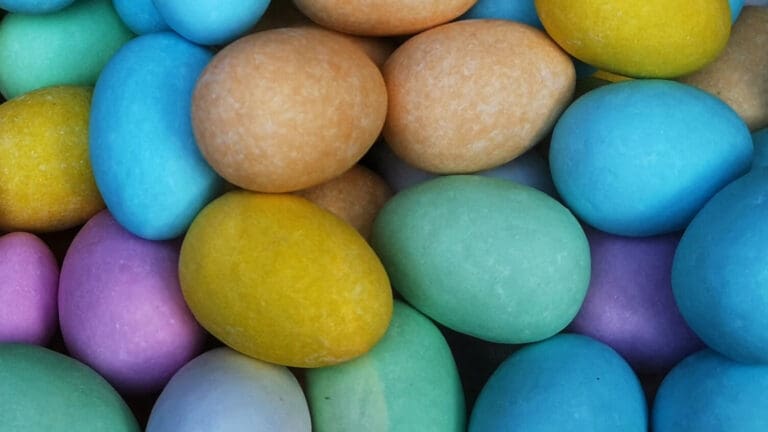
Eggs are the other universal presence – hard-boiled, decorated, and hidden in Easter breads given to children. The Easter eggs of the Italian tradition predate their chocolate descendants by millennia: the ancient Romans gave painted eggs as gifts at spring festivals, and the early Church absorbed the symbolism of the egg as rebirth directly into the Easter celebration. The chocolate Easter eggs that we know around the world are a 20th-century Italian elaboration of a practice that goes back to the empire.
Bread
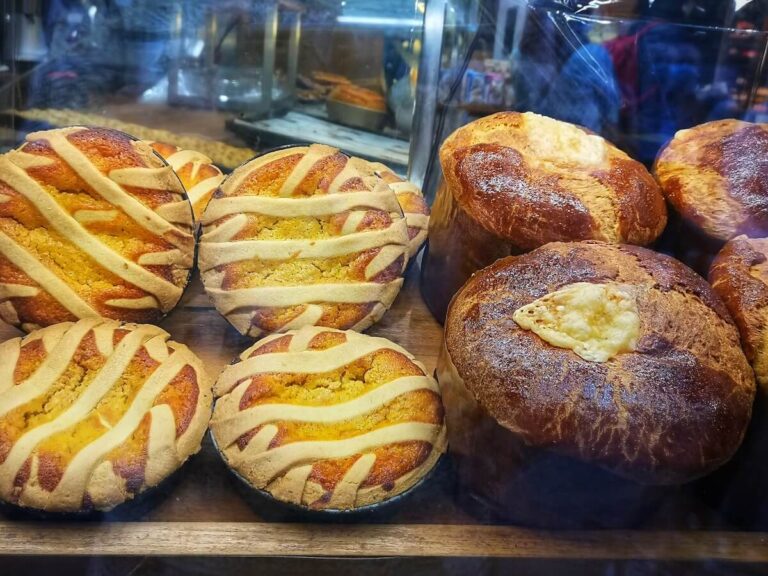
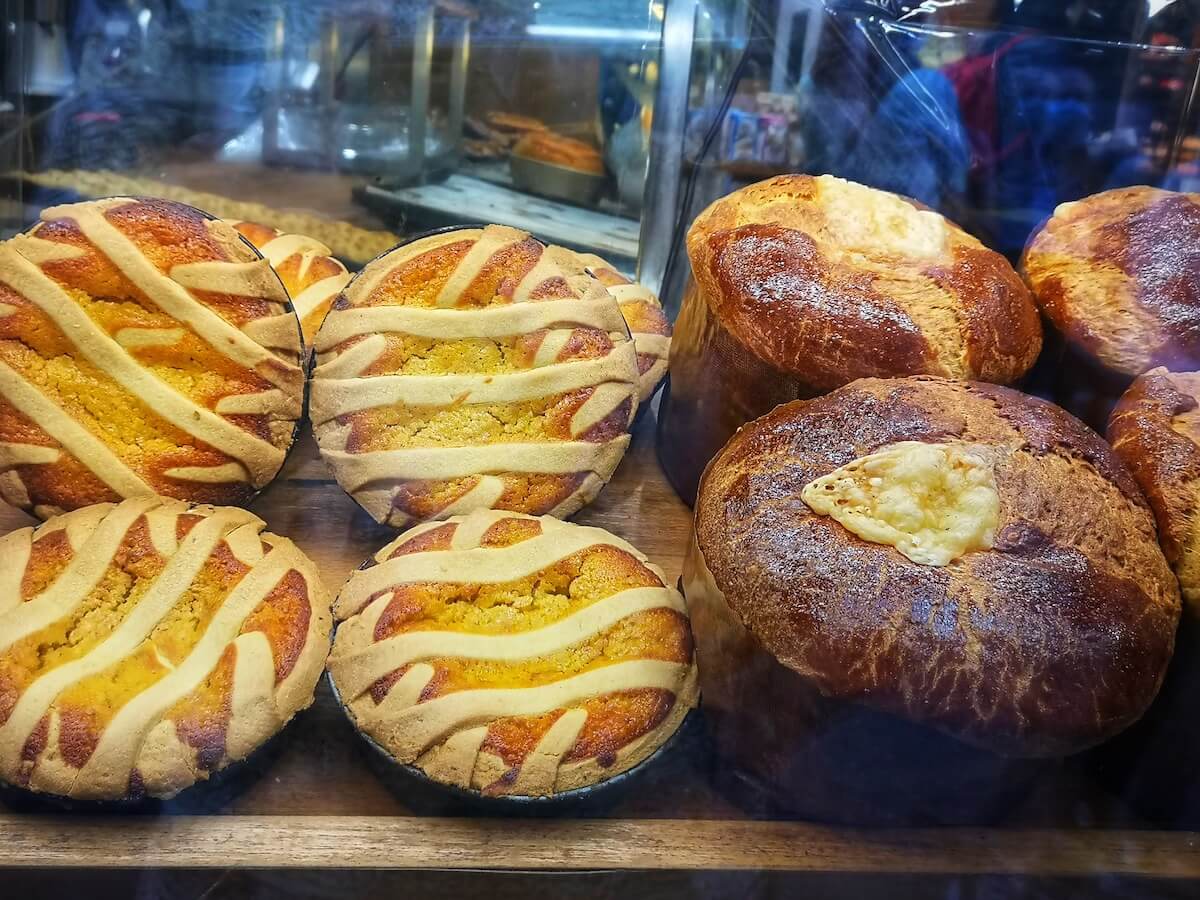
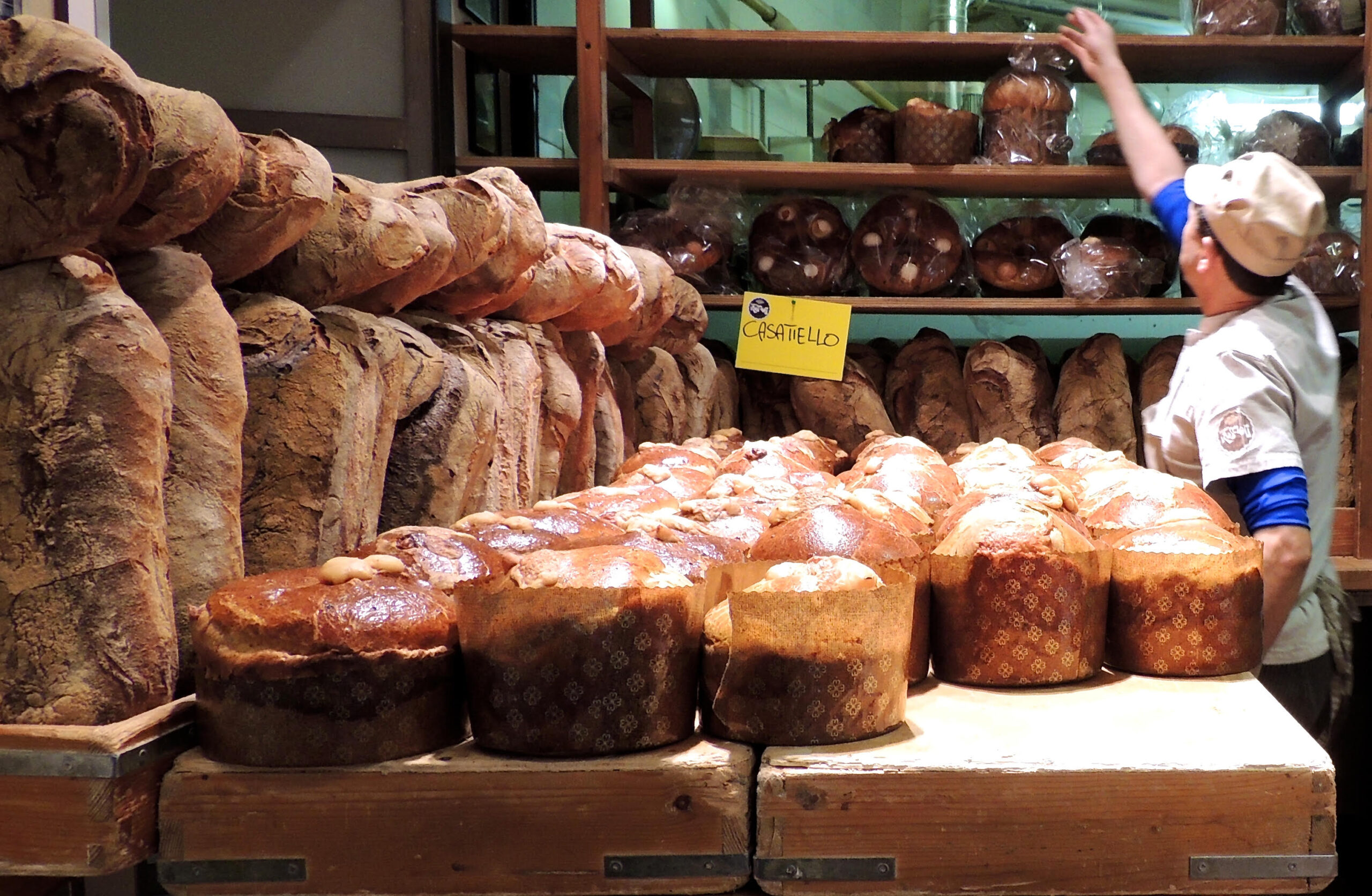
Beyond the universal Colomba di Pasqua, or Easter Dove cake, regional breads and sweet pastries tie the season to specific places with extraordinary precision. In Rome, pizza di Pasqua – a tall, golden cheese bread – is an essential component of Easter Sunday.
In Naples, pastiera – a tart of wheat berries, ricotta, candied citrus and orange flower water, invented by nuns and made only at Easter, is accorded almost sacramental status.
In Sicily the cuddura – a large biscuit, sometimes in the shape of a bird or a basket, with one or more eggs baked whole into its dough – is given by godparents to their godchildren.
In Venice, meanwhile, you’ll find the fugassa: a sweet, golden, leavened bread shaped round like the sun, enriched with eggs and butter. Its origins lie so deep in the city’s traditions that a version of it appears in a 14th-century mosaic in Saint Mark’s.
We hope you enjoyed our trip across the Bel Paese to discover some of the most fascinating Easter traditions in Italy! In truth, we’ve only scratched the surface: to do justice to the regional variety of Italian Easter we’d need a lot more space. From the pious display of sacred vases full of blood-stained earth from Golgotha in Mantua to the traditional Neapolitan Holy Thursday struscio passeggiata, every corner of Italy hides some fascinating tradition related to the great Spring festival. The only way to discover them all is to come visit Italy at Easter for yourself!
Book Your Italian Experience!