At nine o'clock on Good Friday evening, something remarkable happens to the Colosseum.
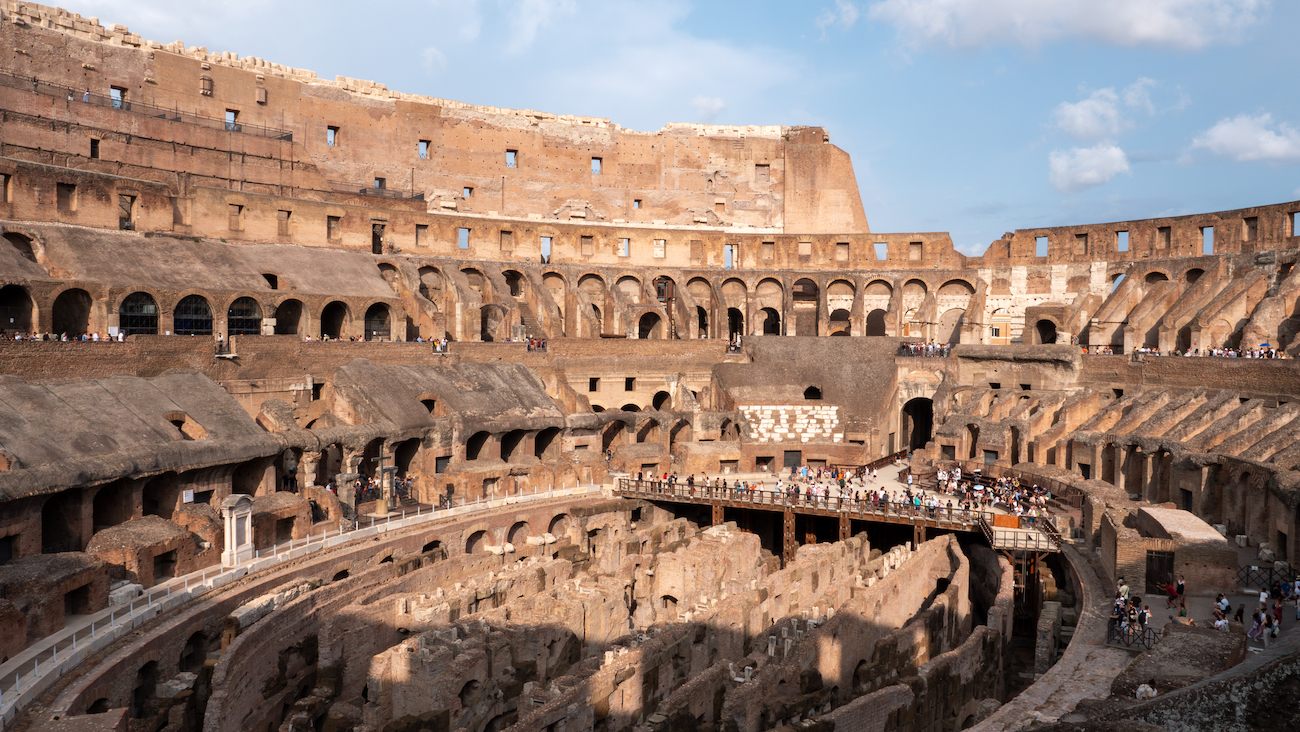
The ancient amphitheatre, which has spent the day receiving tourists, archaeologists and pigeons in roughly equal measure, is lit from below by floodlights that turn its travertine arches a deep amber against the darkening Roman sky.
Then the torches appear. Tens of thousands of people begin to converge on the area from the surrounding streets, many of them carrying candles, the combined light of the crowd building slowly against the darkness.
By the time the ceremony begins, the air around one of the world’s most famous monuments has changed completely: from historical site to sacred stage, from ancient Rome to something that feels timeless in a different, quieter register.
This is the Via Crucis — a torchlit Good Friday procession that is one of the most atmospheric and moving events during Easter in Rome. Open to everyone regardless of faith, presided over by the Pope, and watched live by hundreds of millions of people around the world, it is one of those in-person experiences that photographs and television cannot fully prepare you for.
The scale, the light, the collective silence of the crowd, the ancient stones: they combine into something that visitors consistently describe as one of the most powerful experiences of their time in Rome.
This guide tells the full story of how the ceremony came to the Colosseum, and everything you need to know to attend it in person on Good Friday, 3 April 2026.
Rome Tours
Explore The Eternal City's Ancient Traditions
What Are the Stations of the Cross?
The Stations of the Cross — the Via Crucis in Italian — are a series of fourteen devotional images representing the key events of the day of Christ’s crucifixion, from his condemnation by Pontius Pilate to his burial. At each station, the faithful pause to reflect on a specific scene: Christ falling under the weight of the cross, meeting his mother, being helped by Simon of Cyrene, receiving the veil of Veronica, being nailed to the cross.
The tradition has its roots in the pilgrimages to Jerusalem that began as soon as the holy sites were identified in the early Christian centuries. According to tradition, the Virgin Mary herself established memorials at the sites associated with her son’s Passion, and the Via Dolorosa — the route through Jerusalem’s old city that Christ is believed to have walked to Golgotha — has been a devotional path for pilgrims since the Byzantine era.
As the Middle Ages progressed and the journey to Jerusalem became increasingly difficult or impossible for most Christians, a solution emerged: the Stations could be established in local churches, allowing the faithful to make an imaginary spiritual pilgrimage to the holy city without leaving home.
This practice became widespread across Europe during the early modern period, particularly through the influence of the Franciscan order, which was entrusted with the custody of the holy sites in Jerusalem and took a particular interest in propagating devotion to the Passion.
By the early 18th century the fourteen stations had been formalised into the sequence we recognise today, and the custom had spread to virtually every Catholic parish in the world.
Nowhere in that world, however, performs the Via Crucis quite like Rome.

How the Via Crucis Came to the Colosseum
The man most responsible for bringing the Stations of the Cross to the Colosseum was a Genoese Franciscan friar of remarkable energy named Leonardo da Porto Maurizio — a missionary preacher who spent his adult life travelling the Italian peninsula establishing Stations in churches, monasteries and public spaces wherever he went.
By his own count, he erected more than 570 sets of Stations during his lifetime, and he wrote that his mission was to “introduce this holy exercise in all places.” He was canonised in 1867.
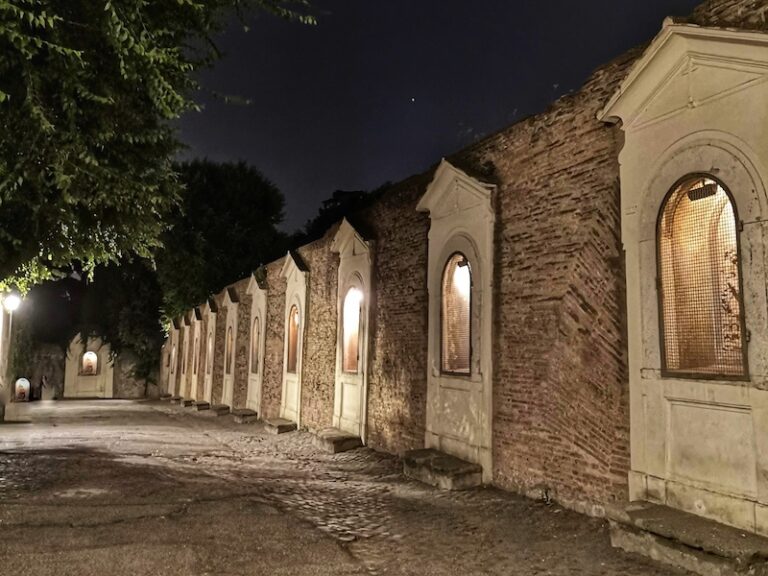
But his most ambitious project was in Rome. In 1744 Leonardo established a set of Stations at the monastery of San Bonaventura on the Palatine Hill — the lovely painted terracotta sculptures depicting Christ’s Passion can still be seen on the road leading up to the church, and Leonardo himself is buried there. It was while he was here, looking down from the Palatine at the great amphitheatre below, that he conceived a larger idea.
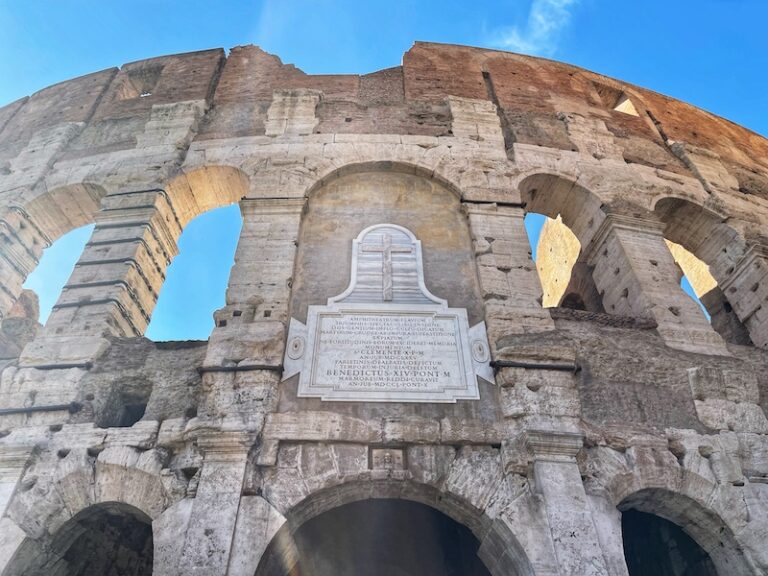
The Colosseum had been associated with Christian martyrdom in the popular imagination for centuries — the belief that early Christians had been thrown to the lions in the arena formed a powerful part of the monument’s sacred identity, even if modern historians have questioned the specifics. Pope Clement X had formally consecrated the building to the memory of the Christian martyrs in 1675, and a Chapel of the Pietà had been built within its walls in the 15th century.
Leonardo, recognising the devotional and symbolic potential of the site, petitioned Pope Benedict XIV for permission to establish a permanent Via Crucis inside the Colosseum itself.
Benedict XIV agreed. On 13 December 1749 he authorised the construction of the Stations within the arena, and four days later formally established the Archconfraternity of the Lovers of Jesus and Mary on Calvary to manage the ceremony.
The new Stations of the Cross and a large central cross were in place and blessed by the Pope within the week — just in time for the Christmas celebrations of that Jubilee year.
From that point on, the faithful gathered regularly at the Colosseum to walk the Via Crucis along the Via Sacra and pray in the shadow of the great cross at the centre of the arena.
The Decline and Revival of the Tradition
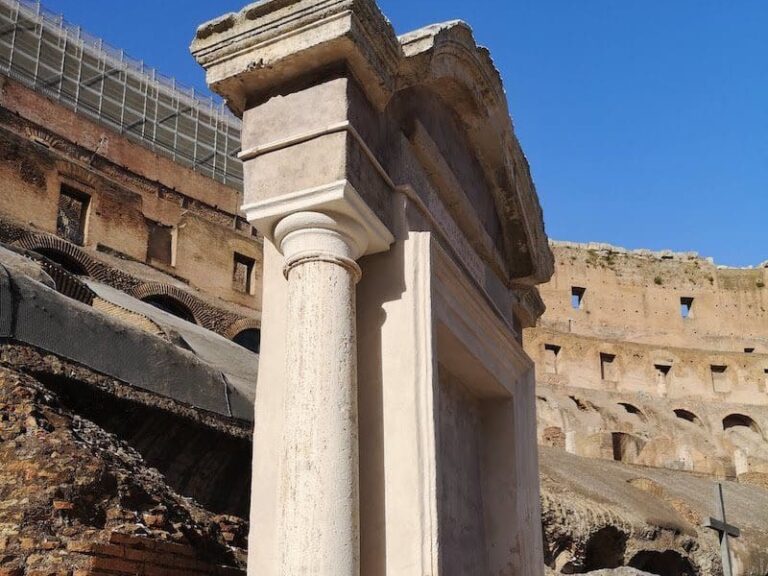
The first era of the Colosseum Via Crucis came to an abrupt end with the unification of Italy in 1870.
As the new secular Italian state absorbed Rome and papal authority contracted within the walls of the Vatican, the public ceremonies that had animated the city’s sacred calendar — processions, outdoor Masses, the great ritual movements of the papal court through the city — were suppressed or abandoned. The cross at the Colosseum was removed in 1874, and the ceremony fell into silence for half a century.
In 1926, amid the political negotiations that would eventually produce the Lateran Treaty and the formal establishment of the Vatican City as an independent state, the cross was returned to the Colosseum — this time placed to the side of the arena, where it still stands.
But it was not until Pope John XXIII revived the Good Friday procession in 1959 that the ceremony began its transformation into the internationally significant event it has become.
The turning point came in 1964, when Pope Paul VI led the Via Crucis before the cameras of Eurovision, which broadcast the ceremony live across Europe for the first time. What had been a powerful local Roman tradition became overnight one of the most recognisable Easter rituals in the world — a status it has maintained and deepened ever since.
In 2026, Pope Leo XIV presides over the Via Crucis at the Colosseum at 9:15pm for the first time in his pontificate, leading a ceremony that draws pilgrims and visitors from every country on earth to one of the oldest monuments in the world.
FAQ
How to Attend the Via Crucis in Person
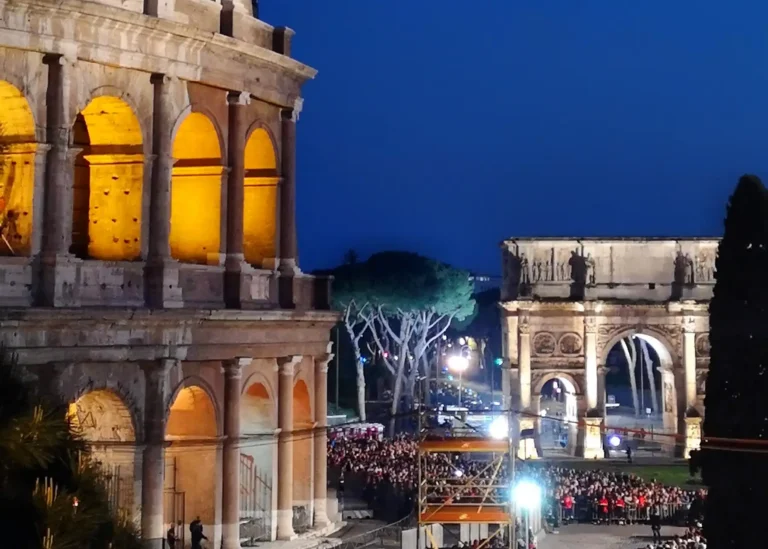
Attending the Via Crucis at the Colosseum is one of the most atmospheric experiences the Roman calendar offers, and it is entirely free and open to all. Here is everything you need to know for Good Friday, 3 April 2026.
Time and Location
The ceremony begins at 9:15pm. The procession moves through fourteen stations in the area between the Colosseum and the Temple of Venus and Roma, with Pope Leo XIV presiding from a raised platform facing the illuminated arches of the amphitheatre. The ceremony lasts approximately ninety minutes, concluding with the Apostolic Blessing.
No Tickets Required
No reservation is needed for the Via Crucis. It is one of the few major Vatican events of the year that is genuinely open to all comers — you simply arrive and find your position. The ceremony is also broadcast live on Vatican Media and Italian national television for those who prefer to watch from elsewhere.
When to Arrive
Early evening is essential – ideally by 7:30pm if you want a good position, and earlier still if you want to be close to the front. The area begins to fill from late afternoon, and security barriers progressively close off access points as the evening advances. Bring a bottle of water, a warm layer (April evenings in Rome can be cold, particularly once the sun has gone), and patience for the wait.
Where to Stand
The best unobstructed views of the ceremony are along Via dei Fori Imperiali on the stretch closest to the Colosseum, where you will have a direct sightline to the illuminated arches and the platform where the Pope is stationed. Large screens are typically set up around Piazza del Colosseo on the northern side near the Metro station for those further back in the crowd.
Our preferred vantage point, for those prepared to climb a little, is the Colle Oppio — the small hill above the Colosseo Metro station, reached by a short flight of steps. It is typically less crowded than the main viewing areas below and the elevated position gives a panoramic view of the entire ceremony unfolding against the lit façade of the Colosseum.
Security and Transport
This is a high-profile event, and security is unsurprisingly considerable. Police checkpoints are established along all access routes from mid-afternoon; expect bag checks and avoid bringing large backpacks. Plan for additional time at all security points.
The Colosseo Metro station is closed from the afternoon onward on Good Friday, as are nearby bus and tram stops. Public transport is the only sensible way to approach the area — do not attempt to drive anywhere near the Colosseum on this evening. The nearest operational Metro stops are Termini (Line A and B) and Circo Massimo (Line B), both a manageable walk from the Colosseum. Allow considerably more time than usual for all journeys in this part of the city from early evening onward.
The Colosseum archaeological site itself closes early on Good Friday — last entry is at noon, with the site closing at 1pm — in preparation for the evening ceremony. If you are planning to visit the Colosseum on Good Friday, organise your morning accordingly.
The Via Crucis in the Context of Holy Week
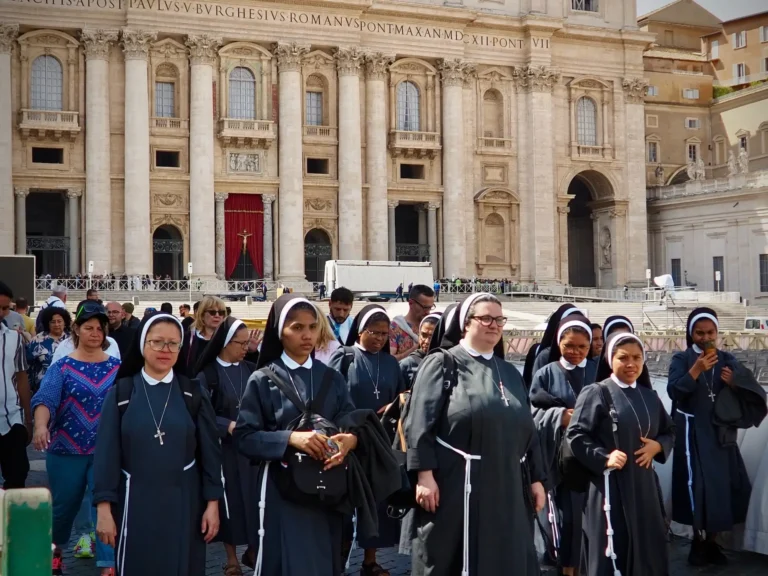
The Good Friday Via Crucis is one of the most powerful individual moments of Holy Week in Rome, but it belongs to a larger sequence of ceremonies that gives it its full meaning.
It follows the morning solemnity of the Celebration of the Passion in St Peter’s Basilica at 5pm — the stripped liturgy in which there is no Mass, no Eucharist, only the ancient rites of Good Friday — and precedes the Easter Vigil on Saturday night, when the darkness that has settled on the city since Thursday lifts with the lighting of the Paschal fire and the first Easter Alleluia.
For the full Holy Week programme in Rome — including the Palm Sunday Mass, the Maundy Thursday ceremonies at San Giovanni in Laterano, the Easter Vigil and the Easter Sunday Mass with Urbi et Orbi — see our complete day-by-day guide to Holy Week in Rome 2026.
For everything else you need to know about visiting Rome at Easter — practical information, crowds, what’s open and closed, Pasquetta, Easter food and the FAQ — our main Easter in Rome guide has you covered.
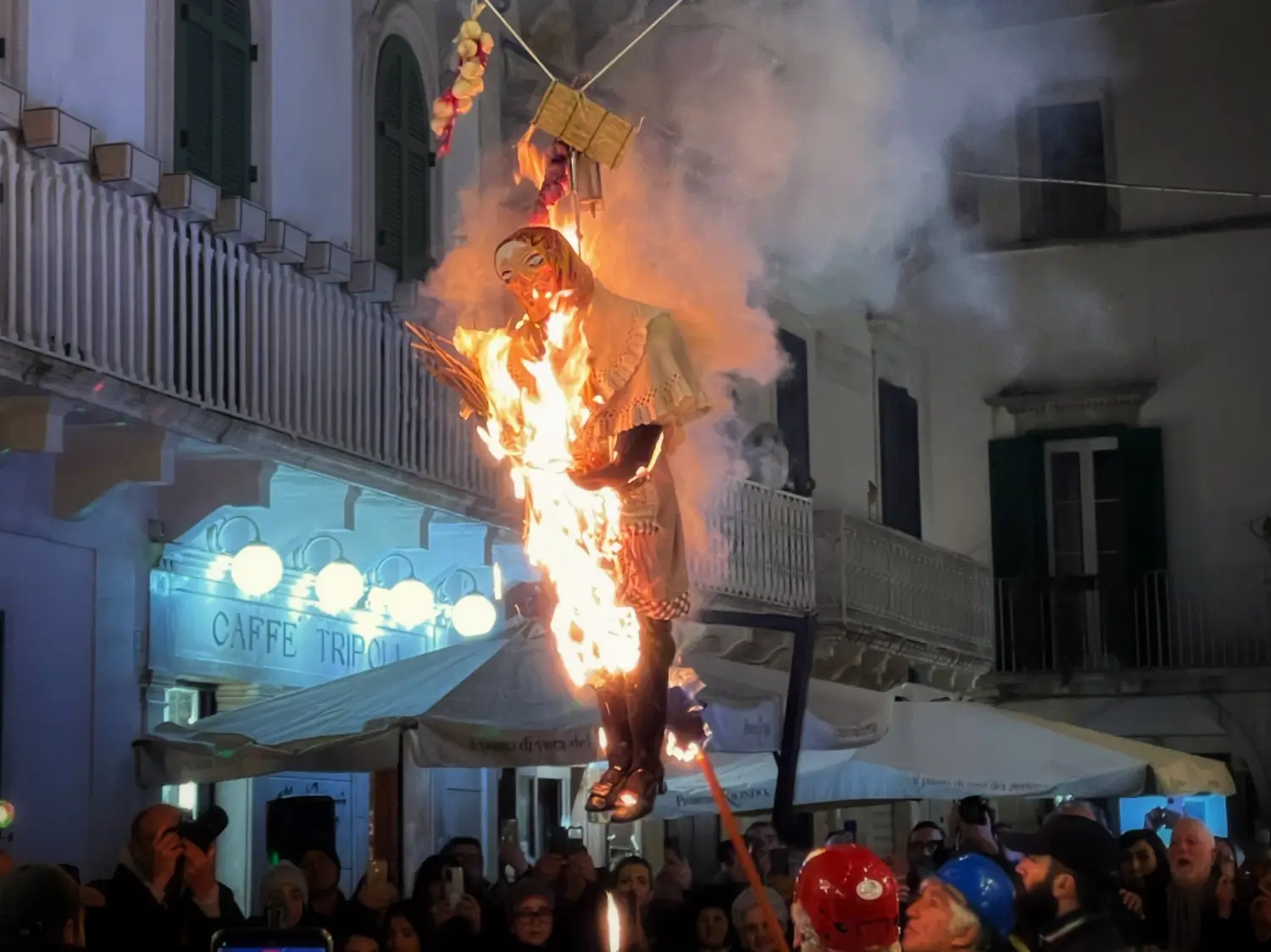
And if the Easter traditions of Italy as a whole interest you — from the great Sicilian processions to the burning of the Quarantana in Puglia and the Scoppio del Carro in Florence — our guide to Easter Traditions in Italy tells the full story.
Rome Tours
Discover the Magic of the Eternal City