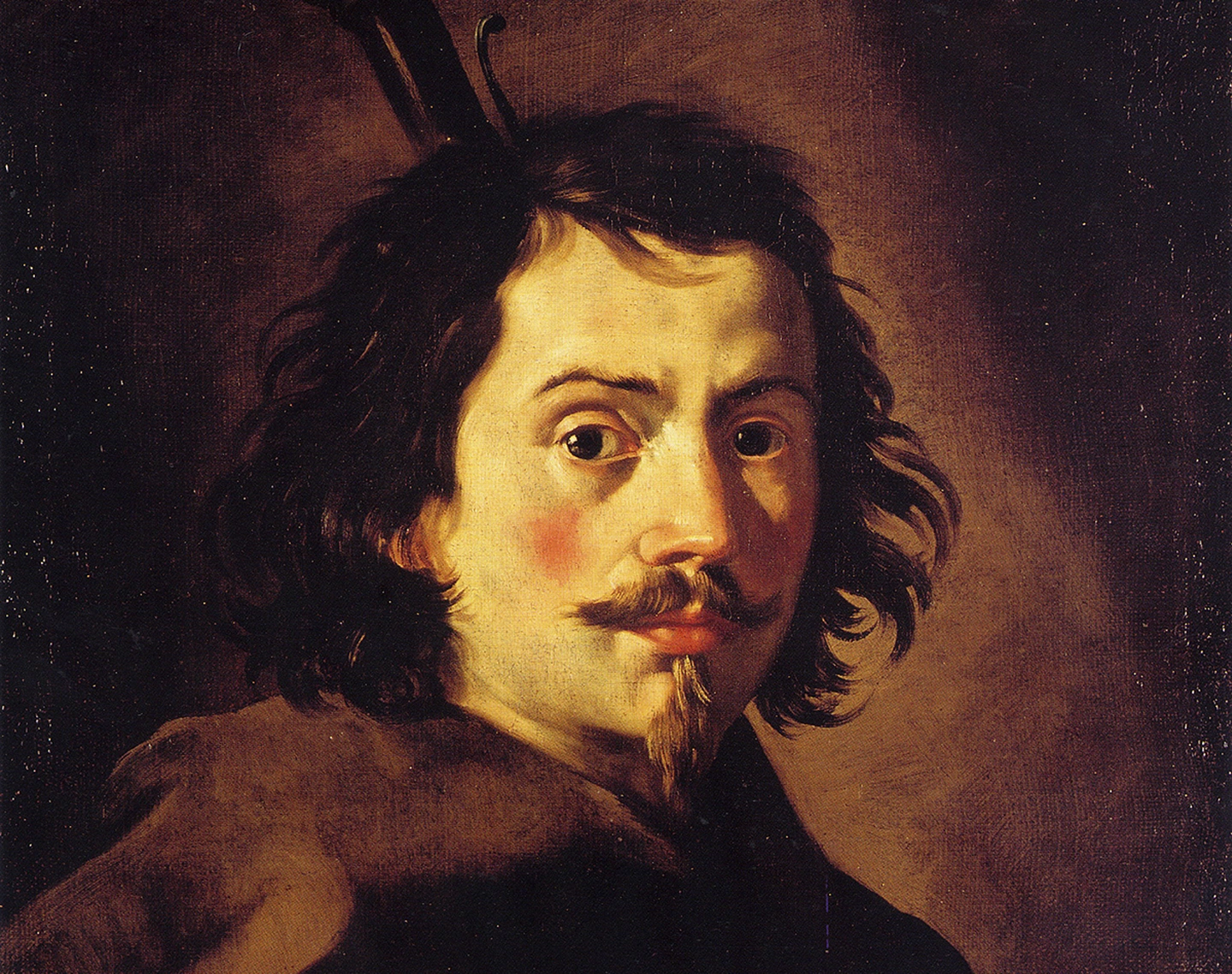
Francesco Borromini never looked at a structure the way his contemporaries did.
In fact, he makes us look at structures in ways we’ve never seen them before, and even now, half a millennium on, modern architects are still working out the implications.
Borromini was the architectural master of illusion, a man of embattled and ferociously original genius who spent his career wrestling impossible effects out of stone and geometry, bending the rules of perspective, proportion and construction until the buildings he produced seemed to operate by their own private physics.
Best Rome Tours
Explore the Best of Rome
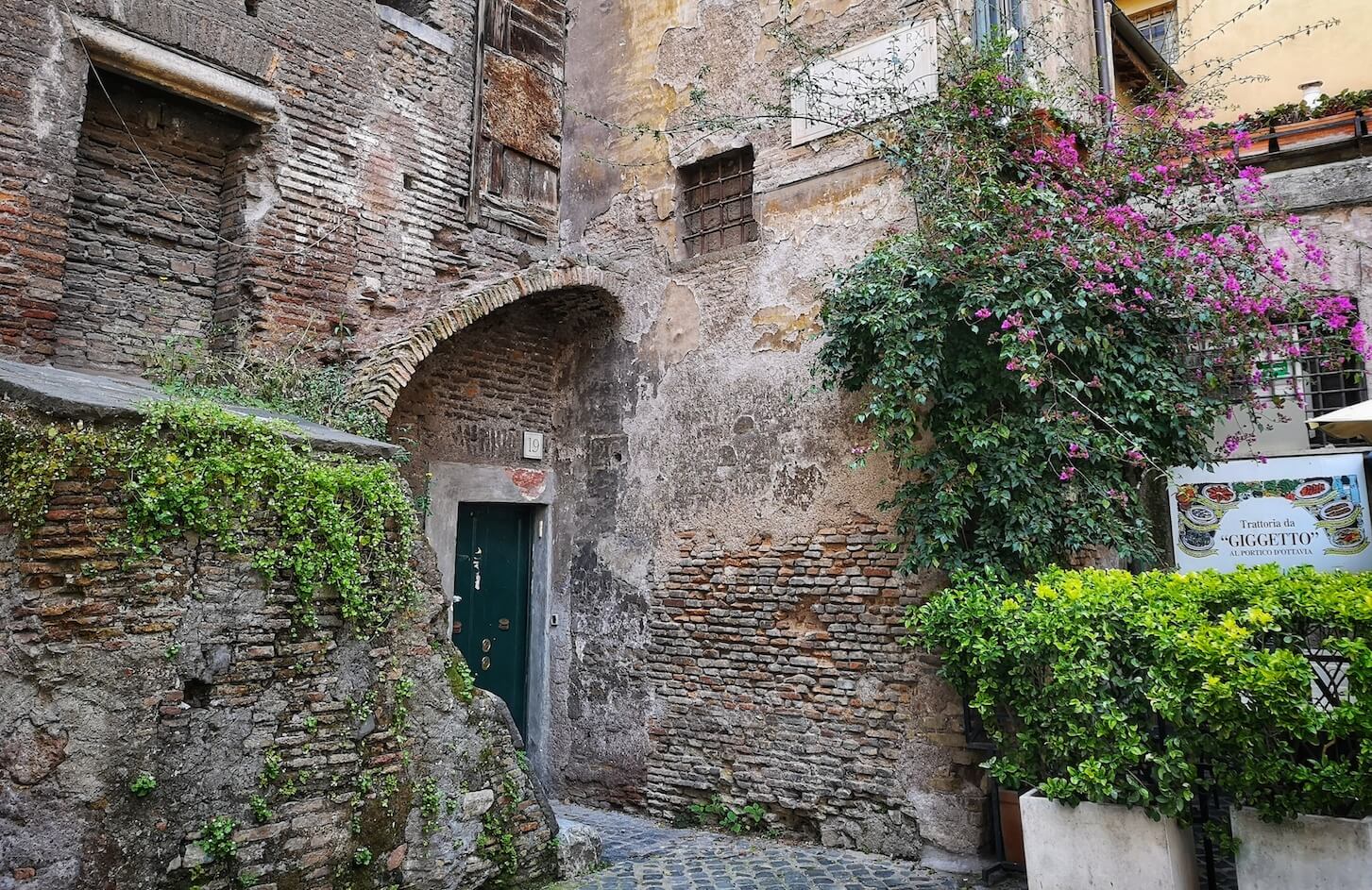
Borromini had the unfortunate timing of coming into his own alongside another architect who wasn’t a bad sculptor either. A man named Gian Lorenzo Bernini. The two dominated Roman architecture for forty years, their rivalry helping to define the Baroque age and producing some of the most extraordinary built spaces in history.
But while Bernini was worldly and charming, at ease with popes and princes, collecting honours and commissions with easy grace, Borromini was difficult, dark, reclusive — a man who seems to have inhabited his own genius like a prison.
He would ultimately die by his own hand in 1667, running himself through with a sword during one of the fits of depression that overcame him more and more frequently as his life progressed.
None of which is visible in the dazzling architectural tricks he played in the courtyard of Palazzo Spada. But once you know the story, you look at them differently.
The Palazzo and its Cardinal
Palazzo Spada is a massive stucco palace in the Piazza Capo di Ferro, one block from beautiful Piazza Farnese and two from rollicking Campo dei Fiori.
Built in 1540 for Cardinal Girolamo Capodiferro — a man who had distinguished himself in the complex diplomacy of the papal states — it stands out in a neighbourhood of grand palaces.
The facade is elaborately decorated with fruit and flower carvings and classical friezes, and flanked by a massive sculpture of Pompey the Great recovered from a Roman site nearby (one of several candidates for the statue at whose base Julius Caesar is said to have fallen when Brutus and his confederates struck him down in 44 BC — though scholars are divided on this, and the statue has had a long career attracting ambitious attributions).
In 1631 the palace passed to Cardinal Bernardino Spada, a man with a particular problem and the means and connections to solve it in a manner nobody had attempted before.
The Problem
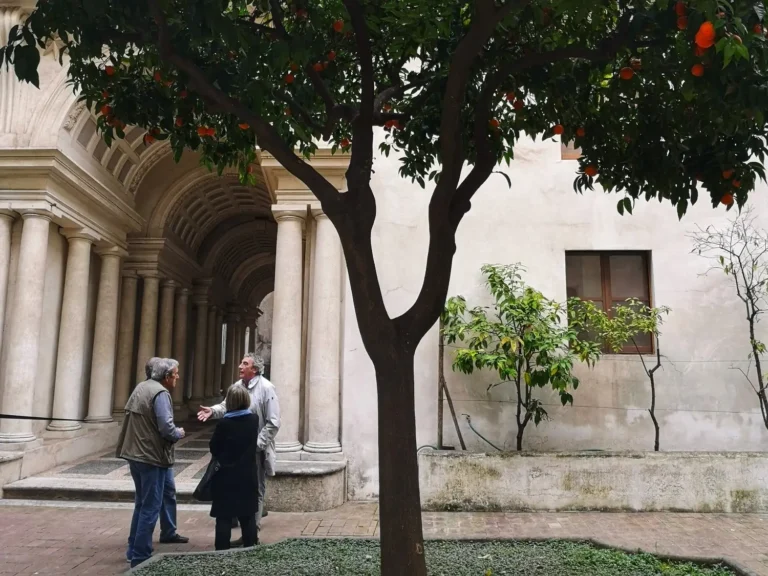
Cardinal Spada wanted a spacious garden adjoining his new palace. The palace itself, however, occupied the entire plot of land available. There was no room. The garden he wanted was an impossibility.
In 1632, Spada hired Borromini — then working with Carlo Maderno on the Palazzo Barberini — to carry out renovations and make the interior of the palace feel bigger.
The garden was not the only problem. The dimensions of the available space were awkward, the light was poor, and the overall effect was of a building that had run up against the limits of its site. Borromini was given the task of making a constrained space feel like a generous one.
His response was a piece of pure architectural theatre that should not have been possible and has not been repeated.
The Trick
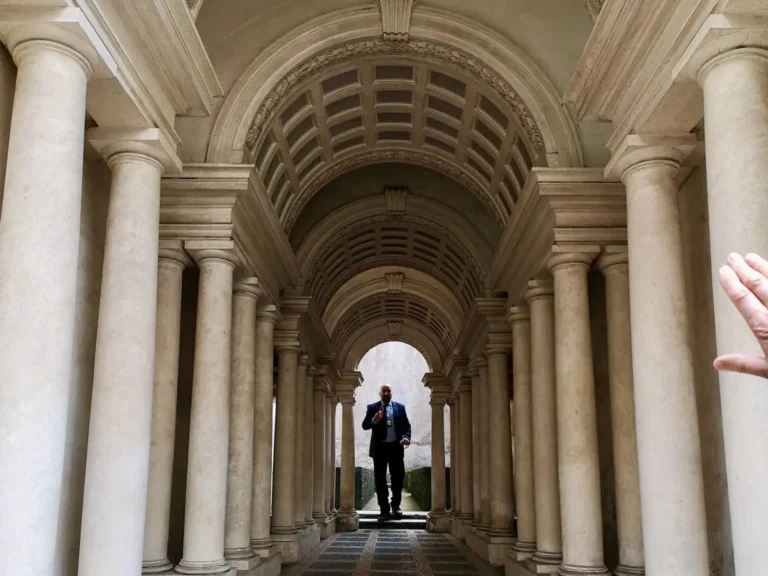
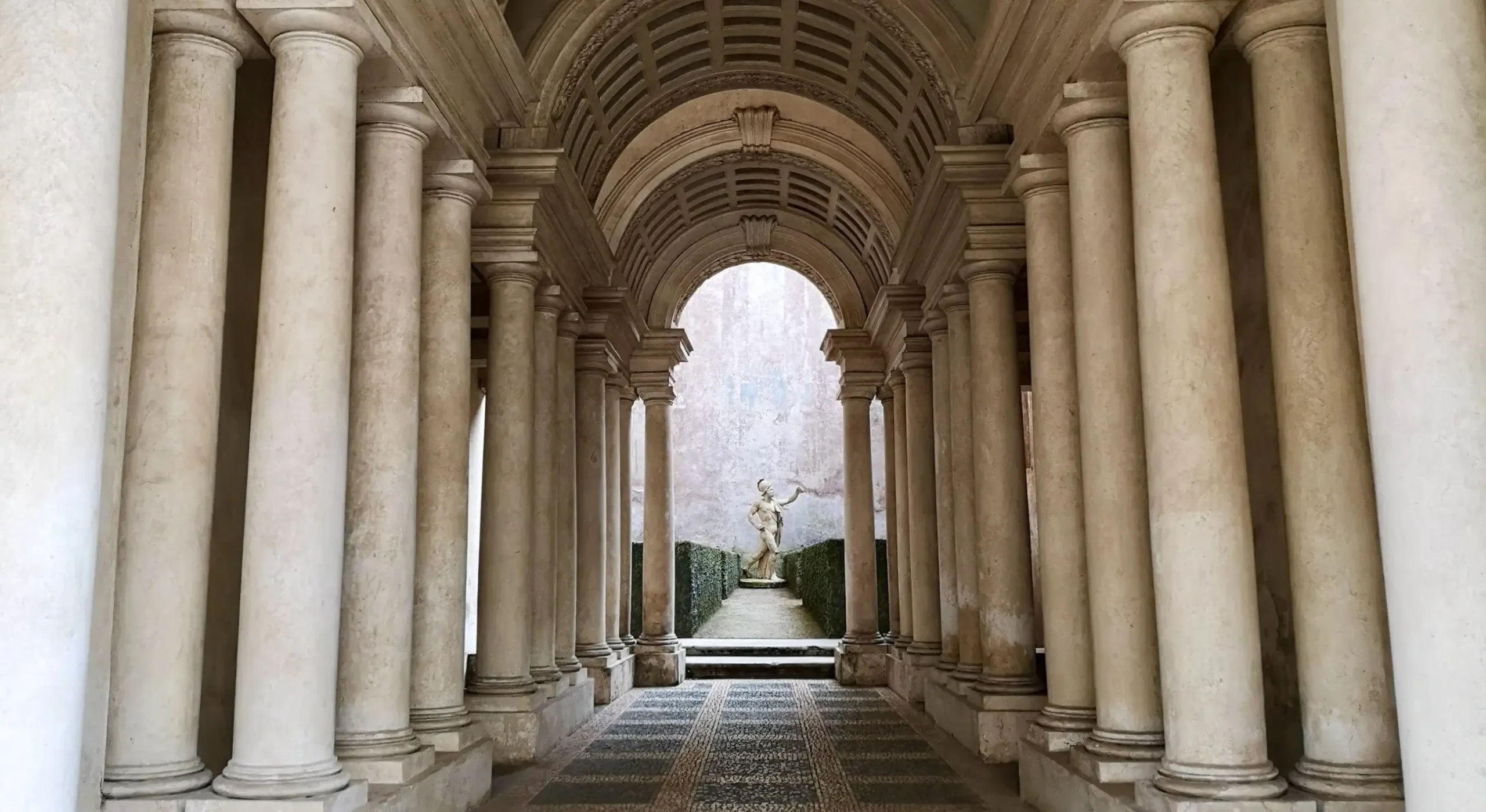
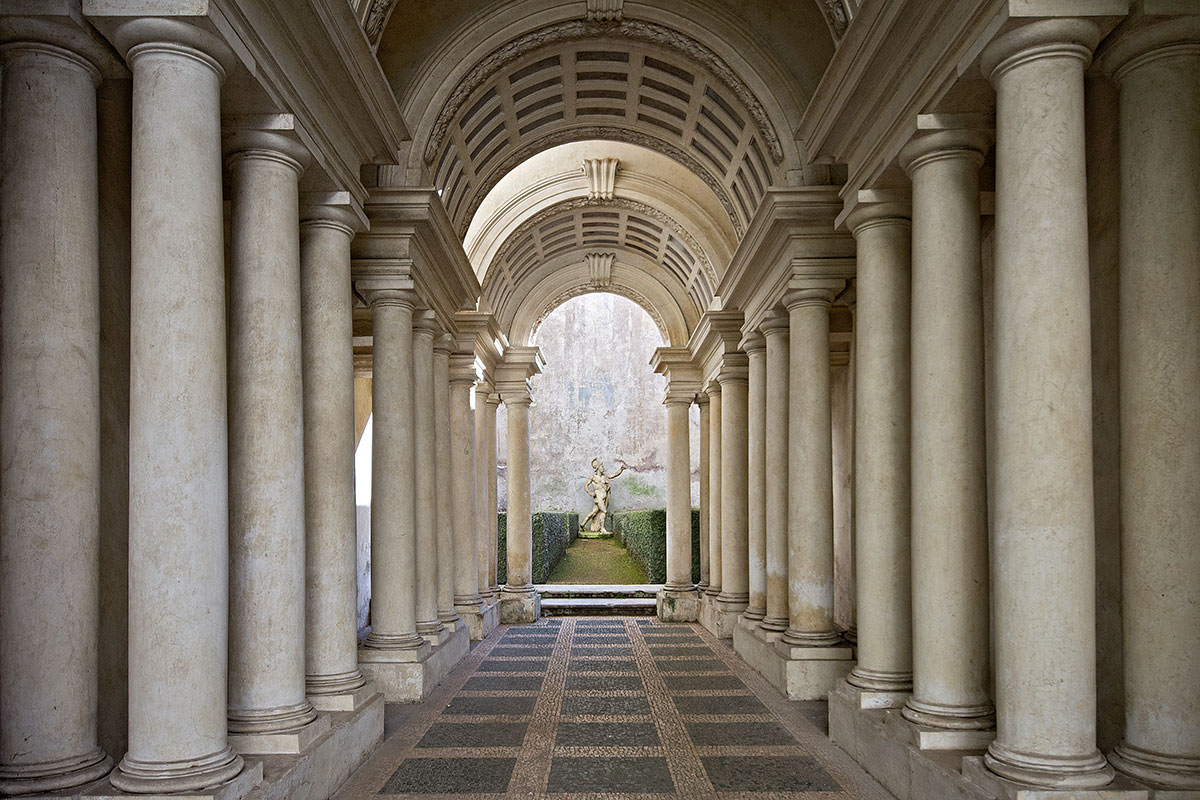
In a small courtyard off the main palace, Borromini constructed a colonnade: a corridor, open on one side, formed by parallel rows of columns stretching away from the viewer. Looking at it from the palace side, you see what appears to be a long and impressive gallery, perhaps 25 or 30 metres deep, drawing the eye towards a window at the far end where a small classical garden and a statue are visible in the distance. It is the kind of long romantic corridor you associate with the great palaces of Europe.
Except that it is 9 metres long. The statue at the end — which appears to be life-size, perhaps slightly larger — is 60 centimetres tall. The garden beyond the window is a flat painted backdrop.
Borromini achieved this by means of a sophisticated manipulation of forced perspective — the same set of techniques used by stage designers and theatre painters of the period, but applied here to three-dimensional architecture.
As the colonnade recedes from the viewer, the columns get shorter and the ceiling gets lower; the floor rises slightly; the width of the corridor narrows. Every spatial element has been calibrated so that the eye, receiving the same visual signals it would from a full-size receding space, concludes — without any act of conscious reasoning — that it is looking at a much larger volume than actually exists.
The effect is perfectly convincing from the intended viewpoint. Walk around to the far end of the colonnade, however, and the magic collapses entirely: now you are seeing a tiny, steeply sloping passage with dwarf columns, and the statue at the near end is absurdly, unmistakably small.
I first encountered this corridor on a quiet Tuesday morning, having spent some time beforehand studying photographs and diagrams. I thought I was prepared. Standing at the entrance and looking down what appeared to be a generous and elegant gallery, I was not prepared at all.
I stood there for a good twenty minutes before I could persuade my eyes to accept what my brain was telling them.

The Collaboration
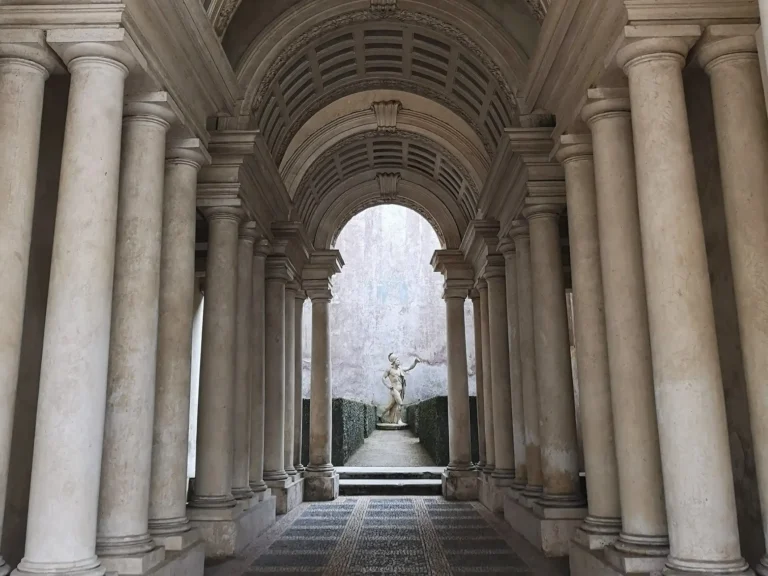
Borromini did not work alone on this project. The mathematical calculations required to calibrate the corridor’s exact proportions — ensuring that the forced perspective works from precisely the intended viewpoint and only from there — required a little outside help; for this he turned to an Augustinian friar named Giovanni Maria da Bitonto, who had developed a considerable local reputation as a mathematical genius.
The specific problem da Bitonto solved is one of projection geometry: given a fixed viewpoint at one end of a corridor, how do you calculate the exact dimensions and inclinations of every architectural element so that the whole reads as a uniform, level, parallel space?
The answer requires understanding how the human visual system processes spatial information, and translating that understanding into a set of precise measurements that can actually be built.
Da Bitonto and Borromini’s collaboration produced something that no one had built before to this degree of complexity: not a drawing of an illusionistic space (trompe-l’oeil painting was well established), but an actual three-dimensional illusionistic space — architecture that lies.
Borromini: The Man Behind the Illusion
Born Francesco Castelli in 1599 in Bissone, then part of the Swiss Confederacy, Borromini trained as a stonemason in Milan before arriving in Rome in 1619, taking advantage of a debt owed to his father to fund the move.
He began working on the great projects of the day — St. Peter’s under Maderno, Palazzo Barberini under both Maderno and then Bernini — while quietly developing the architectural ideas that would make his reputation.
The name change, from Castelli to Borromini, came around this time; it is thought to have been made in honour of Saint Charles Borromeo, the reforming Archbishop of Milan, whose feast was celebrated on the day Borromini left for Rome.
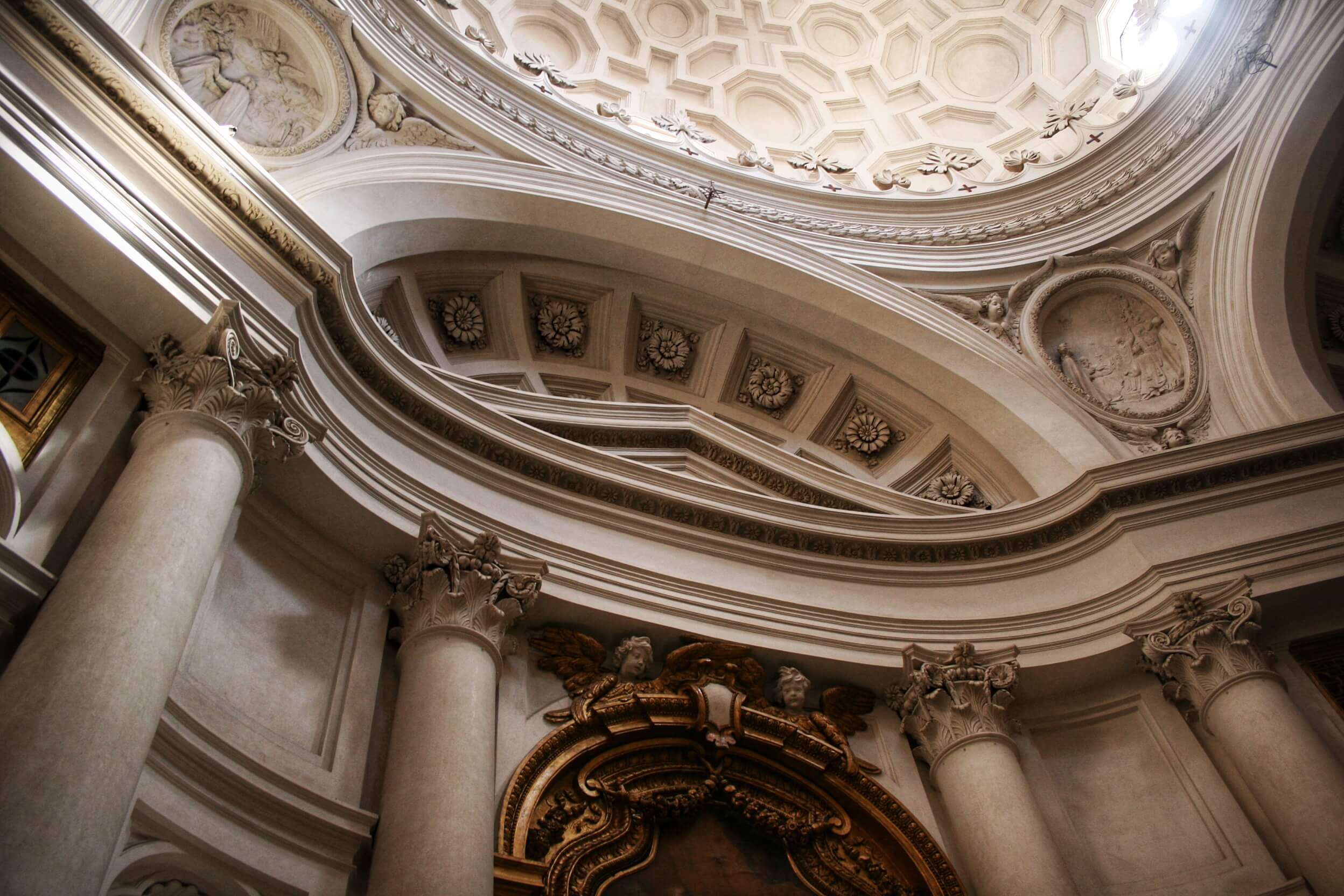
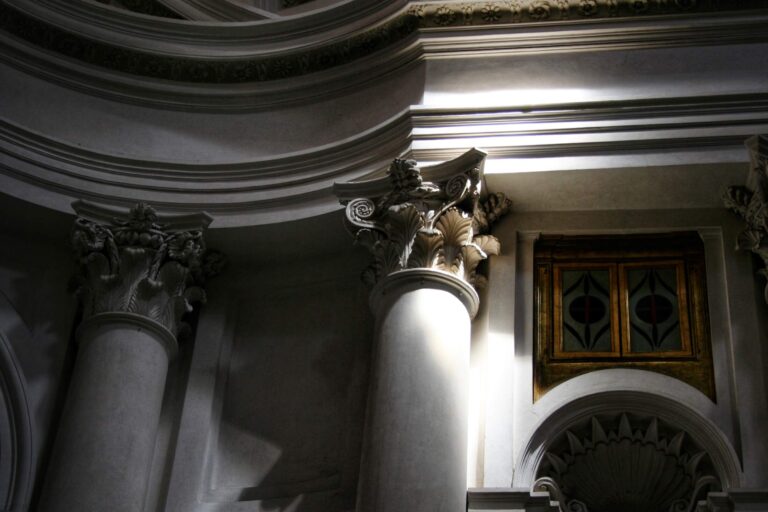
In 1634 he received his first major independent commission — the church of San Carlo alle Quattro Fontane (known to Romans as San Carlino), whose complex geometry and astonishing spatial effects announced that here was an architect working in a completely different register from any of his contemporaries. The Palazzo Spada colonnade followed a year later.
Borromini went on to produce some of the most original buildings in the history of Western architecture: Sant’Ivo alla Sapienza, with its extraordinary spiral lantern; San Giovanni in Laterano, whose vast interior he redesigned in an act of creative audacity that still divides opinion; the Oratorio dei Filippini; the Collegio di Propaganda Fide.
He was the most technically innovative architect of his age, and the one whose ideas took longest to be understood and absorbed. The darkness of his inner life, and the manner of his death, have always seemed inseparable from the restless, destabilising quality of his buildings.
The perspective corridor at Palazzo Spada is, in some ways, the most characteristic thing he ever made: a small masterpiece of rigorous calculation and theatrical effect, hidden in a courtyard most people walk past without knowing it’s there.
The Galleria Spada
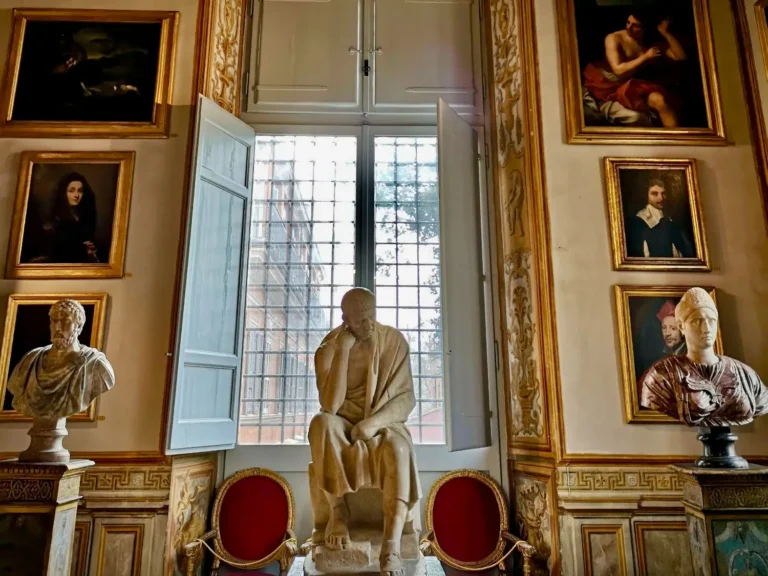
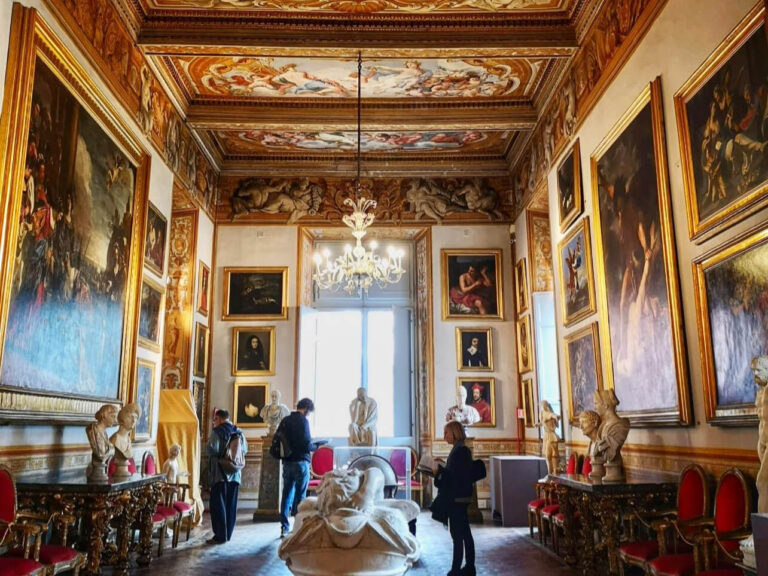
Before or after the corridor, take the time to visit the Galleria Spada upstairs: four rooms of Cardinal Bernardino’s art collection, maintained more or less as he left it in the 17th century — hung floor to ceiling in the manner of a period collection, which has the effect of making the paintings seem less like museum exhibits and more like the possessions of a man who lived here and chose what he hung on his walls with care.
The small but impressive collection reflects the tastes of the refined Cardinal Spada, and features works by leading contemporary painters including Guido Reni, Artemisia Gentileschi and others. The intimate setting makes it feel like stepping into a noble family’s private collection.
Look out for Giovanni Domenico Cerrini’s massive David with the Head of Goliath and Pietro Testa’s profoundly disturbing Allegory of the Massacre of the Innocents (1640), which does exactly what it says on the label and does it with a skill that makes the viewing experience genuinely uncomfortable. There are also fine portraits, landscapes and cabinet pictures, and a series of works by Guercino.
The combined ticket covers both the gallery and the colonnade. Do not visit one without the other.
How to Visit Palazzo Spada
Address: Piazza Capo di Ferro 13, Rome (near Campo dei Fiori and Piazza Farnese)
Opening hours: Tuesday to Sunday, 9:00 AM to 7:00 PM. Closed Mondays.
Tickets: €6 combined entry to the Galleria Spada and the Borromini corridor. One of the best-value admissions in Rome.
Getting there: In the heart of the historic centre, a short walk from Campo dei Fiori and Piazza Farnese. From Largo di Torre Argentina (served by many bus routes), the walk takes about 8 minutes. The nearest bus stops are on Corso Vittorio Emanuele II.
Note on the corridor: The viewpoint for the corridor’s full effect is from the palace side — the entrance is near the first courtyard. You won’t be able to walk into the corridor itself, but the perspective effect is fully visible from the entrance and is in fact most effective when viewed from a distance.
Combine with: A visit to Campo dei Fiori for lunch or an aperitivo (we love old-school wine bar Il Vinaietto), followed by a walk to Piazza Farnese, the most elegant Renaissance square in Rome.
Book Your Rome Experience