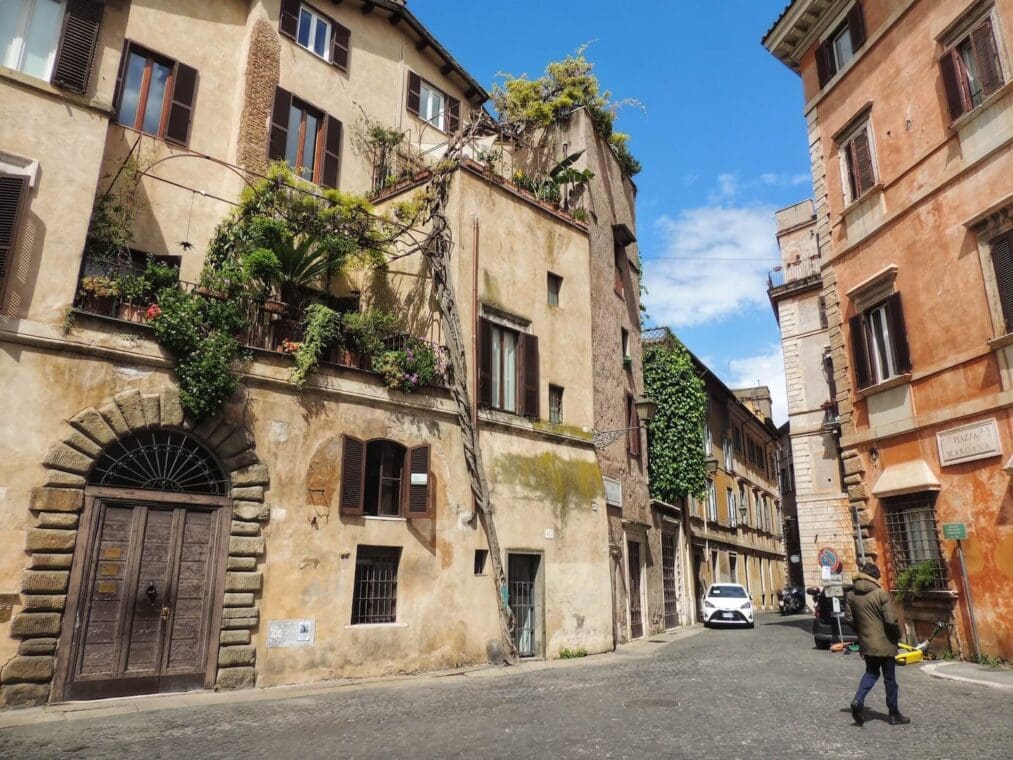
In the soft light of a spring morning, Rome is at its picture-perfect best.
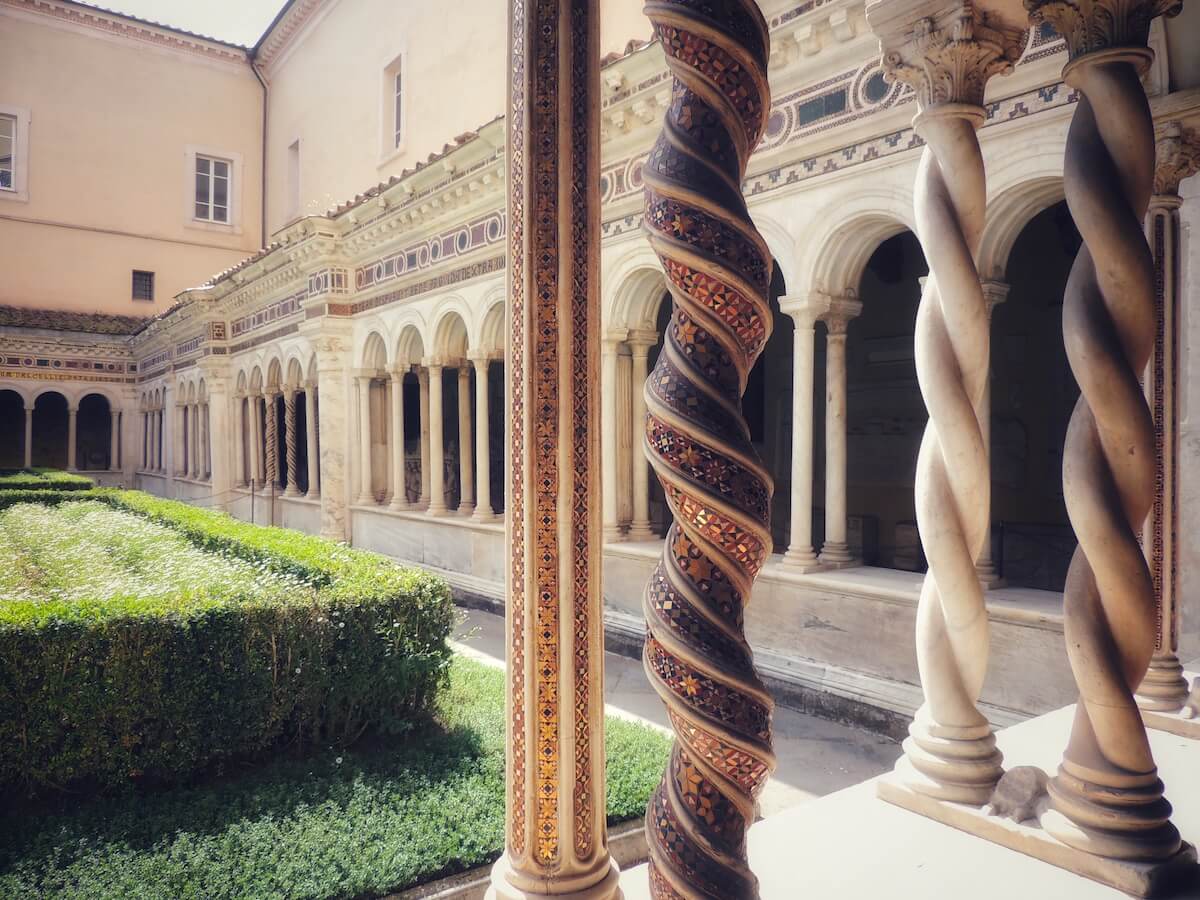
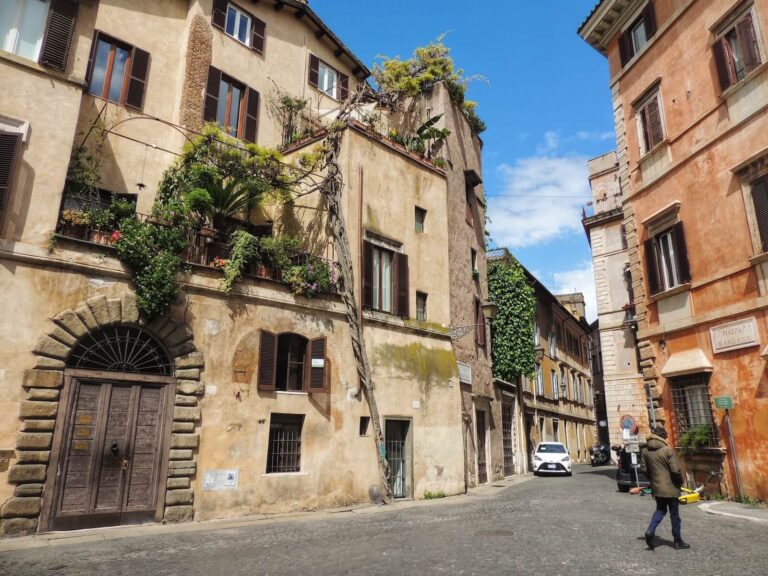
We’re standing in front of a tiny but elegant 18th-century outdoor chapel known locally as the Tempietto del Carmelo. Slender white marble columns stand out against a tangerine facade, bleached by the powerful rays of the Roman sun. Across the road, a bakery’s oven perfumes the air with the aroma of baking bread.
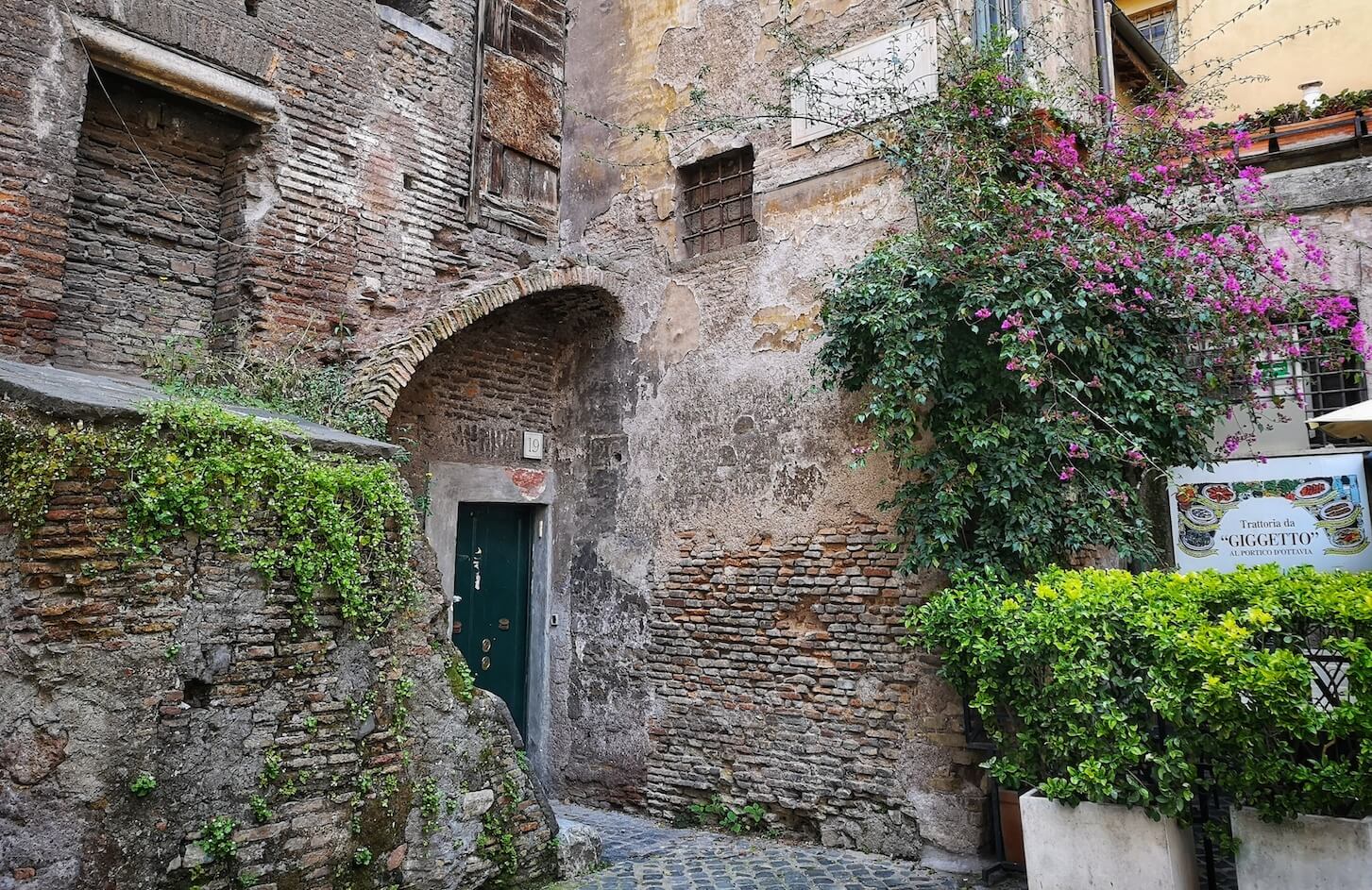
Tucked away off Piazza Costaguti, this is one of the most peaceful spots in the Eternal City — but it conceals a very sinister past. This is the heart of what is historically known as the Roman Ghetto, and it was right here that for centuries Rome’s ancient Jewish community were forced to listen to hectoring sermons demanding their conversion to Christianity every Saturday afternoon after their Sabbath services.
The story of the Jewish Ghetto in Rome is a fascinating tale: both for its atmospheric beauty and its frequently tragic history, the quarter is one of Rome’s most enduringly compelling areas. Read on to discover it with us.
Jewish Ghetto Tours
Discover Rome's Fascinating Jewish Heritage
Europe's Oldest Jewish Community
You probably know the darkest moments of this story already: segregated for over 300 years from the 1550s in a tiny and overcrowded area of the city, discriminated against as second-class citizens and subject to periodic bouts of persecution, the plight of Rome’s Jewish community reached its awful zenith in the unimaginable horror of deportation and genocide at Nazi death camps during the Holocaust.
Outside the homes of Jewish families violently ripped from their community and murdered in distant Auschwitz, unassuming but powerful cobblestone memorials are engraved with the names of the victims and the dates of their deportation and deaths.
As you pass through the area, look out for these stolpersteine — stumbling stones — which stand as silent memorials to one of humanity’s most terrible outrages.
But there is a great deal more to the rich history of Roman Judaism than the atrocities of the modern age. Rome’s Jewish community is the oldest in Europe, with a continuous presence in the Eternal City going back at least as far as the 2nd century BC.
Attracted by the economic potential of the ancient world’s greatest and most ethnically diverse city, the Jewish minority was so well-established that by Julius Caesar’s day their rights and religious practices had received specific imperial protections, making Judaism one of the few non-Roman religions legally tolerated across the empire.
Such was their devotion to Caesar that ancient historians recount how the city’s Jewish population kept a night-long vigil over his tomb after his assassination.
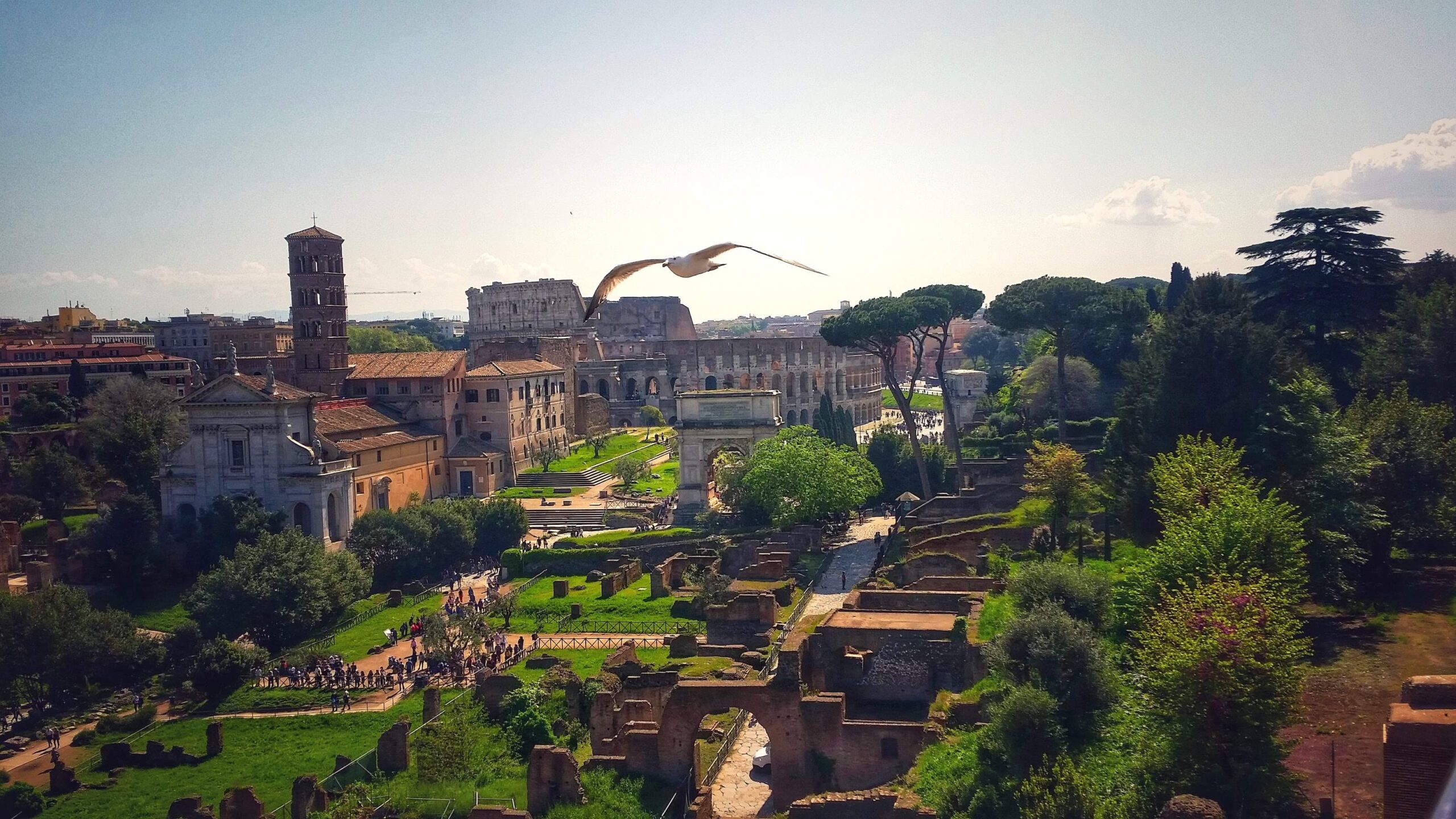
An influx of Jewish slaves into the city in the wake of the brutally suppressed Jewish revolt of 70 AD swelled their numbers further — many of these arrivals were exploited as forced labour on major construction projects, with some scholars believing Jewish captives contributed to the building of the Colosseum. Their descendants would form the majority of the city’s Jewish community in the centuries to come.
Under the Edict of Caracalla in 212 AD they were elevated to the status of Roman citizens, and in late antiquity the city boasted multiple synagogues catering to a congregation estimated at tens of thousands.
Judaism’s more than 2,000-year story in Rome marks the community as unique in Europe. Unlike the history of forced migration and alienation that so frequently characterised Jewish communities elsewhere on the continent, Jewish life in Rome has been a constant and relatively stable feature of the Eternal City’s complex cultural patchwork.
This indigenous community is known as italkim, in contrast to the more recent (though still ancient) Sephardic and Ashkenazi branches of Judaism dominant around the world today, and they practise a distinctive and very old form of Jewish rite and prayer that survives nowhere else.

The Rise of Christianity and a Changing Relationship
The rise of Christianity in the later Roman empire spelled the beginning of the end of the community’s previous good fortunes, and as the Papacy’s power over the city intensified, Jewish rights were gradually stripped away.
By the 13th century, Jews were obliged to wear a distinguishing badge of cloth to identify them from their Christian neighbours — a requirement emanating from the Fourth Lateran Council of 1215.
Despite the best efforts of some of the more fanatical medieval popes and occasional outbreaks of anti-Semitic violence, however, relations between Rome’s Jewish population and the Christian majority remained comparatively measured throughout much of the Middle Ages and into the Renaissance.
The community was widely renowned for its learning, and Jewish physicians were especially valued for their medical expertise — in the 15th century a succession of pontiffs even employed them as personal doctors.
Paul IV and the Creation of the Ghetto
Things took a dramatic turn for the worse in the mid-16th century, when the upheavals of the Protestant Reformation provoked a violent backlash against religious toleration across Europe.
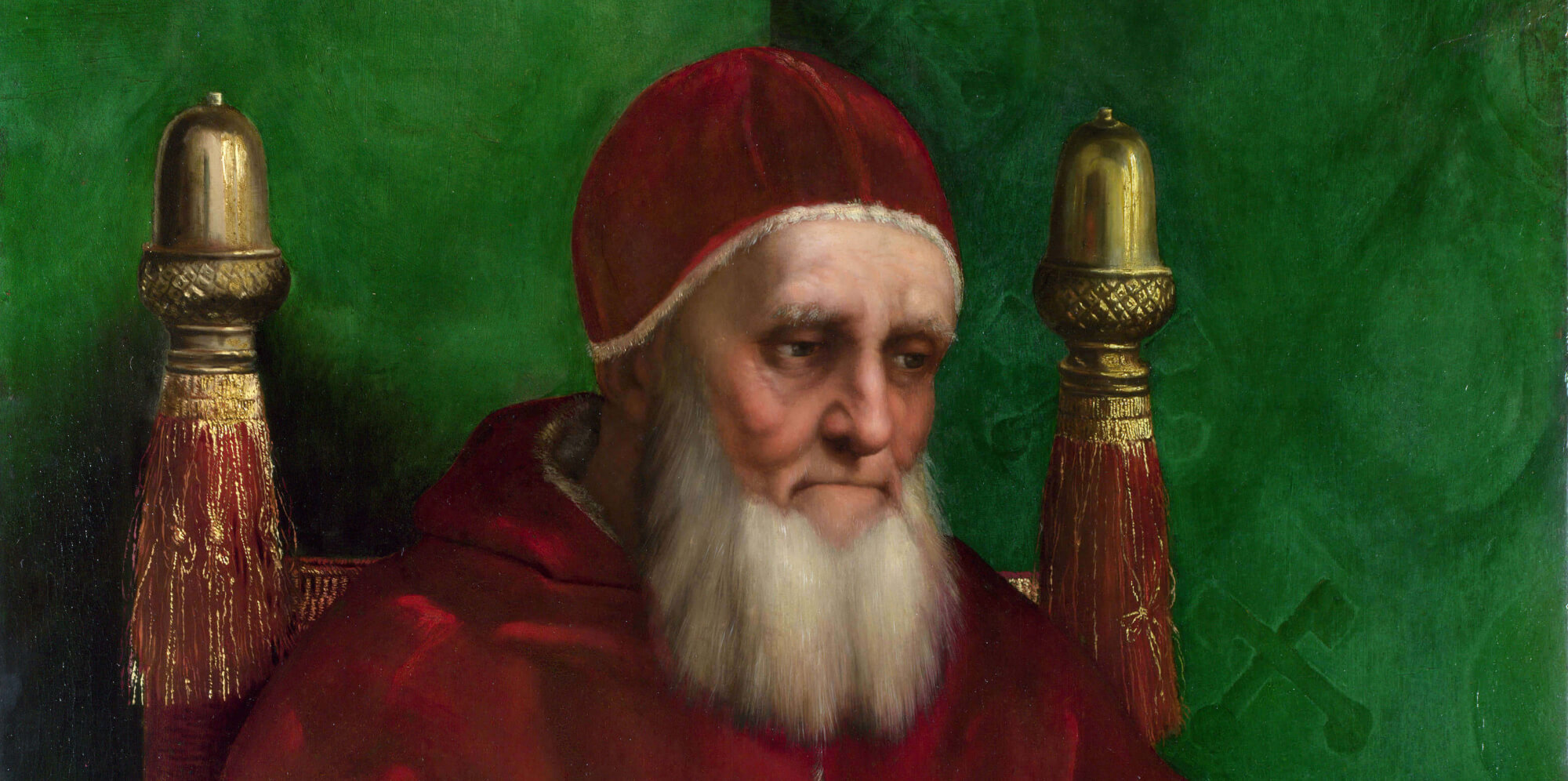
The Talmud was ritually burned on the orders of the Inquisition in 1553, and the fanatical Counter-Reformation pope Paul IV went further two years later, publishing his papal bull Cum nimis absurdum in 1555, demanding that walls be erected to segregate the traditional residential quarter of Rome’s Jewish population — shattering over a millennium of coexistence at a single stroke. To add insult to injury, the Jewish community was required to pay for the construction of the walls that cut them off.
The bull unleashed a torrent of discriminatory measures. Jewish householders were forced to sell their property at a fraction of its value and rent it back at exorbitant rates from Christian landlords. Curfews were introduced and residents had to be inside the Ghetto by nightfall.
Jews were forced to wear yellow hats to signal their status as second-class citizens and were banned from practising most professions, constrained instead to make a living trading in used clothing — the so-called rigattieri.
A small number were permitted to engage in moneylending under strict papal licence, a necessary concession since Catholics were officially forbidden from this vital economic activity.
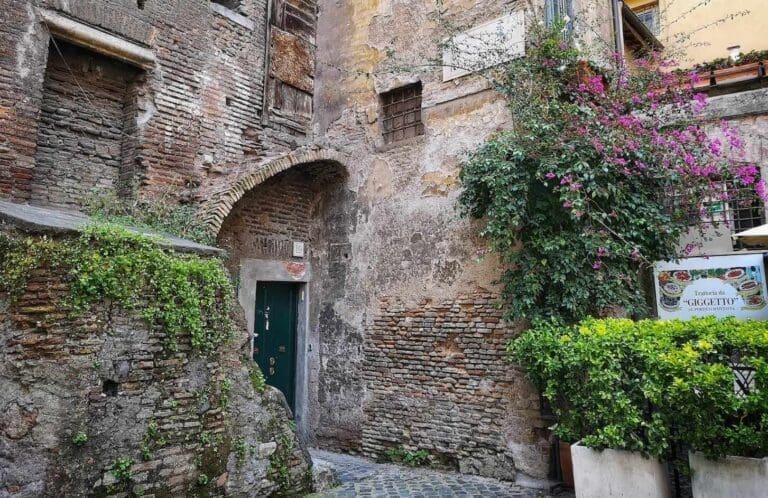
Living conditions in the Ghetto deteriorated rapidly, and poverty reigned in the increasingly cramped tenements looming over narrow streets. The Ghetto occupied a mere seven acres, hemmed in on all sides by high walls, and accommodation was at such a premium that many residents could only afford to rent a portion of a single room, measured by the centimetre.
With no room to expand outward, the only way was up, and the unwieldy edifices grew taller and stranger in form — “tower-like masses of bizarre design”, as one 19th-century observer put it. Worse still, the Tiber burst its banks in the low-lying quarter with alarming frequency, inundating the neighbourhood and creating ideal breeding ground for disease.
Paul IV and his successors were convinced that these inhuman conditions would drive Rome’s Jews to convert to Christianity, and to this end they forced them to attend fire-and-brimstone sermons in the churches on the fringes of the Ghetto every Saturday after their Sabbath services — the harangues that took place in the vicinity of the Tempietto del Carmelo where our story began.
In reality the unforgivable strategy bore negligible fruit. The roots of Roman Judaism were so deeply established that community cohesion remained remarkable across the centuries of enforced hardship. There are even reports of Jews filling their ears with wax to demonstrate their disdain for the preachers’ harangues.
The Walls Come Down
The walls of the Ghetto were finally torn down in 1848, after Pope Pius IX — in the early liberal phase of his pontificate, before he reversed course dramatically — sanctioned their demolition in response to growing pressure from the city’s reformist movement.
The act was part of a brief, unsteady opening towards civil liberties that Pius IX quickly reversed after being forced to flee Rome during the revolutionary upheavals of 1848-49; the actual emancipation of Rome’s Jewish community had to wait for a more decisive political rupture.
That rupture came in 1870 with the final collapse of the Papal States and the entry of Italian unification forces into Rome. The Ghetto was formally abolished; its 9,000 or so residents were granted Italian citizenship and took their place as part of the modern nation.
Although the Ghetto was no longer a ghetto, and the teetering medieval tenements were razed and rebuilt in a sweeping late-19th-century urban renewal programme, the Jewish community remained largely wedded to their traditional quarter.
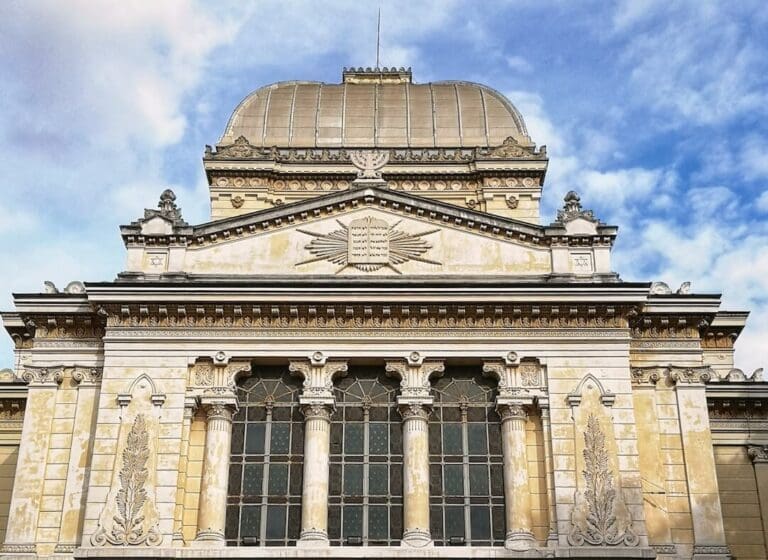
The Great Synagogue, built between 1901 and 1904 on the banks of the Tiber and still a dominant feature of Rome’s skyline today, announced the community’s confident reintegration into the life of the city.
The Shadow of the Holocaust
When the Nazis occupied Rome in September 1943, they moved swiftly. On 26 September, SS Lieutenant Colonel Herbert Kappler summoned Rome’s Jewish leaders and demanded the delivery of 50 kilograms of gold within 36 hours, or 200 Jews would be deported. The community delivered the gold — but it bought only a few weeks of safety.
On 16 October 1943, before dawn, German and Italian Fascist forces swept through the old Ghetto neighbourhood in a coordinated roundup. Of the 1,023 members of the Jewish community deported to Auschwitz that day, just 16 survived. The last remaining survivor, Lello di Segni, died in 2018 at the age of 92.
The Piazza in front of the Porticus Octaviae is today named Largo XVI Ottobre 1943 in permanent commemoration. The stolpersteine you encounter throughout the neighbourhood are there to ensure the individual human stories behind that statistic are never reduced merely to a number.
What to See in the Jewish Ghetto
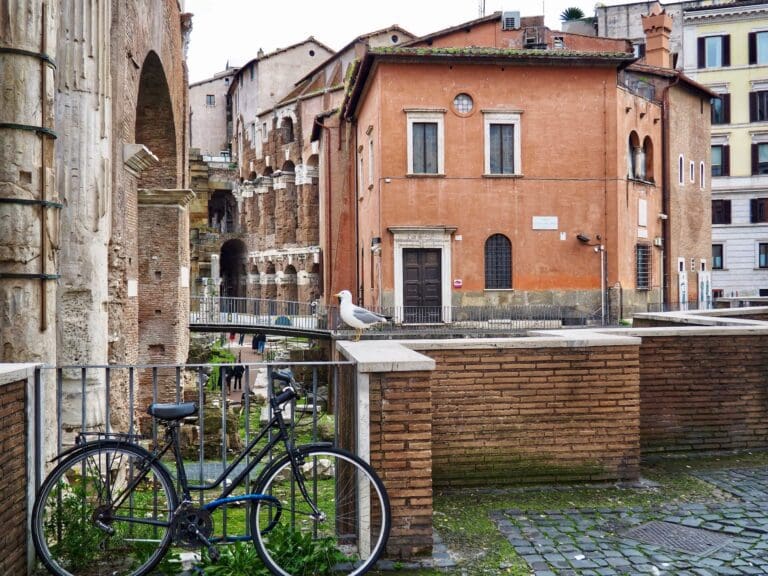
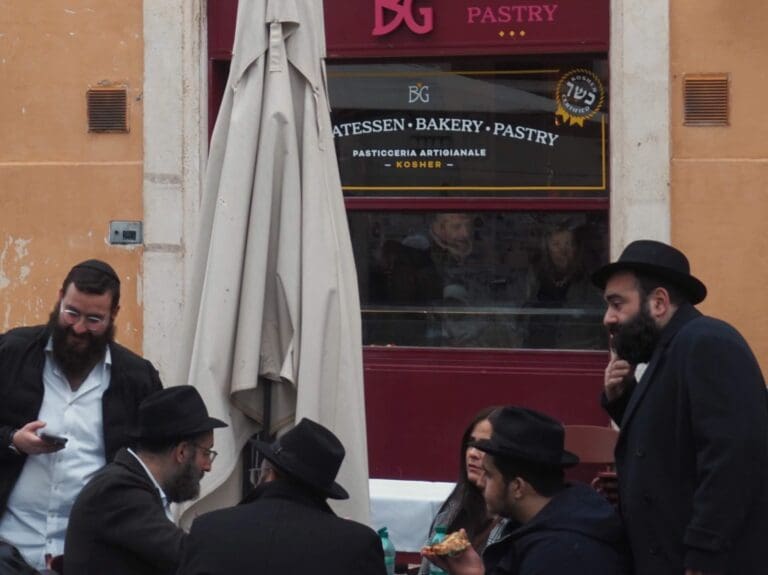
The best thing to do in the Ghetto is to simply wander through its warren of atmospheric streets and squares — to take in the kosher shops, restaurants and bakeries that still bear the unmistakable hallmark of this ancient community, and to absorb a neighbourhood whose peaceful present-day character makes its history feel all the more charged.
The highlights are covered in full in our dedicated guide to what to see in the Jewish Ghetto, but the essentials include:
- The Great Synagogue, whose distinctive square aluminium dome — unique on Rome’s skyline — announces the community’s return to full civic life after the Ghetto’s abolition. Built between 1901 and 1904, it remains an active place of worship and houses the Jewish Museum of Rome in its lower floors.
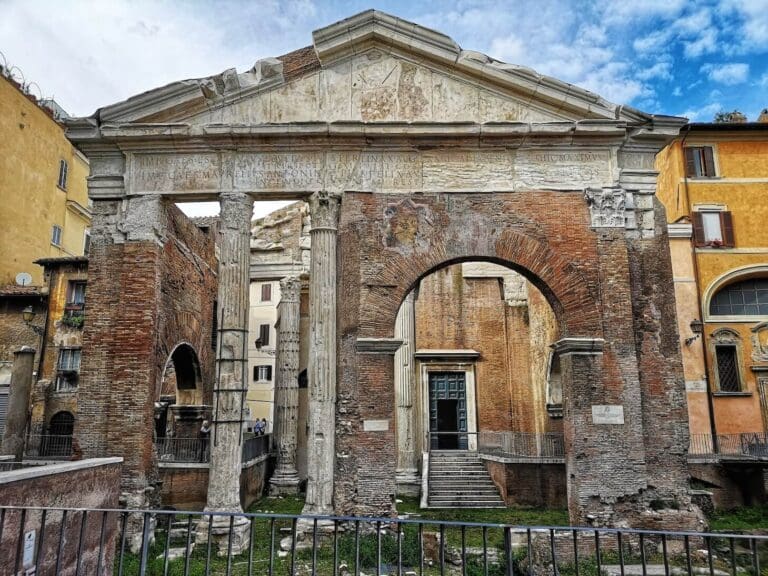
- The Porticus Octaviae (Portico d’Ottavia), a spectacular ancient colonnade whose massive marble columns once framed temples to Jupiter and Juno, later became the city’s fish market and hosts a medieval church built directly into the ruins — the most evocative way to enter the historic quarter.
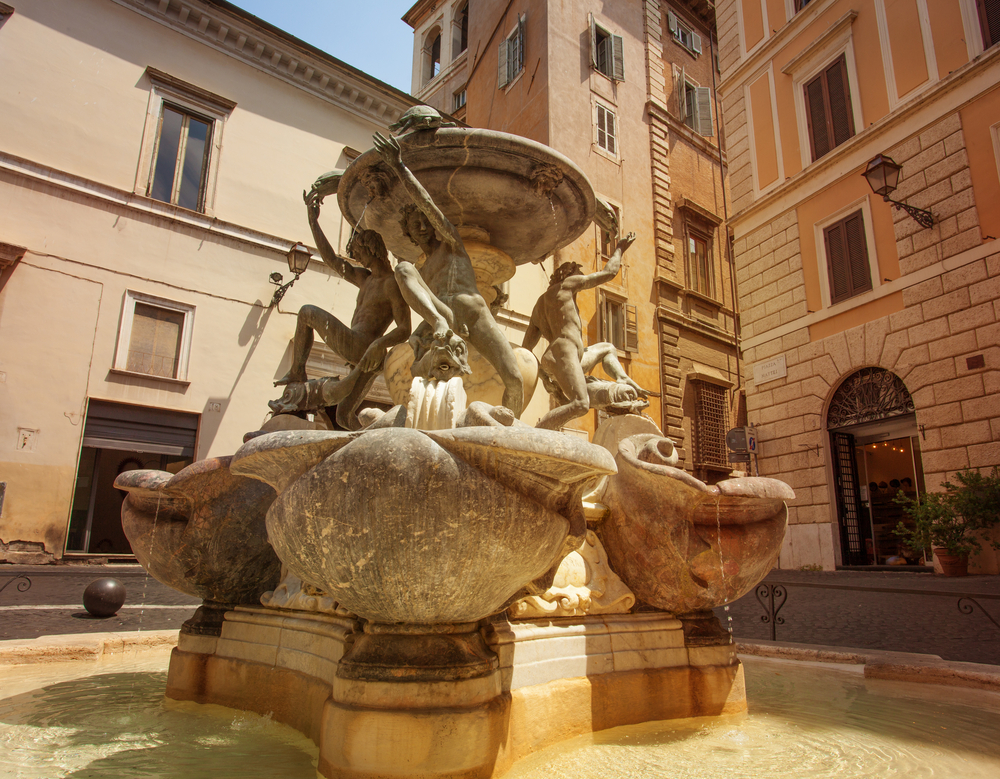
- Piazza Mattei and its extraordinary Fontana delle Tartarughe (Turtle Fountain), one of Rome’s most beloved small piazzas.
- The Teatro Marcello, the magnificent ancient theatre on the boundary of the historical Ghetto, older than the Colosseum and even more astonishing for the Renaissance palazzo that has colonised its upper levels.
- Stolpersteine — the small brass cobblestones that serve as the most personal and affecting memorials in the city.
What to Eat: Roman Jewish Cuisine
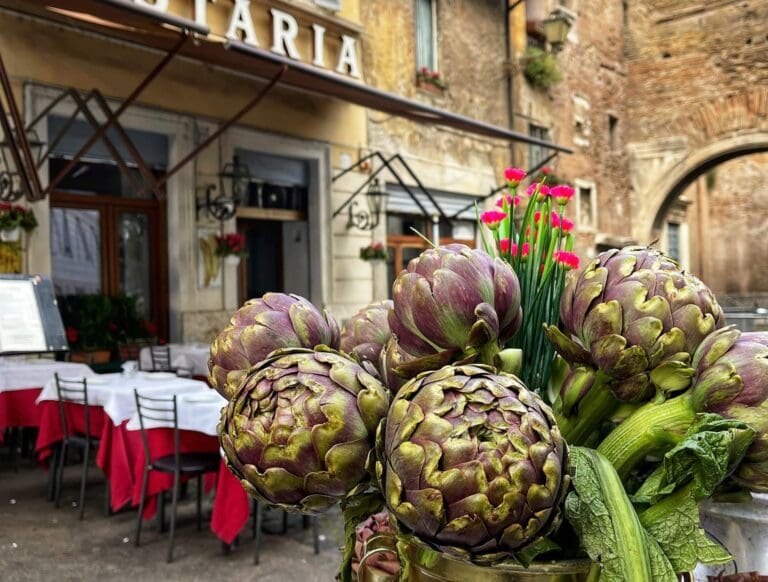
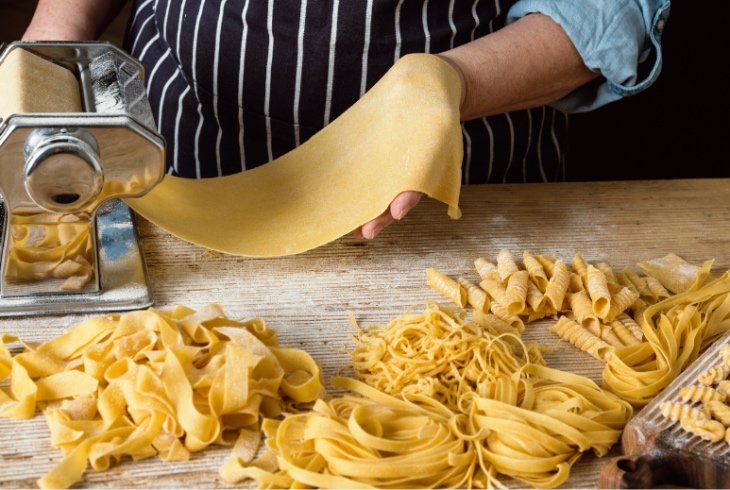
Roman Jewish cooking is one of the great distinct culinary traditions of Italy, and the quarter around Via del Portico d’Ottavia is the best place in the city to experience it. The tradition has been shaped by centuries of specific dietary laws, economic constraints and cultural exchange, producing dishes that are recognisably Roman yet unlike anything else in the city.
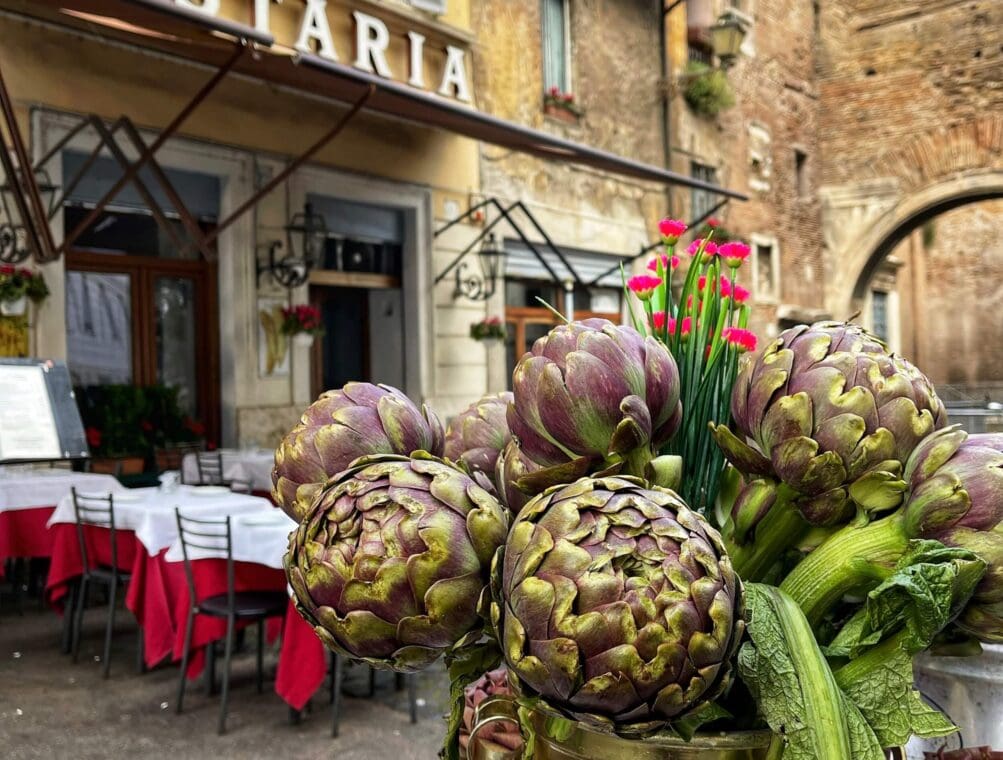
The dish you cannot leave without trying is carciofi alla giudea — artichokes fried whole in olive oil until the outer leaves crisp to a deep bronze and shatter like wafers, while the heart remains tender. It is one of those perfect things, the kind of dish that seems so simple and so obvious once you’ve tasted it that you wonder why the rest of the world hasn’t adopted it wholesale. The spring season (February to May) is when the Roman artichoke is at its best.
Baccalà in pastella — salt cod in a light batter, fried to a golden crisp — is the other essential. Salt cod was one of the few preserved proteins the community could afford during the long centuries of the Ghetto, and it was transformed by Jewish cooks into something genuinely magnificent.
For something sweet, the crostata di ricotta e visciole — a tart of fresh ricotta and sour cherries in a short pastry case — is an institution. The historic bakery Boccione on Via del Portico d’Ottavia has been making it since before anyone can remember and still sells out most days by early afternoon.
For a sit-down meal, several kosher restaurants line the main street. Ba’Ghetto is probably the most reliable for a full lunch or dinner of Roman Jewish classics; Nonna Betta next door is similarly good and popular with local families. Il Portico is a good choice for those who want to try the full range of the tradition. None of these restaurants are cheap, but you won’t find a more authentic experience in the city.
How to Visit the Jewish Ghetto
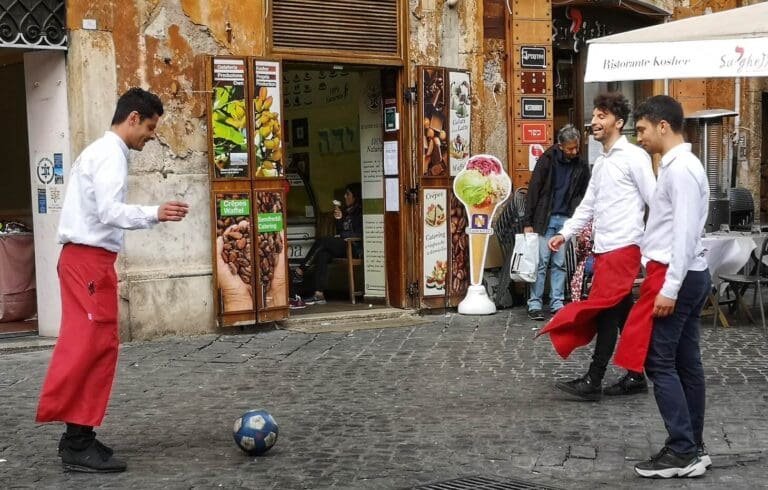
Location: The Jewish Ghetto occupies a compact area on the left bank of the Tiber, between the ancient Teatro Marcello to the south, Largo di Torre Argentina to the north, and the river embankment to the west. The central street is Via del Portico d’Ottavia.
Getting there:
- Metro: There is no metro stop in immediate proximity. The closest is Circo Massimo (Line B), from which it’s a pleasant 10–15 minute walk along the Tiber.
- Bus: Lines 30, 40, 62, 63, 64, 87 and 492 all stop at Largo di Torre Argentina, a 5-minute walk from the heart of the quarter.
- On foot: From Campo de’ Fiori, about 5 minutes. From the Pantheon or Piazza Navona, about 10 minutes.
Entry: The streets and piazzas of the Ghetto are freely accessible at all times. The Great Synagogue and Jewish Museum require a ticket (see the What to See article for current prices and opening hours).
When to visit: The Ghetto is liveliest and most atmospheric in the morning, when the bakeries and kosher shops are open and the neighbourhood goes about its daily business. On Friday afternoons the area quiets as the community prepares for Shabbat; on Saturday (Shabbat), many Jewish-owned businesses will be closed. Sunday mornings can be very pleasant — quieter than weekdays but with cafes and restaurants open.
Guided tours: Through Eternity’s Jewish Ghetto tour covers the history and monuments of the quarter with an expert guide in a small group, and is the most effective way to understand the layers of history compressed into this small area.
Rome's Jewish Ghetto FAQ
How old is Rome’s Jewish community?
Rome’s Jewish community has been continuously present in the city since at least the 2nd century BC, making it the oldest Jewish community in Europe — a presence of over 2,200 years.
When was the Roman Ghetto established?
The Ghetto was formally established by Pope Paul IV with the papal bull Cum nimis absurdum on 14 July 1555. Jews in Rome had been subject to various restrictions before this date, but the 1555 bull created the walled enclosure for the first time.
How long did the Roman Ghetto last?
The Ghetto walls were torn down in 1848, giving the Ghetto a duration of nearly 300 years. Full civic emancipation came with Italian unification in 1870.
What happened to Rome’s Jewish community during the Holocaust?
On 16 October 1943, German forces conducted a large-scale roundup of Rome’s Jews. Of the 1,023 people deported to Auschwitz, only 16 survived.
What language do Roman Jews traditionally speak?
The indigenous Roman Jewish community (italkim) traditionally used a dialect known as giudeo-romanesco, a form of Romanesco dialect with Hebrew and other influences, though this is rarely spoken as a first language today.
Is the Jewish Ghetto a good area for food?
Absolutely. Via del Portico d’Ottavia is one of the best streets in Rome for eating, with a concentration of restaurants and food shops representing the distinctive Roman Jewish culinary tradition. Carciofi alla giudea, baccalà fritto and crostata di ricotta e visciole are the essentials.

Book Your Rome Experience