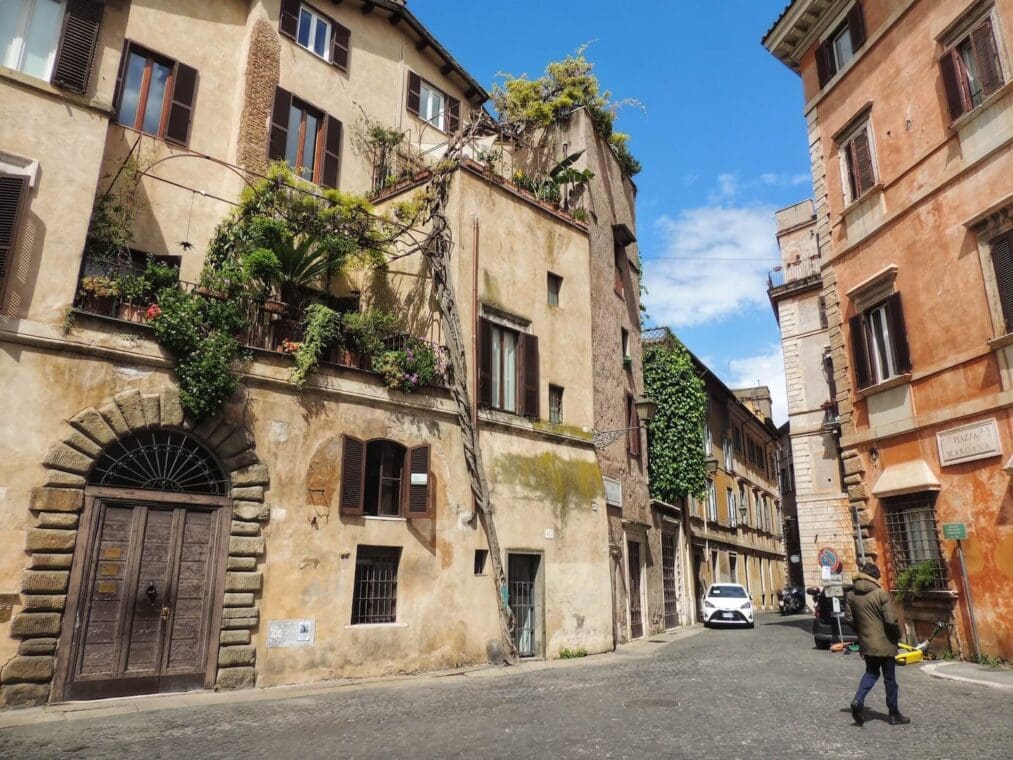
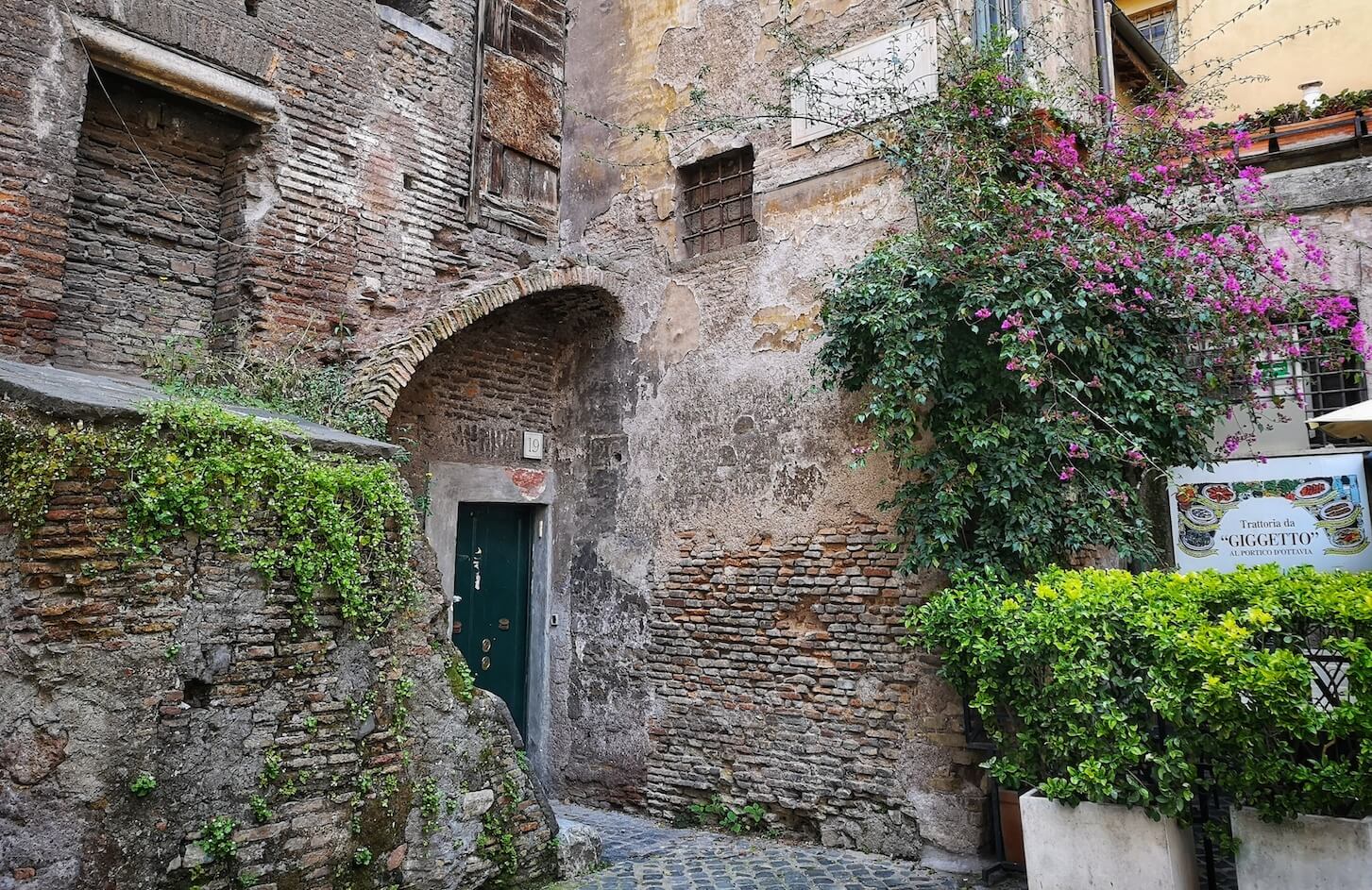
Few places in Rome compress so much history into so little space as the Jewish Ghetto.
Within a handful of narrow streets, ancient Rome, the Renaissance, the Counter-Reformation, the Risorgimento, and the tragedies of the twentieth century all coexist within sight of one another. A few minutes’ walk can take you from the remains of a temple built before the birth of Christ to a synagogue that speaks to one of Europe’s oldest continuous Jewish communities, from one of Rome’s most beautiful Renaissance fountains to streets marked forever by the deportations of October 1943.
Yet the Jewish Ghetto is more than a collection of monuments. It is a living neighbourhood whose history stretches back more than 2,200 years, making Rome’s Jewish community the oldest in the western world. Every corner contains traces of that remarkable story: periods of prosperity and cultural exchange, centuries of confinement behind the ghetto walls, emancipation, renewal, and survival.
This is not a neighbourhood to rush through. The Jewish Ghetto reveals itself gradually, through small details, overlooked corners, and stories accumulated over centuries – which is why a guided tour here adds more to the experience than in almost any other part of the city.
Here are twelve things not to miss.
Jewish Ghetto Tours
Discover Rome's Fascinating Jewish Heritage
one
1. The Great Synagogue
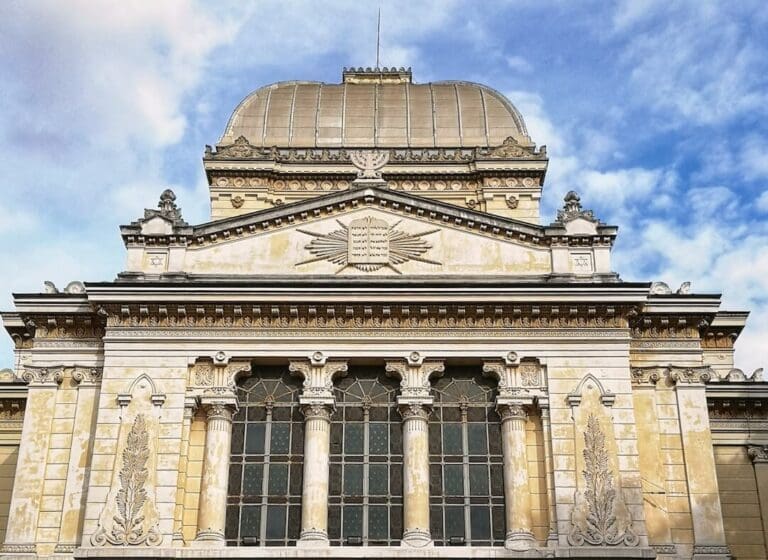
The Great Synagogue is the beating heart of Rome’s Jewish community and the most powerful symbol of its reintegration into the city after three centuries of enforced segregation.
When the Ghetto’s walls came down in 1848 and full emancipation followed in 1870, the community faced the question of where to build a grand new synagogue worthy of the occasion. Their answer was deliberately and meaningfully to build it here, in the same neighbourhood where their ancestors had been confined — not as an act of nostalgia, but as a statement that this quarter remained their home.
The building was designed by the architects Vincenzo Costa and Osvaldo Armanni and completed in 1904. One of Rome’s most striking Art Nouveau buildings, the structure features an eclectic fusion of details inspired by ancient Assyria and Babylonia and a colorful, richly detailed interior.
Look up at the ceiling of the main hall, painted in vivid hues of red, blue, gold and green, and you’ll notice it represents the rainbow — a deliberate theological choice. The rainbow is the sign of God’s covenant with Noah after the Flood: a promise of mercy, a vow of no further destruction.
Given that the building sits in a neighbourhood that was subject to flooding for three centuries of the Ghetto’s existence, and that a far worse destruction was to follow in the 20th century, the choice feels especially appropriate.
The synagogue’s square aluminium dome — the only one of its kind on Rome’s skyline — makes it immediately recognisable from across the Tiber, a counterpoint to the round domes of the innumerable churches that dominate the Roman cityscape. The synagogue remains an active place of worship; opening times for visitors are separate from services.
Practical note: The synagogue can be visited with a ticket. Photography restrictions apply inside the building.

two
2. The Jewish Museum of Rome
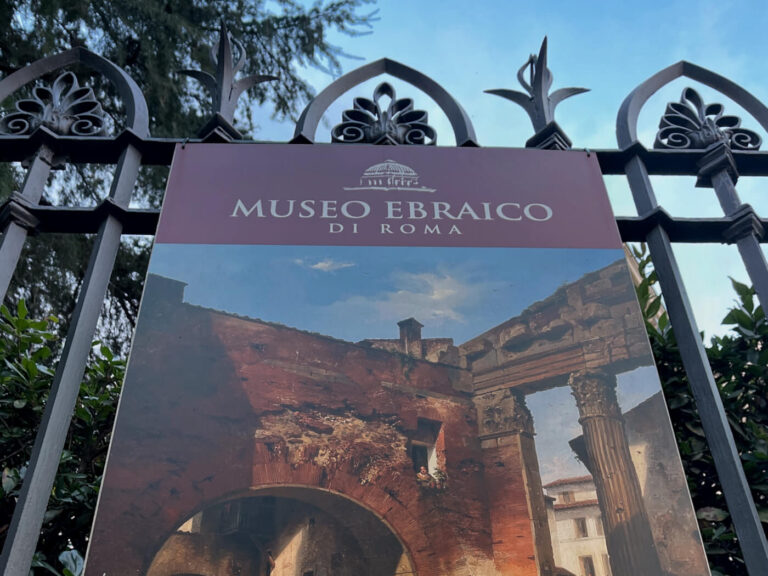
Housed in the lower floors of the Great Synagogue, the Museo Ebraico di Roma is one of the most significant collections documenting Jewish history and culture in Italy.
The permanent collection spans over two millennia of Roman Jewish life, from ancient inscriptions and ceremonial objects to documents from the Ghetto period and the devastating archive of deportation records from 1943.
Among the most important objects are historical mappot (Torah binders), historic festival objects, illuminated ketubot (marriage contracts) demonstrating the visual sophistication of the community’s material culture, and fragments from the five ancient synagogues that once served the Ghetto’s population and were demolished in the urban renewal of the late 19th century.
The museum also holds a permanent exhibition on the Shoah and the October 1943 roundup, including photographs, documents and testimony from the deportation and its aftermath.
The museum offers guided tours in multiple languages and frequently hosts temporary exhibitions on aspects of Roman Jewish history and culture.
Practical note: Open Sunday to Thursday, and Friday mornings. Closed Saturday (Shabbat) and on Jewish holidays. Current admission prices and hours are available on the museum’s official website. Combined tickets for the museum and synagogue are available.
three
3. The Porticus Octaviae (Portico d'Ottavia)
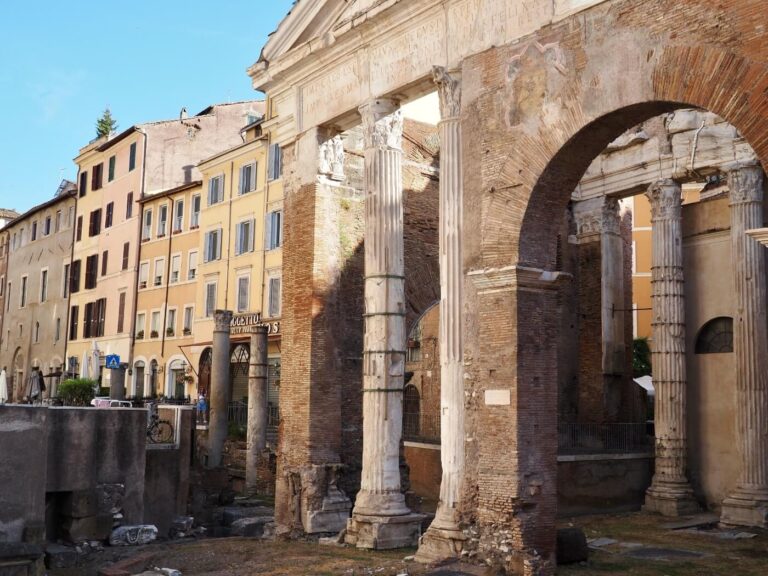
One of the most dramatic ancient monuments in Rome, and the most atmospheric way to enter the heart of the historical Ghetto. The Porticus Octaviae was originally built in the 2nd century BC and substantially rebuilt and enlarged by the Emperor Augustus around 27–23 BC, who dedicated it to his sister Octavia Minor in a characteristically dynastic act of architectural propaganda.
The colonnade once enclosed a large sacred precinct containing two ancient temples — the Temple of Jupiter and the Temple of Juno Regina — and was decorated with celebrated Greek sculptures that Pliny the Elder described with admiration.
After the fall of the Western Roman Empire, the structure was progressively stripped for building materials, leaving the striking partial ruin we see today: a few mighty granite columns supporting an ancient pediment, the whole forming a triumphal gateway into the Ghetto’s main street.
In the medieval period the ruins found new life as the city’s fish market — merchants set up their stalls between and around the ancient columns, and a Latin inscription still legible on the right-hand arch records the city’s regulations for the trade, requiring the heads of any fish longer than the inscribed plaque to be surrendered to the city authorities for a civic fish soup.
A church — Sant’Angelo in Pescheria (see entry 9 below) — was built directly into the ancient columns in the 8th century, using the classical structure as its very fabric. For roughly 260 years, from 1584 until 1848, this was the site of the forced Christian conversion sermons that the Ghetto’s residents were required to attend every Saturday.
four
4. Largo XVI Ottobre 1943
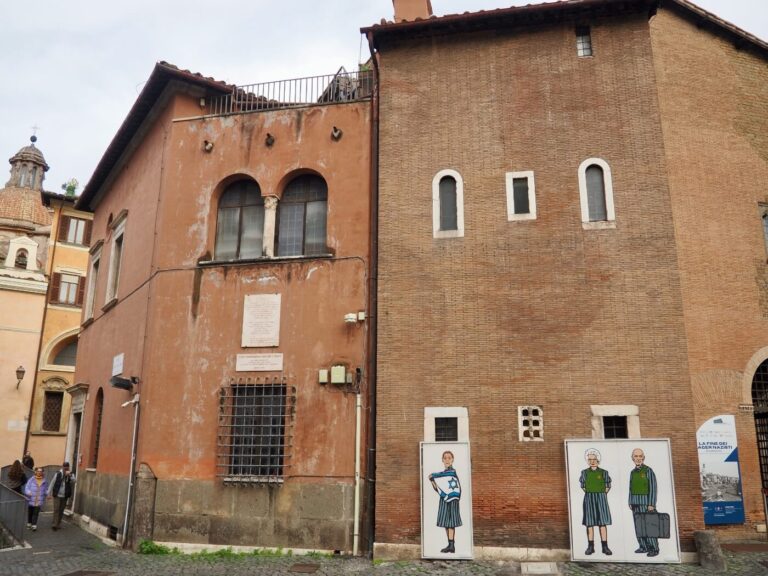
The small piazza in front of the Porticus Octaviae has been officially named Largo XVI Ottobre 1943 in permanent commemoration of the date on which German forces conducted their coordinated roundup of Rome’s Jewish community at dawn on 16 October 1943 — the razzia that swept 1,023 people onto trains bound for Auschwitz.
The roundup began in this very neighbourhood in the hours before sunrise, with soldiers moving house to house through streets that the community had called home for centuries. A small memorial plaque records the events of the day. The stolpersteine in the streets nearby are the more intimate continuation of the same commemoration.
five
5. The Stolpersteine (Stumbling Stones)
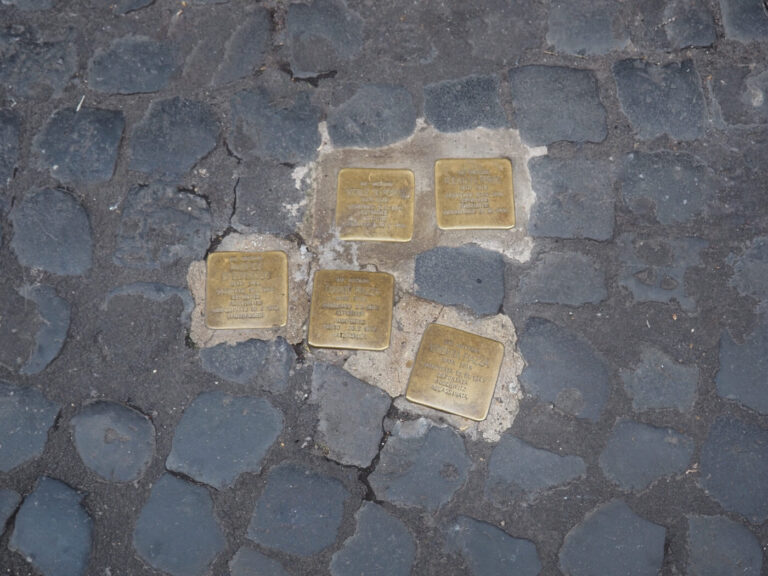
Throughout the Jewish Ghetto and in Jewish neighbourhoods across Rome, you will find small brass plaques set into the cobblestones outside the front doors of residential buildings.
These are the stolpersteine — stumbling stones — a Europe-wide memorial project conceived and executed by the German artist Gunter Demnig, who has been installing these small cobblestone-sized memorials outside the former homes of Holocaust victims since 1992.
Each stone is inscribed with a name, a date of birth, a date of deportation, and a date and place of death. They are deliberately understated — set at street level, easily missed — because Demnig’s intention is that they should be stumbled upon, that the act of looking down and reading should be involuntary and therefore unmediated.
The effect, in a neighbourhood as beautiful and lively as the Ghetto, is quietly devastating. Frequently, you will read of the decimation of entire families in a single instant.
There are thousands of stolpersteine across Rome. In the Ghetto, they accumulate in front of buildings on Via del Portico d’Ottavia, in the side streets around it, and on the residential streets further back from the river. Walking slowly and paying attention is the only approach that does justice to them.
six
6. Via del Portico d'Ottavia
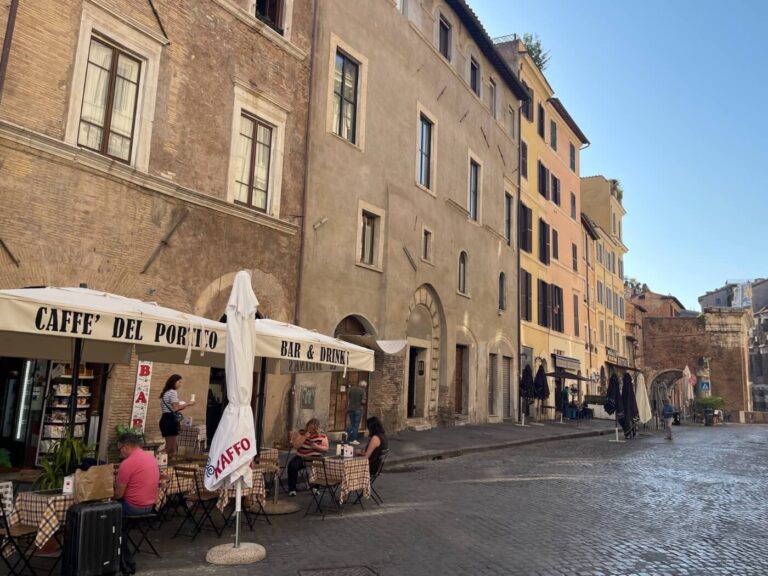
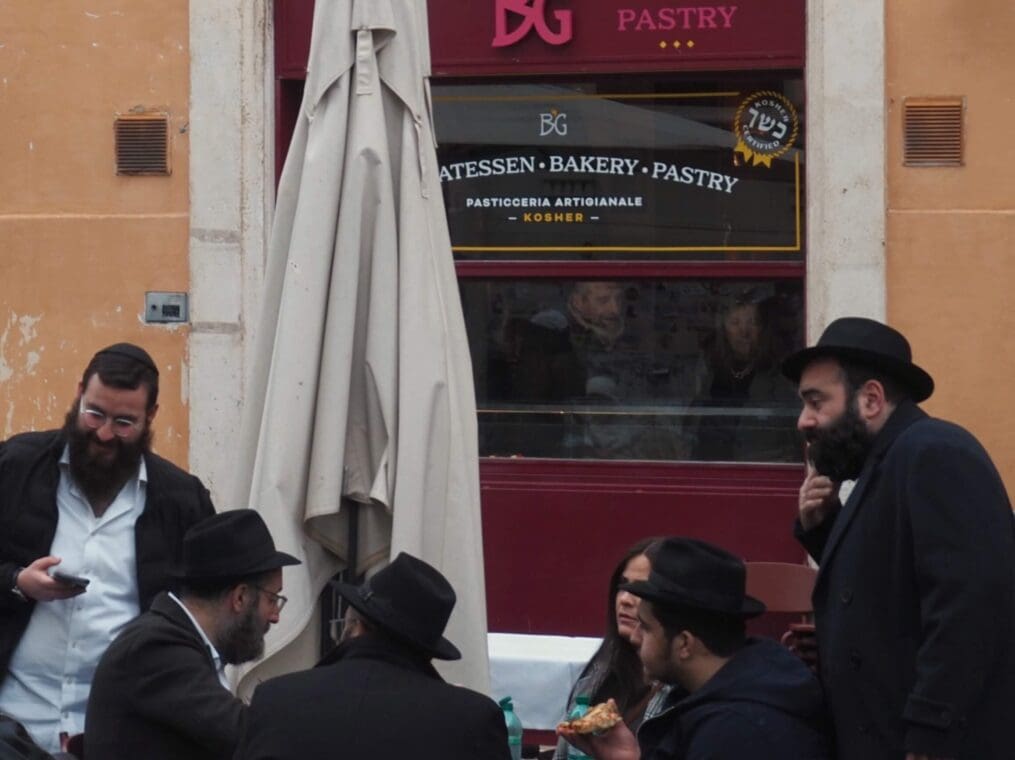
The main artery of the historical Ghetto, Via del Portico d’Ottavia is the street around which the neighbourhood’s daily life still organises itself: its restaurants and kosher delis, its bakeries and food shops, its mix of Jewish and non-Jewish residents going about their morning routines.
The street has been the heart of Jewish Rome for centuries, and retains that character today despite the urban transformation of the surrounding area in the late 19th century.
Look for the Forno Boccione bakery at number 1, a Roman institution whose crostata di ricotta e visciole — a ricotta and sour cherry tart in a flaky, slightly burnt pastry case — is one of the essential things to eat in Rome. The bakery has been in the same family and the same location for generations; it opens early and often sells out of its best items by midday, so arrive early.
The street leads directly to the remains of the Porticus Octaviae at its western end and provides a good central base for exploring the rest of the quarter.
seven
7. Piazza Mattei and the Fontana delle Tartarughe
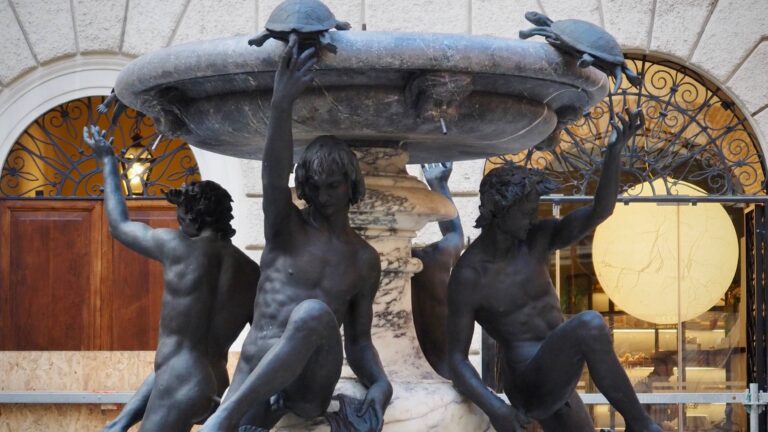
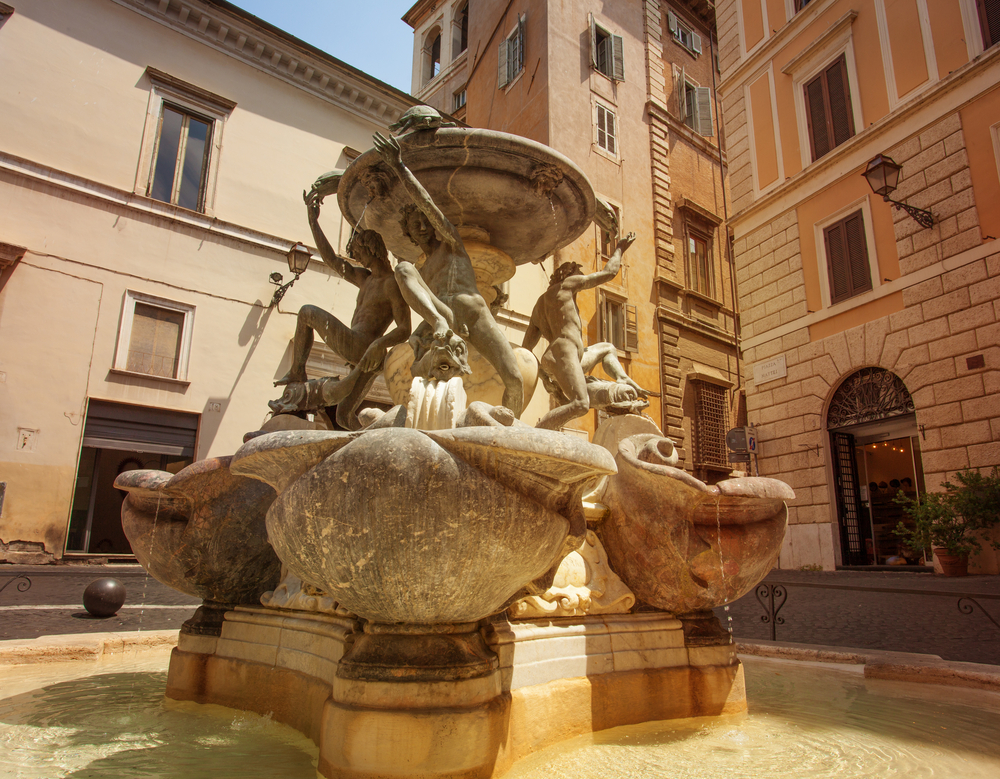
In a city of beautiful piazzas, Piazza Mattei figures near the top of most lists for good reason. The centrepiece is the Fontana delle Tartarughe — the Turtle Fountain — one of the most charming and technically accomplished small fountains in Rome.
The fountain was designed by Giacomo della Porta and sculpted by Taddeo Landini, constructed in the early 1580s during the same period the Ghetto was being consolidated around its walls.
The composition is a masterwork of sinuous late Mannerist design: four lithe young men, each balanced on a dolphin’s head with a foot, reach upward to guide four bronze turtles over the lip of the upper basin. The technical challenge of that upward reach — the weight of a man in bronze, cantilevered on a dolphin, gesturing into space — was solved with a confidence that makes the whole thing look effortless.
The turtles perched at the basin’s rim are traditionally attributed to Gianlorenzo Bernini, who is said to have added them during a restoration around 1658 — though this attribution, while widely repeated, is not documented and is treated with caution by some scholars.
The story behind the fountain’s commissioning is illuminating about the dynamics of power in and around the Ghetto. The fountain was originally intended to provide a water source for the community recently enclosed within the Ghetto walls; the Mattei family, who controlled the entrance gates to the quarter, quickly appropriated the commission and had the fountain repositioned outside their nearby palace instead.
The Ghetto would have to wait decades for its own water source, provided eventually by a second della Porta fountain that can still be seen in Piazza delle Cinque Scole.
eight
8. The Teatro Marcello
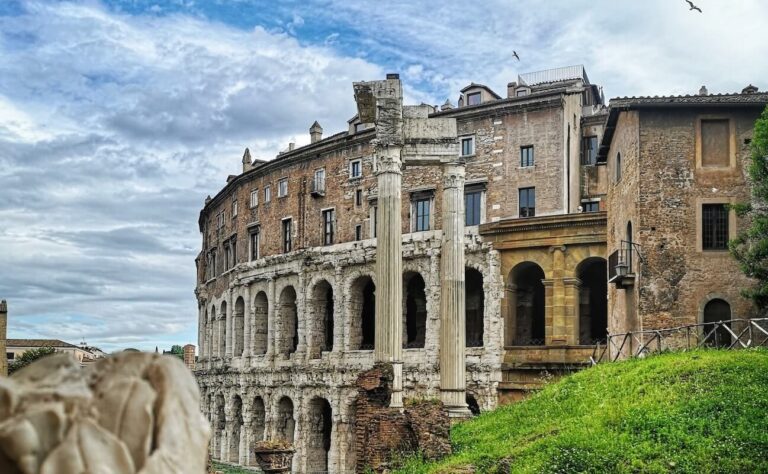
One of the most extraordinary pieces of architectural layering in Rome — and Rome offers very stiff competition in this category — the Teatro Marcello stands on the historical boundary of the Ghetto where the ancient quarter met the open spaces along the Tiber.
The theatre was begun by Julius Caesar and formally dedicated by the Emperor Augustus around 13 BC, named in honour of his nephew and chosen heir Marcellus, who had died prematurely at 23.
With a capacity estimated between 11,000 and 20,000 spectators — a 4th-century catalogue records precisely 17,580 places — it was the largest stone theatre in ancient Rome, hosting dramatic performances, poetry recitals and musical competitions that filled the Campus Martius with the noise and energy of public entertainment.
Its semicircular facade of tiered arches, in the Doric order on the first level and Ionic on the second, directly influenced the design of the Colosseum built several decades later.
What makes the Teatro Marcello uniquely strange and wonderful is what happened to it next. After the fall of the Western Roman Empire the building was quarried for materials, fortified as a medieval castle, and then — in the 16th century — transformed again when it passed to the Orsini family, who commissioned the architect Baldassare Peruzzi to build a Renaissance palazzo directly on top of the surviving ancient arcade.
The result is one of those only-in-Rome juxtapositions: ancient Roman arches on the lower levels, Renaissance window frames sprouting incongruously from above, and private apartments that are still occupied today. The building went on the market in 2012 for a reported €32 million — not a bad return on two millennia of continuous habitation.
nine
9. Sant'Angelo in Pescheria
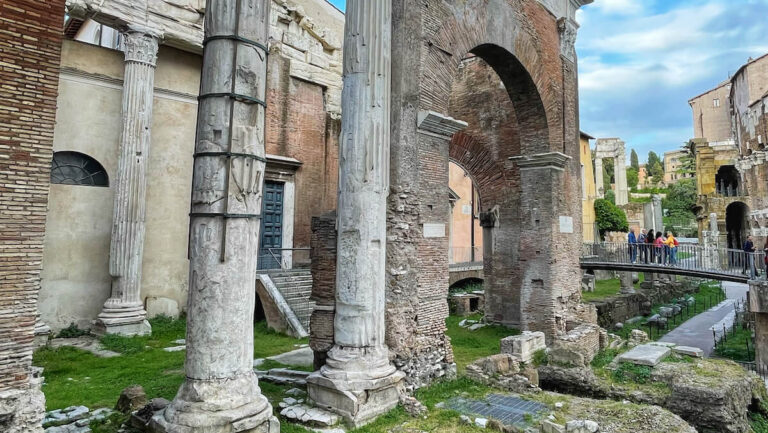
Built into the very fabric of the ancient Porticus Octaviae in the 8th century, the church of Sant’Angelo in Pescheria is one of the oldest continuously functioning churches in Rome and one of the most historically charged. Its name — Saint Angel of the Fishmarket — records the medieval fish trade that operated around and within the ancient ruins; the market ran until the 1870s.
For 264 years, from 1584 to 1848, Sant’Angelo in Pescheria was the site of the forced Christian conversion sermons that the Jewish community of the Ghetto was legally required to attend every Saturday. The practice was mandated by papal decree and enforced by papal authorities; its failure to produce more than a handful of converts over nearly three centuries says something significant about the depth of the community’s roots.
Inside the church, early medieval and Cosmatesque decorations survive. The exterior — with its ancient columns integrated seamlessly into the medieval fabric, the ruins and the church sharing their structural bones — is worth a long look even when the building is closed.
ten
10. Piazza delle Cinque Scole
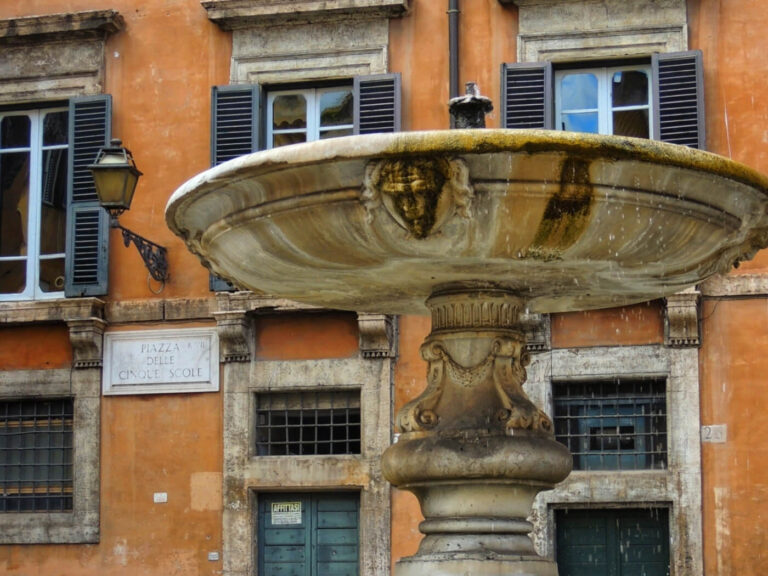
Just south of Via del Portico d’Ottavia, this piazza takes its name from the five scole — synagogues — that once served the Ghetto’s diverse Jewish population.
The five congregations represented different communities and different liturgical traditions, including the indigenous Roman italkim, the Sicilian and Castilian communities, and others; the five scole were eventually compressed into a single building within the Ghetto walls, and that building in turn was demolished in the urban renewal of the 1880s along with almost everything else from the Ghetto period.
The piazza today is quiet and largely overlooked by visitors — but it contains one important surviving piece of Ghetto-era history: a fountain by Giacomo della Porta, the same architect who designed the Turtle Fountain in Piazza Mattei.
This was the water source eventually provided to the Ghetto’s residents after the Mattei family appropriated the earlier della Porta fountain for their own piazza. Simple and functional compared to its more celebrated sibling, it stands as a small, concrete reminder of the everyday material conditions of life within the walls.
eleven
11. The House of Lorenzo Manilio
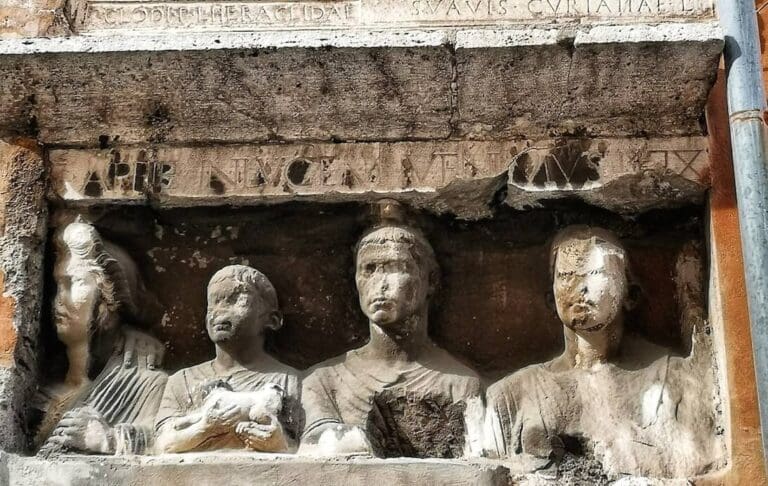
Walk along the Via del Portico d’Ottavia in what would become Rome’s Jewish Ghetto and you will come across one of the city’s most eloquent expressions of Renaissance obsession with antiquity — and one of its most endearing acts of personal vanity.
More than a simple dwelling, the house that the spice merchant Lorenzo Manilio built for himself here in 1468 is a discursive statement about Rome itself.
A long Latin inscription runs across the heavily encrusted facade, along with spolia – fragments of Roman sarcophagi and funerary monuments – embedded directly into the walls. Manilio carved his name on the architraves of the doors. He had Ave Roma inscribed on the windows. He wrote his name three times in Latin and once in Greek.
The inscription dates the building not by the conventional Christian calendar but by the Roman one – year 2221 from the founding of the city, which corresponds to 1468 AD – a deliberate statement of Manilio’s identification with the ancient world.
This was the 1460s, when the recovery of classical antiquity was Rome’s great intellectual project. Manilio was a merchant, not a scholar, but he understood the cultural moment perfectly: to love Rome was to be Roman, and to be Roman was to say so on your facade in letters as large as you could manage.
The house still stands on the Via del Portico d’Ottavia, its ancient fragments glowing in the afternoon sun. Pause for a moment next time you’re passing, and appreciate this extraordinary monument to the persistence of cultural memory.
twelve
12. The Tiber Island
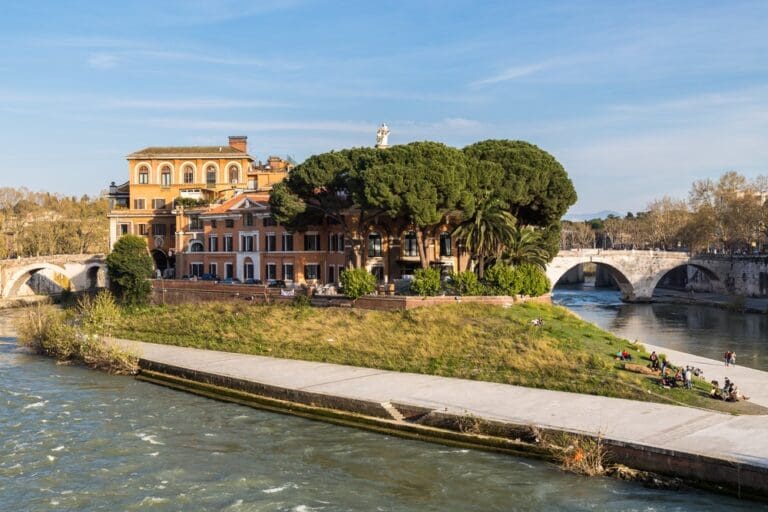
Not strictly within the Ghetto’s historical boundaries, but visible from its embankment and reachable in two minutes by the Ponte Fabricio — Rome’s oldest surviving bridge, built in 62 BC — the Isola Tiberina is an island worth including in any exploration of the neighbourhood.
The island has been associated with healing since antiquity, when a temple to Aesculapius, god of medicine, was established here in 293 BC following a plague; the tradition has continued unbroken, with the Fatebenefratelli hospital occupying the island today as it has since the 16th century.
The island’s association with medicine made it historically significant to Rome’s Jewish community: Jewish doctors, who were permitted to practise medicine when other professions were closed to them, worked extensively in this area, and the island was one of the points of connection between the Ghetto and the wider city even during the period of strictest segregation.
The church of San Bartolomeo on the island contains early Christian relics and a beautiful Romanesque interior; the remains of the ancient Roman bridge Ponte Rotto are visible from the island’s southern tip. It is one of those perfectly compact Roman experiences — ten minutes of walking, two thousand years of history.
Jewish Ghetto FAQ
How do I get to the Jewish Ghetto?
The neighbourhood is accessible on foot from the Campo de’ Fiori (5 minutes), Largo di Torre Argentina (5 minutes), or the Pantheon (10 minutes). By bus, lines 30, 40, 62, 63, 64, 87 and 492 serve Largo di Torre Argentina.
Can I take a tour of the Jewish Ghetto?
Yes. Through Eternity’s Jewish Ghetto walking tour covers the neighbourhood’s history and monuments with an expert local guide in a small group. Click here to find out more and book.
How much time do I need to see the Jewish Ghetto?
For a thorough exploration of the neighbourhood — visiting the synagogue and museum, walking the main streets, taking time with the stolpersteine, and seeing the surrounding monuments — allow half a day. A shorter visit of 90 minutes covers the main visual highlights.
Is the Jewish Ghetto in Rome free to visit?
The streets, piazzas, and most of the outdoor monuments are freely accessible at all times. The Great Synagogue and Jewish Museum require a combined ticket (approximately €15). The Porticus Octaviae and Teatro Marcello are visible from the street without charge.
Is the Jewish Ghetto safe to visit?
Yes, it is a well-populated, centrally located neighbourhood and is safe at all times of day or evening.
Can I eat in the Jewish Ghetto?
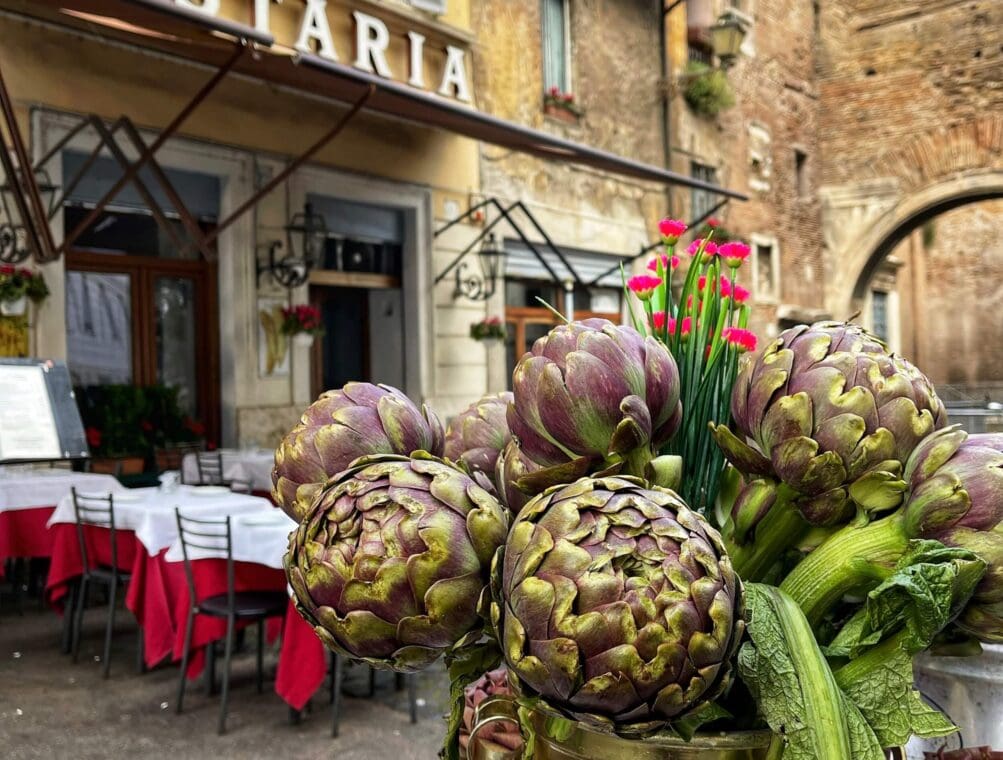
Absolutely — it’s one of the best areas in Rome for lunch. Via del Portico d’Ottavia has several excellent kosher restaurants (Ba’Ghetto, Nonna Betta, Il Portico) and the historic bakery Boccione is an essential stop for pastries.
Can I visit on a Saturday?
Jewish-owned businesses and the synagogue/museum will be closed for Shabbat. The streets, outdoor monuments, and non-Jewish restaurants remain open and accessible.
Are the stolpersteine only in the Ghetto?
No — stolpersteine can be found throughout Rome in neighbourhoods where Jewish families lived before the 1943 deportations. The highest concentration is in and around the historic Ghetto, but they appear across the city wherever victims’ homes can be identified

Book Your Rome Experience