When Cardinal Scipione Borghese saw Domenichino’s Diana and the Hunt, he decided that he had to own it.
There was only one problem: the painting already belonged to someone else.
Domenichino had been commissioned to paint the work by Cardinal Pietro Aldobrandini, a man of no little power and influence himself. Undeterred, Scipione resolved the impasse with characteristic decisiveness. He had Domenichino thrown in prison, where the painter remained until he agreed to give up his masterpiece.
The painting changed hands, Domenichino was recompensed with a risible sum, and Scipione had one-upped his aristocratic rival. This was not an isolated incident. For the greatest art connoisseur of 16th-century Rome, it was a governing philosophy.
The account comes from Giovanni Battista Passeri’s Vite de’ pittori, scultori ed architetti che hanno lavorato in Roma, and reveals something essential about Scipione Borghese. The most voracious collector in Baroque Rome, he pursued great art with a mixture of clear-eyed connoisseurship, political power, and naked coercion that few contemporaries could resist.
This is his story.
Best Rome Tours
Explore Rome's Finest Palaces
Scipione Borghese
The Cardinal Who Built Rome's Greatest Art Collection
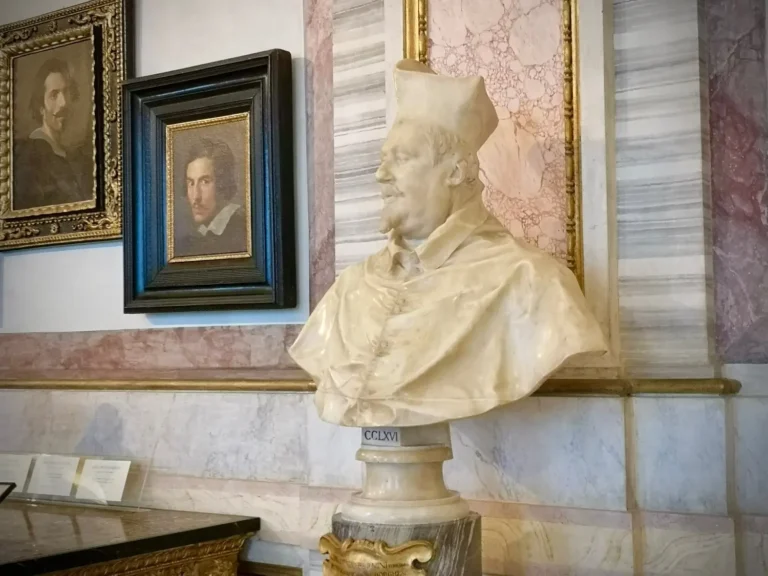
Scipione Caffarelli Borghese, Cardinal Nephew of Pope Paul V and the most powerful ecclesiastical patron of his age, was one of the most remarkable figures in the history of art collecting. Through acute patronage, political muscle, and outright theft, he assembled what remains to this day one of the great private art collections ever brought together in a single place.
The gallery that bears his family name is immersed amidst soaring Roman pines at the northern edge of the Villa Borghese, a patrician casino that was once the most celebrated private villa in Rome.
Behind Scipione’s often aggressive methods lay an exceptionally keen eye for talent. The man who imprisoned Domenichino was also the patron who gave the young Gianlorenzo Bernini his first major commissions. The collector who confiscated works from rivals was among the earliest to recognize in Caravaggio a painter of extraordinary and enduring originality.
Scipione could be grasping, vindictive, and shameless. He could also, when it counted, see further and more clearly than almost anyone else in Rome. What follows is the story of that paradox, and the extraordinary building it produced.

The House of Borghese
From Sienese Bankers to Roman Cardinals
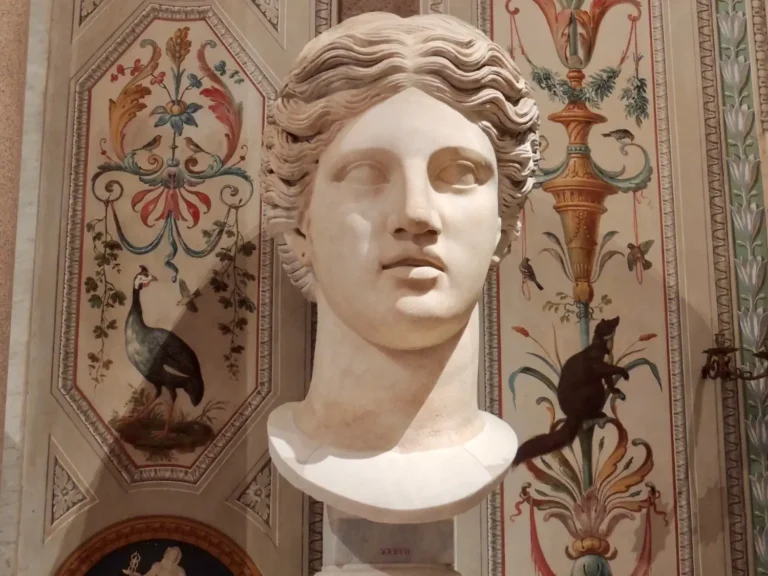
The Borghese family originated in Siena, where from the twelfth century onward they established themselves as merchants and bankers of considerable standing. In a city defined by commerce and factional politics, they were among its more successful dynastic families — wealthy, well-connected, and adept at navigating the shifting alliances of Tuscan civic life.
Their gradual move to Rome marked a transformation from regional mercantile dynasty to aspirant noble house. By the early sixteenth century, members of the family had settled in the city, beginning the slow accumulation of property, influence, and the social capital required to advance within the Roman elite.
It was here that Camillo Borghese, born in 1550 and trained in law at Perugia, began his steady ascent through the ecclesiastical hierarchy. A capable canon lawyer and experienced diplomat, he served in various papal legations abroad and built a reputation for reliability and political judgement.
His election as pope in May 1605, taking the name Paul V, transformed the fortunes of the family and set in motion the rapid rise of his nephew Scipione.
Pope Paul V
The Borghese Pope and the Culture of Nepotism
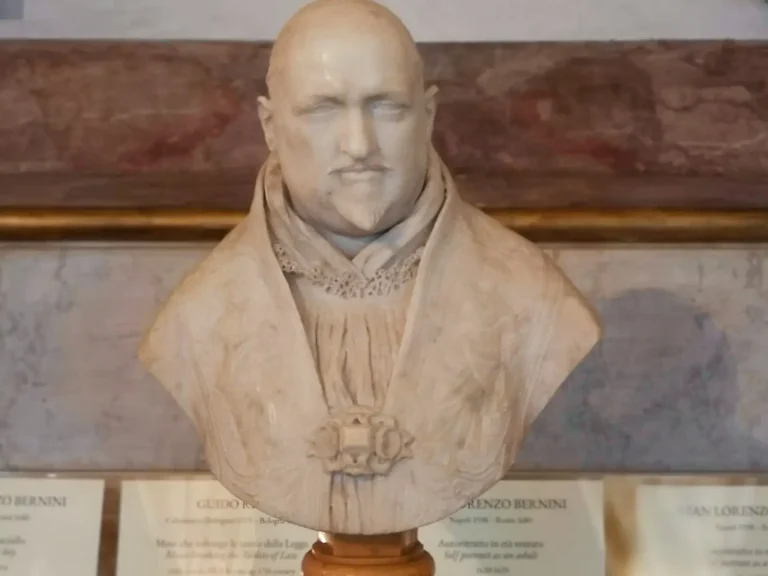
The election of a new pope in seventeenth-century Rome was not simply a spiritual event. It was a political earthquake, and its aftershocks were measured in appointments, properties, and commissions. Every pontificate produced a new dominant family; the nephews, brothers, and cousins of the new pope could expect to find themselves suddenly elevated to positions of enormous wealth and influence.
This system of papal nepotism was universally understood, structurally embedded, and central to how early modern Rome functioned. Paul V was no exception. Within months of his election, his nephew Scipione Caffarelli — who adopted the Borghese name — was made a cardinal at the age of twenty-seven.
His rise was rapid even by contemporary standards. Within a year he held the offices of Cardinal Nephew, Cardinal Librarian of the Holy Roman Church, and Archpriest of Saint Peter’s Basilica, among others — posts that brought extraordinary financial and political authority.
Paul V was genuinely devoted to his nephew and trusted him with the management of much of the routine business of the pontificate. Scipione, in turn, used his position with extraordinary energy.
He was not a notably spiritual man. Contemporary accounts describe a cheerful, sociable figure of enormous appetites, more at home at a banquet than at prayer, more animated by a painting than a homily.
He maintained a household of exceptional luxury; his dress was magnificent, and his table was celebrated throughout Rome. If the Counter-Reformation was supposed to have ushered in an era of clerical austerity, Scipione Borghese appears to have regarded the strictures as largely theoretical.
What he had in abundance was taste, and money. And the will to use both.
Rome in the Early 1600s
Baroque City, Baroque World
To understand what Scipione Borghese created at the Villa Borghese, it helps to understand the extraordinary moment in which he was working.
Rome in the opening decades of the seventeenth century was a city in the grip of reinvention. The long, agonising process of the Counter-Reformation — the Church’s response to the challenge of Protestantism — had produced a cultural climate of exceptional intensity, in which the visual arts were deployed as instruments of faith with an urgency and ambition that had few parallels in Western history.
The papacy was spending on a heroic scale. The construction of the new Saint Peter’s Basilica, a project that had already consumed the energies and resources of several pontificates, was approaching completion under Paul V, who added the nave and the great façade.
Alongside the basilica, churches were being rebuilt, frescoed, and filled with altarpieces across the city. Artists flooded into Rome from across Italy and beyond, drawn by the prospect of patronage, commissions, and the chance to measure themselves against the greatest tradition of European art.
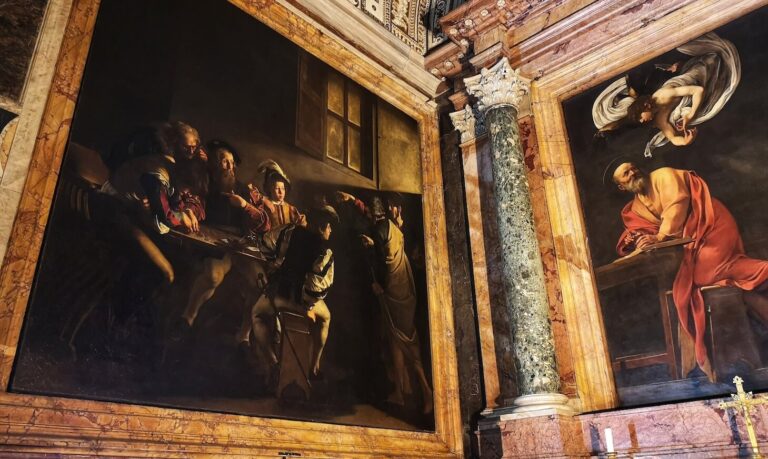
Into this volatile and competitive world arrived an equally volatile and competitive Lombard painter of astonishing originality whose work would shake the Italian art world to its foundations: Michelangelo Merisi, known to posterity as Caravaggio. Just a few years later a Neapolitan-born sculptor of equally remarkable gifts, barely into his teens when Paul V became pope, was poised to make his mark: Gianlorenzo Bernini.
Both men would find in Scipione Borghese their most important early patron. Together, Caravaggio, Bernini, and Borghese would do much to define what the Roman Baroque became.
Building the Villa
Flaminio Ponzio, Giovanni Vasanzio, and the Casino on the Hill
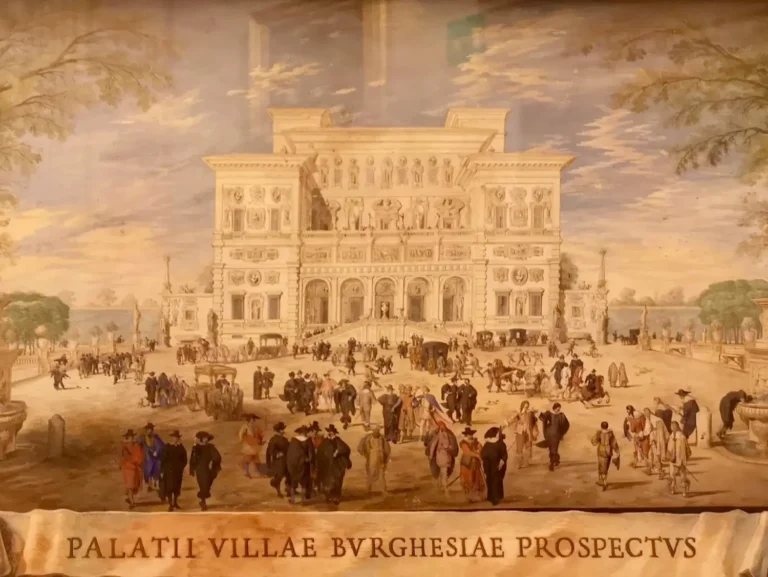
Scipione’s first great project as Cardinal Nephew was the creation of a suburban villa on a large tract of land on the Pincian Hill, just outside the Aurelian Walls to the north of the city. The site had been acquired by the Borghese family in the late sixteenth century, and Scipione set about developing it on an extraordinary scale almost from the moment of his uncle’s election.
The casino — the principal building we now know as the Borghese Gallery — was designed primarily by the Flemish architect Giovanni Vasanzio, working with the Roman architect Flaminio Ponzio, and was constructed between roughly 1612 and 1615.
It was conceived not as a permanent residence but as a place of pleasure and display: a villa suburbana in the Roman tradition, a retreat from the heat and noise of the city where a great lord could entertain in suitable magnificence.
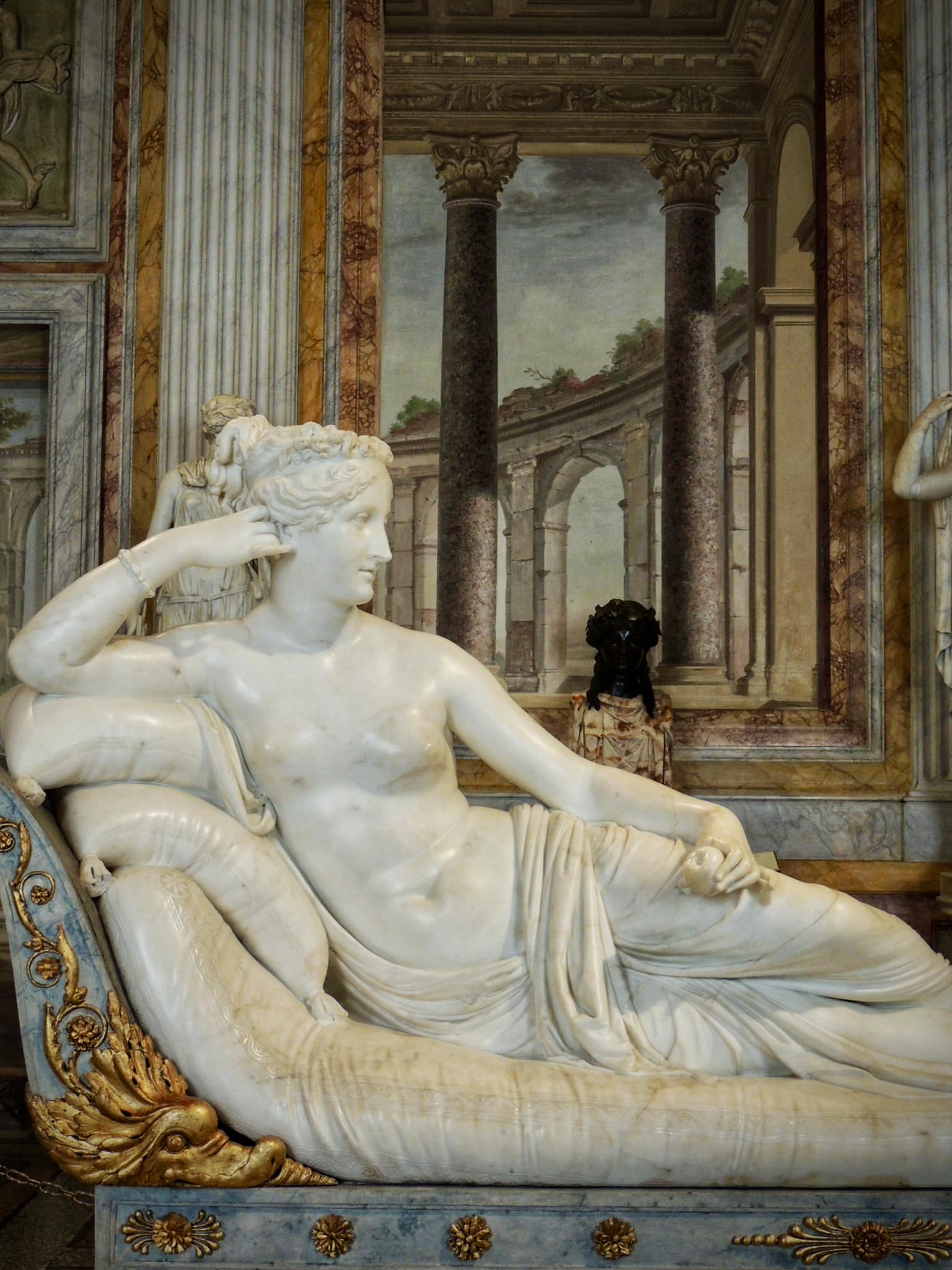
The exterior of the building is elaborately decorated with ancient reliefs and busts embedded directly into the façade, a statement of antiquarian pride as well as aesthetic intent. The interior was equally remarkable: the ground floor given over to sculpture, the upper floor to paintings, with the arrangement of the rooms carefully considered to show each work to its best advantage.
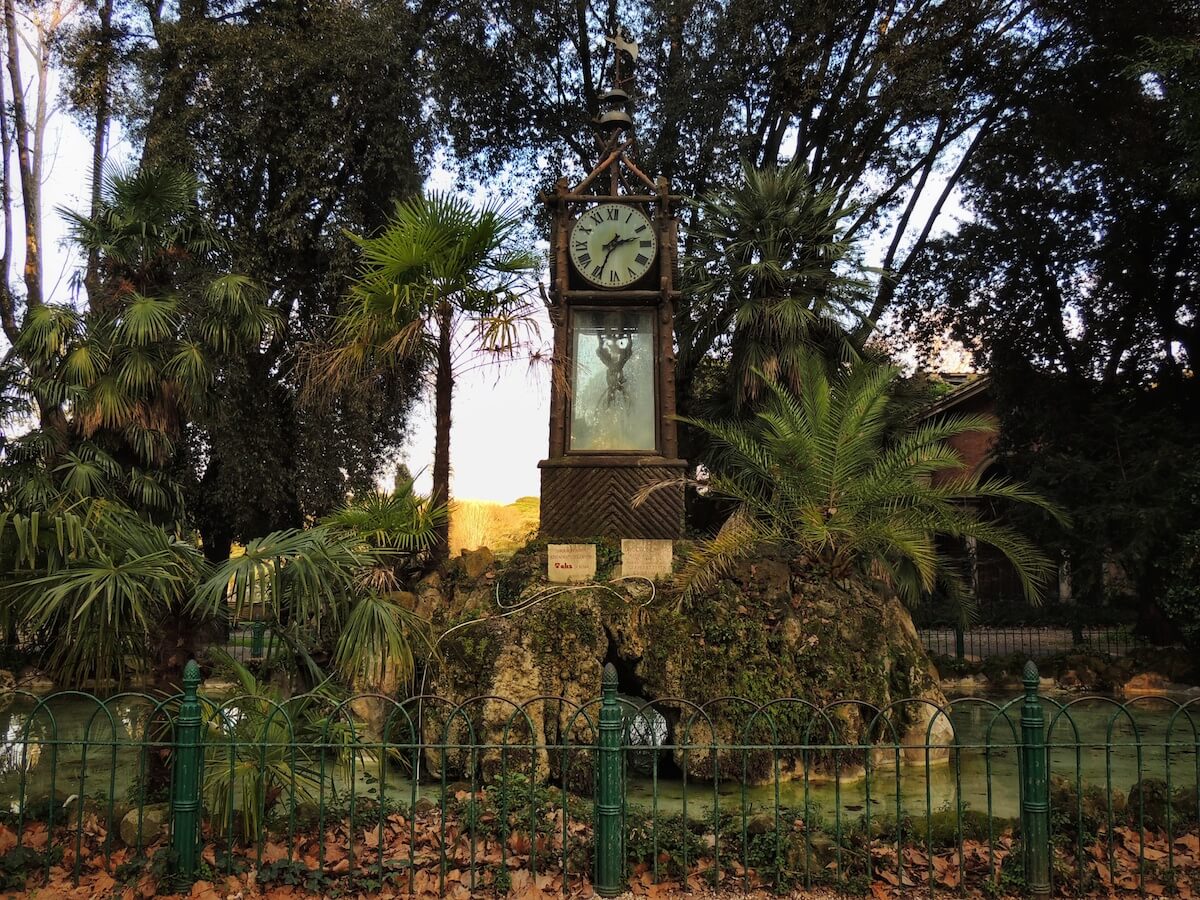
Beyond the casino, Scipione developed the surrounding park on an equally impressive scale. The grounds encompassed woods, formal gardens, fountains, an aviary of exotic birds, enclosures for rare animals, a lake, and a series of smaller buildings — a botanical garden, a second casino — that between them made the Villa Borghese one of the great pleasure grounds of early modern Europe. Visiting dignitaries were routinely brought here as a showpiece of papal Rome. It was, by any measure, a remarkable achievement.
The villa and its grounds remained private Borghese property for nearly three centuries. The surrounding park was eventually acquired by the city of Rome in 1902 and opened to the public as what is now the Villa Borghese park. The casino itself, with its contents, became a public museum a year later.
Methods Fair and Foul
How Scipione Assembled His Collection
The collection that Scipione assembled in the Villa Borghese was acquired by a combination of methods that ranged from the conventional to the extraordinary.
He commissioned works directly, as any great patron of the period would. He purchased paintings and sculptures on the open market, relying on a series of scouts and middlemen to scour the art world. He received gifts. And when none of these routes proved sufficient, he deployed the instruments of papal authority with a brazenness that remains shocking even 4 centuries later.
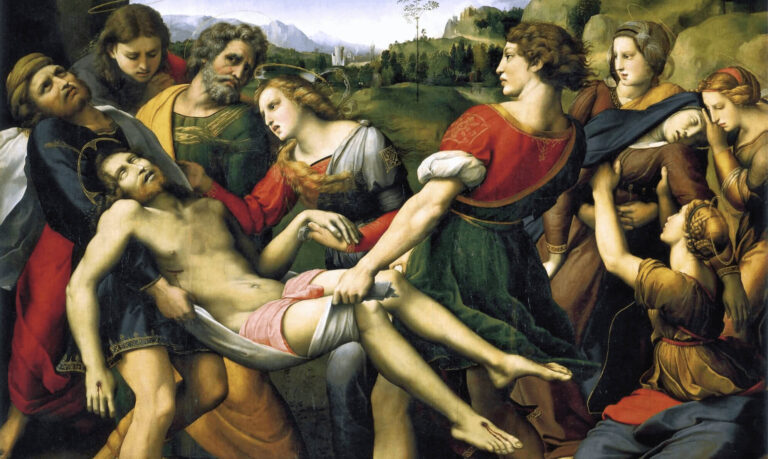
The most celebrated episode of artistic appropriation in Scipione’s career involved the Deposition of Christ by Raphael, originally commissioned in the early sixteenth century for the Baglioni family chapel in Perugia and regarded as one of the masterpieces of High Renaissance painting.
In 1608, Scipione arranged for the painting to be removed from its altar under cover of darkness and transported to Rome. The Perugians were outraged, and protests were dispatched to the papal court. Scipione kept the painting, and it still hangs in the Borghese Gallery today.
The Cavaliere d’Arpino, aka Giuseppe Cesari – one of the most successful painters in Rome and the man in whose studio Caravaggio had worked in his early Roman years – found himself on the receiving end of a different but equally efficient manoeuvre.
In 1607, having apparently failed to pay certain taxes, d’Arpino had over a hundred paintings confiscated from his studio on the orders of Cardinal Borghese. Among them were two early works by Caravaggio — the Sick Bacchus and the Boy with a Basket of Fruit — which duly entered the Borghese collection, where they remain among its most celebrated exhibits.
The Domenichino affair was, if anything, more brazen still. Having set his heart on the painter’s Diana and the Hunt, Scipione engineered the artist’s imprisonment until a sale could be agreed. The painting joined the collection. Domenichino, once released, continued to receive commissions from the cardinal.
This was Scipione’s method: ruthless in acquisition, generous in patronage, and shrewd enough to ensure that the artists he strong-armed remained, on the whole, willing to work for him again. It certainly wasn’t ethical, but it produced a collection of almost unparalleled richness.
The Cardinal and Caravaggio
Rivalry, Protection, and the Art of the Gift
Scipione’s relationship with Caravaggio was of an altogether more complex character than a simple patron-artist dynamic. The two men occupied different social worlds, and their dealings unfolded not through the regular channels of commission and payment but through a tangle of protection, confiscation, and calculated artistic diplomacy.
The Sick Bacchus and the Boy with a Basket of Fruit came to Scipione through the d’Arpino confiscation — works Caravaggio had never intended him to have, seized from a studio where they had apparently remained after the two artists parted ways.
But by the mid-1600s, Caravaggio had become the most talked-about painter in Rome, and Scipione knew it. When the painter found himself in legal trouble in 1605 — a nocturnal assault in Piazza Navona landing him in the kind of difficulty from which only powerful intervention could extract him — it was Scipione Borghese who witnessed the signed peace agreement that allowed Caravaggio to return to the city.
Shortly afterward, it seems, Caravaggio presented the Cardinal with the St. Jerome in his Study that now hangs in the gallery — not a commissioned work, but a carefully calibrated act of gratitude.
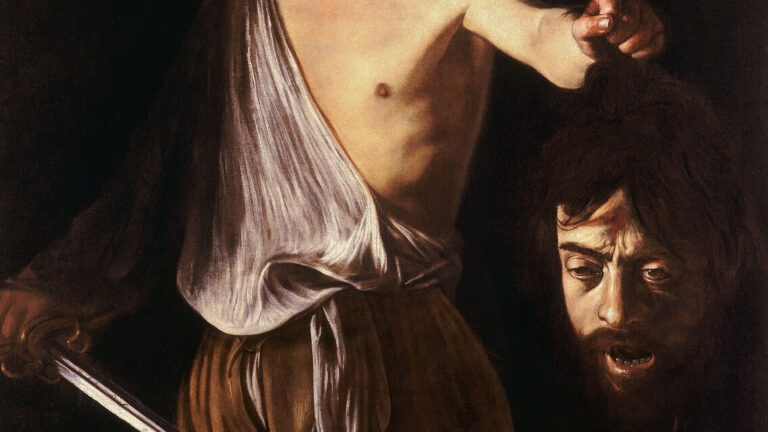
It was not the last time Caravaggio would use painting as a form of currency with Scipione. After the fatal brawl of 1606 that forced the painter into exile, the David with the Head of Goliath — in which Caravaggio painted his own face onto the severed head of the defeated giant — was sent to the Cardinal as a plea for intercession, a work of startling psychological complexity that seems to offer humiliation and appeal simultaneously.
Scholars believe that the ploy succeeded in its immediate purpose, but Caravaggio died before he could reach Rome. Scipione kept the painting. He kept them all.
The Discovery of Bernini
A Genius Launched
If Scipione’s relationship with Caravaggio was a matter of opportunism, protection, and artistic tribute, his relationship with Gianlorenzo Bernini was something altogether rarer: the recognition by a great collector of a once-in-a-generation talent, and the decision to give that talent the space, the resources, and the subjects it needed to transform itself into something extraordinary.
Bernini was barely into his teens when he first attracted Scipione’s attention, through the intercession of the boy’s father Pietro and the enthusiasm of Cardinal Maffeo Barberini, who had identified the younger Bernini as a prodigy of exceptional promise.
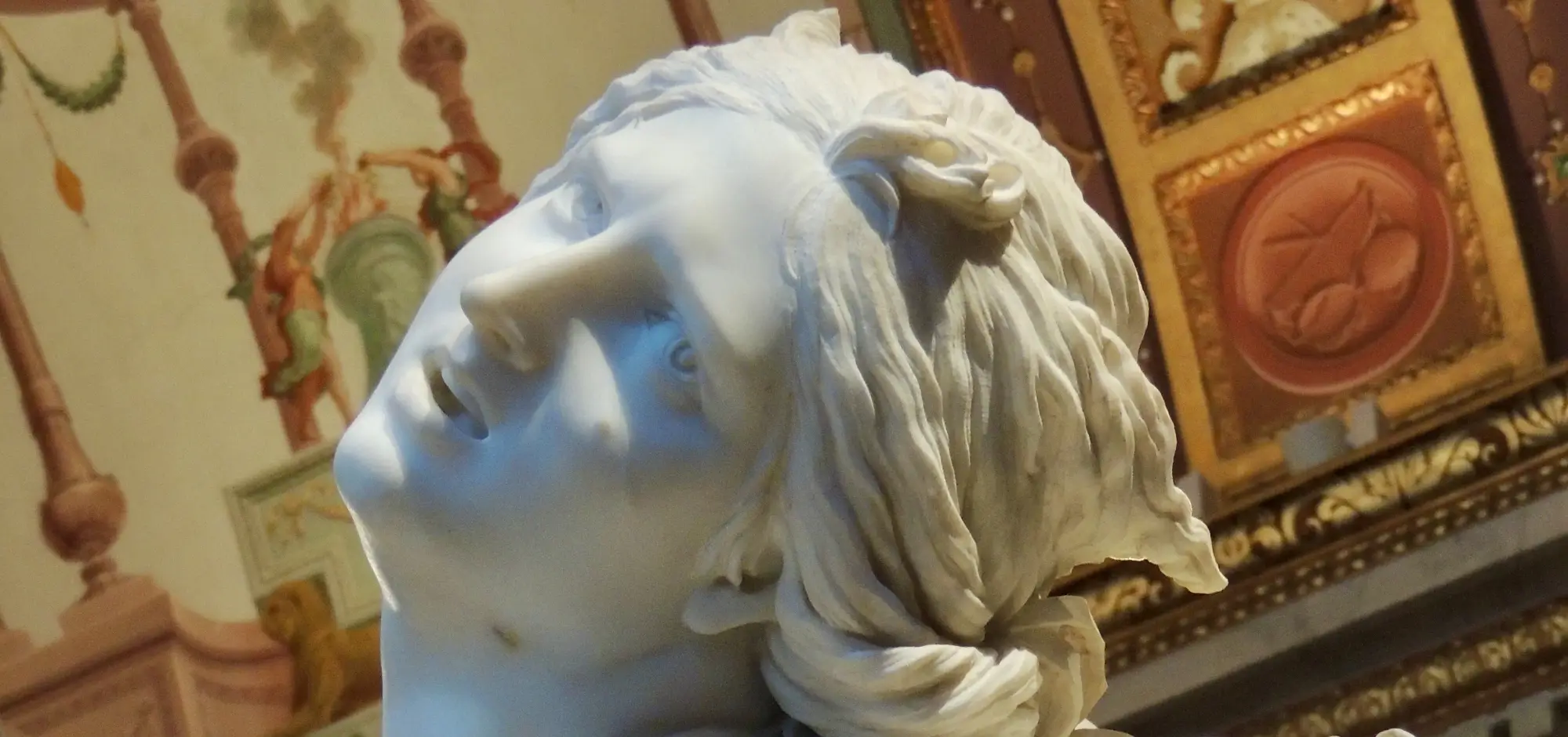
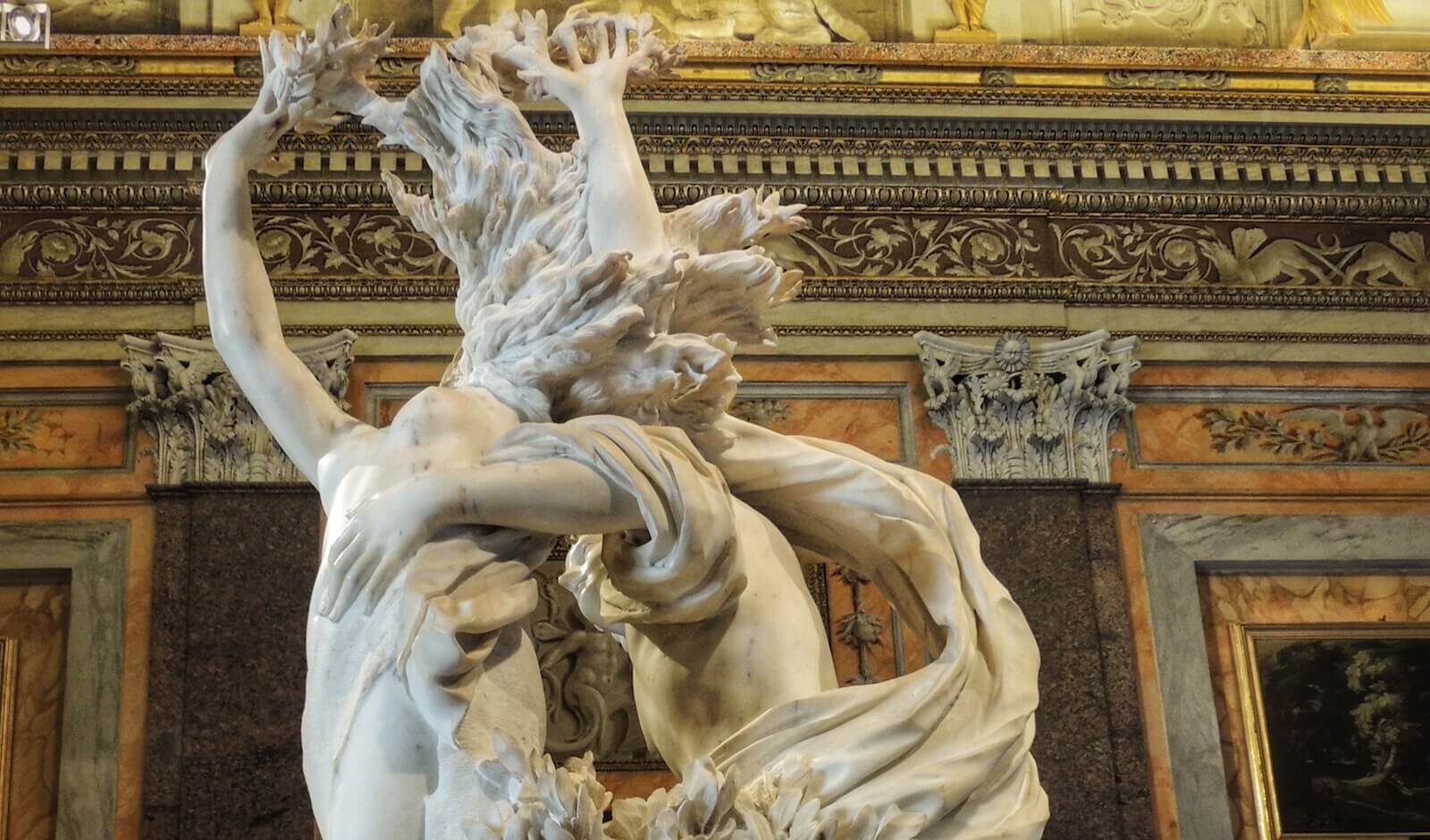
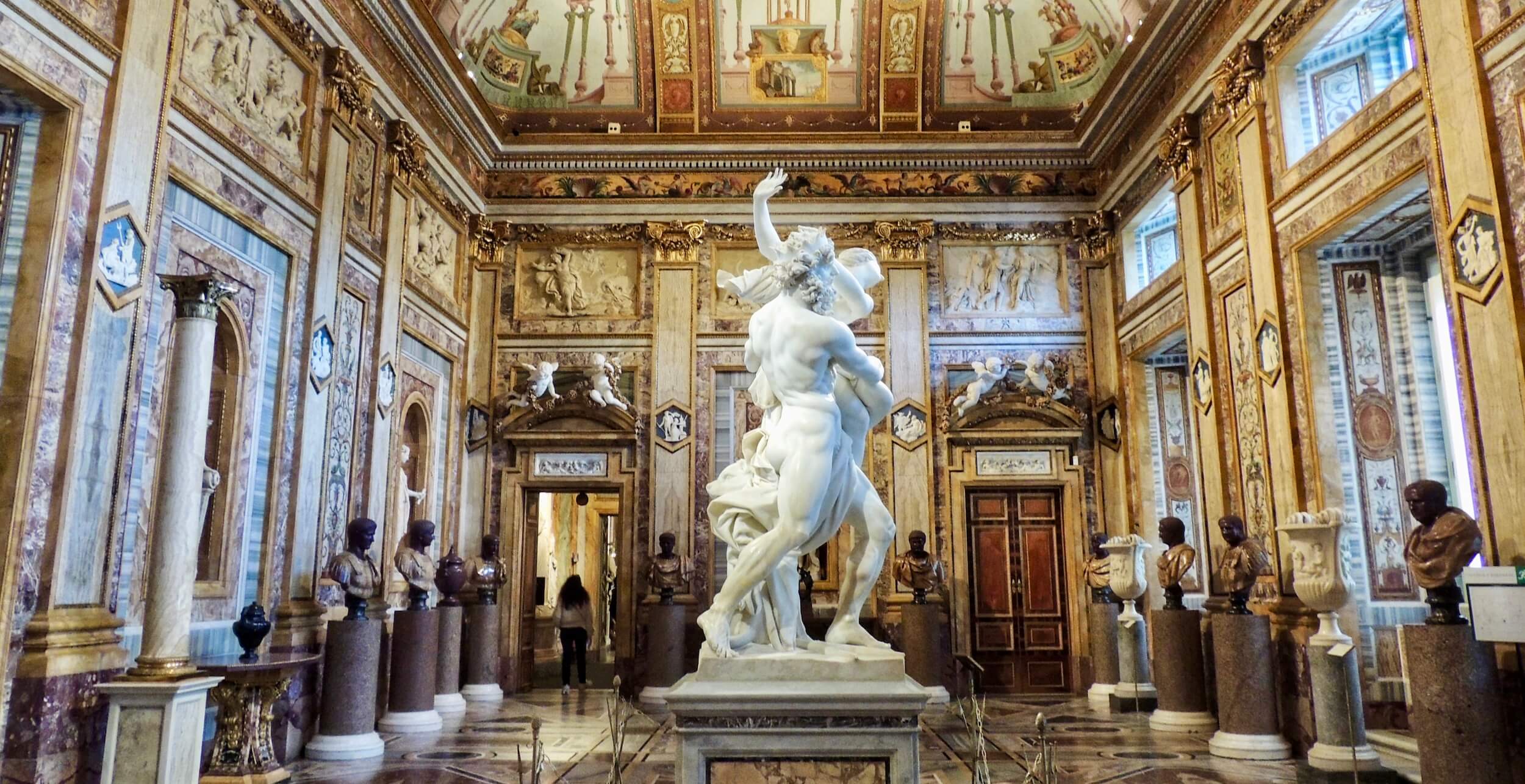
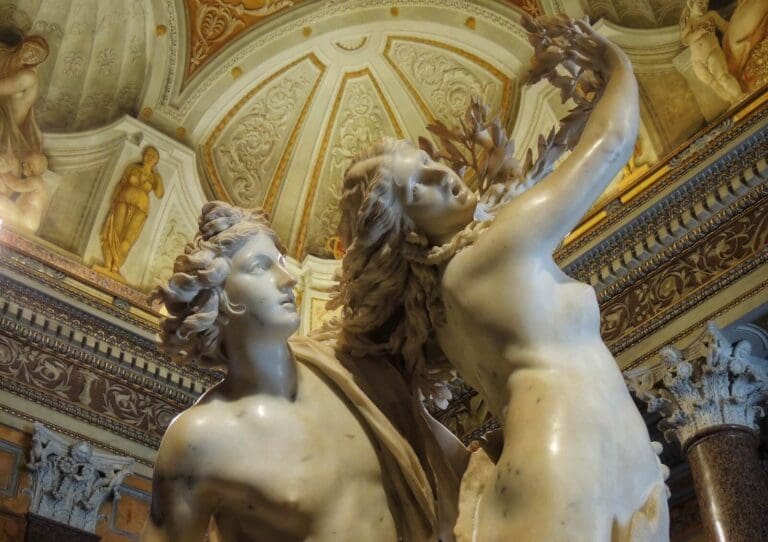
Scipione responded with a series of commissions that constitutes one of the most consequential acts of patronage in the history of art. Between roughly 1618 and 1625, Bernini produced a sequence of site-specific mythological sculptures — Aeneas Fleeing Troy, Pluto and Persephone, Apollo and Daphne, and David — that launched the Baroque age.
What Scipione gave Bernini was not merely money. It was a stage fit for ambition: subjects drawn from Ovid and Virgil that demanded the most extreme technical virtuosity, and the freedom to pursue that virtuosity to its limits.
The results were sculptures that contemporaries could scarcely believe had been carved from marble: flesh that yielded under a god’s fingers, a girl turning into a tree to her pursuer’s visible shock, a young warrior’s face set in a determined expression of concentrated effort. Scipione had understood that he was watching the birth of a new language of art, right in his own home.
In 1632, when Bernini was at the height of his powers and deeply engaged in the great Vatican commissions of Urban VIII, Scipione summoned him back for one final work: the double portrait bust that now stands as one of the masterpieces of Baroque sculpture.
Read our complete guide to Bernini in the Villa Borghese for the full story of this remarkable partnership and the eight works it produced:
The Wider Collection
Raphael, Titian, Rubens, and the Renaissance Masters
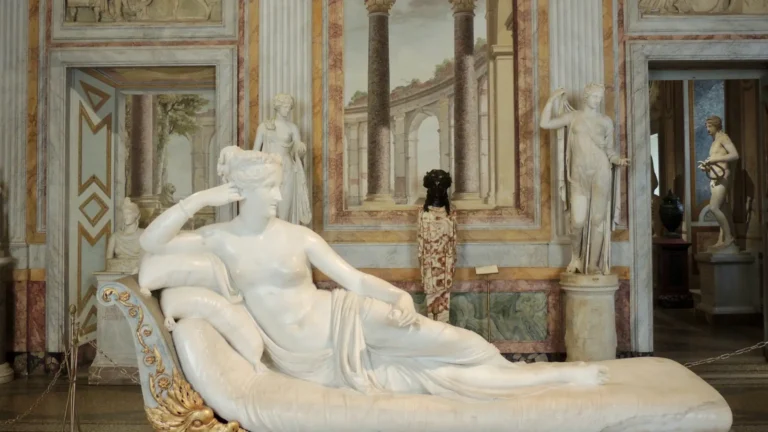
The Bernini sculptures and the Caravaggio paintings are the twin peaks of the Borghese Gallery. But the collection that Scipione assembled extends far beyond them, reaching back into the High Renaissance with a quality and depth that few private collectors of any era have equalled.
However it was obtained, the Raphael Deposition remains one of the most powerful altarpieces of the High Renaissance, a work of incredible compositional ambition and emotional force. The portrait of a Young Woman with a Unicorn, also by Raphael, is one of the most beguiling female portraits of the period: partly inspired by Leonardo’s Mona Lisa, partly a vehicle for Raphael’s own developing mastery of light and surface.
Titian’s Sacred and Profane Love, painted around 1514, is among the greatest paintings in Rome: two female figures — one clothed, one nude — posed beside a fountain in a landscape of glowing Venetian light, their meaning still disputed after five centuries.
There are also important works by Rubens, painted during the Flemish master’s Italian sojourn; by Correggio; by Canova; and by a host of lesser-known Italian masters whose work filled the upper gallery rooms with a density of quality rare in any collection of the period.
The Villa After Scipione
Napoleon, Dispersal, and the Long Road to the Public Museum
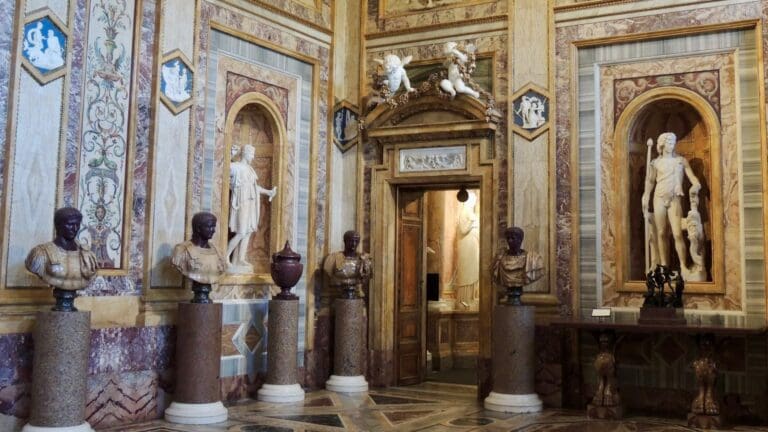
Scipione Borghese died in 1633, and the Villa passed to his heirs, the main Borghese family line, who maintained it as a private estate for the next two centuries with varying degrees of engagement.
The late eighteenth century brought a disaster that Scipione would have found incomprehensible: in 1807, Camillo Borghese — who had married Napoleon’s sister Pauline — sold 344 works of ancient sculpture from the Villa Borghese collection to Napoleon himself, for a sum that was, in hindsight, negligible. These works went to Paris, where they remain in the Louvre.
The visible legacy of this catastrophic transaction is part of what makes the Borghese Gallery as it now stands an exercise in historical imagination: the collection that exists today is remarkable, but the collection that Scipione assembled was more remarkable still.
The Borghese family eventually ceded the Villa and its remaining contents to the Italian state in 1902. The surrounding park became the public gardens that Romans still use every weekend: a place of Sunday cyclists, rowboats on the lake and picnicking families. The gallery itself opened to the public in 1903.
How to Visit the Borghese Gallery
Tickets, Hours, and Getting There
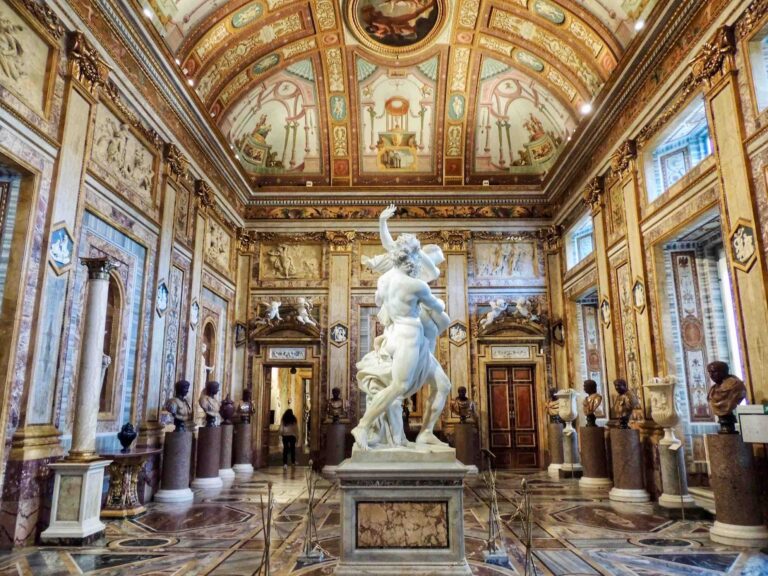
Booking: The Borghese Gallery operates a strict timed-entry system — visits are limited to two hours, with a maximum of 360 visitors admitted per session. The gallery is cleared between sessions, so you can’t stay longer. Tickets routinely sell out weeks in advance during spring and summer. Book well ahead through the official gallery website (tosc.it) or through a guided tour, which will handle the booking for you.
Opening hours: Tuesday to Sunday, 9:00 AM to 7:00 PM (last entry at 5:00 PM). The gallery is closed on Mondays.
Getting there: The most pleasant approach is walking through the Villa Borghese gardens themselves. Take Metro Line A to Flaminio then climb the steps starting at Piazza del Popolo – the walk takes roughly twenty minutes and passes through beautiful grounds.
What to bring: All bags must be checked in the cloakroom, which is free but can involve a wait. Travel as light as possible. The two-hour limit applies strictly, so arriving on time and ready to go is essential.
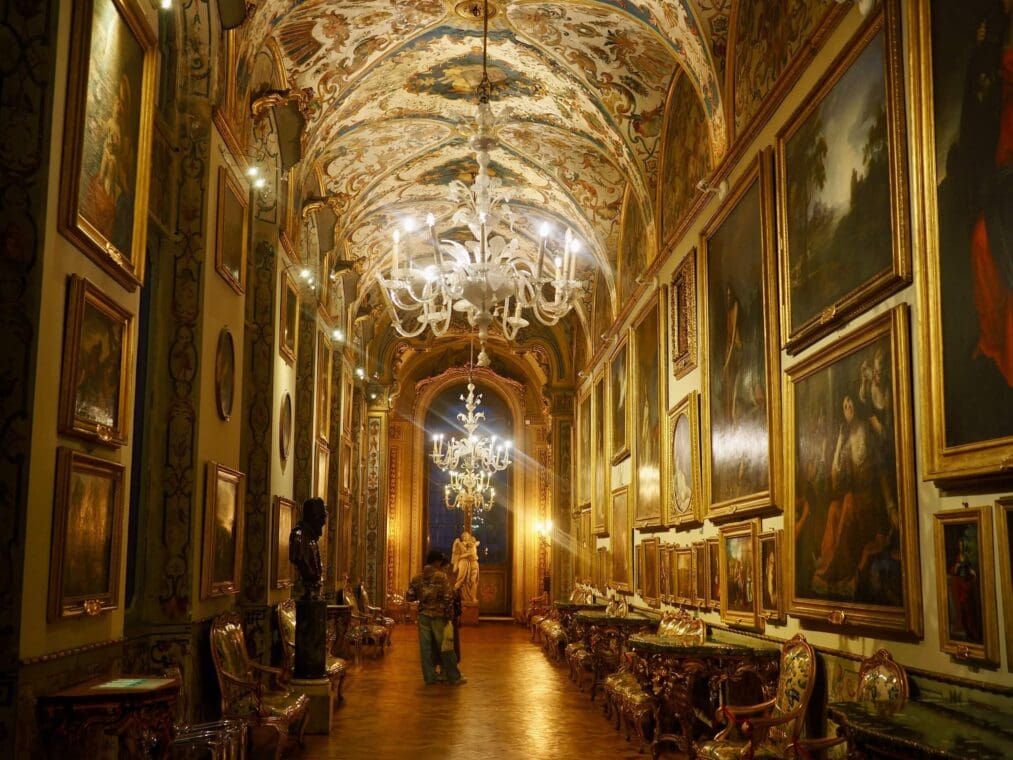
Tours: Through Eternity offers both private tours and small-group visits of the Borghese Gallery led by expert art-historian guides, with skip-the-line access and tickets handled in advance.

Best Rome Tours
Explore Rome's Finest Palaces