Rome’s museums contain multitudes.
In a single afternoon you can move from an Etruscan banquet scene to a Caravaggio, from the bruised face of a Hellenistic boxer to a Bernini marble, or from the world of the Caesars to a building designed by Zaha Hadid. The challenge isn’t finding something worth seeing; it’s deciding what deserves your limited time.
That’s why we’ve put together this guide: not as a definitive ranking, but as a practical starting point for exploring Rome through its collections. These are the museums and galleries that we think offer something genuinely worthwhile to visitors, whatever your interests. Some are famous world-class institutions; others earn their place because they reveal a side of the city that the blockbuster itinerary misses.
We have kept the focus on museums and galleries rather than archaeological sites, churches or parks, and have divided our list into four sections for convenience: Essential Museums, Ancient Rome, Renaissance and Baroque Rome and Modern Rome.
You won’t have time to see everything on this list on a single visit to Rome, and nor should you try. Choose the museums that appeal to you, allow yourself time to explore their collections, and remember that one absorbing encounter with a work of art can be worth more than a dozen hurried visits.
 Want to discover more of Rome with a guide?

From ancient ruins to Renaissance masterpieces, explore the city’s history and art with us.
Our Rome Tours
1. Rome’s Essential Museums
These are the museums that make the strongest case for inclusion on almost any first visit. Together they cover ancient sculpture, Renaissance painting, the Baroque and the collecting habits of the popes and princes who shaped Rome.
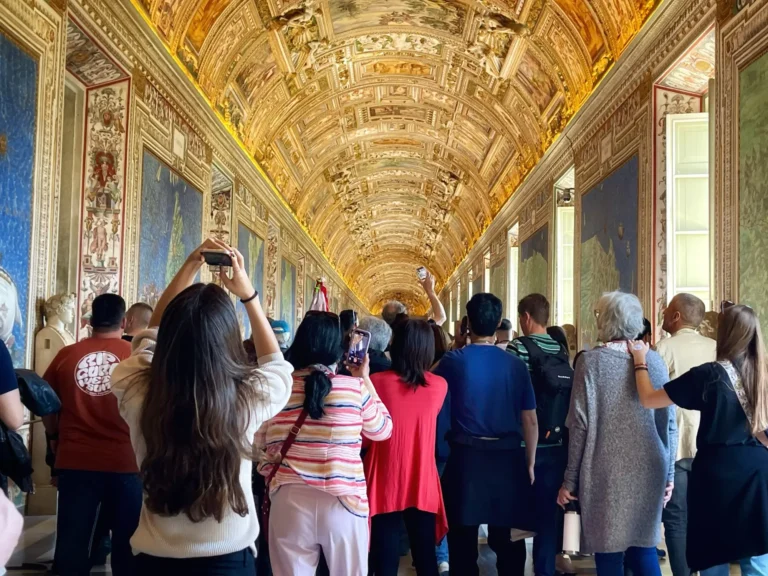
Come for Michelangelo and Raphael, then keep looking: ancient sculptures, maps and tapestries make the Vatican such a vast portrait of Western art.
The Vatican Museums are the obvious place to begin because there is simply so much here. The collection ranges across antiquity and the Renaissance and beyond, from Egyptian artifacts and Roman sculpture to tapestries, paintings and the extraordinary rooms commissioned by successive popes. At the end of the route comes the Sistine Chapel, where Michelangelo’s ceiling and Last Judgment dominate the space.
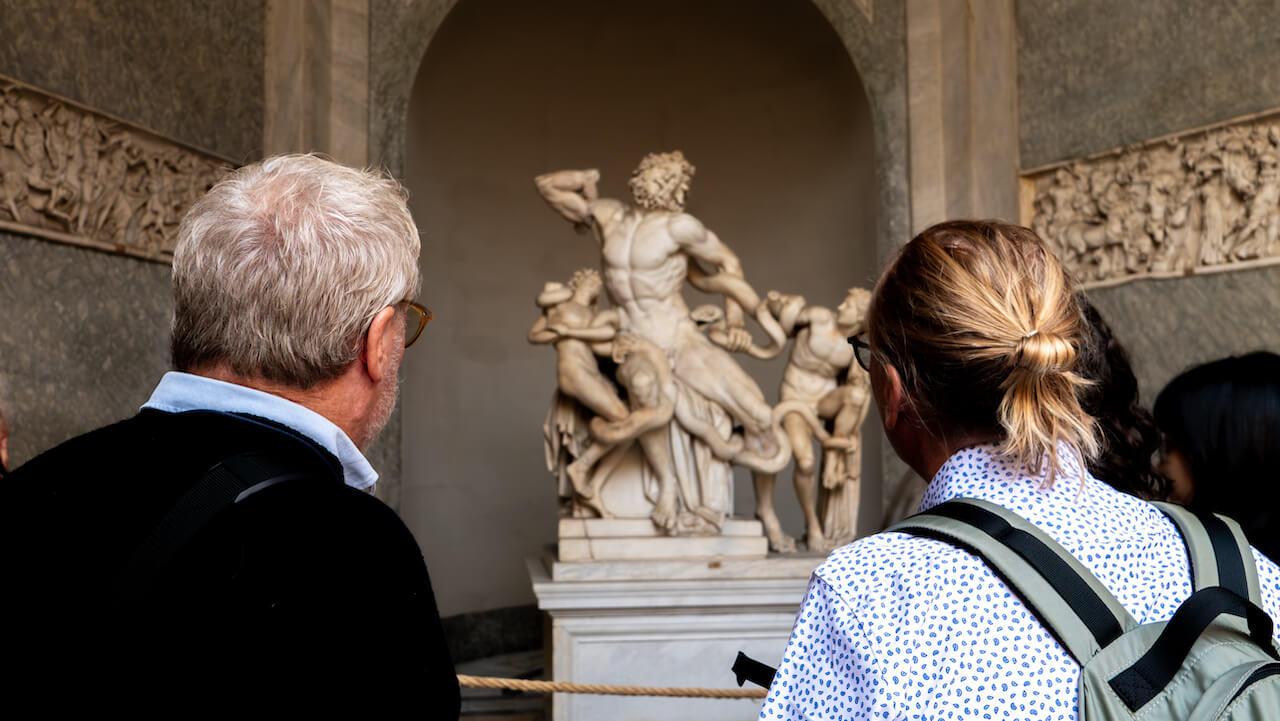
For first-time visitors, the temptation is to rush headling towards the Sistine Chapel, but that misses much of the pleasure. The Laocoön, unearthed in Rome in 1506, offers a glimpse of the ancient world that Renaissance artists themselves were studying; Raphael’s frescoes reveal the intellectual ambitions of Julius II’s papacy; and the Gallery of Maps presents 16th -century Italy in glorious cartographic miniature.
The biggest challenge is deciding what to skip over. The Vatican is enormous and trying to see everything in one visit simply isn’t possible. Decide what you simply can’t afford to miss before you arrive, but allow the collection to surprise you along the way.

How to Visit
Viale Vaticano, 00165. Open Monday to Saturday, 8am–8pm (last entry 6pm). Closed Sundays, except the last Sunday of the month, when admission is free from 9am to 2pm (last entry 12:30pm). Full admission €20; reduced €10. Online booking costs an additional €5 per ticket. Visit the Vatican Museums on a guided tour.

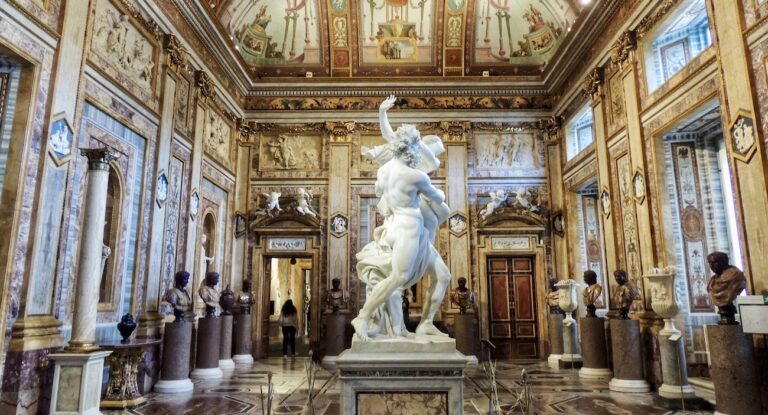
From Bernini to Caravaggio, masterpieces are everywhere you look in the sumptuous palace of Baroque Rome’s greatest art collector.
The Borghese Gallery is a testament to the taste, ambition and sometimes ruthless methods of one of seventeenth-century Rome’s most formidable art collectors: Cardinal Scipione Borghese. Nephew of Pope Paul V, Scipione combined immense wealth and political influence with an insatiable appetite for art, assembling a collection that would help define the artistic glories of Baroque Rome.
His eye for a masterpiece was matched only by his unscrupulous methods: for Scipione, the end always justified the means. Scipione was known to confiscate entire artist’s studios for his own collection, imprison painters unwilling to hand over coveted works, and, more brazen still, even steal religious paintings from their altars. That was the fate of Raphael’s masterful Deposition, spirited away from a Perugia church by hired heavies in the dead of night and deposited in the Cardinal’s Villa.
But Scipione was an enlightened patron as well as a thief. In commissioning the young Bernini to sculpt the Apollo and Daphne, David and Rape of Proserpina for his villa, Borghese helped kickstart the age of the Baroque. Further masterpieces by Caravaggio, Titian, Raphael and Canova offer a remarkable panorama of Roman art across the centuries.
How to Visit
Piazzale Scipione Borghese, 5. Open Tuesday to Sunday, 9am–7pm. Closed Mondays. Full admission €16; reduced €2, plus a compulsory €2 booking fee per ticket. Temporary exhibitions may affect ticket prices. Visit the Borghese Gallery on a guided tour.

The world’s finest collection of ancient Roman art features Marcus Aurelius, the Capitoline Wolf, the Dying Gaul and a magnificent view across the Roman Forum.
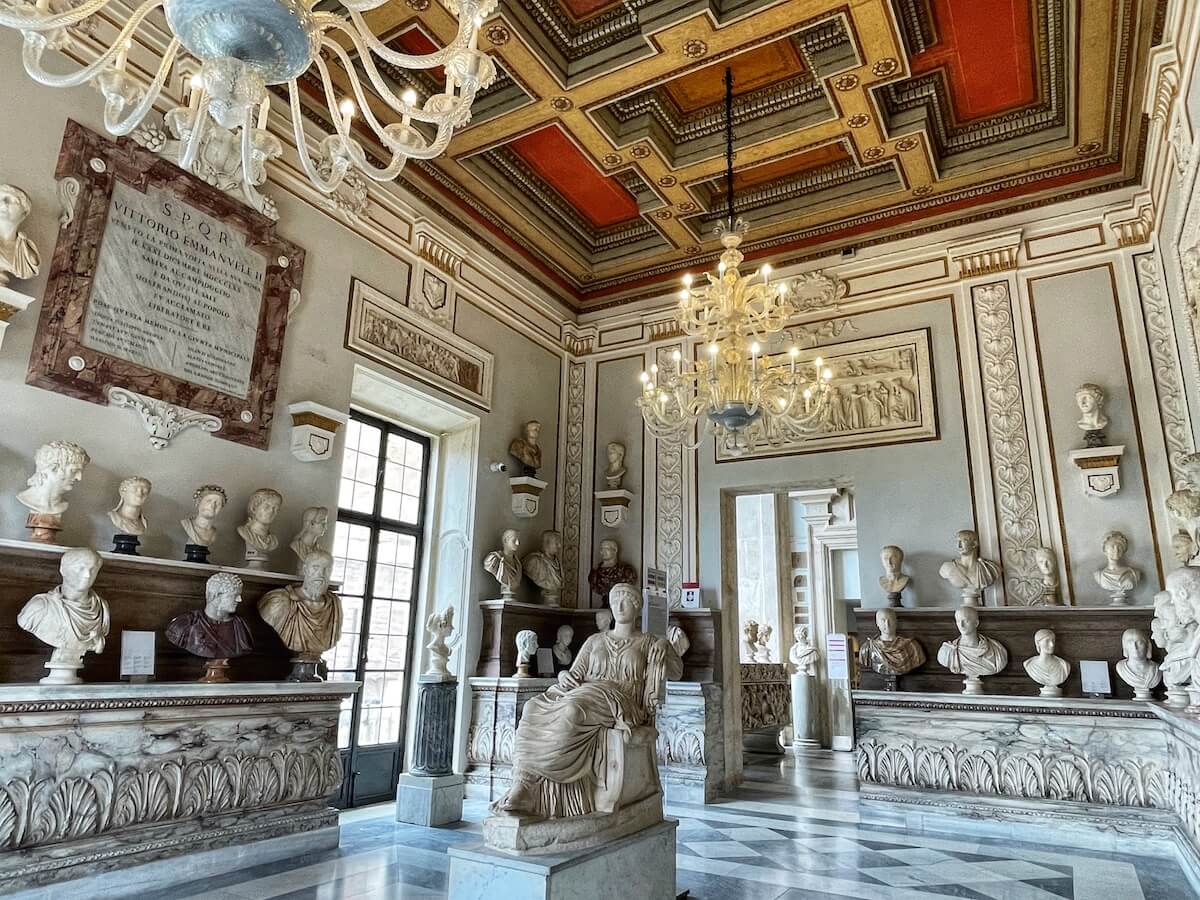
The Capitoline Museums occupy a pair of palaces on the Campidoglio, one of the ancient city’s most important locations. Their story begins in 1471 when Pope Sixtus IV donated a group of ancient bronze sculptures to the people of Rome, creating the foundation of what is widely regarded as the world’s oldest public art collection.
The setting is part of the charm. Michelangelo’s redesigned piazza gives the museum a civic grandeur before you even reach the galleries, while the Tabularium offers a remarkable view over the Roman Forum. Inside, the collection traces Roman power through portraits, public monuments and mythological sculpture: the colossal Equestrian Statue of Marcus Aurelius, the Capitoline Venus, the Dying Gaul and the famous She-Wolf are just the tip of the iceberg.
Make sure to visit the upstairs galleries too, where paintings by Caravaggio, Guercino, Rubens and Pietro da Cortona amongst others, give the museum a much broader chronological range than its ancient reputation suggests.
How to Visit
Piazza del Campidoglio, 1. Open daily, 9:30am–7:30pm (last entry one hour before closing). Closed 1 May and 25 December. Standard admission €15; reduced €9.50. Exhibition-inclusive tickets may cost more. Visit the Capitoline Museums on a guided tour.
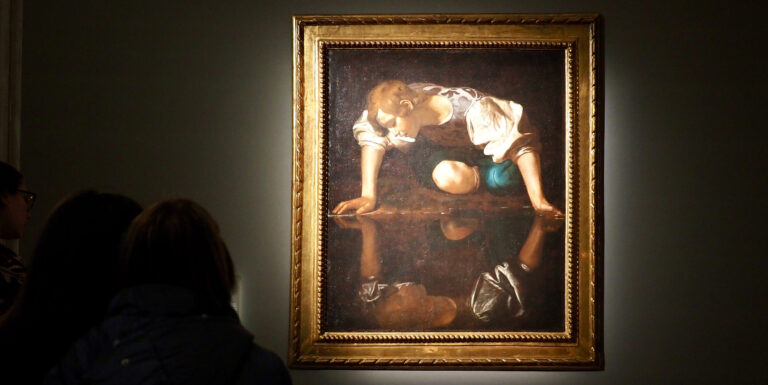
This sumptuous palace encapsulates the ambition of Baroque Rome, while its collection of painting is the finest in the city.
Palazzo Barberini was built when one Roman family suddenly found itself at the center of European power. Maffeo Barberini became Pope Urban VIII in 1623, and the family responded with a palace on a suitably extravagant scale. Carlo Maderno began the project; after his death, Bernini and Borromini reshaped it, while Pietro da Cortona covered the great hall with the spectacular Allegory of Divine Providence – one of the city’s finest ceiling paintings.
The paintings inside are every bit as compelling. Raphael’s La Fornarina sees the great artist at his most intimate, while Caravaggio’s blood-spattered Judith Beheading Holofernes remains one of the most unsettling paintings ever put to canvas.
Look beyond those headline works too. Filippo Lippi’s Annunciation with Two Donors, Holbein’s portrait of Henry VIII and works by Tintoretto, El Greco and Guido Reni all contribute to Palazzo Barberini’s exceptional cross-section of Renaissance and Baroque art in Rome. The architecture is part of the argument, too: the twin stairways built here by Bernini and Borromini capture two of Baroque Rome’s greatest minds at the peak of their creative powers.
How to Visit
Via delle Quattro Fontane, 13. Open Tuesday to Sunday, 10am–7pm (ticket office closes at 6pm). Closed Mondays, 1 January and 25 December. Full admission €15; reduced €2. The ticket also covers Galleria Corsini and is valid for 20 days from first use.
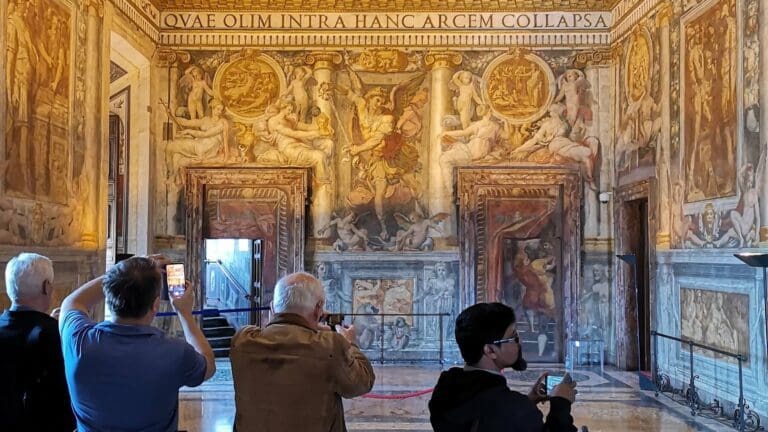
One building, almost two thousand years of reinvention: imperial mausoleum, fortress, papal palace, prison and museum, crowned by one of the best views in Rome.
Few buildings in Rome have reinvented themselves as frequently – or as dramatically – as Castel Sant’Angelo. Hadrian commissioned the immense cylindrical mausoleum as his grand family tomb in the second century AD, but the monument outlived the empire that built it. As Rome changed, the great tomb was absorbed into the city’s defences, transformed into a fortified papal stronghold and eventually expanded into a sumptuous residence for the popes. It became a museum in 1925.
Exploring the castle today means moving through these different worlds. Ramparts and military passages recall its life as a fortress, while the painted ceilings and elaborate decoration of the papal apartments are testament to the gilded court culture of Pope Paul III. Above it all rises the original cylindrical mass of Hadrian’s mausoleum, still at the heart of the building despite centuries of change.
The grand finale is the rooftop terrace, where the bronze Archangel Michael watches over one of Rome’s finest panoramas, with St Peter’s dome rising beyond the rooftops. The castle’s connection to the Vatican was once a matter of survival: the elevated Passetto di Borgo allowed popes to flee from the Vatican Palace to the fortress in times of danger.
How to Visit
Lungotevere Castello, 50. Open Tuesday to Sunday, 9am–7:30pm (last entry 6:30pm). Closed Mondays, 1 January and 25 December, with occasional additional openings. Full admission €18; reduced €2. Visit Castel Sant’Angelo on a guided tour.
2. Rome and the Ancient World
Rome’s archaeological museums are where the city’s ancient history becomes human. After visiting the ruins of the Colosseum and Roman Forum, the sculptures, frescoes and mosaics safely housed in Rome’s collections help bring that distant world of temples and columns dramatically back to life.

Dazzling frescoes, mosaics, and portraits animate Rome’s most underrated museum, home to the extraordinary Greek bronze Boxer at Rest.
Most visitors to Rome overlook Palazzo Massimo – don’t make their mistake! Located just minutes from Termini station, it houses one of the city’s richest collections of ancient Greek and Roman art, with galleries devoted to sculpture, portraits, mosaics, frescoes, and much more.
The jaw-dropping Boxer at Rest is worth the price of admission alone. This battered Hellenistic bronze captures an exhausted and aging fighter immediately after a bout. The degree of detail and technical virtuosity is incredible. Right down to the damaged ears, swollen face and reddish marks that remain imprinted on the metal. Never has ancient art felt more thrillingly alive.
Upstairs frescoes from the Villa of Livia reconstruct a painted garden filled with trees, flowers and birds, while mosaics preserve the elaborate decorative schemes that once transformed Roman houses and public spaces into lavish theatrical environments.
Exquisitely carved funeral monuments and a series of startlingly individualized Imperial portrait busts – look out for thuggish Caracalla and workaday Vespasian – round out the picture. Look out for two other highlights of ancient sculpture whilst you’re here: the famed Discus Thrower and the delicate Sleeping Hermaphrodite.
How to Visit
Largo di Villa Peretti, 2. Open Tuesday to Sunday, 9am–7pm (ticket office closes at 6pm). Closed Mondays. Full admission €15; reduced €2. The combined ticket also covers Palazzo Altemps and the Baths of Diocletian, with one entry to each site, valid for one week.

An intimate Renaissance palace filled with ancient sculpture, where masterpieces of Greek and Roman art are displayed in the setting of an old aristocratic collection.
Just north of Piazza Navona, Palazzo Altemps offers a very different experience from Palazzo Massimo. The museum occupies a fifteenth-century palace transformed by Cardinal Marco Sittico Altemps in the sixteenth century, and much of the pleasure lies in seeing ancient sculpture in rooms that still retain the character of a Renaissance residence.
The collection tells the story of collecting as much as it does of antiquity. The Altemps family assembled a substantial group of classical sculptures to furnish the palace, and later collections, above all that of the Ludovisi family, expanded the holdings. The superb Galatian Suicide is the dramatic centerpiece: a defeated warrior kills himself while supporting the body of his wife rather than submit to capture.
Then there is the colossal Ludovisi Sarcophagus, whose densely carved battle scene swarms with Romans and barbarians in a display of sculptural virtuosity that rewards close looking. The architecture is scarcely less impressive, with a grand central courtyard, sweeping loggias and a frescoed chapel giving a sense of what life was like for Rome’s early-modern elites.
To round out your exploration of the Museo Nazionale Romano, stop in at the Baths of Diocletian across the road from Termini station. Here the building itself is the star of the show – the remains of an ancient Roman bathing complex converted into a monastery by Michelangelo before becoming a modern museum.
How to Visit
Piazza di Sant’Apollinare, 46. Open Tuesday to Sunday, 9am–7pm (ticket office closes at 6pm). Closed Mondays. Full admission €15; reduced €2. Admission is covered by the combined Museo Nazionale Romano ticket, which also includes Palazzo Massimo and the Baths of Diocletian.

Meet the people who lived in central Italy before the rise of Rome in a Renaissance villa filled to the brim with priceless Etruscan artefacts.
The Etruscans can sometimes disappear from the standard Rome itinerary, despite having occupied the landscape around the city for centuries before and during Rome’s rise. Villa Giulia is the place to correct that omission.
The museum itself occupies a Renaissance villa built for the pleasure-loving Pope Julius III between 1550 and 1555, with contributions from major artists and architects including Vignola, Vasari and Ammannati. Inside is the finest collection of Etruscan art in the world, ranging from delicate goldwork and funerary objects to monumental terracotta sculpture.
The star of the show is the Sarcophagus of the Spouses, a terracotta cinerary urn from Cerveteri showing a couple reclining together at a banquet. The intimacy of the embrace is striking, but so is the unusual prominence of the woman, represented beside her husband as an equal participant in the scene. The Apollo of Veii, a brilliantly colored terracotta figure from a temple at Veii, gives another sense of the sophistication and energy of Etruscan art.
How to Visit
Piazzale di Villa Giulia, 9. Open Tuesday to Sunday, 8:30am–7:30pm (last entry 6:30pm; galleries close at 7pm). Closed Mondays, 1 January and 25 December. Full admission €13; reduced €2.

Ancient Rome with turbines and diesel engines looming overhead: a disused power station provides one of the city’s most memorable museum settings.
Centrale Montemartini began life in 1912 as Rome’s first public power station. When the electricity plant was converted into a museum in the 1990s, the Capitoline Museums moved ancient sculptures, mosaics and archaeological finds into its industrial spaces. The result is a wonderfully strange juxtaposition of the ancient and the modern.
Marble gods and Roman dignitaries stand beneath vast machinery; ancient mosaics occupy rooms that once fed the insatiable energy demands of Italy’s rapidly growing capital. Rather than disguising the building’s industrial past, the museum makes it part of the display, allowing two very different histories of Rome to coexist.
The collection ranges chronologically from Republican Rome to the late Empire and includes sculpture recovered from temples, public buildings and wealthy houses. The Togato Barberini, a Roman patrician holding the heads of two ancestors, is a standout, although its exact identity remains debated.
How to Visit
Via Ostiense, 106. Open Tuesday to Sunday, 9am–7pm (last entry one hour before closing). Closed Mondays, 1 May and 25 December. Standard admission €11; reduced €6.50. Combined tickets including temporary exhibitions may cost more.

An ancient altar built to celebrate Augustus, presented inside Richard Meier’s striking modernist museum overlooking the Tiber.
The Ara Pacis is unusual even by Roman standards because the museum and the monument are inseparable. The altar was commissioned in 13 BC to honor Augustus’s return from campaigns in Spain and Gaul, and its carved reliefs combine imperial propaganda with images of Rome’s legendary origins, the imperial family and the fertility associated with a new age of peace.
Today it sits inside a light-filled structure designed by Richard Meier, whose white geometry forms a deliberate counterpoint to the pale marble of the ancient monument. The modern building was conceived in part as a protective enclosure: the altar had previously suffered from pollution, vibrations and fluctuations in temperature and humidity.
The result is another fascinating encounter between ancient and contemporary architecture in Rome. The reliefs reward close attention, particularly the procession of priests and members of Augustus’s family along the sides of the enclosure. The building also puts the monument back into conversation with its modern surroundings, with the Tiber and the city visible beyond the glass.
How to Visit
Lungotevere in Augusta. Open daily, 9:30am–7:30pm (last entry one hour before closing). Closed 1 May and 25 December. Full admission €14; reduced €8. Temporary exhibitions may incur an additional charge.
3. Renaissance, Baroque and Aristocratic Rome
Some of Rome’s most enjoyable museums are still essentially houses. Their collections make sense because of the families who commissioned them, the rooms they built to display their possessions and the rivalries that shaped elite life in the city.
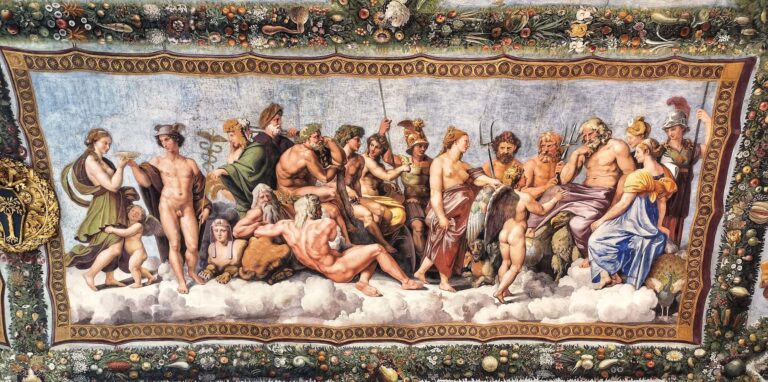
Raphael without the Vatican crowds: a riverside Renaissance villa where mythological frescoes evoke the lavish lifestyle of Europe’s richest
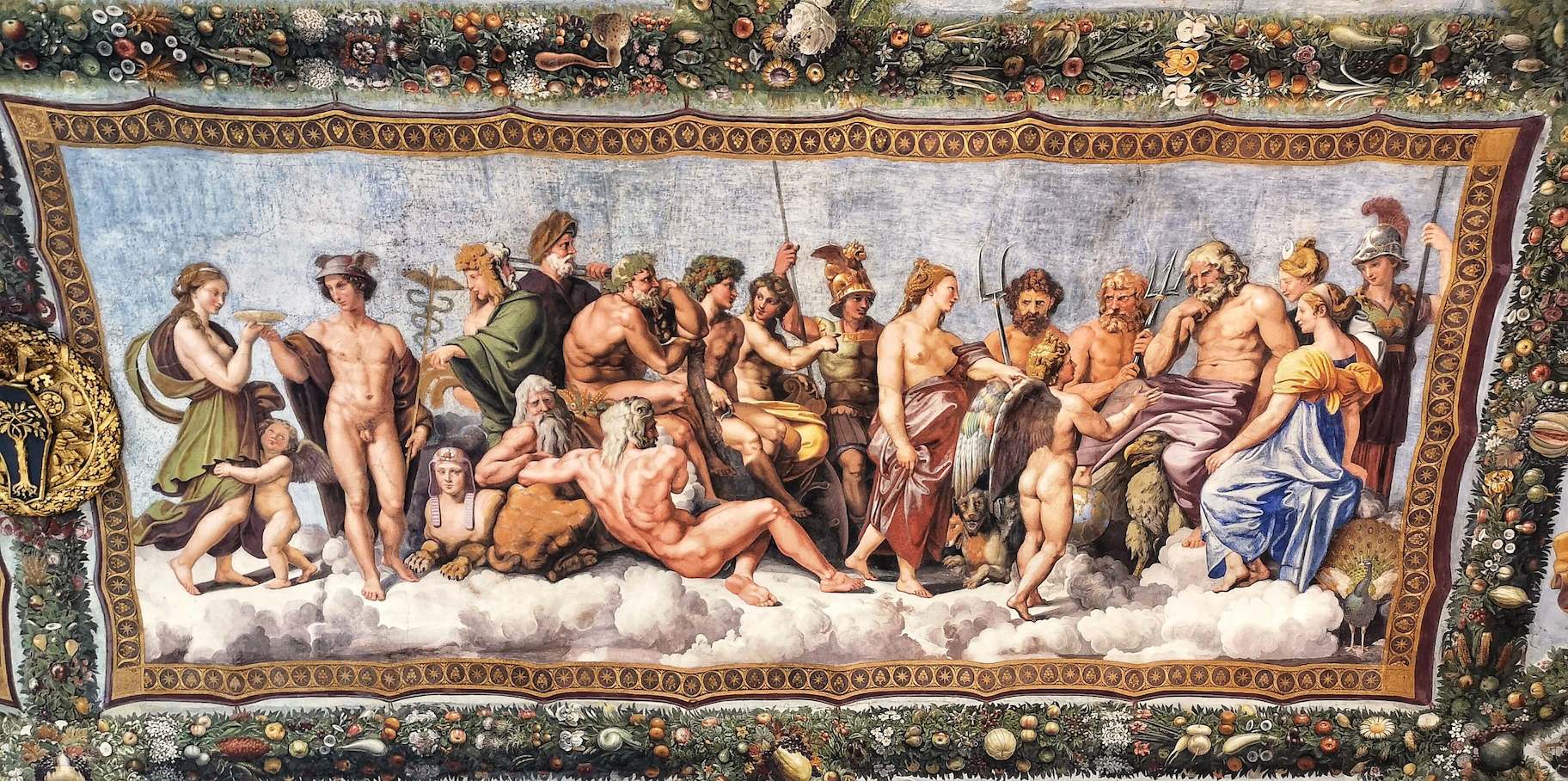
The Renaissance lets its hair down at this lavish private palace whose decorations mark one of the highpoints of a golden age in Rome. The Villa Farnesina was home to Agostino Chigi, an immensely wealthy banker, entrepreneur and financier to the popes in the 16th century who sought a space where he could both conduct business, entertain and display his extraordinary wealth.
Chigi recruited some of the leading artists of the age to help bring his vision to reality. Raphael painted Galatea, with its exuberant sea-nymph skimming across the waves, and designed the frescoes of the Loggia of Cupid and Psyche alongside his workshop. Upstairs Baldassarre Peruzzi created the famous Hall of Perspectives, whose painted architecture dissolves the boundary between the room and the landscape beyond.
Taken together, they give a vivid sense of Chigi’s world: a man with the wealth to summon the finest artists of his age, and the taste to surround himself with their work while entertaining Rome’s most illustrious guests. The best part? Unlike the Vatican Palaces just up the river, this monument to the splendors of Renaissance Rome is never crowded.
How to Visit
Via della Lungara, 230. Open Monday to Saturday, 9am–2pm (last entry 1:15pm). Closed Sundays, except the second Sunday of the month, when it opens 9am–5pm (last entry 4:15pm). Full admission €12; reduced €10. Visit Villa Farnesina on a guided tour.

Enter the private world of a Roman dynasty, where Caravaggio, Velázquez and Raphael hang inside a palace that still belongs to the family that built its collection.
The Doria Pamphilj Gallery offers a rare glimpse inside the world of Rome’s aristocracy, with an extraordinary collection of paintings, sculpture and lavish furnishings still displayed in the family palace for which much of it was assembled. The building itself grew over centuries, shaped by dynastic ambition, inheritance and rivalry among the city’s great families. Even today you feel like you’re exploring a family collection rather than a purpose-built public museum. But what a family collection it is!
Velázquez’s portrait of Pope Innocent X is the obvious star, where the fearsome pontiff glares out at us with a startlingly direct psychological force. Nearby Caravaggio’s meditative Rest on the Flight into Egypt and Penitent Magdalene reveal a very different side of an artist more famous for bombast, while Raphael’s double portrait of Andrea Navagero and Agostino Beazzano is one of the great Renaissance portrait groups in Rome.
The paintings are only part of the story. Beyond the gallery, the palace unfolds through the dazzling Gallery of Mirrors, gilded reception rooms where Handel once entertained the Pamphilj family, an intimate private chapel and a leafy courtyard that feels a world away from the bustle of central Rome. Remarkably, the Pamphilj continue to call the palace home to this day.
How to Visit
Via del Corso, 305. Open Monday, Tuesday and Thursday, 9am–7pm; Friday to Sunday, 10am–8pm. Last entry one hour before closing. Closed Wednesdays, 1 January, Easter and 25 December. Full admission €16 at the ticket office or €17 online. No general reduced rate is listed; children under 12 enter free. Visit the Doria Pamphilj gallery on a guided tour.

Palazzo Colonna is Baroque Rome turned up to full volume: a princely residence of mirrors, gilded stucco, battle imagery and paintings by some of Italy’s greatest artists.
For sheer aristocratic spectacle, few places in Rome can compete with Palazzo Colonna. The Colonnas have been one of the city’s most powerful families for centuries, producing popes, cardinals, military commanders and political heavyweights, and their palace is a fitting monument to that long pursuit of influence. Step inside the Galleria Colonna and the effect is almost dizzying: marble columns, gilded mirrors, monumental canvases and frescoed ceilings combine in a dazzling display of wealth and ambition.
The climax is the Great Hall, a vast gallery surmounted by a frescoed ceiling alive with colour and movement where the great feats of the family are depicted, including the dramatic triumph of Christian troops over the Turkish fleet at Lepanto, led by Marcantonio Colonna. Yet the collection offers quieter pleasures too, with paintings by Bronzino, Veronese, Tintoretto, Guercino and Guido Reni lining the halls. Don’t miss Annibale Carracci’s Bean Eater, where an ordinary man is caught mid-meal, apparently oblivious to the magnificence that surrounds him.
Palazzo Colonna is still the Colonnas’ home, and is only open to the public on Friday and Saturday mornings. It requires a little planning to organize a visit here, but it’s more than worth it.
How to Visit
Via della Pilotta, 17. Open for public visits on Friday and Saturday, with different itineraries and entry arrangements. Friday visits are guided and require reservations; Saturday visits run from 9:15am to 1:15pm. Saturday admission is €15 for the short visit or €25 for the complete visit; Friday guided visits cost €35. Visit the Colonna Gallery on a guided tour.

A fine collection of Baroque painting in the atmosphere of a private collection and Borromini’s ingenious perspective gallery make this an off-the-beaten-path gem.
The Galleria Spada is small enough to visit without it taking up most of your day, but the quality of the collection more than makes up for its compact scale. The gallery preserves the seventeenth-century collection assembled by Cardinals Bernardino and Fabrizio Spada, with fine works by Guido Reni, Guercino, Artemisia and Orazio Gentileschi, Titian, Parmigianino and others.
But what makes the Palazzo Spada an unmissable museum in Rome is located in the courtyard outside. Here master Baroque trickster Francesco Borromini created his celebrated Prospettiva for the palace’s Secret Garden in 1653. The corridor is less than nine meters long, but carefully diminishing columns, a rising floor and converging surfaces persuade the eye that it extends far deeper into the distance. The tiny statue at the far end only strengthens the illusion.
How to Visit
Piazza Capo di Ferro, 13. Open Monday and Wednesday to Sunday, 8:30am–7:30pm (ticket office closes at 7pm). Closed Tuesdays, 1 January and 25 December. Full admission €6; reduced €2.
4. Modern and Contemporary Rome
Rome’s art story didn’t end with the close of the Baroque era. These two museums provide very different ways of understanding the city after the nineteenth century: one through a major national collection of modern art, the other through contemporary art, architecture and photography.

Rome’s answer to the question of what Italian art became after the age of Raphael and Bernini, with works ranging from Canova and Monet to Balla, de Chirico, Warhol and Cattelan.
The Galleria Nazionale d’Arte Moderna e Contemporanea fills one of the biggest gaps in the traditional Rome itinerary. Its collection stretches from the nineteenth century to the present, following the changing language of art through realism, Impressionism, Symbolism, Futurism, abstraction and contemporary practice.
There are plenty of big names here: Monet and Degas capture fleeting impressions of nineteenth-century life, while Klimt’s The Three Ages of Woman is a masterpiece of his unique decorative style. Giacomo Balla’s Futurist works capture movement and speed in daring visual experiments, while Giorgio de Chirico’s eerily deserted piazzas conjure a Rome-like world in which familiar architecture becomes strangely unsettling. Later, Lucio Fontana slashes his canvases and Alberto Burri transforms burnt and battered materials into art. Van Gogh, Modigliani, Cy Twombly and Andy Warhol widen the picture still further.
GNAM is particularly rewarding after a few days immersed in Rome’s ancient monuments, Renaissance palaces and Baroque churches, and a valuable reminder that Italian art didn’t end with Bernini.
How to Visit
Viale delle Belle Arti, 131. Open Tuesday to Sunday, 8:30am–7:30pm (last entry 45 minutes before closing). Closed Mondays, 1 January and 25 December. Full admission €10; reduced €5.

Come for Zaha Hadid’s building, then explore a museum devoted to the art, architecture and photography of the modern world.
MAXXI is one of the clearest signs that Rome has a contemporary architectural identity as well as an ancient one. Zaha Hadid’s blockbuster building, opened in 2010 years late and millions over budget, is designed around flowing concrete volumes, ramps and intersecting routes that make movement through the building an integral part of the museum experience.
The collection ranges across contemporary art, architecture and photography, with key works by artists including Alighiero Boetti, William Kentridge and Gerhard Richter featuring an interesting collection of architectural models and drawings. Regular exhibitions and temporary installations are the biggest draw card though, so make sure to check the latest listings if you’re interested in seeing what contemporary art has to offer in Rome.
How to Visit
Via Guido Reni, 4/A. Open Tuesday to Sunday, 11am–7pm (ticket office closes one hour before the museum). Closed Mondays, 1 May and 25 December. Full admission €15 at the ticket office or €14 online; reduced €12 or €11 online. Special exhibition tickets and temporary offers may differ.
Through Eternity offers group and private tours of many of the museums featured in this guide, with expert guides bringing their collections and stories to life. If you don’t see a tour of a particular museum on our website, get in touch and we can arrange a tailor-made visit to suit your interests. Please note that opening hours and ticket prices quoted in this article are correct at the time of going to press but are subject to change, so check the official museum websites before your visit.
Plan Your Rome Visit Today!