Divine love has never looked so good.
Swooning high on a cloud of gravity-defying marble, the 16th-century saint Teresa of Avila throws her head back in a silent cry of ecstasy. A mischievous angel rises above her and giggles as he pulls back a gold-tipped arrow, ready to plunge it deep into the limp body of this young saint. The nun’s bare foot dangles precariously over the cloud’s edge, a naked limb that scandalised conservative viewers when the sculpture was unveiled in 1652.
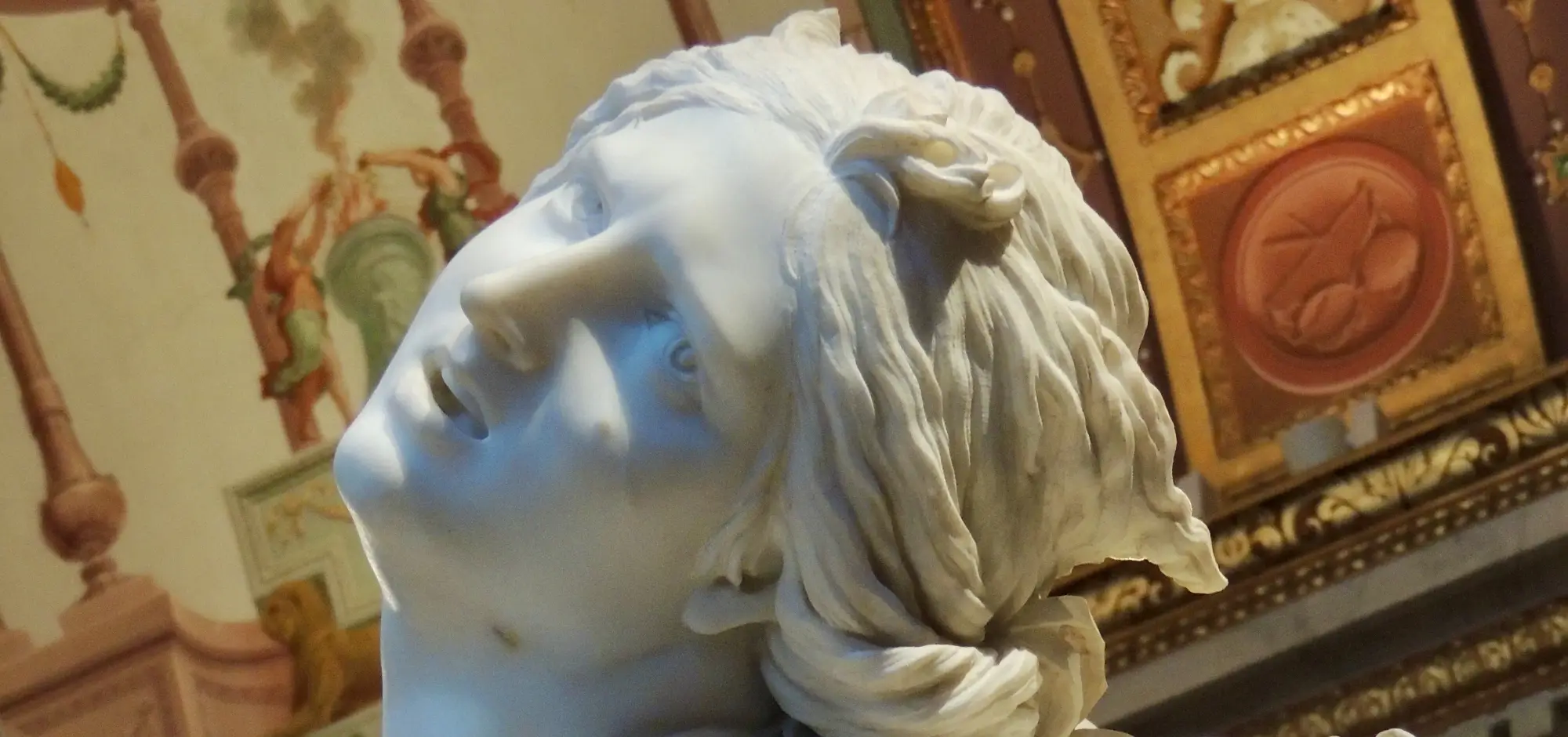
But our eyes seem magnetically drawn back to that dramatically foreshortened face, those delicately parted lips and those eyes rolling helplessly backwards in their sockets. Is this an expression of purest piety or thinly-veiled 17th-century erotica? You decide.
Discover the Art of Bernini
Join a Rome Tour
Saint Teresa and the Cornaro Chapel

We’re in the Cornaro Chapel in the Roman church of Santa Maria della Vittoria. Suspended high in the air above the chapel’s floor, Gianlorenzo Bernini’s sculptural masterpiece Ecstasy of Saint Teresa levitates as if by magic. Bernini, the pied-piper of the Roman Baroque and history’s greatest maximalist long before it became 2018’s trending interior design craze, set to work on this sculpture when he was at the very height of his powers in the 1640s, commissioned by the churchman Federico Cornaro to provide a fitting monument to the mystically inclined Spanish nun who had been canonized a quarter-century earlier.
Teresa’s route to the spiritual top wasn’t an easy one. In an age rife with suspicions of heresy and the terrors of the Inquisition, charismatic women were viewed with profound misgivings by religious hierarchies. Teresa’s propensity to experience vivid full-body visions and shuddering raptures made her an object of suspicion for theologians fearful of unorthodox expressions of religious sentiment. The saint-to-be was even interrogated by the Spanish Inquisition, who confiscated and censured her steamy writings about divine love. Thankfully things went well for her in the end: the church ultimately ruled that Teresa’s mystic experiences were genuine encounters with God rather than Satan’s temptations, and her path to sainthood was ensured.

The Angel

Teresa was no run-of-the-mill saint, and Bernini pulled out all the stops to do justice to the blazing emotional intensity that was her hallmark. The sculptor chose to picture her experiencing her most famous all-body vision, following to the letter the breathless autobiographical account written by the saint. Teresa describes how a beautiful angel plunged ‘a great golden spear’ with a fiery tip deep into her heart several times.
When he pulled it out it, Teresa was left ‘utterly consumed by the great love of God.’ For the uninitiated, Teresa’s masochistic account seems like it’s sacreligiously straight from the 50 Shades playbook: ‘the pain was so severe that it made me utter several moans. The sweetness caused by this intense pain is so extreme that one cannot possibly wish it to cease, nor is one’s soul content with anything but God.’
The angel’s gleeful penetration of the inert young woman has unavoidably led to centuries of accusations that Bernini got a bit hot and bothered on the job and left piety at the door. But though the statue throbs with an erotic charge that’s hard to ignore, such brilliant emotionalism had its role to play in inspiring pious devotion. This is how much you need to love God, it seems to say; this is how much you need to feel the force of the Divine with all your body and soul.
With the unique touch of a genius, Bernini has breathed so much life into his marble protagonists that you almost want to reach out and take their pulses – feel the warm blood coursing through the sprightly angel’s veins, search for the spark of life in the limp and heavy limbs of the out-for-the-count saint.
The Cornaro Patrons

Cast your eyes to either side of Teresa and the angel, and you realise that we’re not the only ones given privileged ringside seats at this theatre of mystic revelation. On the chapel’s side walls, eight venerable bearded men take their seats on balconies overlooking the action, leaning out of the boxes as they turn to one another in animated discussion.
These are members of the Cornaro family, whose act of patronage ensured that they got to eternally partake in the miracle. The man who commissioned the chapel was Cardinal Federico Cornaro, a Venetian aristocrat whose family had been accumulating wealth, political influence and ecclesiastical honours for generations. The Cornaros had produced four doges of Venice, along with a string of cardinals, and Federico himself was the seventh member of the family to receive a cardinal’s hat. He was therefore commissioning considerably more than a private place of worship: this was a family monument, a conspicuous statement of Cornaro prestige planted in the heart of Rome.
Federico himself appears in this carefully choreographed family gathering alongside his father, Giovanni I Cornaro, who had served as Doge of Venice from 1625 to 1629 and whose face here might bear the features of Bernini himself in a secret self-portrait. The other figures include several of the family’s cardinals, creating something like a marble roll call of Cornaro distinction. Federico died in 1653 and was buried in the chapel he had commissioned.
Bernini gives these distinguished ancestors an unexpectedly lively role. They don’t kneel in prayer or gaze solemnly towards the altar like the inhabitants of a conventional funerary chapel. They lean over the balustrades, turn towards one another, gesture and appear to discuss what is happening before them. They have the air of a group of aristocratic gentlemen who have wandered into the theatre and are already exchanging their opinions about the performance.
Crucially, the figures are not merely there to honour the family name; they are there to watch. Their presence turns Teresa’s private vision into a public event, giving the supernatural episode a chorus of aristocratic witnesses. Their anachronistic act of witness is the much needed proof that Teresa’s vision was real, sent by God and not the devil, and the guarantee of her elevation to sainthood.
Bernini and the 'Bel Composto'

Bernini’s real genius lies in the fact that the spectacle does not stop with Teresa and the angel. He has turned the entire chapel into a theater, carefully choreographing the architecture, sculpture, painting and light so that everything conspires to make Teresa’s private vision appear before us as a living event. The gilded rays behind her seem to pour down from heaven, while a concealed opening above floods the marble group with natural light. The architectural frame itself resembles a theatrical proscenium, complete with the marble boxes from which the Cornaros lean out to watch the action.
That creates a wonderfully complicated chain of looking. The Cornaros watch Teresa; we watch the Cornaros watching Teresa; and all of us are drawn towards the same vision at the centre of the chapel. Bernini has effectively erased the boundary between sculpture and theatre, turning a side chapel into a stage and the visitor into part of the audience. Even the architecture seems to participate in the drama, framing the apparition and controlling the way light falls upon it.
This is what Bernini meant by the bel composto, his idea of bringing different artistic disciplines together so that they function as a single, unified work. Here marble, painted decoration, stucco, gilded bronze, coloured stone and architecture are all enlisted in the same enterprise, extending the supernatural world of divine encounter into the real space of the chapel.
Ecstasy or Erotic Fantasy?

The Cornaro crew’s sober appraisal and rational beard-stroking bearings indicate that they take the scene for what it’s meant to be: a pure and holy vision that brought Teresa closer to God. But what about those of us who see something more in the chemistry between Teresa and that angel who looks for all the world like a pagan Cupid, locked in a dangerous game of earthly pain and spiritual pleasure?
The sensuality is difficult to miss. Teresa’s head falls back, her eyes close and her mouth opens as the angel approaches with his golden arrow. Her body seems to surrender completely beneath the great waves of drapery, while the angel himself looks almost mischievous as he prepares to plunge the arrow into her heart. Bernini was depicting a specifically Christian mystical experience, based closely on Teresa’s own account of the transverberation, but he chose to render it with a physical intensity that inevitably invites comparison with earthly desire.
The Cornaros would no doubt tell us to get our minds out of the gutter, but I’m not so sure we’ve got it wrong. I think Bernini knew exactly what he was doing, and brought together piety and eroticism in a potent cocktail that he was sure would set tongues wagging for centuries to come. What do you think?
How to Visit Bernini’s Saint Teresa

When in Rome don’t miss the city’s most spectacular piece of Baroque stagecraft. Bernini’s Ecstasy of Saint Teresa is in the Cornaro Chapel, in the left transept of Santa Maria della Vittoria on Via XX Settembre, just a few minutes’ walk from Piazza della Repubblica. The church is free to enter, and you can go straight to the chapel once inside. Current visiting hours are 8am to noon and 4pm to 6pm Monday through Saturday, and 9am to noon and 4pm to 6pm on Sundays and feast days. Bear in mind that visits are suspended during Masses and other religious services and opening hours are subject to change, so it is worth checking the church’s schedule if you are planning your visit around a particular time.
Don’t rush straight up to the altar. The Cornaro Chapel was conceived as a complete theatrical environment, and the effect makes most sense when you first take in the whole composition: Teresa and the angel at the centre, the gilt rays and concealed light above them, and the Cornaro family members leaning out of their marble boxes on either side. Then move closer and look at Bernini’s handling of the marble, particularly Teresa’s face, the angel’s wings and the extraordinary treatment of the saint’s heavy drapery. The chapel rewards both views: from a distance you experience Bernini’s carefully orchestrated spectacle, while close up you can appreciate just how improbably alive he has made the stone.
If you’d like to avail of a custom tour that takes you inside all the highlights of Baroque Rome, get in touch with Through Eternity today.
Bernini’s Saint Teresa FAQ

What does Bernini’s Ecstasy of Saint Teresa depict?
The sculpture depicts Teresa of Ávila experiencing the mystical transverberation described in her autobiography, in which an angel pierces her heart with a fiery golden arrow, leaving her overwhelmed by divine love.
Where is Bernini’s Saint Teresa in Rome?
It is in the Cornaro Chapel inside the Church of Santa Maria della Vittoria, on Via XX Settembre near Piazza della Repubblica.
When did Bernini make the Ecstasy of Saint Teresa?
Bernini created the Cornaro Chapel and its central sculpture between 1647 and 1652.
Who commissioned the Ecstasy of Saint Teresa?
The chapel was commissioned by Cardinal Federico Cornaro, a Venetian cardinal who intended it as his family burial chapel.
Why does Bernini’s Saint Teresa look so sensual?
Bernini deliberately translated Teresa’s mystical experience into intensely physical terms. Her head falls back, her eyes close and her mouth opens as the angel’s arrow penetrates her heart. The imagery is rooted in Teresa’s own description of the experience as simultaneously painful and overwhelmingly pleasurable, which is why the sculpture has generated centuries of debate about the relationship between religious ecstasy and eroticism.
Who are the people watching Saint Teresa?
The figures in the marble boxes on either side of the chapel are members of the Cornaro family. They function as spectators within Bernini’s theatrical conception of the chapel, appearing to witness Teresa’s mystical vision as though it were unfolding before them.
Was Saint Teresa actually experiencing a vision?
Teresa herself described the experience as a genuine mystical encounter with an angel and with divine love. Bernini based his sculpture closely on her account in her Life, including the golden spear that pierces her heart.
Is the Ecstasy of Saint Teresa free to visit?
Yes. Santa Maria della Vittoria is a functioning church and there is no admission charge to enter and see the Cornaro Chapel.
Ready to Discover the Art of Bernini?
Book Your Tour Here!