When the architecture-mad Pope Urban VIII ascended to the papacy in the early 17th century, he ordered an inscription to be chiseled into the entrance porch of the iconic Pantheon in Rome.
In it, he lauded the venerable ancient temple as “the most celebrated edifice in all the world.” Ironically, despite his justifiable awe, Urban was also guilty of plundering the Pantheon for its precious bronze, which he had melted down and recast as cannons.
Nonetheless, the two-faced old Pope had a point. No building in the world has had a bigger influence on the history of western architecture than the fabulously beautiful Pantheon, and whenever I’m hosting friends and family in Rome it’s the very first place we go to visit.
Elsewhere we’ve detailed exactly why you need to visit the Pantheon and how to do so, including answering all your questions about the new ticketing system. This week we’re taking a look at ten things you need to see when you get to the Pantheon.
Rome Tours
Visit the Pantheon
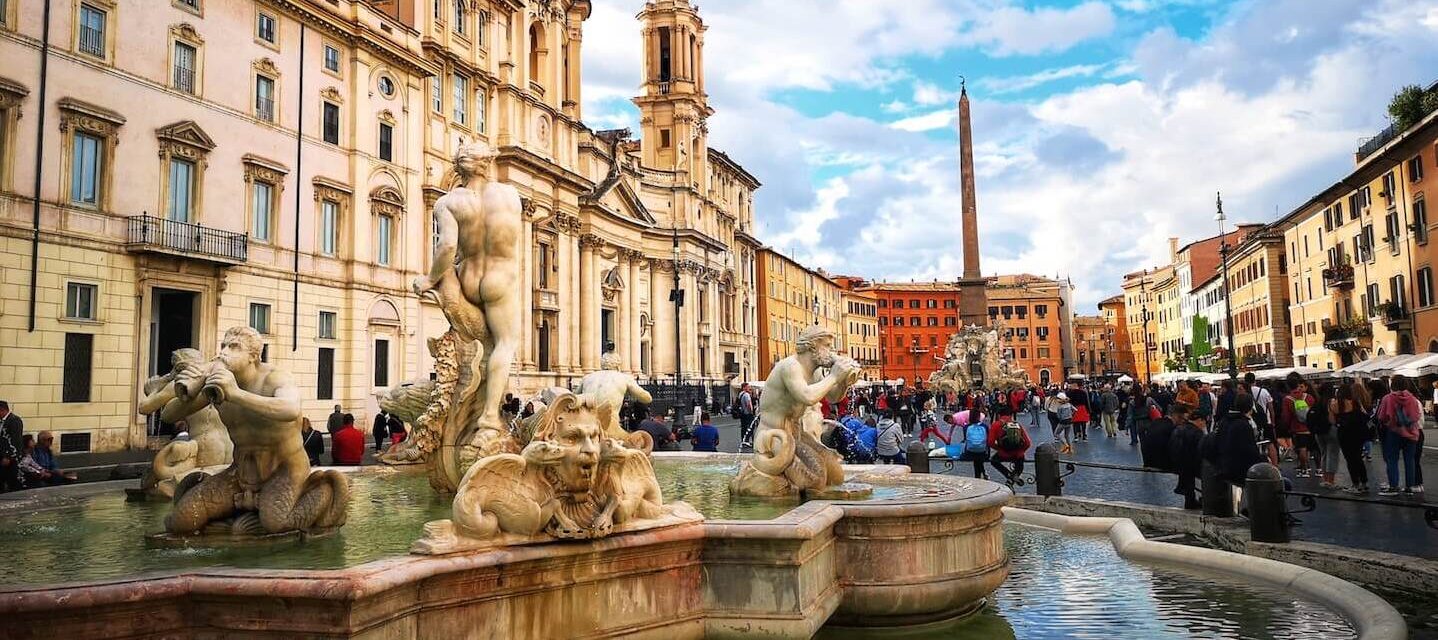
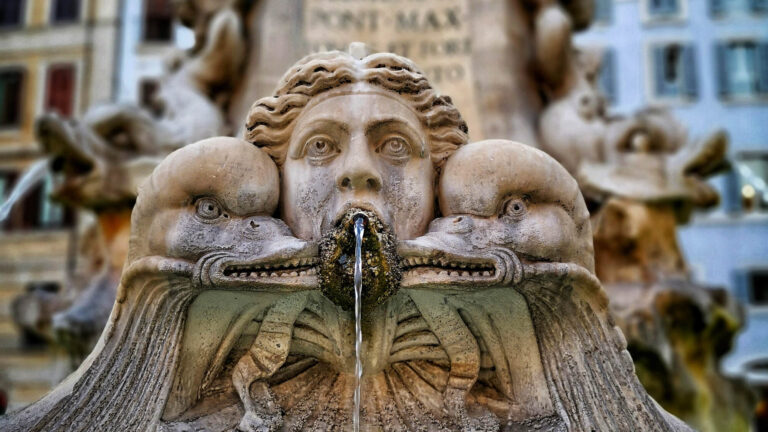
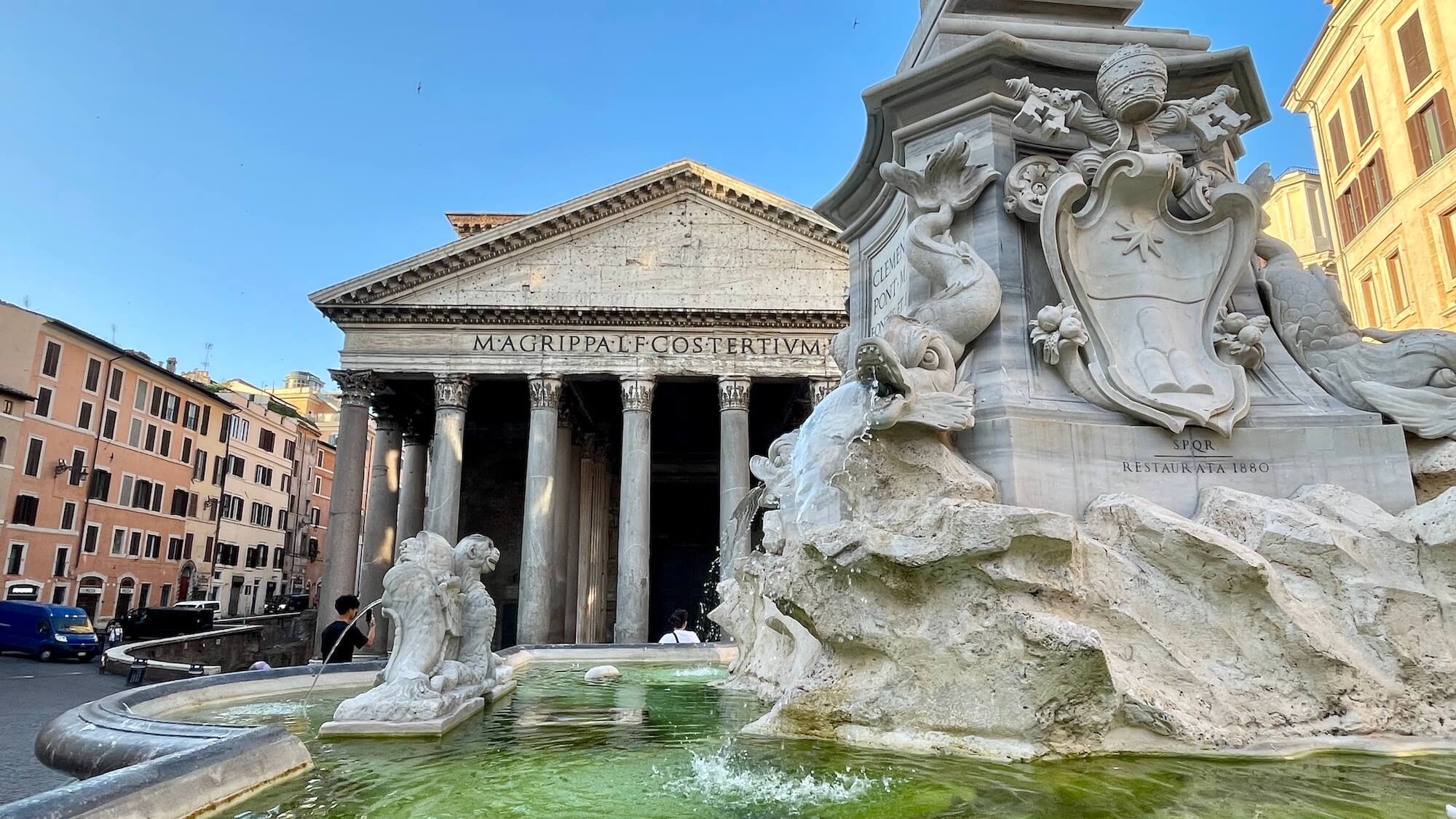
Before you even enter the building, pause in Piazza della Rotonda and turn your attention to the fountain at its centre. It is easy to walk straight past — the Pantheon’s looming facade naturally draws the eye — but that would be a mistake, because the Fontana del Pantheon is one of the most beautiful fountains in Rome.
The fountain was designed by Giacomo della Porta in the 1570s, fed by water from the restored ancient Acqua Vergine aqueduct — the same source that still feeds the Trevi Fountain today, and whose restoration was a pivotal moment in Rome’s post-medieval revival.
The original design featured those magnificently grumpy dolphins and theatrical masks, spewing water from their scowling faces. Pope Clement XI added the Egyptian obelisk in 1711, balancing it on a rocky plinth above the basin; the obelisk itself originally adorned the nearby Temple of Isis.
The ensemble you see today is a characteristically Roman layering of ancient and early modern, of pagan and Christian, of the grandiose and the quietly functional.

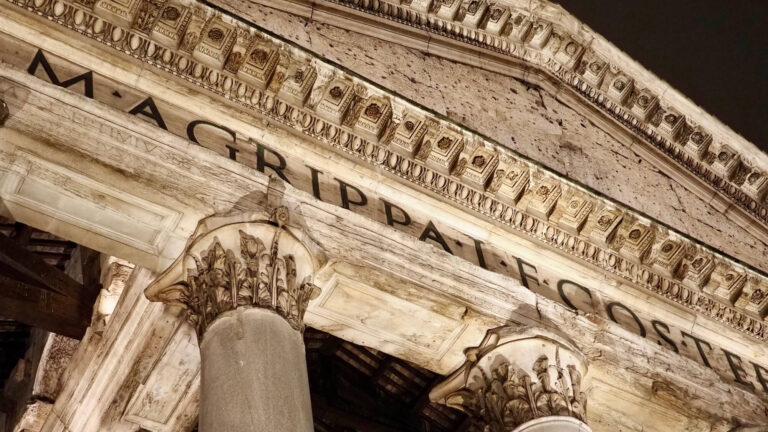
Look up at the massive triangular pediment that dominates the Pantheon’s facade. Notice the pockmarked surface: those holes were drilled to hold the large metal clamps that once supported gleaming marble panels — long since stripped away and reused in other Roman building projects after the fall of the empire.
The inscription running across the portico reads: M·AGRIPPA·L·F·COS·TERTIVM·FECIT — “Marcus Agrippa, son of Lucius, made this in his third consulate.” It is, as we know, not entirely true. Agrippa, a Roman general and close friend of the Emperor Augustus, was responsible for the construction of the first Pantheon as part of his duties as Consul in around 25 BC. The building we see today, however, was entirely reconstructed by the Emperor Hadrian around 125 AD.
In an act of imperial modesty, Hadrian kept Agrippa’s original inscription rather than replacing it with his own name. The result is one of antiquity’s most enduring white lies, preserved in bronze for the ages.
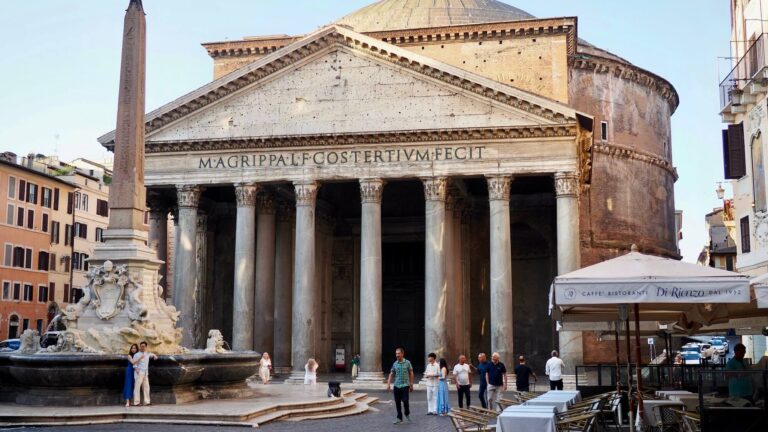
Passing through the piazza, you walk under sixteen enormous Corinthian columns that hold up the portico: each one a single piece of stone, forty feet tall and five feet in diameter, quarried in the mountains of eastern Egypt and transported thousands of miles overland and by sea to Rome.
They are made of grey and pink granite from the quarries of Mons Claudianus, a region far off in the eastern desert known for the particular quality and colour of its stone, which was highly prized by the Romans for monumental construction.
The sheer logistics of moving these monoliths staggers the imagination. They were dragged to the Nile, floated down to Alexandria, loaded onto ocean-going vessels, sailed across the Mediterranean, towed up the Tiber to Rome’s river port, dragged to the building site and raised into position. All of this before the invention of modern lifting machinery.
The columns are divided into three rows — eight across the front and two sets of four behind — creating an elegant sense of depth and shadow that gives the portico its theatrical, three-dimensional quality.
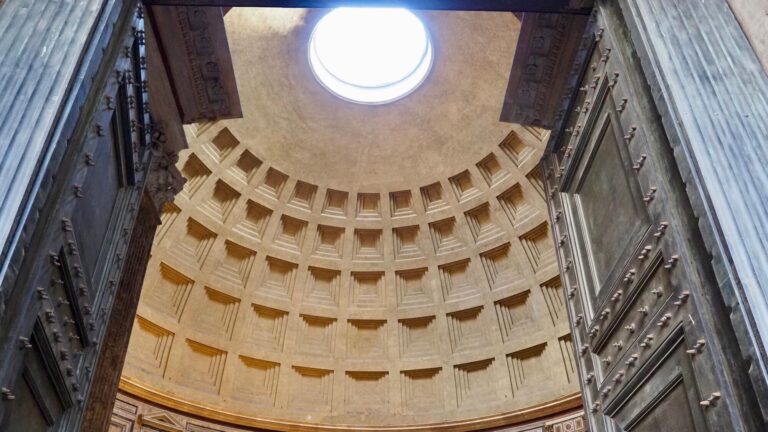
Push open the Pantheon’s vast entrance doors and you are touching a piece of bronze that was cast sometime in the 2nd century AD — the oldest surviving large-scale bronze doors in the world.
They stand nearly 24 feet tall, built from thick bronze sheets laid over an internal wooden structure; the hinges and the lock mechanism are believed to be original. Despite their immense weight, the doors are so perfectly balanced that a single person can open them with one hand.
The doors have stood in this position for nearly nineteen centuries, welcoming in Roman generals and emperors, medieval pilgrims, Renaissance artists and millions of modern visitors. Whilst the bronze is widely considered original, we’re less certain about the wooden interiors, which may have been replaced in the Middle Ages.
Running your hand along their ancient surface is one of those moments of direct physical contact with the ancient world that Rome offers like nowhere else on earth.
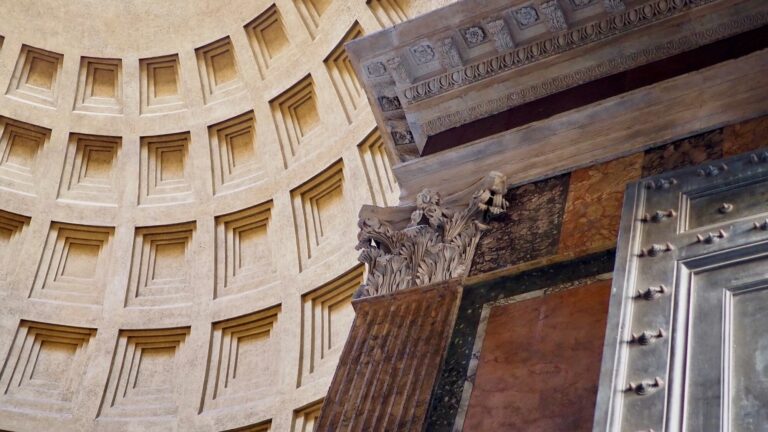
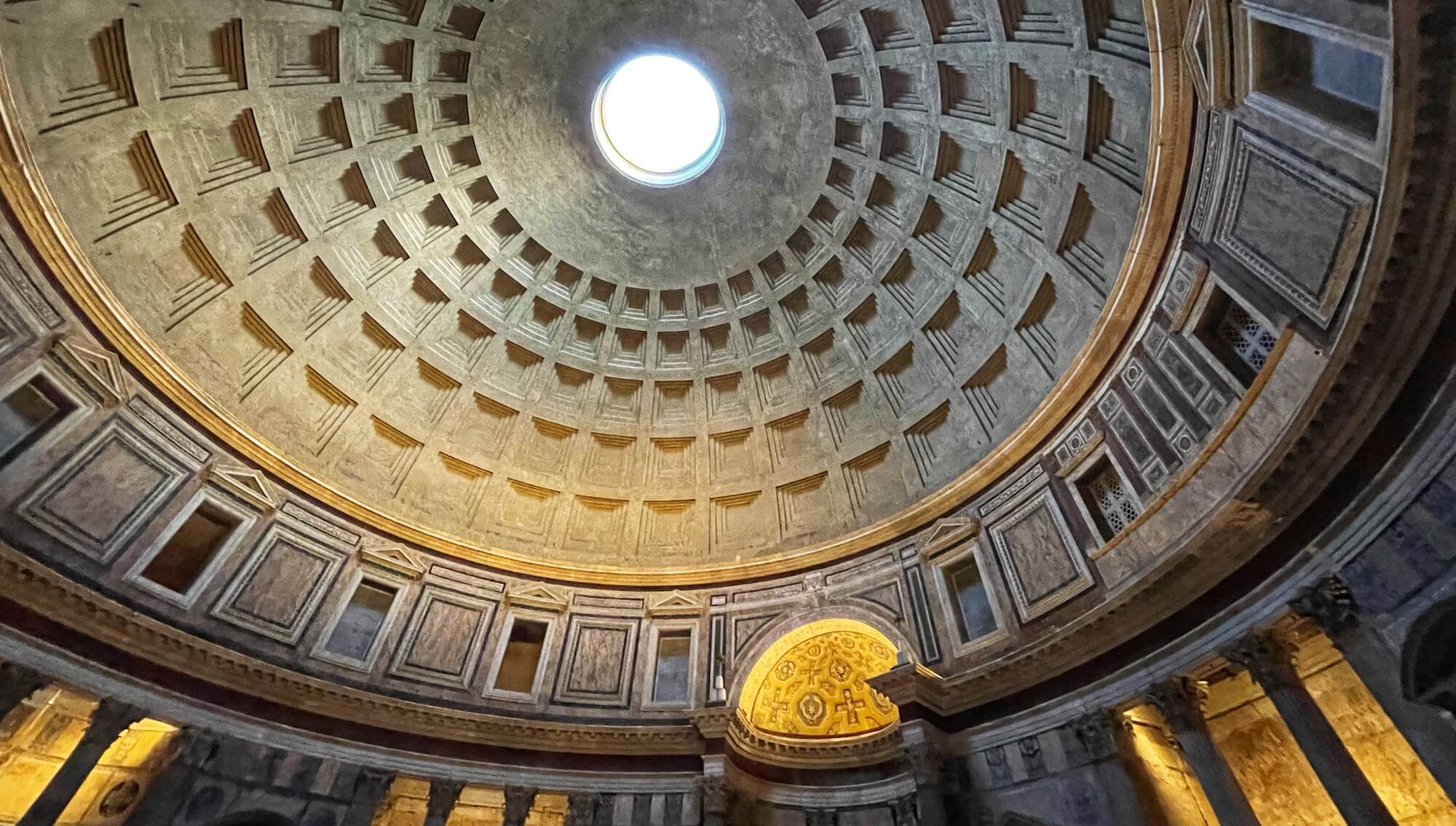
The instant you step inside the Pantheon, tilt your head back. What you are looking at is one of the most audacious feats of engineering in human history: a concrete dome 43.3 metres in diameter — the same measurement as its interior height, forming a perfect sphere contained within the cylinder of the drum beneath — that was built nearly two thousand years ago and has never been surpassed in scale by any other unreinforced structure.
The dome weighs in at a mind-boggling 4,535-tonnes; to enable them to build on such a gargantuan scale, Roman engineers deployed advanced construction techniques that saw them using progressively lighter materials as the dome ascended. At the base, the concrete was mixed with heavy travertine, while at the top, pumice – a much lighter volcanic rock – was used. This massively reduced the stress that the dome placed on the building.
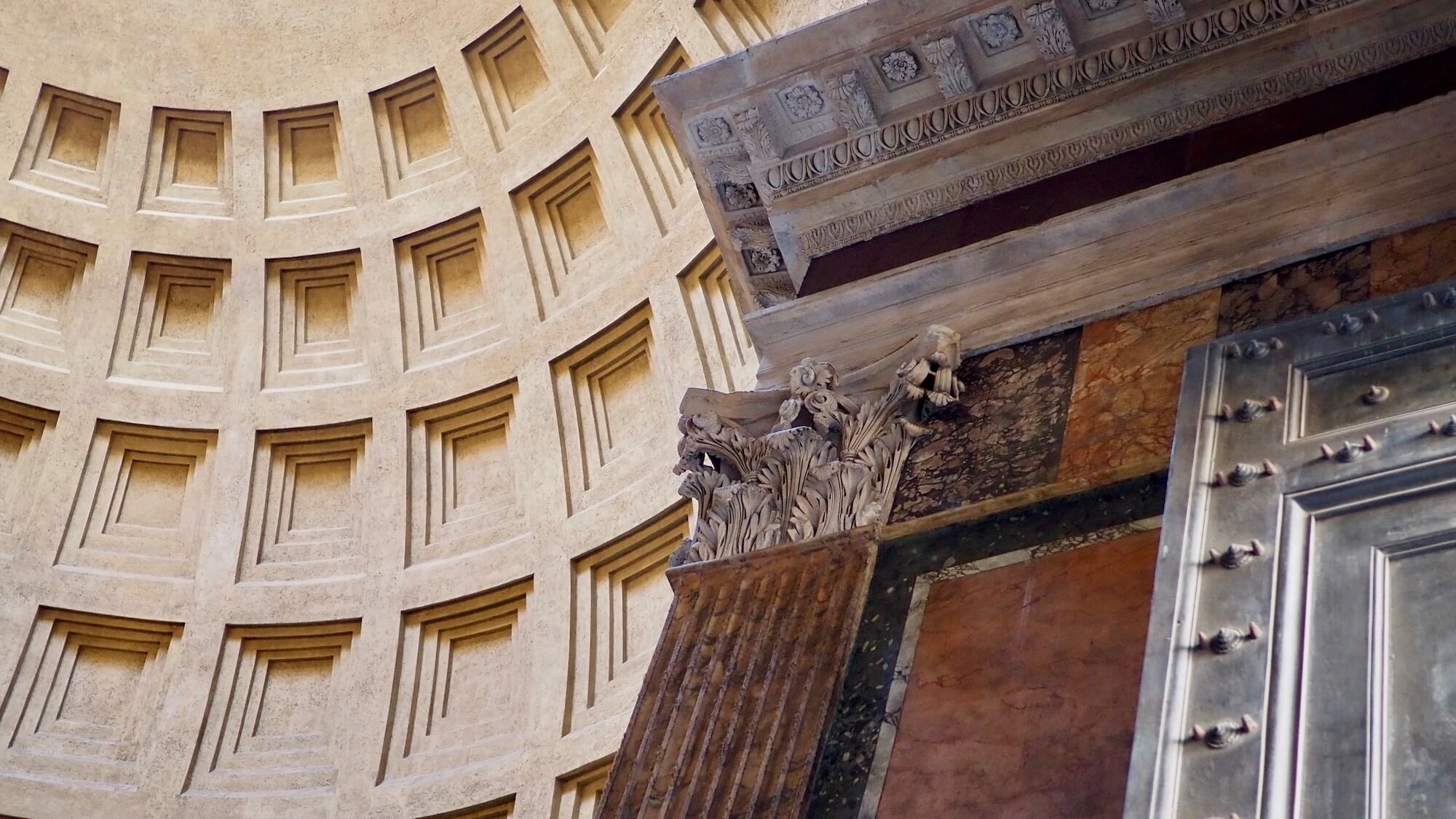
The interior of the dome is divided into five rows of 28 coffered panels each: 140 sunken rectangular recesses that diminish subtly in size as they approach the apex, creating a perspectival illusion that makes the dome appear even higher than it truly is.
These coffers are not merely decorative — taken together they save hundreds of thousands of pounds from the dome’s total weight, allowing the Romans to build at a scale that has never been equalled. Look carefully and you will see small holes at the centre of each coffer: these once held bronze rosettes — all long since removed — at the centre of each panel.
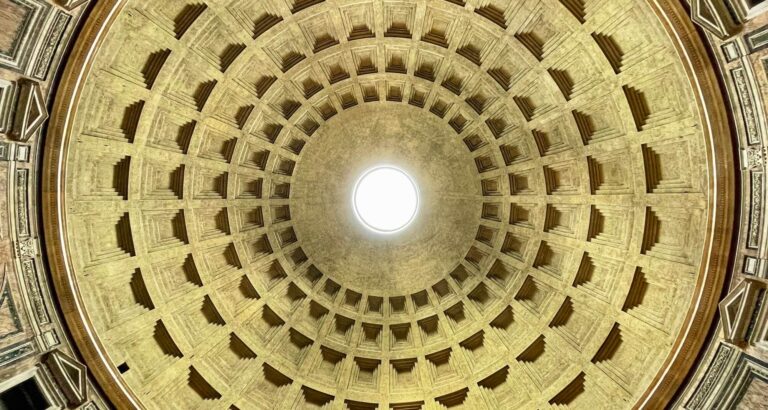
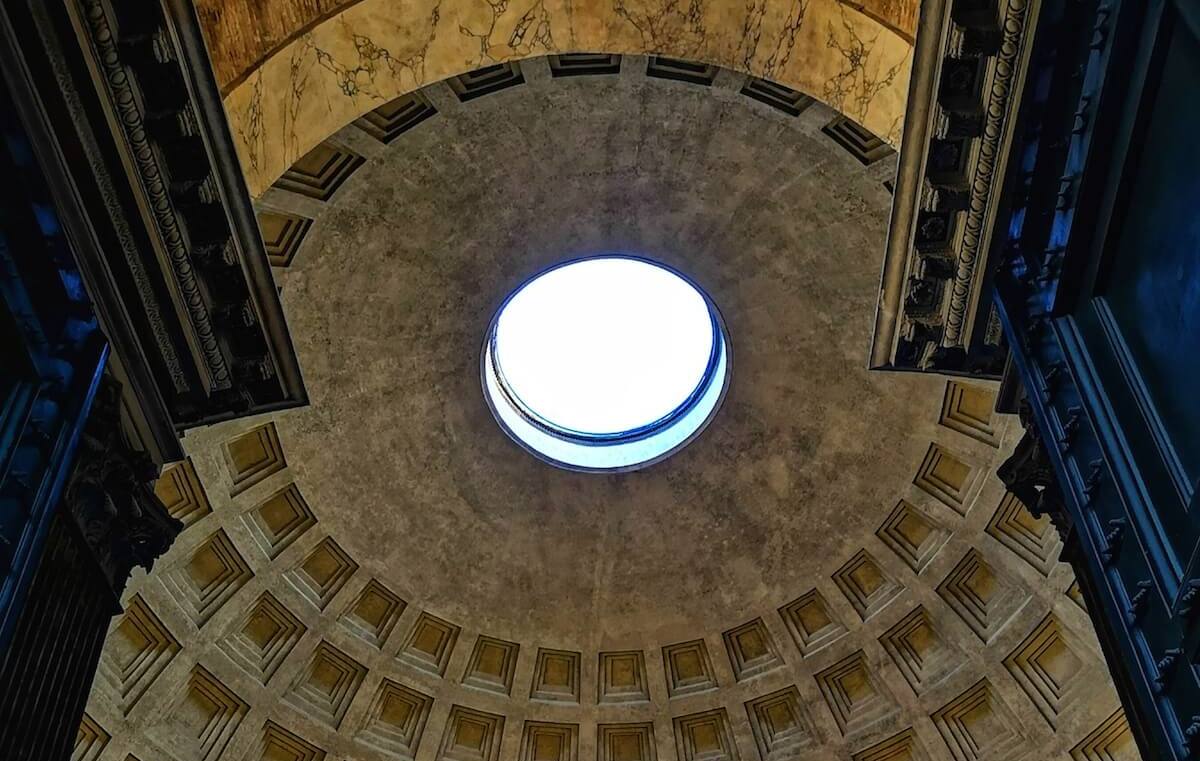
At the very apex of the dome is the building’s most iconic feature: the oculus, a circular opening 8.9 metres in diameter, perfectly open to the sky.
It is the sole source of natural light inside the building, and its effect is extraordinary: a column of light that moves slowly across the interior walls and floor as the sun tracks across the Roman sky, creating constantly shifting patterns of illumination and shadow that give the space a meditative, almost sacred quality.
The oculus served multiple purposes for Hadrian’s architects: it significantly reduced the weight of the dome’s summit, it flooded the interior with natural light, and — on 21 April each year, the legendary founding day of Rome — it sent a precise beam of light flooding across the floor and out through a grille above the main entrance at exactly noon, a powerful ceremonial alignment.
Despite being permanently open to the elements, the Pantheon has a beautifully simple solution to the problem of rain: the floor is very slightly convex, and drains strategically placed at intervals in the original ancient marble allow water to run away naturally.
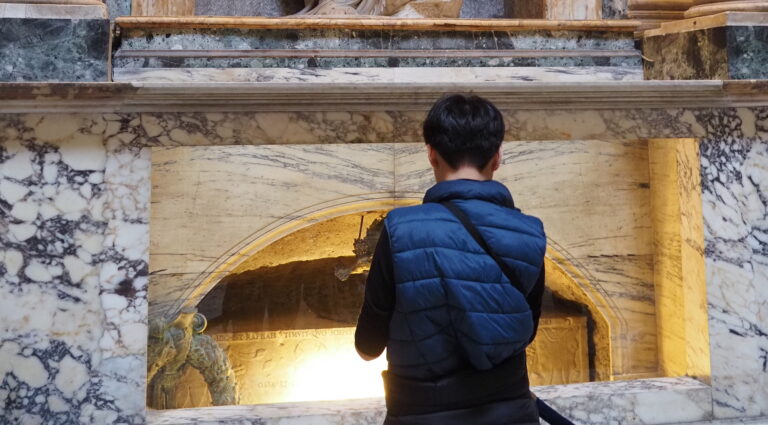
On the left-hand side of the interior as you enter, look for the arched niche containing the tomb of Raphael Sanzio da Urbino — the great Renaissance artist who died on Good Friday 1520, aged thirty-seven. The so-called ‘Prince of Painters’ was struck down by a fever, as he completed his final masterpiece, the Transfiguration, which you can now see in the Vatican Museums.
As he lay dying, the stricken artist made one final request: that he be buried in the Pantheon, a building that for him expressed the pinnacle of human creative achievement. Massive crowds attended his funeral, and four cardinals carried his bier to Rome’s greatest ancient temple.
The Pope himself kissed Raphael’s hand, and the artist was laid to rest in a grand tomb surmounted by a tender sculpture of the Madonna del Sasso (Madonna of the Rock) by the artist Lorenzetto, a pupil of Raphael.
Below it, set into the red porphyry sarcophagus, is a small plaque with the Latin inscription composed by the scholar Pietro Bembo: “Ille hic est Raphael timuit quo sospite vinci rerum magna parens, et moriente mori” — “Here lies Raphael, by whom Nature feared to be outdone while he lived, and when he died, feared that she herself would die.”
Raphael chose this building above all others as his final resting place, believing it to be the greatest work of architecture ever created. Given what was built here, it is hard to argue with him.
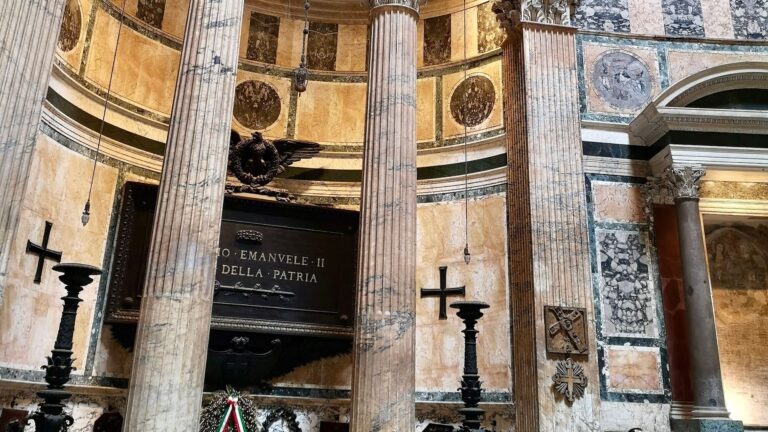
Raphael established the Pantheon as Rome’s premier burial place for Italy’s great artistic minds, and in the 19th century the first kings of a newly unified Italy followed his example.
On the right-hand side of the interior is the immense tomb of King Vittorio Emanuele II, whose role in the creation of the modern Italian state is commemorated on his sarcophagus with the title Padre della Patria — Father of the Homeland. His tomb is guarded at all times by members of the Honour Guard to the Royal Tombs.
Nearby is the equally imposing tomb of King Umberto I, buried alongside his wife Queen Margherita of Savoy — the woman after whom the classic pizza was supposedly named during a royal visit to Naples in 1889.
Umberto was assassinated in Monza in 1900 by an Italian-American anarchist; his tomb, a massive slab of purple porphyry adorned with lions’ heads, is one of the most striking objects in the building.
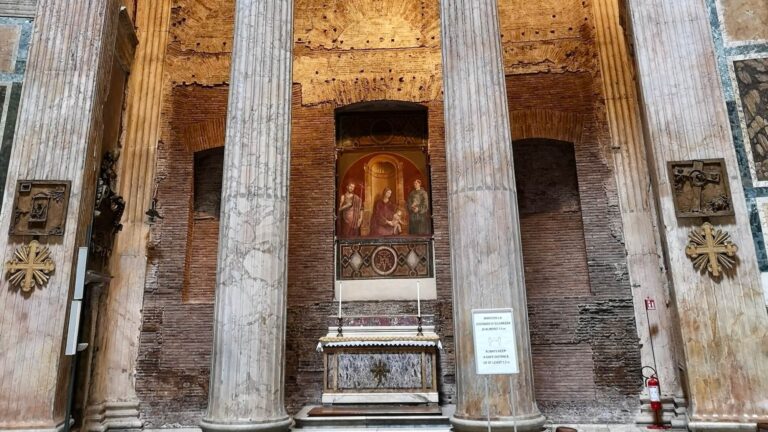
Set into one of the Pantheon’s interior niches is a painted icon of the Virgin Mary with the Infant Christ, installed in the newly consecrated church sometime in the early medieval period.
We know the icon was present in 770 AD because of a vivid contemporary account: a renegade priest who had taken part in an unsuccessful plot against the Pope fled to the Pantheon for sanctuary, and was recorded clutching the icon to his body as he made his frantic appeal for mercy.
The icon is a rare surviving example of Byzantine sacred art in Rome, and its presence in this ancient building — set into a niche that once would have housed a pagan deity — is a quietly eloquent symbol of the Pantheon’s extraordinary historical continuity.
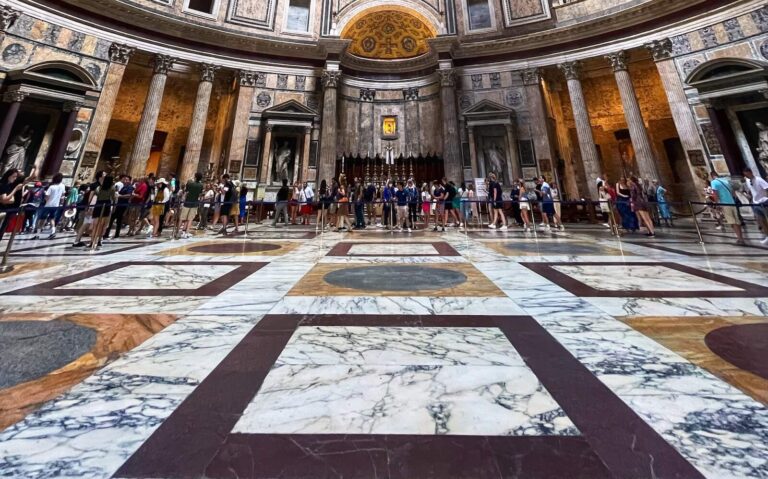
With so much to look at above your head, it’s easy to forget the floor beneath your feet. Don’t.
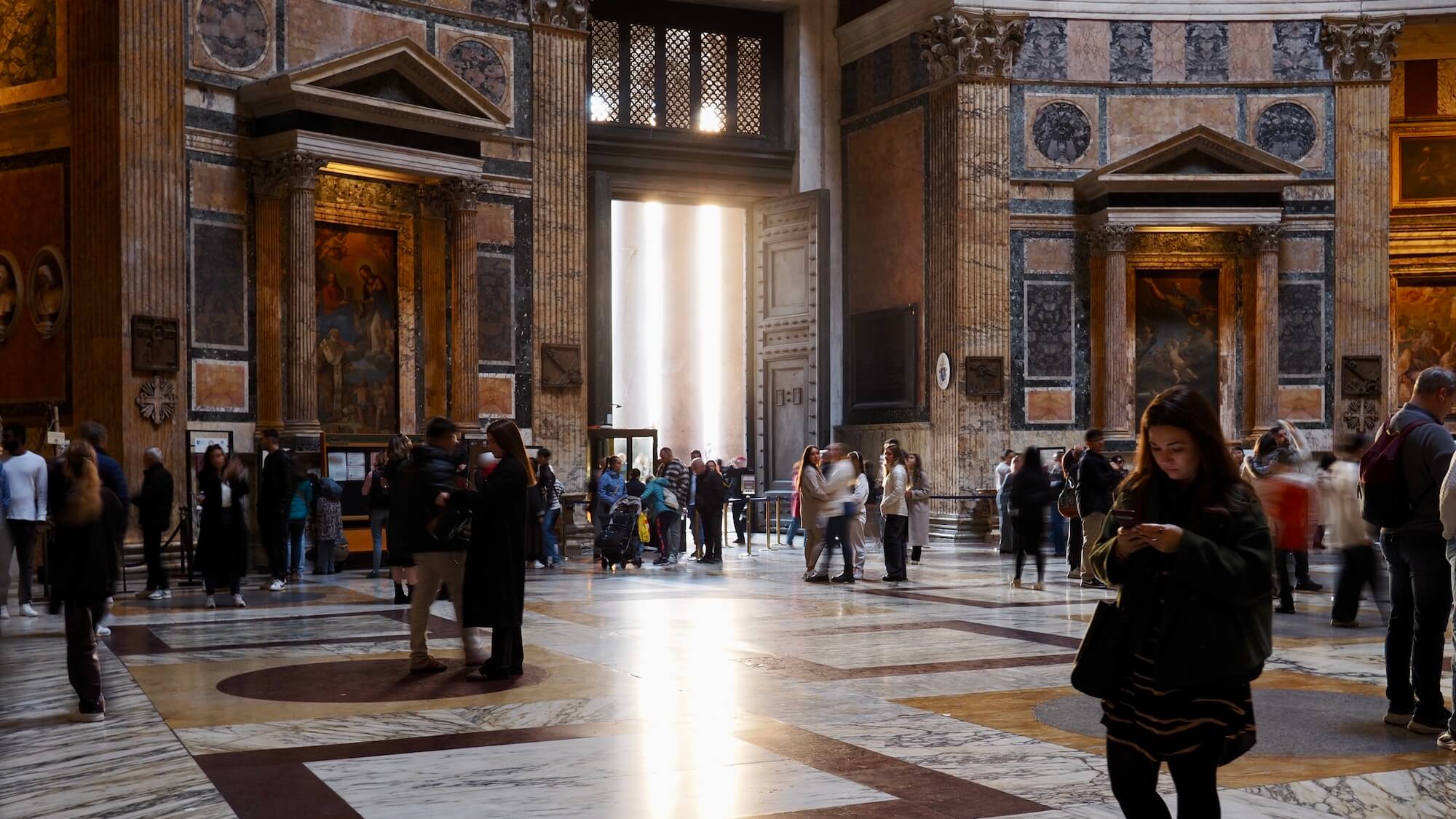
The Pantheon’s marble floor is the original ancient Roman one, decorated with geometric patterns of circles and squares in coloured marbles — rich purple porphyry, verde antico, grey granite — inlaid in a design of remarkable sophistication and beauty.
It has been worn smooth by the feet of visitors over nearly two thousand years, and in places the ancient materials have been repaired with later patches. But the essential composition and most of the materials are Roman, making it one of the oldest floors of its kind anywhere in the world still in its original location.
How long does it take to visit the Pantheon?
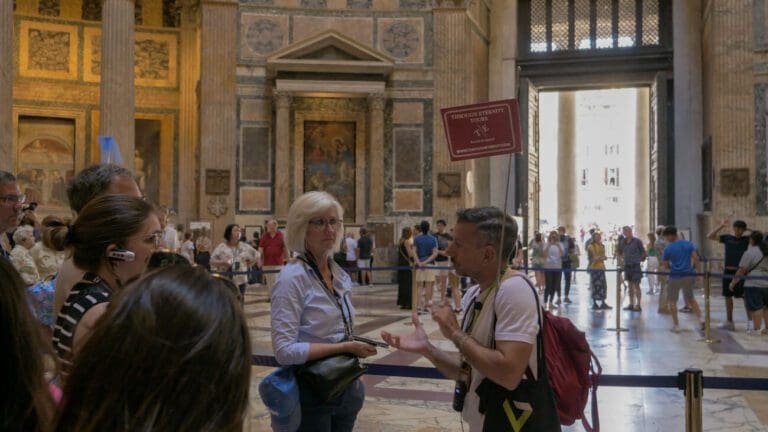
Most independent visitors spend between 30 and 45 minutes inside. With a guided tour of the Pantheon, you might spend a little longer in the temple and the surrounding area.
Can I take photographs inside the Pantheon?
Yes, photography for personal use is permitted inside the Pantheon. Flash photography is not allowed out of respect for the artworks and other visitors.
Is it worth visiting the Pantheon on a rainy day?
Absolutely. In fact, a rainy day adds a unique dimension — watching the rain fall through the open oculus and disappear into the ancient drainage system is an unforgettable sight, and the damp smell of the ancient stone adds to the atmosphere.
Are there any restrictions on dress?
As an active church, the Pantheon requires visitors to dress appropriately: shoulders and knees should be covered.
Book Your Pantheon Experience