The word “gladiator” tends to conjure up an iconic image in our collective consciousness: a muscled figure in sandals, sword raised, waiting for the crowd’s verdict. But whilst there’s a lot of truth to the picture, the Roman arena was never quite that simple.
The men who fought on the Colosseum’s sand were not an undifferentiated mass of warriors. They were specialists — each type defined by a precise combination of armour, weapons and fighting style, trained in dedicated schools, matched against opponents chosen to create the most interesting possible contest.
These were not arbitrary distinctions. Each gladiator type carried what we might call a cultural signature: a set of associations that Roman audiences read instantly and that gave the combat an additional layer of meaning beyond the purely physical contest. The matchups between types were carefully choreographed to dramatise specific contrasts: heavy versus light, discipline versus agility, Roman order versus barbarian flair.
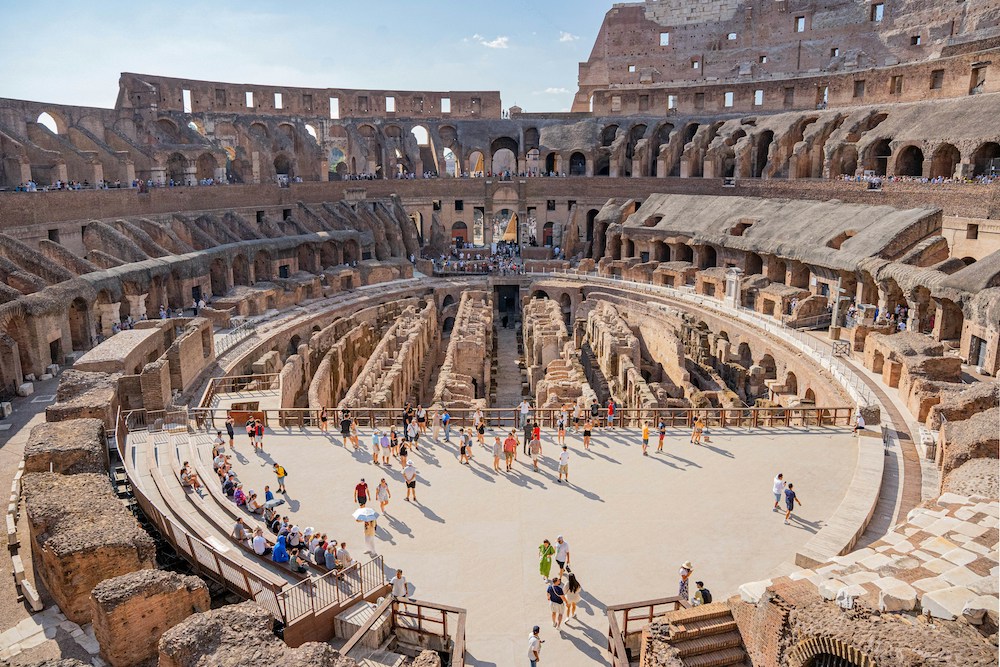
Understanding the different gladiator types transforms the way you read the spectacle when you visit the Colosseum for yourself. What looked from the upper tiers like two men fighting was, to the Roman audience, a drama with a cast of characters they knew intimately, whose fortunes they had followed across multiple appearances, and whose weapons and styles encoded a whole world of social and political meaning.
What follows is a guide to the principal gladiator types of the Roman arena, from its most recognisable combatants to some of its strangest.
 Visit the Colosseum

Discover where gladiators fought and explore the ancient amphitheatre with an expert guide who brings its history to life.
Ancient Rome Tours
Explore the Colosseum

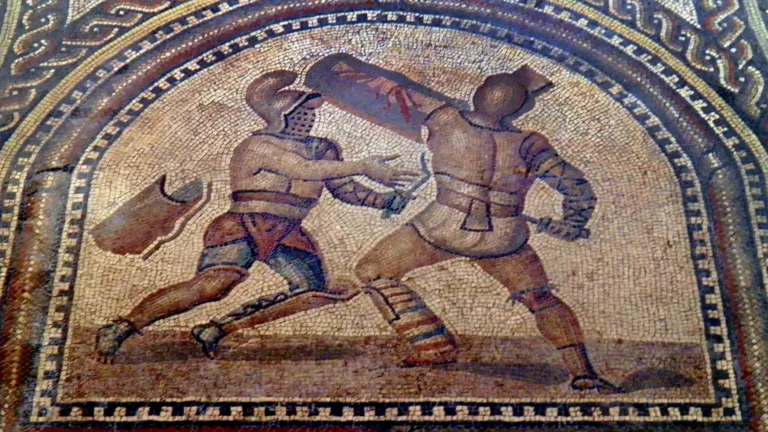
The murmillo entered combat behind a large rectangular shield, the scutum, resembling the shield carried by Roman infantry. His short sword, or gladius, and protective equipment included an arm guard (manica) and a greave on one leg. His helmet was particularly striking, featuring a high crest associated with a fish, with a face-covering grille that left him looking more like an armoured machine than an individual fighter.
The fish motif was more than decoration. The name murmillo is associated with the Greek mormylos, a kind of fish, and ancient descriptions connect the fish emblem on the helmet with the fighter’s identity.
The murmillo’s equipment made him a formidable opponent, but it came with trade-offs. His large shield offered substantial protection; his helmet restricted his field of vision and ventilation. Against a lighter-armed fighter, he needed to use that protection intelligently, closing the distance without exposing himself to a weapon that could exploit the gaps in his defences.
His usual opponent was the Thraex, whose small shield and hooked sword offered a very different approach to combat. The Thraex could try to reach around the murmillo’s shield with his curved sica, while the murmillo had the advantage of greater shield coverage and a weapon suited to close combat.

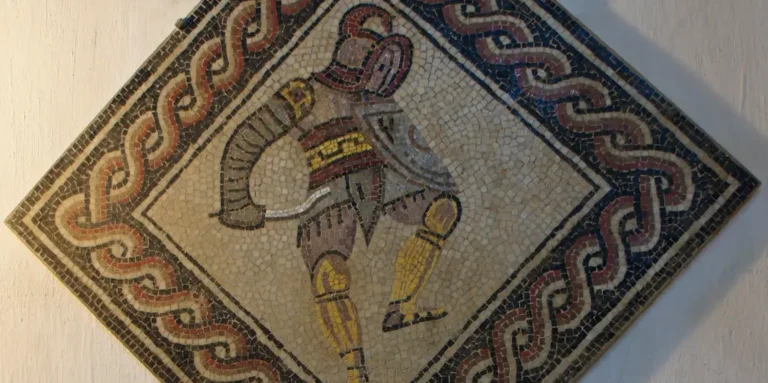
If the murmillo was the embodiment of Rome, the Thraex was its compelling opposite. The Thracians – an ancient Balkan people hailing from a region that encompassed parts of modern Bulgaria, Greece and Turkey – had been among Rome’s most formidable enemies before their eventual subjugation, and Roman military culture had a persistent habit of outfitting gladiators as the conquered enemies of the empire.
The Thraex carried a small round or square shield (parmula) and fought with the sica – a wicked curved sword designed to hook past an opponent’s shield or helmet, reaching parts that a straight blade could not. His own visored helmet was steeply crested and featured a stylised griffin in profile; combined with tall greaves on both legs, he presented an appearance that was simultaneously alarming and spectacular, almost like an animated Hellenistic bronze.
Spartacus, the Thracian slave whose revolt in 73–71 BC came closer than any other to bringing the Roman Republic to its knees, was himself from Thrace, a detail that perhaps gave the Thraex type an additional resonance in the history of Roman spectacle: in the arena the conquered enemy temporarily wielded his weapons again, but within a structure that guaranteed the outcome.
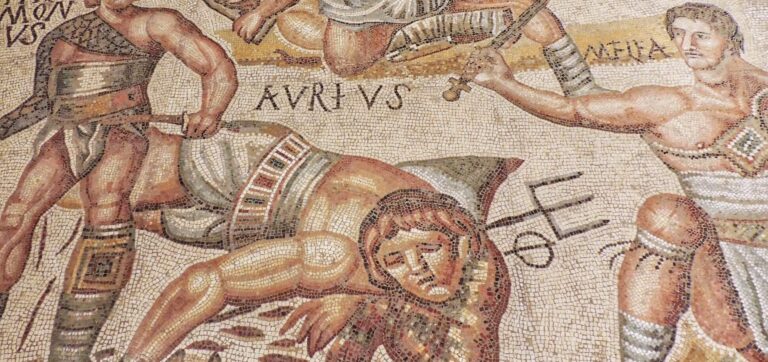
The most unconventional and controversial figure in the Roman arena was a man carrying a net and a trident, wearing almost nothing by way of armour, and considered by sections of Roman opinion to be somewhat shameless.
The retiarius, or net-man, fought with a weighted net (rete), a three-pronged trident (fuscina) and a dagger for close-quarters combat. His only defensive equipment was a padded shoulder-guard (galerus) on the left arm and, in some configurations, a form of arm-guard. He wore no helmet. Compared with the heavily armoured murmillo or secutor, he appeared startlingly exposed.
His equipment demanded a different approach to combat: the retiarius fought not by absorbing punishment but by avoiding it, relying on speed, positioning and the sudden entanglement of the net to disable a heavily armoured opponent who could not catch him.
This fighting style – mobile, indirect, dependent on cunning rather than traditional martial virtue – attracted a certain Roman disdain. The writer Juvenal sneered at an aristocratic youth who disgraced himself and his class by taking up the retiarius’s weapons, and the type occupied a lower rung of the gladiatorial social hierarchy than the heavily armoured fighters.
To a certain type of Roman there was something faintly improper about the retiarius: he didn’t stand and fight, he ran and entangled. Seneca, too, complained about men choosing what he regarded as a shameful kind of gladiatorial equipment.
The retiarius was usually matched against the secutor, a type whose equipment was particularly well suited to countering him.
Their encounter became one of the arena’s most recognisable contests: the net-man seeking an opening at a distance, the armoured pursuer trying to close the gap. The retiarius could not afford to be caught, while the secutor had to find a way through the net and trident without exhausting himself in the process.
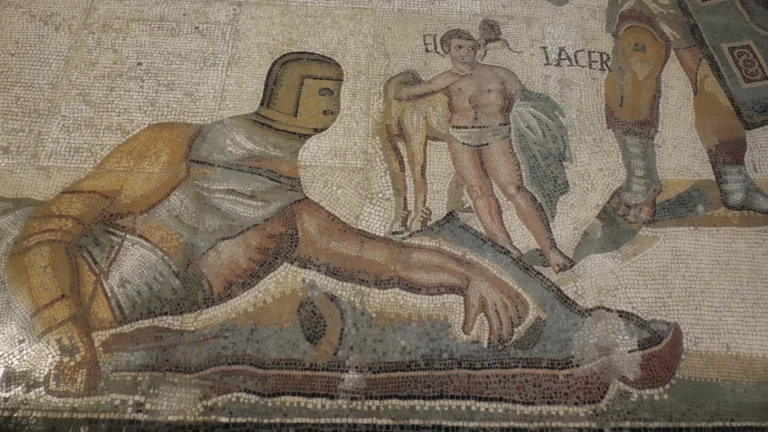
The secutor’s name means “pursuer,” and his equipment was engineered specifically to hunt the retiarius. Otherwise equipped like a murmillo with a large rectangular shield, short sword, arm guard and single leg greave, he was differentiated by his smooth, featureless helmet with small eye openings and a face-covering grille.
The helmet was designed to reduce the net’s chances of catching on a crest or projecting ornament, while its small openings helped protect the face against the points of the retiarius’s trident.
But there was a substantial trade-off. A heavy helmet with restricted openings limited vision and ventilation, and the rest of the secutor’s armour added weight. In the heat of a Roman summer, fighting in such equipment must have been physically demanding. The retiarius by contrast had far less weight to carry, and could use movement to keep his opponent at a distance.
The drama of the secutor-retiarius matchup was constructed around this asymmetry of risks: The secutor was better protected but burdened by his equipment; the retiarius was more mobile but far more exposed if the distance closed. The outcome depended on how each man managed those advantages, and on whether a single mistake allowed the other to dictate the fight.
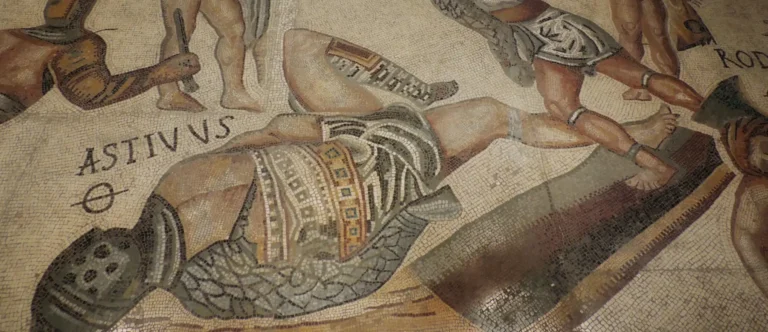
Where the Thraex evoked Rome’s Thracian enemies, the Hoplomachus looked further back in time: to the Greek hoplite warrior of the classical period.
His name is formed from Greek words for weapons and fighting, and his equipment included a small round shield, a long spear and a short sword or dagger for close combat. He wore a helmet with a high crest and greaves on both legs, along with an arm guard.
The spear changed the geometry of the fight. It allowed the hoplomachus to threaten an opponent from farther away than a short sword could, making distance and timing crucial. But the spear was not an all-purpose solution: once an opponent got past its point, the hoplomachus had to rely on his shield and secondary weapon. His equipment combined the reach of the spear with the need to survive at close quarters.
The hoplomachus was commonly paired with the murmillo. The contrast made tactical sense: the murmillo’s large shield offered formidable protection, while the hoplomachus could use the spear to probe for openings before committing to closer combat.
The Greek equipment also gave the type a cultural identity. Roman audiences were steeped in Greek literature, art and ideas about warfare. The hoplite had a long literary afterlife, from the heroic world of Homer to accounts of the Persian Wars and the classical Greek city-states. For educated Romans with a taste for the heroic past, the Hoplomachus carried a nostalgic appeal that the arena’s other types couldn’t offer.

The provocator – or “challenger” – was the arena’s specialist in the mirror match. He was unusual among gladiators because he was characteristically paired with another provocator. Rather than setting a lightly armed fighter against a heavily protected one, these contests brought together opponents with broadly comparable equipment.
The provocator’s equipment had a strongly military appearance, powerfully evoking the martial valor of the Roman legions. His kit included a rectangular shield, a short sword, an arm guard, a greave on one leg and a small breastplate, usually called a cardiophylax or pectorale. That chest protection distinguished him from most other types. His helmet varied over time: early examples could have a crest and broad brim, while later forms developed into more enclosed helmets with distinctive plumes.
Pairing two provocatores created a different kind of contest from the familiar mismatch between a murmillo and a Thraex or a secutor and a retiarius. Both fighters had broadly similar tools and vulnerabilities, so differences in timing, technique, judgement and stamina could become especially important. It was a contest between comparable opponents rather than a dramatic contrast between two specialised fighting systems, and arguably rendered these bouts the purest tests of gladiatorial skill.
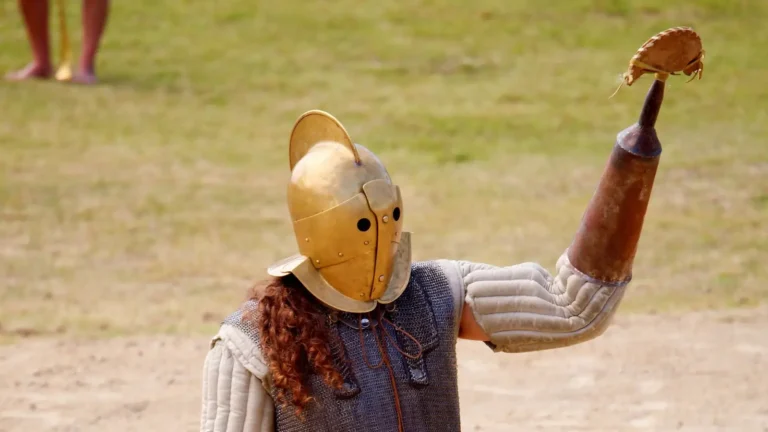
The scissor is one of the least understood gladiator types, but his existence is beyond doubt. An inscription from ancient Venusia, in southern Italy, lists a fighter named Marcus Caecilius under the designation scissor, alongside other recognised classes of gladiator. What the inscription cannot tell us is what he carried into combat.
Our best clues come from ancient reliefs. A funerary monument now in the Louvre shows a gladiator named Myron wearing scale armour and a rounded helmet, with a short dagger in his right hand and a remarkable crescent-shaped blade attached to his left arm. Other reliefs from the Roman East show similar equipment. Modern scholars have identified these figures as scissores, or as a related Greek type known as the arbelas, named after a curved knife used by shoemakers.
One relief from ancient Tomis appears to show such a fighter facing a retiarius, with the distinctive weapon lying on the ground. This has prompted the attractive theory that the curved blade was designed to cut through the retiarius’s net. It makes tactical sense, but no surviving ancient text confirms that this was its original purpose.
Even the weapon’s precise construction remains uncertain: no securely identified surviving example has confirmed how the blade was attached or how it worked. Other scholarly sources present a different reconstruction, describing the scissor as a heavily armoured fighter who used a double-headed hammer and dagger rather than the crescent-shaped arm blade.
The scissor is a reminder of how much of the gladiatorial world remains beyond our grasp. We can piece together clues from inscriptions and images, but the precise shape of his weapon, how he used it and whom he fought remain open to interpretation. The portraits of these fascinating figures that we have attempted to reconstruct are necessarily only a partial glimpse of a spectacle whose full details have been lost to time.
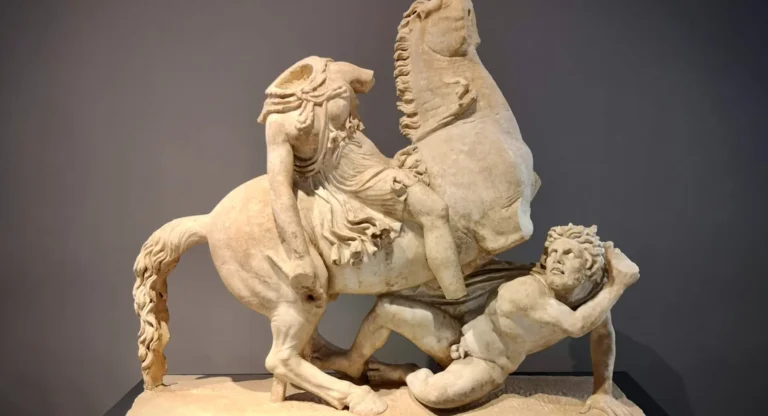
The eques, or horseman, was exceptional among gladiator types for one obvious reason: he began the fight on horseback. Mounted combatants occupied a special place in the ceremonial programme of the games, typically opening the day’s events in what the 7th-century scholar Isidore of Seville describes as the first competition after the opening procession.
Isidore’s account describes two horsemen entering from opposite sides of the arena after military standards had been carried before them. They first fought on horseback, then dismounted and continued the contest on foot. Although Isidore wrote long after the Colosseum’s inauguration, his account preserves a tradition about the eques’s distinctive two-stage encounter.
The equipment reflected this combination of mounted and foot combat. The eques is generally depicted with a spear for fighting from horseback and a short sword for the fight on foot. His costume included a tunic and a helmet often distinguished by a brim and plumes. Compared with the heavier armour of gladiators such as the murmillo and secutor, the eques presented a different spectacle, in which the horse and the rider’s mobility were central to the action.
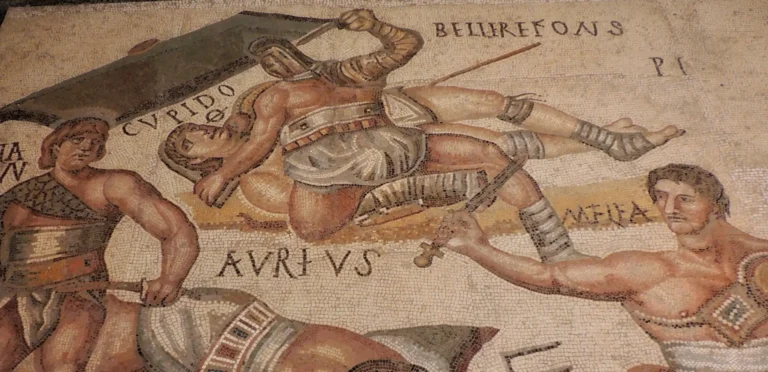
Arena — The sand-covered performance floor of the amphitheatre. The Latin word for sand (harena) is the origin of our modern English word “arena.”
Bestiarius — A fighter specialised in animal combat, typically of lower status than the gladiators proper. Distinguished from the venator, who was a trained professional; the bestiarius was often a condemned criminal.
Damnatio ad Bestias — Condemnation to face wild animals in the arena, a form of judicial execution staged as public spectacle.
Editor — The sponsor of the games, typically a politician or emperor seeking public favour. The editor financed the spectacle and had authority over decisions of mercy for defeated gladiators.
Galea — A helmet, often ornate, with distinctive crests, visors or animal motifs identifying the gladiator’s type.
Gladius — The short, double-edged thrusting sword that gave gladiators their name. The standard weapon of the Roman legionary, adapted for arena use.
Lanista — The owner, trainer and manager of gladiators, responsible for their purchase, upkeep and match negotiations. Often of low social status despite handling significant financial transactions.
Ludus — A gladiatorial training school. The most important in Rome was the Ludus Magnus, located adjacent to the Colosseum and connected to it by an underground passage.
Manica — An arm-guard of metal, leather or wrapped linen protecting the sword arm. Found across multiple gladiator types in varying forms.
Missio — The granting of mercy to a defeated gladiator, allowing him to leave the arena alive. Its opposite, sine missione (without mercy), denoted a fight to the death from which no appeal was possible.
Munus/Munera — The games themselves, originally meaning “duty” or “obligation” — referring to their origins as funerary gifts to the spirits of the dead. Later used loosely for any gladiatorial spectacle.
Ocrea — A bronze greave protecting the lower leg, worn in varying configurations by different gladiator types.
Palus — The wooden training post against which gladiators practised their attacks and footwork in the ludus. Training was conducted with wooden weapons to prevent injury and discourage revolt.
Parmula — The small round or square shield used by lighter-armed types such as the Thraex and Hoplomachus.
Pollice Verso — “Turned thumb” — the crowd gesture associated with decisions of mercy or death for a defeated gladiator. Contrary to the modern image (thumb down for death), the actual ancient significance of the gesture’s direction is uncertain.
Rudis — The wooden training sword, also presented to a gladiator upon the granting of his freedom as a symbol of the transition from slave fighter to free man.
Scutum — The large rectangular shield carried by heavily armed gladiators such as the murmillo, secutor and provocator.
Spoliarium — The room adjacent to the arena where the dead were taken after the spectacle, their equipment stripped for reuse.
Summa Rudis — The senior referee of a bout, typically a retired gladiator of long experience, responsible for enforcing the rules and ensuring fair play.
Venator — A professional trained animal hunter, distinct from the bestiarius. Fought in the morning venatio spectacles rather than the gladiatorial bouts of the afternoon.

What were the most common types of gladiator?
The murmillo, Thraex, retiarius and secutor are among the best-documented gladiator types in Roman art, inscriptions and literature. The hoplomachus and provocator are also well attested. Other types, such as the scissor, are known from more limited evidence, which makes their precise equipment and fighting methods harder to reconstruct.
Were gladiators always slaves?
No. Gladiators included enslaved people, prisoners of war, condemned criminals and free volunteers who entered the profession under contract. Some free men were drawn by money or the prospect of fame, while others may have been attracted by the life itself. The profession carried serious social stigma, yet successful fighters could become celebrities whose names were known far beyond the arena.
Did gladiators train together?
Yes. Gladiators trained in specialist schools called ludi, where instructors known as doctores taught fighting techniques associated with different weapons and equipment. The Ludus Magnus, built under Domitian beside the Colosseum, was Rome’s largest and best-preserved gladiatorial barracks. It was connected to the amphitheatre by an an underground tunnel, allowing fighters to move between the training complex and the arena. Training was conducted with wooden weapons and padded equipment to prevent the kind of injury that would put a financially valuable fighter out of action before the games.
How long was a typical gladiatorial career?
This is difficult to determine precisely from the surviving evidence. Epitaphs and inscriptions suggest that gladiators who survived their first few years in the arena could fight for a decade or more.. Death rates in the arena appear to have been significantly lower than popular culture suggests – in one infliential study, Georges Ville concluded that only about 20% of bouts ended in death in the timeframe he considered. This can’t be taken as exemplary across different time periods and across the empire, but it remains a valuable corrective to the idea that death was a near-certainty in every encounter.
Who decided the outcome of a bout?
The referee supervised the fight, but the sponsor of the games (editor) played the central role in deciding the fate of a defeated gladiator. A fighter might signal surrender, and the crowd could demand mercy or death. The editor weighed the circumstances and the audience’s reaction; if the emperor was present, his decision could be decisive. The outcome was therefore not simply a matter of the crowd’s thumbs, despite the familiar image passed down by modern popular culture.
What happened to retired gladiators?
A gladiator could be released from service, sometimes receiving a rudis, a wooden sword that symbolised his discharge. Some former fighters became trainers or continued to work in the gladiatorial world; others left the profession. The surviving evidence does not support a single standard path into retirement, and the circumstances depended on the individual, his status and his relationship with his owner or patrons. For more information on gladiators in the Colosseum, see our dedicated guide below:
Ancient City Tours
Explore the Colosseum!