Please note: This tour includes walking between sites, and there are some walks of about 10-15 minutes each
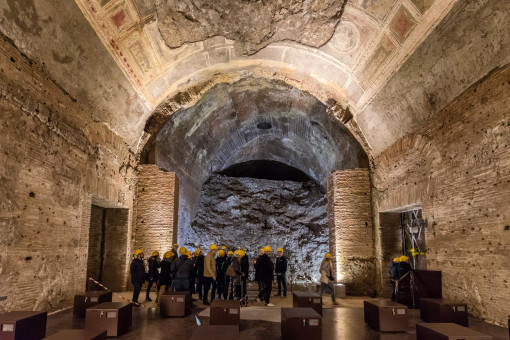
Description: There is another Rome underneath the known and loved Rome, there is another silent and humble city under the grandiose Renaissance and Baroque architecture. There are centuries of history buried in the subterranean layers beneath the five churches that we invite you to visit with us in a fascinating voyage into the bowels of the earth.
There were difficult centuries for Rome, from its passage as capital of an immense empire to small province with the constant threat of wars and economic and political crises. In fact, notwithstanding that the emperor Constantine had already moved the capital to Constantinople in 330 AD, Rome still numbered around 450,000 inhabitants in the 5th century AD, but there were no more than 25,000 inhabitants by the 8th century AD. The drastic decline in the population also saw the slow disuse of the old political institutions and the rise of new ones tied to the papacy. Meanwhile vast areas of the city within the ancient walls were abandoned or turned into vegetable gardens, and entire structures were readapted, most often as churches.
1) San Clemente, (St. Clement) is a very beautiful 12th century AD basilica with wonderful and absolutely unique mosaics in which, among other things, the Crucified Christ is represented in a festival of trees and doves. Not far from the mosaics is the Cappella di Santa Caterina (Chapel of St. Catherine), with some of the earliest surviving Renaissance frescoes from the early 15th century AD by Masaccio and Masolino. But that is only the beginning: a small stairway takes us to the lower basilica from the 4th century AD, which is perfectly preserved with many medieval frescoes that recount some fascinating Christian legends, among which is that of St. Clement. From here another little staircase takes us to the third level underground where we are in the first century AD: some of the rooms of this layer were part of an apartment block of several floors, separated by a passable street, from another large building that was perhaps a state mint.
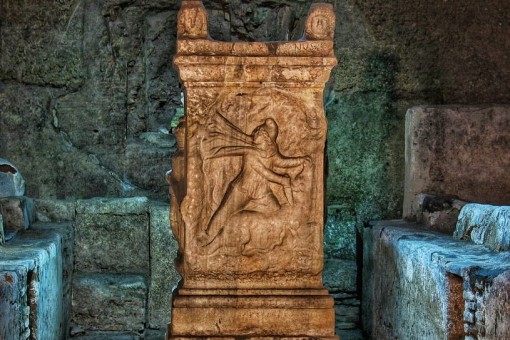
From the many decorations and relief sculptures that refer to the killing of the bull and to the constellations, we know that one of these spaces at the beginning of the 3rd century AD was used by the followers of the cult of Mithras, while a few meters away a Christian sect gathered. And perhaps this is no accident, given that from the beginning of the 1st century AD both these religions were widely diffused in Rome and in the empire. Their similarities are also noteworthy: both celebrated ritual banquets with water and wine and both incited the faithful to morally correct behavior in order to reach salvation in a nether world. Nearby there are remains from 6th century AD burials with sarcophagi, early Christian symbols, and much more.
2) Not far from the Colosseum, the Basilica of Santi Giovanni e Paolo (Saints John and Paul), with its monastery and bell tower built upon the imposing ruins of the temple dedicated to the emperor Claudius, preserves intact a little corner of the middle ages. The history begins in the 2nd century AD with a little uphill street and two houses, one of which had elegant pagan frescoes and a small garden with a pool. The story continues until the 4th century AD with the grand domus (rich roman house) that incorporates the pre-existing buildings and presents frescoes with Christian subject matter. It was probably the owners of the domus to be martyred—Giovanni and Paolo—and over whose tombs by the 5th century AD arose a small church where the faithful venerated their relics. With time the underlying past of the basilica was completely covered and forgotten: the excavations began only in 1887 and only recently are the buried areas again accessible.
After a lovely walk past the gardens still cultivated today by the nuns, which takes us back to the spaces of the medieval city, and the Circo Massimo (Circus Maximus), immense area where the horse races of republican Rome were held, we will reach the third site of our subterranean Rome.
3) The church of San Nicola in Carcere (St. Nicholas in Prison) is in fact absolutely unique in the world. Even at a distance we realize that there are six imposing columns of an ancient Roman temple built into the side walls of the church. The church is indeed entirely constructed on three temples of the 3rd and 2nd centuries BC, one of which, the central one, is fully incorporated into the church. Descending to the underground level we find ourselves catapulted into a remote and magical time. We are actually in the spaces—at the time open to the sky—between the three temples. We are on the beaten path of the Romans who for centuries passed this way on their daily comings and goings to the vegetable and cattle market a few steps away, from the 5th century BC. The foundations and the massive load-bearing structures of the temples survived the collapse and devastation of the centuries, wars and destruction. During the reconstruction, around the 9th century AD, it seemed a good idea to reuse the strong arms of the temples to anchor a church. On the inside of the church, among the many historical details, one of the columns preserves an interesting engraving from the 8th century AD, while the bell in the medieval tower is still the original one from the end of the 13th century AD.
Then we will reach the Isola Tiberina (Tiber Island). There we will find an ancient bridge, the ponte Fabriano (Fabricius bridge) of the 1st century BC, the medieval tower, and the church of San Bartolomeo (St. Bartholomew) that was built over the pre-existing Roman temple of the 3rd century BC, dedicated to the god of medicine Esculapius. Sheltered by the porch of this temple, the sick gathered to await their cure and the ancient tradition has carried on through the centuries until today: there is an important Roman hospital on the island.
4) In the heart of Trastevere the Basilica of Santa Cecilia, with two monasteries and a tall bell tower from the late 12th century AD evoke a medieval atmosphere. Inside the church, 9th century AD mosaics of Christ as redeemer and the splendid gothic ciborium over the altar (ancestor of the more modern baldachin in the Basilica of St. Peter, see link) by Arnolfo di Cambio resound with the centuries-old Gregorian chants.
Beneath the altar is the absolutely extraordinary statue of St. Cecilia from 1600, the work of a barely 24-year-old Stefano Maderno: the body lies lifeless on the ground, turned on one side in fragile and painful abandon, while the face is averted, removing the agony of death from our sight. The veil that covers the hair remains softly suspended in this final movement, perpetuating it. On the neck there is cut of the sword, which struck three times and three times Cecilia survived, suffering a terrible agony for three days before passing away. In the final instant of life the beautiful Cecilia clasped her fingers to indicate the number three, fateful recurrence and extreme reaffirmation of her faith in the Holy Trinity. The legendary history of St. Cecilia is much longer: we recall the epilogue from October, 1599 when her coffin was found with the body inside in a state of perfect preservation, in the same touching position that Maderno presents. He saw her and wanted to portray her that way. Upon contact with the air the body rapidly decomposed but the artwork continues to capture the gaze and the heart of those who see it.
Then there are the subterranean areas, large spaces from the 2nd to the 4th centuries AD with black and white mosaic pavements, private baths, a room with various wells probably reused later as leather tanning vats, and sarcophagi with symbols from Christianity at its origins.
5) The church of San Crisogono of the 12th century AD, with very beautiful cosmatesque pavement from the 13th century AD, tells of another history, that of the great floods of the Tiber and the attempt to elude future destruction by rebuilding the new church more than 5 meters above the preceding one. Thus an iron staircase takes us beneath the present church and into the vast spaces of the underground church of the 5th century AD where there are the altar and its underlying crypt, the large frescoed walls of the 8th and 10th centuries AD, and the separate baptistery hall with a basin for immersion from the 5th century AD, as that was the practice in the first centuries of Christianity. There is also a wonderful pagan sarcophagus, 3rd century AD, finely carved with figures on the sides and a philosopher in the center, another beautiful one with the nine muses, 3rd century AD, and a last sarcophagus with hundreds of bones of unknown origin lying inside. As you will see, not all the mysteries have been uncovered yet.
|